
Chapter 11 MLS Microwave Landing System ILS Limitations
- Slides: 9
Chapter 11 MLS Microwave Landing System
ILS Limitations ILS has limitations. It only has 40 channels. It only can serve one runway, causing congestion in bad weather. It is subject to interference by powerful FM broadcasts. It can be blocked by terrain.
Advantages of MLS Can be used to land aircraft on aircraft carriers. Has 200 channels, instead of just 40. Can handle curved and stepped approaches. The glideslope is selectable, which can handle steeper approaches that helicopters use. Is not subject to interference from FM radio stations. Is not subject to blockage from terrain. MLS is at very few airports, however. This is because it is anticipated to be replaced by GPS.
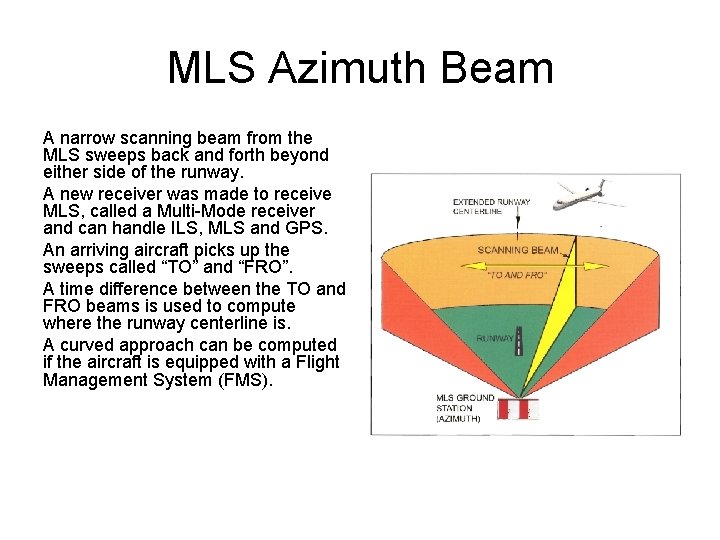
MLS Azimuth Beam A narrow scanning beam from the MLS sweeps back and forth beyond either side of the runway. A new receiver was made to receive MLS, called a Multi-Mode receiver and can handle ILS, MLS and GPS. An arriving aircraft picks up the sweeps called “TO” and “FRO”. A time difference between the TO and FRO beams is used to compute where the runway centerline is. A curved approach can be computed if the aircraft is equipped with a Flight Management System (FMS).
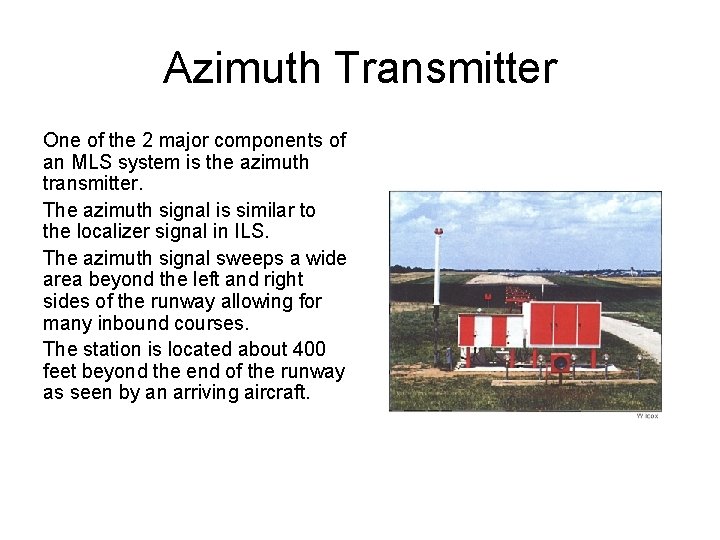
Azimuth Transmitter One of the 2 major components of an MLS system is the azimuth transmitter. The azimuth signal is similar to the localizer signal in ILS. The azimuth signal sweeps a wide area beyond the left and right sides of the runway allowing for many inbound courses. The station is located about 400 feet beyond the end of the runway as seen by an arriving aircraft.
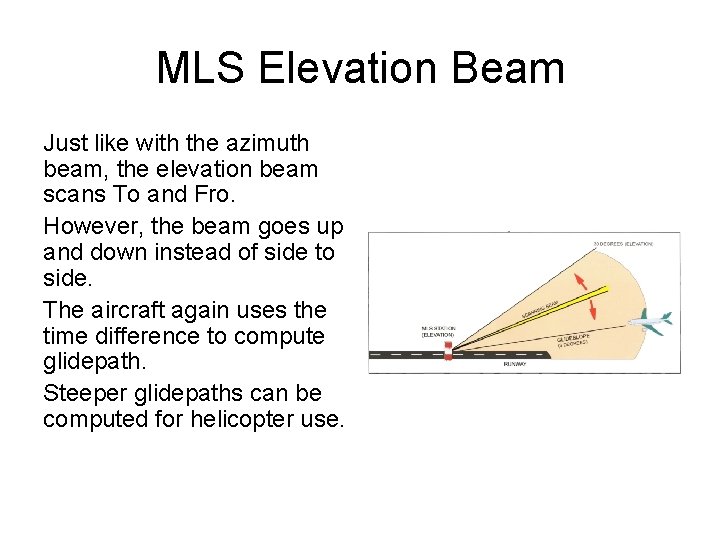
MLS Elevation Beam Just like with the azimuth beam, the elevation beam scans To and Fro. However, the beam goes up and down instead of side to side. The aircraft again uses the time difference to compute glidepath. Steeper glidepaths can be computed for helicopter use.
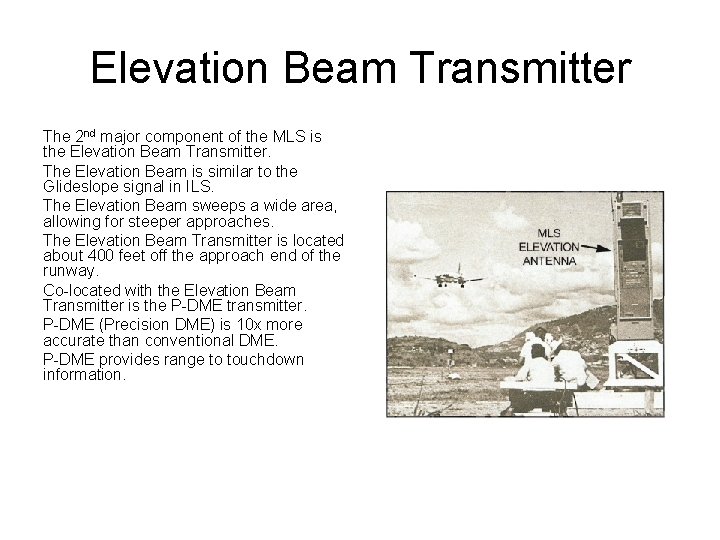
Elevation Beam Transmitter The 2 nd major component of the MLS is the Elevation Beam Transmitter. The Elevation Beam is similar to the Glideslope signal in ILS. The Elevation Beam sweeps a wide area, allowing for steeper approaches. The Elevation Beam Transmitter is located about 400 feet off the approach end of the runway. Co-located with the Elevation Beam Transmitter is the P-DME transmitter. P-DME (Precision DME) is 10 x more accurate than conventional DME. P-DME provides range to touchdown information.
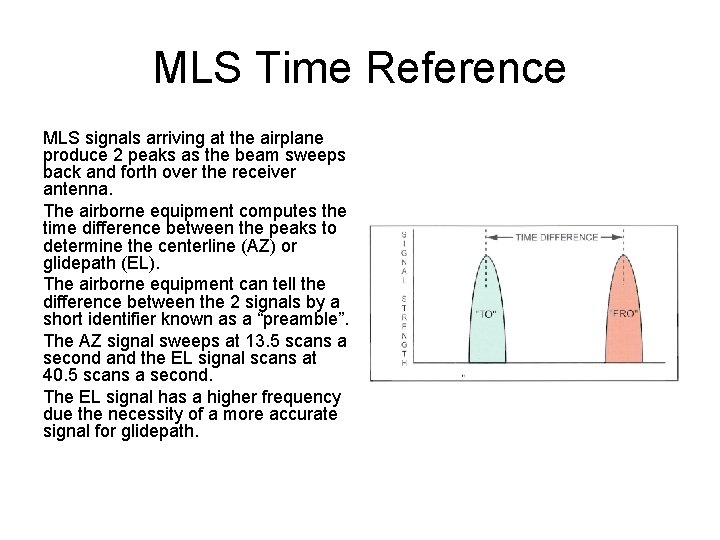
MLS Time Reference MLS signals arriving at the airplane produce 2 peaks as the beam sweeps back and forth over the receiver antenna. The airborne equipment computes the time difference between the peaks to determine the centerline (AZ) or glidepath (EL). The airborne equipment can tell the difference between the 2 signals by a short identifier known as a “preamble”. The AZ signal sweeps at 13. 5 scans a second and the EL signal scans at 40. 5 scans a second. The EL signal has a higher frequency due the necessity of a more accurate signal for glidepath.
Chapter 11 MLS Review Q&A 11. 1 What are the reasons (advantages) for approving the Microwave Landing System? Answer: Can be used on an aircraft carrier, has more channels, not subject to FM interference, not blocked by terrain, can be used for stepped and curved approaches, can be used by helicopters. 11. 2 MLS creates inbound courses to runways by a scanning beam which moves ______. This is called the _____ signal. Answer: Laterally; Azimuth 11. 3 Glide paths are created by a scanning beam that moves____. This is called the ____ signal. Answer: Vertically: Elevation 11. 4 How does an MLS scanning beam determine the centerline of a runway? Answer: By measuring the time difference between the TO and FRO sweeps. 11. 5 Why are there so few MLS installations at airports? Answer: Because it is anticipated to be replaced by GPS. 11. 6 What type of receiver can use ILS, MLS and GPS signals? Answer: Multimode Receiver (MMR).