
CHAPTER 11 MANAGING INDIVIDUAL DIFFERENCES BEHAVIOR Supervising People
CHAPTER 11 MANAGING INDIVIDUAL DIFFERENCES & BEHAVIOR Supervising People as People ©Olivier Renck/ Getty Images ©Mc. Graw-Hill Education. All rights reserved. Authorized only for instructor use in the classroom. No reproduction or further distribution permitted without the prior written consent of Mc. Graw-Hill Education.
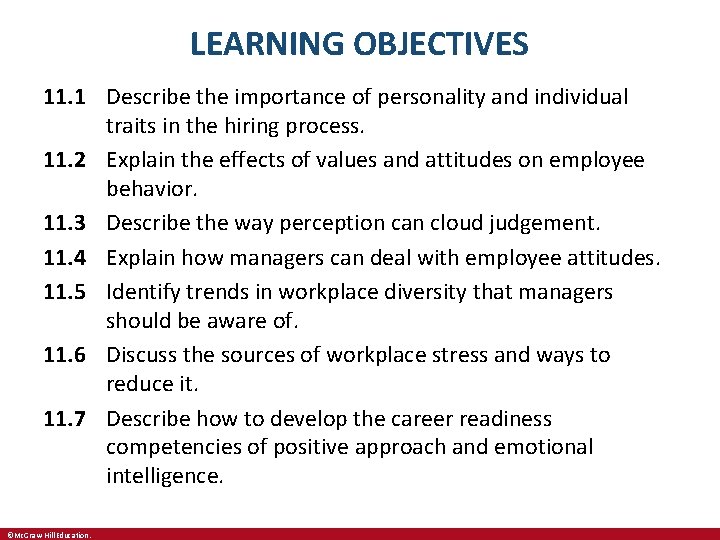
LEARNING OBJECTIVES 11. 1 Describe the importance of personality and individual traits in the hiring process. 11. 2 Explain the effects of values and attitudes on employee behavior. 11. 3 Describe the way perception can cloud judgement. 11. 4 Explain how managers can deal with employee attitudes. 11. 5 Identify trends in workplace diversity that managers should be aware of. 11. 6 Discuss the sources of workplace stress and ways to reduce it. 11. 7 Describe how to develop the career readiness competencies of positive approach and emotional intelligence. ©Mc. Graw-Hill Education.

PERSONALITY and INDIVIDUAL BEHAVIOR Personality • The stable psychological traits and behavioral attributes that give a person his or her identity. ©Mc. Graw-Hill Education. ©Monkey Business Images/Shutterstock
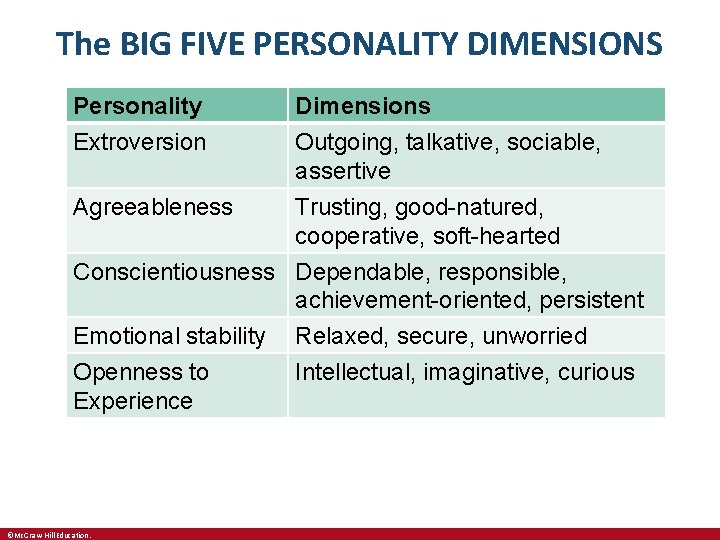
The BIG FIVE PERSONALITY DIMENSIONS Personality Extroversion Dimensions Outgoing, talkative, sociable, assertive Agreeableness Trusting, good-natured, cooperative, soft-hearted Conscientiousness Dependable, responsible, achievement-oriented, persistent Emotional stability Openness to Experience ©Mc. Graw-Hill Education. Relaxed, secure, unworried Intellectual, imaginative, curious
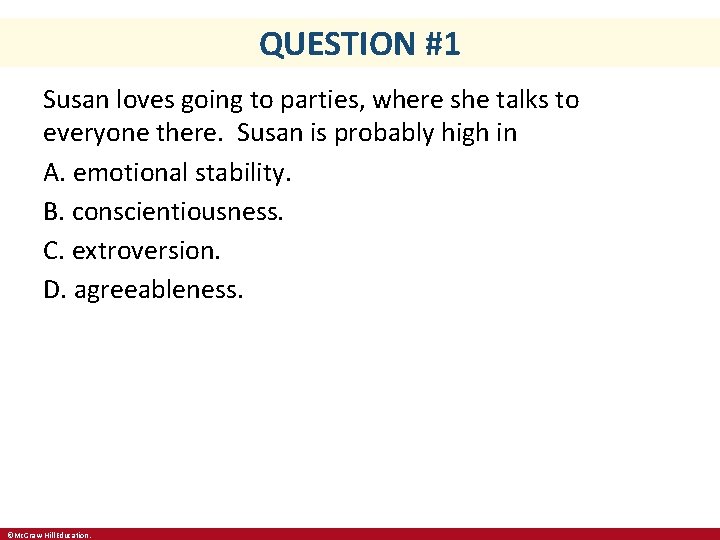
QUESTION #1 Susan loves going to parties, where she talks to everyone there. Susan is probably high in A. emotional stability. B. conscientiousness. C. extroversion. D. agreeableness. ©Mc. Graw-Hill Education.
CORE SELF-EVALUATIONS Core self-evaluation • Represents a broad personality trait comprising four positive individual traits. ©Mc. Graw-Hill Education. 1. Self-efficacy 2. Self-esteem 3. Locus of control 4. Emotional stability
SELF-EFFICACY Self-efficacy • Belief in one’s ability to do a task. Generalized self-efficacy • Represents individuals’ perceptions of their ability to perform across a variety of different situations. • Career readiness competency desired by employers. What can managers do? • Assign jobs accordingly. • Develop employees’ self-efficacy and generalized self-efficacy by giving constructive pointers and positive feedback. • Monitor employees to avoid learned helplessness by offering guided experiences, mentoring, and role modeling. ©Mc. Graw-Hill Education.
SELF-ESTEEM Self-esteem • The extent to which people like or dislike themselves. • High self-esteem: more apt to handle failure better, emphasize the positive and to take more risks. • Low self-esteem: tend to focus more on one’s weaknesses, may be more dependent on others. What can managers do? • Reinforce employees’ positive attributes and skills. • Provide positive feedback whenever possible. • Break larger projects into smaller tasks and projects. • Express confidence in employees’ abilities to complete their tasks. • Provide coaching when employees are struggling to complete task. ©Mc. Graw-Hill Education.
LOCUS of CONTROL Locus of control • Indicates how much people believe they control their fate through their own efforts. • Internal locus of control: You believe you control your destiny. • External locus of control: You believe external forces control you. What can managers do? • Employees with internal locus of control should probably be placed in jobs requiring high initiative and lower compliance. • Employees with external locus of control might do better in highly structured jobs requiring greater compliance. • Internals may prefer and respond more productively to incentives such as merit pay or sales commissions. ©Mc. Graw-Hill Education.
EMOTIONAL STABILITY Emotional stability • The extent to which people feel secure and unworried and to which they are likely to experience negative emotions under pressure. • Low levels are prone to anxiety and tend to view the world negatively. • High levels tend to show better job performance. ©Mc. Graw-Hill Education.
EMOTIONAL INTELLIGENCE (EI) Emotional intelligence • Ability to monitor your and others’ feelings and to use this information to guide your thinking and actions. • First introduced in 1909, some claim it to be the “secret elixir” to happiness and higher performance. Moderately associated with: • Better social relations, well-being, and satisfaction. • Job satisfaction. • Better emotional control. • Conscientiousness and self-efficacy. • Organizational citizenship behavior. • Self-rated performance. ©Mc. Graw-Hill Education.
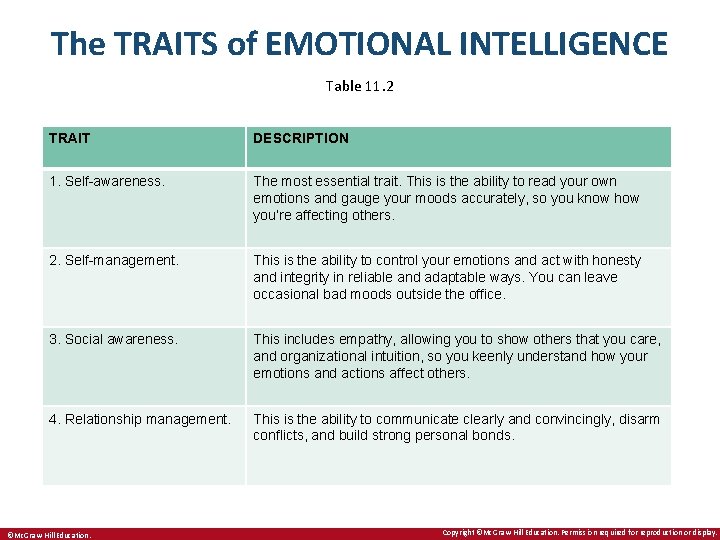
The TRAITS of EMOTIONAL INTELLIGENCE Table 11. 2 TRAIT DESCRIPTION 1. Self-awareness. The most essential trait. This is the ability to read your own emotions and gauge your moods accurately, so you know how you’re affecting others. 2. Self-management. This is the ability to control your emotions and act with honesty and integrity in reliable and adaptable ways. You can leave occasional bad moods outside the office. 3. Social awareness. This includes empathy, allowing you to show others that you care, and organizational intuition, so you keenly understand how your emotions and actions affect others. 4. Relationship management. This is the ability to communicate clearly and convincingly, disarm conflicts, and build strong personal bonds. ©Mc. Graw-Hill Education. Copyright ©Mc. Graw-Hill Education. Permission required for reproduction or display.
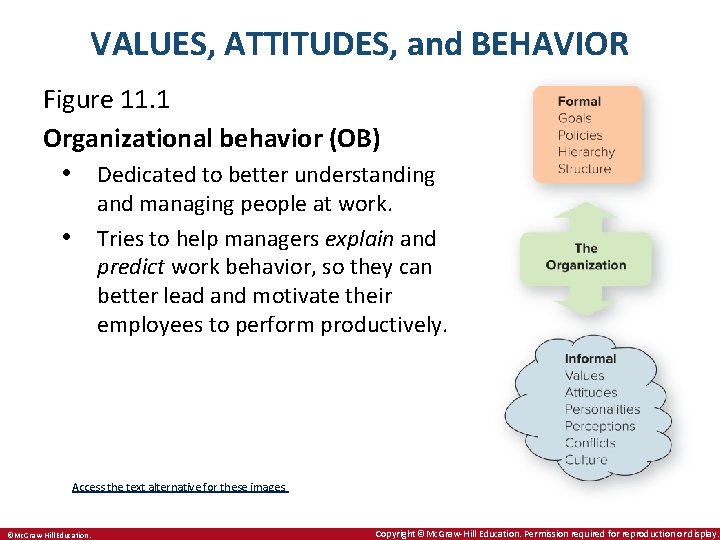
VALUES, ATTITUDES, and BEHAVIOR Figure 11. 1 Organizational behavior (OB) • Dedicated to better understanding and managing people at work. Tries to help managers explain and predict work behavior, so they can better lead and motivate their employees to perform productively. • Access the text alternative for these images. ©Mc. Graw-Hill Education. Copyright ©Mc. Graw-Hill Education. Permission required for reproduction or display.

VALUES and ATTITUDES Values • Abstract ideals that guide one’s thinking and behavior across all situations. Attitude • A learned predisposition toward a given object. • Directly influences our behavior. ©Mc. Graw-Hill Education.
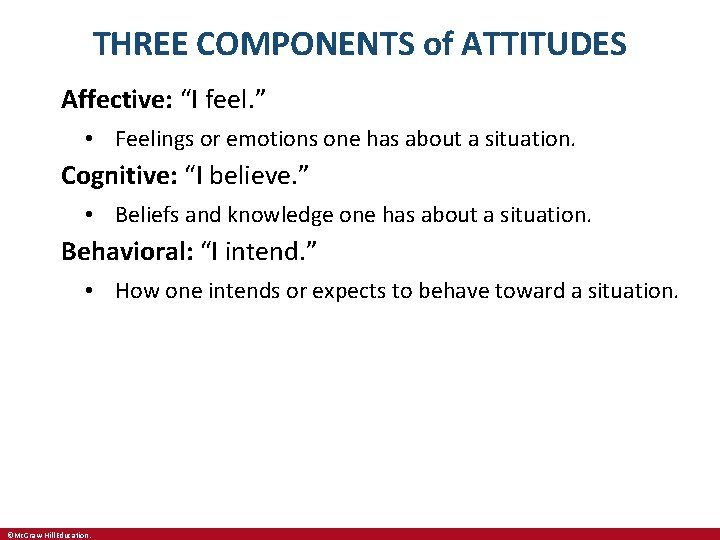
THREE COMPONENTS of ATTITUDES Affective: “I feel. ” • Feelings or emotions one has about a situation. Cognitive: “I believe. ” • Beliefs and knowledge one has about a situation. Behavioral: “I intend. ” • How one intends or expects to behave toward a situation. ©Mc. Graw-Hill Education.
QUESTION #2 The statement, “I am never going to eat at this restaurant again, ” reflects the ______ component of an attitude. A. behavioral B. decisional C. cognitive D. affective ©Mc. Graw-Hill Education.
COGNITIVE DISSONANCE Cognitive dissonance • The psychological discomfort a person experiences between his or her cognitive attitude and incompatible behavior. How people deal with the discomfort depends on: • Importance: Can you live with the ambiguity? • Control: How much control do you have over the situation? • Rewards: What rewards are at stake with the dissonance? ©Mc. Graw-Hill Education.
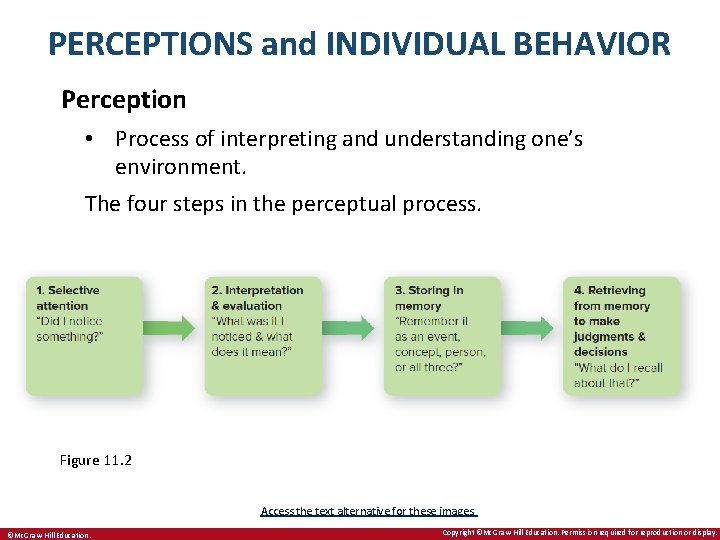
PERCEPTIONS and INDIVIDUAL BEHAVIOR Perception • Process of interpreting and understanding one’s environment. The four steps in the perceptual process. Figure 11. 2 Access the text alternative for these images. ©Mc. Graw-Hill Education. Copyright ©Mc. Graw-Hill Education. Permission required for reproduction or display.
DISTORTIONS in PERCEPTION: STEREOTYPING Stereotyping • Tendency to attribute to an individual the characteristics one believes are typical of the group to which that individual belongs. Sex-role stereotypes • Research revealed that men were preferred for male-dominated jobs, women have harder time being perceived as effective leaders. Age stereotypes • Inaccurately believing that older workers are less motivated, resistant to change, less trusting, and less healthy (research refuted all of these). Race stereotypes • Studies demonstrated that people of color experienced more perceived discrimination and less psychological support than whites. ©Mc. Graw-Hill Education.
DISTORTIONS in PERCEPTION: IMPLICIT BIAS Implicit bias • Attitudes or beliefs that affect our understanding, actions, and decisions in an unconscious manner. • “I really don’t think I’m biased, but I just have feelings about some people. ” • Implicit bias affects employment-related decisions: a recent study showed that both racism and ageism has impacted hiring decisions. How to take steps forward? • Requiring intergroup contact, positive feedback, clear norms of behavior. ©Mc. Graw-Hill Education.
DISTORTIONS in PERCEPTION: HALO EFFECT Halo effect • Forming an impression of an individual based on a single trait. • “One trait tells me all I need to know. ” ©Mc. Graw-Hill Education.
DISTORTIONS in PERCEPTION: The RECENCY EFFECT The recency effect • Tendency to remember recent information better than earlier information. Examples: • Employee has recently made a mistake, and it ends up being the only topic of a performance review. • Students’ course evaluations of professors may be affected by course activity closer to the time of formal appraisal. • Some stock market investors leap into holdings that are doing well and cash out investments that are doing poorly, ignoring trends. ©Mc. Graw-Hill Education.
DISTORTIONS in PERCEPTION: CAUSAL ATTRIBUTIONS Causal attributions • Inferring causes for observed behavior. Fundamental attribution bias • People attribute another person’s behavior to his or her personal characteristics rather than to situational factors. Self-serving bias • People tend to take more personal responsibility for success than for failure. ©Mc. Graw-Hill Education.
SELF-FULFILLING PROPHECY Self-fulfilling prophecy • Is a phenomenon by which people’s expectations of themselves or others lead them to behave in ways that make those expectations come true. • Also known as Pygmalion effect. • Managerial expectations powerfully influence employee behavior and performance. What can managers do? • Create positive performance expectations. • Recognize that everyone has the potential to increase performance. • Introduce new employees as if they have outstanding potential. • Encourage employees to visualize successful execution of tasks. • Help employees master key skills. ©Mc. Graw-Hill Education.
QUESTION #3 John is interviewing Bambi for a job opening at his accounting firm. He notices that she has several tattoos visible on both arms. He does not believe that people with tattoos can be good accountants. John is engaged in A. counseling. B. stereotyping. C. behavioral interviewing. D. situational interviewing. ©Mc. Graw-Hill Education.
WORK-RELATED ATTITUDES and BEHAVIORS Employee engagement • An individual’s involvement, satisfaction, and enthusiasm for work. • A “mental state in which a person performing a work activity is full immersed in the activity, feeling full of energy and enthusiasm for the work. ” • Employees more likely to become engaged when a culture promotes employee development, recognition, and trust. • Managers can increase employee engagement with personal resource building, job resource building, leadership training, and health promotion interventions. ©Mc. Graw-Hill Education.
JOB SATISFACTION Job satisfaction • Extent to which you feel positively or negatively about various aspects of your work. • Depends on how you feel about several components, such as work, pay, promotions, coworkers, and supervision. • Key correlates: ©Mc. Graw-Hill Education. • Stronger motivation, job involvement, and life satisfaction. • Less absenteeism, tardiness, turnover, and stress.
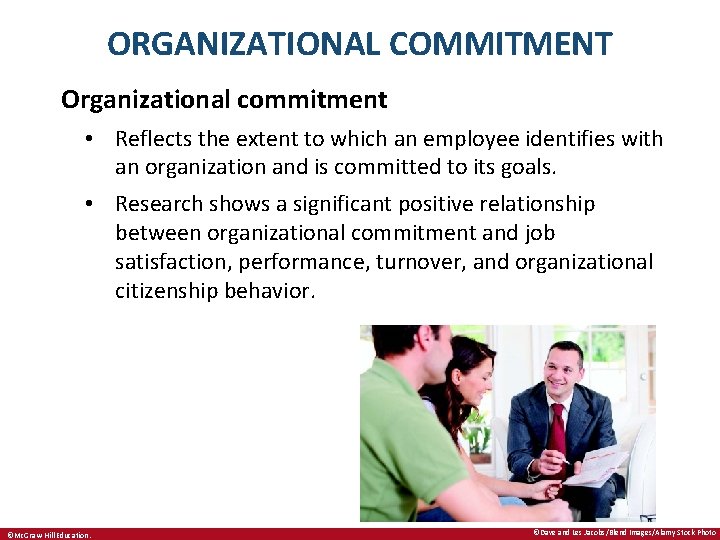
ORGANIZATIONAL COMMITMENT Organizational commitment • Reflects the extent to which an employee identifies with an organization and is committed to its goals. • Research shows a significant positive relationship between organizational commitment and job satisfaction, performance, turnover, and organizational citizenship behavior. ©Mc. Graw-Hill Education. ©Dave and Les Jacobs/Blend Images/Alamy Stock Photo
IMPORTANT WORKPLACE BEHAVIORS • Why, as a manager, do you need to learn how to manage individual differences? So that you can influence employees to do their best work. • Evaluating the performance of employees should include: 1. Performance and productivity. 2. Absenteeism and turnover. 3. Organizational citizenship behaviors. 4. Counterproductive work behaviors. ©Mc. Graw-Hill Education.
QUESTION #4 Herman spends his lunch hour drinking beer in his car in the parking lot. This is an example of a(n) _______ behavior. A. evaluating B. discerning C. counterproductive work D. destructive work ©Mc. Graw-Hill Education.
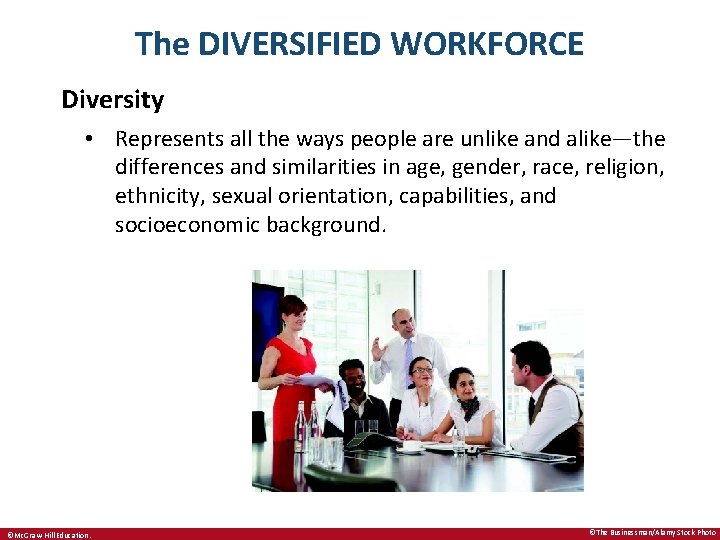
The DIVERSIFIED WORKFORCE Diversity • Represents all the ways people are unlike and alike—the differences and similarities in age, gender, race, religion, ethnicity, sexual orientation, capabilities, and socioeconomic background. ©Mc. Graw-Hill Education. ©The Businessman/Alamy Stock Photo

The DIVERSITY WHEEL Figure 11. 3 Source: From Diverse Teams at Work by Lee Gardenswartz and Anita Rowe. Copyright 2003, Society for Human Resource Management, Alexandria, VA. Access the text alternative for these images. ©Mc. Graw-Hill Education. Copyright ©Mc. Graw-Hill Education. Permission required for reproduction or display.
TRENDS in WORKFORCE DIVERSITY • Age: Millennials will replace baby boomers as the largest • • • adult generation in the U. S. by the time this is read. Gender: Many more women now work compared to 1960 s with their share of the workforce increasing to 47. 2% by 2024. Race and ethnicity: U. S. population is becoming more racially and ethnically diverse. Sexual orientation: Workplaces are becoming more inclusive. People with differing physical and mental abilities: about 19% of civilian Americans have a physical or mental disability. Educational levels: Mismatches between education and workforce needs. ©Mc. Graw-Hill Education.
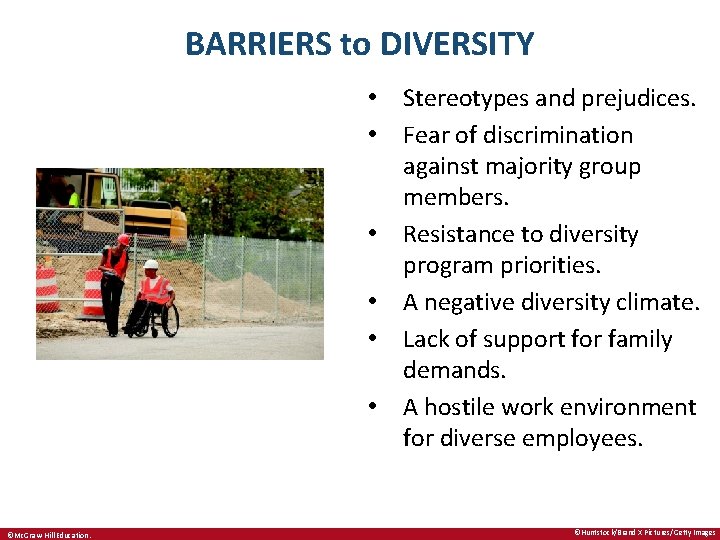
BARRIERS to DIVERSITY • Stereotypes and prejudices. • Fear of discrimination • • ©Mc. Graw-Hill Education. against majority group members. Resistance to diversity program priorities. A negative diversity climate. Lack of support for family demands. A hostile work environment for diverse employees. ©Huntstock/Brand X Pictures/Getty Images
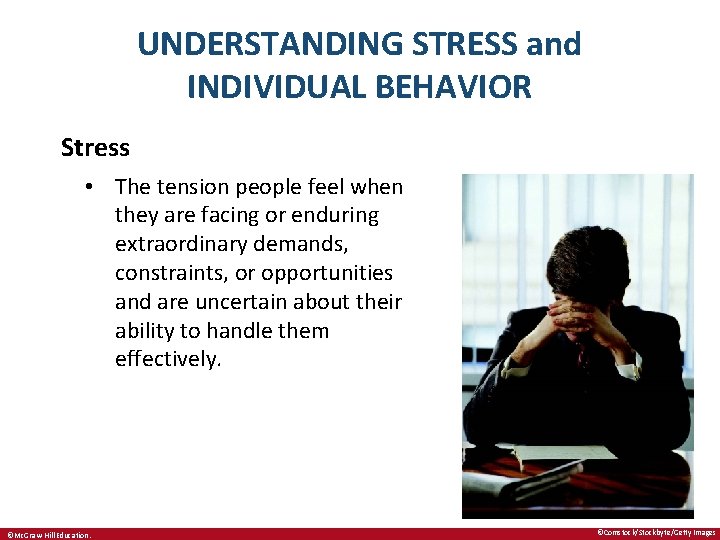
UNDERSTANDING STRESS and INDIVIDUAL BEHAVIOR Stress • The tension people feel when they are facing or enduring extraordinary demands, constraints, or opportunities and are uncertain about their ability to handle them effectively. ©Mc. Graw-Hill Education. ©Comstock/Stockbyte/Getty Images
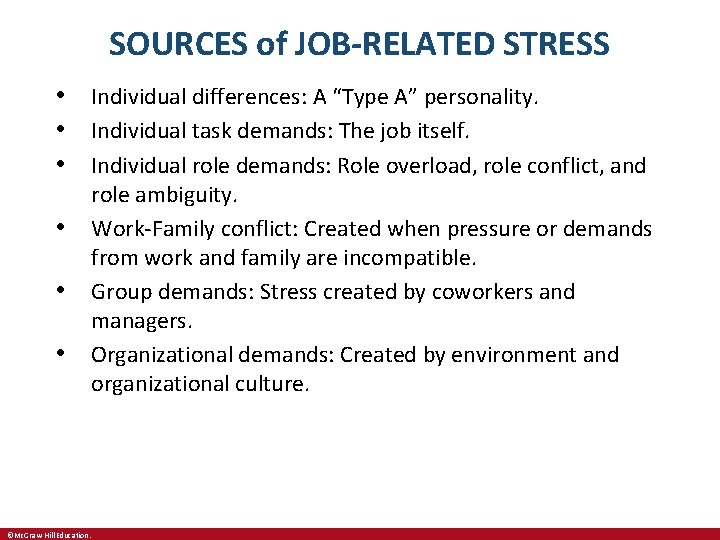
SOURCES of JOB-RELATED STRESS • Individual differences: A “Type A” personality. • Individual task demands: The job itself. • Individual role demands: Role overload, role conflict, and • • • ©Mc. Graw-Hill Education. role ambiguity. Work-Family conflict: Created when pressure or demands from work and family are incompatible. Group demands: Stress created by coworkers and managers. Organizational demands: Created by environment and organizational culture.
QUESTION #5 Your boss expects you to stay late to cover the workload of a coworker who is out sick, but you are supposed to help your mother with some work on her house tonight. You are suffering from A. role overload. B. role conflict. C. role ambiguity. D. burnout. ©Mc. Graw-Hill Education.
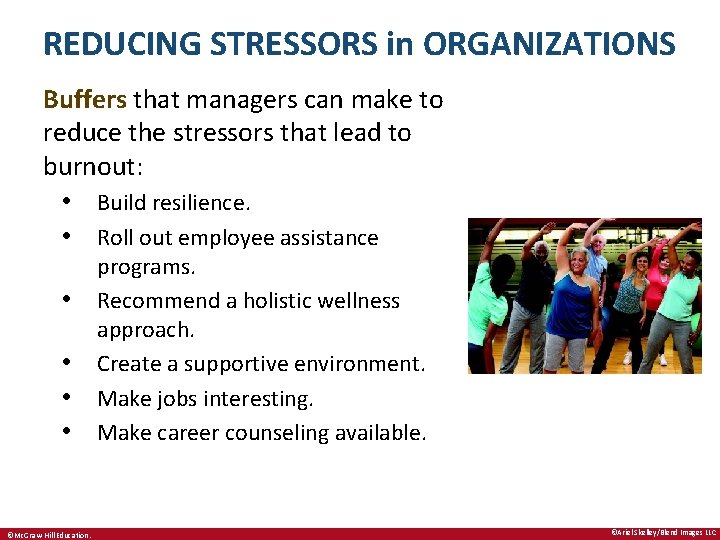
REDUCING STRESSORS in ORGANIZATIONS Buffers that managers can make to reduce the stressors that lead to burnout: • Build resilience. • Roll out employee assistance • • ©Mc. Graw-Hill Education. programs. Recommend a holistic wellness approach. Create a supportive environment. Make jobs interesting. Make career counseling available. ©Ariel Skelley/Blend Images LLC
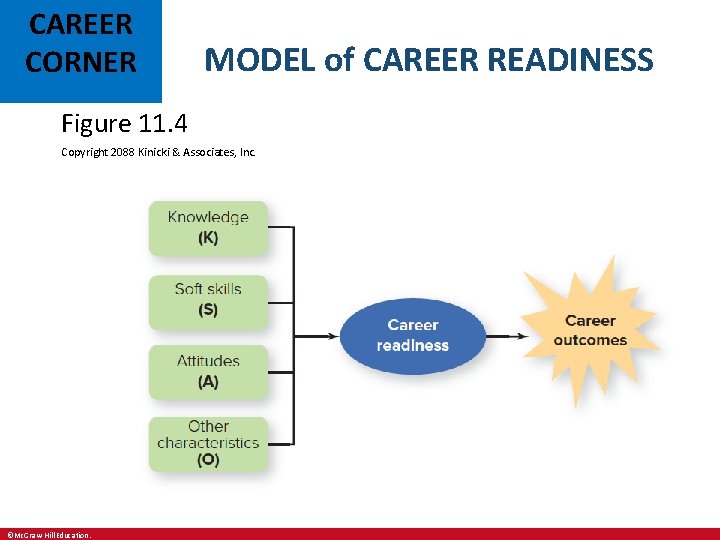
CAREER CORNER MODEL of CAREER READINESS Figure 11. 4 Copyright 2088 Kinicki & Associates, Inc. ©Mc. Graw-Hill Education.
CAREER CORNER MANAGING YOUR CAREER READINESS (1 of 2) Developing a positive approach A positive approach represents a willingness to accept developmental feedback, try and suggest new ideas, and maintain a positive attitude at work. Step 1: Identify potentially bad attitudes and consider how your behaviors may be perceived by others. Step 2: Identify “good attitude” behaviors and focus on developing them at work. ©Mc. Graw-Hill Education.
CAREER CORNER MANAGING YOUR CAREER READINESS (2 of 2) Self-managing your emotions Self-management involves the ability to control your emotions and act with honest and integrity in reliable and adaptable ways. • Identify your emotional triggers and physiological responses. • Engage in emotional regulation. • Channel your emotions. ©Mc. Graw-Hill Education.
- Slides: 41