
Chapter 11 Maintaining the System Shari L Pfleeger
- Slides: 58
Chapter 11 Maintaining the System Shari L. Pfleeger Joann M. Atlee 4 th Edition
Contents 11. 1 11. 2 11. 3 11. 4 11. 5 11. 6 11. 7 11. 8 11. 9 The Changing System The Nature of Maintenance Problems Measuring Maintenance Characteristics Maintenance Techniques and Tools Software Rejuvenation Information System Example Real Time Example What this Chapter Means for You Pfleeger and Atlee, Software Engineering: Theory and Practice Chapter 11. 2
Chapter 11 Objectives • System evolution • Legacy systems • Impact analysis • Software rejuvenation Pfleeger and Atlee, Software Engineering: Theory and Practice Chapter 11. 3
11. 1 The Changing System • Maintenance: Any work done to change the system after it is in operation – Software does not degrade or require periodic maintenance – However, software is continually evolving – Maintenance process can be difficult Pfleeger and Atlee, Software Engineering: Theory and Practice Chapter 11. 4
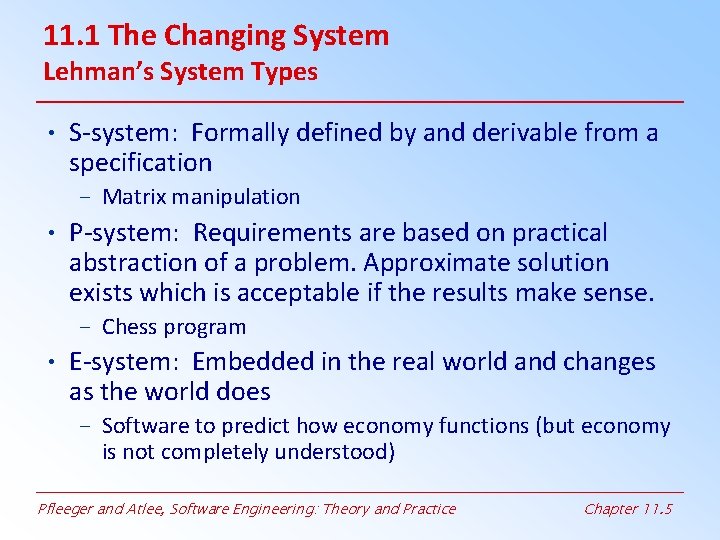
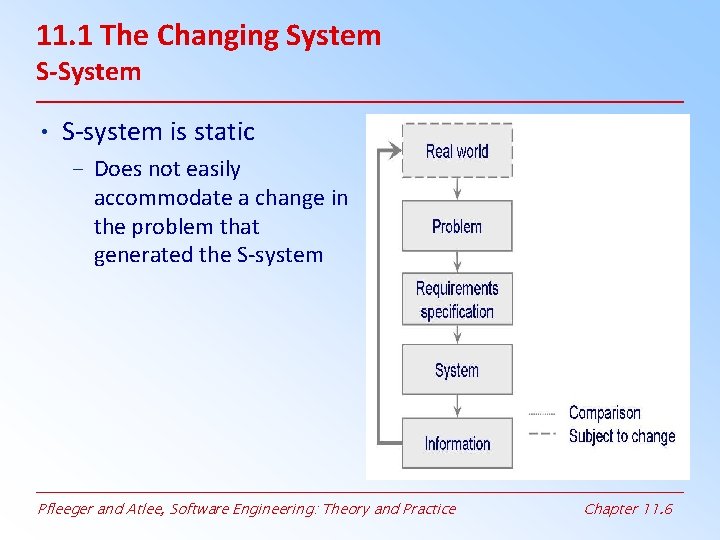
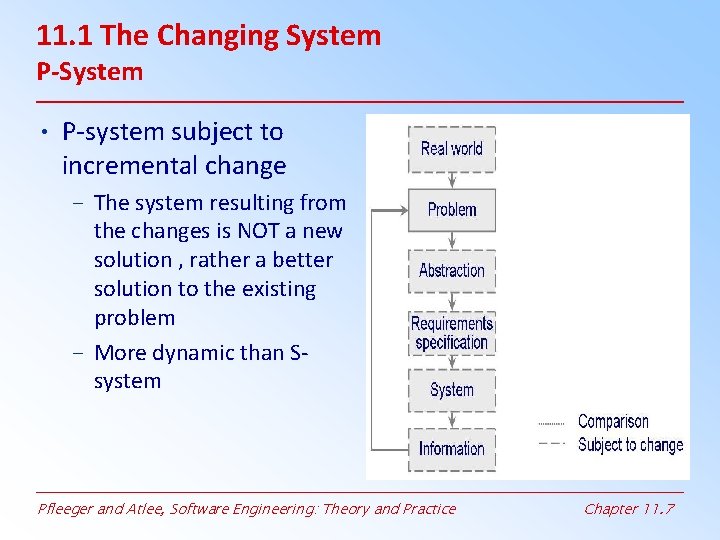
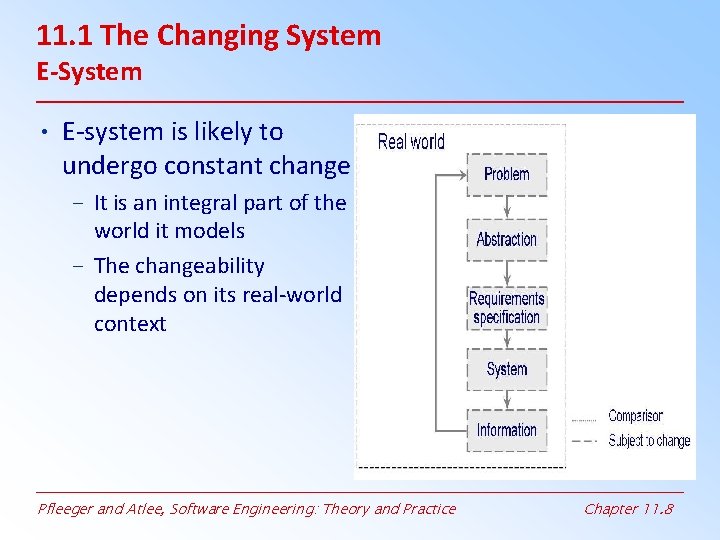
11. 1 The Changing System Lehman’s System Types • S-system: Formally defined by and derivable from a specification – Matrix manipulation • P-system: Requirements are based on practical abstraction of a problem. Approximate solution exists which is acceptable if the results make sense. – Chess program • E-system: Embedded in the real world and changes as the world does – Software to predict how economy functions (but economy is not completely understood) Pfleeger and Atlee, Software Engineering: Theory and Practice Chapter 11. 5
11. 1 The Changing System S-System • S-system is static – Does not easily accommodate a change in the problem that generated the S-system Pfleeger and Atlee, Software Engineering: Theory and Practice Chapter 11. 6
11. 1 The Changing System P-System • P-system subject to incremental change – The system resulting from the changes is NOT a new solution , rather a better solution to the existing problem – More dynamic than Ssystem Pfleeger and Atlee, Software Engineering: Theory and Practice Chapter 11. 7
11. 1 The Changing System E-System • E-system is likely to undergo constant change – It is an integral part of the world it models – The changeability depends on its real-world context Pfleeger and Atlee, Software Engineering: Theory and Practice Chapter 11. 8
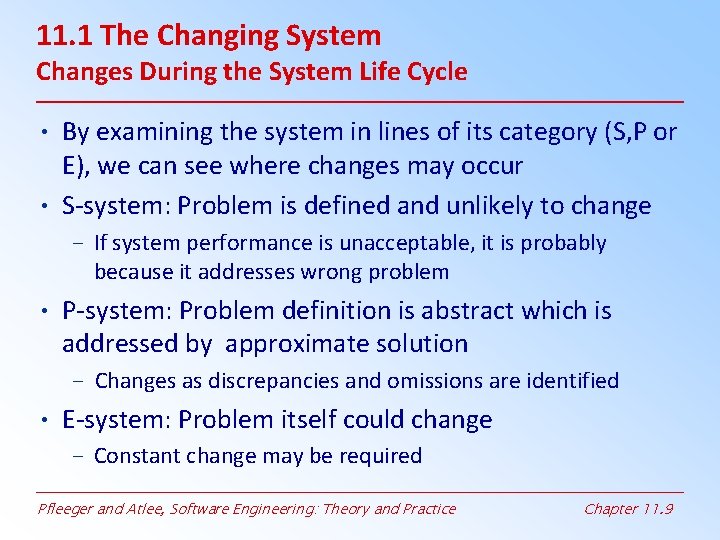
11. 1 The Changing System Changes During the System Life Cycle • By examining the system in lines of its category (S, P or E), we can see where changes may occur • S-system: Problem is defined and unlikely to change – If system performance is unacceptable, it is probably because it addresses wrong problem • P-system: Problem definition is abstract which is addressed by approximate solution – Changes as discrepancies and omissions are identified • E-system: Problem itself could change – Constant change may be required Pfleeger and Atlee, Software Engineering: Theory and Practice Chapter 11. 9
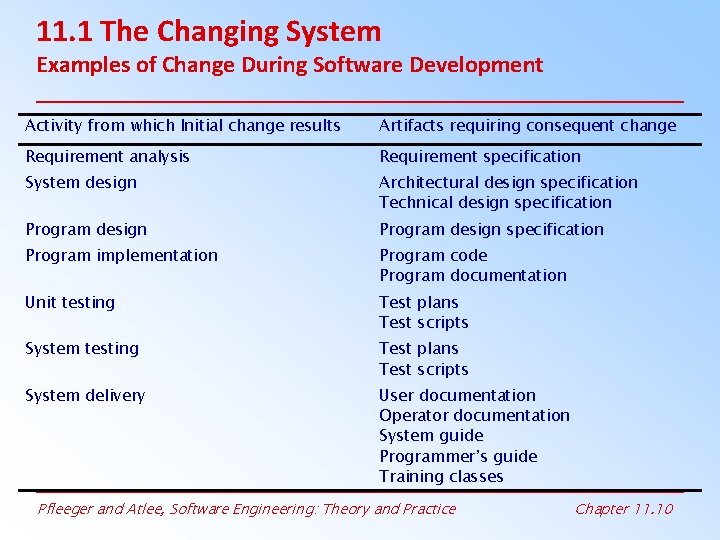
11. 1 The Changing System Examples of Change During Software Development Activity from which Initial change results Artifacts requiring consequent change Requirement analysis Requirement specification System design Architectural design specification Technical design specification Program implementation Program code Program documentation Unit testing Test plans Test scripts System delivery User documentation Operator documentation System guide Programmer’s guide Training classes Pfleeger and Atlee, Software Engineering: Theory and Practice Chapter 11. 10
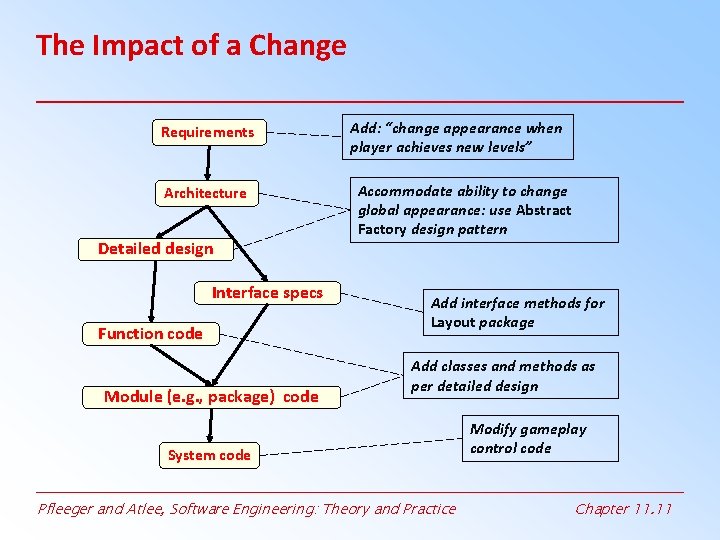
The Impact of a Change Requirements Architecture Detailed design Interface specs Function code Module (e. g. , package) code Add: “change appearance when player achieves new levels” Accommodate ability to change global appearance: use Abstract Factory design pattern Add interface methods for Layout package Add classes and methods as per detailed design System code Pfleeger and Atlee, Software Engineering: Theory and Practice Modify gameplay control code Chapter 11. 11
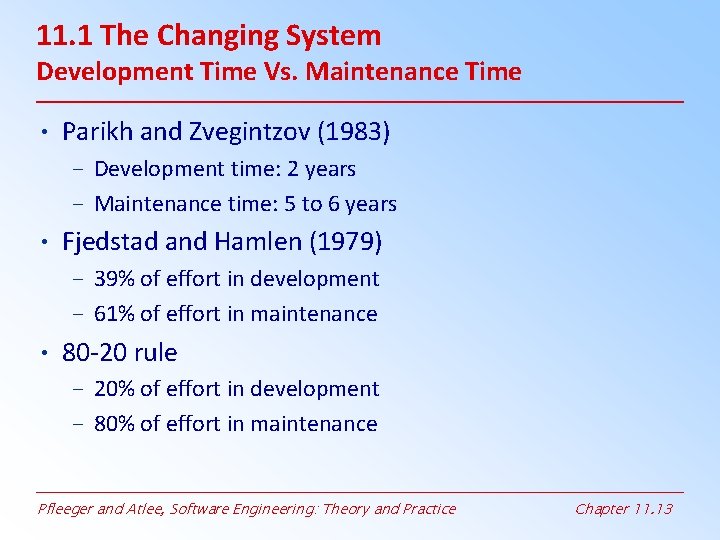
11. 1 The Changing System Development Time Vs. Maintenance Time • Parikh and Zvegintzov (1983) – Development time: 2 years – Maintenance time: 5 to 6 years • Fjedstad and Hamlen (1979) – 39% of effort in development – 61% of effort in maintenance • 80 -20 rule – 20% of effort in development – 80% of effort in maintenance Pfleeger and Atlee, Software Engineering: Theory and Practice Chapter 11. 13
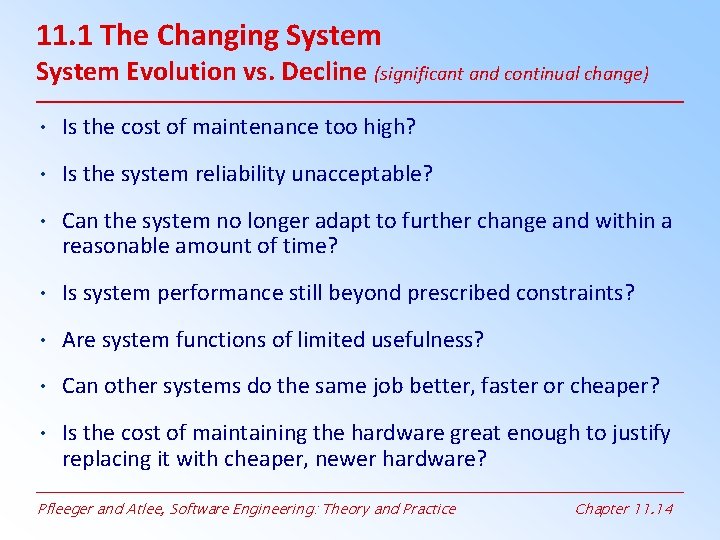
11. 1 The Changing System Evolution vs. Decline (significant and continual change) • Is the cost of maintenance too high? • Is the system reliability unacceptable? • Can the system no longer adapt to further change and within a reasonable amount of time? • Is system performance still beyond prescribed constraints? • Are system functions of limited usefulness? • Can other systems do the same job better, faster or cheaper? • Is the cost of maintaining the hardware great enough to justify replacing it with cheaper, newer hardware? Pfleeger and Atlee, Software Engineering: Theory and Practice Chapter 11. 14
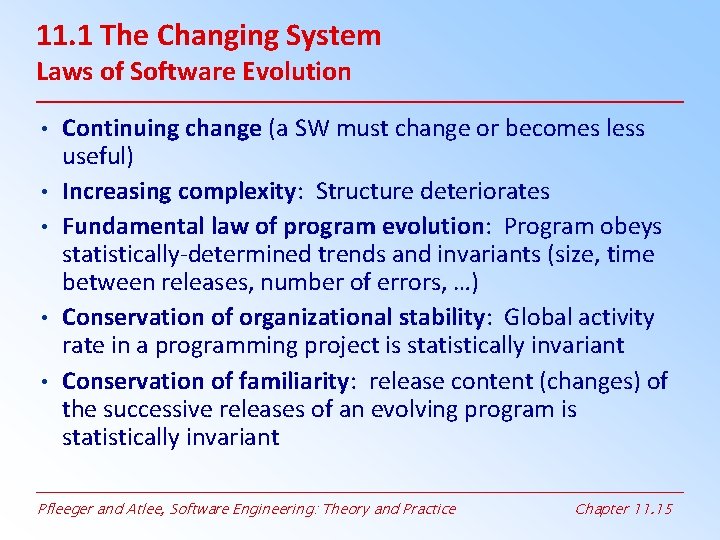
11. 1 The Changing System Laws of Software Evolution • Continuing change (a SW must change or becomes less useful) • Increasing complexity: Structure deteriorates • Fundamental law of program evolution: Program obeys statistically-determined trends and invariants (size, time between releases, number of errors, …) • Conservation of organizational stability: Global activity rate in a programming project is statistically invariant • Conservation of familiarity: release content (changes) of the successive releases of an evolving program is statistically invariant Pfleeger and Atlee, Software Engineering: Theory and Practice Chapter 11. 15
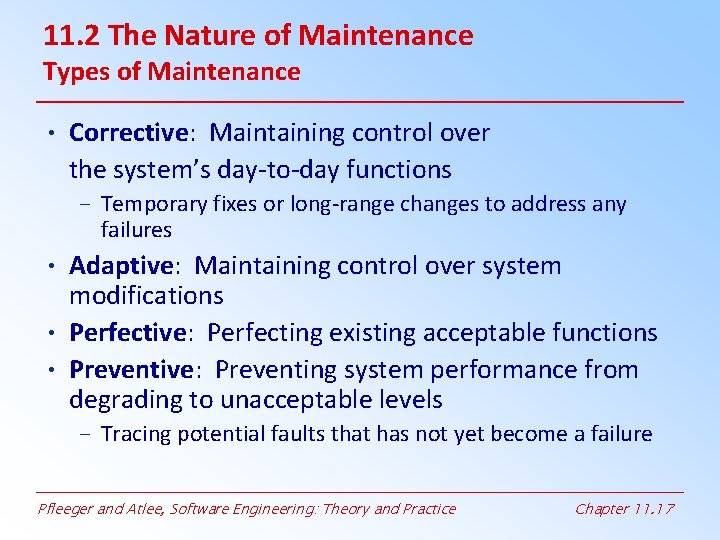
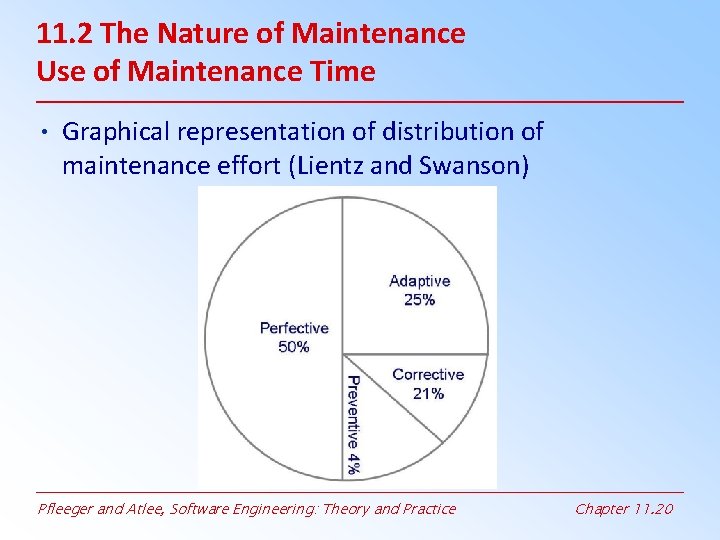
11. 2 The Nature of Maintenance Types of Maintenance • Corrective: Maintaining control over the system’s day-to-day functions – Temporary fixes or long-range changes to address any failures • Adaptive: Maintaining control over system modifications • Perfective: Perfecting existing acceptable functions • Preventive: Preventing system performance from degrading to unacceptable levels – Tracing potential faults that has not yet become a failure Pfleeger and Atlee, Software Engineering: Theory and Practice Chapter 11. 17
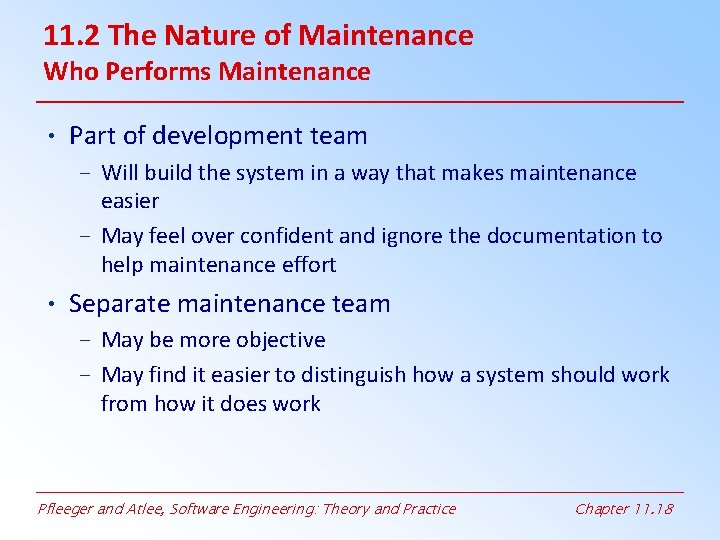
11. 2 The Nature of Maintenance Who Performs Maintenance • Part of development team – Will build the system in a way that makes maintenance easier – May feel over confident and ignore the documentation to help maintenance effort • Separate maintenance team – May be more objective – May find it easier to distinguish how a system should work from how it does work Pfleeger and Atlee, Software Engineering: Theory and Practice Chapter 11. 18
11. 2 The Nature of Maintenance Team Responsibilities • Understanding the system • Locating information in system documentation • Keeping system documentation up-to-date • Extending existing functions to accommodate new or changing requirements • Adding new functions to the system • Finding the source of system failures or problems • Locating and correcting faults • Answering questions about the way the system works • Restructuring design and code components • Rewriting design and code components • Deleting design and code components that are no longer useful • Managing changes to the system as they are made Pfleeger and Atlee, Software Engineering: Theory and Practice Chapter 11. 19
11. 2 The Nature of Maintenance Use of Maintenance Time • Graphical representation of distribution of maintenance effort (Lientz and Swanson) Pfleeger and Atlee, Software Engineering: Theory and Practice Chapter 11. 20
11. 3 Maintenance Problems Staff Problems • Limited understanding (the importance of documentation) – 47% of effort is spent on understanding – For a system with m components and k changes, there are k*(m - k) + k*(k - 1)/2 interfaces to be evaluated • Management priorities – Rushing a new product to the market vs. taking time to follow good SE practices • Morale: “Second-hand” status accorded to maintenance team – Maintenance process requires skill in writing code, in working with users, in anticipating change, in sleuthing Pfleeger and Atlee, Software Engineering: Theory and Practice Chapter 11. 21
11. 3 Maintenance Problems Technical Problems • Artifacts and paradigms (e. g. , legacy, non-OO) – OO systems can be difficult (highly interconnected components via complex inheritance) • Testing difficulties – Some systems must be available around the clock (e. g. , airline reservation) – Adequate test data may not be available for testing the changes made – Effects of design or code changes are difficult to be predicted and to be prepared for Pfleeger and Atlee, Software Engineering: Theory and Practice Chapter 11. 22
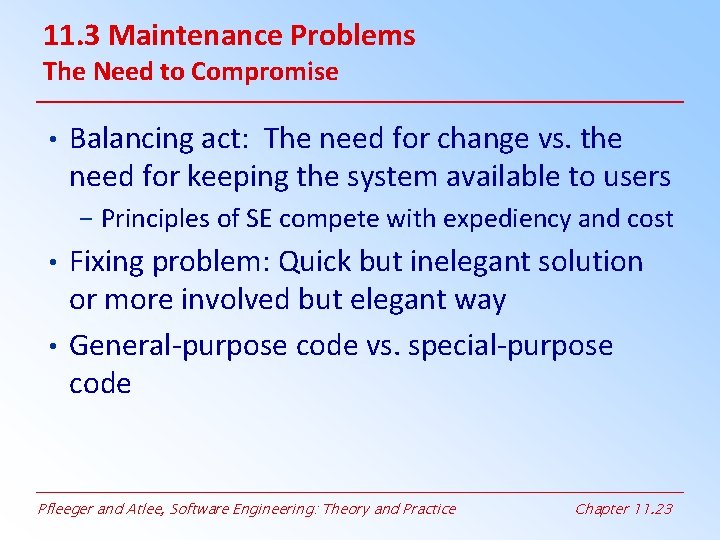
11. 3 Maintenance Problems The Need to Compromise • Balancing act: The need for change vs. the need for keeping the system available to users – Principles of SE compete with expediency and cost • Fixing problem: Quick but inelegant solution or more involved but elegant way • General-purpose code vs. special-purpose code Pfleeger and Atlee, Software Engineering: Theory and Practice Chapter 11. 23
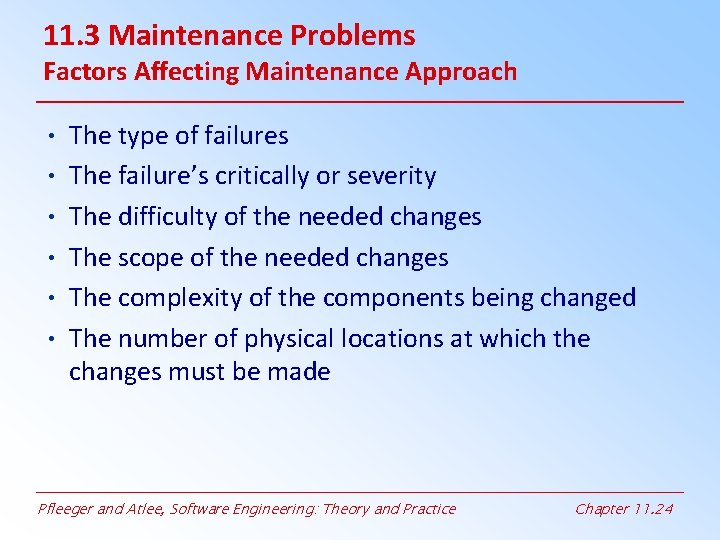
11. 3 Maintenance Problems Factors Affecting Maintenance Approach • The type of failures • The failure’s critically or severity • The difficulty of the needed changes • The scope of the needed changes • The complexity of the components being changed • The number of physical locations at which the changes must be made Pfleeger and Atlee, Software Engineering: Theory and Practice Chapter 11. 24
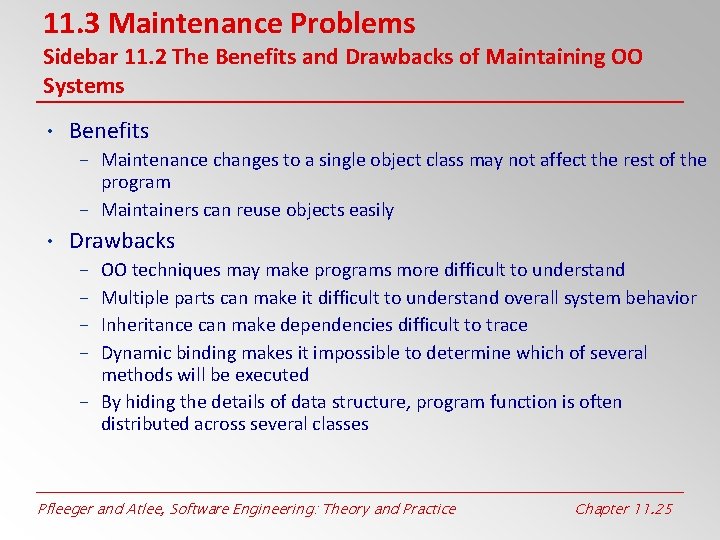
11. 3 Maintenance Problems Sidebar 11. 2 The Benefits and Drawbacks of Maintaining OO Systems • Benefits – Maintenance changes to a single object class may not affect the rest of the program – Maintainers can reuse objects easily • Drawbacks – – OO techniques may make programs more difficult to understand Multiple parts can make it difficult to understand overall system behavior Inheritance can make dependencies difficult to trace Dynamic binding makes it impossible to determine which of several methods will be executed – By hiding the details of data structure, program function is often distributed across several classes Pfleeger and Atlee, Software Engineering: Theory and Practice Chapter 11. 25
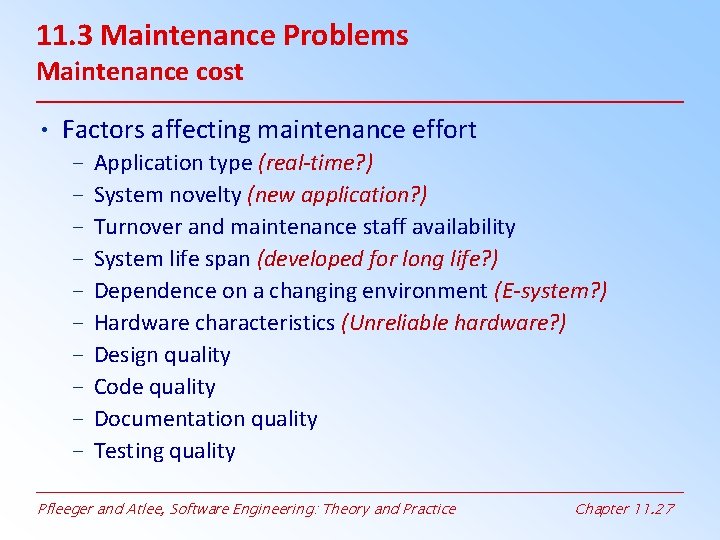
11. 3 Maintenance Problems Maintenance cost • Factors affecting maintenance effort – – – – – Application type (real-time? ) System novelty (new application? ) Turnover and maintenance staff availability System life span (developed for long life? ) Dependence on a changing environment (E-system? ) Hardware characteristics (Unreliable hardware? ) Design quality Code quality Documentation quality Testing quality Pfleeger and Atlee, Software Engineering: Theory and Practice Chapter 11. 27
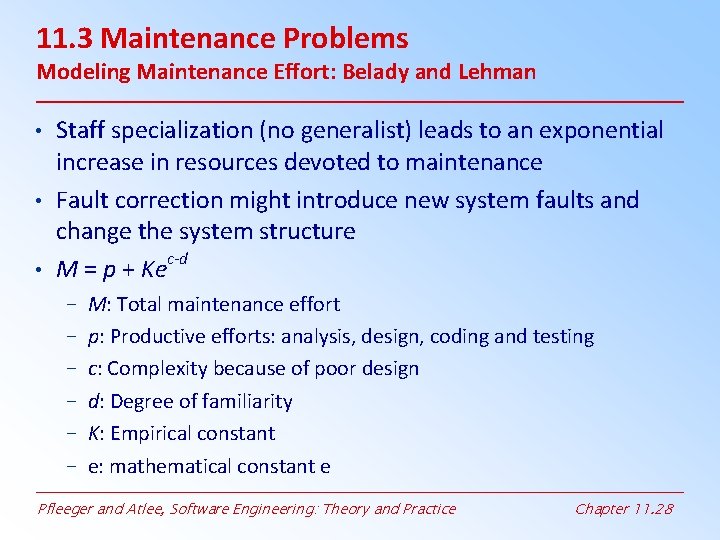
11. 3 Maintenance Problems Modeling Maintenance Effort: Belady and Lehman • Staff specialization (no generalist) leads to an exponential increase in resources devoted to maintenance • Fault correction might introduce new system faults and change the system structure • M = p + Kec-d – – – M: Total maintenance effort p: Productive efforts: analysis, design, coding and testing c: Complexity because of poor design d: Degree of familiarity K: Empirical constant e: mathematical constant e Pfleeger and Atlee, Software Engineering: Theory and Practice Chapter 11. 28
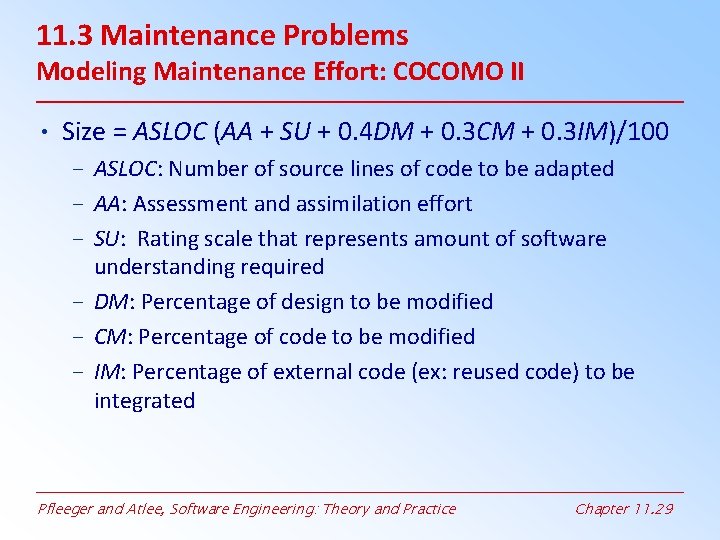
11. 3 Maintenance Problems Modeling Maintenance Effort: COCOMO II • Size = ASLOC (AA + SU + 0. 4 DM + 0. 3 CM + 0. 3 IM)/100 – ASLOC: Number of source lines of code to be adapted – AA: Assessment and assimilation effort – SU: Rating scale that represents amount of software understanding required – DM: Percentage of design to be modified – CM: Percentage of code to be modified – IM: Percentage of external code (ex: reused code) to be integrated Pfleeger and Atlee, Software Engineering: Theory and Practice Chapter 11. 29
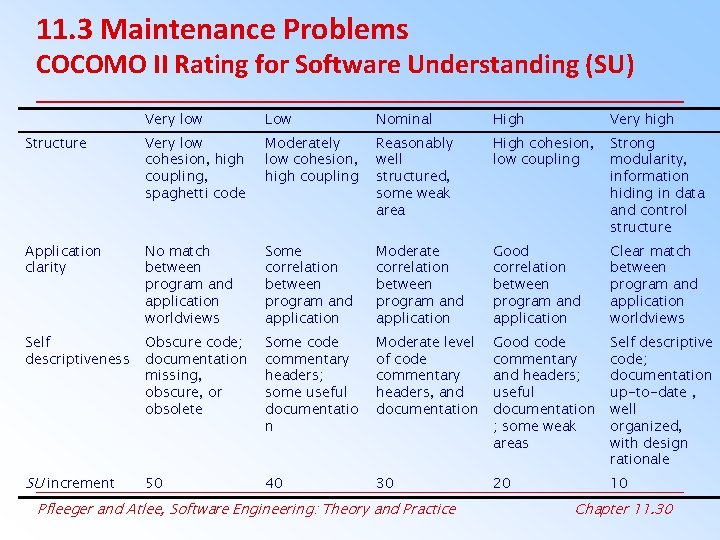
11. 3 Maintenance Problems COCOMO II Rating for Software Understanding (SU) Very low Low Nominal High Very high Structure Very low cohesion, high coupling, spaghetti code Moderately low cohesion, high coupling Reasonably well structured, some weak area High cohesion, low coupling Strong modularity, information hiding in data and control structure Application clarity No match between program and application worldviews Some correlation between program and application Moderate correlation between program and application Good correlation between program and application Clear match between program and application worldviews Self descriptiveness Obscure code; documentation missing, obscure, or obsolete Some code commentary headers; some useful documentatio n Moderate level of code commentary headers, and documentation Good code commentary and headers; useful documentation ; some weak areas Self descriptive code; documentation up-to-date , well organized, with design rationale SU increment 50 40 30 20 10 Pfleeger and Atlee, Software Engineering: Theory and Practice Chapter 11. 30
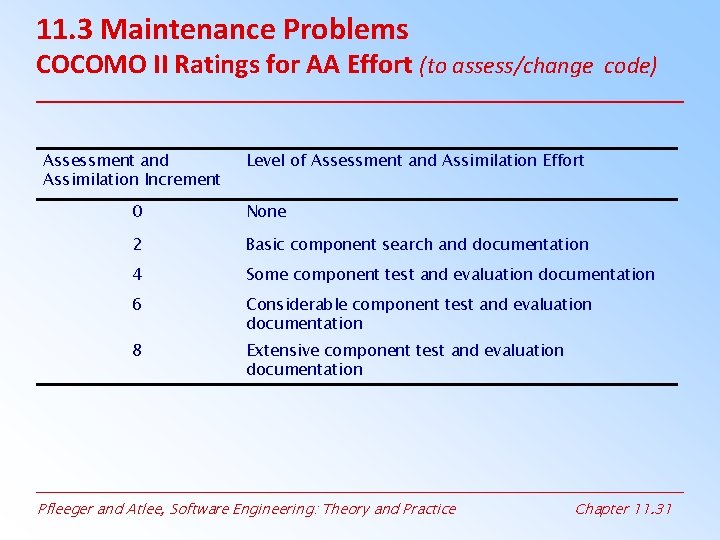
11. 3 Maintenance Problems COCOMO II Ratings for AA Effort (to assess/change code) Assessment and Assimilation Increment Level of Assessment and Assimilation Effort 0 None 2 Basic component search and documentation 4 Some component test and evaluation documentation 6 Considerable component test and evaluation documentation 8 Extensive component test and evaluation documentation Pfleeger and Atlee, Software Engineering: Theory and Practice Chapter 11. 31
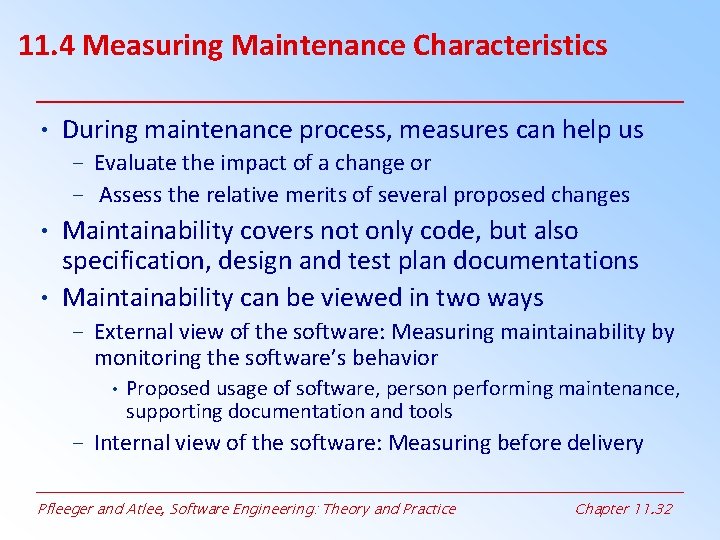
11. 4 Measuring Maintenance Characteristics • During maintenance process, measures can help us – Evaluate the impact of a change or – Assess the relative merits of several proposed changes • Maintainability covers not only code, but also specification, design and test plan documentations • Maintainability can be viewed in two ways – External view of the software: Measuring maintainability by monitoring the software’s behavior • Proposed usage of software, person performing maintenance, supporting documentation and tools – Internal view of the software: Measuring before delivery Pfleeger and Atlee, Software Engineering: Theory and Practice Chapter 11. 32
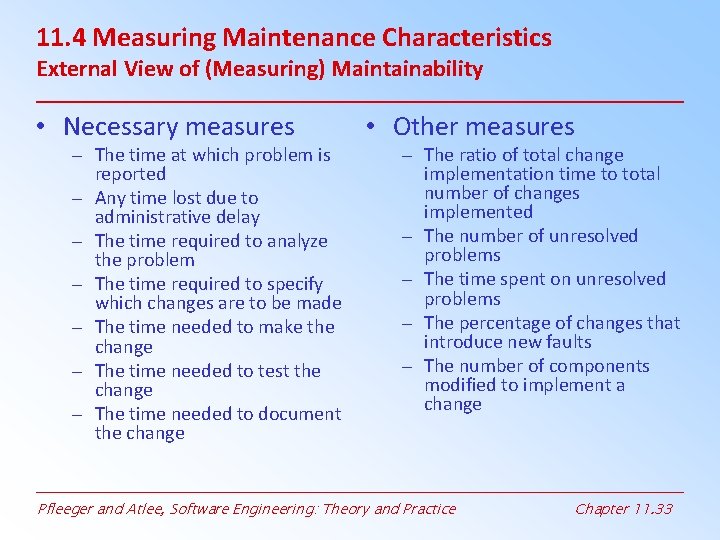
11. 4 Measuring Maintenance Characteristics External View of (Measuring) Maintainability • Necessary measures – The time at which problem is reported – Any time lost due to administrative delay – The time required to analyze the problem – The time required to specify which changes are to be made – The time needed to make the change – The time needed to test the change – The time needed to document the change • Other measures – The ratio of total change implementation time to total number of changes implemented – The number of unresolved problems – The time spent on unresolved problems – The percentage of changes that introduce new faults – The number of components modified to implement a change Pfleeger and Atlee, Software Engineering: Theory and Practice Chapter 11. 33
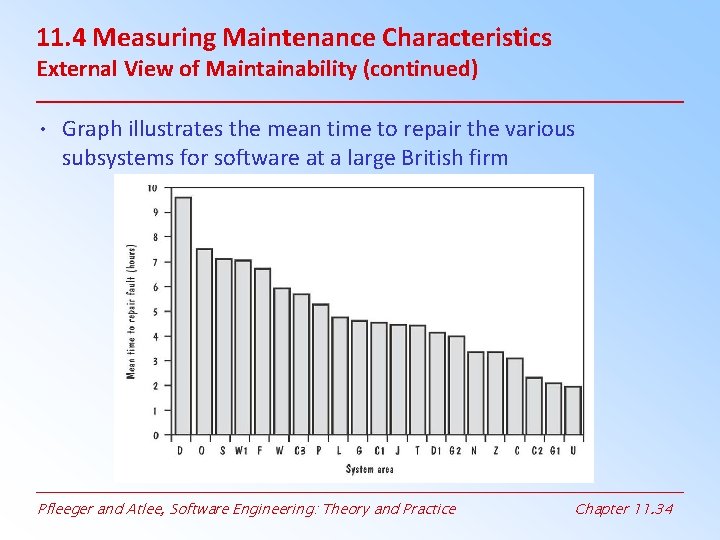
11. 4 Measuring Maintenance Characteristics External View of Maintainability (continued) • Graph illustrates the mean time to repair the various subsystems for software at a large British firm Pfleeger and Atlee, Software Engineering: Theory and Practice Chapter 11. 34
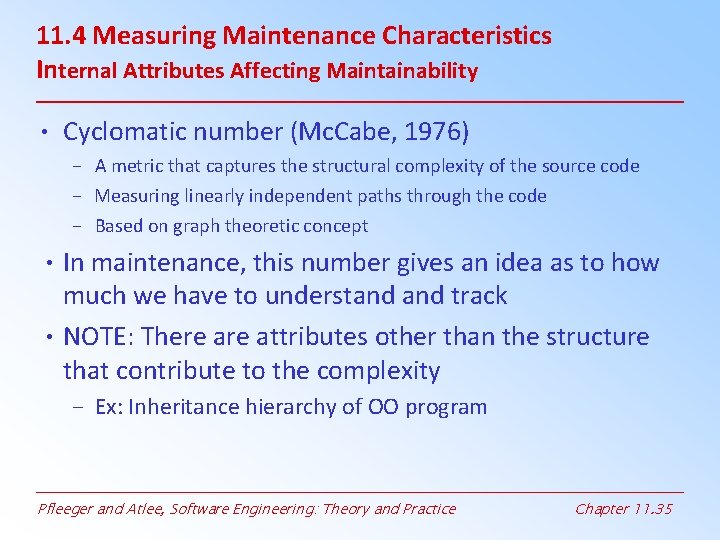
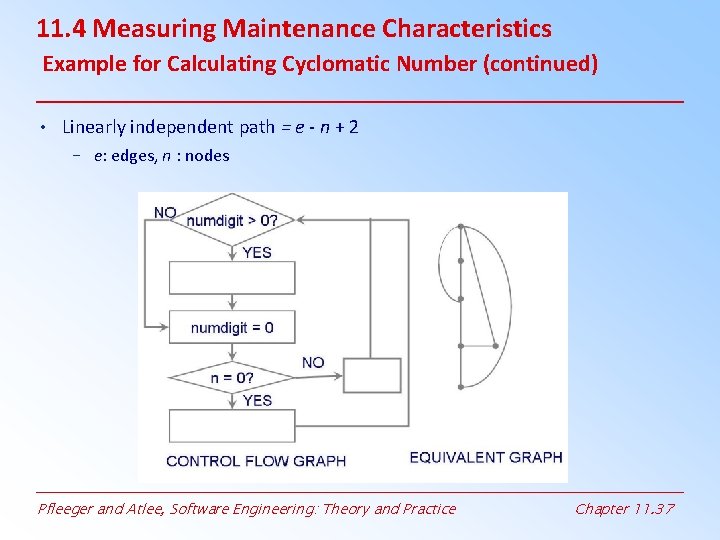
11. 4 Measuring Maintenance Characteristics Internal Attributes Affecting Maintainability • Cyclomatic number (Mc. Cabe, 1976) – A metric that captures the structural complexity of the source code – Measuring linearly independent paths through the code – Based on graph theoretic concept • In maintenance, this number gives an idea as to how much we have to understand track • NOTE: There attributes other than the structure that contribute to the complexity – Ex: Inheritance hierarchy of OO program Pfleeger and Atlee, Software Engineering: Theory and Practice Chapter 11. 35
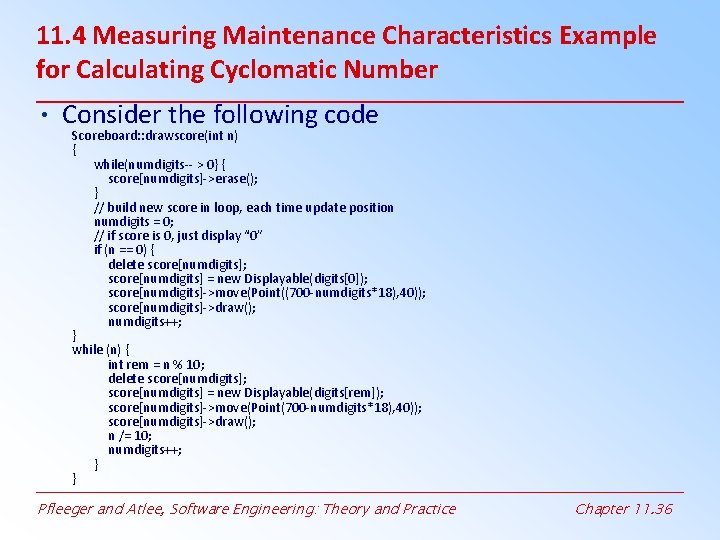
11. 4 Measuring Maintenance Characteristics Example for Calculating Cyclomatic Number • Consider the following code Scoreboard: : drawscore(int n) { while(numdigits-- > 0} { score[numdigits]->erase(); } // build new score in loop, each time update position numdigits = 0; // if score is 0, just display “ 0” if (n == 0) { delete score[numdigits]; score[numdigits] = new Displayable(digits[0]); score[numdigits]->move(Point((700 -numdigits*18), 40)); score[numdigits]->draw(); numdigits++; } while (n) { int rem = n % 10; delete score[numdigits]; score[numdigits] = new Displayable(digits[rem]); score[numdigits]->move(Point(700 -numdigits*18), 40)); score[numdigits]->draw(); n /= 10; numdigits++; } } Pfleeger and Atlee, Software Engineering: Theory and Practice Chapter 11. 36
11. 4 Measuring Maintenance Characteristics Example for Calculating Cyclomatic Number (continued) • Linearly independent path = e - n + 2 – e: edges, n : nodes Pfleeger and Atlee, Software Engineering: Theory and Practice Chapter 11. 37
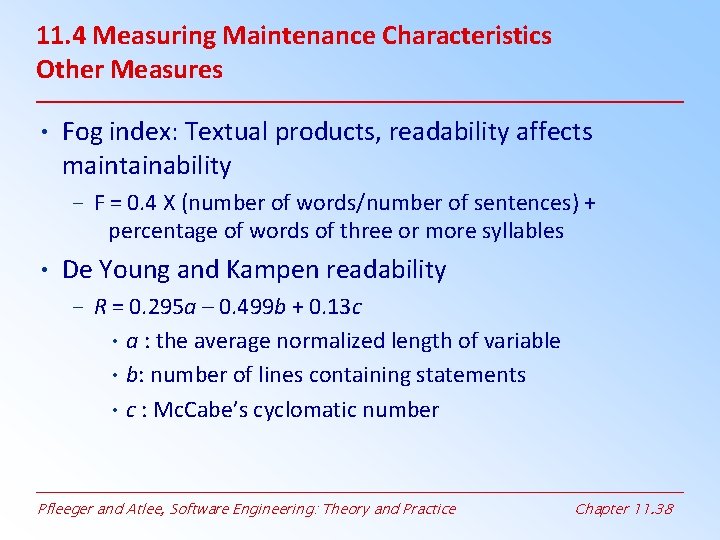
11. 4 Measuring Maintenance Characteristics Other Measures • Fog index: Textual products, readability affects maintainability – F = 0. 4 X (number of words/number of sentences) + percentage of words of three or more syllables • De Young and Kampen readability – R = 0. 295 a – 0. 499 b + 0. 13 c • a : the average normalized length of variable • b: number of lines containing statements • c : Mc. Cabe’s cyclomatic number Pfleeger and Atlee, Software Engineering: Theory and Practice Chapter 11. 38
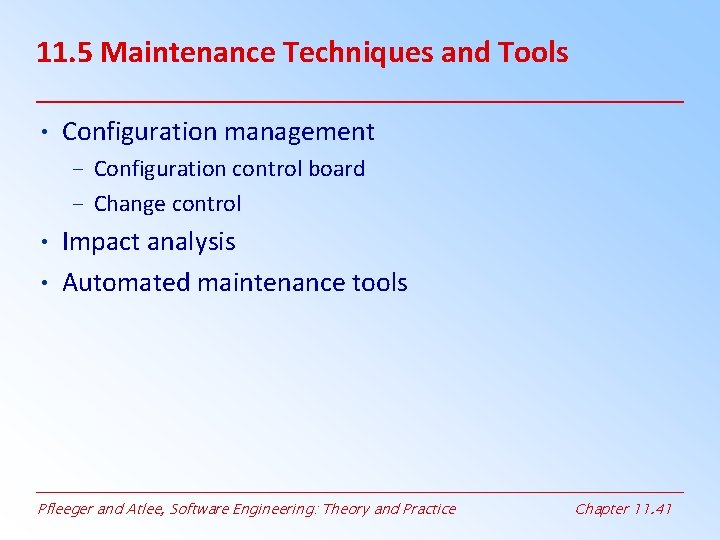
11. 5 Maintenance Techniques and Tools • Configuration management – Configuration control board – Change control • Impact analysis • Automated maintenance tools Pfleeger and Atlee, Software Engineering: Theory and Practice Chapter 11. 41
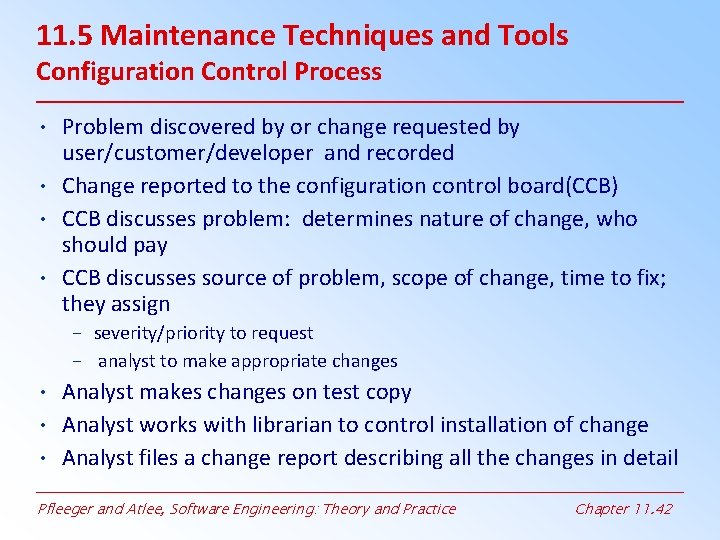
11. 5 Maintenance Techniques and Tools Configuration Control Process • Problem discovered by or change requested by user/customer/developer and recorded • Change reported to the configuration control board(CCB) • CCB discusses problem: determines nature of change, who should pay • CCB discusses source of problem, scope of change, time to fix; they assign – severity/priority to request – analyst to make appropriate changes • Analyst makes changes on test copy • Analyst works with librarian to control installation of change • Analyst files a change report describing all the changes in detail Pfleeger and Atlee, Software Engineering: Theory and Practice Chapter 11. 42
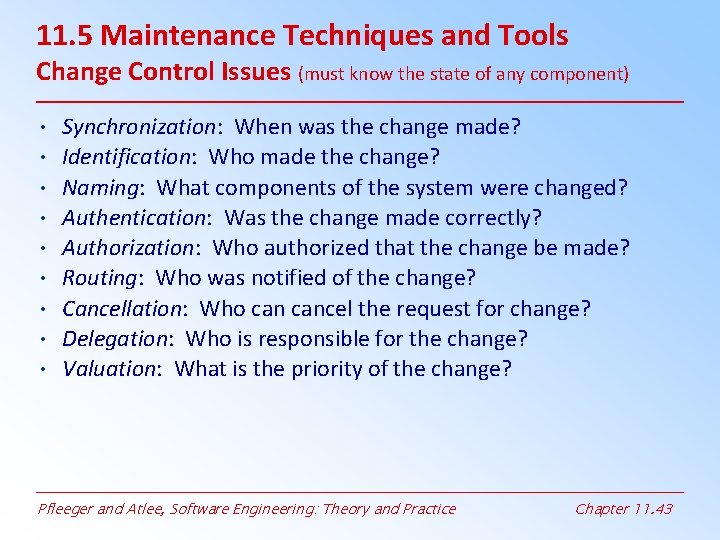
11. 5 Maintenance Techniques and Tools Change Control Issues (must know the state of any component) • • • Synchronization: When was the change made? Identification: Who made the change? Naming: What components of the system were changed? Authentication: Was the change made correctly? Authorization: Who authorized that the change be made? Routing: Who was notified of the change? Cancellation: Who cancel the request for change? Delegation: Who is responsible for the change? Valuation: What is the priority of the change? Pfleeger and Atlee, Software Engineering: Theory and Practice Chapter 11. 43
11. 5 Maintenance Techniques and Tools Impact Analysis • The evaluation of the many risks associated with the change, including estimates of effects on resources, effort and schedule • Helps control maintenance costs Pfleeger and Atlee, Software Engineering: Theory and Practice Chapter 11. 44
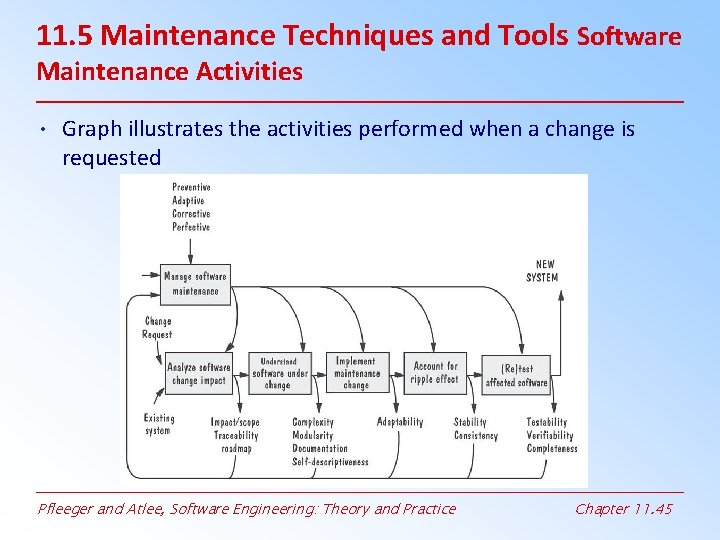
11. 5 Maintenance Techniques and Tools Software Maintenance Activities • Graph illustrates the activities performed when a change is requested Pfleeger and Atlee, Software Engineering: Theory and Practice Chapter 11. 45
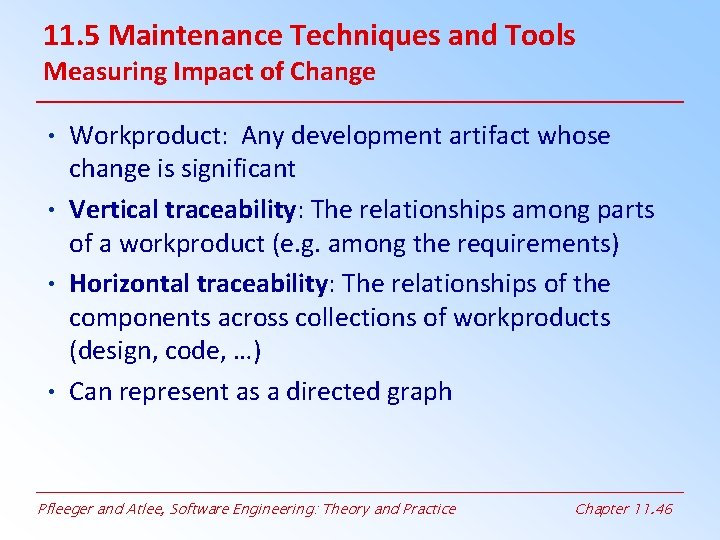
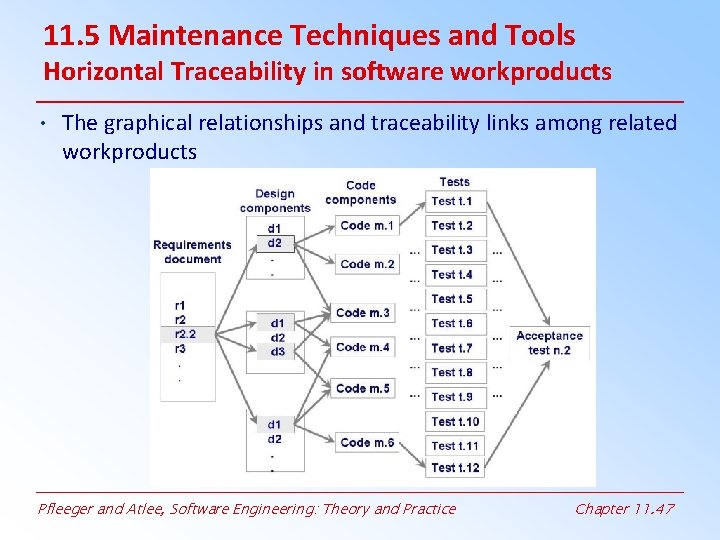
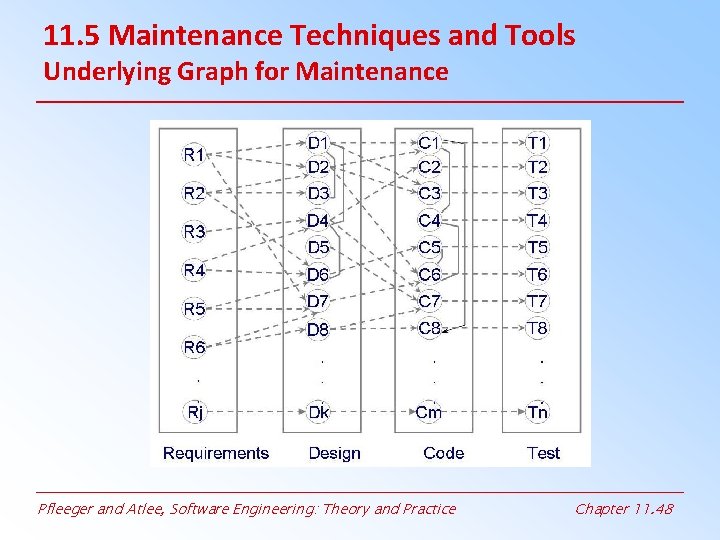
11. 5 Maintenance Techniques and Tools Measuring Impact of Change • Workproduct: Any development artifact whose change is significant • Vertical traceability: The relationships among parts of a workproduct (e. g. among the requirements) • Horizontal traceability: The relationships of the components across collections of workproducts (design, code, …) • Can represent as a directed graph Pfleeger and Atlee, Software Engineering: Theory and Practice Chapter 11. 46
11. 5 Maintenance Techniques and Tools Horizontal Traceability in software workproducts • The graphical relationships and traceability links among related workproducts Pfleeger and Atlee, Software Engineering: Theory and Practice Chapter 11. 47
11. 5 Maintenance Techniques and Tools Underlying Graph for Maintenance Pfleeger and Atlee, Software Engineering: Theory and Practice Chapter 11. 48
11. 5 Maintenance Techniques and Tools Automated Maintenance Tools • Many automated tools exist to track the status of all components – – – – Text editors File comparators Compilers and linkers Debugging tools Cross-reference generators Static code analyzers Configuration management repositories Pfleeger and Atlee, Software Engineering: Theory and Practice Chapter 11. 50
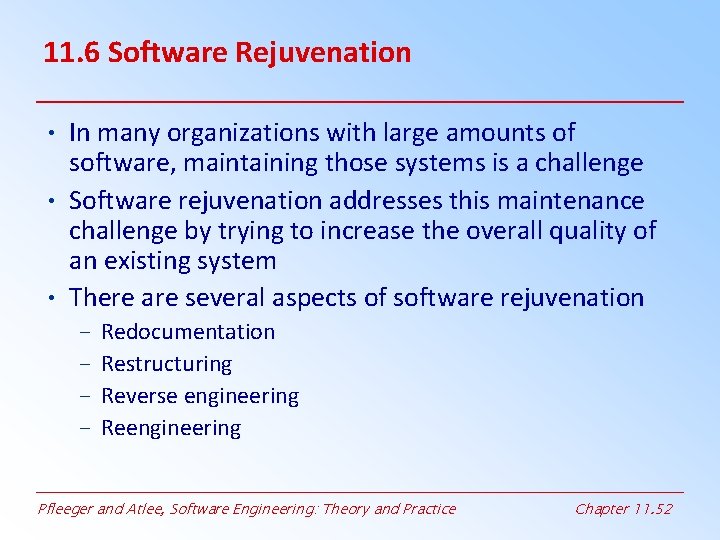
11. 6 Software Rejuvenation • In many organizations with large amounts of software, maintaining those systems is a challenge • Software rejuvenation addresses this maintenance challenge by trying to increase the overall quality of an existing system • There are several aspects of software rejuvenation – – Redocumentation Restructuring Reverse engineering Reengineering Pfleeger and Atlee, Software Engineering: Theory and Practice Chapter 11. 52
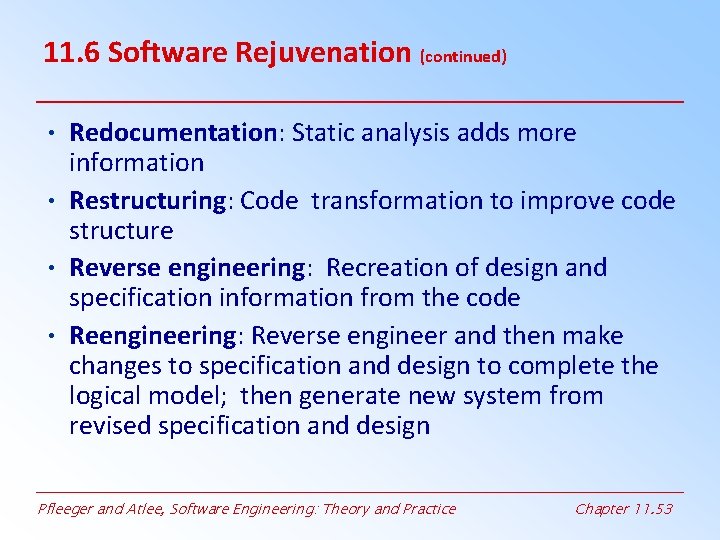
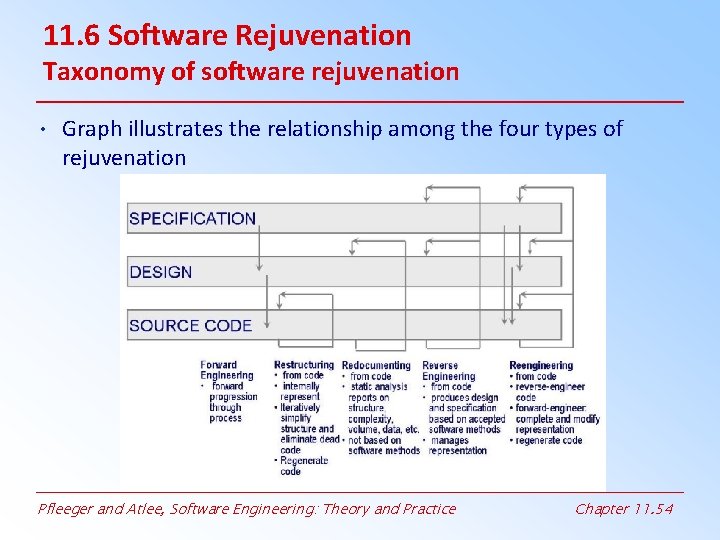
11. 6 Software Rejuvenation (continued) • Redocumentation: Static analysis adds more information • Restructuring: Code transformation to improve code structure • Reverse engineering: Recreation of design and specification information from the code • Reengineering: Reverse engineer and then make changes to specification and design to complete the logical model; then generate new system from revised specification and design Pfleeger and Atlee, Software Engineering: Theory and Practice Chapter 11. 53
11. 6 Software Rejuvenation Taxonomy of software rejuvenation • Graph illustrates the relationship among the four types of rejuvenation Pfleeger and Atlee, Software Engineering: Theory and Practice Chapter 11. 54
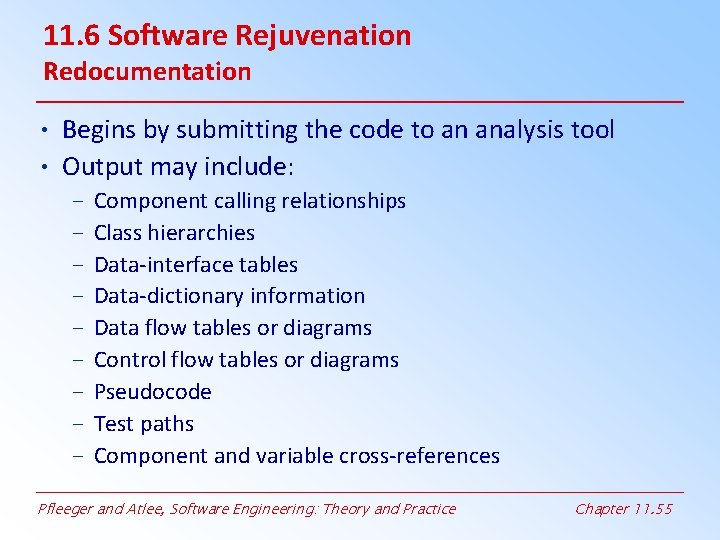
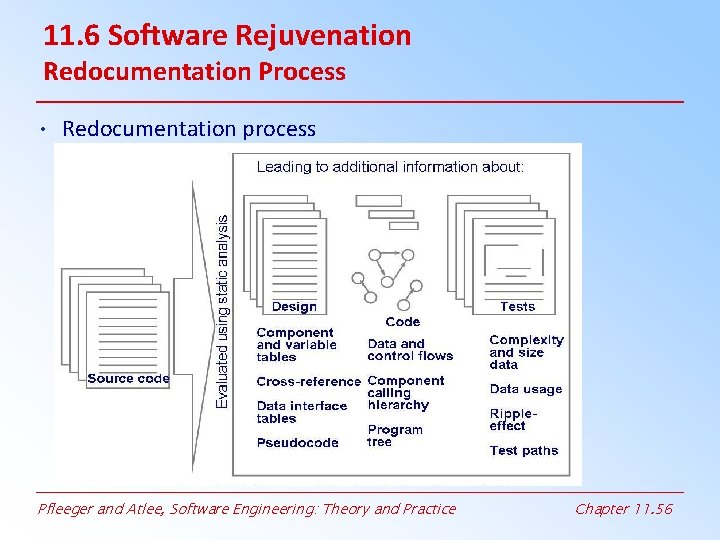
11. 6 Software Rejuvenation Redocumentation • Begins by submitting the code to an analysis tool • Output may include: – – – – – Component calling relationships Class hierarchies Data-interface tables Data-dictionary information Data flow tables or diagrams Control flow tables or diagrams Pseudocode Test paths Component and variable cross-references Pfleeger and Atlee, Software Engineering: Theory and Practice Chapter 11. 55
11. 6 Software Rejuvenation Redocumentation Process • Redocumentation process Pfleeger and Atlee, Software Engineering: Theory and Practice Chapter 11. 56
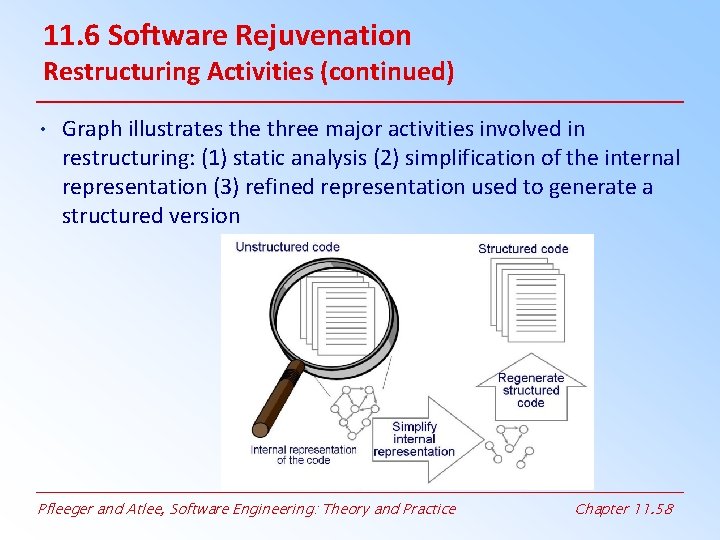
11. 6 Software Rejuvenation Restructuring Activities • Interpreting the source code and representing it internally • Using transformation rules to simplify the internal representation • Regenerating structured code Pfleeger and Atlee, Software Engineering: Theory and Practice Chapter 11. 57
11. 6 Software Rejuvenation Restructuring Activities (continued) • Graph illustrates the three major activities involved in restructuring: (1) static analysis (2) simplification of the internal representation (3) refined representation used to generate a structured version Pfleeger and Atlee, Software Engineering: Theory and Practice Chapter 11. 58
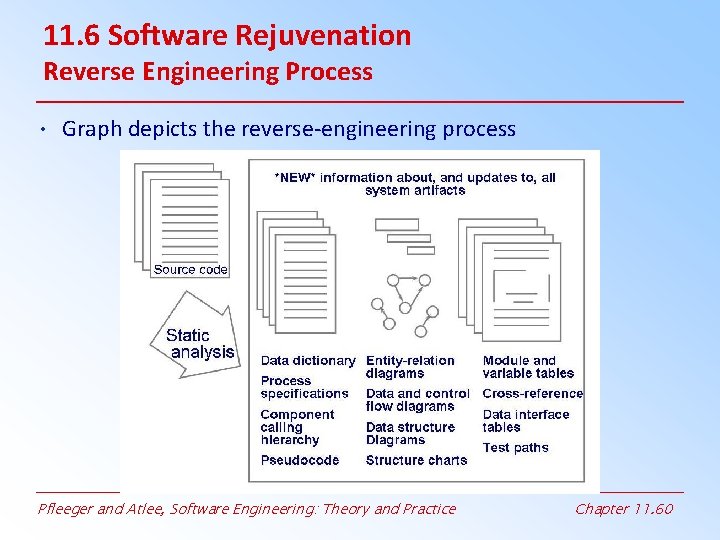
11. 6 Software Rejuvenation Reverse Engineering • Attempting to recover engineering information based on software specification and design methods • Obstacles remain before reverse engineering can be used universally – Real time system problem – Extremely complex system • Successful when expectations are low Pfleeger and Atlee, Software Engineering: Theory and Practice Chapter 11. 59
11. 6 Software Rejuvenation Reverse Engineering Process • Graph depicts the reverse-engineering process Pfleeger and Atlee, Software Engineering: Theory and Practice Chapter 11. 60
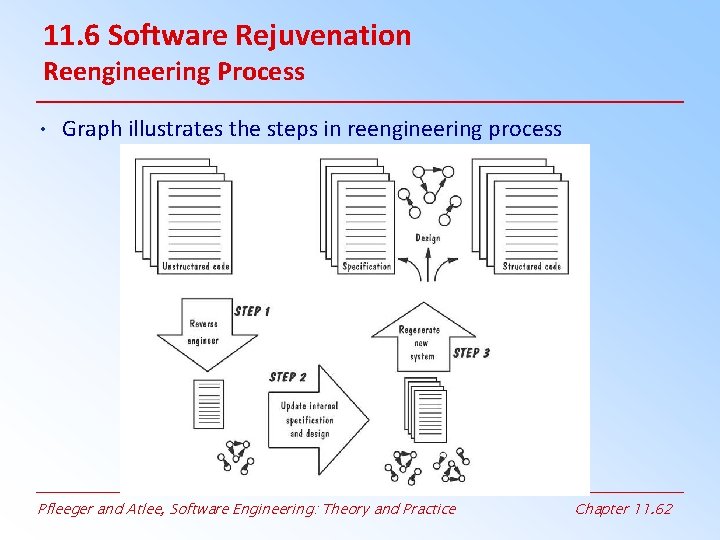
11. 6 Software Rejuvenation Reengineering • An extension of reverse engineering – produces new software code without changing the overall system function • Reengineering steps – The system is reverse-engineered – The software system is corrected or completed – The new system is generated Pfleeger and Atlee, Software Engineering: Theory and Practice Chapter 11. 61
11. 6 Software Rejuvenation Reengineering Process • Graph illustrates the steps in reengineering process Pfleeger and Atlee, Software Engineering: Theory and Practice Chapter 11. 62
11. 7 Information System Example Piccadilly System • The software can not be an S-system – the problem may change dramatically • The software can not be a P-system – P-system requires a stable abstraction, while Piccadilly changes constantly • The software must be a E-system – The system is an integral part of the world it models Pfleeger and Atlee, Software Engineering: Theory and Practice Chapter 11. 64
11. 8 Real-Time Example Ariane-5 • Developers focused on mitigating random failure – The inertial reference system failed because of a design fault, not a result of a random failure • Needs to change the failure strategy and implement a series of preventive enhancements Pfleeger and Atlee, Software Engineering: Theory and Practice Chapter 11. 65
11. 9 What this Chapter Means for You • The more a system is linked to the real world, the more likely it will change and the more difficult it will be to maintain • Maintainers have many jobs in addition to software developers • Measuring maintainability is difficult • Impact analysis builds and tracks links among the requirements, design, code and test cases • Software rejuvenation involves redocumenting, restructuring, reverse engineering and reengineering Pfleeger and Atlee, Software Engineering: Theory and Practice Chapter 11. 66