
CHAPTER 11 LIQUIDS INTERMOLECULAR FORCES Chem 1212 Dr
- Slides: 46
CHAPTER 11: LIQUIDS & INTERMOLECULAR FORCES Chem 1212 Dr. Aimée Tomlinson
Section 11. 1 A Molecular Comparison of Gases, Liquids, and Solids
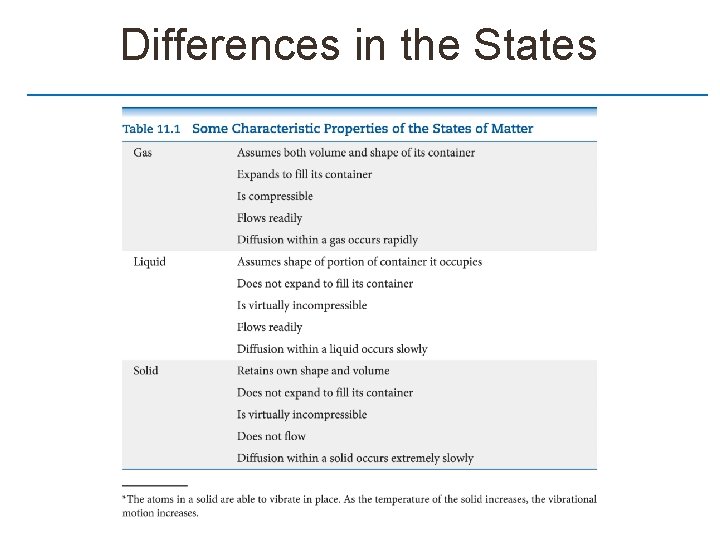
Differences in the States
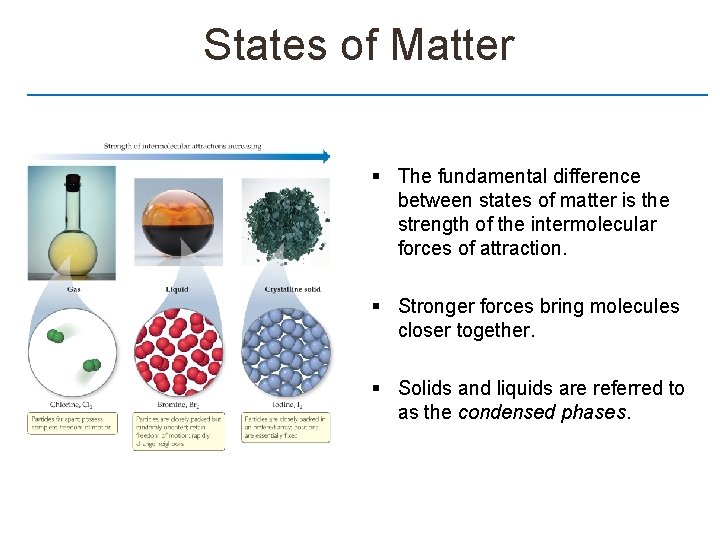
States of Matter § The fundamental difference between states of matter is the strength of the intermolecular forces of attraction. § Stronger forces bring molecules closer together. § Solids and liquids are referred to as the condensed phases.
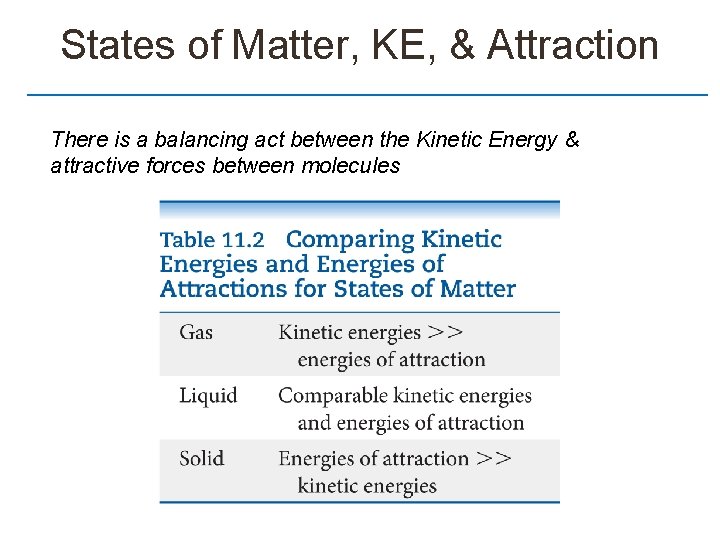
States of Matter, KE, & Attraction There is a balancing act between the Kinetic Energy & attractive forces between molecules
Before we talk about Intermolecular Forces we need to review what makes a polar bond and then a polar molecule
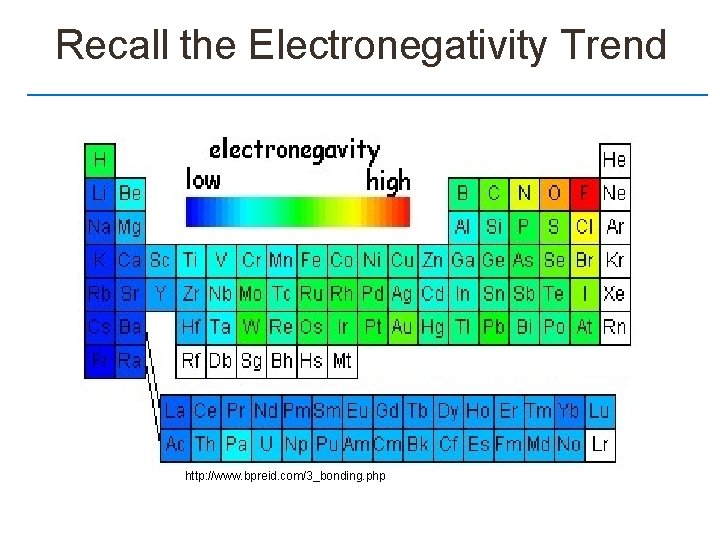
Recall the Electronegativity Trend http: //www. bpreid. com/3_bonding. php
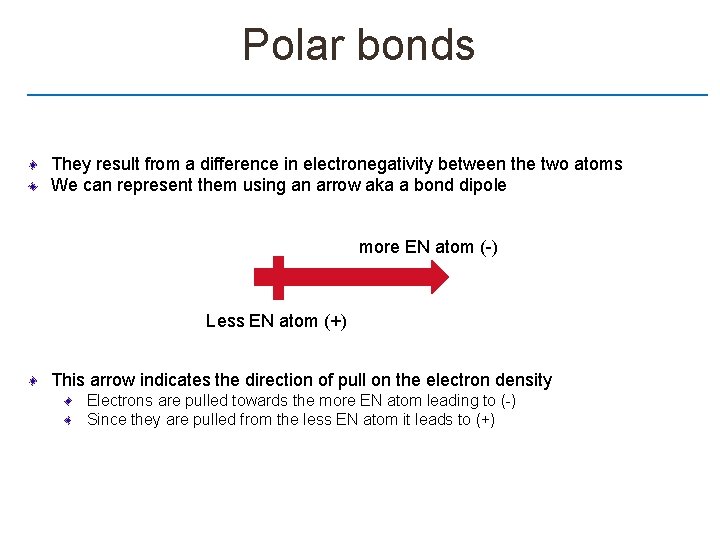
Polar bonds They result from a difference in electronegativity between the two atoms We can represent them using an arrow aka a bond dipole more EN atom (-) Less EN atom (+) This arrow indicates the direction of pull on the electron density Electrons are pulled towards the more EN atom leading to (-) Since they are pulled from the less EN atom it leads to (+)
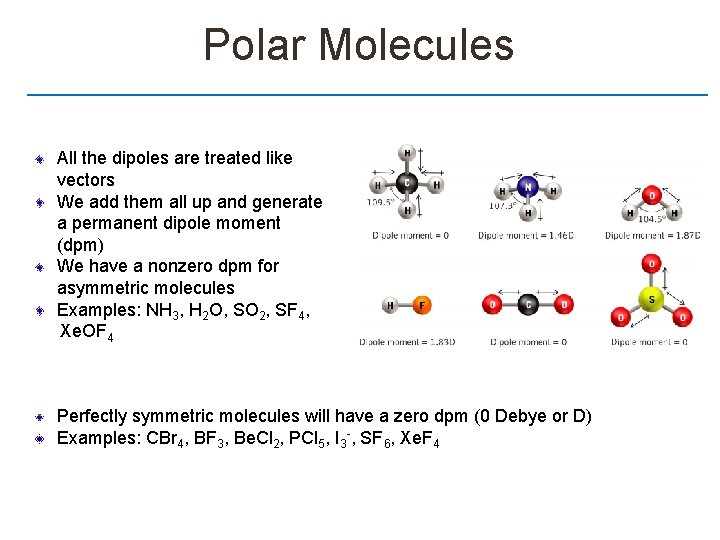
Polar Molecules All the dipoles are treated like vectors We add them all up and generate a permanent dipole moment (dpm) We have a nonzero dpm for asymmetric molecules Examples: NH 3, H 2 O, SO 2, SF 4, Xe. OF 4 Perfectly symmetric molecules will have a zero dpm (0 Debye or D) Examples: CBr 4, BF 3, Be. Cl 2, PCl 5, I 3 -, SF 6, Xe. F 4
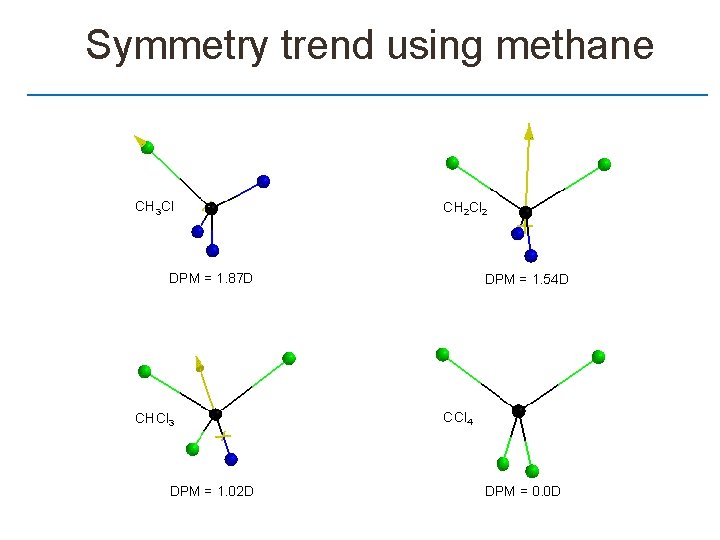
Symmetry trend using methane CH 3 Cl CH 2 Cl 2 DPM = 1. 87 D CHCl 3 DPM = 1. 02 D DPM = 1. 54 D CCl 4 DPM = 0. 0 D
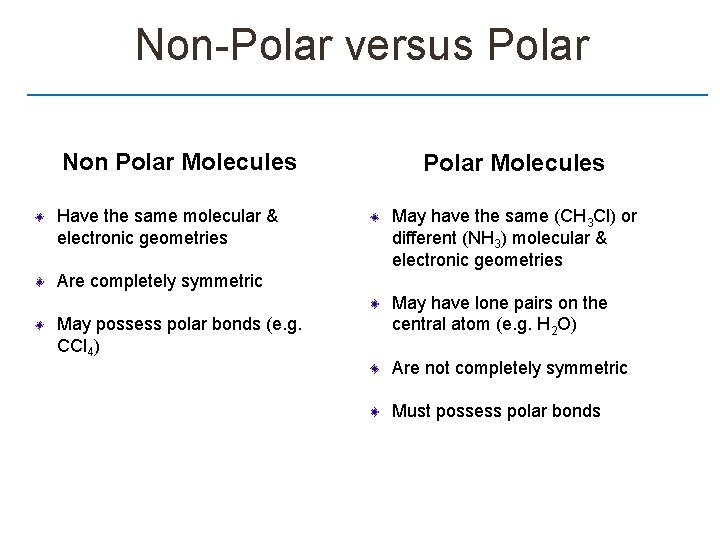
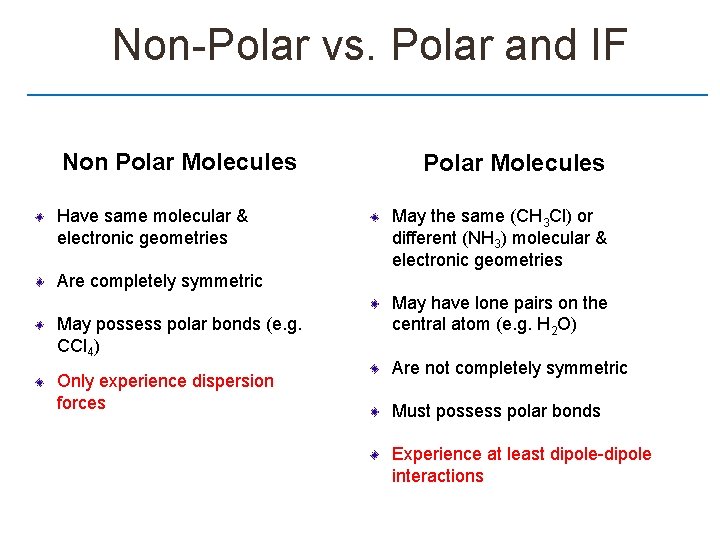
Non-Polar versus Polar Non Polar Molecules Have the same molecular & electronic geometries Polar Molecules May have the same (CH 3 Cl) or different (NH 3) molecular & electronic geometries Are completely symmetric May possess polar bonds (e. g. CCl 4) May have lone pairs on the central atom (e. g. H 2 O) Are not completely symmetric Must possess polar bonds
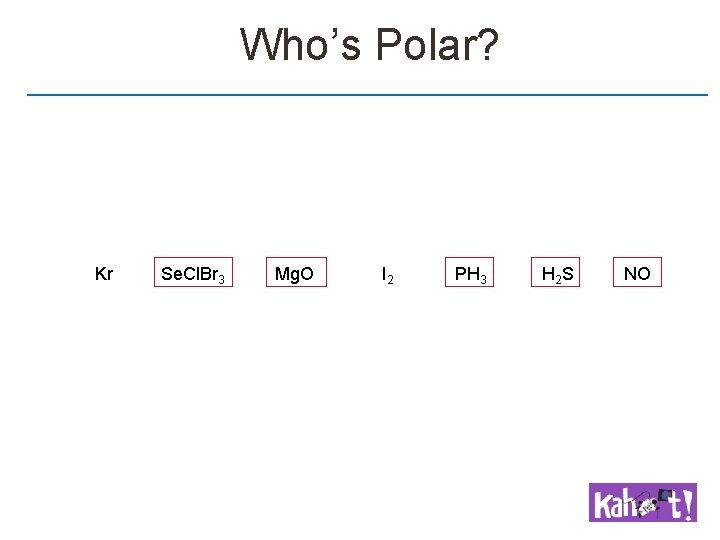
Who’s Polar? Kr Se. Cl. Br 3 Mg. O I 2 PH 3 H 2 S NO
Section 11. 2 Intermolecular Forces (IF) Meaning between two molecules
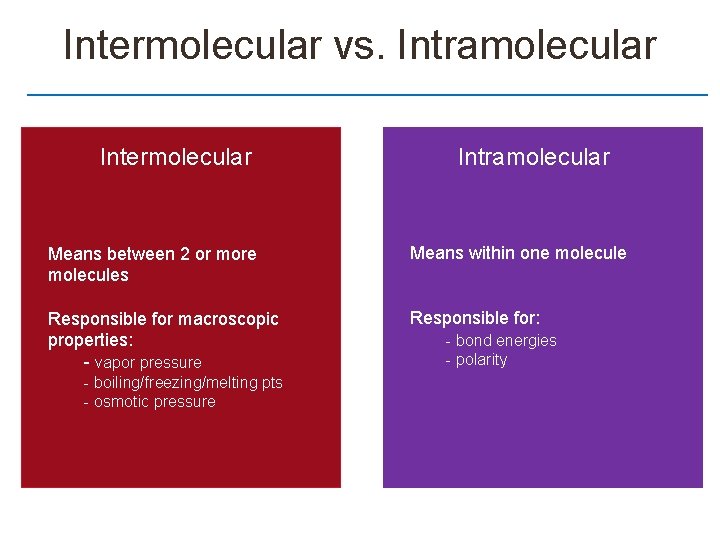
Intermolecular vs. Intramolecular Intermolecular Intramolecular Means between 2 or more molecules Means within one molecule Responsible for macroscopic properties: - vapor pressure Responsible for: - boiling/freezing/melting pts - osmotic pressure - bond energies - polarity
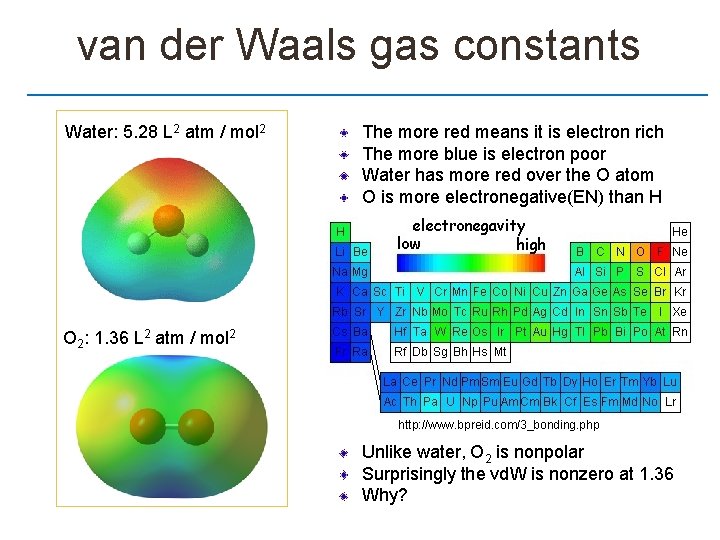
van der Waals gas constants Water: 5. 28 L 2 atm / mol 2 The more red means it is electron rich The more blue is electron poor Water has more red over the O atom O is more electronegative(EN) than H O 2: 1. 36 L 2 atm / mol 2 http: //www. bpreid. com/3_bonding. php Unlike water, O 2 is nonpolar Surprisingly the vd. W is nonzero at 1. 36 Why?
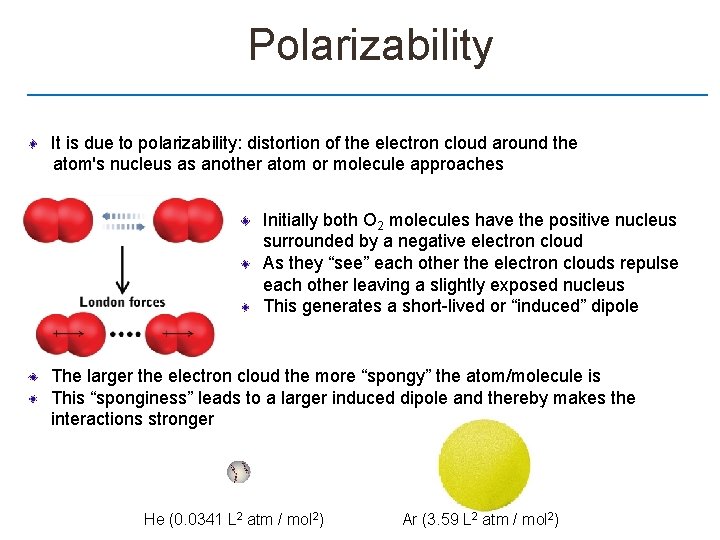
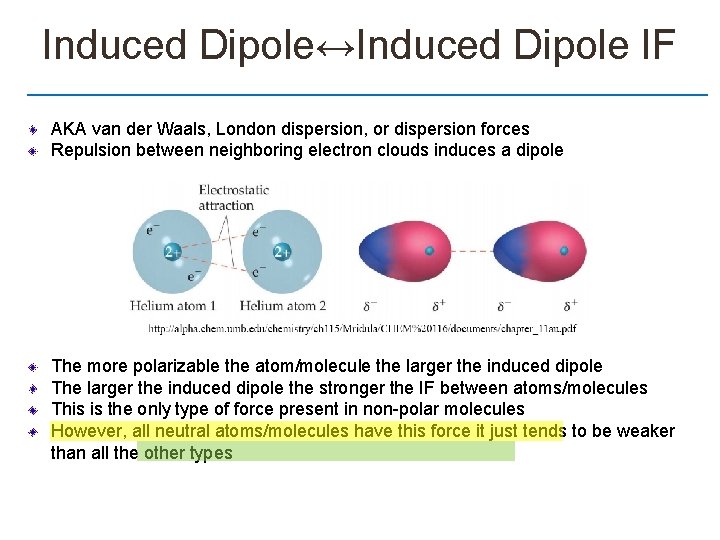
Polarizability It is due to polarizability: distortion of the electron cloud around the atom's nucleus as another atom or molecule approaches Initially both O 2 molecules have the positive nucleus surrounded by a negative electron cloud As they “see” each other the electron clouds repulse each other leaving a slightly exposed nucleus This generates a short-lived or “induced” dipole The larger the electron cloud the more “spongy” the atom/molecule is This “sponginess” leads to a larger induced dipole and thereby makes the interactions stronger He (0. 0341 L 2 atm / mol 2) Ar (3. 59 L 2 atm / mol 2)
Induced Dipole↔Induced Dipole IF AKA van der Waals, London dispersion, or dispersion forces Repulsion between neighboring electron clouds induces a dipole The more polarizable the atom/molecule the larger the induced dipole The larger the induced dipole the stronger the IF between atoms/molecules This is the only type of force present in non-polar molecules However, all neutral atoms/molecules have this force it just tends to be weaker than all the other types
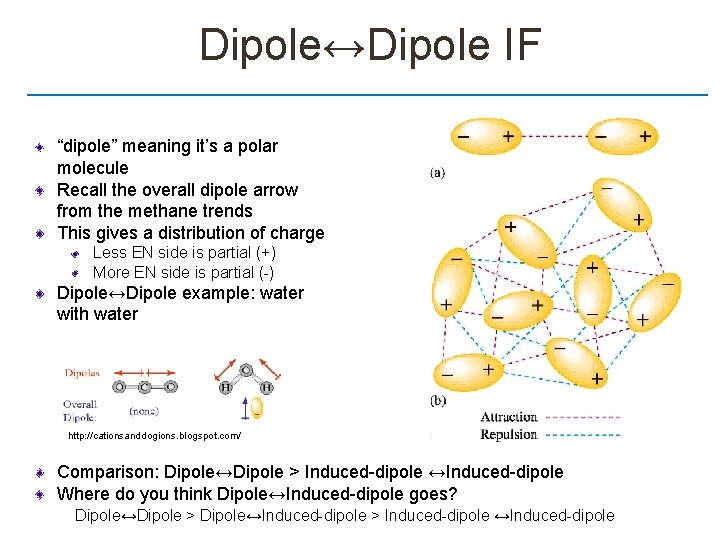
Dipole↔Dipole IF “dipole” meaning it’s a polar molecule Recall the overall dipole arrow from the methane trends This gives a distribution of charge Less EN side is partial (+) More EN side is partial (-) Dipole↔Dipole example: water with water http: //cationsanddogions. blogspot. com/ Comparison: Dipole↔Dipole > Induced-dipole ↔Induced-dipole Where do you think Dipole↔Induced-dipole goes? Dipole↔Dipole > Dipole↔Induced-dipole > Induced-dipole ↔Induced-dipole
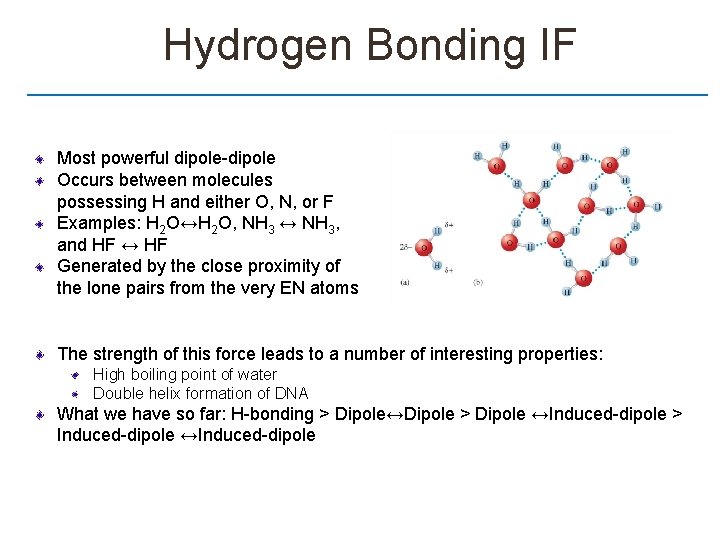
Hydrogen Bonding IF Most powerful dipole-dipole Occurs between molecules possessing H and either O, N, or F Examples: H 2 O↔H 2 O, NH 3 ↔ NH 3, and HF ↔ HF Generated by the close proximity of the lone pairs from the very EN atoms The strength of this force leads to a number of interesting properties: High boiling point of water Double helix formation of DNA What we have so far: H-bonding > Dipole↔Dipole > Dipole ↔Induced-dipole > Induced-dipole ↔Induced-dipole
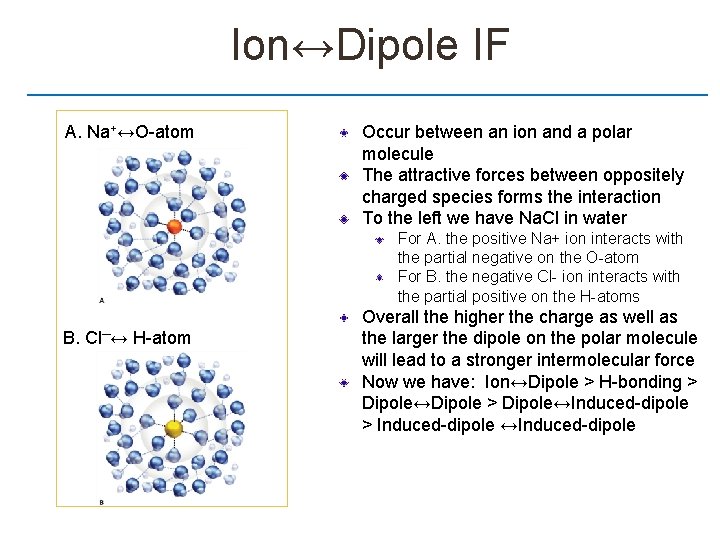
Ion↔Dipole IF A. Na+↔O-atom Occur between an ion and a polar molecule The attractive forces between oppositely charged species forms the interaction To the left we have Na. Cl in water For A. the positive Na+ ion interacts with the partial negative on the O-atom For B. the negative Cl- ion interacts with the partial positive on the H-atoms B. Cl─↔ H-atom Overall the higher the charge as well as the larger the dipole on the polar molecule will lead to a stronger intermolecular force Now we have: Ion↔Dipole > H-bonding > Dipole↔Dipole > Dipole↔Induced-dipole > Induced-dipole ↔Induced-dipole
Non-Polar vs. Polar and IF Non Polar Molecules Have same molecular & electronic geometries Polar Molecules May the same (CH 3 Cl) or different (NH 3) molecular & electronic geometries Are completely symmetric May possess polar bonds (e. g. CCl 4) Only experience dispersion forces May have lone pairs on the central atom (e. g. H 2 O) Are not completely symmetric Must possess polar bonds Experience at least dipole-dipole interactions
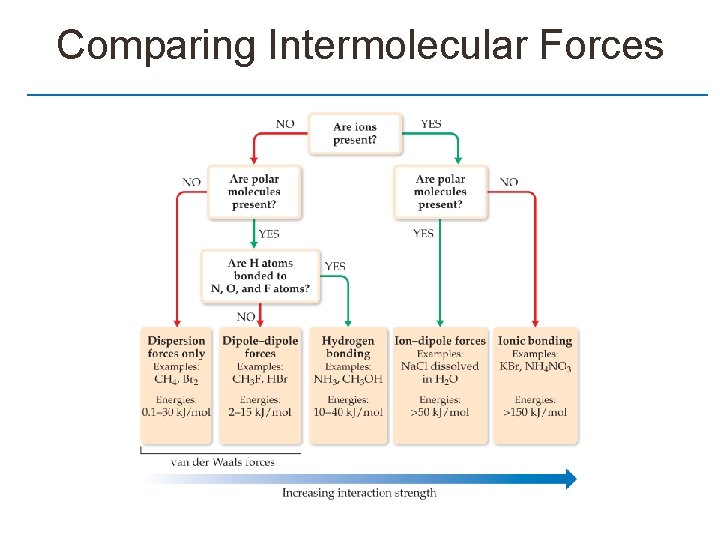
Comparing Intermolecular Forces
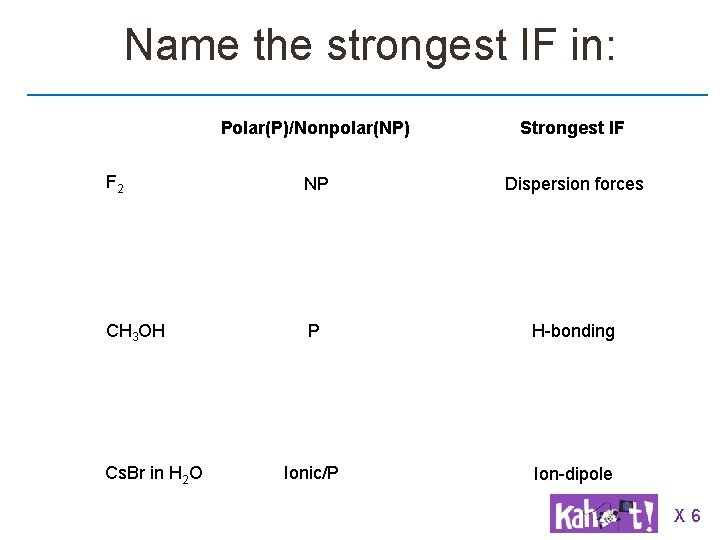
Name the strongest IF in: Polar(P)/Nonpolar(NP) Strongest IF F 2 NP Dispersion forces CH 3 OH P H-bonding Ionic/P Ion-dipole Cs. Br in H 2 O X 6
Section 11. 3 Select Properties of Liquids
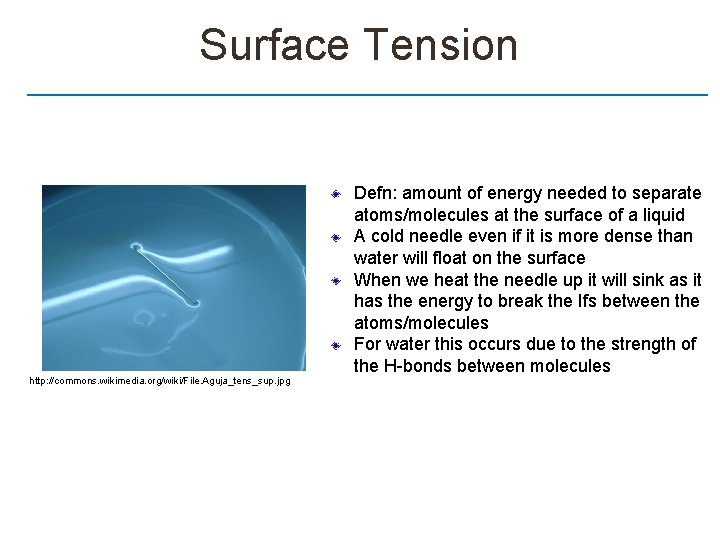
Surface Tension http: //commons. wikimedia. org/wiki/File. Aguja_tens_sup. jpg Defn: amount of energy needed to separate atoms/molecules at the surface of a liquid A cold needle even if it is more dense than water will float on the surface When we heat the needle up it will sink as it has the energy to break the Ifs between the atoms/molecules For water this occurs due to the strength of the H-bonds between molecules
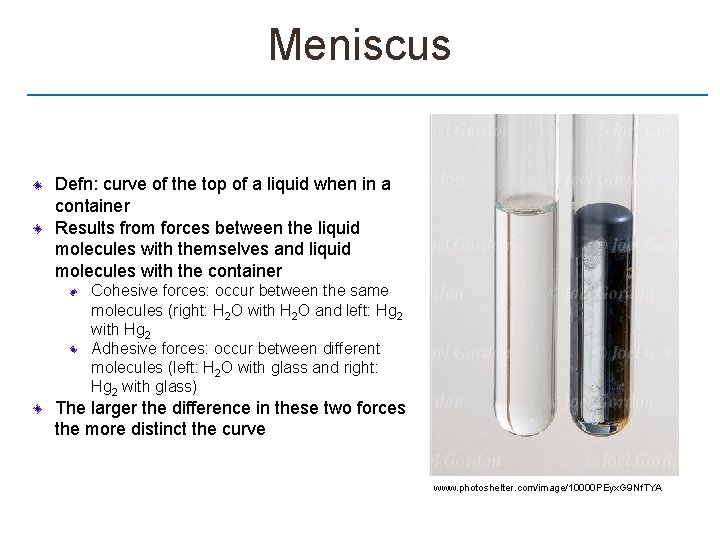
Meniscus Defn: curve of the top of a liquid when in a container Results from forces between the liquid molecules with themselves and liquid molecules with the container Cohesive forces: occur between the same molecules (right: H 2 O with H 2 O and left: Hg 2 with Hg 2 Adhesive forces: occur between different molecules (left: H 2 O with glass and right: Hg 2 with glass) The larger the difference in these two forces the more distinct the curve www. photoshelter. com/image/10000 PEyx. G 9 Nf. TYA
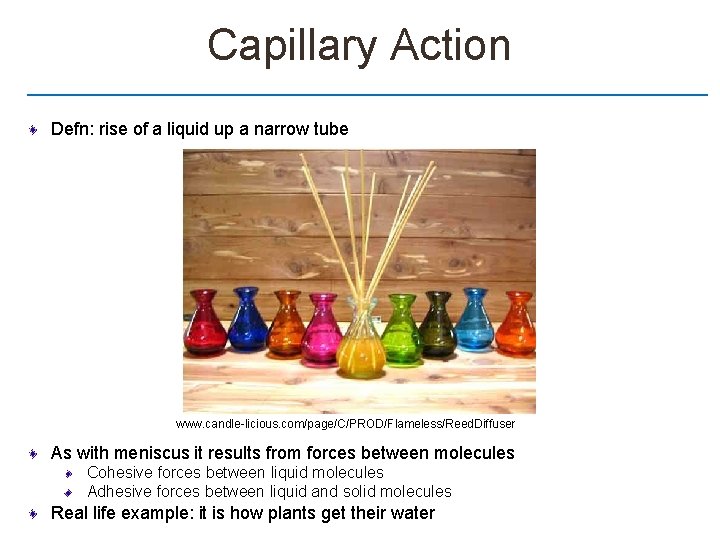
Capillary Action Defn: rise of a liquid up a narrow tube www. candle-licious. com/page/C/PROD/Flameless/Reed. Diffuser As with meniscus it results from forces between molecules Cohesive forces between liquid molecules Adhesive forces between liquid and solid molecules Real life example: it is how plants get their water
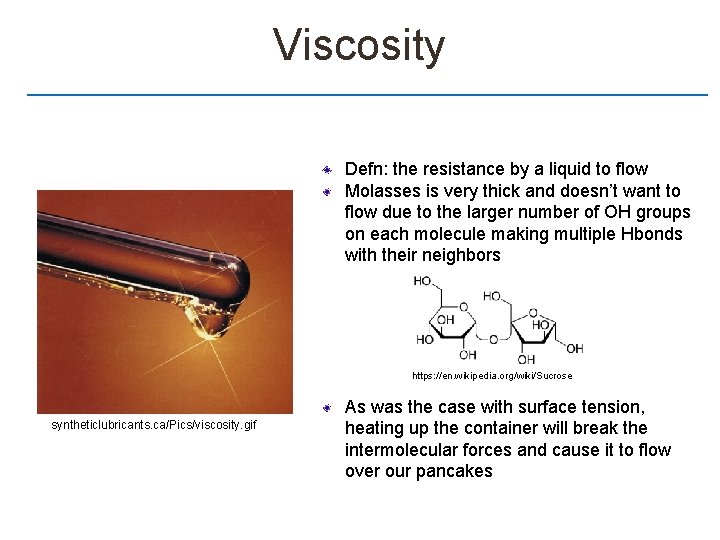
Viscosity Defn: the resistance by a liquid to flow Molasses is very thick and doesn’t want to flow due to the larger number of OH groups on each molecule making multiple Hbonds with their neighbors https: //en. wikipedia. org/wiki/Sucrose syntheticlubricants. ca/Pics/viscosity. gif As was the case with surface tension, heating up the container will break the intermolecular forces and cause it to flow over our pancakes
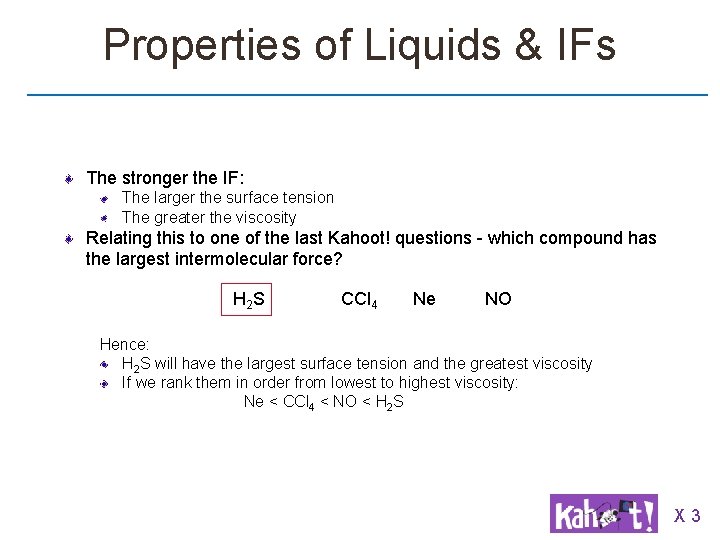
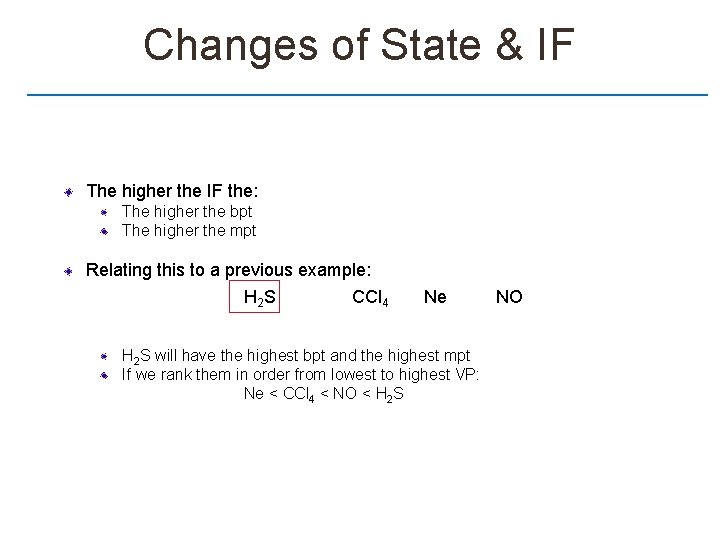
Properties of Liquids & IFs The stronger the IF: The larger the surface tension The greater the viscosity Relating this to one of the last Kahoot! questions - which compound has the largest intermolecular force? H 2 S CCl 4 Ne NO Hence: H 2 S will have the largest surface tension and the greatest viscosity If we rank them in order from lowest to highest viscosity: Ne < CCl 4 < NO < H 2 S X 3
Section 11. 4 Phase Changes
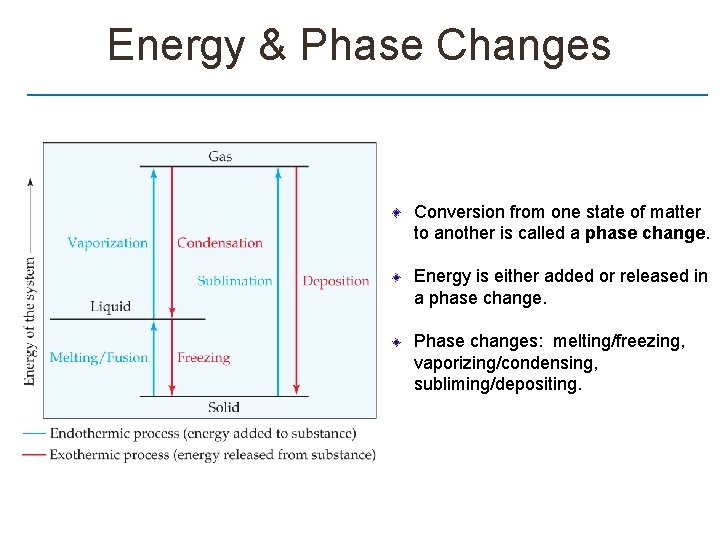
Energy & Phase Changes Conversion from one state of matter to another is called a phase change. Energy is either added or released in a phase change. Phase changes: melting/freezing, vaporizing/condensing, subliming/depositing.
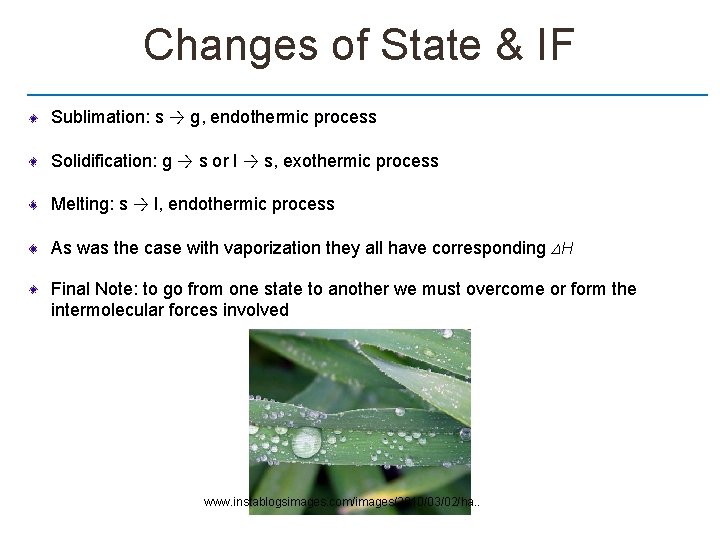
Changes of State & IF Sublimation: s → g, endothermic process Solidification: g → s or l → s, exothermic process Melting: s → l, endothermic process As was the case with vaporization they all have corresponding H Final Note: to go from one state to another we must overcome or form the intermolecular forces involved www. instablogsimages. com/images/2010/03/02/ha. .
Changes of State & IF The higher the IF the: The higher the bpt The higher the mpt Relating this to a previous example: H 2 S CCl 4 Ne H 2 S will have the highest bpt and the highest mpt If we rank them in order from lowest to highest VP: Ne < CCl 4 < NO < H 2 S NO
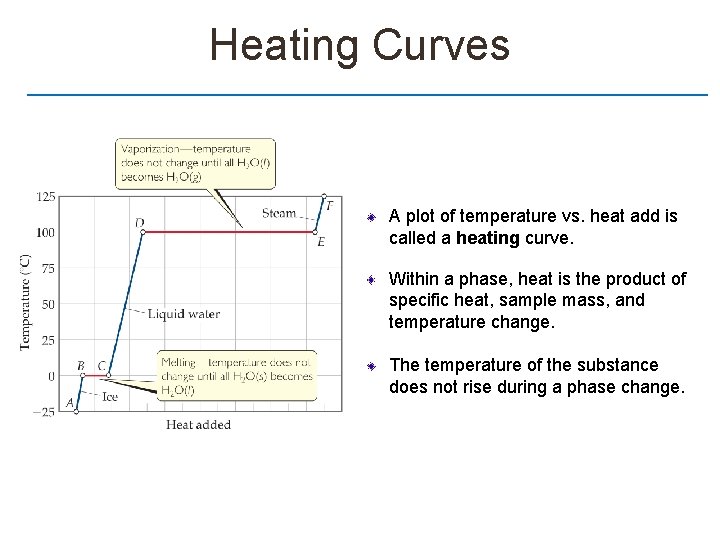
Heating Curves A plot of temperature vs. heat add is called a heating curve. Within a phase, heat is the product of specific heat, sample mass, and temperature change. The temperature of the substance does not rise during a phase change.
Critical Temperatures & Pressures All substances have a T & P in which the liquid and gas phases are completely indistinguishable this is called the critical point The density is the same for both states The liquid phase is less dense due to high T The gas phase is more dense due to high P The name we give to this state is supercritical fluid X 3
Section 11. 5 Vapor Pressure
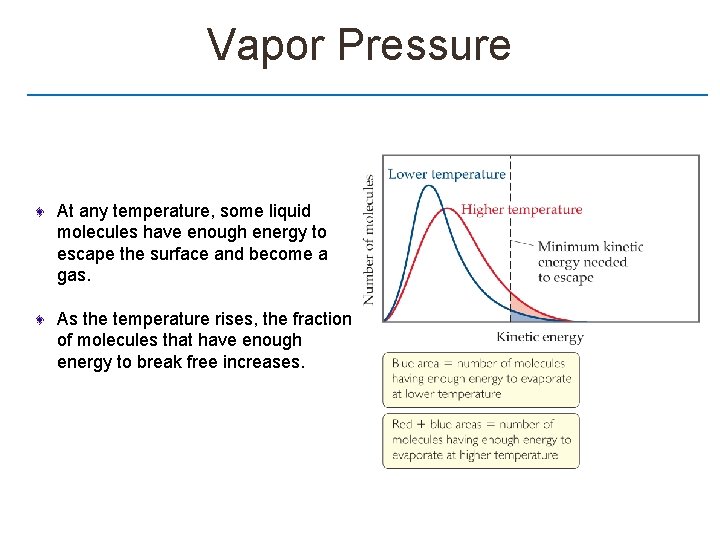
Vapor Pressure At any temperature, some liquid molecules have enough energy to escape the surface and become a gas. As the temperature rises, the fraction of molecules that have enough energy to break free increases.
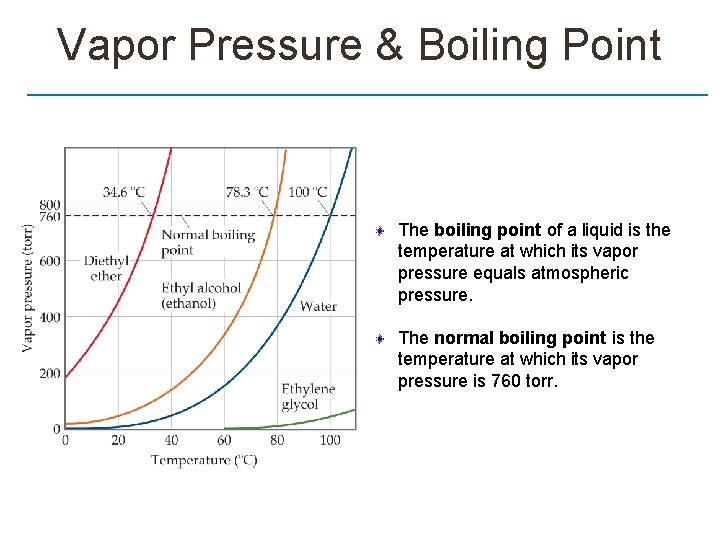
Vapor Pressure & Boiling Point The boiling point of a liquid is the temperature at which its vapor pressure equals atmospheric pressure. The normal boiling point is the temperature at which its vapor pressure is 760 torr.
Vapor Pressure & IF VP is the one where we end up going backwards – this will be more clear after we get to Chapter 13 The lower the VP the higher the intermolecular force The higher the VP the lower the intermolecular force Relating this to our earlier example: H 2 S CCl 4 Ne H 2 S will have the lowest VP If we rank them in order from lowest to highest VP: H 2 S < NO < CCl 4 < Ne NO
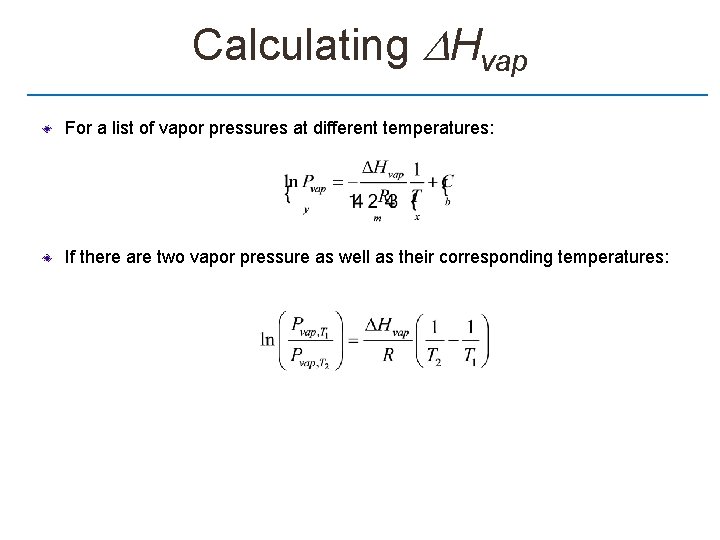
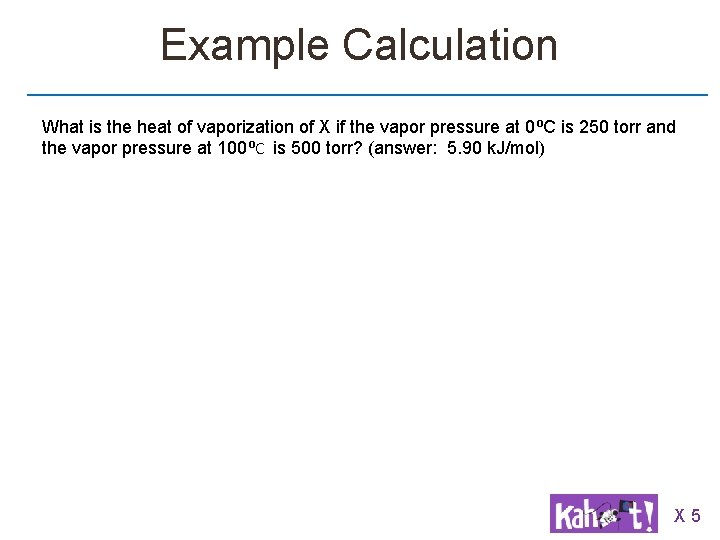
Calculating Hvap For a list of vapor pressures at different temperatures: If there are two vapor pressure as well as their corresponding temperatures:
Example Calculation What is the heat of vaporization of X if the vapor pressure at 0⁰C is 250 torr and the vapor pressure at 100⁰C is 500 torr? (answer: 5. 90 k. J/mol) X 5
Section 11. 6 Phase Diagrams Graphical representations of physical states as function of T & P
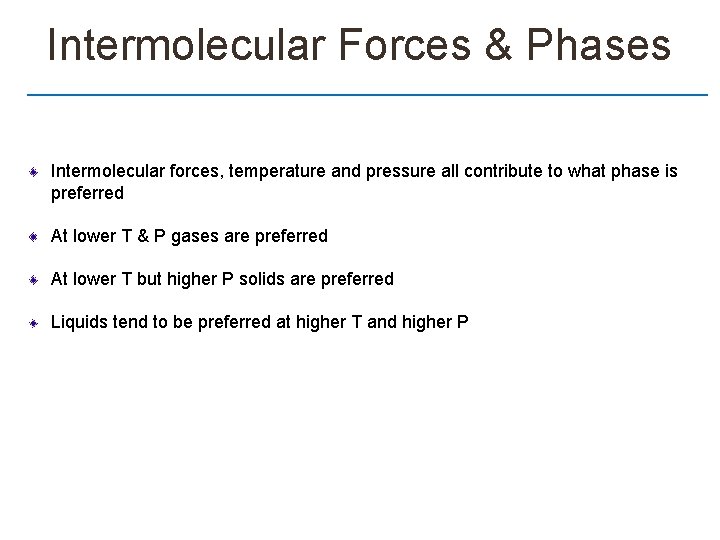
Intermolecular Forces & Phases Intermolecular forces, temperature and pressure all contribute to what phase is preferred At lower T & P gases are preferred At lower T but higher P solids are preferred Liquids tend to be preferred at higher T and higher P
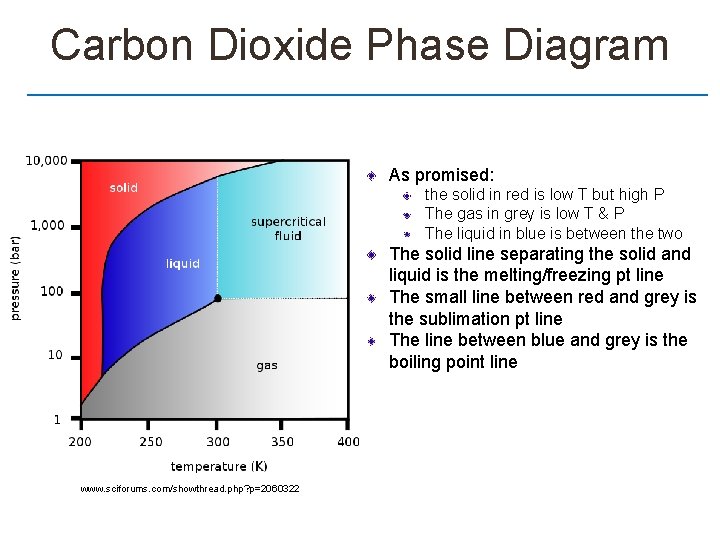
Carbon Dioxide Phase Diagram As promised: the solid in red is low T but high P The gas in grey is low T & P The liquid in blue is between the two The solid line separating the solid and liquid is the melting/freezing pt line The small line between red and grey is the sublimation pt line The line between blue and grey is the boiling point line www. sciforums. com/showthread. php? p=2060322
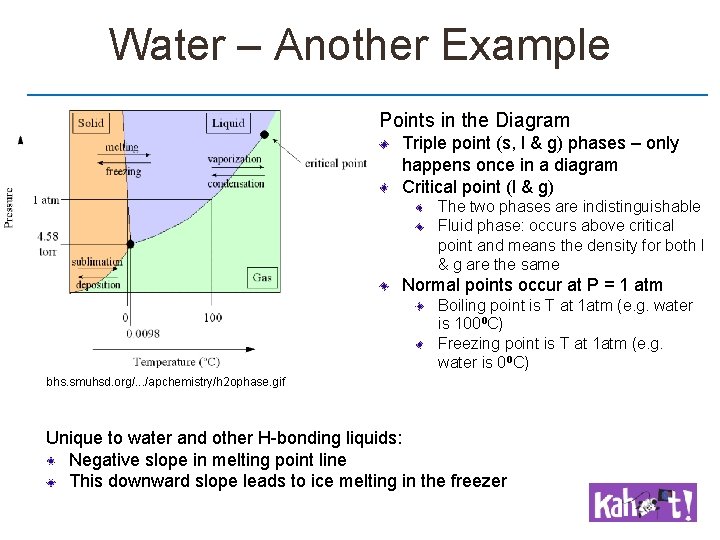
Water – Another Example Points in the Diagram Triple point (s, l & g) phases – only happens once in a diagram Critical point (l & g) The two phases are indistinguishable Fluid phase: occurs above critical point and means the density for both l & g are the same Normal points occur at P = 1 atm Boiling point is T at 1 atm (e. g. water is 100⁰C) Freezing point is T at 1 atm (e. g. water is 0⁰C) bhs. smuhsd. org/. . . /apchemistry/h 2 ophase. gif Unique to water and other H-bonding liquids: Negative slope in melting point line This downward slope leads to ice melting in the freezer
Section 11. 7 Skip – YIPPEE!!!