
Chapter 11 Lecture Outline Prepared by Ashlyn Smith
Chapter 11 Lecture Outline Prepared by Ashlyn Smith Anderson University 1 Copyright © Mc. Graw-Hill Education. Permission required for reproduction or display.
11. 1 Introduction to Organic Chemistry • Organic chemistry is the study of compounds that contain the element carbon. • Organic chemicals affect virtually every facet of our lives. • Products such as clothes, foods, medicines, gasoline, refrigerants, and soaps are composed almost solely of organic compounds. • Some organic products can be obtained directly from natural sources—cotton, wool, and silk. • Others can be synthetically produced—nylon and polyester. 2
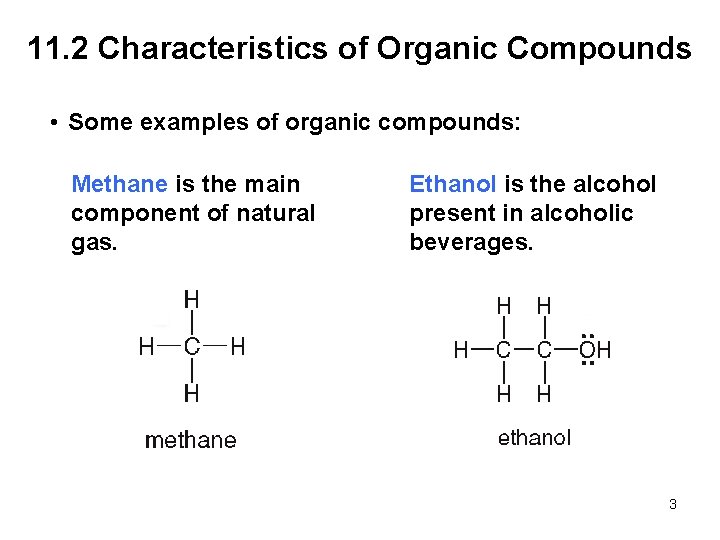
11. 2 Characteristics of Organic Compounds • Some examples of organic compounds: Methane is the main component of natural gas. Ethanol is the alcohol present in alcoholic beverages. 3
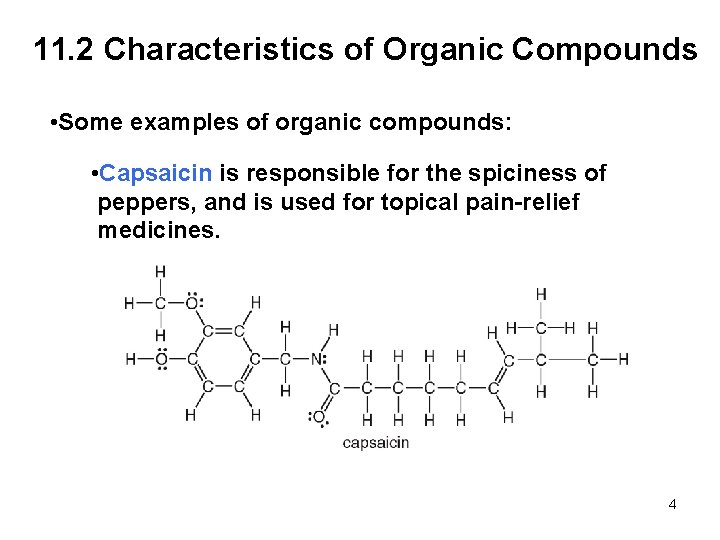
11. 2 Characteristics of Organic Compounds • Some examples of organic compounds: • Capsaicin is responsible for the spiciness of peppers, and is used for topical pain-relief medicines. 4
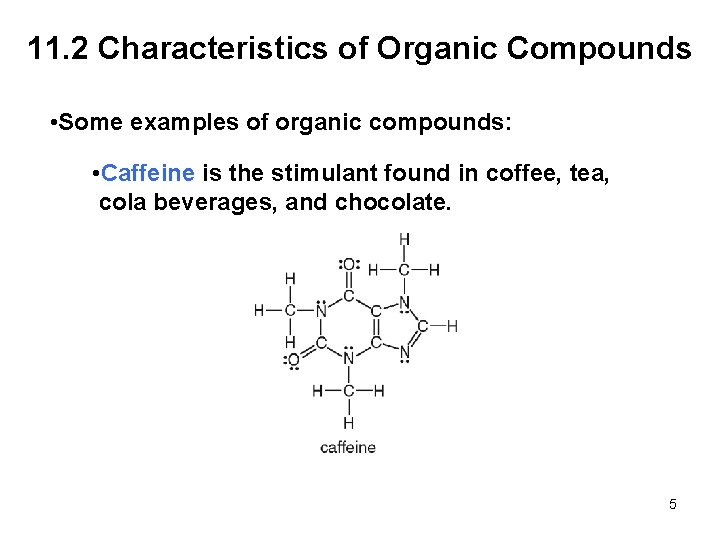
11. 2 Characteristics of Organic Compounds • Some examples of organic compounds: • Caffeine is the stimulant found in coffee, tea, cola beverages, and chocolate. 5
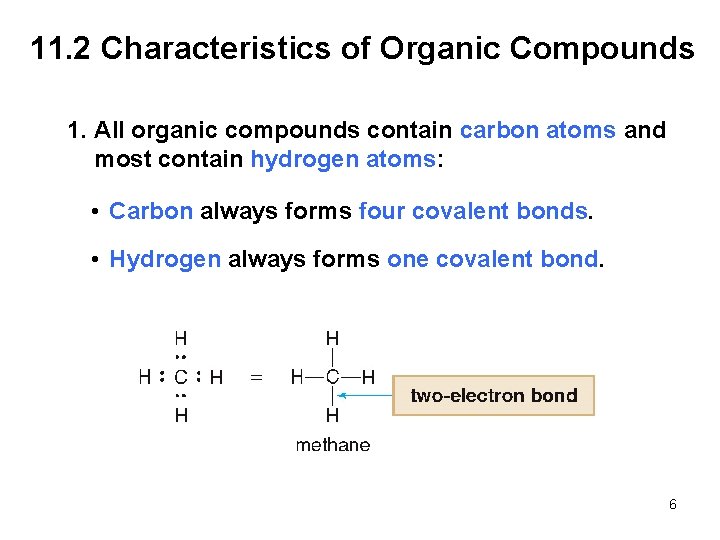
11. 2 Characteristics of Organic Compounds 1. All organic compounds contain carbon atoms and most contain hydrogen atoms: • Carbon always forms four covalent bonds. • Hydrogen always forms one covalent bond. 6
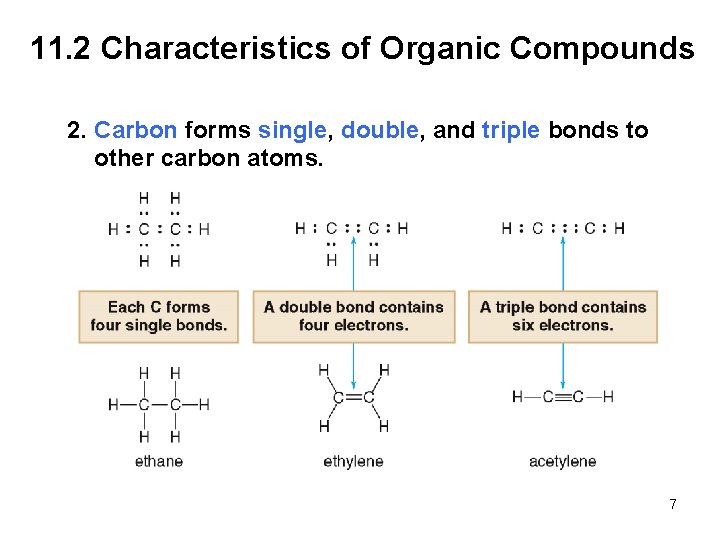
11. 2 Characteristics of Organic Compounds 2. Carbon forms single, double, and triple bonds to other carbon atoms. 7
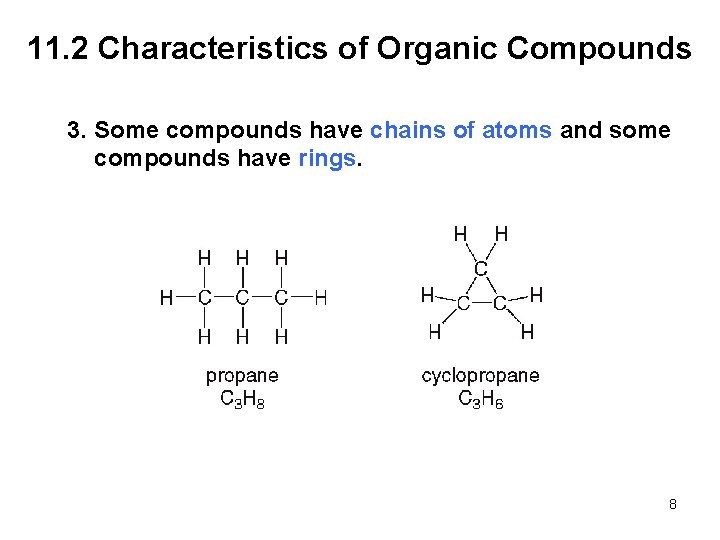
11. 2 Characteristics of Organic Compounds 3. Some compounds have chains of atoms and some compounds have rings. 8
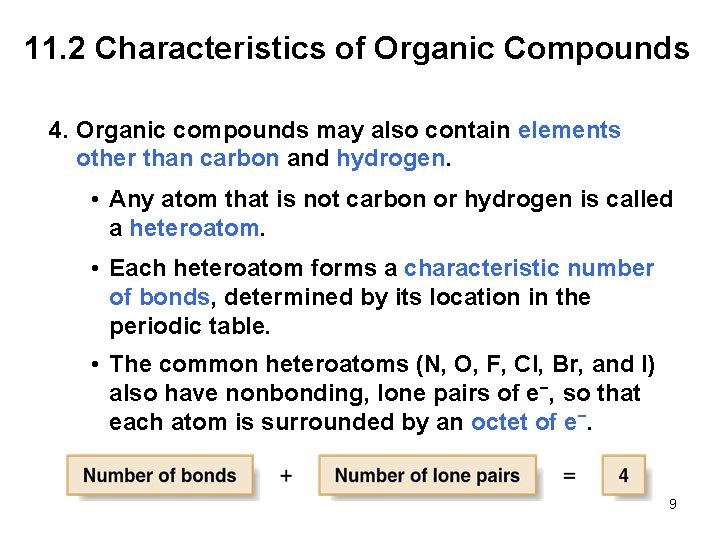
11. 2 Characteristics of Organic Compounds 4. Organic compounds may also contain elements other than carbon and hydrogen. • Any atom that is not carbon or hydrogen is called a heteroatom. • Each heteroatom forms a characteristic number of bonds, determined by its location in the periodic table. • The common heteroatoms (N, O, F, Cl, Br, and I) also have nonbonding, lone pairs of e−, so that each atom is surrounded by an octet of e−. 9
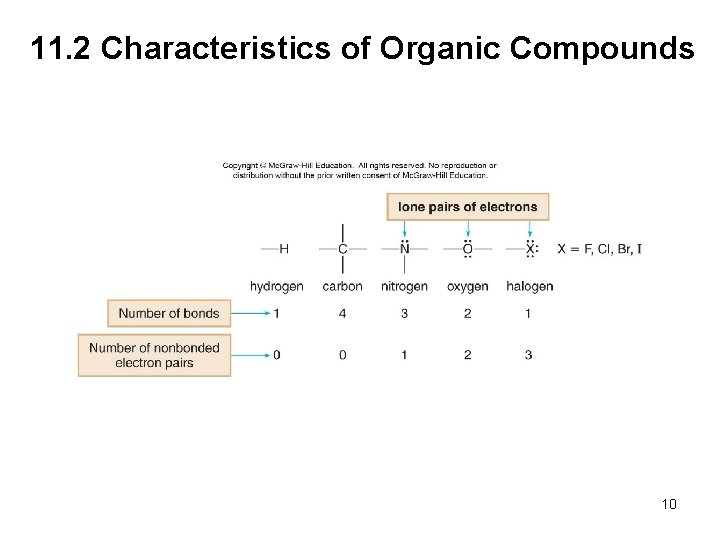
11. 2 Characteristics of Organic Compounds 10
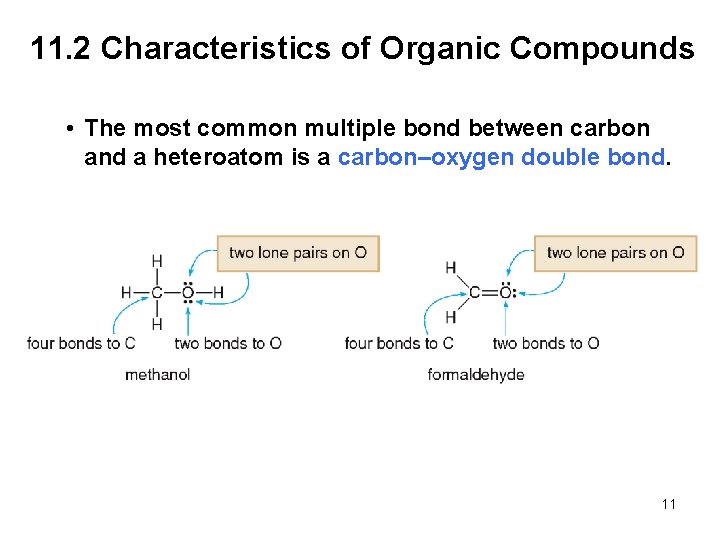
11. 2 Characteristics of Organic Compounds • The most common multiple bond between carbon and a heteroatom is a carbon–oxygen double bond. 11
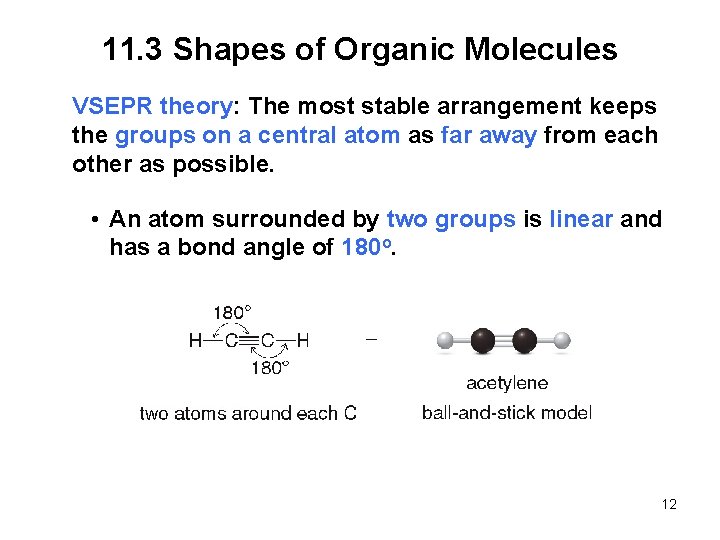
11. 3 Shapes of Organic Molecules VSEPR theory: The most stable arrangement keeps the groups on a central atom as far away from each other as possible. • An atom surrounded by two groups is linear and has a bond angle of 180 o. 12
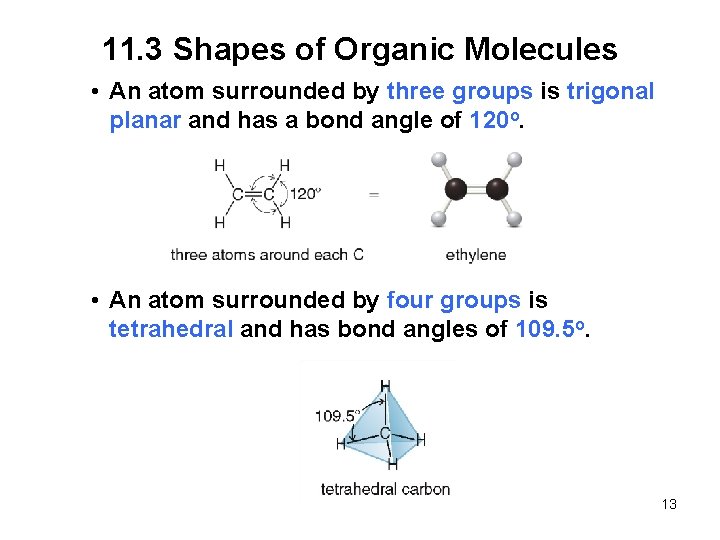
11. 3 Shapes of Organic Molecules • An atom surrounded by three groups is trigonal planar and has a bond angle of 120 o. • An atom surrounded by four groups is tetrahedral and has bond angles of 109. 5 o. 13
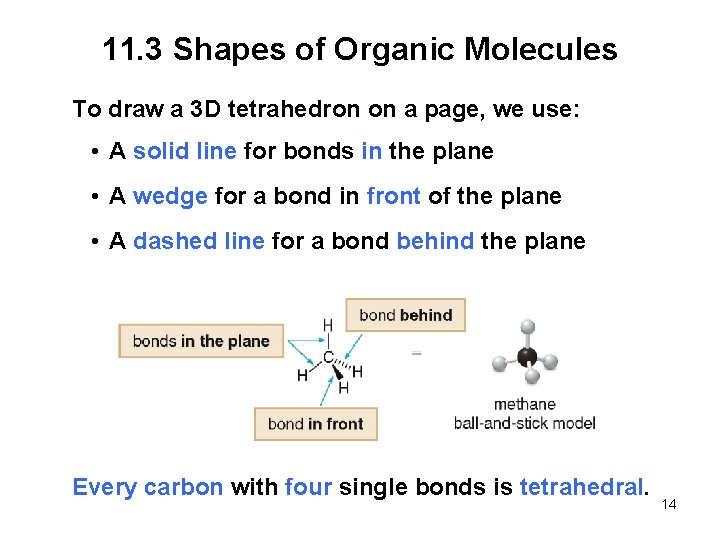
11. 3 Shapes of Organic Molecules To draw a 3 D tetrahedron on a page, we use: • A solid line for bonds in the plane • A wedge for a bond in front of the plane • A dashed line for a bond behind the plane Every carbon with four single bonds is tetrahedral. 14

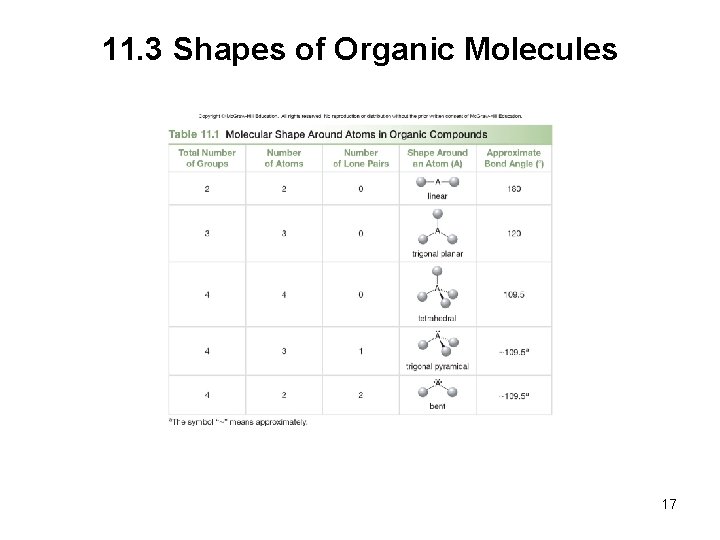
11. 3 Shapes of Organic Molecules • Nitrogen is attached to 3 atoms and has 1 lone pair, making its shape a trigonal pyramid. 15
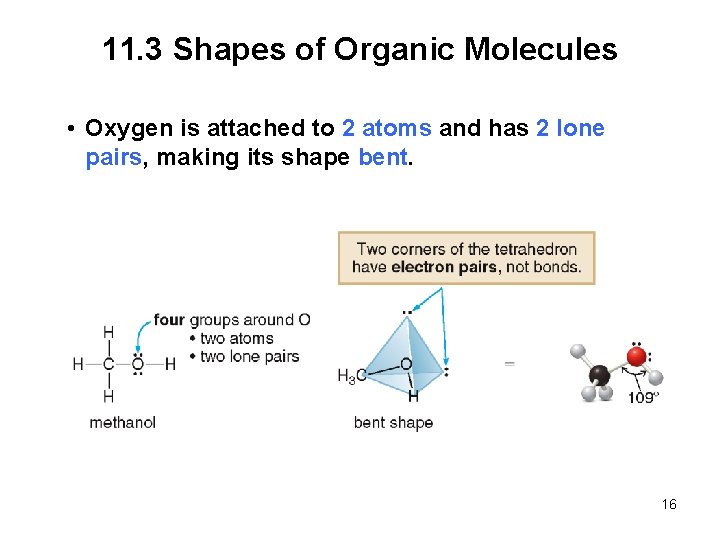
11. 3 Shapes of Organic Molecules • Oxygen is attached to 2 atoms and has 2 lone pairs, making its shape bent. 16
11. 3 Shapes of Organic Molecules 17

11. 4 Drawing Organic Molecules A. Condensed Structures In a condensed structure, all of the atoms are drawn in, but the two-electron bond lines and lone pairs on heteroatoms are generally omitted. • A carbon bonded to 3 H’s becomes CH 3. • A carbon bonded to 2 H’s becomes CH 2. 18
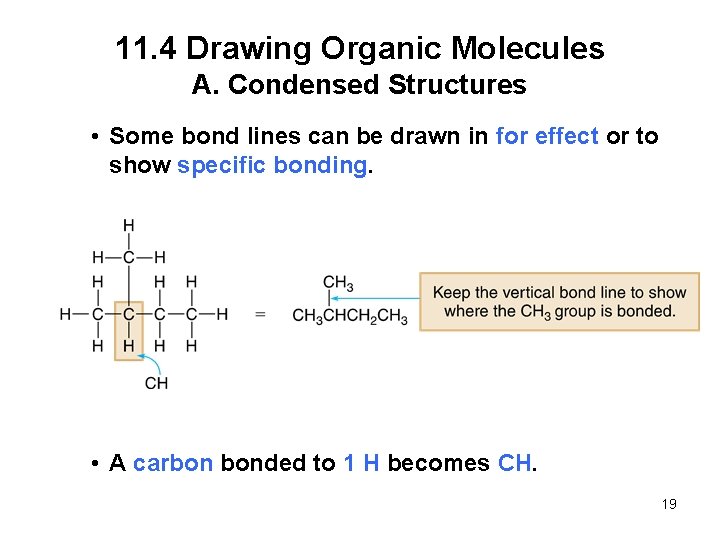
11. 4 Drawing Organic Molecules A. Condensed Structures • Some bond lines can be drawn in for effect or to show specific bonding. • A carbon bonded to 1 H becomes CH. 19

11. 4 Drawing Organic Molecules A. Condensed Structures • Identical groups can be condensed further: 20
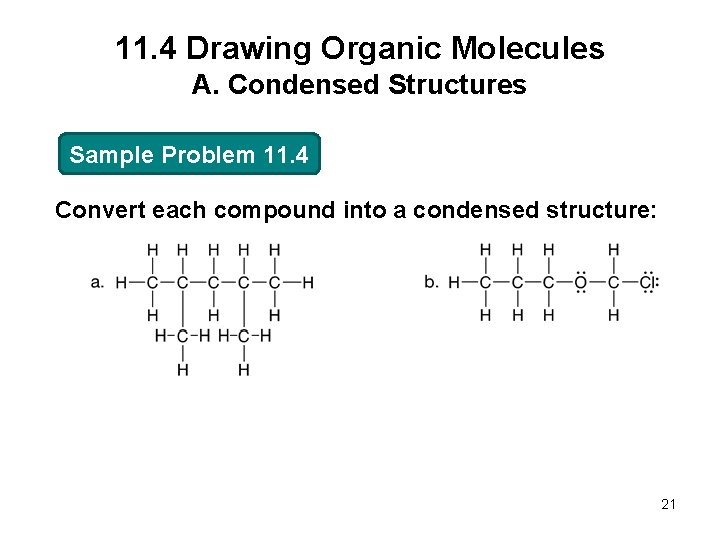
11. 4 Drawing Organic Molecules A. Condensed Structures Sample Problem 11. 4 Convert each compound into a condensed structure: 21
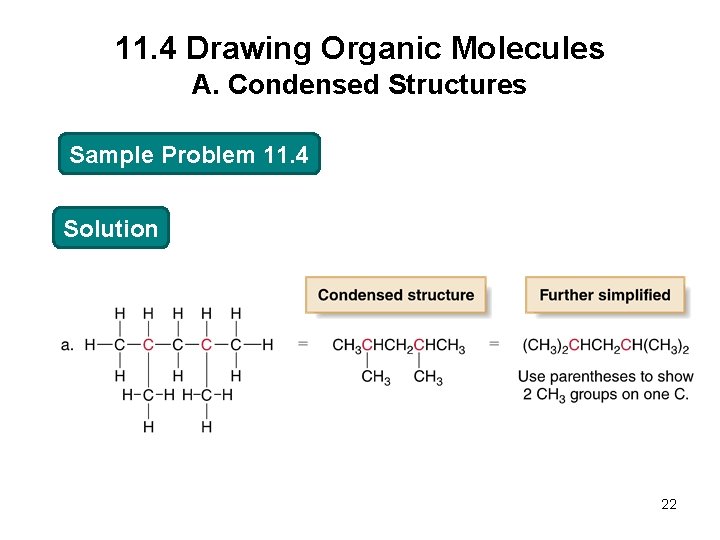
11. 4 Drawing Organic Molecules A. Condensed Structures Sample Problem 11. 4 Solution 22
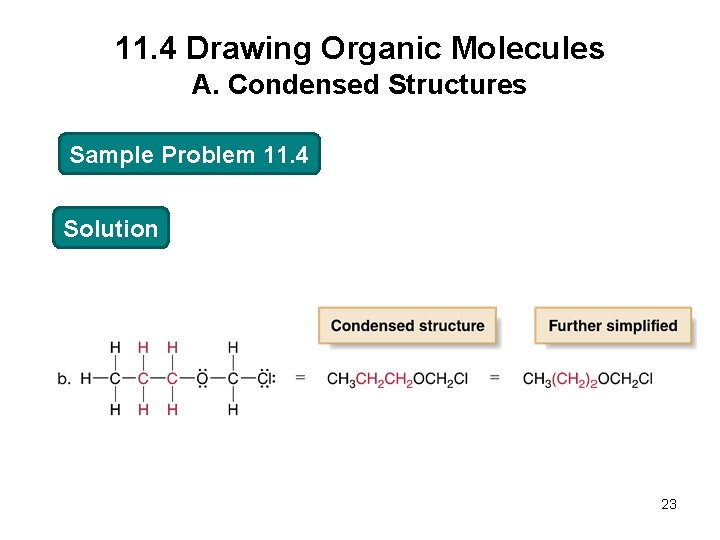
11. 4 Drawing Organic Molecules A. Condensed Structures Sample Problem 11. 4 Solution 23
11. 4 Drawing Organic Molecules B. Skeletal Structures When drawing a skeletal structure: • Assume there is a carbon atom at the junction of any two lines or at the end of any line • Assume there are enough hydrogens around each carbon to give it four bonds • Draw in all heteroatoms and the hydrogens directly bonded to them 24
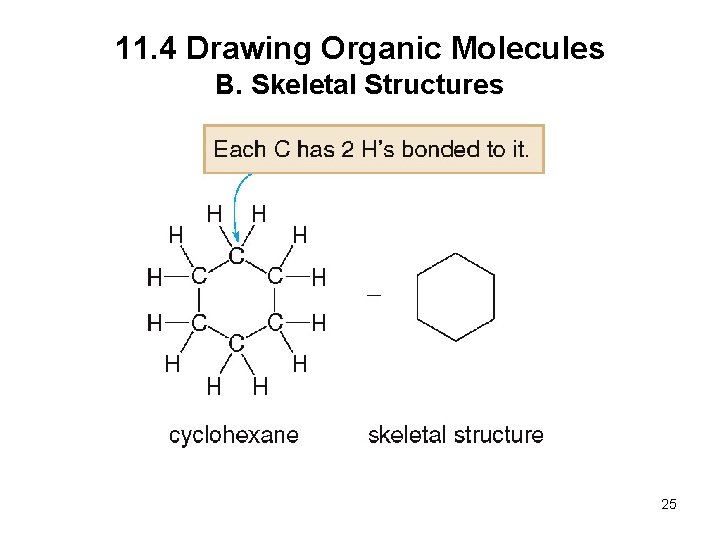
11. 4 Drawing Organic Molecules B. Skeletal Structures 25
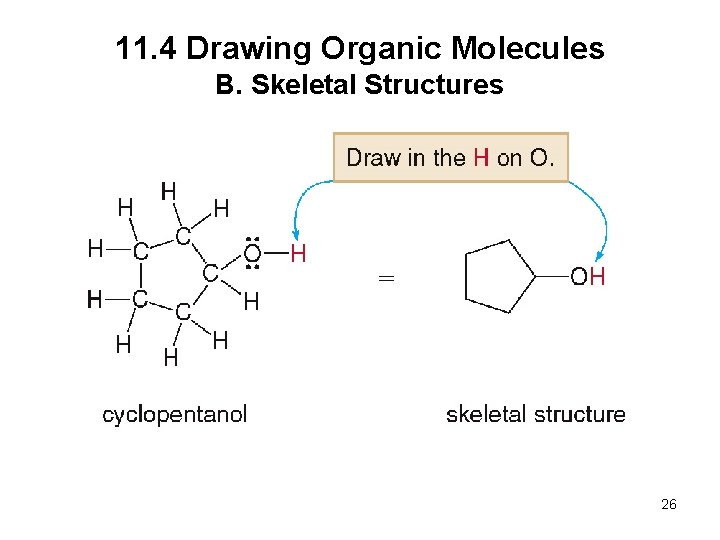
11. 4 Drawing Organic Molecules B. Skeletal Structures 26
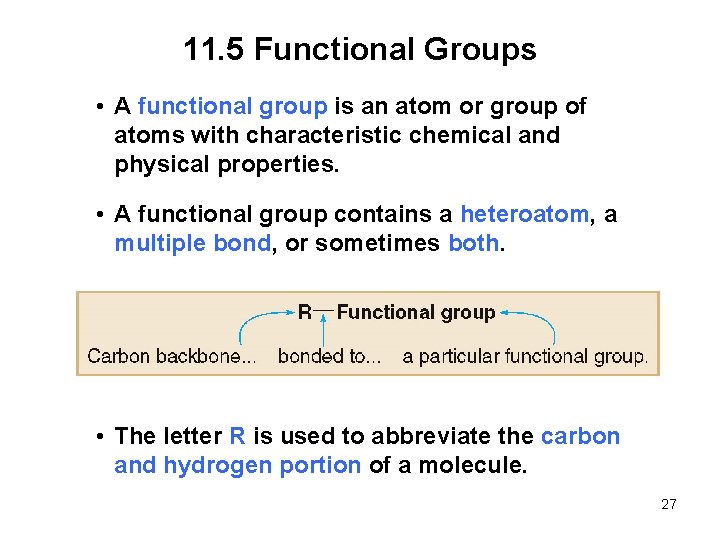
11. 5 Functional Groups • A functional group is an atom or group of atoms with characteristic chemical and physical properties. • A functional group contains a heteroatom, a multiple bond, or sometimes both. • The letter R is used to abbreviate the carbon and hydrogen portion of a molecule. 27
11. 5 Functional Groups A. Hydrocarbons are compounds that contain only carbon and hydrogen. • Alkanes have only C–C single bonds and no functional group. • Alkenes have a C–C double bond as their functional group. • Alkynes have a C–C triple bond as their functional group. • Aromatic hydrocarbons contain a benzene ring, a six-membered ring with three double bonds. 28
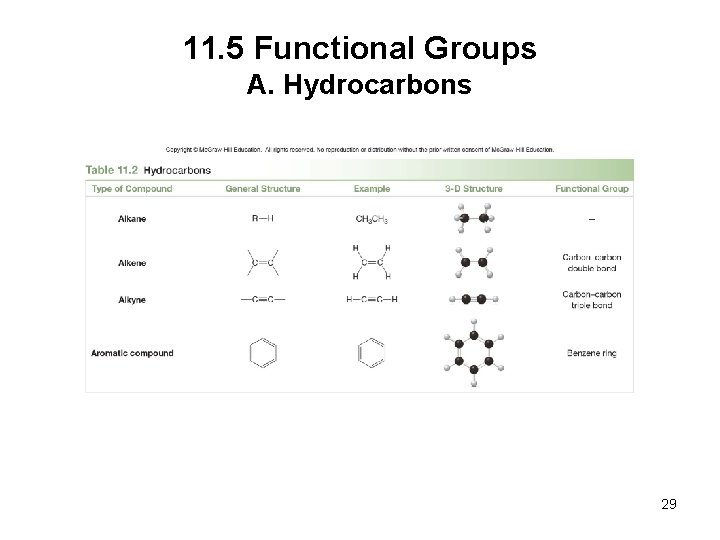
11. 5 Functional Groups A. Hydrocarbons 29
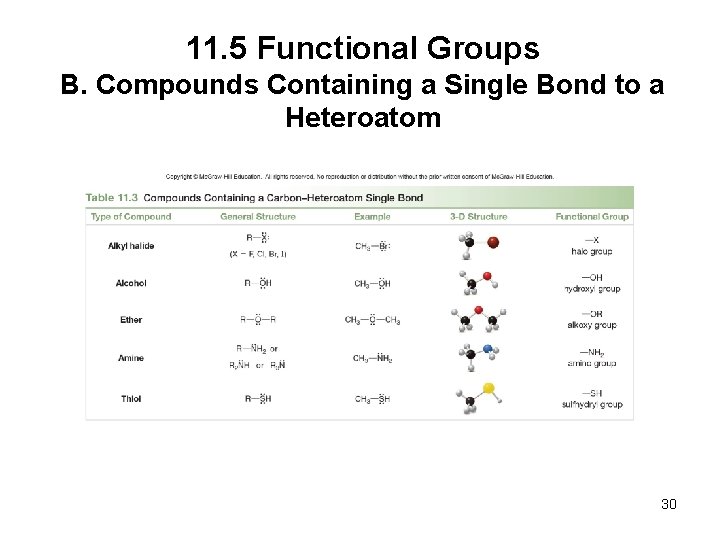
11. 5 Functional Groups B. Compounds Containing a Single Bond to a Heteroatom 30
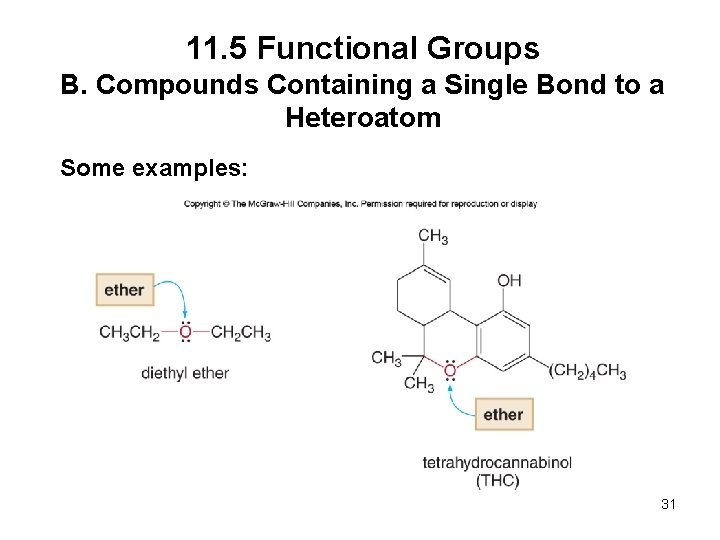
11. 5 Functional Groups B. Compounds Containing a Single Bond to a Heteroatom Some examples: 31
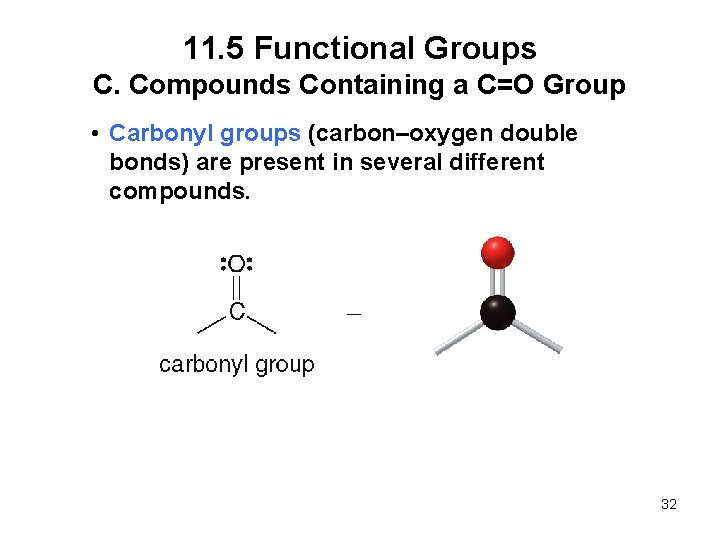
11. 5 Functional Groups C. Compounds Containing a C=O Group • Carbonyl groups (carbon–oxygen double bonds) are present in several different compounds. 32
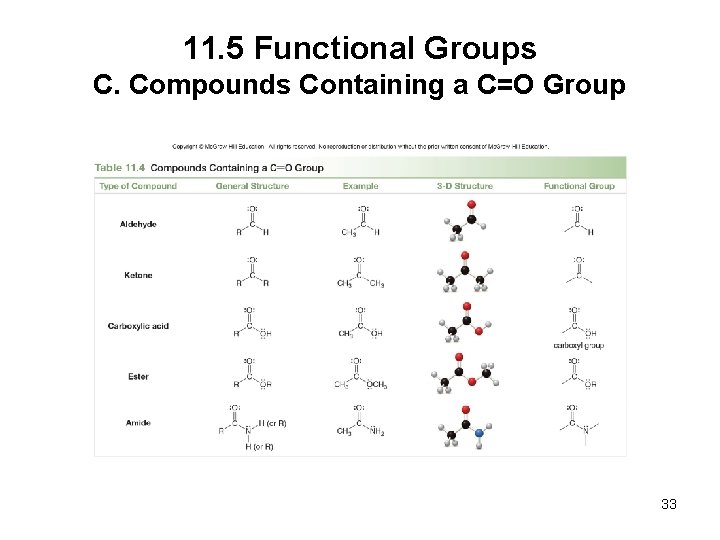
11. 5 Functional Groups C. Compounds Containing a C=O Group 33
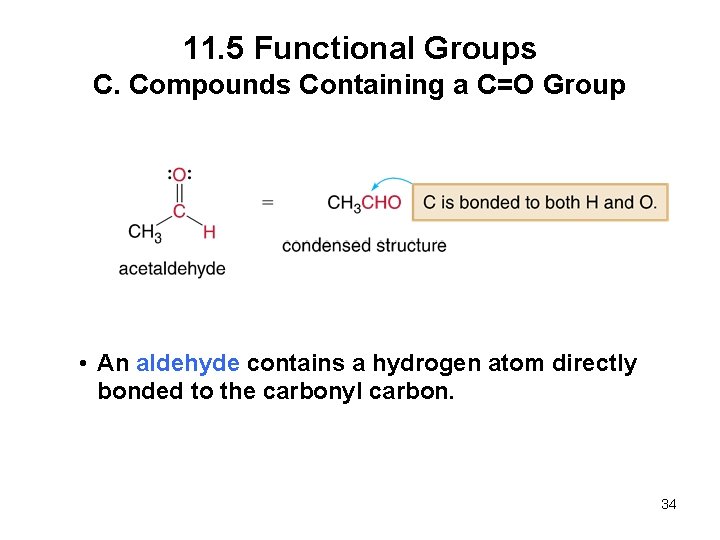
11. 5 Functional Groups C. Compounds Containing a C=O Group • An aldehyde contains a hydrogen atom directly bonded to the carbonyl carbon. 34
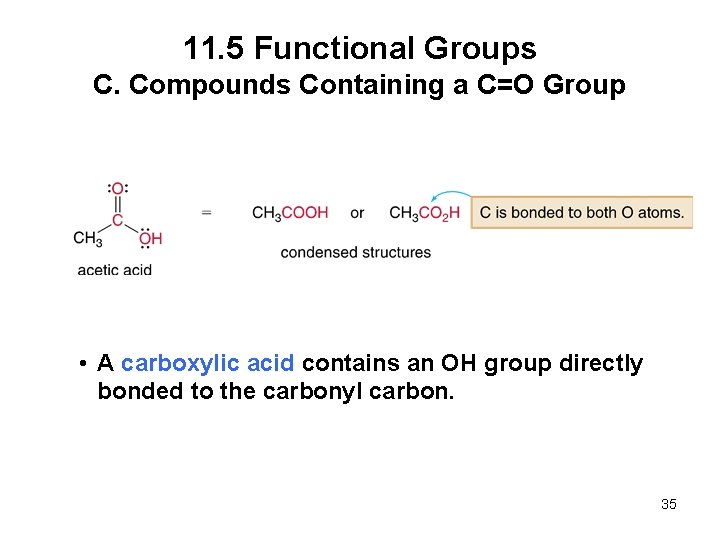
11. 5 Functional Groups C. Compounds Containing a C=O Group • A carboxylic acid contains an OH group directly bonded to the carbonyl carbon. 35
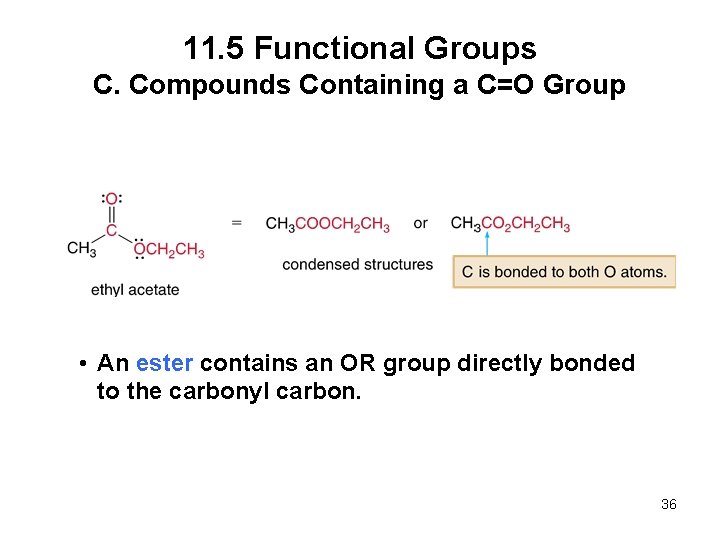
11. 5 Functional Groups C. Compounds Containing a C=O Group • An ester contains an OR group directly bonded to the carbonyl carbon. 36
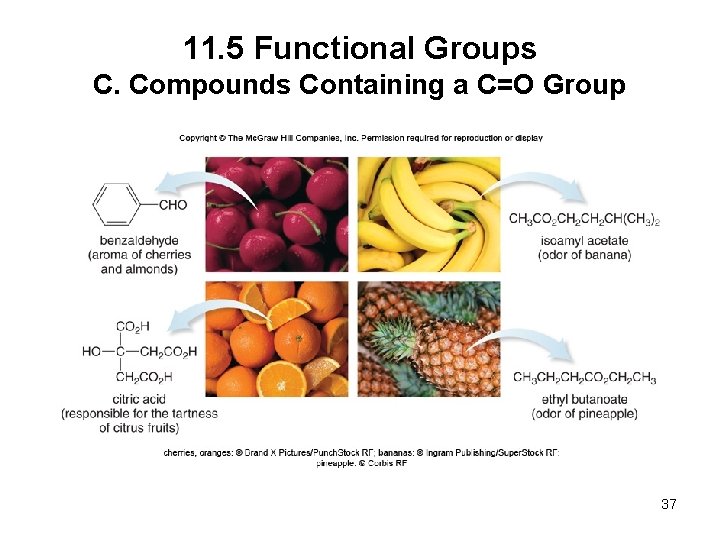
11. 5 Functional Groups C. Compounds Containing a C=O Group 37
11. 6 Properties of Organic Compounds • Organic compounds are composed of covalent bonds only. • Organic compounds exist as discrete molecules with much weaker intermolecular forces than those seen in ionic compounds. • As a result, organic compounds have lower boiling points and melting points than ionic compounds. • Organic compounds tend to be liquids or gases at room temperature, while ionic compounds are solids. 38
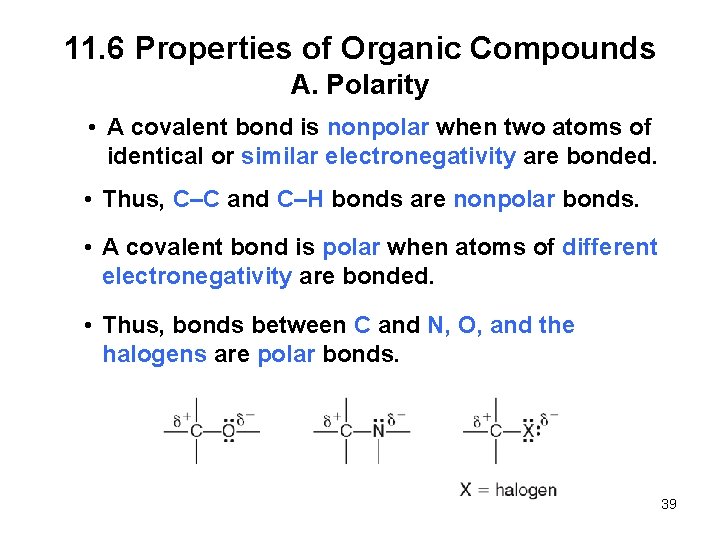
11. 6 Properties of Organic Compounds A. Polarity • A covalent bond is nonpolar when two atoms of identical or similar electronegativity are bonded. • Thus, C–C and C–H bonds are nonpolar bonds. • A covalent bond is polar when atoms of different electronegativity are bonded. • Thus, bonds between C and N, O, and the halogens are polar bonds. 39
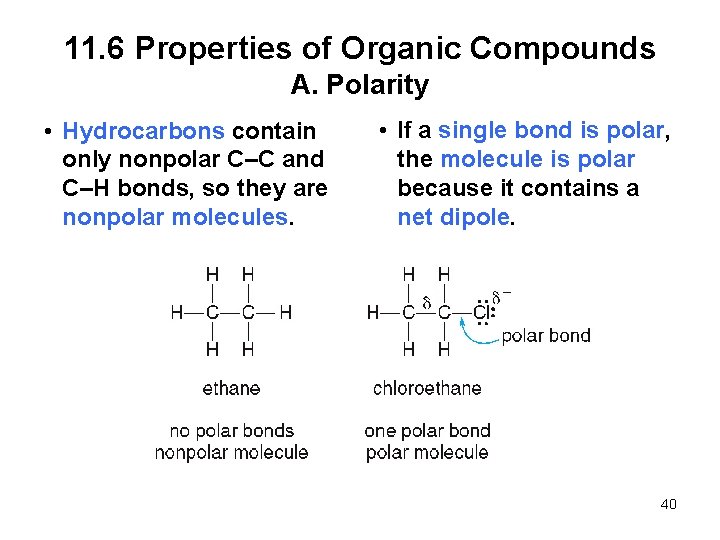
11. 6 Properties of Organic Compounds A. Polarity • Hydrocarbons contain only nonpolar C–C and C–H bonds, so they are nonpolar molecules. • If a single bond is polar, the molecule is polar because it contains a net dipole. 40

11. 6 Properties of Organic Compounds A. Polarity • If the individual polar bonds (dipoles) cancel in a molecule, the molecule is nonpolar. • If the individual bond dipoles do not cancel, the molecule is polar. 41
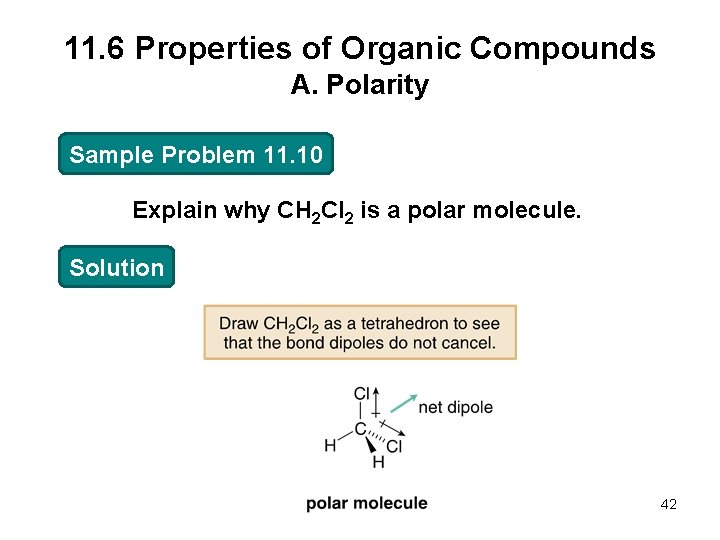
11. 6 Properties of Organic Compounds A. Polarity Sample Problem 11. 10 Explain why CH 2 Cl 2 is a polar molecule. Solution 42
11. 6 Properties of Organic Compounds B. Solubility • The rule of solubility is “like dissolves like. ” • Most organic compounds are soluble in organic solvents. • Hydrocarbons and other nonpolar organic compounds are insoluble in water. • Polar organic compounds are water soluble only if they are small and contain a N or O atom that can hydrogen bond with water. 43
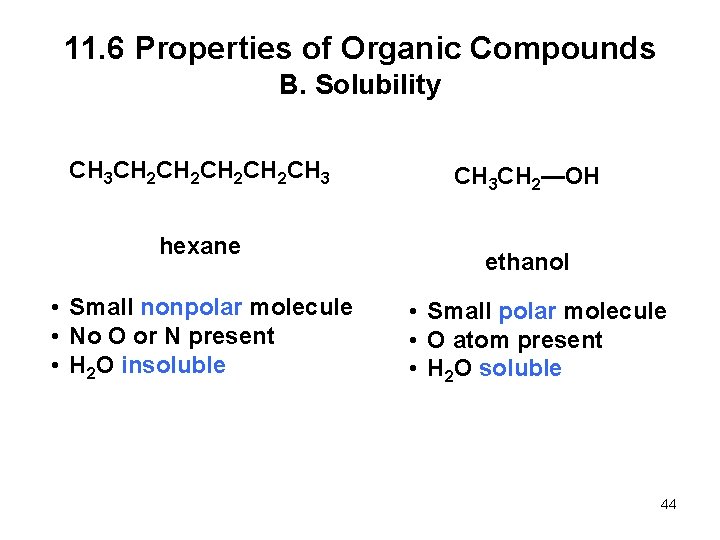
11. 6 Properties of Organic Compounds B. Solubility CH 3 CH 2 CH 2 CH 3 hexane • Small nonpolar molecule • No O or N present • H 2 O insoluble CH 3 CH 2—OH ethanol • Small polar molecule • O atom present • H 2 O soluble 44
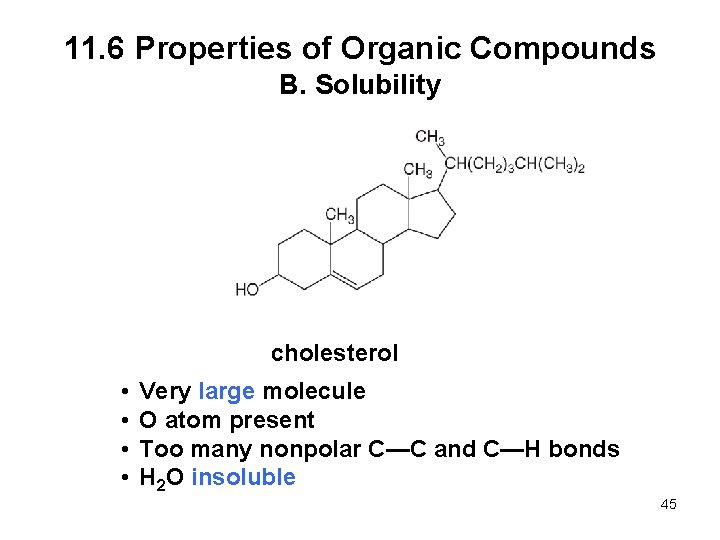
11. 6 Properties of Organic Compounds B. Solubility cholesterol • • Very large molecule O atom present Too many nonpolar C—C and C—H bonds H 2 O insoluble 45
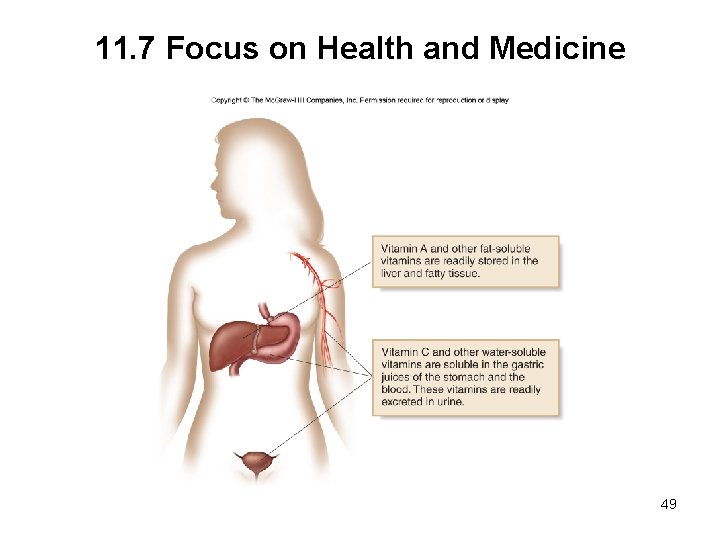
11. 7 Focus on Health and Medicine Vitamins are organic compounds needed in small amounts for normal cell function. • The body cannot synthesize these compounds; they must be obtained in the diet. • A fat-soluble vitamin dissolves in an organic solvent but is insoluble in water. • Fat-soluble vitamins have many nonpolar C–C and C–H bonds and few polar functional groups. • A water-soluble vitamin dissolves in water. • Water-soluble vitamins have many polar bonds. 46
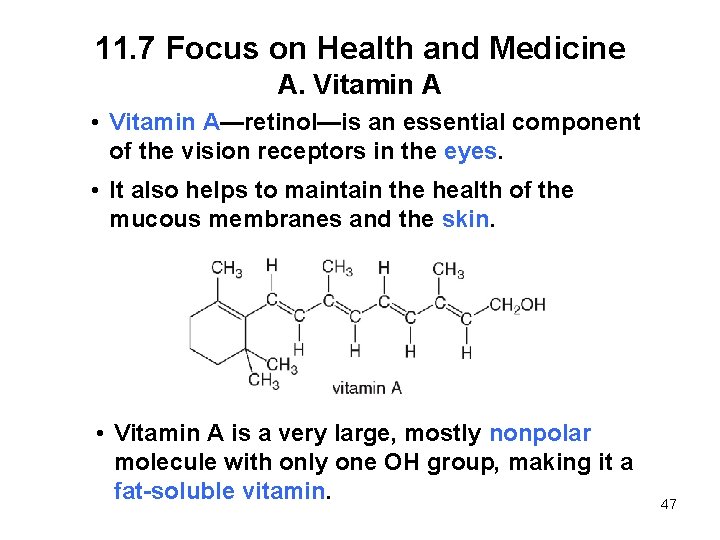
11. 7 Focus on Health and Medicine A. Vitamin A • Vitamin A—retinol—is an essential component of the vision receptors in the eyes. • It also helps to maintain the health of the mucous membranes and the skin. • Vitamin A is a very large, mostly nonpolar molecule with only one OH group, making it a fat-soluble vitamin. 47
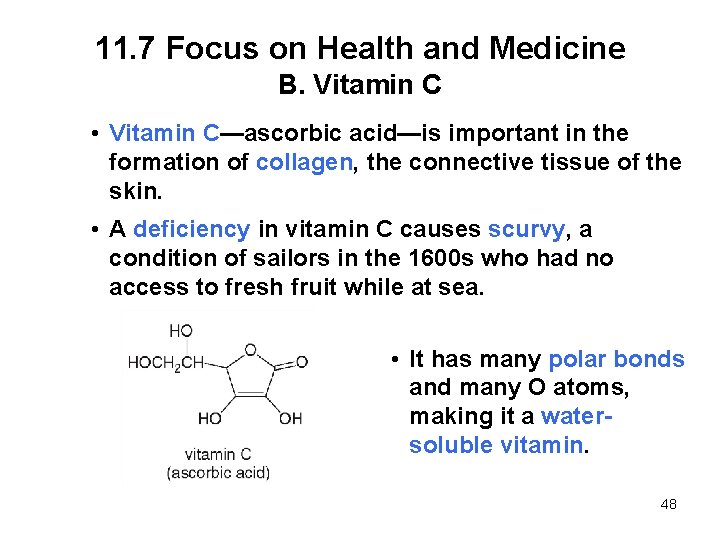
11. 7 Focus on Health and Medicine B. Vitamin C • Vitamin C—ascorbic acid—is important in the formation of collagen, the connective tissue of the skin. • A deficiency in vitamin C causes scurvy, a condition of sailors in the 1600 s who had no access to fresh fruit while at sea. • It has many polar bonds and many O atoms, making it a watersoluble vitamin. 48
11. 7 Focus on Health and Medicine 49
- Slides: 49