
Chapter 11 Keys Couplings and Seals 11 1










- Slides: 37
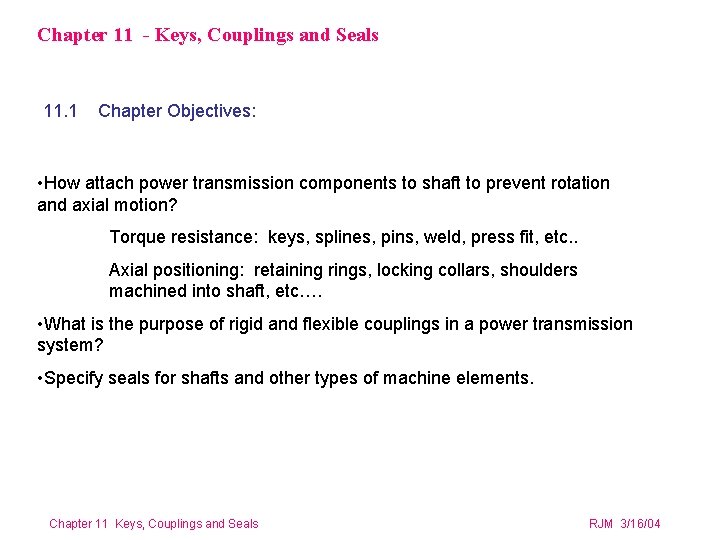
Chapter 11 - Keys, Couplings and Seals 11. 1 Chapter Objectives: • How attach power transmission components to shaft to prevent rotation and axial motion? Torque resistance: keys, splines, pins, weld, press fit, etc. . Axial positioning: retaining rings, locking collars, shoulders machined into shaft, etc…. • What is the purpose of rigid and flexible couplings in a power transmission system? • Specify seals for shafts and other types of machine elements. Chapter 11 Keys, Couplings and Seals RJM 3/16/04
11. 2 Keys Most common for shafts up to 6. 5” is the square and rectangular keys: Advantages: 1. Cost effective means of locking the 2. Can replace damaged component 3. Ease of installation 4. Can use key as “fuse” – fails in shear at some predetermined torque to avoid damaging drive train. Figure 11. 1 Chapter 11 Keys, Couplings and Seals RJM 3/16/04
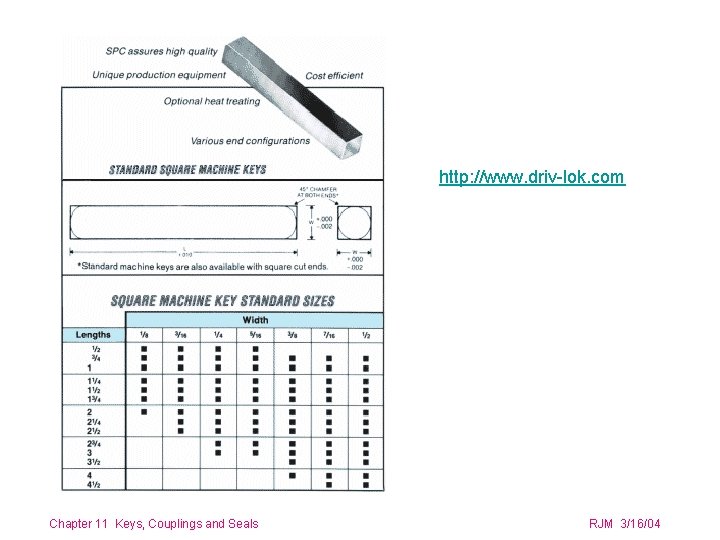
Square and rectangular keys: Step 1 – Determine key size based on shaft diameter Step 2 – Calculate required length, L, based on torque (11. 4) Chapter 11 Keys, Couplings and Seals RJM 3/16/04
Step 3 – Specify appropriate shaft and bore dimensions for keyseat: See Figure 11. 2 For 5/16” key SHAFT BORE Note, should also specify fillet radii and key chamfers – see Table 11 -2 Chapter 11 Keys, Couplings and Seals RJM 3/16/04
http: //www. driv-lok. com Chapter 11 Keys, Couplings and Seals RJM 3/16/04
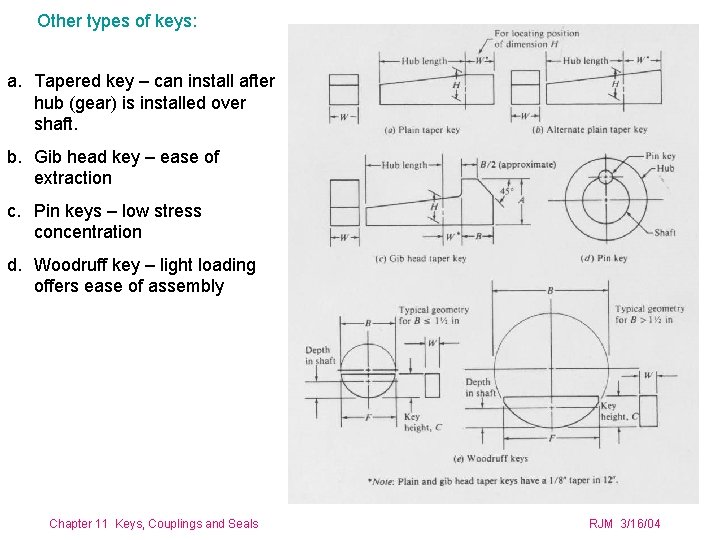
Other types of keys: a. Tapered key – can install after hub (gear) is installed over shaft. b. Gib head key – ease of extraction c. Pin keys – low stress concentration d. Woodruff key – light loading offers ease of assembly Chapter 11 Keys, Couplings and Seals RJM 3/16/04
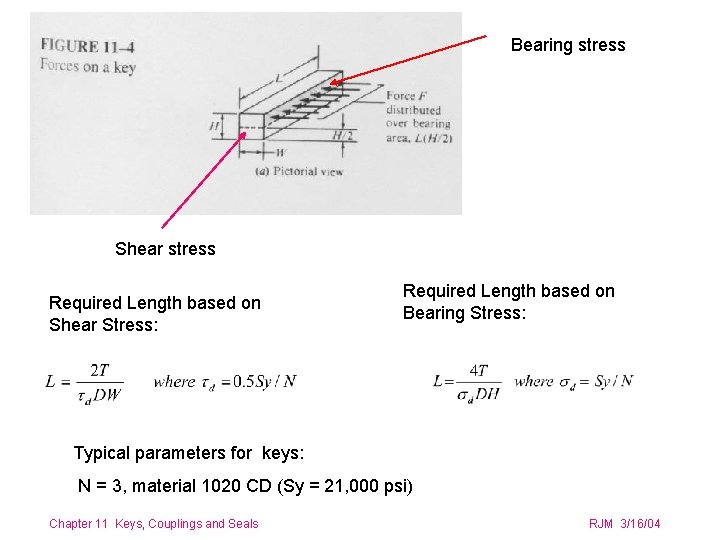
11. 4 Design of Keys – stress analysis to determine required length: = Torque being transmitted No load T = F/(D/2) or F = T/(D/2) this is the force the key must react!!! Chapter 11 Keys, Couplings and Seals RJM 3/16/04
Bearing stress Shear stress Required Length based on Shear Stress: Required Length based on Bearing Stress: Typical parameters for keys: N = 3, material 1020 CD (Sy = 21, 000 psi) Chapter 11 Keys, Couplings and Seals RJM 3/16/04
Example: Specify the complete key geometry and material for an application requiring a gear (AISI OQT 1000) with a 4” hub to be mounted to a 3. 6” diameter shaft (AISI 1040 CD). The torque delivered through the system is 21, 000 lb-in. Assume the key material is 1020 CD (Sy = 21, 000 psi) and N = 3. Solution (note since key is weakest material, focus analysis on key!): See handout Chapter 11 Keys, Couplings and Seals RJM 3/16/04
11. 4 Splines Advantages: • Can carry higher torque for given diameter (vs keys) or • Lower stress on attachment (gear) • Better fit, less vibration (spline integral to shaft so no vibrating key) • May allow axial motion while reacting torque Disadvantage: • Cost • Impractical to use as fuse Chapter 11 Keys, Couplings and Seals RJM 3/16/04
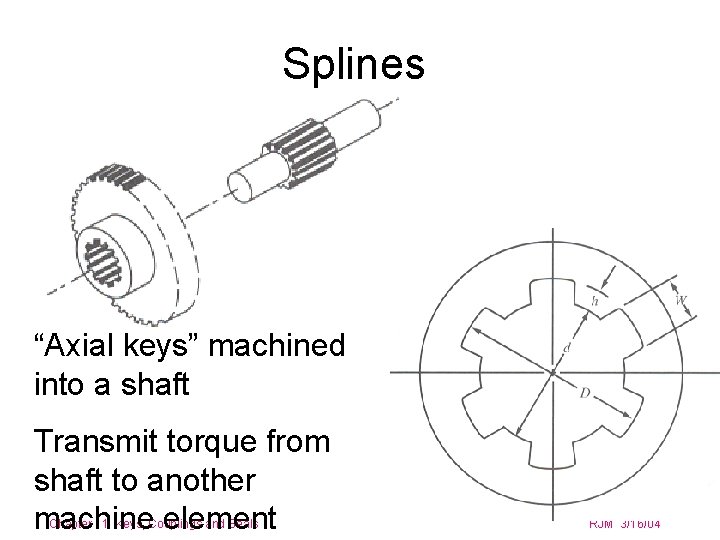
Splines “Axial keys” machined into a shaft Transmit torque from shaft to another machine element Chapter 11 Keys, Couplings and Seals RJM 3/16/04
Advantages • Uniform transfer of torque • Lower loading on elements • No relative motion between “key” and shaft • Axial motion can be accommodated (can cause fretting and corrosion) • Mating element can be indexed with a spline • Generally hardened to resist wear Chapter 11 Keys, Couplings and Seals RJM 3/16/04
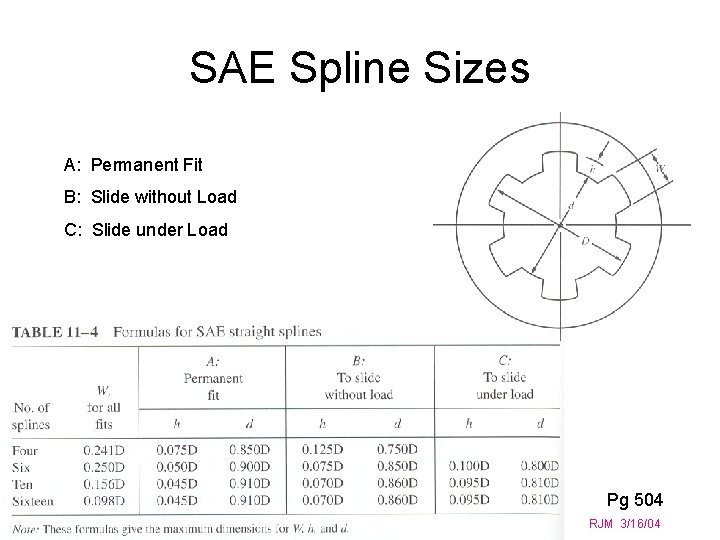
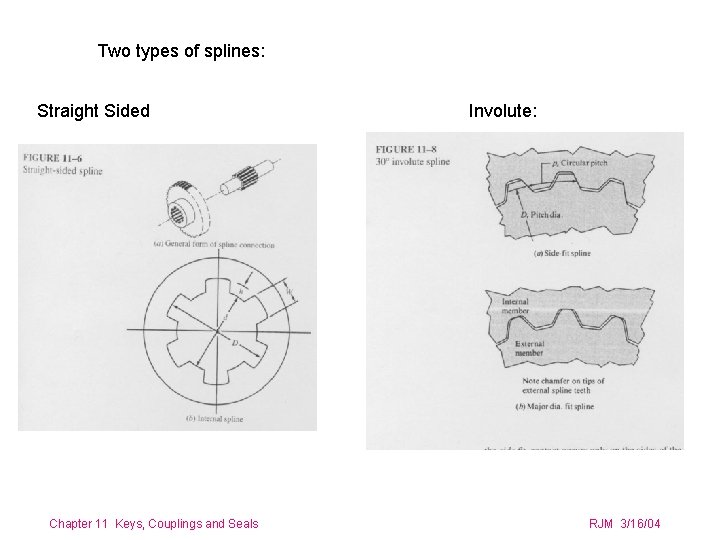
Spline Types • Straight – SAE – 4, 6, 10 or 16 splines • Involute – Pressure angles of 30, 37. 5, or 45 deg. – Tend to center shafts for better concentricity Chapter 11 Keys, Couplings and Seals RJM 3/16/04
SAE Spline Sizes A: Permanent Fit B: Slide without Load C: Slide under Load Pg 504 Chapter 11 Keys, Couplings and Seals RJM 3/16/04
Two types of splines: Straight Sided Chapter 11 Keys, Couplings and Seals Involute: RJM 3/16/04
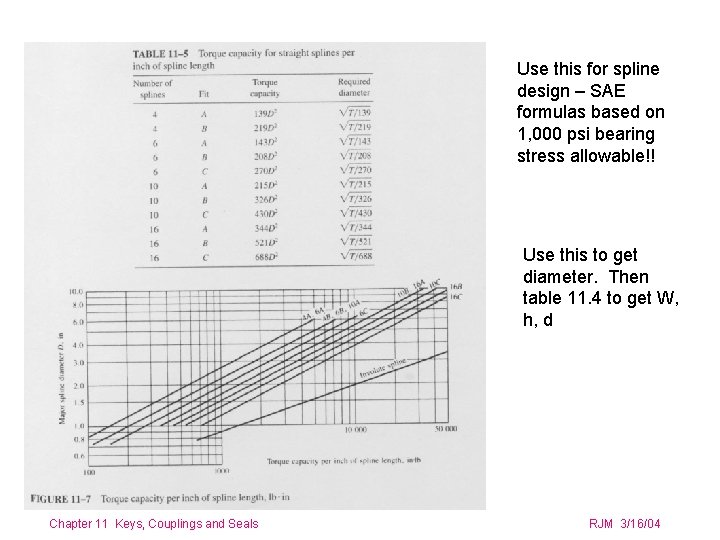
Use this for spline design – SAE formulas based on 1, 000 psi bearing stress allowable!! Use this to get diameter. Then table 11. 4 to get W, h, d Chapter 11 Keys, Couplings and Seals RJM 3/16/04
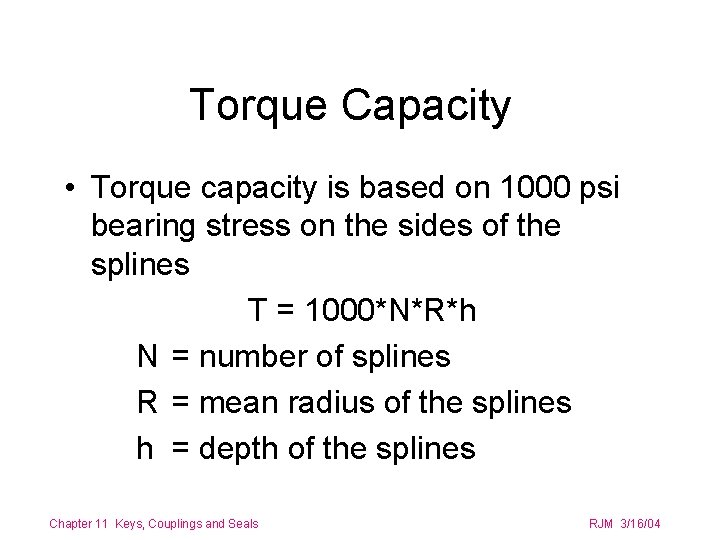
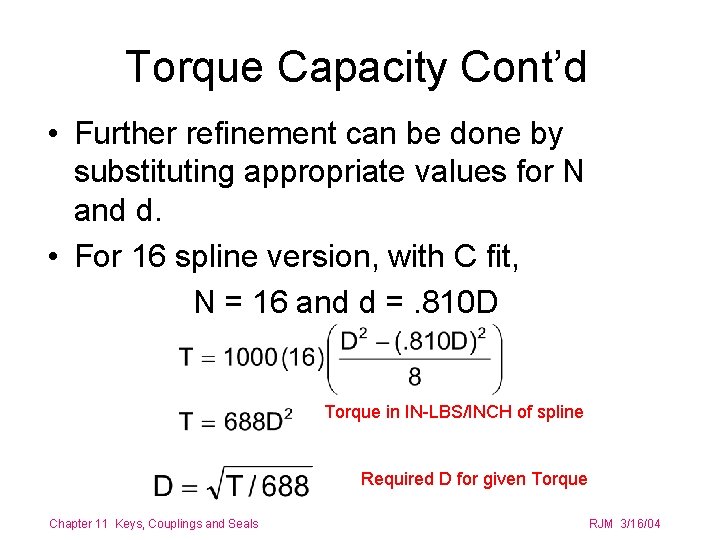
Torque Capacity • Torque capacity is based on 1000 psi bearing stress on the sides of the splines T = 1000*N*R*h N = number of splines R = mean radius of the splines h = depth of the splines Chapter 11 Keys, Couplings and Seals RJM 3/16/04
Torque Capacity Cont’d Substituting R and h into torque equation: Chapter 11 Keys, Couplings and Seals RJM 3/16/04
Torque Capacity Cont’d • Further refinement can be done by substituting appropriate values for N and d. • For 16 spline version, with C fit, N = 16 and d =. 810 D Torque in IN-LBS/INCH of spline Required D for given Torque Chapter 11 Keys, Couplings and Seals RJM 3/16/04
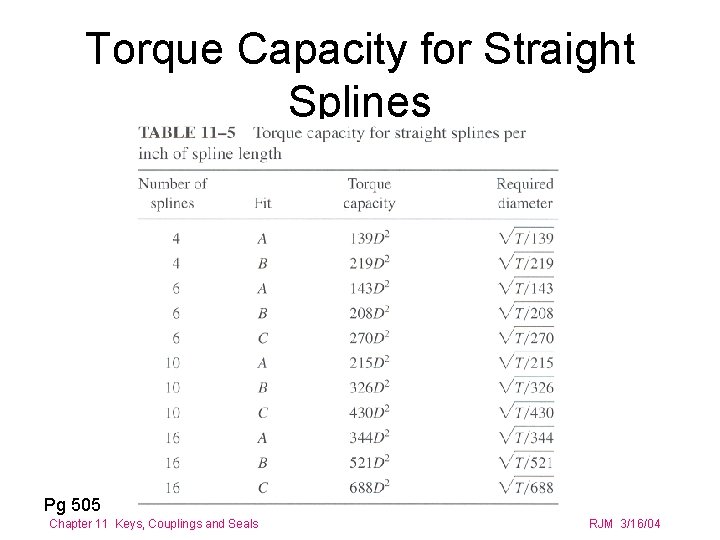
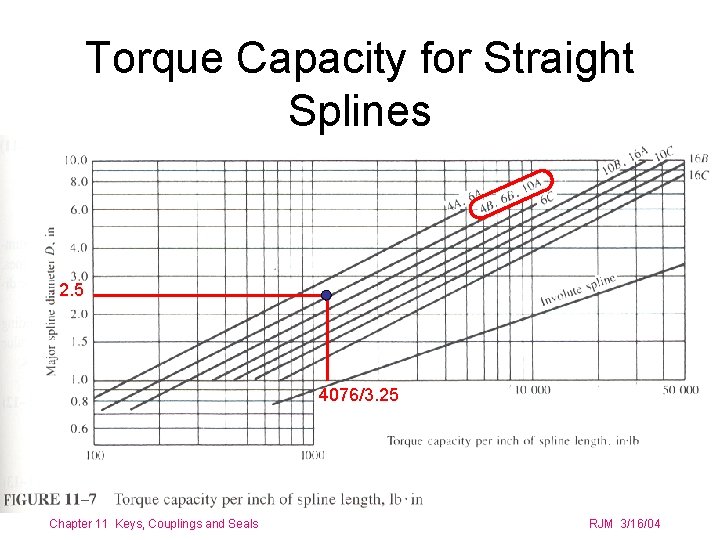
Torque Capacity for Straight Splines Pg 505 Chapter 11 Keys, Couplings and Seals RJM 3/16/04
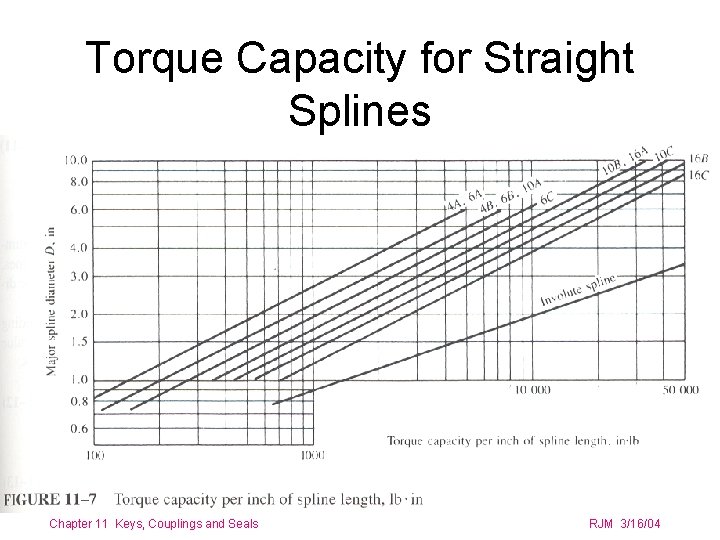
Torque Capacity for Straight Splines Chapter 11 Keys, Couplings and Seals RJM 3/16/04
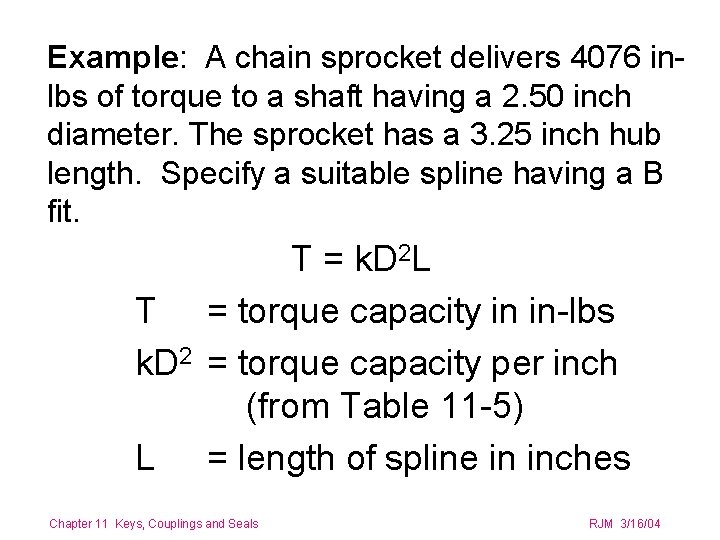
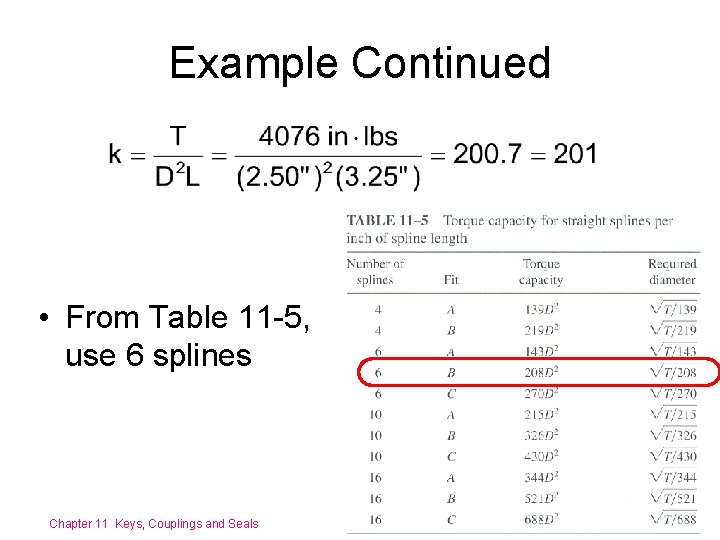
Example: A chain sprocket delivers 4076 inlbs of torque to a shaft having a 2. 50 inch diameter. The sprocket has a 3. 25 inch hub length. Specify a suitable spline having a B fit. T = k. D 2 L T = torque capacity in in-lbs k. D 2 = torque capacity per inch (from Table 11 -5) L = length of spline in inches Chapter 11 Keys, Couplings and Seals RJM 3/16/04
Example Continued • From Table 11 -5, use 6 splines Chapter 11 Keys, Couplings and Seals RJM 3/16/04
Torque Capacity for Straight Splines 2. 5 4076/3. 25 Chapter 11 Keys, Couplings and Seals RJM 3/16/04
Example: Specify straight spline for the previous problem (i. e. Torque = 21, 000 lb-in and shaft is 3. 6 in diameter. Chapter 11 Keys, Couplings and Seals RJM 3/16/04
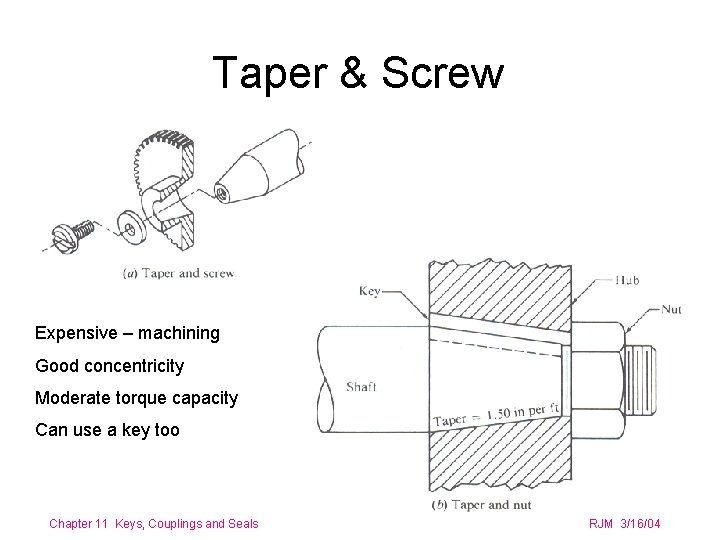
Taper & Screw Expensive – machining Good concentricity Moderate torque capacity Can use a key too Chapter 11 Keys, Couplings and Seals RJM 3/16/04
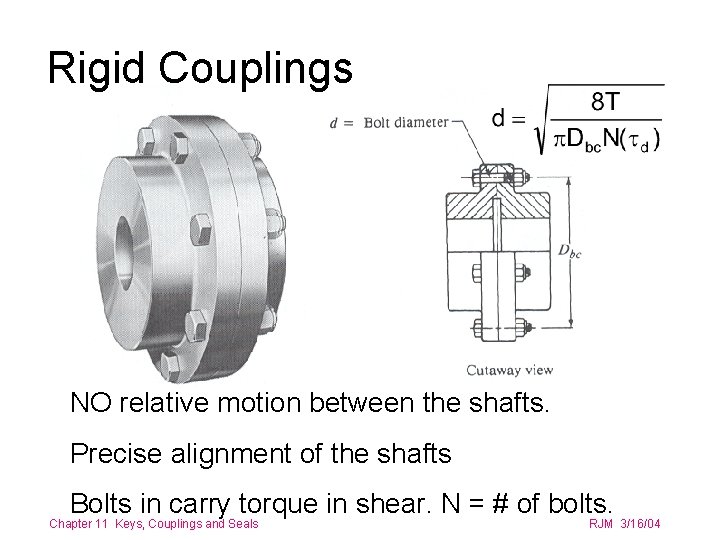
Couplings • Used to connect two shafts together at their ends to transmit torque from one to the other. • Two kinds of couplings: – RIGID – FLEXIBLE Chapter 11 Keys, Couplings and Seals RJM 3/16/04
Rigid Couplings NO relative motion between the shafts. Precise alignment of the shafts Bolts in carry torque in shear. N = # of bolts. Chapter 11 Keys, Couplings and Seals RJM 3/16/04
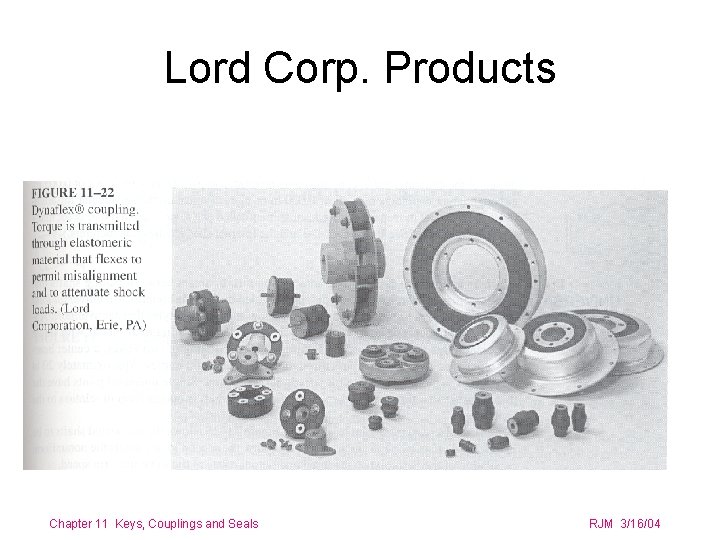
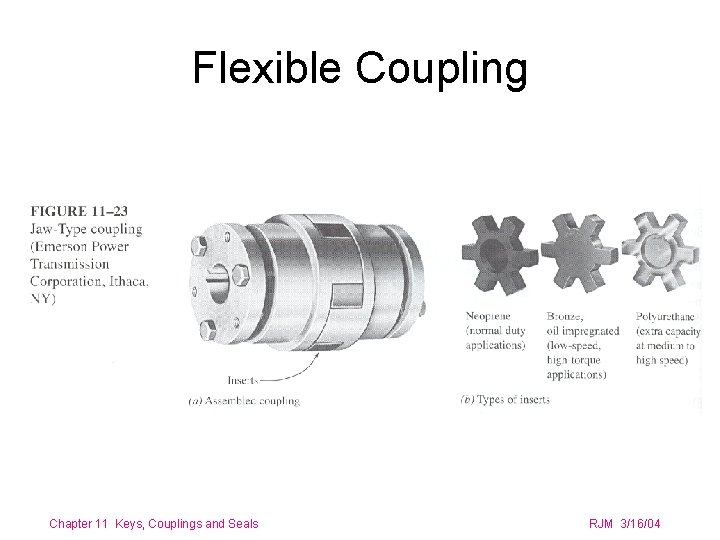
Flexible Couplings • Transmit torque smoothly • Permit some axial, radial and angular misalignment Chapter 11 Keys, Couplings and Seals RJM 3/16/04
Flexible Couplings Chapter 11 Keys, Couplings and Seals RJM 3/16/04
Flexible Couplings Chapter 11 Keys, Couplings and Seals RJM 3/16/04
Lord Corp. Products Chapter 11 Keys, Couplings and Seals RJM 3/16/04
Flexible Coupling Chapter 11 Keys, Couplings and Seals RJM 3/16/04
Universal Joints Large shaft misalignments permissible Key factors in selection are Torque, Angular Speed and the Operating Angle Output not uniform wrt input Chapter 11 Keys, Couplings and Seals Output IS uniform wrt input RJM 3/16/04
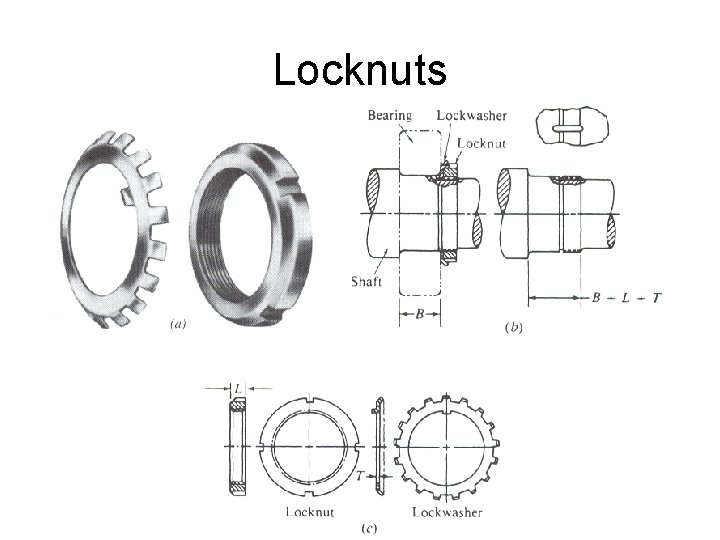
Axial Constraint Methods Spacers Retaining ring Chapter 11 Keys, Couplings and Seals Shoulders RJM 3/16/04
Retaining Rings Chapter 11 Keys, Couplings and Seals RJM 3/16/04
Locknuts Chapter 11 Keys, Couplings and Seals RJM 3/16/04