
Chapter 11 Introduction to Organic Chemistry Hydrocarbons Firefighters
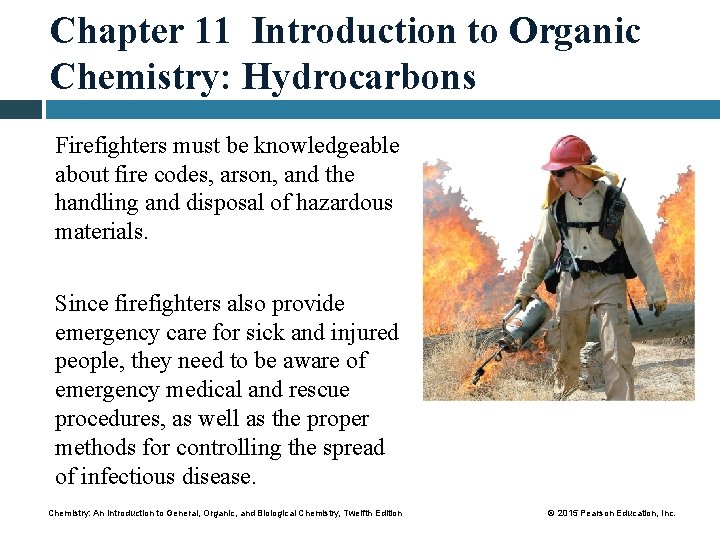
Chapter 11 Introduction to Organic Chemistry: Hydrocarbons Firefighters must be knowledgeable about fire codes, arson, and the handling and disposal of hazardous materials. Since firefighters also provide emergency care for sick and injured people, they need to be aware of emergency medical and rescue procedures, as well as the proper methods for controlling the spread of infectious disease. Chemistry: An Introduction to General, Organic, and Biological Chemistry, Twelfth Edition © 2015 Pearson Education, Inc.
Chapter 11 Readiness Core Chemistry Skills • Drawing Electron-Dot Formulas (6. 5) • Predicting Shape (6. 7) • Balancing a Chemical Equation (7. 3) Chemistry: An Introduction to General, Organic, and Biological Chemistry, Twelfth Edition © 2015 Pearson Education, Inc.
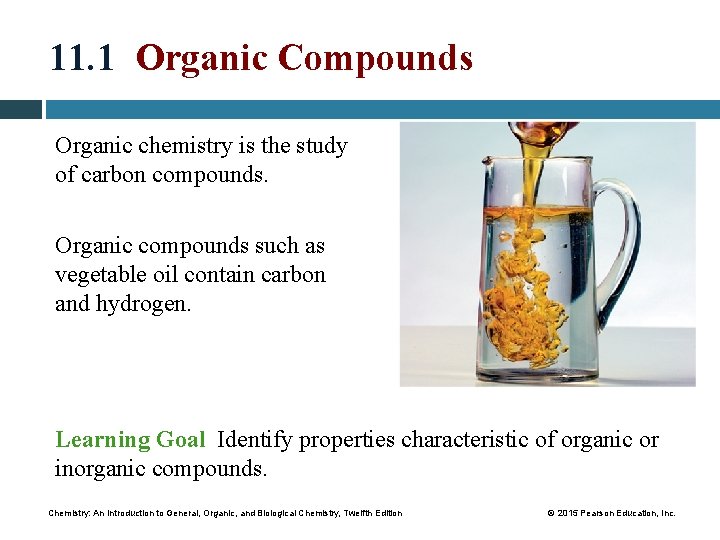
11. 1 Organic Compounds Organic chemistry is the study of carbon compounds. Organic compounds such as vegetable oil contain carbon and hydrogen. Learning Goal Identify properties characteristic of organic or inorganic compounds. Chemistry: An Introduction to General, Organic, and Biological Chemistry, Twelfth Edition © 2015 Pearson Education, Inc.
Organic Compounds An organic compound • is a compound made from carbon and hydrogen atoms • may also contain other nonmetals such as oxygen, sulfur, nitrogen, phosphorus, or a halogen • is often found in common products such as gasoline, medicines, shampoos, plastics, and perfumes The formulas of organic compounds are written with carbon first, followed by hydrogen, and then any other elements. Chemistry: An Introduction to General, Organic, and Biological Chemistry, Twelfth Edition © 2015 Pearson Education, Inc.
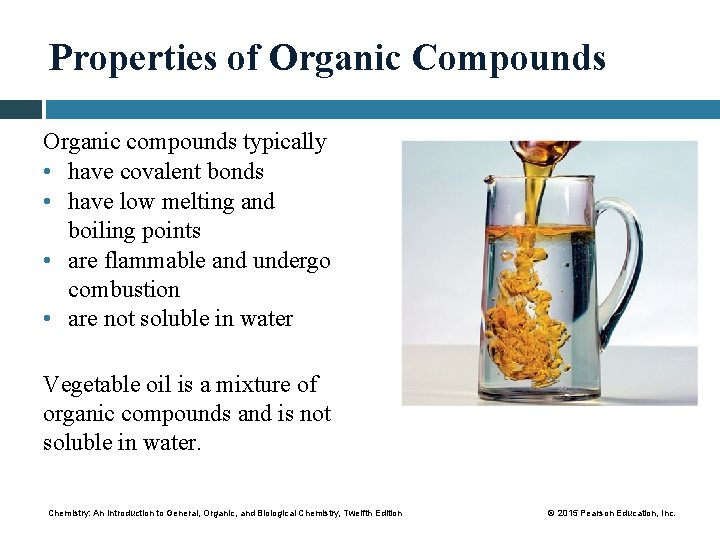
Properties of Organic Compounds Organic compounds typically • have covalent bonds • have low melting and boiling points • are flammable and undergo combustion • are not soluble in water Vegetable oil is a mixture of organic compounds and is not soluble in water. Chemistry: An Introduction to General, Organic, and Biological Chemistry, Twelfth Edition © 2015 Pearson Education, Inc.
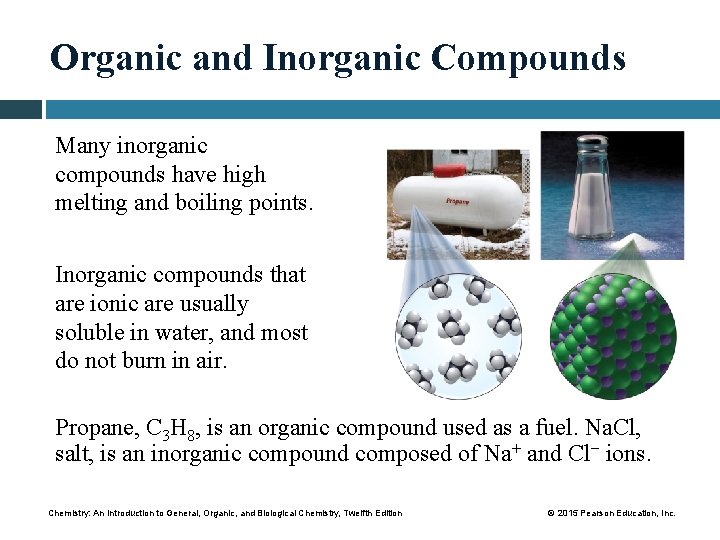
Organic and Inorganic Compounds Many inorganic compounds have high melting and boiling points. Inorganic compounds that are ionic are usually soluble in water, and most do not burn in air. Propane, C 3 H 8, is an organic compound used as a fuel. Na. Cl, salt, is an inorganic compound composed of Na+ and Cl− ions. Chemistry: An Introduction to General, Organic, and Biological Chemistry, Twelfth Edition © 2015 Pearson Education, Inc.
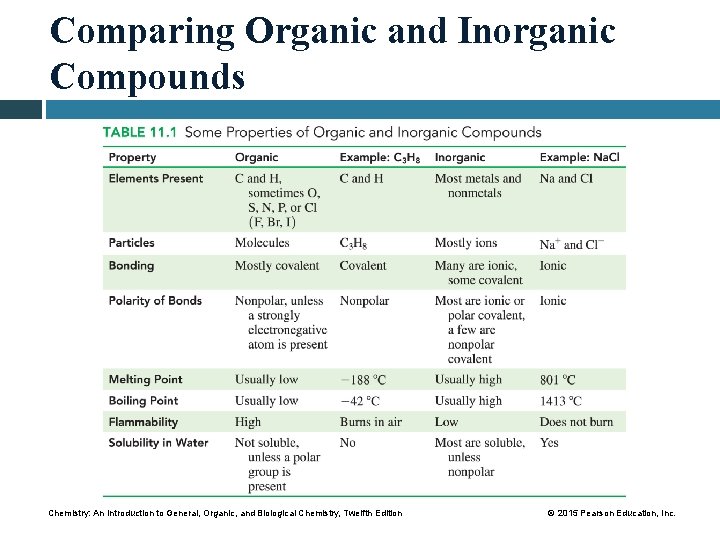
Comparing Organic and Inorganic Compounds Chemistry: An Introduction to General, Organic, and Biological Chemistry, Twelfth Edition © 2015 Pearson Education, Inc.
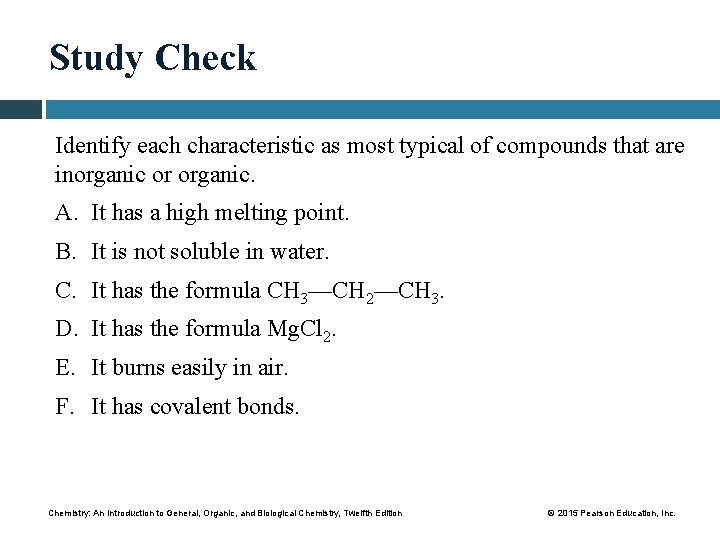
Study Check Identify each characteristic as most typical of compounds that are inorganic or organic. A. It has a high melting point. B. It is not soluble in water. C. It has the formula CH 3—CH 2—CH 3. D. It has the formula Mg. Cl 2. E. It burns easily in air. F. It has covalent bonds. Chemistry: An Introduction to General, Organic, and Biological Chemistry, Twelfth Edition © 2015 Pearson Education, Inc.
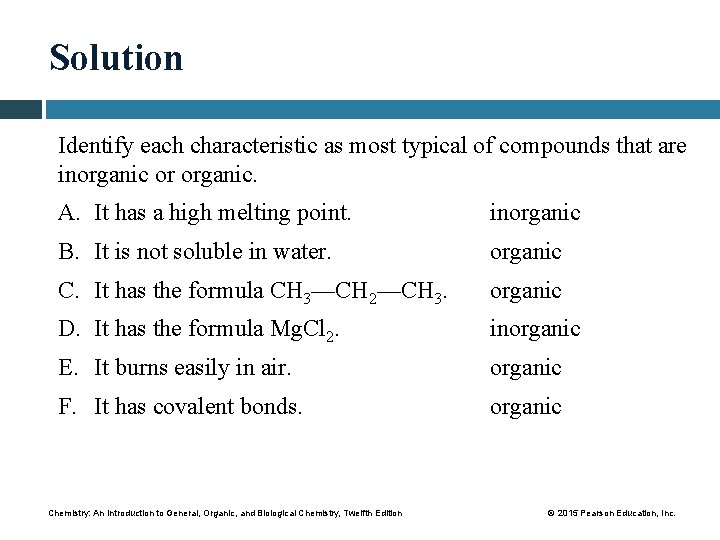
Solution Identify each characteristic as most typical of compounds that are inorganic or organic. A. It has a high melting point. inorganic B. It is not soluble in water. organic C. It has the formula CH 3—CH 2—CH 3. organic D. It has the formula Mg. Cl 2. inorganic E. It burns easily in air. organic F. It has covalent bonds. organic Chemistry: An Introduction to General, Organic, and Biological Chemistry, Twelfth Edition © 2015 Pearson Education, Inc.
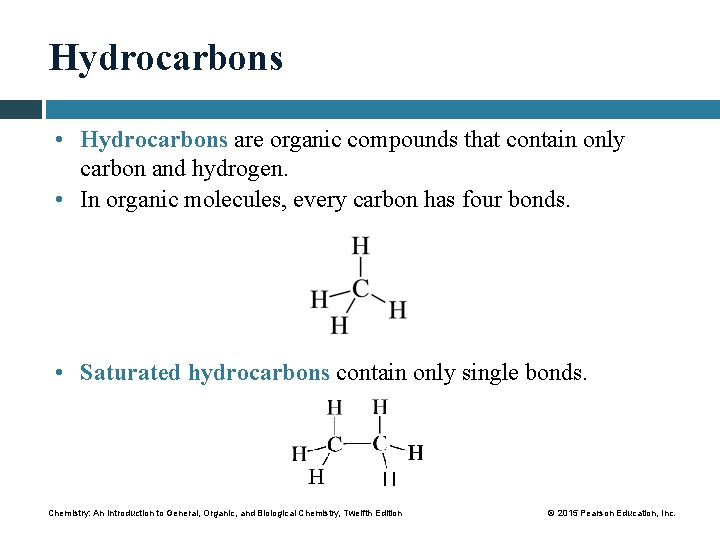
Hydrocarbons • Hydrocarbons are organic compounds that contain only carbon and hydrogen. • In organic molecules, every carbon has four bonds. • Saturated hydrocarbons contain only single bonds. Chemistry: An Introduction to General, Organic, and Biological Chemistry, Twelfth Edition © 2015 Pearson Education, Inc.
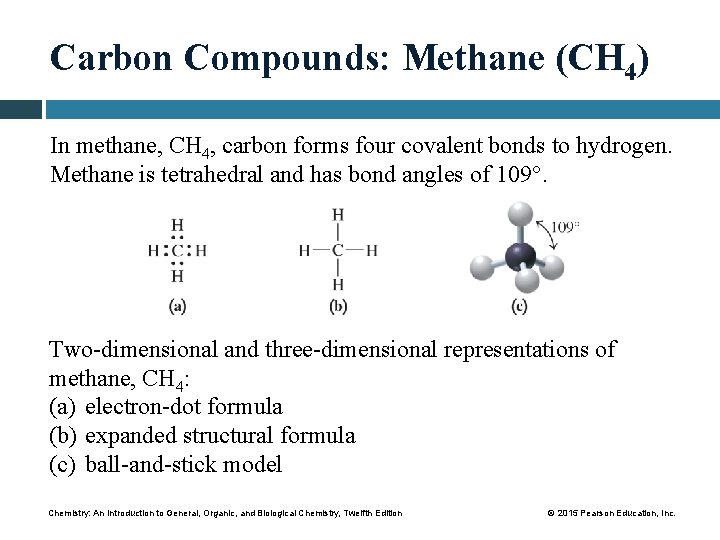
Carbon Compounds: Methane (CH 4) In methane, CH 4, carbon forms four covalent bonds to hydrogen. Methane is tetrahedral and has bond angles of 109°. Two-dimensional and three-dimensional representations of methane, CH 4: (a) electron-dot formula (b) expanded structural formula (c) ball-and-stick model Chemistry: An Introduction to General, Organic, and Biological Chemistry, Twelfth Edition © 2015 Pearson Education, Inc.
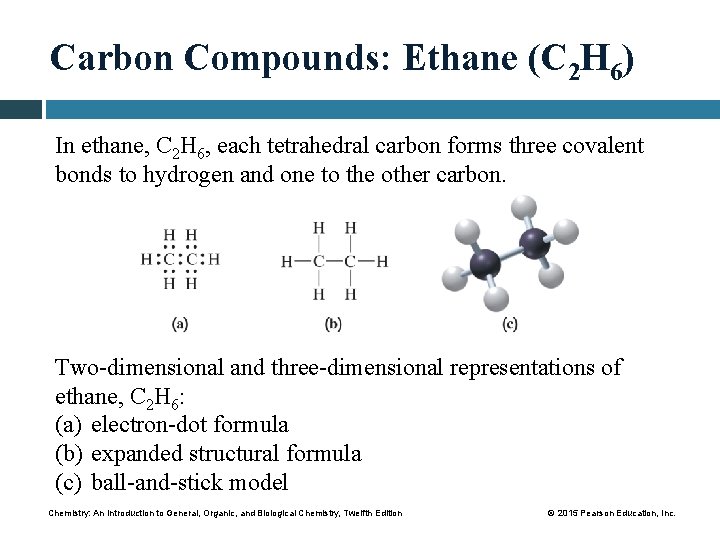
Carbon Compounds: Ethane (C 2 H 6) In ethane, C 2 H 6, each tetrahedral carbon forms three covalent bonds to hydrogen and one to the other carbon. Two-dimensional and three-dimensional representations of ethane, C 2 H 6: (a) electron-dot formula (b) expanded structural formula (c) ball-and-stick model Chemistry: An Introduction to General, Organic, and Biological Chemistry, Twelfth Edition © 2015 Pearson Education, Inc.
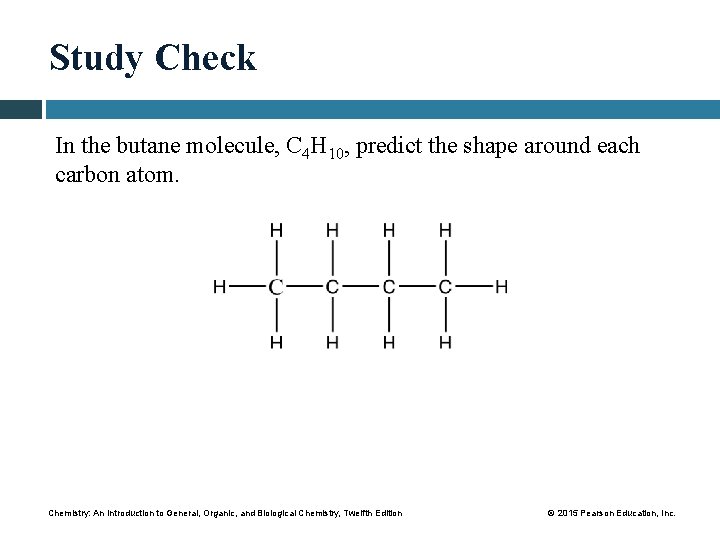
Study Check In the butane molecule, C 4 H 10, predict the shape around each carbon atom. Chemistry: An Introduction to General, Organic, and Biological Chemistry, Twelfth Edition © 2015 Pearson Education, Inc.
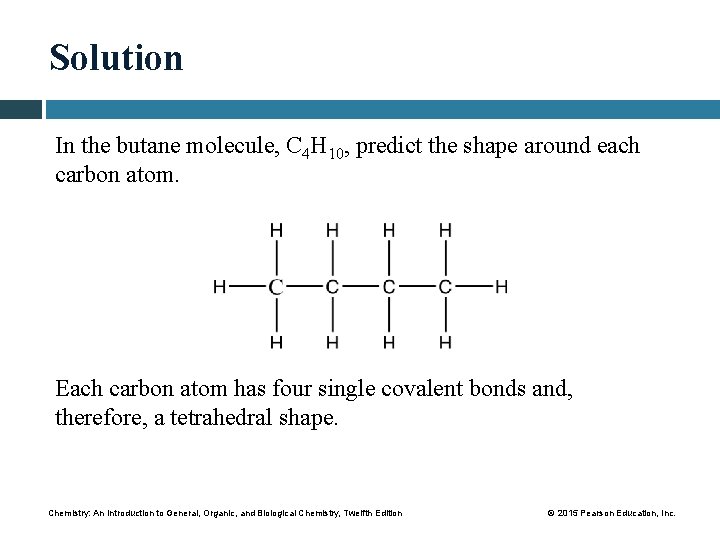
Solution In the butane molecule, C 4 H 10, predict the shape around each carbon atom. Each carbon atom has four single covalent bonds and, therefore, a tetrahedral shape. Chemistry: An Introduction to General, Organic, and Biological Chemistry, Twelfth Edition © 2015 Pearson Education, Inc.
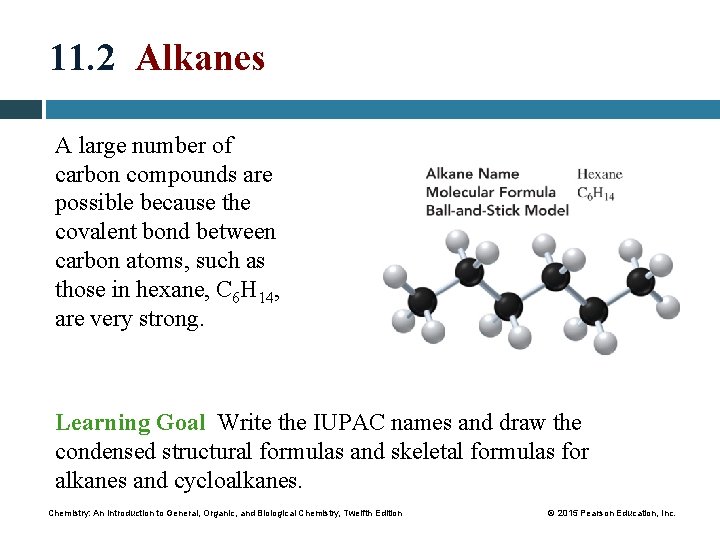
11. 2 Alkanes A large number of carbon compounds are possible because the covalent bond between carbon atoms, such as those in hexane, C 6 H 14, are very strong. Learning Goal Write the IUPAC names and draw the condensed structural formulas and skeletal formulas for alkanes and cycloalkanes. Chemistry: An Introduction to General, Organic, and Biological Chemistry, Twelfth Edition © 2015 Pearson Education, Inc.
Naming Alkanes • are hydrocarbons that contain only C—C and C—H bonds • are formed by a continuous chain of carbon atoms • are named using the IUPAC (International Union of Pure and Applied Chemistry) system • have names that end in ane • use Greek prefixes to name carbon chains with five or more carbon atoms Chemistry: An Introduction to General, Organic, and Biological Chemistry, Twelfth Edition © 2015 Pearson Education, Inc.
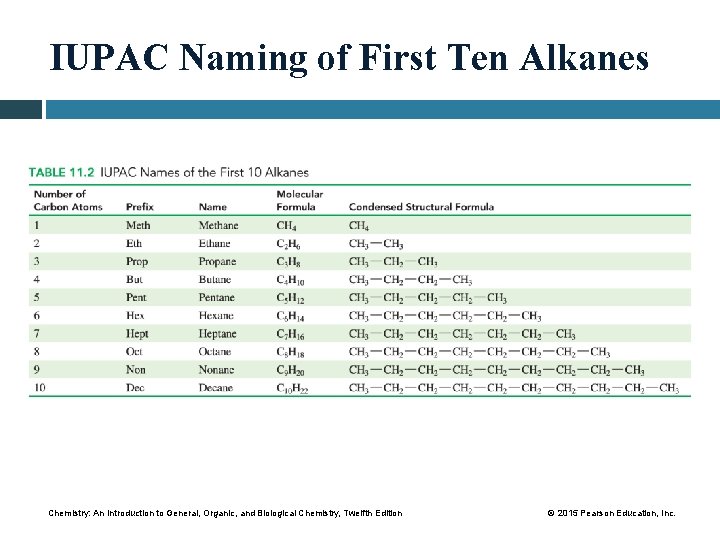
IUPAC Naming of First Ten Alkanes Chemistry: An Introduction to General, Organic, and Biological Chemistry, Twelfth Edition © 2015 Pearson Education, Inc.
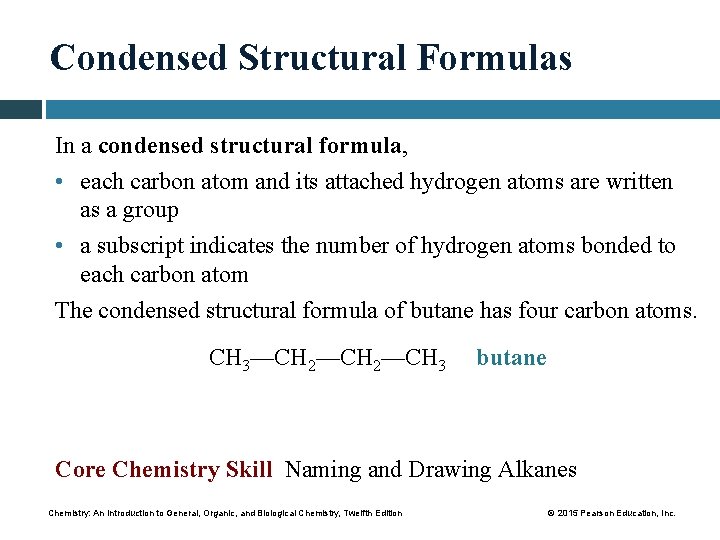
Condensed Structural Formulas In a condensed structural formula, • each carbon atom and its attached hydrogen atoms are written as a group • a subscript indicates the number of hydrogen atoms bonded to each carbon atom The condensed structural formula of butane has four carbon atoms. CH 3—CH 2—CH 3 butane Core Chemistry Skill Naming and Drawing Alkanes Chemistry: An Introduction to General, Organic, and Biological Chemistry, Twelfth Edition © 2015 Pearson Education, Inc.
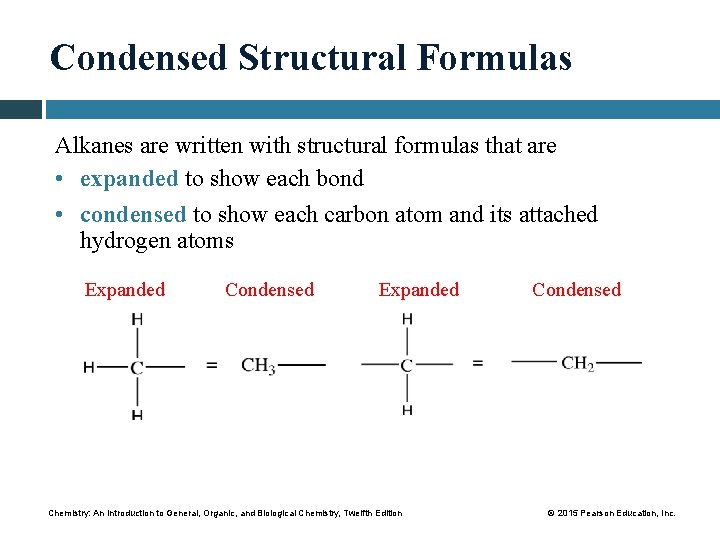
Condensed Structural Formulas Alkanes are written with structural formulas that are • expanded to show each bond • condensed to show each carbon atom and its attached hydrogen atoms Expanded Condensed Expanded Chemistry: An Introduction to General, Organic, and Biological Chemistry, Twelfth Edition Condensed © 2015 Pearson Education, Inc.
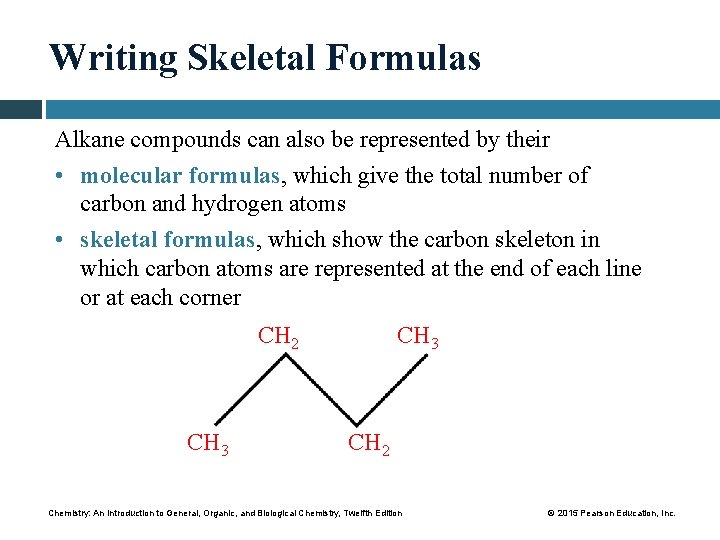
Writing Skeletal Formulas Alkane compounds can also be represented by their • molecular formulas, which give the total number of carbon and hydrogen atoms • skeletal formulas, which show the carbon skeleton in which carbon atoms are represented at the end of each line or at each corner CH 2 CH 3 CH 2 Chemistry: An Introduction to General, Organic, and Biological Chemistry, Twelfth Edition © 2015 Pearson Education, Inc.
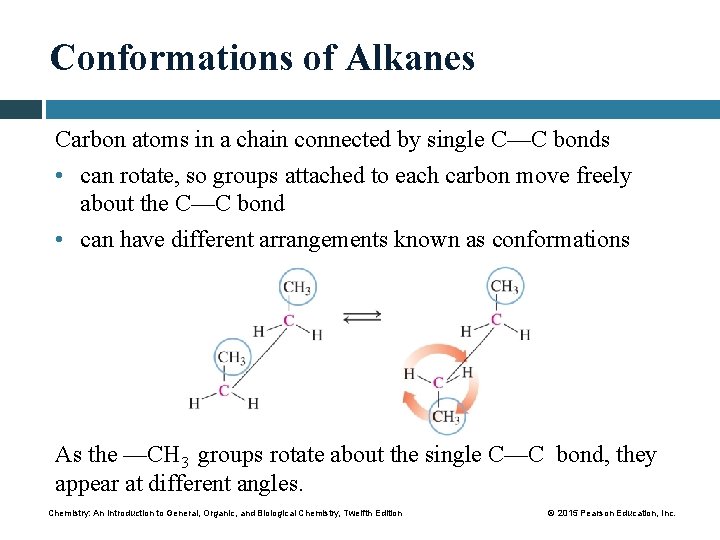
Conformations of Alkanes Carbon atoms in a chain connected by single C—C bonds • can rotate, so groups attached to each carbon move freely about the C—C bond • can have different arrangements known as conformations As the —CH 3 groups rotate about the single C—C bond, they appear at different angles. Chemistry: An Introduction to General, Organic, and Biological Chemistry, Twelfth Edition © 2015 Pearson Education, Inc.
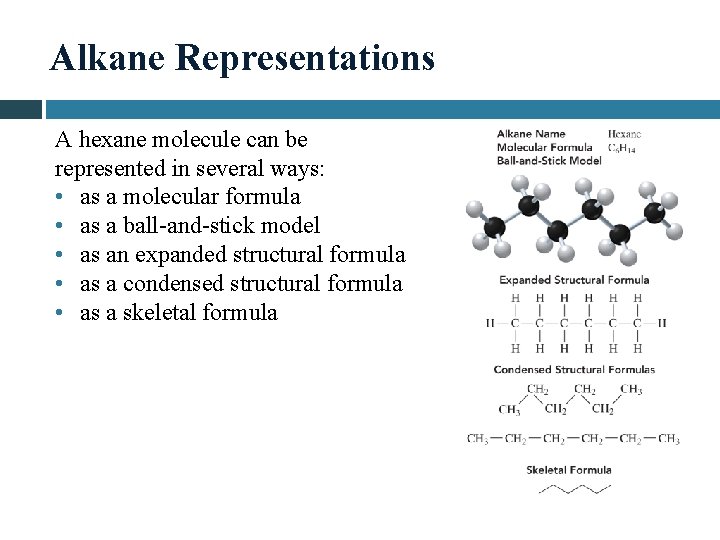
Alkane Representations A hexane molecule can be represented in several ways: • as a molecular formula • as a ball-and-stick model • as an expanded structural formula • as a condensed structural formula • as a skeletal formula
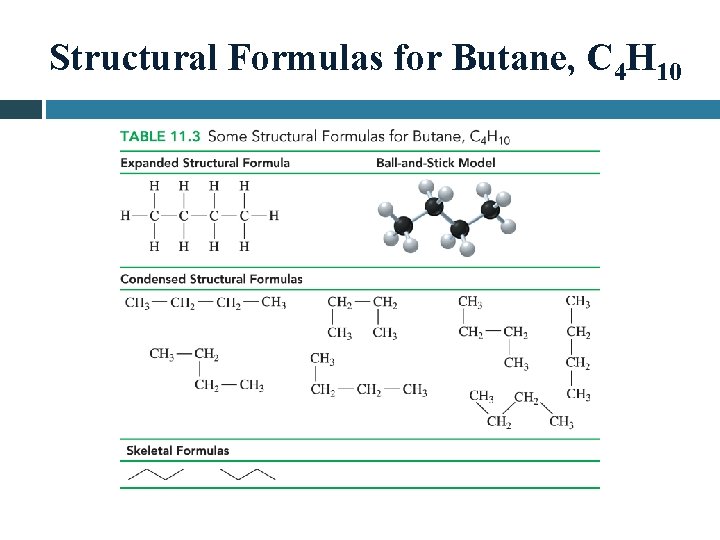
Structural Formulas for Butane, C 4 H 10
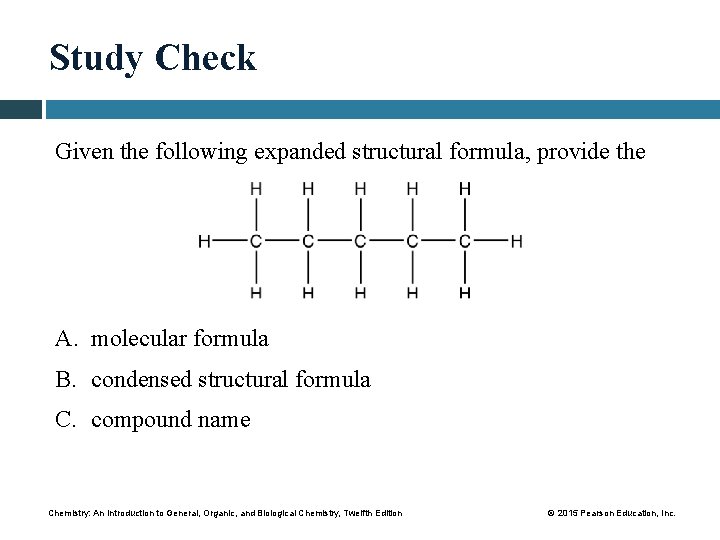
Study Check Given the following expanded structural formula, provide the A. molecular formula B. condensed structural formula C. compound name Chemistry: An Introduction to General, Organic, and Biological Chemistry, Twelfth Edition © 2015 Pearson Education, Inc.
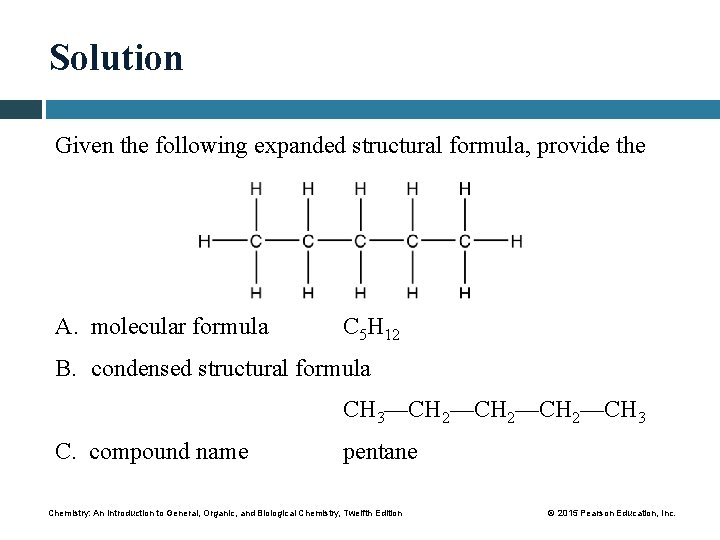
Solution Given the following expanded structural formula, provide the A. molecular formula C 5 H 12 B. condensed structural formula CH 3—CH 2—CH 3 C. compound name pentane Chemistry: An Introduction to General, Organic, and Biological Chemistry, Twelfth Edition © 2015 Pearson Education, Inc.
Study Check Write the condensed structural formula for A. ethane B. heptane Chemistry: An Introduction to General, Organic, and Biological Chemistry, Twelfth Edition © 2015 Pearson Education, Inc.
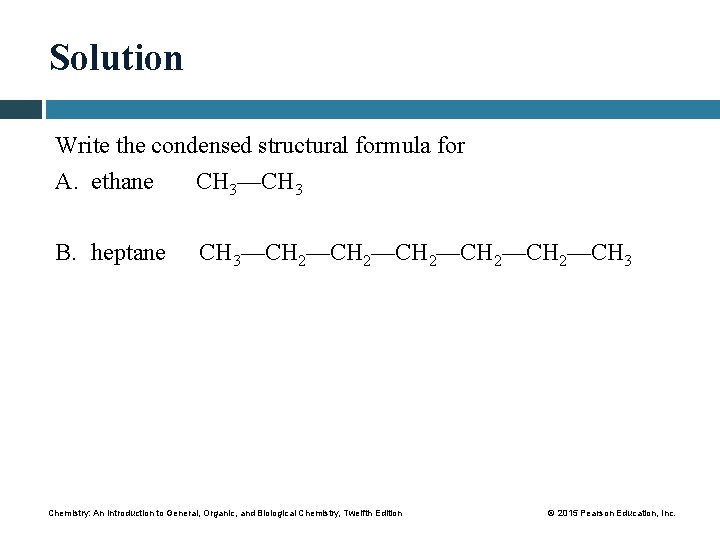
Solution Write the condensed structural formula for A. ethane CH 3—CH 3 B. heptane CH 3—CH 2—CH 2—CH 3 Chemistry: An Introduction to General, Organic, and Biological Chemistry, Twelfth Edition © 2015 Pearson Education, Inc.
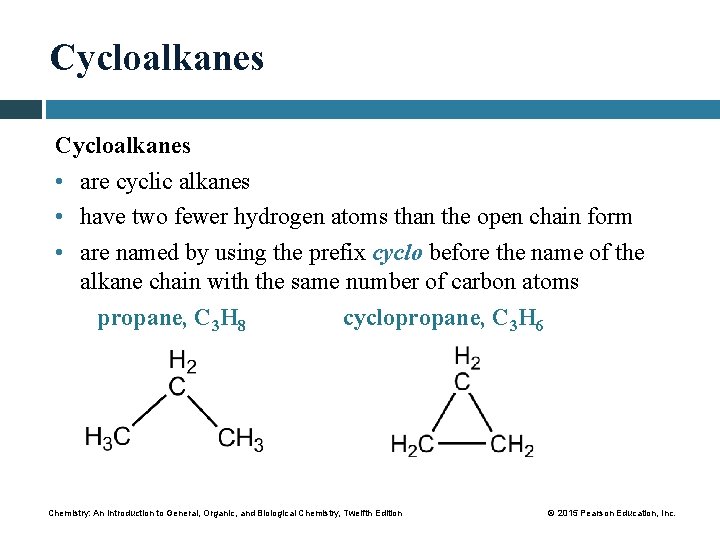
Cycloalkanes • are cyclic alkanes • have two fewer hydrogen atoms than the open chain form • are named by using the prefix cyclo before the name of the alkane chain with the same number of carbon atoms propane, C 3 H 8 cyclopropane, C 3 H 6 Chemistry: An Introduction to General, Organic, and Biological Chemistry, Twelfth Edition © 2015 Pearson Education, Inc.
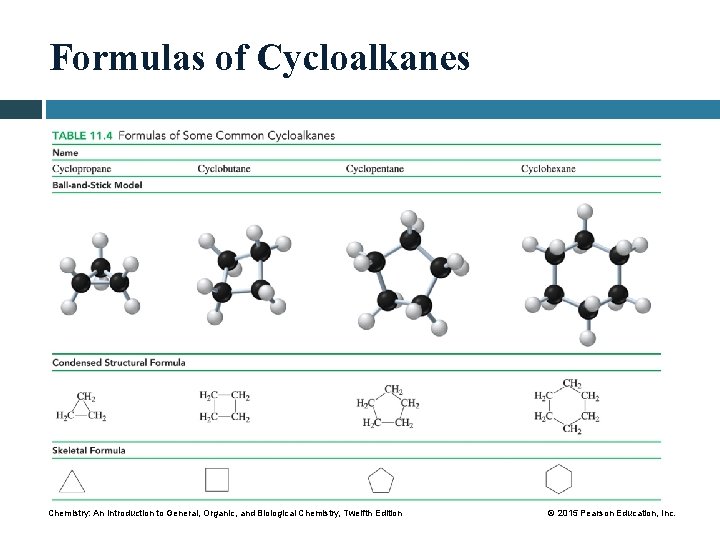
Formulas of Cycloalkanes Chemistry: An Introduction to General, Organic, and Biological Chemistry, Twelfth Edition © 2015 Pearson Education, Inc.
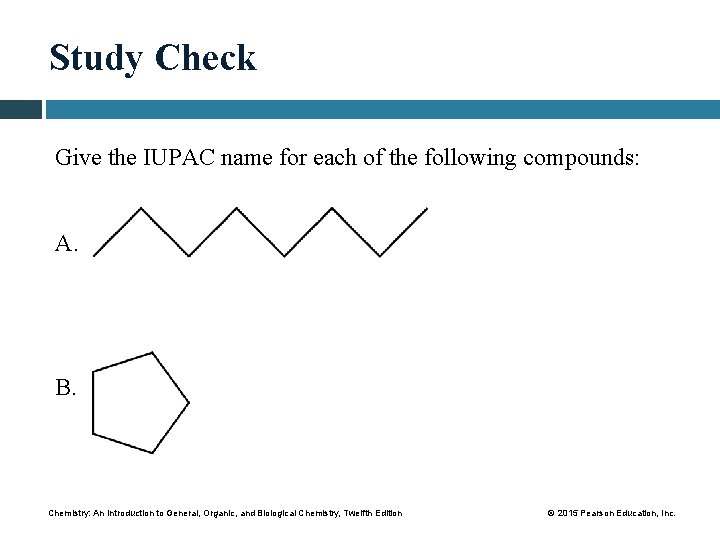
Study Check Give the IUPAC name for each of the following compounds: A. B. Chemistry: An Introduction to General, Organic, and Biological Chemistry, Twelfth Edition © 2015 Pearson Education, Inc.
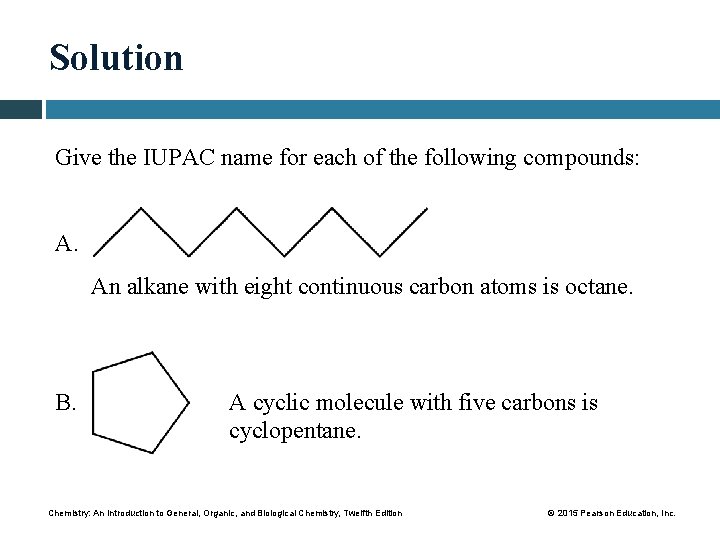
Solution Give the IUPAC name for each of the following compounds: A. An alkane with eight continuous carbon atoms is octane. B. A cyclic molecule with five carbons is cyclopentane. Chemistry: An Introduction to General, Organic, and Biological Chemistry, Twelfth Edition © 2015 Pearson Education, Inc.
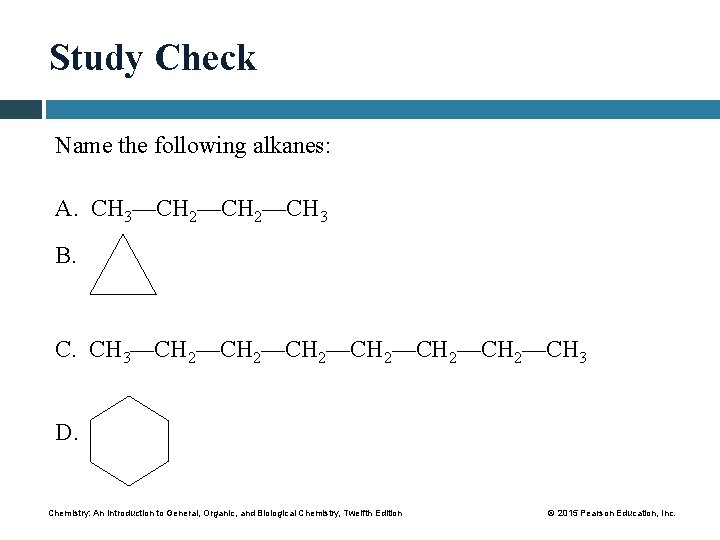
Study Check Name the following alkanes: A. CH 3—CH 2—CH 3 B. C. CH 3—CH 2—CH 2—CH 3 D. Chemistry: An Introduction to General, Organic, and Biological Chemistry, Twelfth Edition © 2015 Pearson Education, Inc.
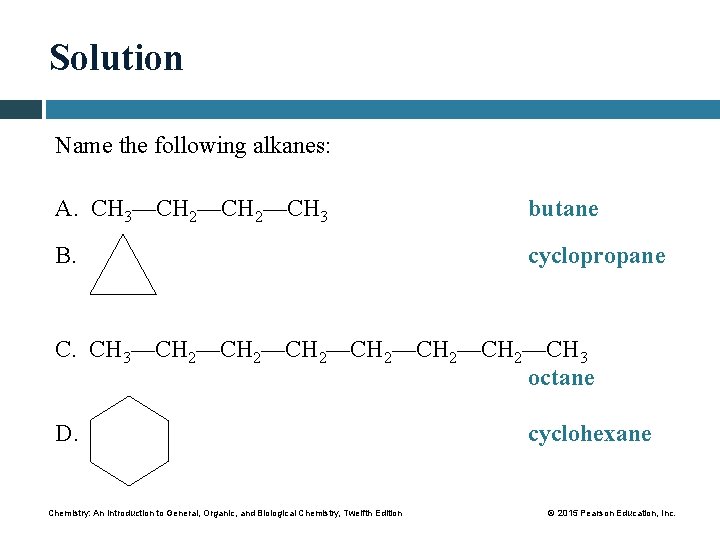
Solution Name the following alkanes: A. CH 3—CH 2—CH 3 butane B. cyclopropane C. CH 3—CH 2—CH 2—CH 3 octane D. Chemistry: An Introduction to General, Organic, and Biological Chemistry, Twelfth Edition cyclohexane © 2015 Pearson Education, Inc.
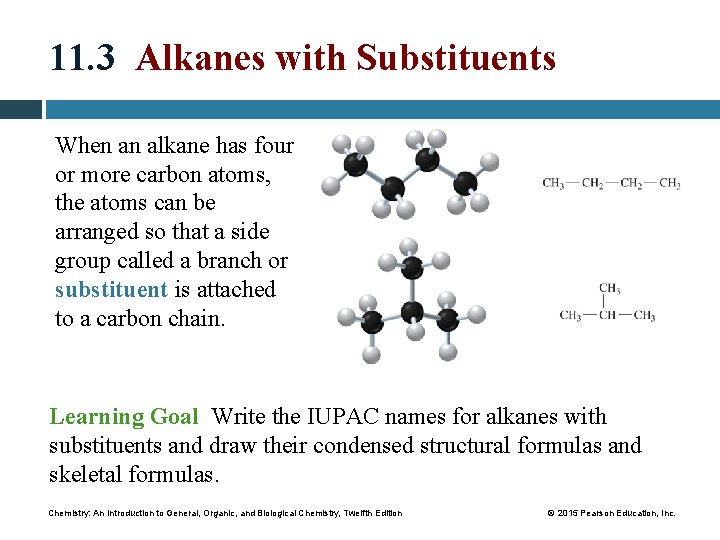
11. 3 Alkanes with Substituents When an alkane has four or more carbon atoms, the atoms can be arranged so that a side group called a branch or substituent is attached to a carbon chain. Learning Goal Write the IUPAC names for alkanes with substituents and draw their condensed structural formulas and skeletal formulas. Chemistry: An Introduction to General, Organic, and Biological Chemistry, Twelfth Edition © 2015 Pearson Education, Inc.
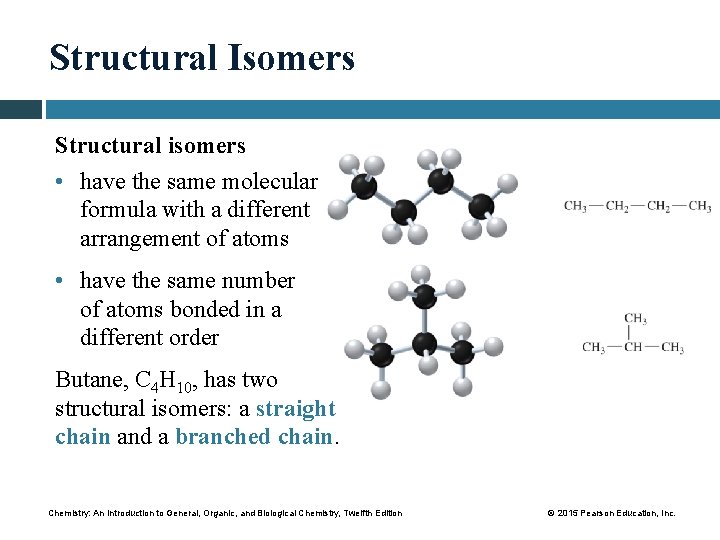
Structural Isomers Structural isomers • have the same molecular formula with a different arrangement of atoms • have the same number of atoms bonded in a different order Butane, C 4 H 10, has two structural isomers: a straight chain and a branched chain. Chemistry: An Introduction to General, Organic, and Biological Chemistry, Twelfth Edition © 2015 Pearson Education, Inc.
Study Check Draw three possible structural isomers of pentane, C 5 H 12. Chemistry: An Introduction to General, Organic, and Biological Chemistry, Twelfth Edition © 2015 Pearson Education, Inc.
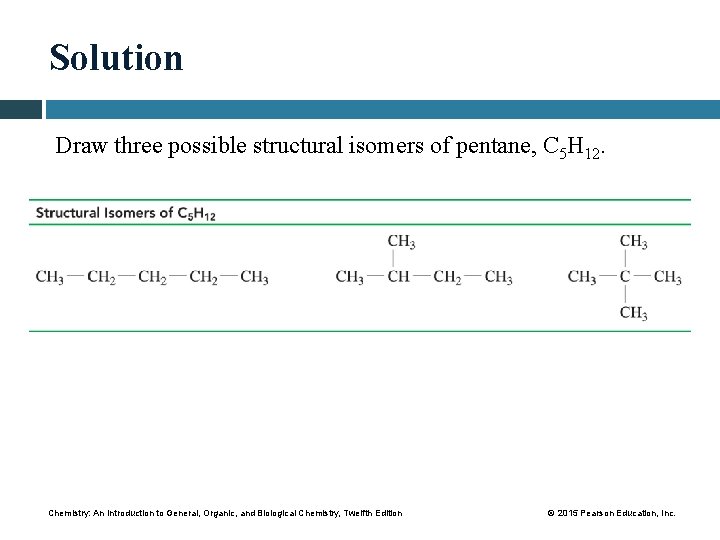
Solution Draw three possible structural isomers of pentane, C 5 H 12. Chemistry: An Introduction to General, Organic, and Biological Chemistry, Twelfth Edition © 2015 Pearson Education, Inc.
Alkane Substituents are atoms or groups of atoms attached to the carbon chain and include alkyl and halo groups. Alkyl groups are • groups of carbon atoms attached to carbon chains • named in the IUPAC system with an yl ending Halo substituents are • halogen atoms attached to the carbon chain • named in the IUPAC system as fluoro, chloro, bromo, or iodo. Chemistry: An Introduction to General, Organic, and Biological Chemistry, Twelfth Edition © 2015 Pearson Education, Inc.
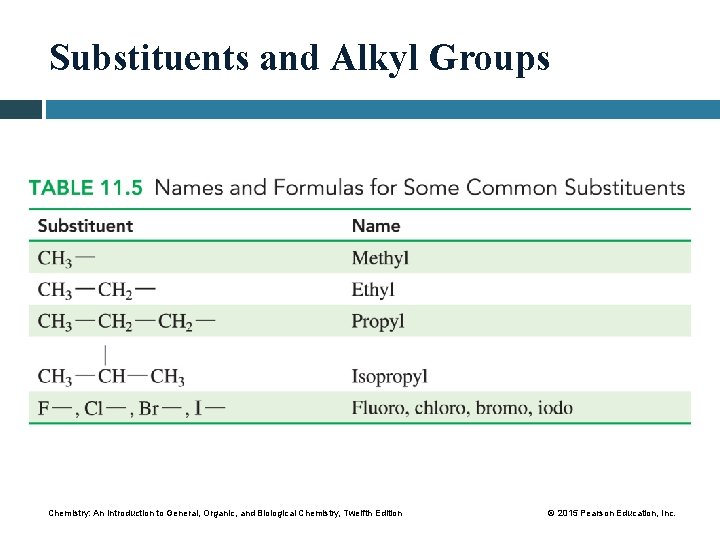
Substituents and Alkyl Groups Chemistry: An Introduction to General, Organic, and Biological Chemistry, Twelfth Edition © 2015 Pearson Education, Inc.
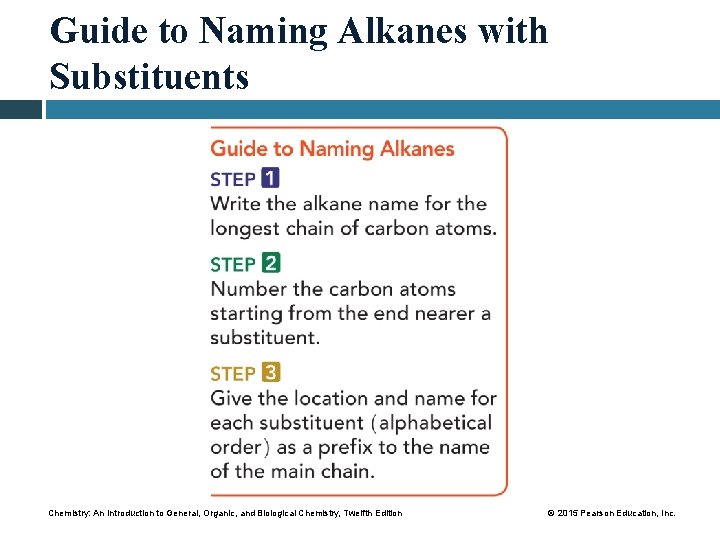
Guide to Naming Alkanes with Substituents Chemistry: An Introduction to General, Organic, and Biological Chemistry, Twelfth Edition © 2015 Pearson Education, Inc.
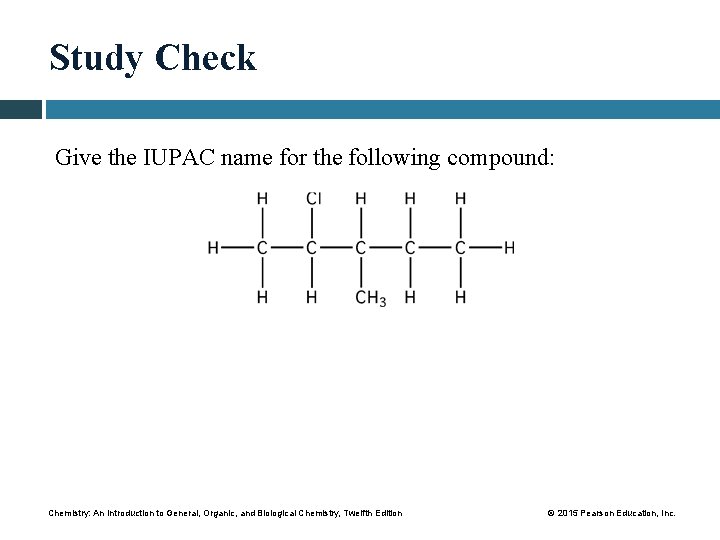
Study Check Give the IUPAC name for the following compound: Chemistry: An Introduction to General, Organic, and Biological Chemistry, Twelfth Edition © 2015 Pearson Education, Inc.
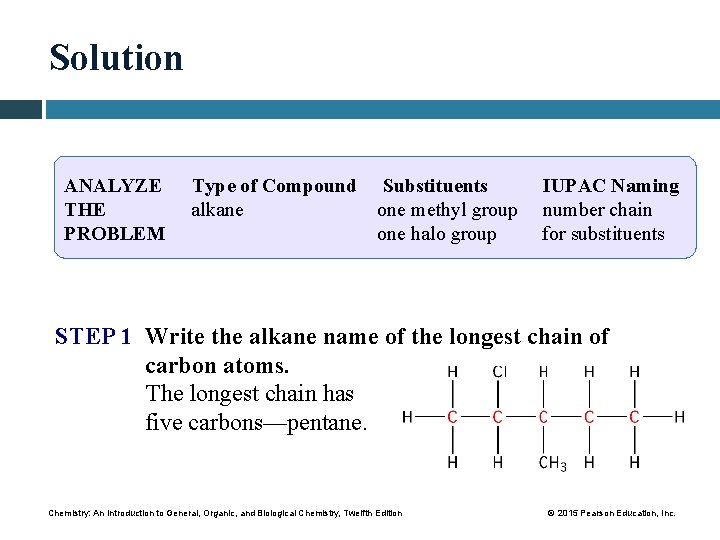
Solution ANALYZE THE PROBLEM Type of Compound Substituents alkane one methyl group one halo group IUPAC Naming number chain for substituents STEP 1 Write the alkane name of the longest chain of carbon atoms. The longest chain has five carbons—pentane. Chemistry: An Introduction to General, Organic, and Biological Chemistry, Twelfth Edition © 2015 Pearson Education, Inc.
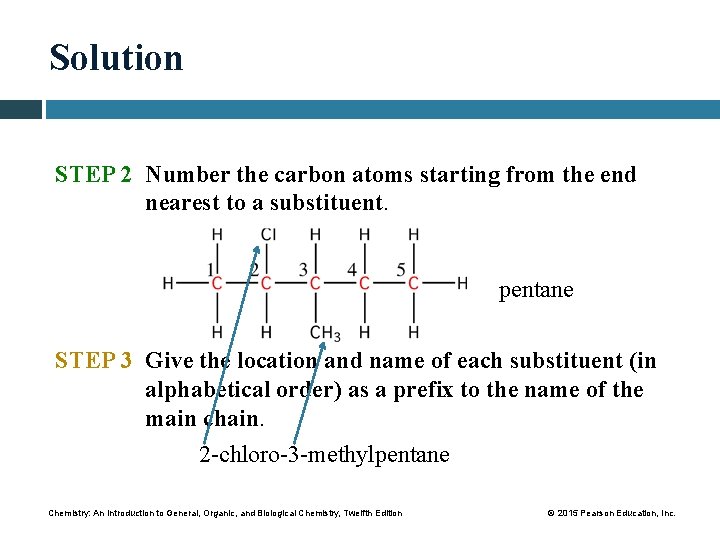
Solution STEP 2 Number the carbon atoms starting from the end nearest to a substituent. pentane STEP 3 Give the location and name of each substituent (in alphabetical order) as a prefix to the name of the main chain. 2 -chloro-3 -methylpentane Chemistry: An Introduction to General, Organic, and Biological Chemistry, Twelfth Edition © 2015 Pearson Education, Inc.
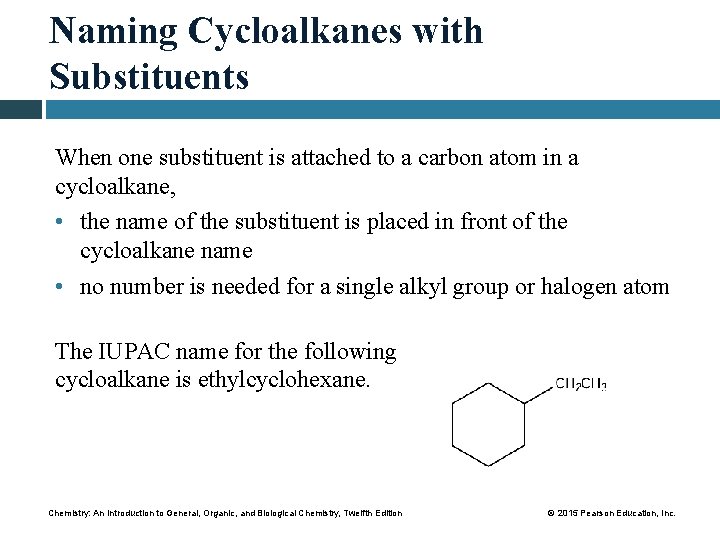
Naming Cycloalkanes with Substituents When one substituent is attached to a carbon atom in a cycloalkane, • the name of the substituent is placed in front of the cycloalkane name • no number is needed for a single alkyl group or halogen atom The IUPAC name for the following cycloalkane is ethylcyclohexane. Chemistry: An Introduction to General, Organic, and Biological Chemistry, Twelfth Edition © 2015 Pearson Education, Inc.
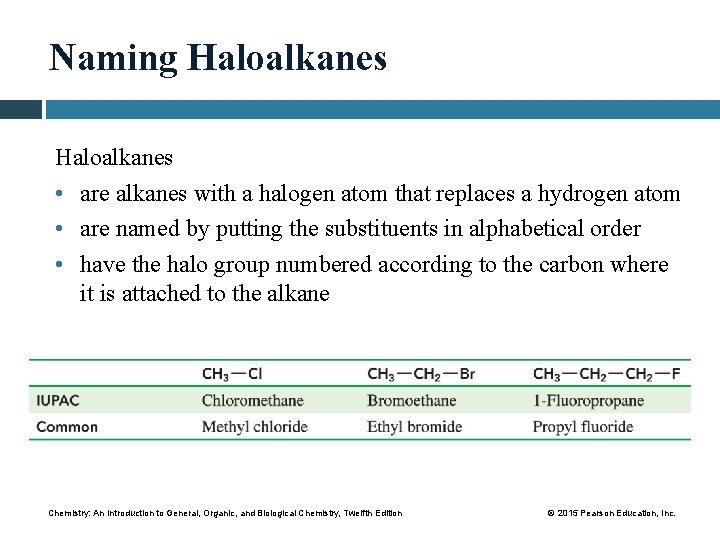
Naming Haloalkanes • are alkanes with a halogen atom that replaces a hydrogen atom • are named by putting the substituents in alphabetical order • have the halo group numbered according to the carbon where it is attached to the alkane Chemistry: An Introduction to General, Organic, and Biological Chemistry, Twelfth Edition © 2015 Pearson Education, Inc.
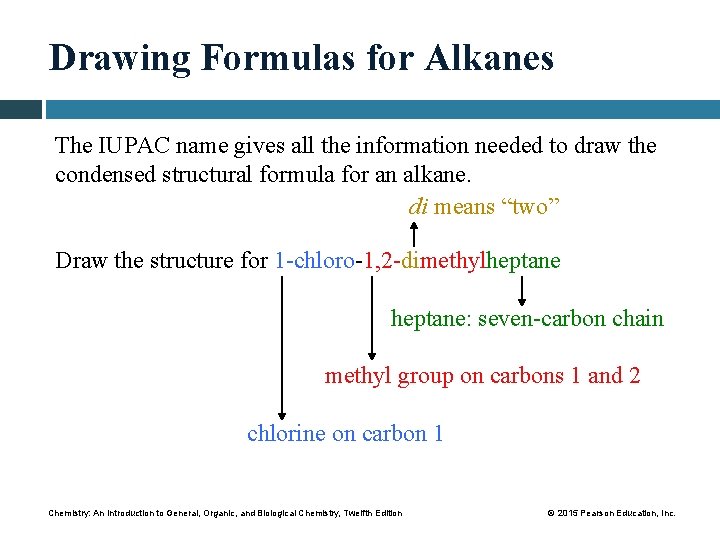
Drawing Formulas for Alkanes The IUPAC name gives all the information needed to draw the condensed structural formula for an alkane. di means “two” Draw the structure for 1 -chloro-1, 2 -dimethylheptane: seven-carbon chain methyl group on carbons 1 and 2 chlorine on carbon 1 Chemistry: An Introduction to General, Organic, and Biological Chemistry, Twelfth Edition © 2015 Pearson Education, Inc.
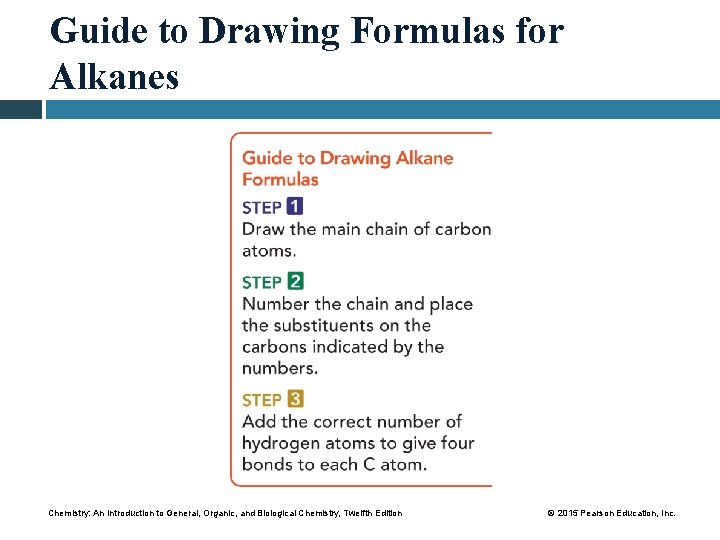
Guide to Drawing Formulas for Alkanes Chemistry: An Introduction to General, Organic, and Biological Chemistry, Twelfth Edition © 2015 Pearson Education, Inc.
Study Check Draw the condensed structural formula for 3 -bromo-1 -chlorobutane. Chemistry: An Introduction to General, Organic, and Biological Chemistry, Twelfth Edition © 2015 Pearson Education, Inc.
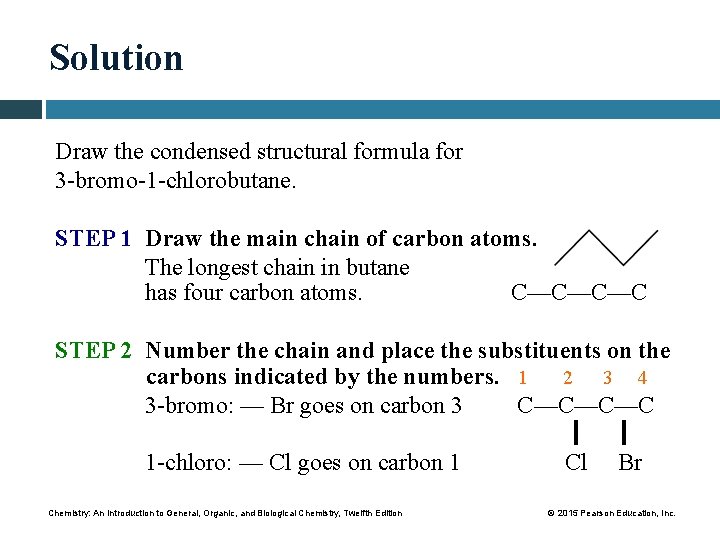
Solution Draw the condensed structural formula for 3 -bromo-1 -chlorobutane. STEP 1 Draw the main chain of carbon atoms. The longest chain in butane has four carbon atoms. C—C—C—C STEP 2 Number the chain and place the substituents on the carbons indicated by the numbers. 1 2 3 4 3 -bromo: — Br goes on carbon 3 C—C—C—C 1 -chloro: — Cl goes on carbon 1 Chemistry: An Introduction to General, Organic, and Biological Chemistry, Twelfth Edition Cl Br © 2015 Pearson Education, Inc.
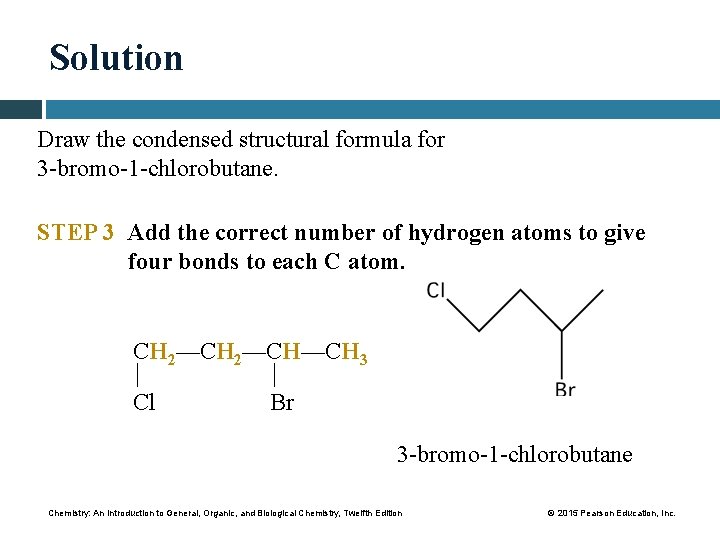
Solution Draw the condensed structural formula for 3 -bromo-1 -chlorobutane. STEP 3 Add the correct number of hydrogen atoms to give four bonds to each C atom. CH 2—CH—CH 3 Cl Br 3 -bromo-1 -chlorobutane Chemistry: An Introduction to General, Organic, and Biological Chemistry, Twelfth Edition © 2015 Pearson Education, Inc.
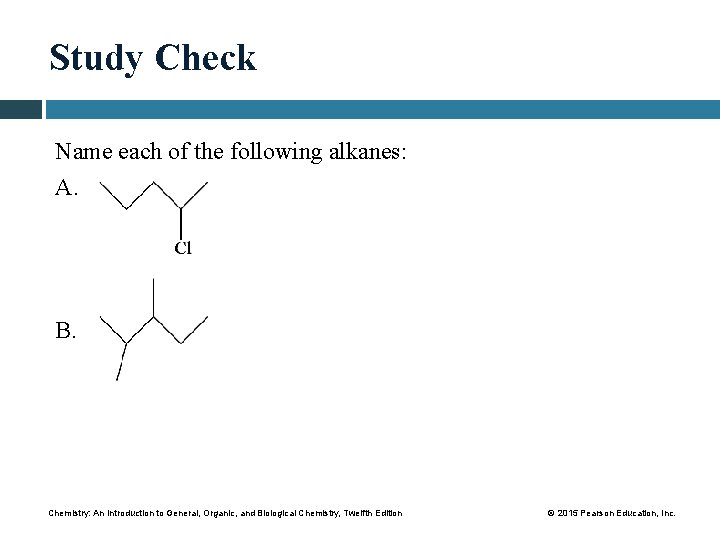
Study Check Name each of the following alkanes: A. B. Chemistry: An Introduction to General, Organic, and Biological Chemistry, Twelfth Edition © 2015 Pearson Education, Inc.
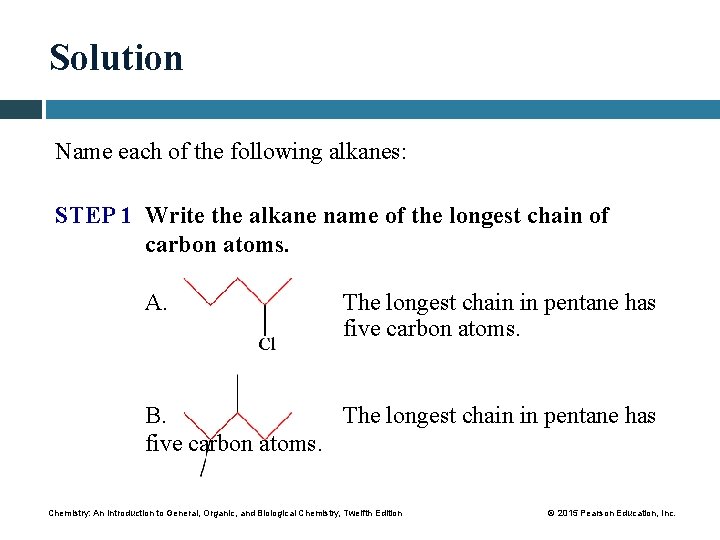
Solution Name each of the following alkanes: STEP 1 Write the alkane name of the longest chain of carbon atoms. A. The longest chain in pentane has five carbon atoms. B. The longest chain in pentane has five carbon atoms. Chemistry: An Introduction to General, Organic, and Biological Chemistry, Twelfth Edition © 2015 Pearson Education, Inc.
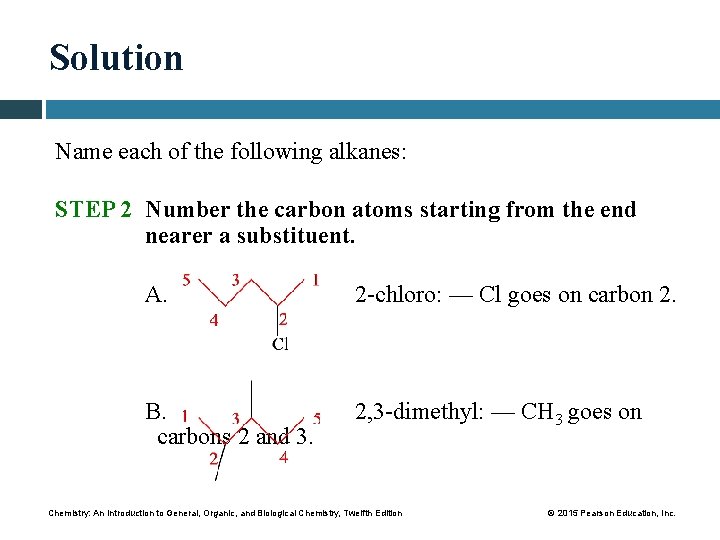
Solution Name each of the following alkanes: STEP 2 Number the carbon atoms starting from the end nearer a substituent. A. 2 -chloro: — Cl goes on carbon 2. B. carbons 2 and 3. 2, 3 -dimethyl: — CH 3 goes on Chemistry: An Introduction to General, Organic, and Biological Chemistry, Twelfth Edition © 2015 Pearson Education, Inc.
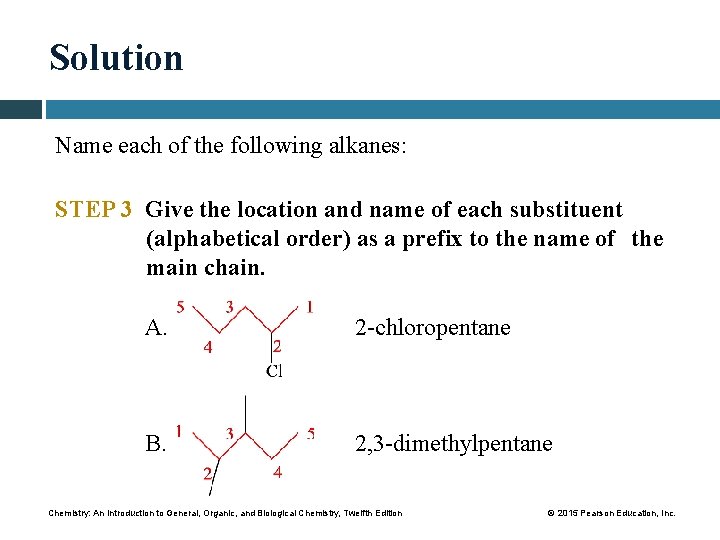
Solution Name each of the following alkanes: STEP 3 Give the location and name of each substituent (alphabetical order) as a prefix to the name of the main chain. A. 2 -chloropentane B. 2, 3 -dimethylpentane Chemistry: An Introduction to General, Organic, and Biological Chemistry, Twelfth Edition © 2015 Pearson Education, Inc.
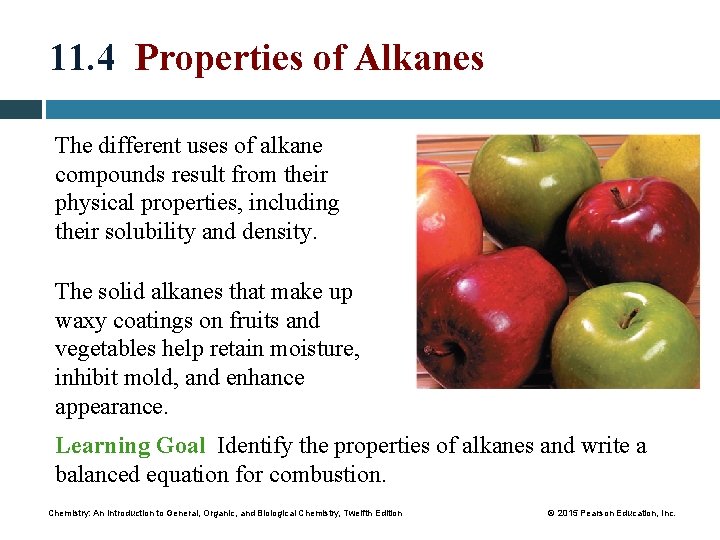
11. 4 Properties of Alkanes The different uses of alkane compounds result from their physical properties, including their solubility and density. The solid alkanes that make up waxy coatings on fruits and vegetables help retain moisture, inhibit mold, and enhance appearance. Learning Goal Identify the properties of alkanes and write a balanced equation for combustion. Chemistry: An Introduction to General, Organic, and Biological Chemistry, Twelfth Edition © 2015 Pearson Education, Inc.
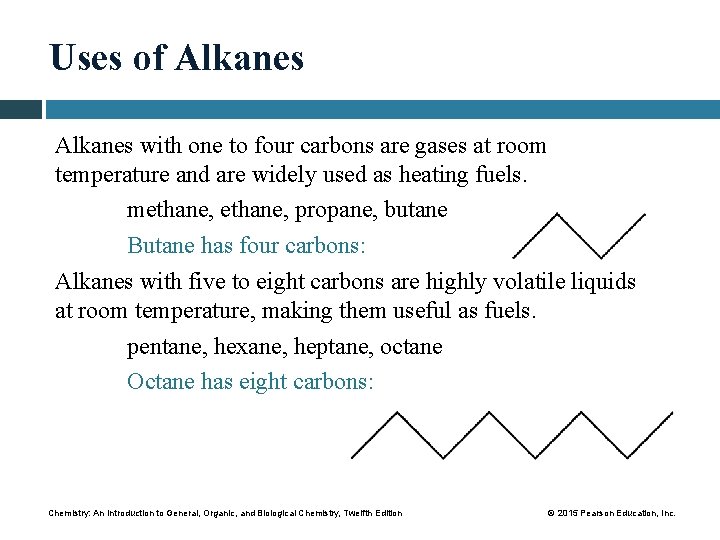
Uses of Alkanes with one to four carbons are gases at room temperature and are widely used as heating fuels. methane, propane, butane Butane has four carbons: Alkanes with five to eight carbons are highly volatile liquids at room temperature, making them useful as fuels. pentane, hexane, heptane, octane Octane has eight carbons: Chemistry: An Introduction to General, Organic, and Biological Chemistry, Twelfth Edition © 2015 Pearson Education, Inc.
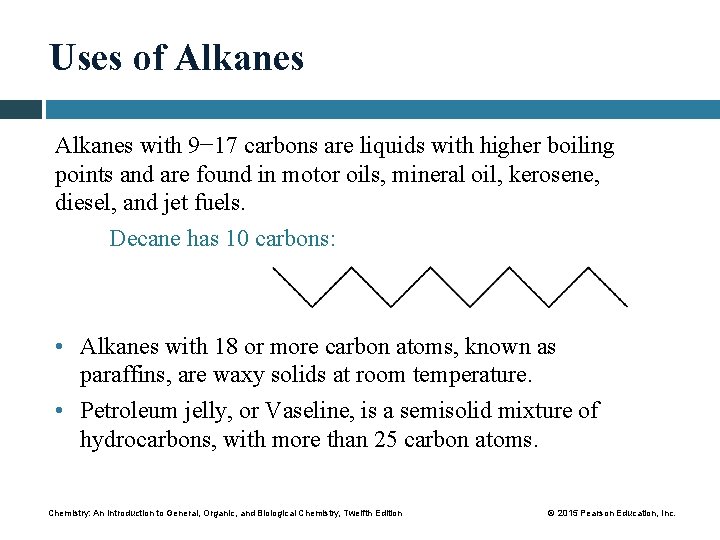
Uses of Alkanes with 9− 17 carbons are liquids with higher boiling points and are found in motor oils, mineral oil, kerosene, diesel, and jet fuels. Decane has 10 carbons: • Alkanes with 18 or more carbon atoms, known as paraffins, are waxy solids at room temperature. • Petroleum jelly, or Vaseline, is a semisolid mixture of hydrocarbons, with more than 25 carbon atoms. Chemistry: An Introduction to General, Organic, and Biological Chemistry, Twelfth Edition © 2015 Pearson Education, Inc.
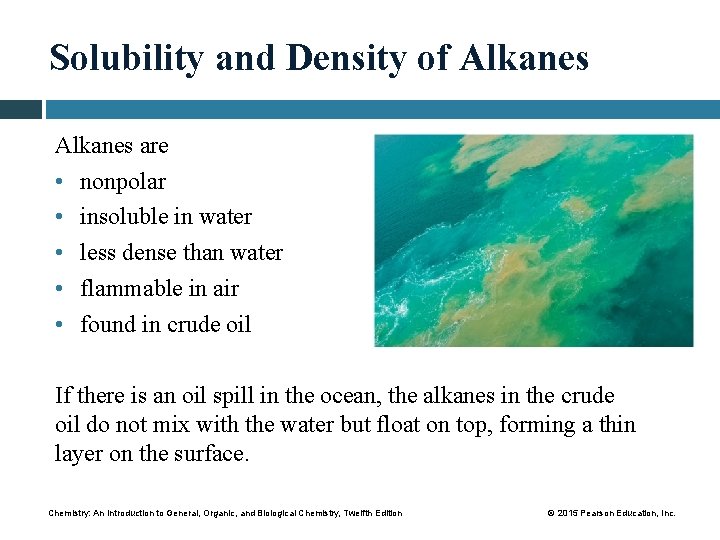
Solubility and Density of Alkanes are • nonpolar • insoluble in water • less dense than water • flammable in air • found in crude oil If there is an oil spill in the ocean, the alkanes in the crude oil do not mix with the water but float on top, forming a thin layer on the surface. Chemistry: An Introduction to General, Organic, and Biological Chemistry, Twelfth Edition © 2015 Pearson Education, Inc.
Oil Spills In April 2010, an explosion on an oil-drilling rig in the Gulf of Mexico caused the largest oil spill in U. S. history, spilling at its maximum about 10 million liters per day. Cleaning up an oil spill includes the following processes: • Mechanical—a boom may be placed around the oil so that boats called skimmers can scoop it up and place it in tanks. • Chemical—a substance that attracts oil is used to pick up the oil, which is then scraped off into recovery tanks. • Microbiological—certain bacteria that ingest oil are used to break oil down into less harmful products. Chemistry: An Introduction to General, Organic, and Biological Chemistry, Twelfth Edition © 2015 Pearson Education, Inc.
Combustion of Alkanes with strong C—C bonds • react with oxygen gas to make carbon dioxide and water in combustion reactions • release energy when C—C bonds are broken in combustion reactions CH 4(g) + 2 O 2(g) CO 2(g) + 2 H 2 O(g) + energy Methane is the natural gas used to cook our food on gas cooktops and to heat our homes. Chemistry: An Introduction to General, Organic, and Biological Chemistry, Twelfth Edition © 2015 Pearson Education, Inc.
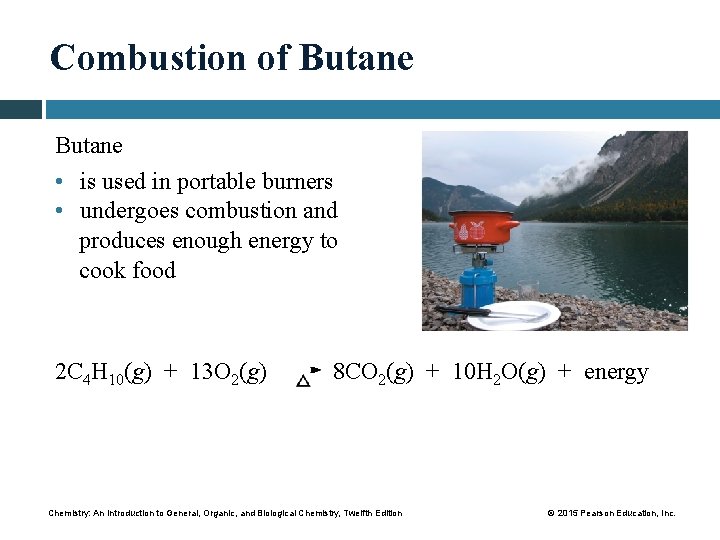
Combustion of Butane • is used in portable burners • undergoes combustion and produces enough energy to cook food 2 C 4 H 10(g) + 13 O 2(g) 8 CO 2(g) + 10 H 2 O(g) + energy Chemistry: An Introduction to General, Organic, and Biological Chemistry, Twelfth Edition © 2015 Pearson Education, Inc.
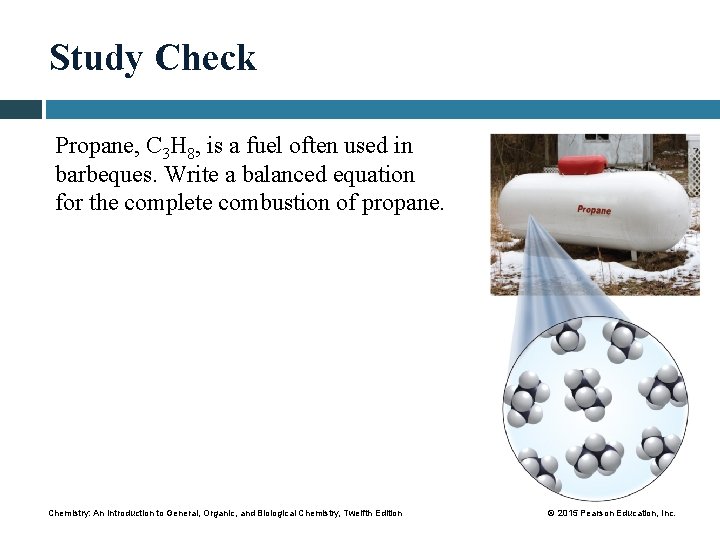
Study Check Propane, C 3 H 8, is a fuel often used in barbeques. Write a balanced equation for the complete combustion of propane. Chemistry: An Introduction to General, Organic, and Biological Chemistry, Twelfth Edition © 2015 Pearson Education, Inc.
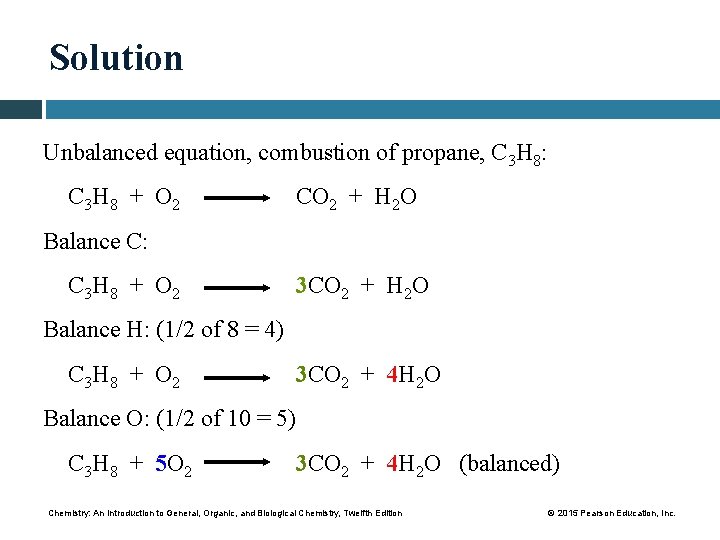
Solution Unbalanced equation, combustion of propane, C 3 H 8: C 3 H 8 + O 2 CO 2 + H 2 O Balance C: C 3 H 8 + O 2 3 CO 2 + H 2 O Balance H: (1/2 of 8 = 4) C 3 H 8 + O 2 3 CO 2 + 4 H 2 O Balance O: (1/2 of 10 = 5) C 3 H 8 + 5 O 2 3 CO 2 + 4 H 2 O (balanced) Chemistry: An Introduction to General, Organic, and Biological Chemistry, Twelfth Edition © 2015 Pearson Education, Inc.
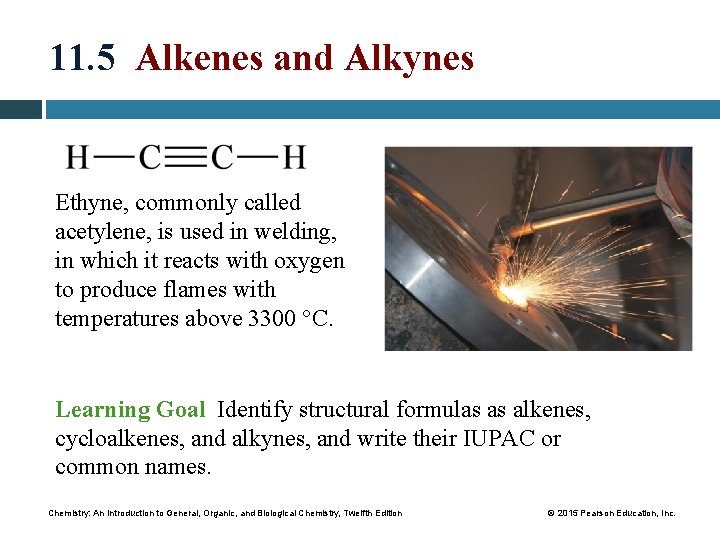
11. 5 Alkenes and Alkynes Ethyne, commonly called acetylene, is used in welding, in which it reacts with oxygen to produce flames with temperatures above 3300 °C. Learning Goal Identify structural formulas as alkenes, cycloalkenes, and alkynes, and write their IUPAC or common names. Chemistry: An Introduction to General, Organic, and Biological Chemistry, Twelfth Edition © 2015 Pearson Education, Inc.
Alkenes and Alkynes Alkenes and alkynes are families of hydrocarbons that • contain double and triple bonds, respectively • are called unsaturated hydrocarbons because they do not contain the maximum number of hydrogen atoms • react with hydrogen gas to increase the number of hydrogen atoms and become alkanes Chemistry: An Introduction to General, Organic, and Biological Chemistry, Twelfth Edition © 2015 Pearson Education, Inc.
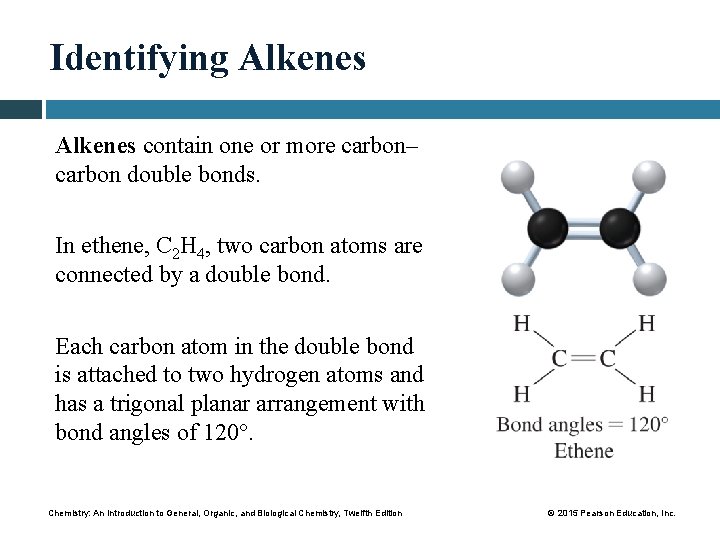
Identifying Alkenes contain one or more carbon– carbon double bonds. In ethene, C 2 H 4, two carbon atoms are connected by a double bond. Each carbon atom in the double bond is attached to two hydrogen atoms and has a trigonal planar arrangement with bond angles of 120°. Chemistry: An Introduction to General, Organic, and Biological Chemistry, Twelfth Edition © 2015 Pearson Education, Inc.
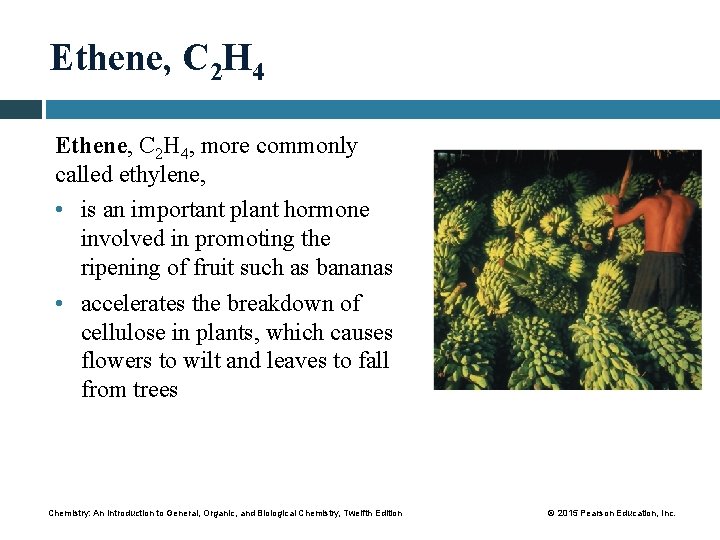
Ethene, C 2 H 4, more commonly called ethylene, • is an important plant hormone involved in promoting the ripening of fruit such as bananas • accelerates the breakdown of cellulose in plants, which causes flowers to wilt and leaves to fall from trees Chemistry: An Introduction to General, Organic, and Biological Chemistry, Twelfth Edition © 2015 Pearson Education, Inc.
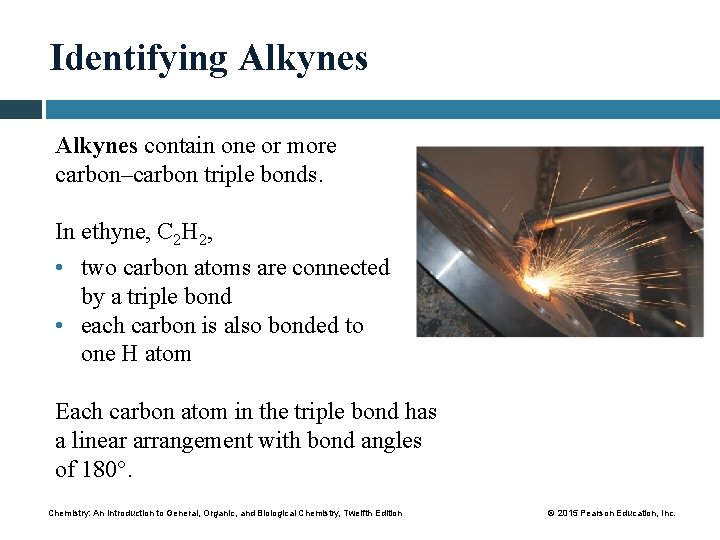
Identifying Alkynes contain one or more carbon–carbon triple bonds. In ethyne, C 2 H 2, • two carbon atoms are connected by a triple bond • each carbon is also bonded to one H atom Each carbon atom in the triple bond has a linear arrangement with bond angles of 180°. Chemistry: An Introduction to General, Organic, and Biological Chemistry, Twelfth Edition © 2015 Pearson Education, Inc.
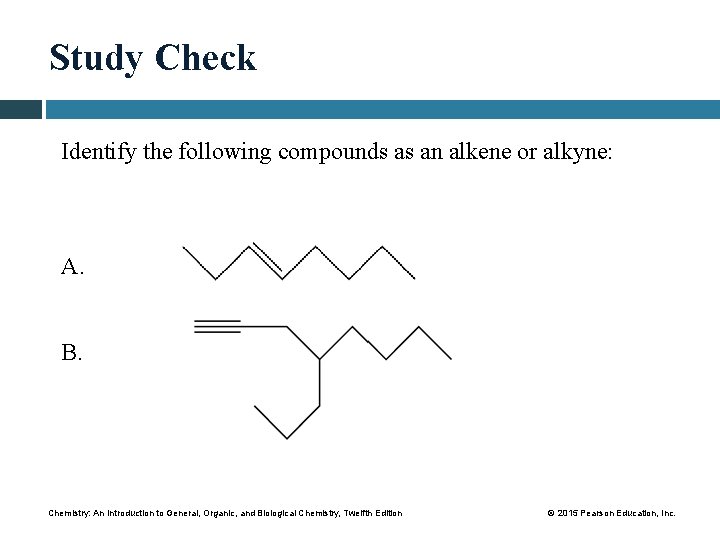
Study Check Identify the following compounds as an alkene or alkyne: A. B. Chemistry: An Introduction to General, Organic, and Biological Chemistry, Twelfth Edition © 2015 Pearson Education, Inc.
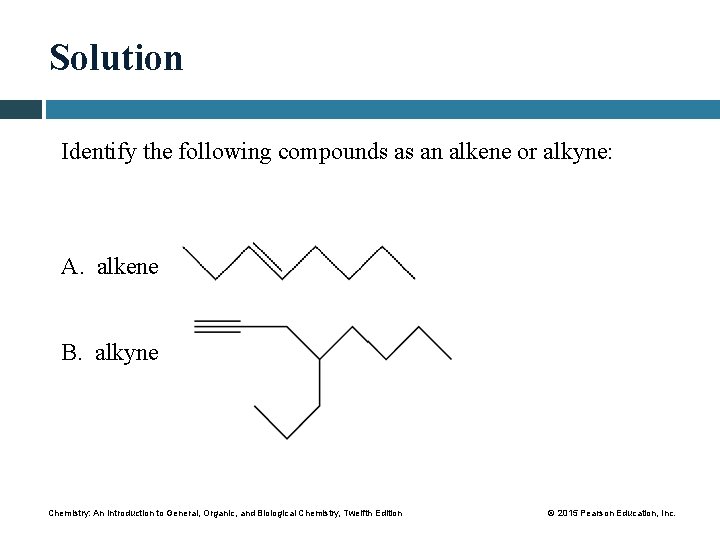
Solution Identify the following compounds as an alkene or alkyne: A. alkene B. alkyne Chemistry: An Introduction to General, Organic, and Biological Chemistry, Twelfth Edition © 2015 Pearson Education, Inc.
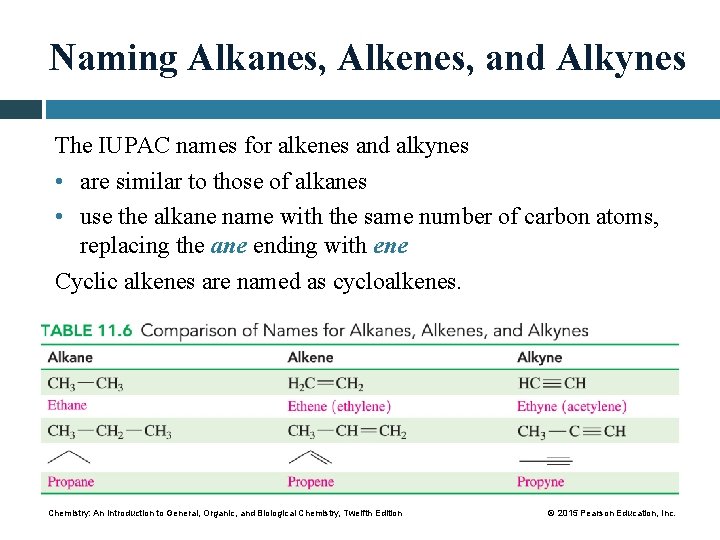
Naming Alkanes, Alkenes, and Alkynes The IUPAC names for alkenes and alkynes • are similar to those of alkanes • use the alkane name with the same number of carbon atoms, replacing the ane ending with ene Cyclic alkenes are named as cycloalkenes. Chemistry: An Introduction to General, Organic, and Biological Chemistry, Twelfth Edition © 2015 Pearson Education, Inc.
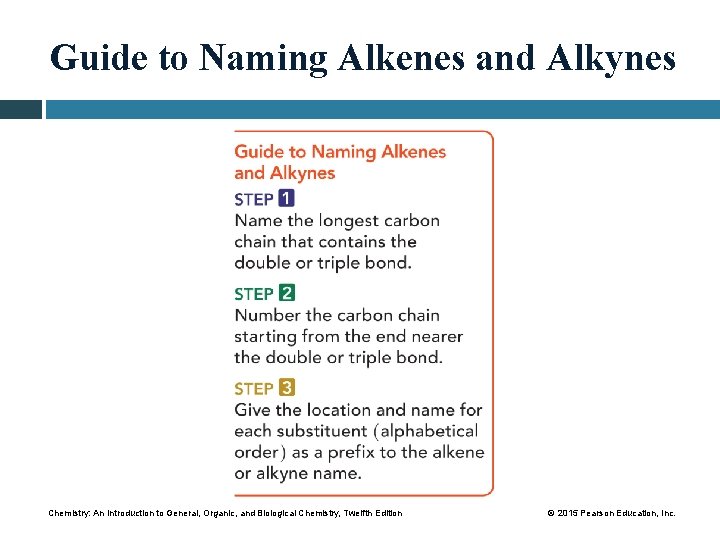
Guide to Naming Alkenes and Alkynes Chemistry: An Introduction to General, Organic, and Biological Chemistry, Twelfth Edition © 2015 Pearson Education, Inc.
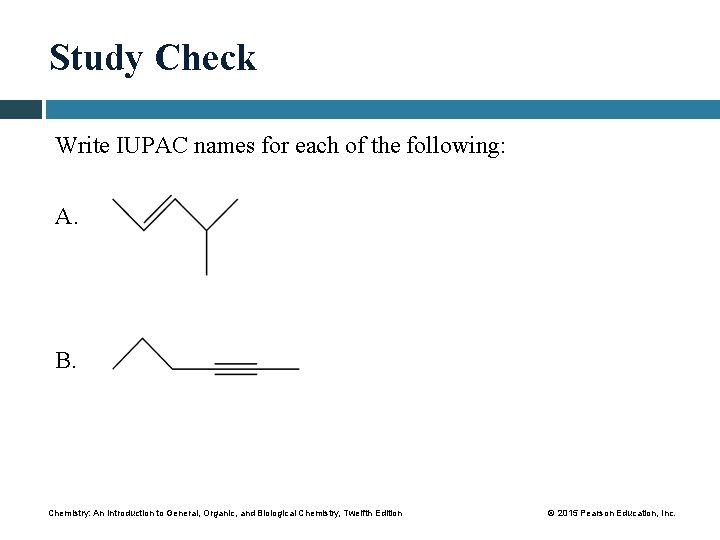
Study Check Write IUPAC names for each of the following: A. B. Chemistry: An Introduction to General, Organic, and Biological Chemistry, Twelfth Edition © 2015 Pearson Education, Inc.
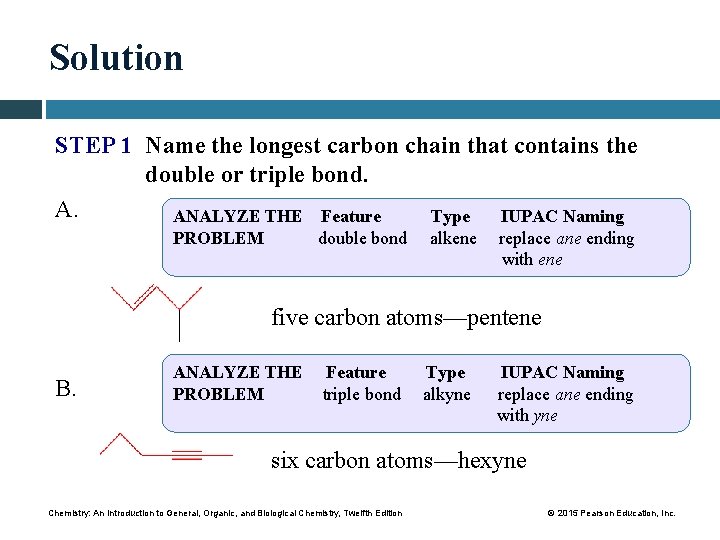
Solution STEP 1 Name the longest carbon chain that contains the double or triple bond. A. ANALYZE THE Feature Type IUPAC Naming PROBLEM double bond alkene replace ane ending with ene five carbon atoms—pentene B. ANALYZE THE PROBLEM Feature triple bond Type alkyne IUPAC Naming replace ane ending with yne six carbon atoms—hexyne Chemistry: An Introduction to General, Organic, and Biological Chemistry, Twelfth Edition © 2015 Pearson Education, Inc.
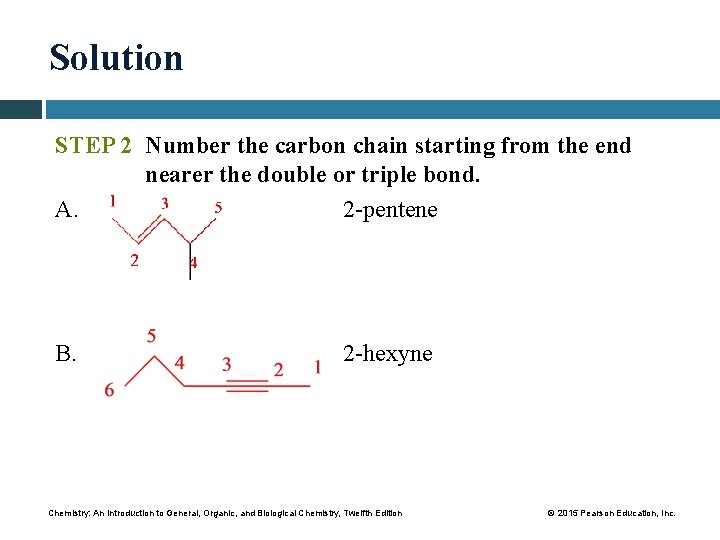
Solution STEP 2 Number the carbon chain starting from the end nearer the double or triple bond. A. 2 -pentene B. 2 -hexyne Chemistry: An Introduction to General, Organic, and Biological Chemistry, Twelfth Edition © 2015 Pearson Education, Inc.
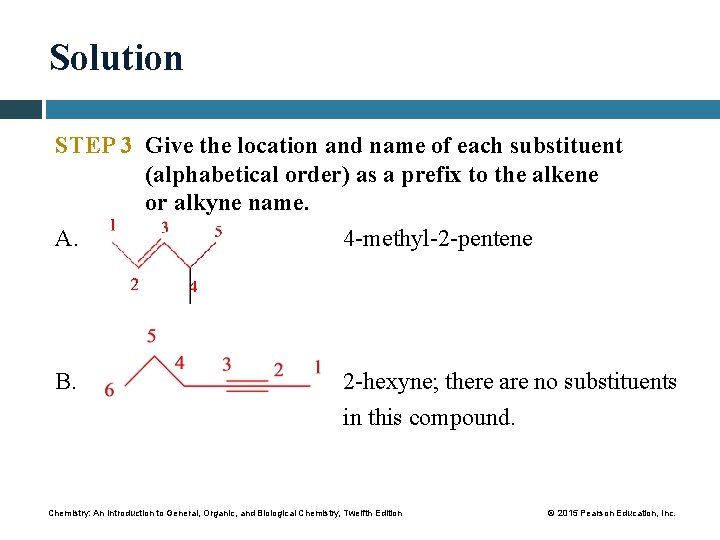
Solution STEP 3 Give the location and name of each substituent (alphabetical order) as a prefix to the alkene or alkyne name. A. 4 -methyl-2 -pentene B. 2 -hexyne; there are no substituents in this compound. Chemistry: An Introduction to General, Organic, and Biological Chemistry, Twelfth Edition © 2015 Pearson Education, Inc.
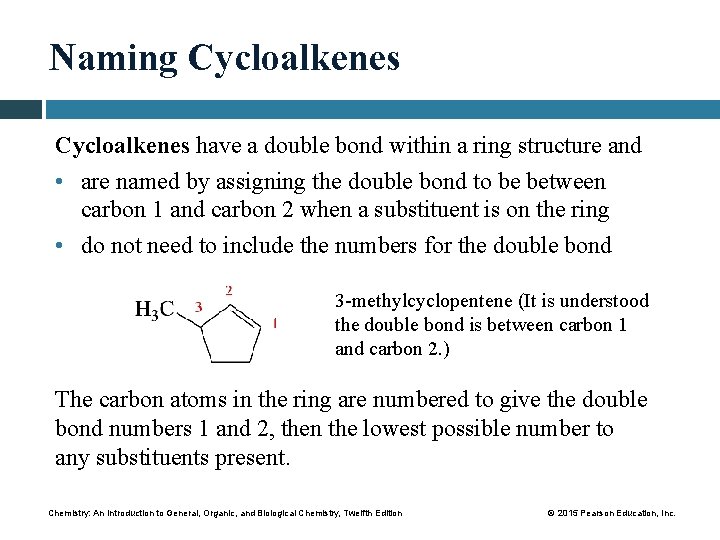
Naming Cycloalkenes have a double bond within a ring structure and • are named by assigning the double bond to be between carbon 1 and carbon 2 when a substituent is on the ring • do not need to include the numbers for the double bond 3 -methylcyclopentene (It is understood the double bond is between carbon 1 and carbon 2. ) The carbon atoms in the ring are numbered to give the double bond numbers 1 and 2, then the lowest possible number to any substituents present. Chemistry: An Introduction to General, Organic, and Biological Chemistry, Twelfth Edition © 2015 Pearson Education, Inc.
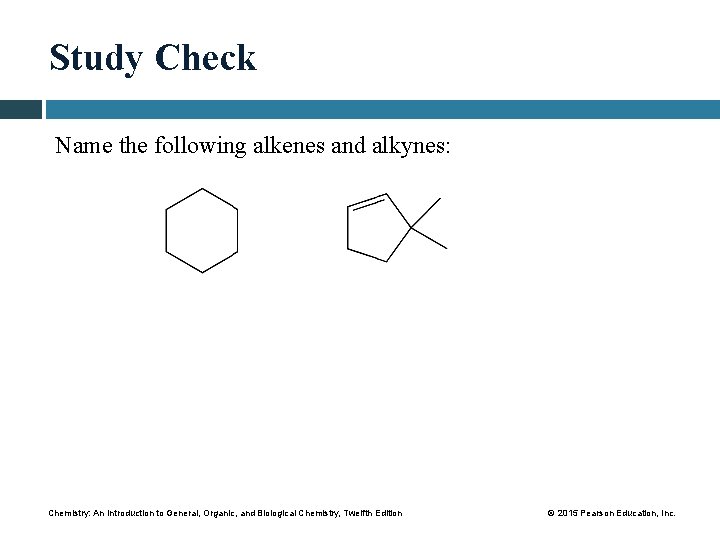
Study Check Name the following alkenes and alkynes: Chemistry: An Introduction to General, Organic, and Biological Chemistry, Twelfth Edition © 2015 Pearson Education, Inc.
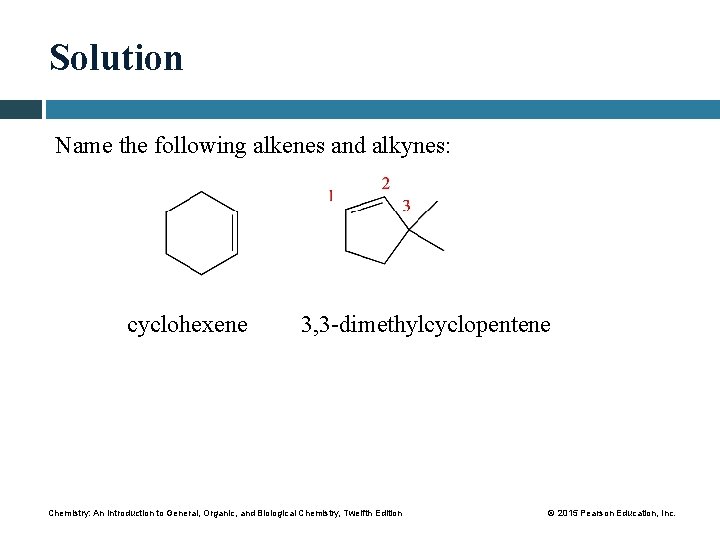
Solution Name the following alkenes and alkynes: cyclohexene 3, 3 -dimethylcyclopentene Chemistry: An Introduction to General, Organic, and Biological Chemistry, Twelfth Edition © 2015 Pearson Education, Inc.
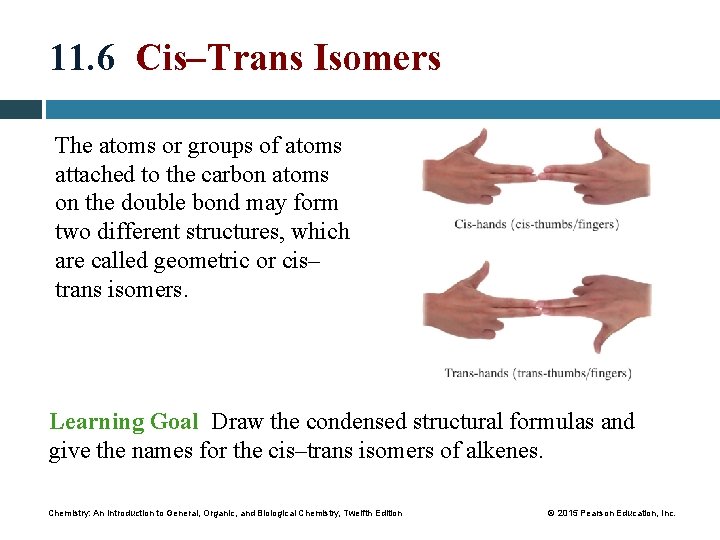
11. 6 Cis–Trans Isomers The atoms or groups of atoms attached to the carbon atoms on the double bond may form two different structures, which are called geometric or cis– trans isomers. Learning Goal Draw the condensed structural formulas and give the names for the cis–trans isomers of alkenes. Chemistry: An Introduction to General, Organic, and Biological Chemistry, Twelfth Edition © 2015 Pearson Education, Inc.
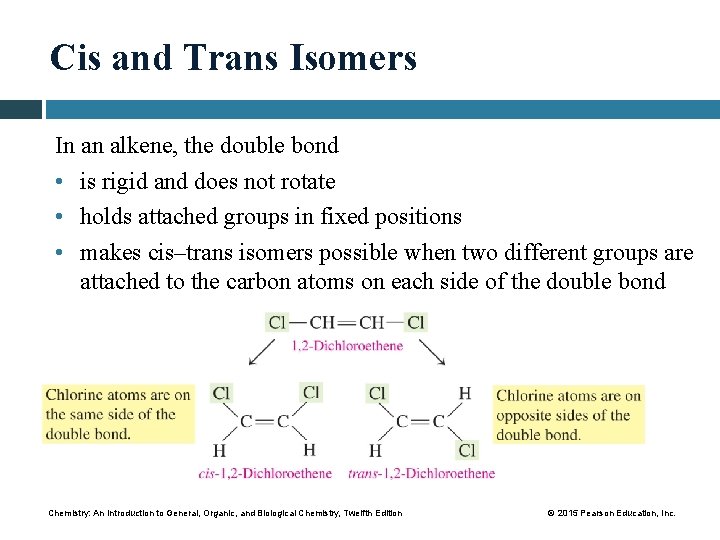
Cis and Trans Isomers In an alkene, the double bond • is rigid and does not rotate • holds attached groups in fixed positions • makes cis–trans isomers possible when two different groups are attached to the carbon atoms on each side of the double bond Chemistry: An Introduction to General, Organic, and Biological Chemistry, Twelfth Edition © 2015 Pearson Education, Inc.
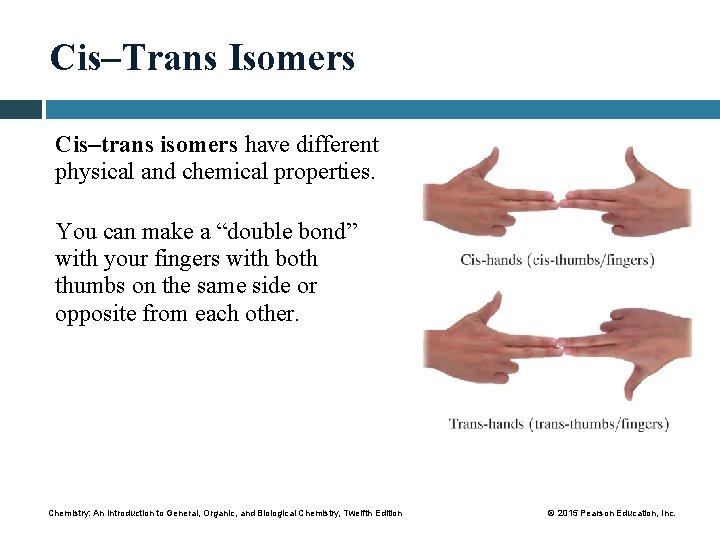
Cis–Trans Isomers Cis–trans isomers have different physical and chemical properties. You can make a “double bond” with your fingers with both thumbs on the same side or opposite from each other. Chemistry: An Introduction to General, Organic, and Biological Chemistry, Twelfth Edition © 2015 Pearson Education, Inc.
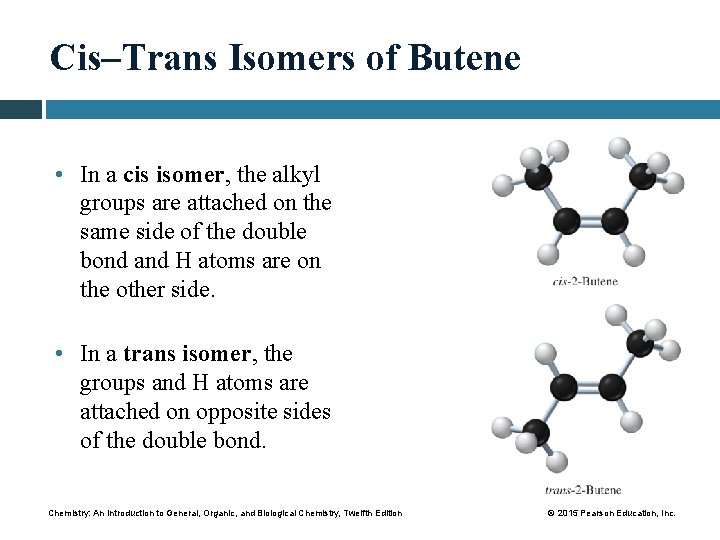
Cis–Trans Isomers of Butene • In a cis isomer, the alkyl groups are attached on the same side of the double bond and H atoms are on the other side. • In a trans isomer, the groups and H atoms are attached on opposite sides of the double bond. Chemistry: An Introduction to General, Organic, and Biological Chemistry, Twelfth Edition © 2015 Pearson Education, Inc.
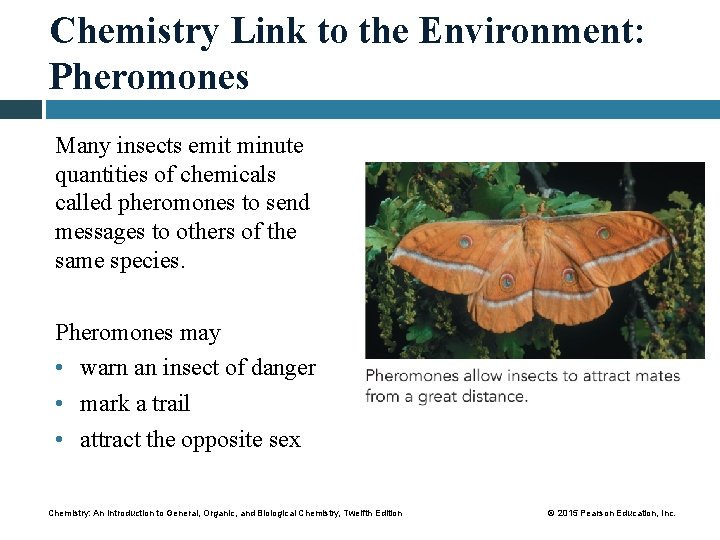
Chemistry Link to the Environment: Pheromones Many insects emit minute quantities of chemicals called pheromones to send messages to others of the same species. Pheromones may • warn an insect of danger • mark a trail • attract the opposite sex Chemistry: An Introduction to General, Organic, and Biological Chemistry, Twelfth Edition © 2015 Pearson Education, Inc.
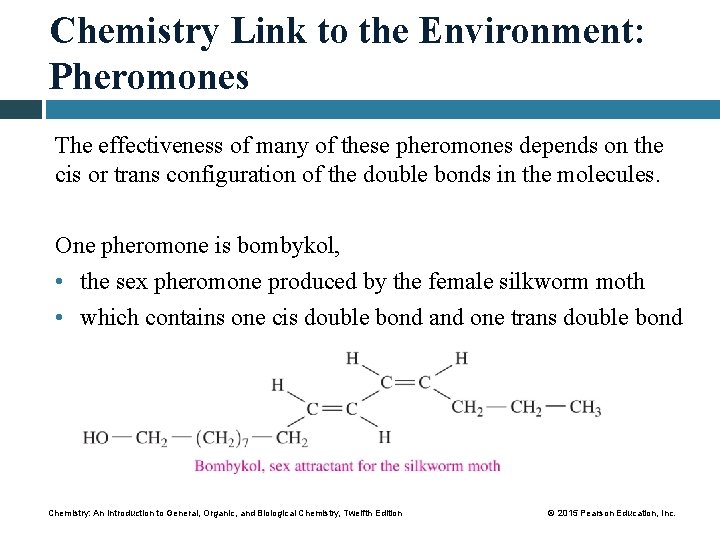
Chemistry Link to the Environment: Pheromones The effectiveness of many of these pheromones depends on the cis or trans configuration of the double bonds in the molecules. One pheromone is bombykol, • the sex pheromone produced by the female silkworm moth • which contains one cis double bond and one trans double bond Chemistry: An Introduction to General, Organic, and Biological Chemistry, Twelfth Edition © 2015 Pearson Education, Inc.
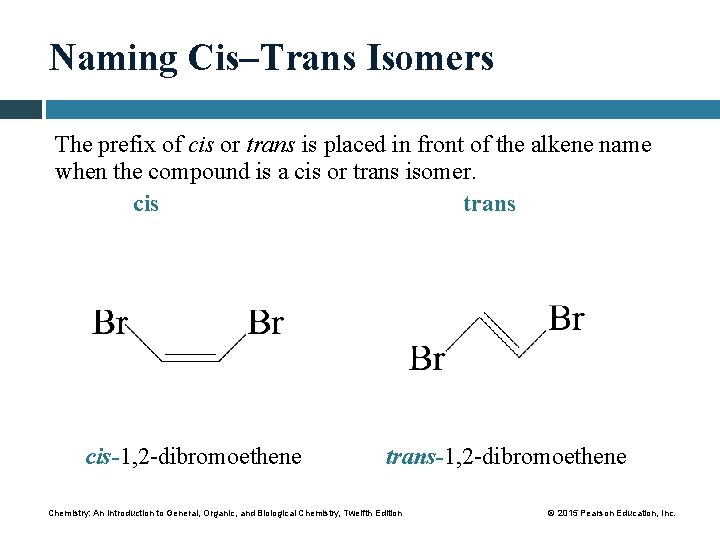
Naming Cis–Trans Isomers The prefix of cis or trans is placed in front of the alkene name when the compound is a cis or trans isomer. cis trans cis-1, 2 -dibromoethene trans-1, 2 -dibromoethene Chemistry: An Introduction to General, Organic, and Biological Chemistry, Twelfth Edition © 2015 Pearson Education, Inc.
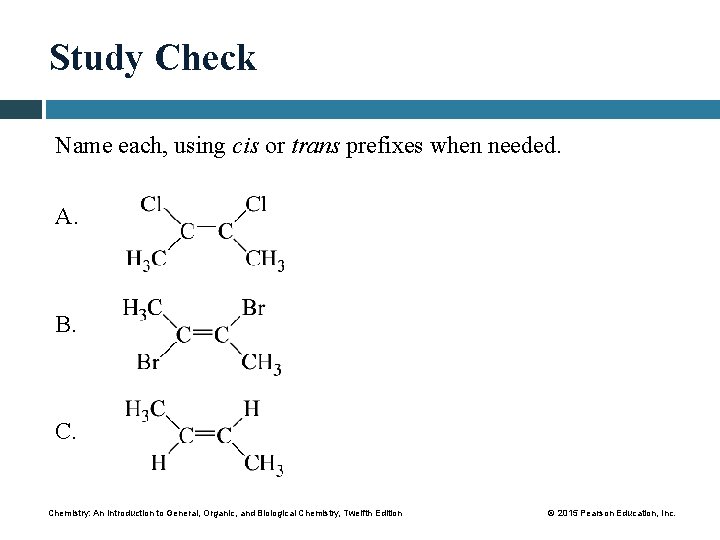
Study Check Name each, using cis or trans prefixes when needed. A. B. Chemistry: An Introduction to General, Organic, and Biological Chemistry, Twelfth Edition © 2015 Pearson Education, Inc.
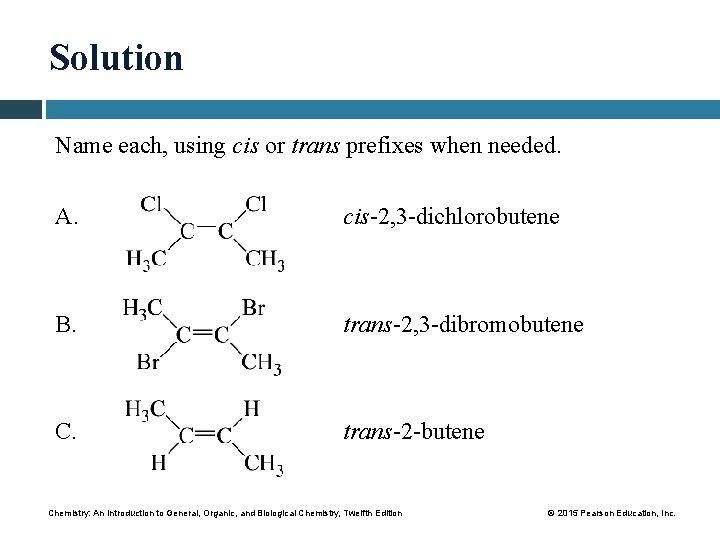
Solution Name each, using cis or trans prefixes when needed. A. cis-2, 3 -dichlorobutene B. trans-2, 3 -dibromobutene C. trans-2 -butene Chemistry: An Introduction to General, Organic, and Biological Chemistry, Twelfth Edition © 2015 Pearson Education, Inc.
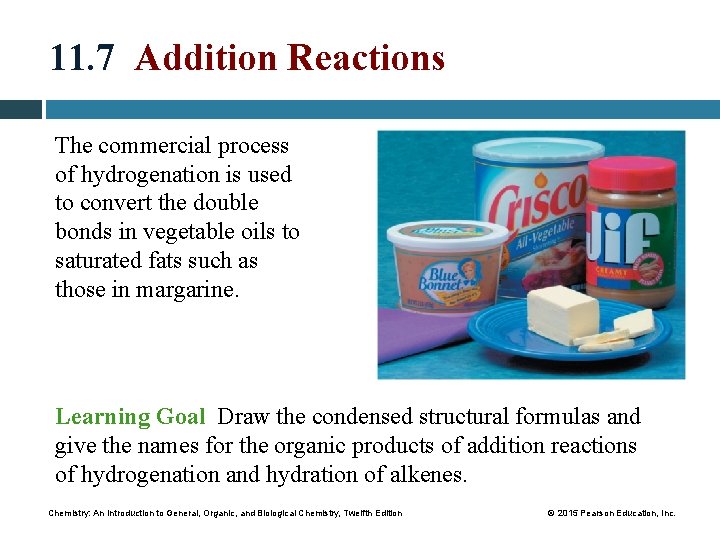
11. 7 Addition Reactions The commercial process of hydrogenation is used to convert the double bonds in vegetable oils to saturated fats such as those in margarine. Learning Goal Draw the condensed structural formulas and give the names for the organic products of addition reactions of hydrogenation and hydration of alkenes. Chemistry: An Introduction to General, Organic, and Biological Chemistry, Twelfth Edition © 2015 Pearson Education, Inc.
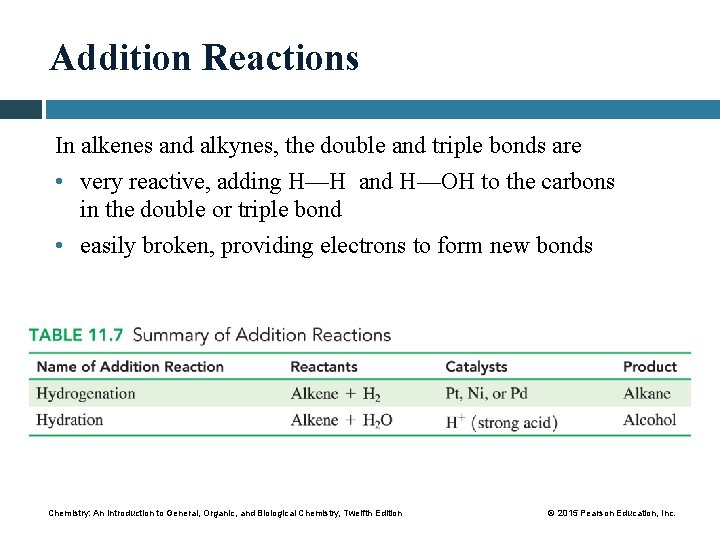
Addition Reactions In alkenes and alkynes, the double and triple bonds are • very reactive, adding H—H and H—OH to the carbons in the double or triple bond • easily broken, providing electrons to form new bonds Chemistry: An Introduction to General, Organic, and Biological Chemistry, Twelfth Edition © 2015 Pearson Education, Inc.
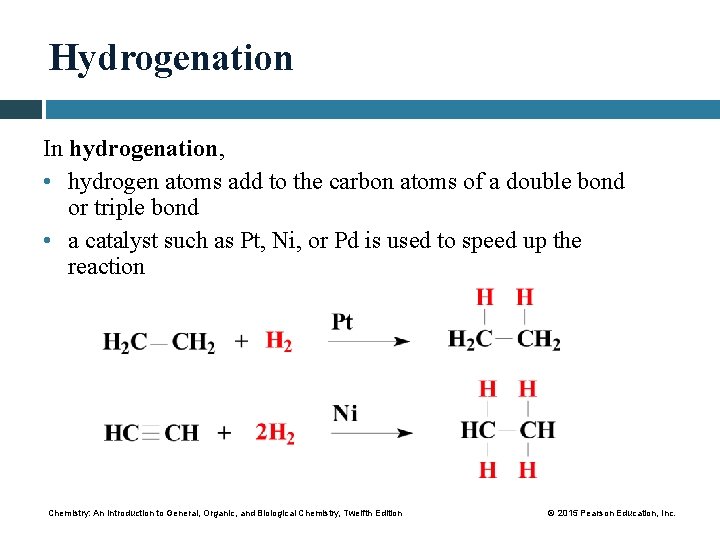
Hydrogenation In hydrogenation, • hydrogen atoms add to the carbon atoms of a double bond or triple bond • a catalyst such as Pt, Ni, or Pd is used to speed up the reaction Chemistry: An Introduction to General, Organic, and Biological Chemistry, Twelfth Edition © 2015 Pearson Education, Inc.
Study Check Write an equation for the hydrogenation of 1 -butene using a platinum catalyst. Chemistry: An Introduction to General, Organic, and Biological Chemistry, Twelfth Edition © 2015 Pearson Education, Inc.
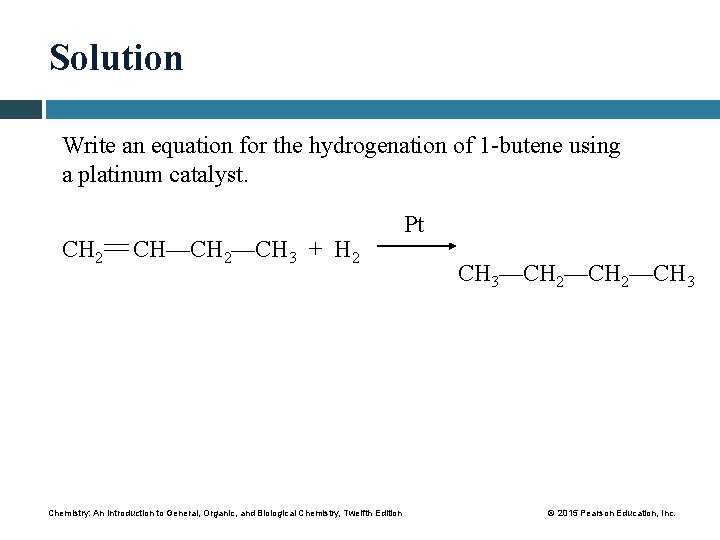
Solution Write an equation for the hydrogenation of 1 -butene using a platinum catalyst. CH 2 CH—CH 2—CH 3 + H 2 Chemistry: An Introduction to General, Organic, and Biological Chemistry, Twelfth Edition Pt CH 3—CH 2—CH 3 © 2015 Pearson Education, Inc.
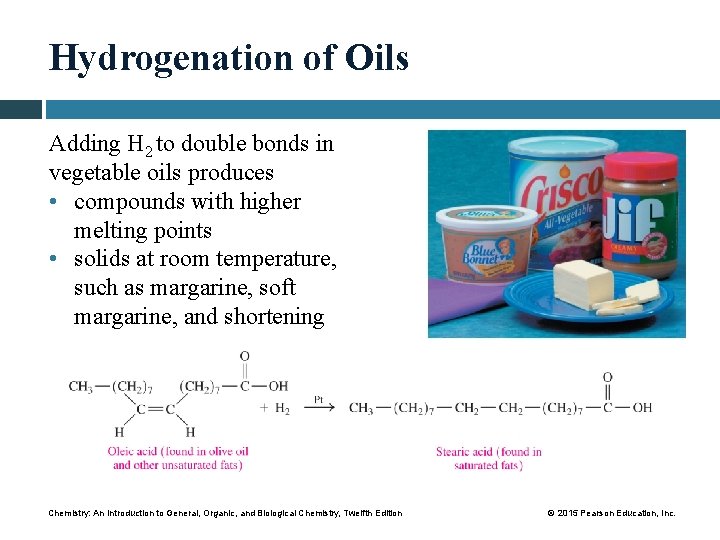
Hydrogenation of Oils Adding H 2 to double bonds in vegetable oils produces • compounds with higher melting points • solids at room temperature, such as margarine, soft margarine, and shortening Chemistry: An Introduction to General, Organic, and Biological Chemistry, Twelfth Edition © 2015 Pearson Education, Inc.
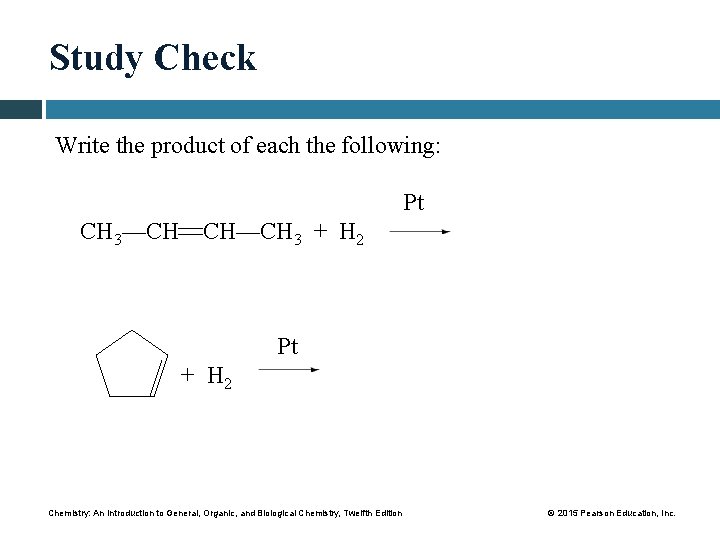
Study Check Write the product of each the following: Pt CH 3—CH CH—CH 3 + H 2 Pt + H 2 Chemistry: An Introduction to General, Organic, and Biological Chemistry, Twelfth Edition © 2015 Pearson Education, Inc.
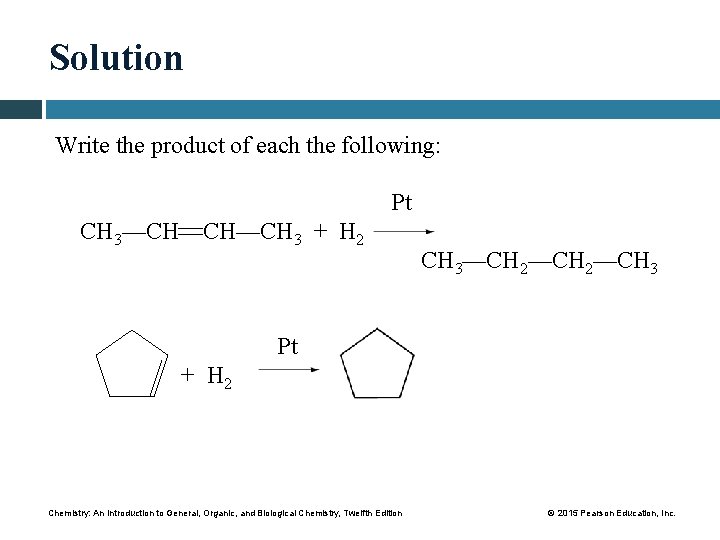
Solution Write the product of each the following: Pt CH 3—CH CH—CH 3 + H 2 CH 3—CH 2—CH 3 Pt + H 2 Chemistry: An Introduction to General, Organic, and Biological Chemistry, Twelfth Edition © 2015 Pearson Education, Inc.
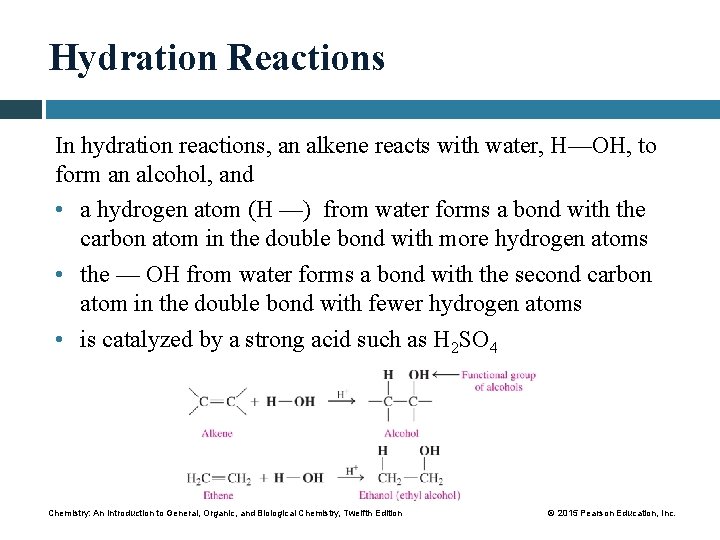
Hydration Reactions In hydration reactions, an alkene reacts with water, H—OH, to form an alcohol, and • a hydrogen atom (H —) from water forms a bond with the carbon atom in the double bond with more hydrogen atoms • the — OH from water forms a bond with the second carbon atom in the double bond with fewer hydrogen atoms • is catalyzed by a strong acid such as H 2 SO 4 Chemistry: An Introduction to General, Organic, and Biological Chemistry, Twelfth Edition © 2015 Pearson Education, Inc.
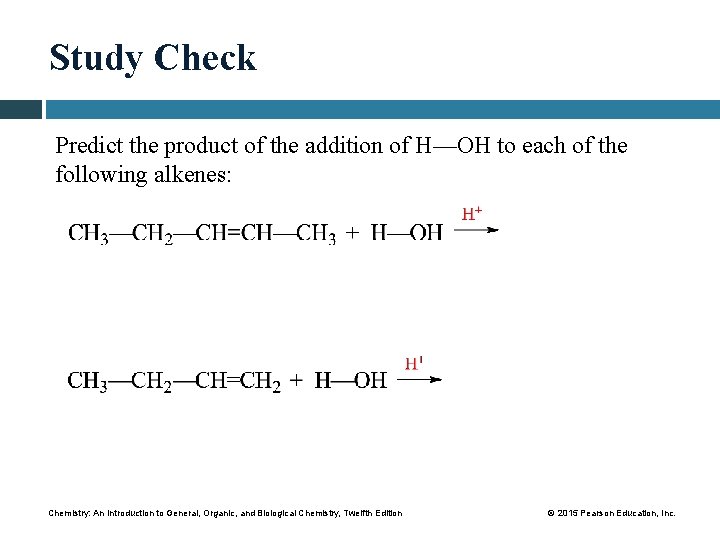
Study Check Predict the product of the addition of H—OH to each of the following alkenes: Chemistry: An Introduction to General, Organic, and Biological Chemistry, Twelfth Edition © 2015 Pearson Education, Inc.
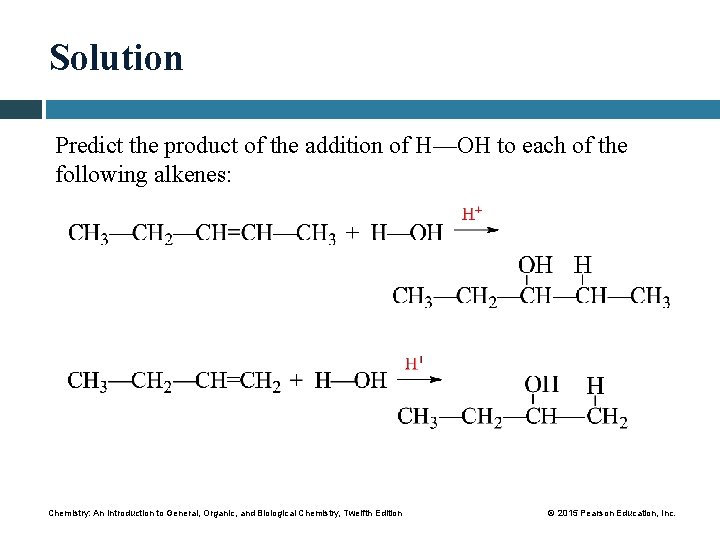
Solution Predict the product of the addition of H—OH to each of the following alkenes: Chemistry: An Introduction to General, Organic, and Biological Chemistry, Twelfth Edition © 2015 Pearson Education, Inc.
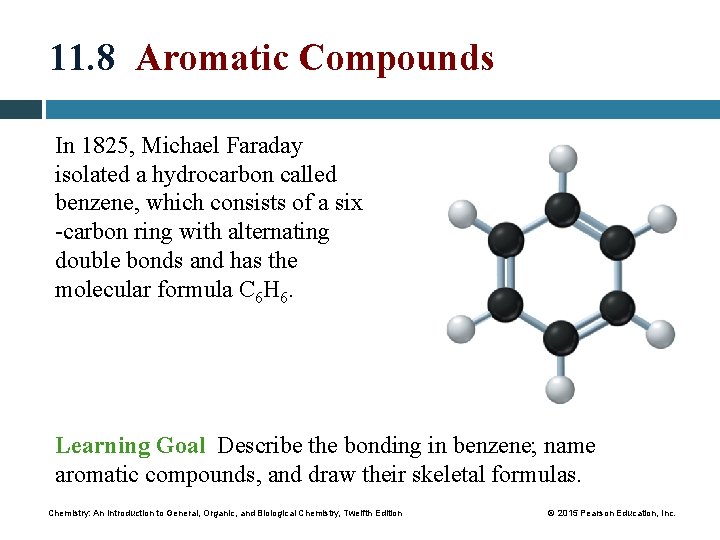
11. 8 Aromatic Compounds In 1825, Michael Faraday isolated a hydrocarbon called benzene, which consists of a six -carbon ring with alternating double bonds and has the molecular formula C 6 H 6. Learning Goal Describe the bonding in benzene; name aromatic compounds, and draw their skeletal formulas. Chemistry: An Introduction to General, Organic, and Biological Chemistry, Twelfth Edition © 2015 Pearson Education, Inc.
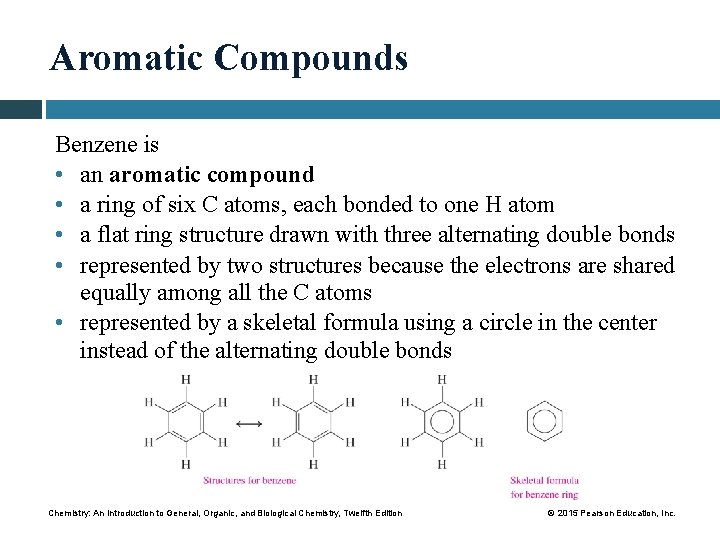
Aromatic Compounds Benzene is • an aromatic compound • a ring of six C atoms, each bonded to one H atom • a flat ring structure drawn with three alternating double bonds • represented by two structures because the electrons are shared equally among all the C atoms • represented by a skeletal formula using a circle in the center instead of the alternating double bonds Chemistry: An Introduction to General, Organic, and Biological Chemistry, Twelfth Edition © 2015 Pearson Education, Inc.
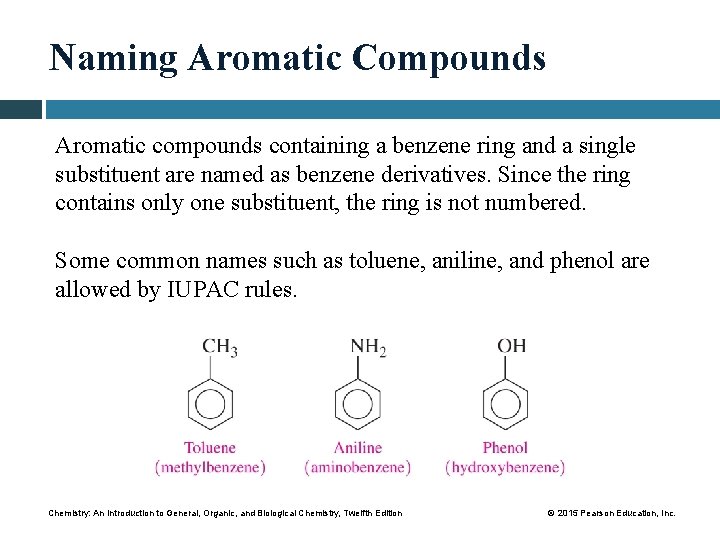
Naming Aromatic Compounds Aromatic compounds containing a benzene ring and a single substituent are named as benzene derivatives. Since the ring contains only one substituent, the ring is not numbered. Some common names such as toluene, aniline, and phenol are allowed by IUPAC rules. Chemistry: An Introduction to General, Organic, and Biological Chemistry, Twelfth Edition © 2015 Pearson Education, Inc.
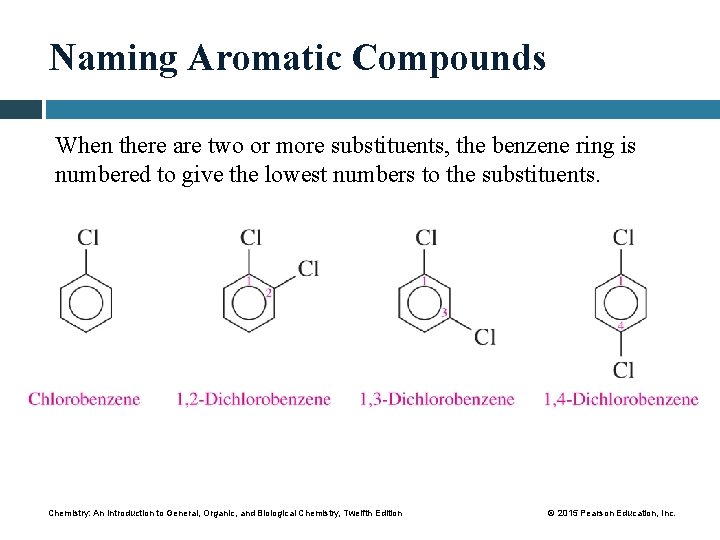
Naming Aromatic Compounds When there are two or more substituents, the benzene ring is numbered to give the lowest numbers to the substituents. Chemistry: An Introduction to General, Organic, and Biological Chemistry, Twelfth Edition © 2015 Pearson Education, Inc.
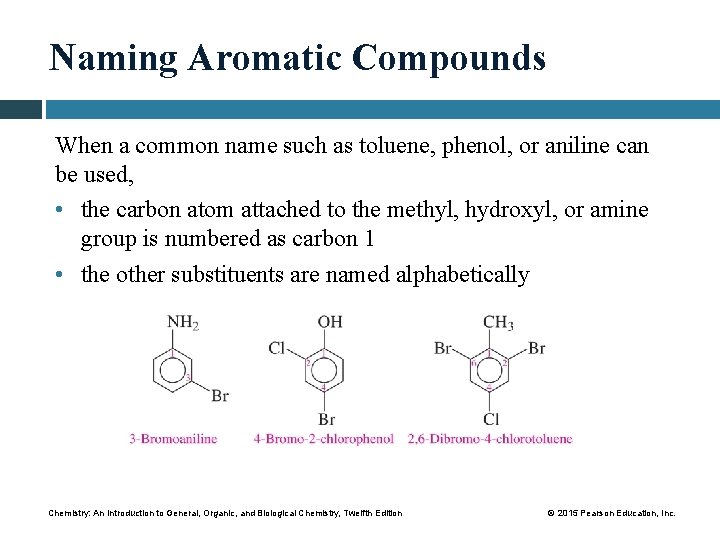
Naming Aromatic Compounds When a common name such as toluene, phenol, or aniline can be used, • the carbon atom attached to the methyl, hydroxyl, or amine group is numbered as carbon 1 • the other substituents are named alphabetically Chemistry: An Introduction to General, Organic, and Biological Chemistry, Twelfth Edition © 2015 Pearson Education, Inc.
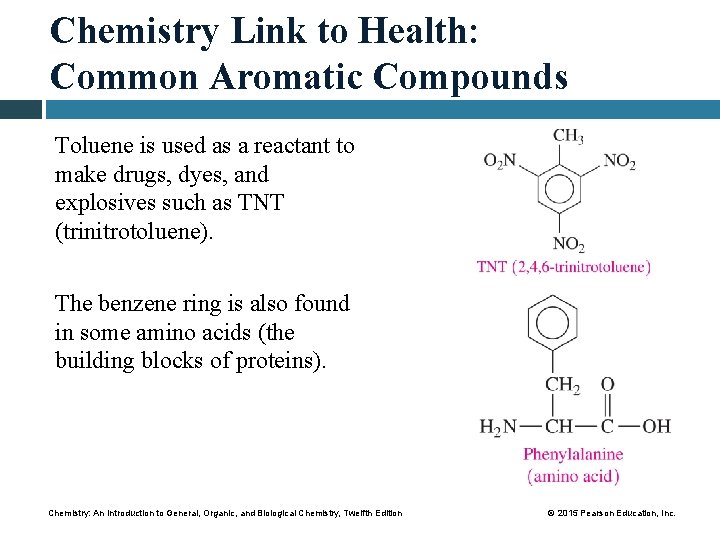
Chemistry Link to Health: Common Aromatic Compounds Toluene is used as a reactant to make drugs, dyes, and explosives such as TNT (trinitrotoluene). The benzene ring is also found in some amino acids (the building blocks of proteins). Chemistry: An Introduction to General, Organic, and Biological Chemistry, Twelfth Edition © 2015 Pearson Education, Inc.
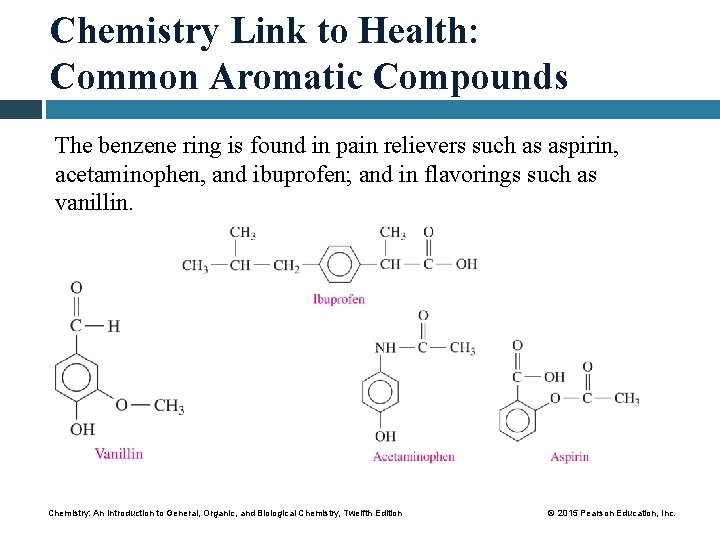
Chemistry Link to Health: Common Aromatic Compounds The benzene ring is found in pain relievers such as aspirin, acetaminophen, and ibuprofen; and in flavorings such as vanillin. Chemistry: An Introduction to General, Organic, and Biological Chemistry, Twelfth Edition © 2015 Pearson Education, Inc.
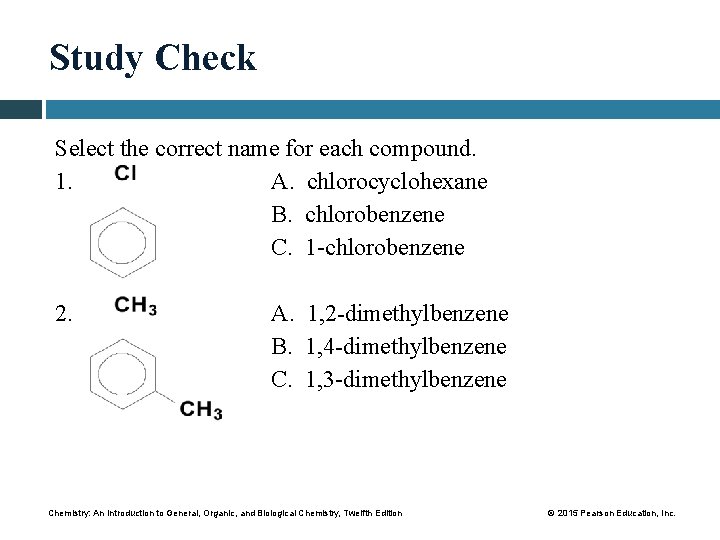
Study Check Select the correct name for each compound. 1. A. chlorocyclohexane B. chlorobenzene C. 1 -chlorobenzene 2. A. 1, 2 -dimethylbenzene B. 1, 4 -dimethylbenzene C. 1, 3 -dimethylbenzene Chemistry: An Introduction to General, Organic, and Biological Chemistry, Twelfth Edition © 2015 Pearson Education, Inc.
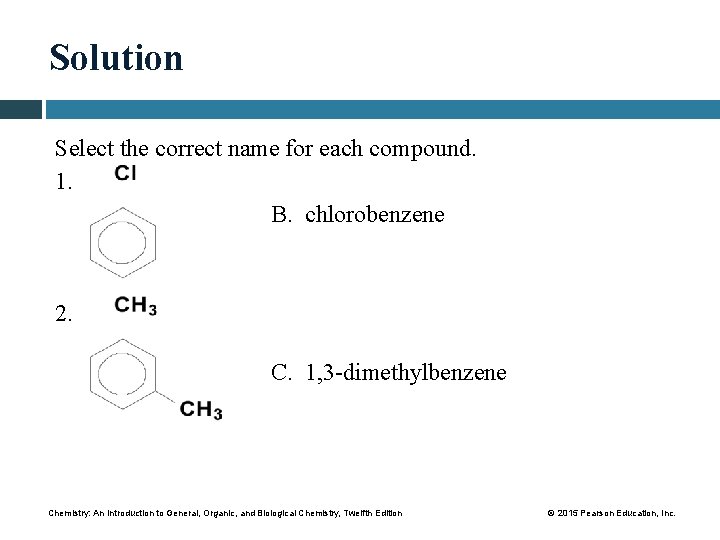
Solution Select the correct name for each compound. 1. B. chlorobenzene 2. C. 1, 3 -dimethylbenzene Chemistry: An Introduction to General, Organic, and Biological Chemistry, Twelfth Edition © 2015 Pearson Education, Inc.
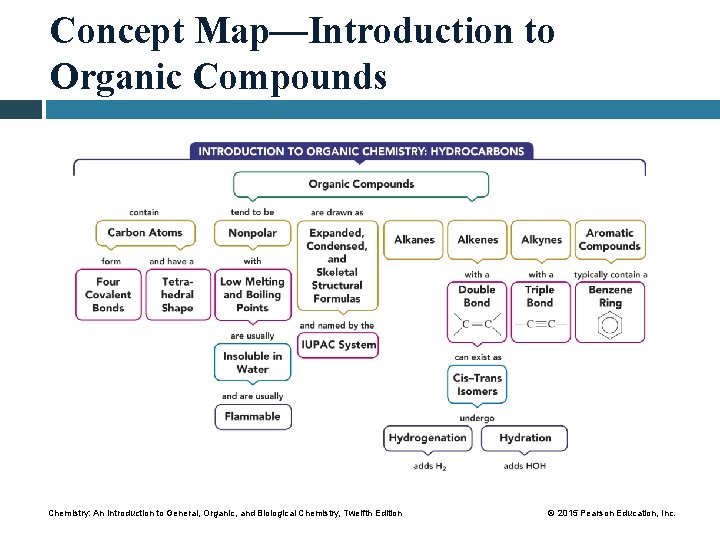
Concept Map—Introduction to Organic Compounds Chemistry: An Introduction to General, Organic, and Biological Chemistry, Twelfth Edition © 2015 Pearson Education, Inc.
- Slides: 109