
Chapter 11 Introduction to Genetics SC 912 L
- Slides: 76
Chapter 11 Introduction to Genetics SC. 912. L. 16. 1 Use Mendel’s Laws of segregation and independent assortment to analyze patterns of inheritance
11. 1 The work of Gregor Mendel Objectives Describe Mendel’s studies and conclusions about inheritance. Describe the role of fertilization.
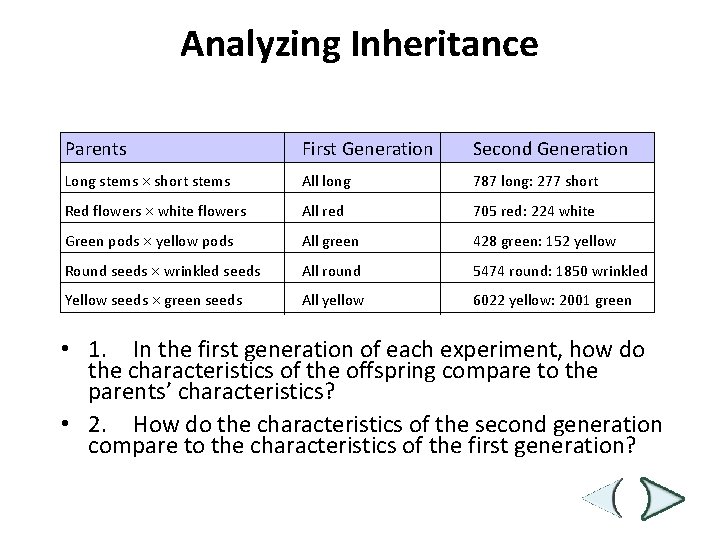
Analyzing Inheritance • Offspring resemble their parents. Offspring inherit genes for characteristics from their parents. To learn about inheritance, scientists have experimented with breeding various plants and animals. • In each experiment shown in the table on the next slide, two pea plants with different characteristics were bred. Then, the offspring produced were bred to produce a second generation of offspring. Consider the data and answer the questions that follow.
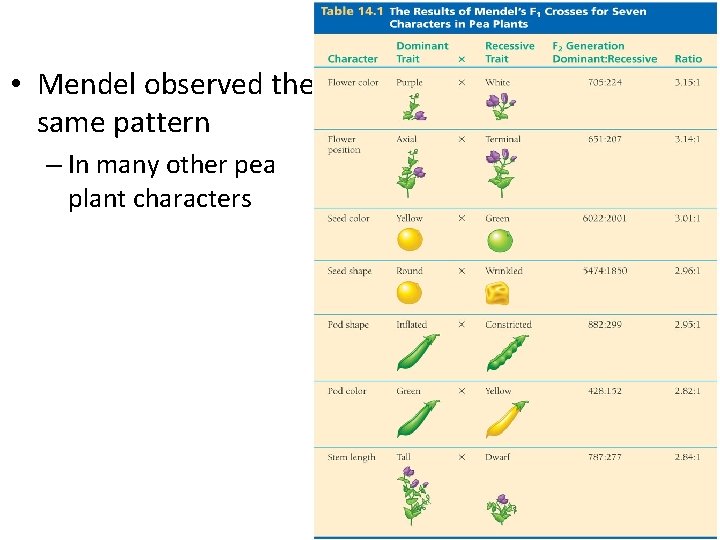
Interest Grabber continued Analyzing Inheritance Parents First Generation Second Generation Long stems short stems All long 787 long: 277 short Red flowers white flowers All red 705 red: 224 white Green pods yellow pods All green 428 green: 152 yellow Round seeds wrinkled seeds All round 5474 round: 1850 wrinkled Yellow seeds green seeds All yellow 6022 yellow: 2001 green • 1. In the first generation of each experiment, how do the characteristics of the offspring compare to the parents’ characteristics? • 2. How do the characteristics of the second generation compare to the characteristics of the first generation?
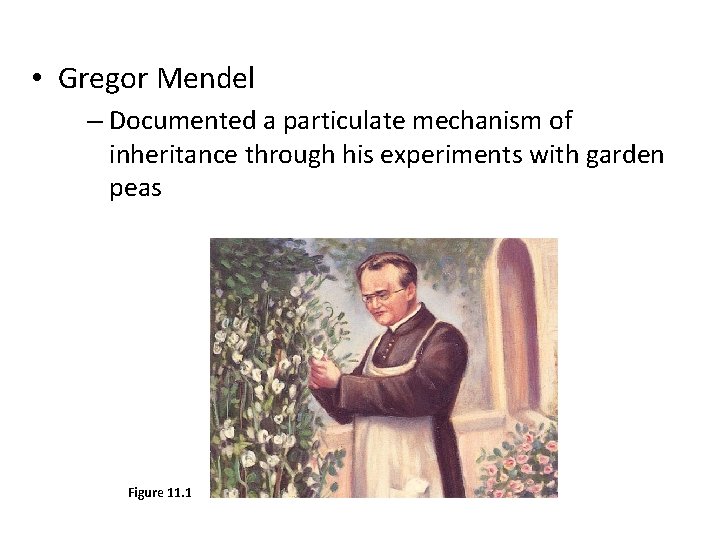
• Gregor Mendel – Documented a particulate mechanism of inheritance through his experiments with garden peas Figure 11. 1
11. 1 The work of Gregor Mendel • Mendel discovered the basic principles of heredity – By breeding garden peas in carefully planned experiments • Why do you think Mendel chose to work with pea plants? – Because they are available in many varieties – Reproduce fast, and – Because he could strictly control which plants mated with which
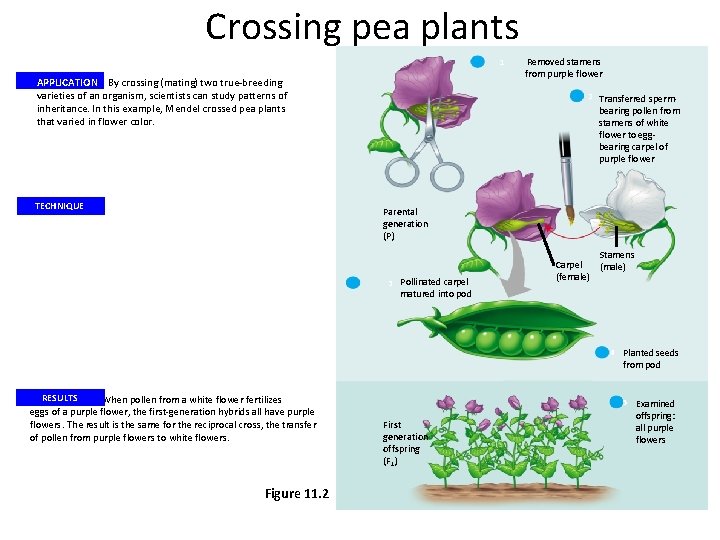
Crossing pea plants 1 APPLICATION By crossing (mating) two true-breeding varieties of an organism, scientists can study patterns of inheritance. In this example, Mendel crossed pea plants that varied in flower color. TECHNIQUE Removed stamens from purple flower 2 Transferred sperm- bearing pollen from stamens of white flower to eggbearing carpel of purple flower Parental generation (P) 3 Pollinated carpel Stamens Carpel (male) (female) matured into pod 4 Planted seeds from pod TECHNIQUE RESULTS When pollen from a white flower fertilizes eggs of a purple flower, the first-generation hybrids all have purple flowers. The result is the same for the reciprocal cross, the transfer of pollen from purple flowers to white flowers. Figure 11. 2 5 Examined First generation offspring (F 1) offspring: all purple flowers
• Some genetic vocabulary – Character: a heritable feature, such as flower color – Trait: a variant of a character, such as purple or white flowers
• Mendel chose to track – Only those characters that varied in an “either-or” manner • Mendel also made sure that – He started his experiments with varieties that were “true-breeding”
• In a typical breeding experiment – Mendel mated two contrasting, truebreeding varieties, a process called hybridization • The true-breeding parents – Are called the P generation
• The hybrid offspring of the P generation – Are called the F 1 generation • When F 1 individuals self-pollinate – The F 2 generation is produced
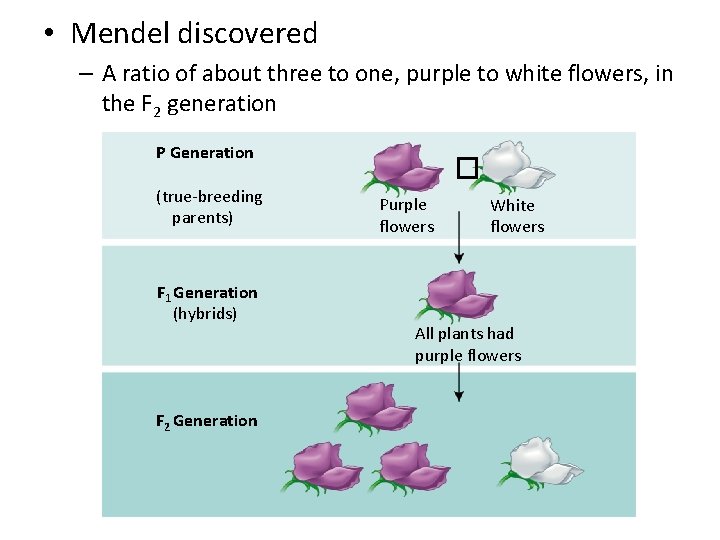
The Law of Segregation • When Mendel crossed contrasting, truebreeding white and purple flowered pea plants – All of the offspring were purple • When Mendel crossed the F 1 plants – Many of the plants had purple flowers, but some had white flowers
• Mendel discovered – A ratio of about three to one, purple to white flowers, in the F 2 generation P Generation (true-breeding parents) F 1 Generation (hybrids) F 2 Generation � Purple flowers White flowers All plants had purple flowers
• Mendel reasoned that – In the F 1 plants, only the purple flower factor was affecting flower color in these hybrids – Purple flower color was dominant, and white flower color was recessive
• Mendel observed the same pattern – In many other pea plant characters
Mendel’s Model • Mendel developed a hypothesis – To explain the 3: 1 inheritance pattern that he observed among the F 2 offspring • Four related concepts make up this model
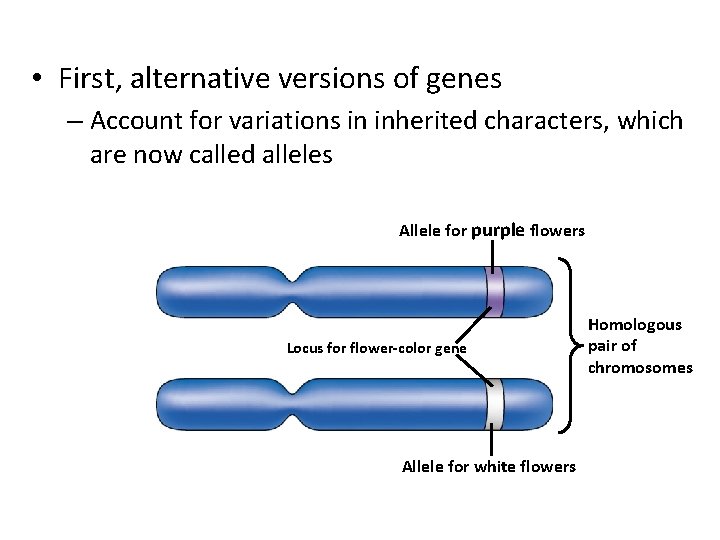
• First, alternative versions of genes – Account for variations in inherited characters, which are now called alleles Allele for purple flowers Locus for flower-color gene Allele for white flowers Homologous pair of chromosomes
• Second, for each character – An organism inherits two alleles, one from each parent – A genetic locus is actually represented twice
• Third, if the two alleles at a locus differ – Then one, the dominant allele, determines the organism’s appearance – The other allele, the recessive allele, has no noticeable effect on the organism’s appearance
• Fourth, the law of segregation – The two alleles for a heritable character separate (segregate) during gamete formation and end up in different gametes
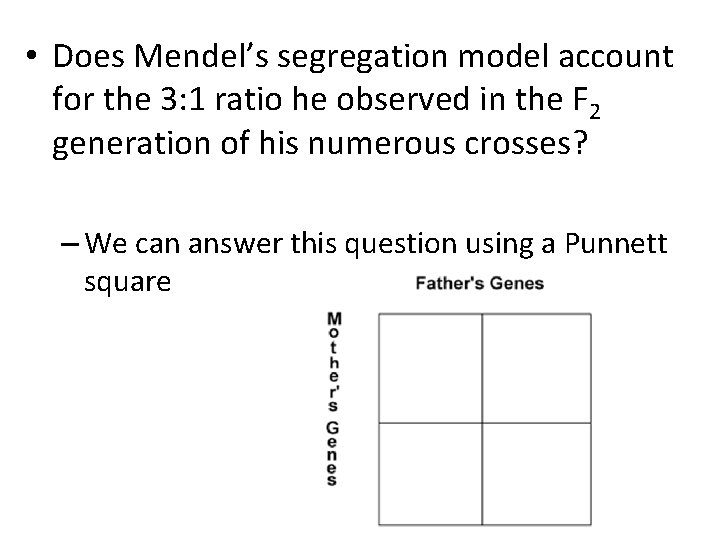
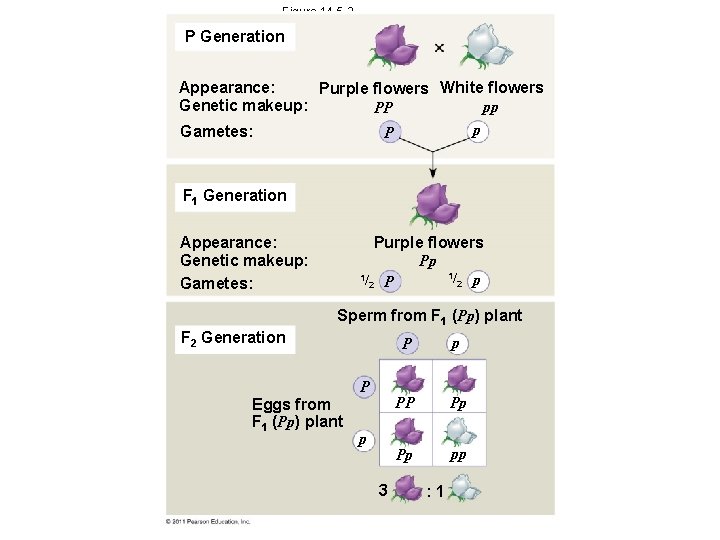
• Does Mendel’s segregation model account for the 3: 1 ratio he observed in the F 2 generation of his numerous crosses? – We can answer this question using a Punnett square
• Mendel’s segregation model accounts for the 3: 1 ratio he observed in the F 2 generation of his numerous crosses • The possible combinations of sperm and egg can be shown using a Punnett square, a diagram for predicting the results of a genetic cross between individuals of known genetic makeup • A capital letter represents a dominant allele, and a lowercase letter represents a recessive allele © 2011 Pearson Education, Inc.
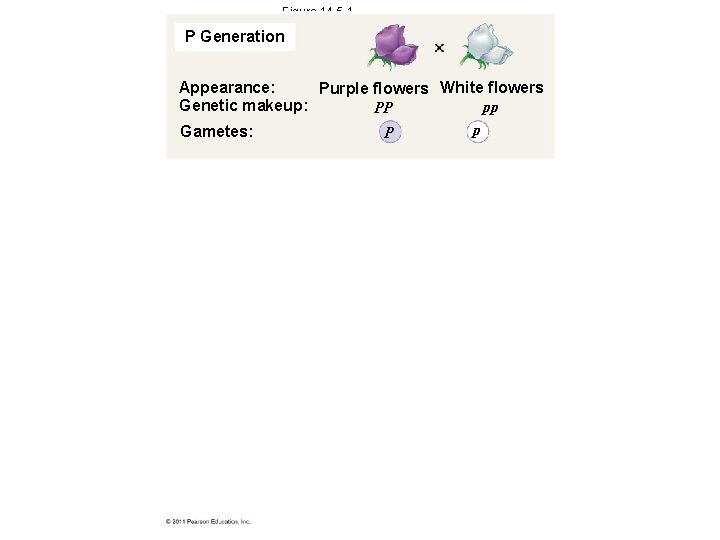
Figure 14. 5 -1 P Generation Appearance: Purple flowers White flowers Genetic makeup: pp PP p Gametes: P
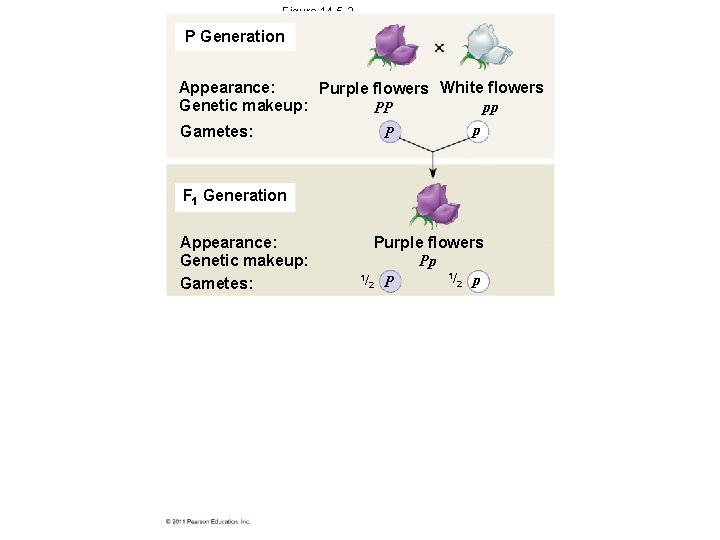
Figure 14. 5 -2 P Generation Appearance: Purple flowers White flowers Genetic makeup: pp PP p Gametes: P F 1 Generation Appearance: Genetic makeup: Gametes: Purple flowers Pp 1/ 1/ 2 p 2 P
Figure 14. 5 -3 P Generation Appearance: Purple flowers White flowers Genetic makeup: pp PP p Gametes: P F 1 Generation Appearance: Genetic makeup: Gametes: Purple flowers Pp 1/ 1/ 2 p 2 P Sperm from F 1 (Pp) plant F 2 Generation Eggs from F 1 (Pp) plant P p 3 P p PP Pp Pp pp : 1
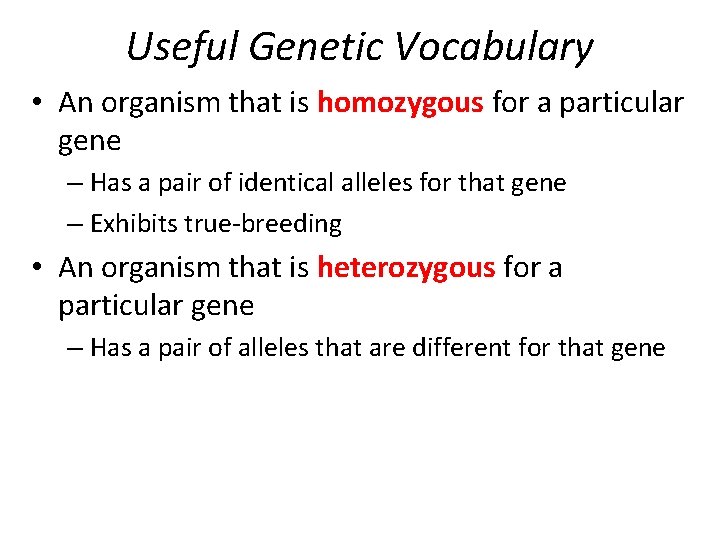
Useful Genetic Vocabulary • An organism that is homozygous for a particular gene – Has a pair of identical alleles for that gene – Exhibits true-breeding • An organism that is heterozygous for a particular gene – Has a pair of alleles that are different for that gene
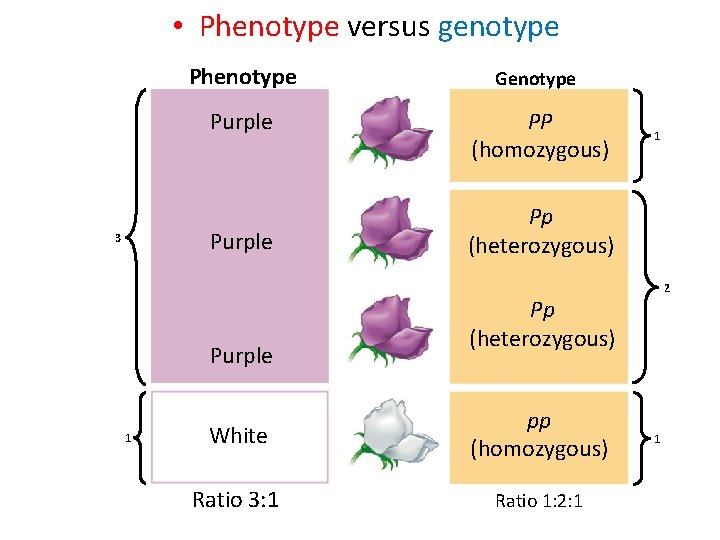
• An organism’s phenotype – Is its physical appearance • An organism’s genotype – Is its genetic makeup
• Phenotype versus genotype Phenotype Genotype Purple PP (homozygous) Purple 3 Purple 1 1 Pp (heterozygous) 2 Pp (heterozygous) White pp (homozygous) Ratio 3: 1 Ratio 1: 2: 1 1
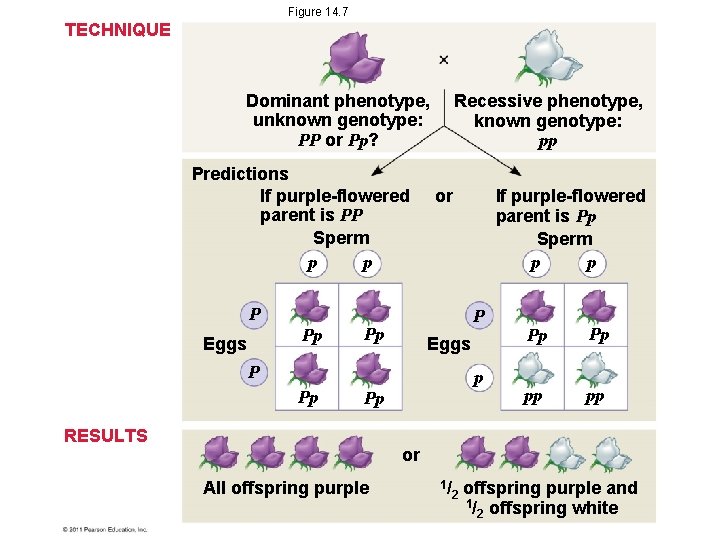
The Testcross • In pea plants with purple flowers – The genotype is not immediately obvious • How can we tell the genotype of an individual with the dominant phenotype? o Such an individual could be either homozygous dominant or heterozygous
• A testcross – Allows us to determine the genotype of an organism with the dominant phenotype, but unknown genotype – Crosses an individual with the dominant phenotype with an individual that is homozygous recessive for a trait
Figure 14. 7 TECHNIQUE Dominant phenotype, unknown genotype: PP or Pp? Predictions If purple-flowered parent is PP Sperm p p Recessive phenotype, known genotype: pp or If purple-flowered parent is Pp Sperm p p P Pp Eggs P p Pp Pp RESULTS Pp Pp pp pp or All offspring purple 1/ 2 offspring purple and 1/ offspring white 2
The Law of Independent Assortment • Mendel derived the law of segregation by following a single character • The F 1 offspring produced in this cross were monohybrids, individuals that are heterozygous for one character • A cross between such heterozygotes is called a monohybrid cross © 2011 Pearson Education, Inc.
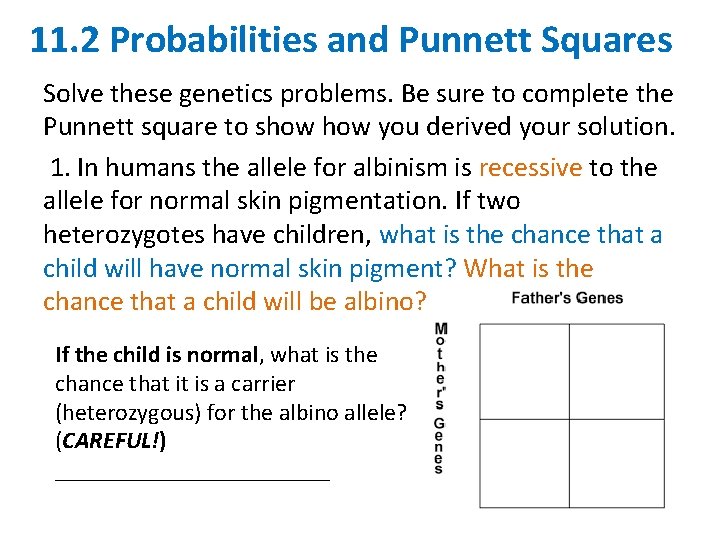
11. 2 Probabilities and Punnett Squares Solve these genetics problems. Be sure to complete the Punnett square to show you derived your solution. 1. In humans the allele for albinism is recessive to the allele for normal skin pigmentation. If two heterozygotes have children, what is the chance that a child will have normal skin pigment? What is the chance that a child will be albino? If the child is normal, what is the chance that it is a carrier (heterozygous) for the albino allele? (CAREFUL!) ____________
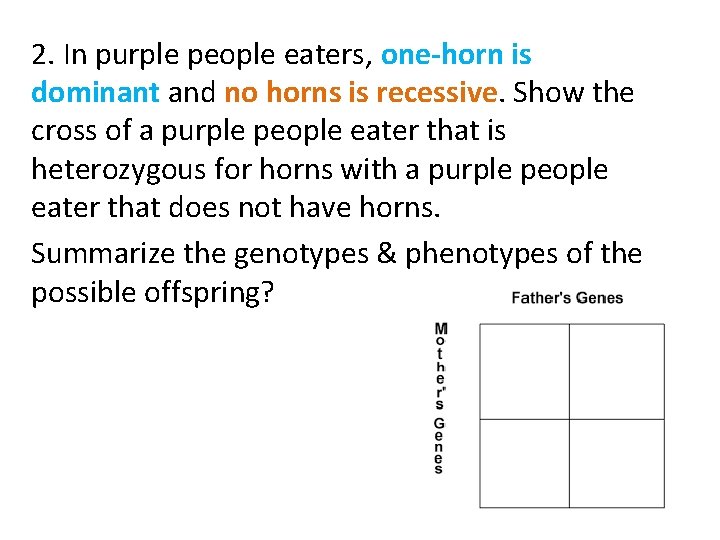
2. In purple people eaters, one-horn is dominant and no horns is recessive. Show the cross of a purple people eater that is heterozygous for horns with a purple people eater that does not have horns. Summarize the genotypes & phenotypes of the possible offspring?
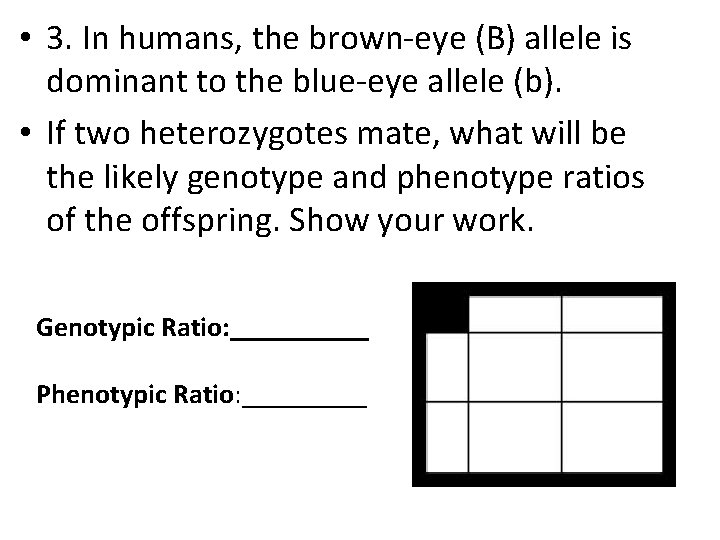
• 3. In humans, the brown-eye (B) allele is dominant to the blue-eye allele (b). • If two heterozygotes mate, what will be the likely genotype and phenotype ratios of the offspring. Show your work. Genotypic Ratio: _____ Phenotypic Ratio: _____
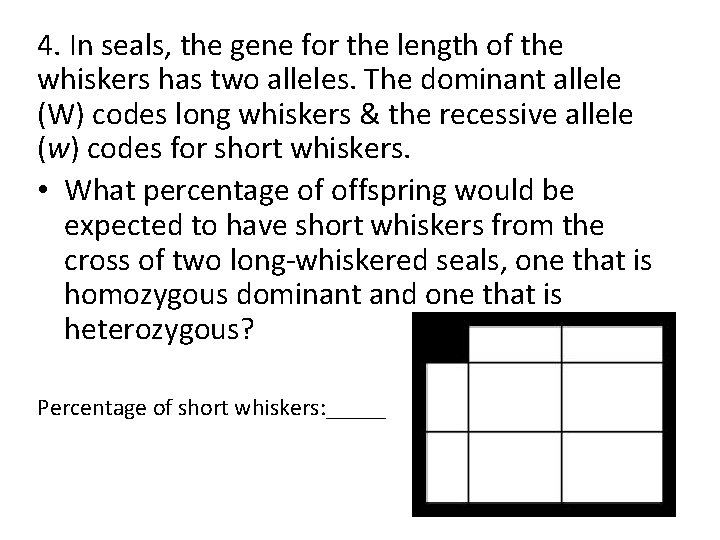
4. In seals, the gene for the length of the whiskers has two alleles. The dominant allele (W) codes long whiskers & the recessive allele (w) codes for short whiskers. • What percentage of offspring would be expected to have short whiskers from the cross of two long-whiskered seals, one that is homozygous dominant and one that is heterozygous? Percentage of short whiskers: _____
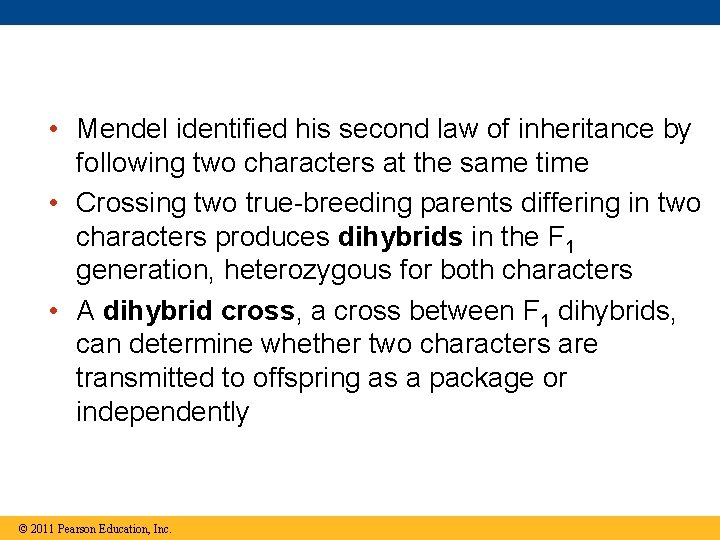
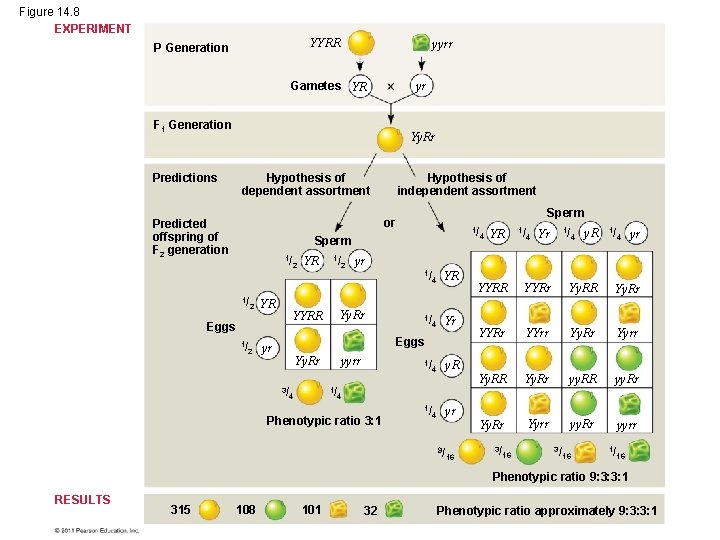
• Mendel identified his second law of inheritance by following two characters at the same time • Crossing two true-breeding parents differing in two characters produces dihybrids in the F 1 generation, heterozygous for both characters • A dihybrid cross, a cross between F 1 dihybrids, can determine whether two characters are transmitted to offspring as a package or independently © 2011 Pearson Education, Inc.
Figure 14. 8 EXPERIMENT YYRR P Generation yyrr Gametes YR yr F 1 Generation Predictions Yy. Rr Hypothesis of dependent assortment Hypothesis of independent assortment Sperm or Predicted offspring of F 2 generation 1/ Sperm 1/ 1/ 2 YR 1/ 2 1/ 1/ 4 YR 4 Yr 4 y. R 4 yr Eggs yr Yy. Rr 3/ yyrr 1/ 4 YR 1/ 4 1/ Yr 4 y. R 1/ 4 yr yr Yy. Rr YYRR Eggs 1/ 2 4 1/ YYRR YYRr Yy. RR Yy. Rr YYrr Yy. Rr Yyrr Yy. RR Yy. Rr yy. RR yy. Rr Yyrr yy. Rr yyrr 4 Phenotypic ratio 3: 1 1/ 9/ 16 3/ 16 1/ 16 Phenotypic ratio 9: 3: 3: 1 RESULTS 315 108 101 32 Phenotypic ratio approximately 9: 3: 3: 1
• Using a dihybrid cross, Mendel developed the law of independent assortment • The law of independent assortment states that each pair of alleles segregates independently of each other pair of alleles during gamete formation • Strictly speaking, this law applies only to genes on different, nonhomologous chromosomes or those far apart on the same chromosome • Genes located near each other on the same chromosome tend to be inherited together © 2011 Pearson Education, Inc.
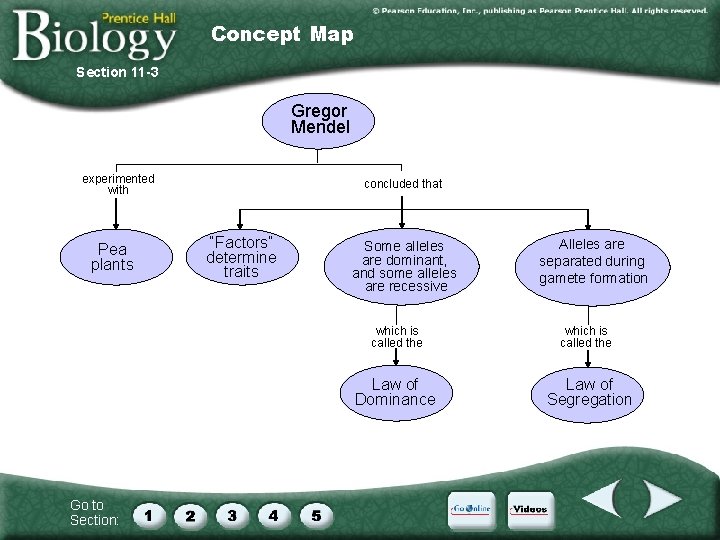
Concept Map Section 11 -3 Gregor Mendel experimented with Pea plants concluded that “Factors” determine traits Some alleles are dominant, and some alleles are recessive which is called the Law of Dominance Go to Section: Alleles are separated during gamete formation which is called the Law of Segregation
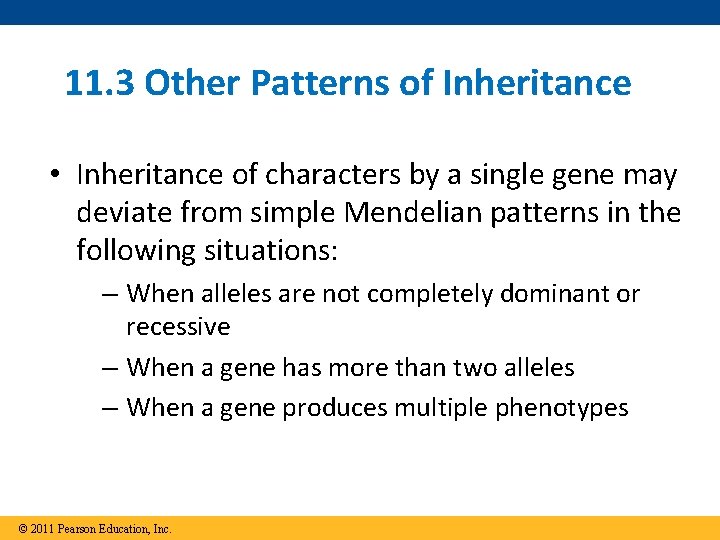
11. 3 Other Patterns of Inheritance • Inheritance of characters by a single gene may deviate from simple Mendelian patterns in the following situations: – When alleles are not completely dominant or recessive – When a gene has more than two alleles – When a gene produces multiple phenotypes © 2011 Pearson Education, Inc.
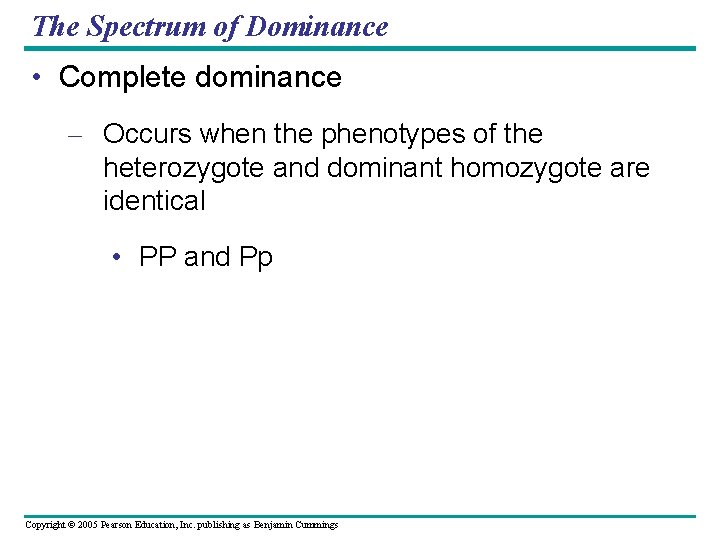
The Spectrum of Dominance • Complete dominance – Occurs when the phenotypes of the heterozygote and dominant homozygote are identical • PP and Pp Copyright © 2005 Pearson Education, Inc. publishing as Benjamin Cummings
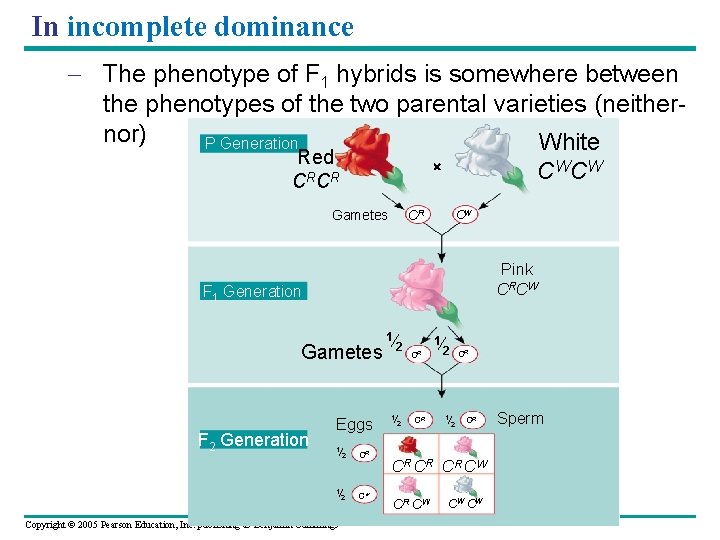
In incomplete dominance – The phenotype of F 1 hybrids is somewhere between the phenotypes of the two parental varieties (neithernor) P Generation White Red CRCR CW CW CR Gametes CW Pink C RC W F 1 Generation Gametes F 2 Generation Eggs 1⁄ 1⁄ Copyright © 2005 Pearson Education, Inc. publishing as Benjamin Cummings 2 CR 2 Cw 1⁄ 2 CR CR 1⁄ 2 1⁄ CR 2 CR CR CW CW CW Sperm
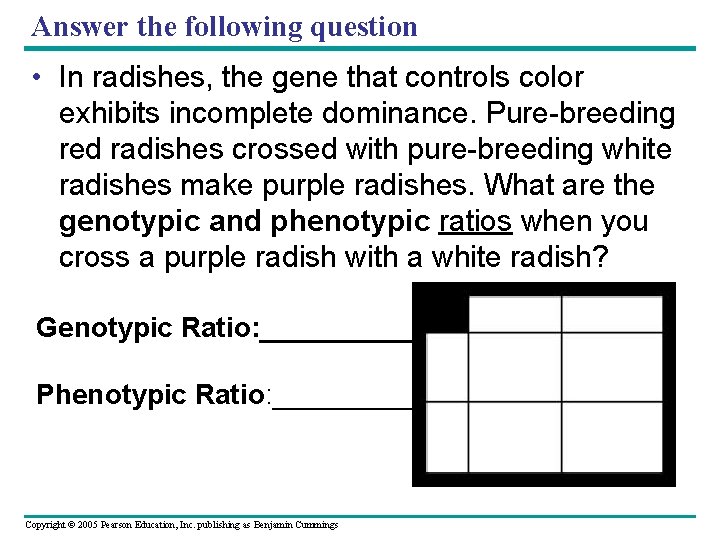
Answer the following question • In radishes, the gene that controls color exhibits incomplete dominance. Pure-breeding red radishes crossed with pure-breeding white radishes make purple radishes. What are the genotypic and phenotypic ratios when you cross a purple radish with a white radish? Genotypic Ratio: _____ Phenotypic Ratio: _____ Copyright © 2005 Pearson Education, Inc. publishing as Benjamin Cummings
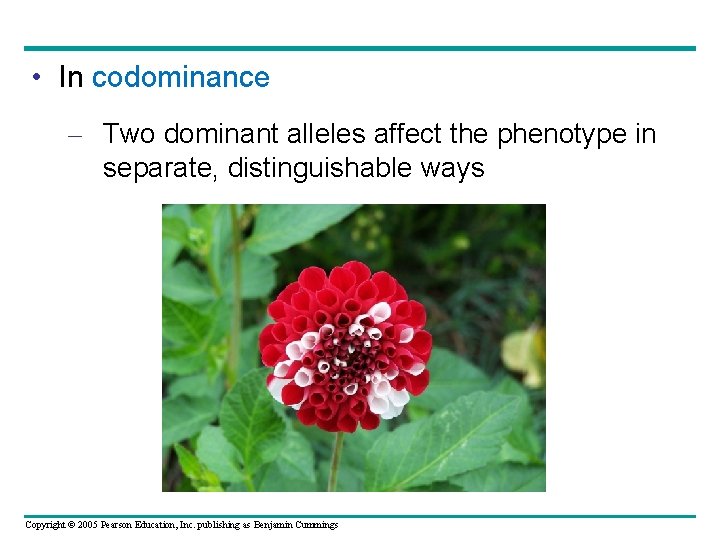
• In codominance – Two dominant alleles affect the phenotype in separate, distinguishable ways Copyright © 2005 Pearson Education, Inc. publishing as Benjamin Cummings
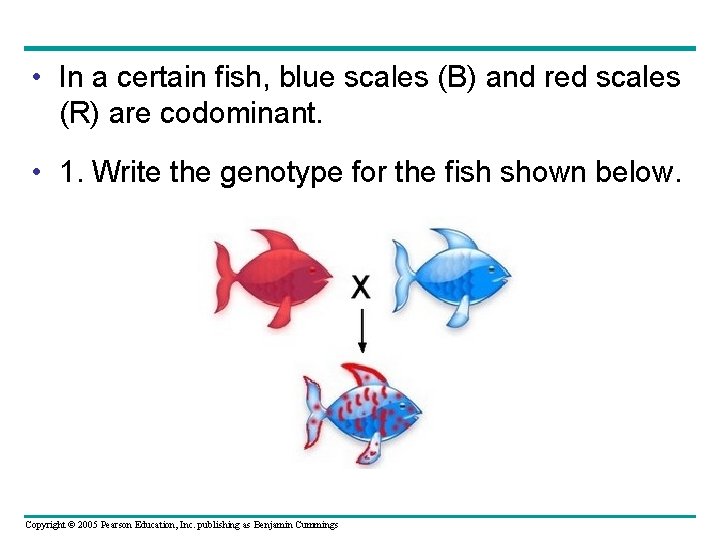
• In a certain fish, blue scales (B) and red scales (R) are codominant. • 1. Write the genotype for the fish shown below. Copyright © 2005 Pearson Education, Inc. publishing as Benjamin Cummings
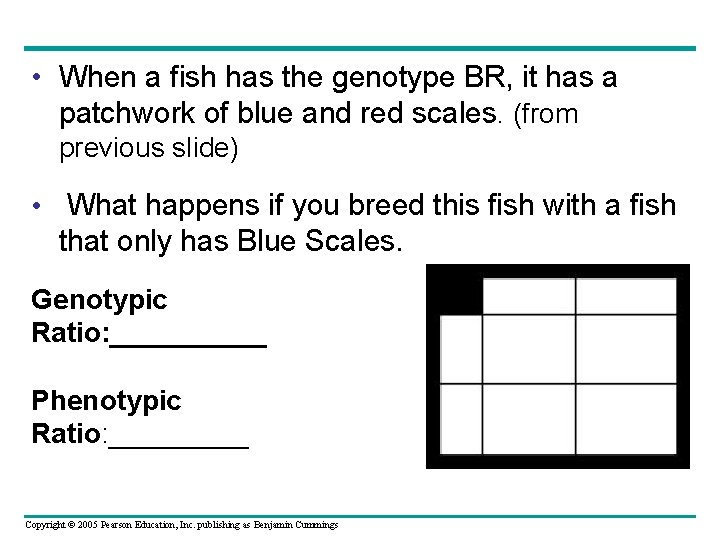
• When a fish has the genotype BR, it has a patchwork of blue and red scales. (from previous slide) • What happens if you breed this fish with a fish that only has Blue Scales. Genotypic Ratio: _____ Phenotypic Ratio: _____ Copyright © 2005 Pearson Education, Inc. publishing as Benjamin Cummings
• Frequency of Dominant Alleles • Dominant alleles – Are not necessarily more common in populations than recessive alleles Copyright © 2005 Pearson Education, Inc. publishing as Benjamin Cummings
Multiple Alleles • Most genes exist in populations – In more than two allelic forms Copyright © 2005 Pearson Education, Inc. publishing as Benjamin Cummings
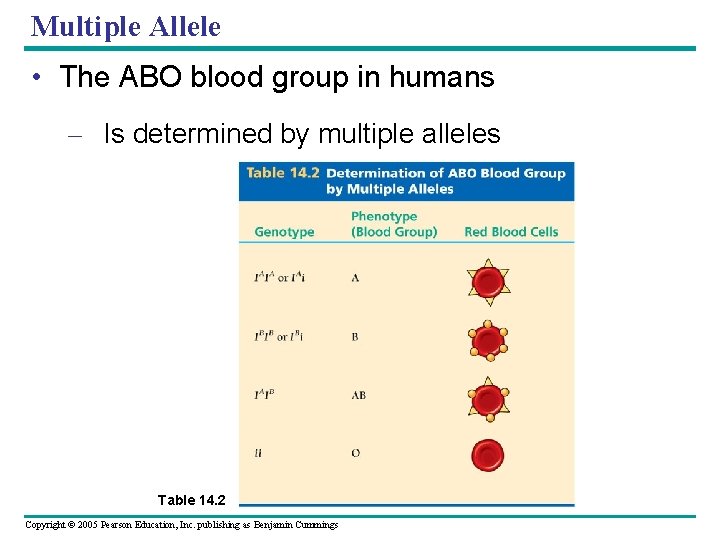
Multiple Allele • The ABO blood group in humans – Is determined by multiple alleles Table 14. 2 Copyright © 2005 Pearson Education, Inc. publishing as Benjamin Cummings
Extending Mendelian Genetics for Two or More Genes • Some traits – May be determined by two or more genes Copyright © 2005 Pearson Education, Inc. publishing as Benjamin Cummings
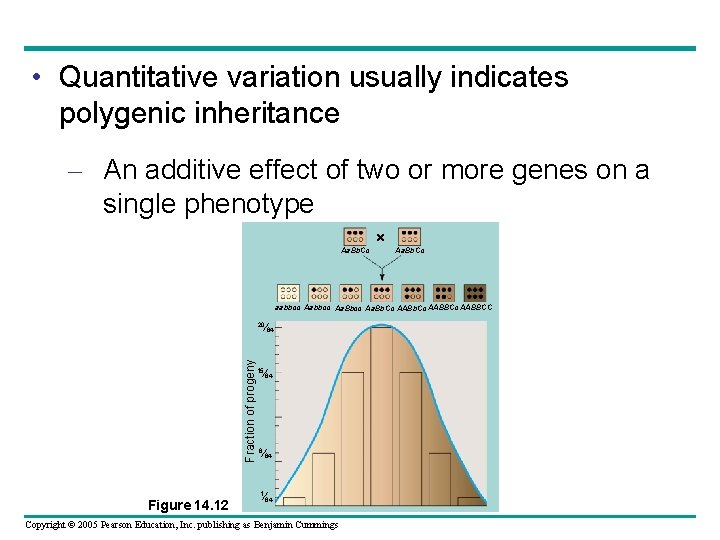
Polygenic Inheritance • Many human characters – Vary in the population along a continuum and are called quantitative characters Copyright © 2005 Pearson Education, Inc. publishing as Benjamin Cummings
• Quantitative variation usually indicates polygenic inheritance – An additive effect of two or more genes on a single phenotype Aa. Bb. Cc aabbcc Aa. Bbcc Aa. Bb. Cc AABBCc AABBCC Fraction of progeny 20⁄ 64 15⁄ 64 Figure 14. 12 6⁄ 64 1⁄ 64 Copyright © 2005 Pearson Education, Inc. publishing as Benjamin Cummings
Nature and Nurture: The Environmental Impact on Phenotype • Another departure from simple Mendelian genetics arises – When the phenotype for a character depends on environment as well as on genotype Copyright © 2005 Pearson Education, Inc. publishing as Benjamin Cummings
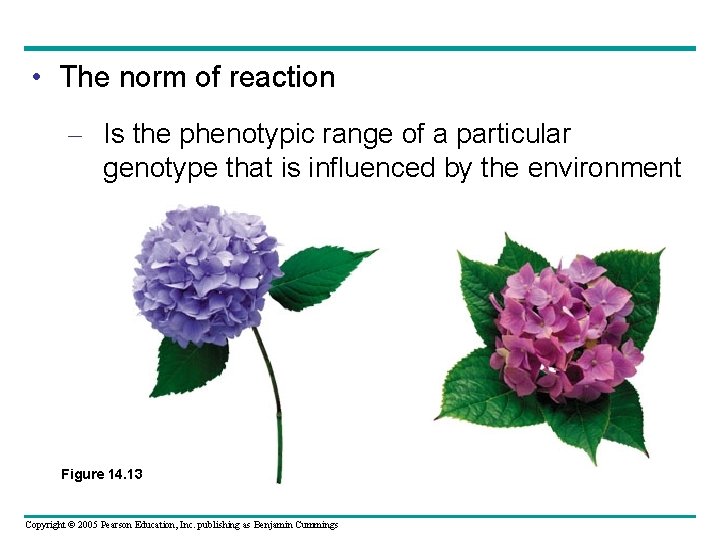
• The norm of reaction – Is the phenotypic range of a particular genotype that is influenced by the environment Figure 14. 13 Copyright © 2005 Pearson Education, Inc. publishing as Benjamin Cummings
• Multifactorial characters – Are those that are influenced by both genetic and environmental factors Copyright © 2005 Pearson Education, Inc. publishing as Benjamin Cummings
Integrating a Mendelian View of Heredity and Variation • An organism’s phenotype – Includes its physical appearance, internal anatomy, physiology, and behavior – Reflects its overall genotype and unique environmental history Copyright © 2005 Pearson Education, Inc. publishing as Benjamin Cummings
• Even in more complex inheritance patterns – Mendel’s fundamental laws of segregation and independent assortment still apply Copyright © 2005 Pearson Education, Inc. publishing as Benjamin Cummings
Pedigree Analysis • A pedigree – Is a family tree that describes the interrelationships of parents and children across generations Copyright © 2005 Pearson Education, Inc. publishing as Benjamin Cummings
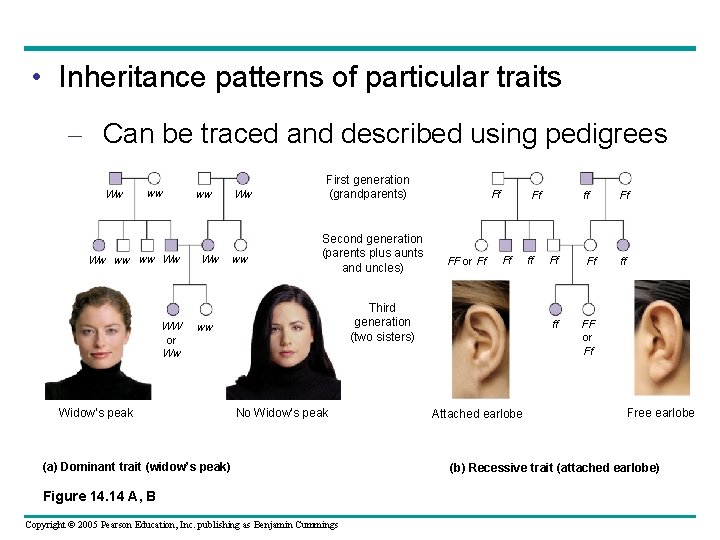
• Inheritance patterns of particular traits – Can be traced and described using pedigrees Ww ww ww Ww WW or Ww ww Ww Ww ww First generation (grandparents) Second generation (parents plus aunts and uncles) FF or Ff Ff Ff Third generation (two sisters) ww Widow’s peak Ff No Widow’s peak (a) Dominant trait (widow’s peak) Figure 14. 14 A, B Copyright © 2005 Pearson Education, Inc. publishing as Benjamin Cummings Attached earlobe ff ff Ff Ff Ff ff ff FF or Ff Free earlobe (b) Recessive trait (attached earlobe)
• Pedigrees – Can also be used to make predictions about future offspring Copyright © 2005 Pearson Education, Inc. publishing as Benjamin Cummings
Recessively Inherited Disorders • Many genetic disorders – Are inherited in a recessive manner Copyright © 2005 Pearson Education, Inc. publishing as Benjamin Cummings
• Recessively inherited disorders – Show up only in individuals homozygous for the allele • Carriers – Are heterozygous individuals who carry the recessive allele but are phenotypically normal Copyright © 2005 Pearson Education, Inc. publishing as Benjamin Cummings
Cystic Fibrosis • Symptoms of cystic fibrosis include – Mucus buildup in the some internal organs – Abnormal absorption of nutrients in the small intestine Copyright © 2005 Pearson Education, Inc. publishing as Benjamin Cummings
Sickle-Cell Disease • Sickle-cell disease – Affects one out of 400 African-Americans – Is caused by the substitution of a single amino acid in the hemoglobin protein in red blood cells • Symptoms include – Physical weakness, pain, organ damage, and even paralysis Copyright © 2005 Pearson Education, Inc. publishing as Benjamin Cummings
Mating of Close Relatives • Matings between relatives – Can increase the probability of the appearance of a genetic disease – Are called consanguineous matings Copyright © 2005 Pearson Education, Inc. publishing as Benjamin Cummings
Dominantly Inherited Disorders • Some human disorders – Are due to dominant alleles Copyright © 2005 Pearson Education, Inc. publishing as Benjamin Cummings
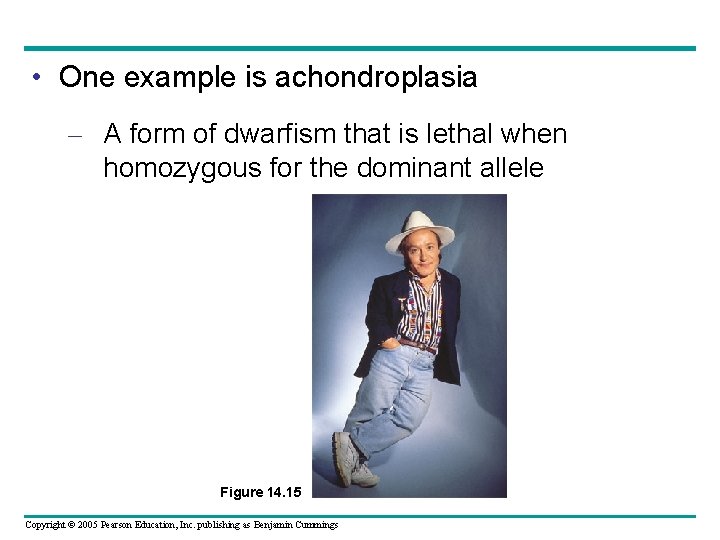
• One example is achondroplasia – A form of dwarfism that is lethal when homozygous for the dominant allele Figure 14. 15 Copyright © 2005 Pearson Education, Inc. publishing as Benjamin Cummings
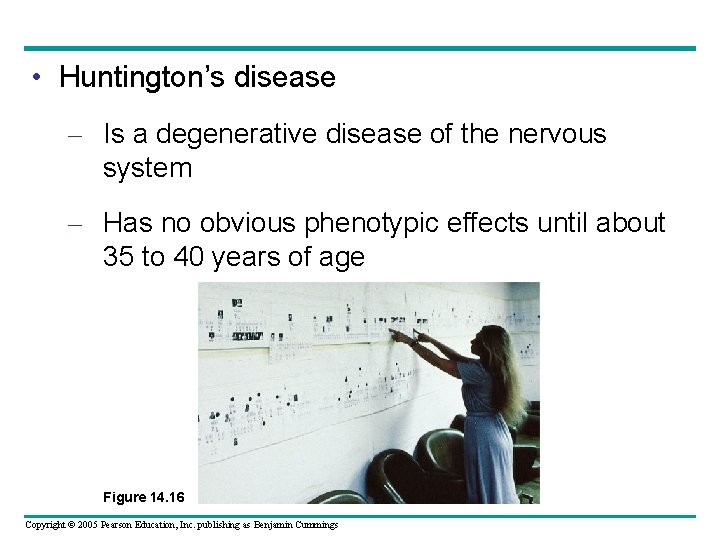
• Huntington’s disease – Is a degenerative disease of the nervous system – Has no obvious phenotypic effects until about 35 to 40 years of age Figure 14. 16 Copyright © 2005 Pearson Education, Inc. publishing as Benjamin Cummings
Multifactorial Disorders • Many human diseases – Have both genetic and environment components • Examples include – Heart disease and cancer Copyright © 2005 Pearson Education, Inc. publishing as Benjamin Cummings
Genetic Testing and Counseling • Genetic counselors – Can provide information to prospective parents concerned about a family history for a specific disease Copyright © 2005 Pearson Education, Inc. publishing as Benjamin Cummings
Counseling Based on Mendelian Genetics and Probability Rules • Using family histories – Genetic counselors help couples determine the odds that their children will have genetic disorders Copyright © 2005 Pearson Education, Inc. publishing as Benjamin Cummings
Tests for Identifying Carriers • For a growing number of diseases – Tests are available that identify carriers and help define the odds more accurately Copyright © 2005 Pearson Education, Inc. publishing as Benjamin Cummings
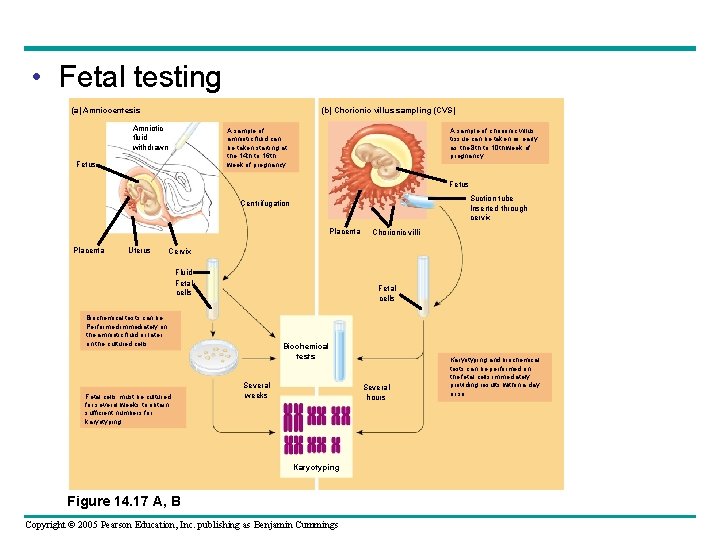
Fetal Testing • In amniocentesis – The liquid that bathes the fetus is removed and tested • In chorionic villus sampling (CVS) – A sample of the placenta is removed and tested Copyright © 2005 Pearson Education, Inc. publishing as Benjamin Cummings
• Fetal testing (b) Chorionic villus sampling (CVS) (a) Amniocentesis Amniotic fluid withdrawn A sample of chorionic villus tissue can be taken as early as the 8 th to 10 th week of pregnancy. A sample of amniotic fluid can be taken starting at the 14 th to 16 th week of pregnancy. Fetus Suction tube Inserted through cervix Centrifugation Placenta Uterus Chorionic vi. IIi Cervix Fluid Fetal cells Biochemical tests can be Performed immediately on the amniotic fluid or later on the cultured cells. Fetal cells must be cultured for several weeks to obtain sufficient numbers for karyotyping. Biochemical tests Several weeks Several hours Karyotyping Figure 14. 17 A, B Copyright © 2005 Pearson Education, Inc. publishing as Benjamin Cummings Karyotyping and biochemical tests can be performed on the fetal cells immediately, providing results within a day or so.
Newborn Screening • Some genetic disorders can be detected at birth – By simple tests that are now routinely performed in most hospitals in the United States Copyright © 2005 Pearson Education, Inc. publishing as Benjamin Cummings