
Chapter 11 Introduction to Genetics Genetics Scientific study
- Slides: 50
Chapter 11 Introduction to Genetics
Genetics • Scientific study of Heredity
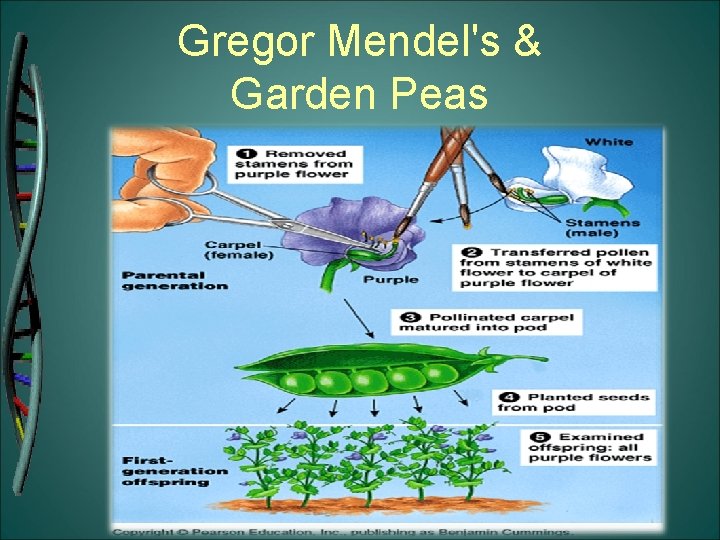
Gregor Mendel’s Peas • He worked with Garden peas • The male part of each flower produces pollen – Contains male sex cells • The female part of the flower produces eggs – Female sex cells
Gregor Mendel's & Garden Peas
Gregor Mendel’s Peas • Pollen fertilizes an egg cell and a seed for a new plant is formed • Normally reproduce by self- pollination – Pollen fertilizes the egg cells of the same flower – Inherit all of their characteristics from that single plant
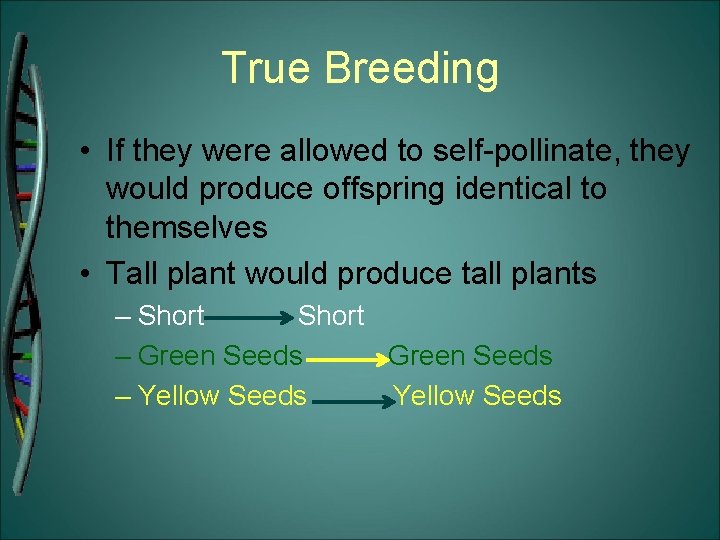
True Breeding • If they were allowed to self-pollinate, they would produce offspring identical to themselves • Tall plant would produce tall plants – Short – Green Seeds – Yellow Seeds
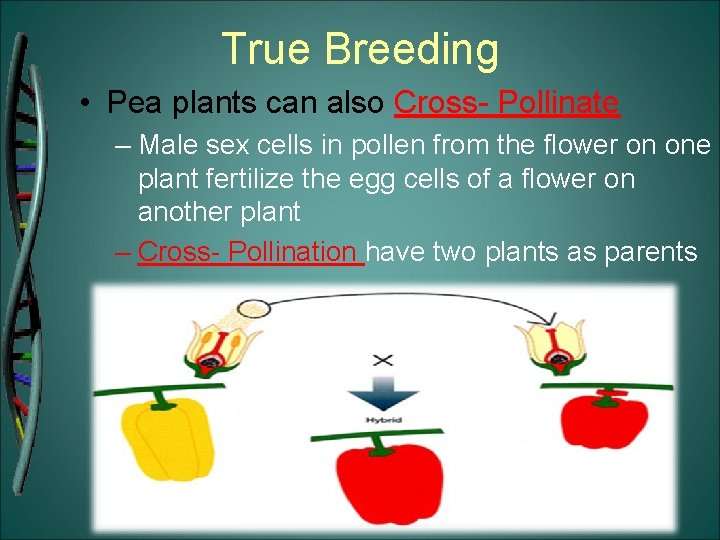
True Breeding • Pea plants can also Cross- Pollinate – Male sex cells in pollen from the flower on one plant fertilize the egg cells of a flower on another plant – Cross- Pollination have two plants as parents
Genes and Dominance • Trait – A specific characteristic that varies from one individual to another – Original pair of plants – P(parental) – Off spring F 1 or “First filial”
Genes and Dominance • The off springs of crosses between parents with different traits are called Hybrids • To Mendel’s surprise, all of the off spring had the character of only one of the parents • In each cross, the character of the other parent seemed to have disappeared
Gene and Dominance • Mendel’s 1 st conclusion • Biological inheritance is determined by factors that are passed from one generation to the next. • Chemical factors that determine traits are called Genes • Different forms of genes are called Alleles
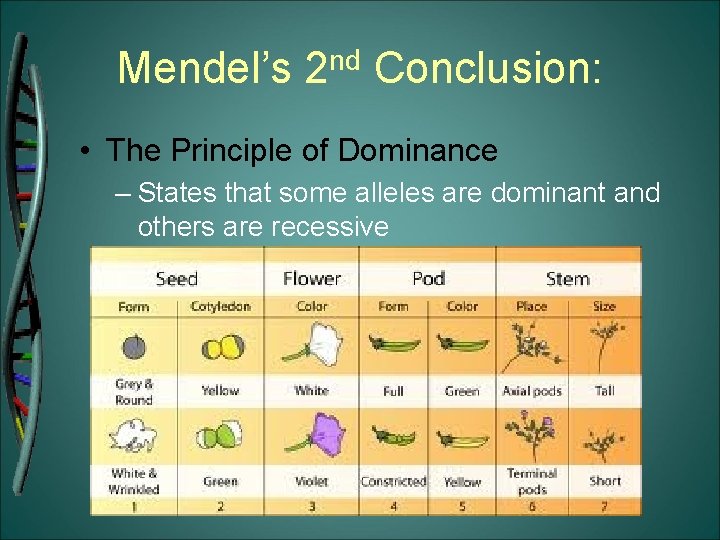
Mendel’s 2 nd Conclusion: • The Principle of Dominance – States that some alleles are dominant and others are recessive
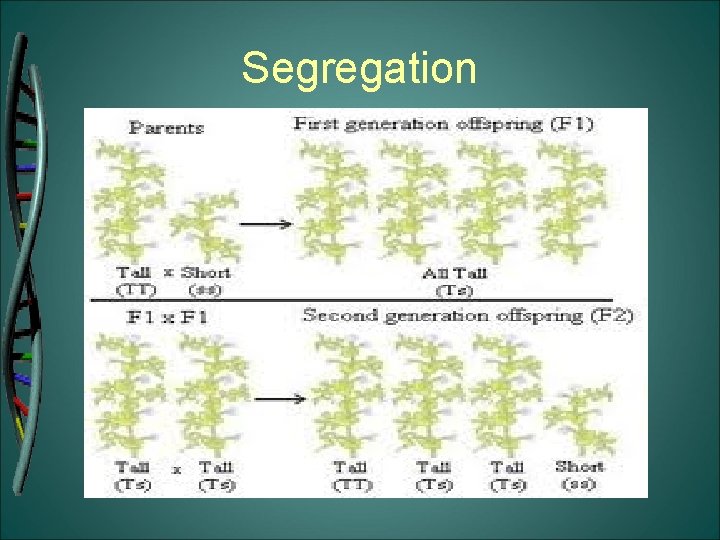
Segregation (separation) • F 2 (second filial) • Crossed the F 1 generation with itself to produce the F 2 offspring • Gametes – Sex Cells • When each F 1 plant flowers, the two alleles are segregated from each other so that each gamete carries single copy of each Gene
Segregation • Therefore, each F, plant produces two types of gametes- those with the allele for tallness and those with the allele for shortness • The likelihood that a particular event will occur is called Probability • The principles of Probability can be used to predict the out comes of genetic crosses
Segregation
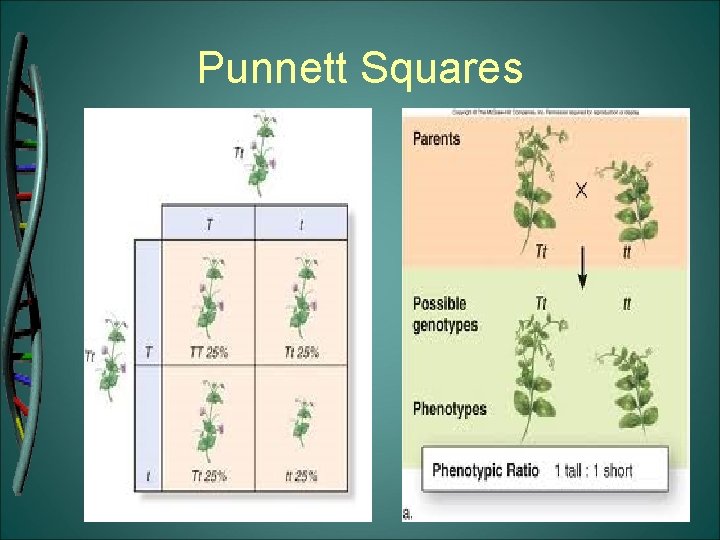
Punnett Squares • The gene combinations that might result from a genetic cross can be determined by drawing a diagram known as a Punnett Square • Organisms that have two identical alleles for a particular trait are Homozygous TT or tt
Punnett Squares
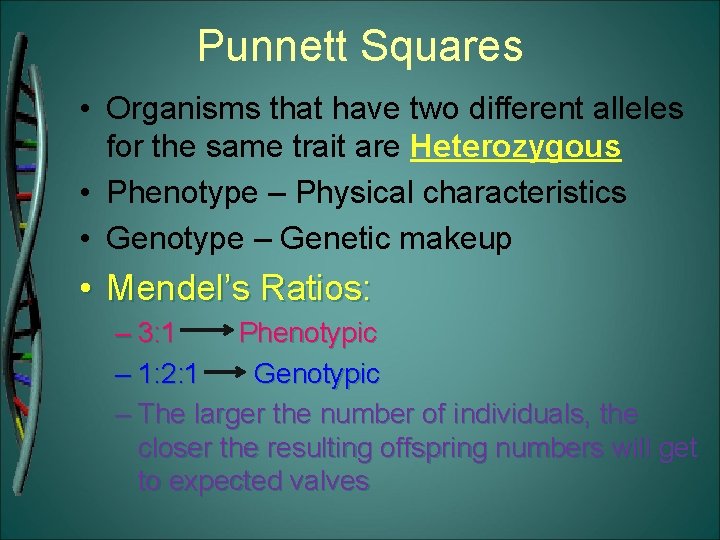
Punnett Squares • Organisms that have two different alleles for the same trait are Heterozygous • Phenotype – Physical characteristics • Genotype – Genetic makeup • Mendel’s Ratios: – 3: 1 Phenotypic – 1: 2: 1 Genotypic – The larger the number of individuals, the closer the resulting offspring numbers will get to expected valves
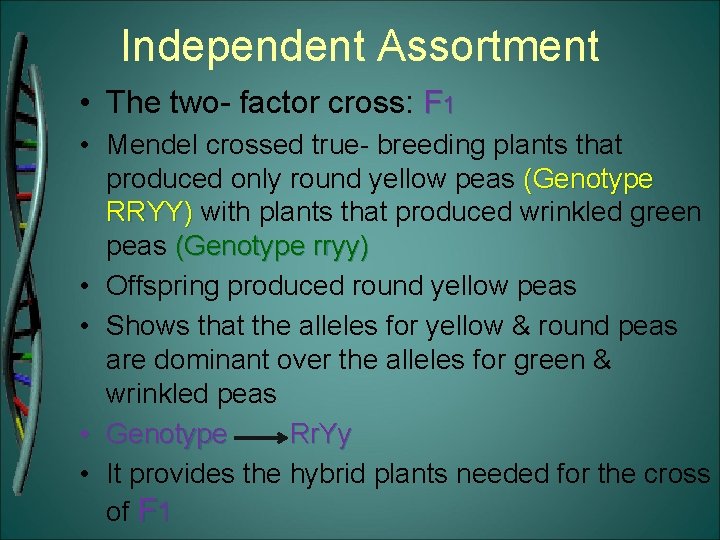
Independent Assortment • The two- factor cross: F 1 • Mendel crossed true- breeding plants that produced only round yellow peas (Genotype RRYY) with plants that produced wrinkled green peas (Genotype rryy) • Offspring produced round yellow peas • Shows that the alleles for yellow & round peas are dominant over the alleles for green & wrinkled peas • Genotype Rr. Yy • It provides the hybrid plants needed for the cross of F 1
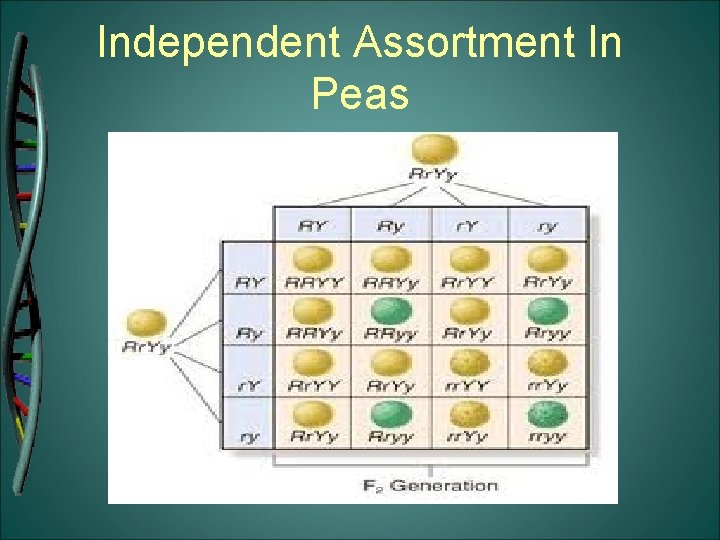
Independent Assortment In Peas
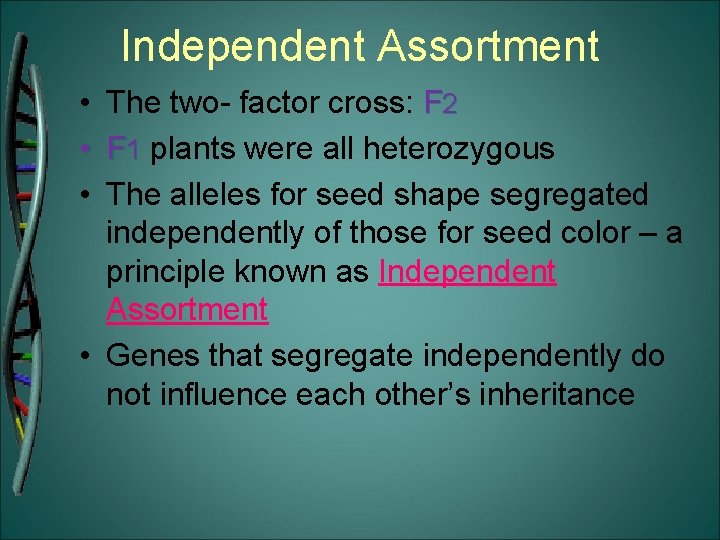
Independent Assortment • • • The two- factor cross: F 2 F 1 plants were all heterozygous The alleles for seed shape segregated independently of those for seed color – a principle known as Independent Assortment • Genes that segregate independently do not influence each other’s inheritance
Principle of Independent Assortment • States that genes for different traits can segregate independently during the formation of gametes • Mendel’s principles form the base on which modern science of genetics has been built
The Inheritance of Biological Characteristics • Is determined by individual units known as genes in organisms that reproduce sexually, genes are passed from parents to their offspring • In cases in which two or more forms of the gene for a single trait exist some forms of the gene may be dominant and others may be recessive
The Inheritance of Biological Characteristics • In most sexually reproducing organisms each adult has two copies of each gene – one from each parent. These genes are segregated from each other when gametes are formed. • The alleles for different genes usually segregate independently of one another. • Some alleles are neither dominant nor recessive, and many traits are controlled by multiple alleles or multiple genes
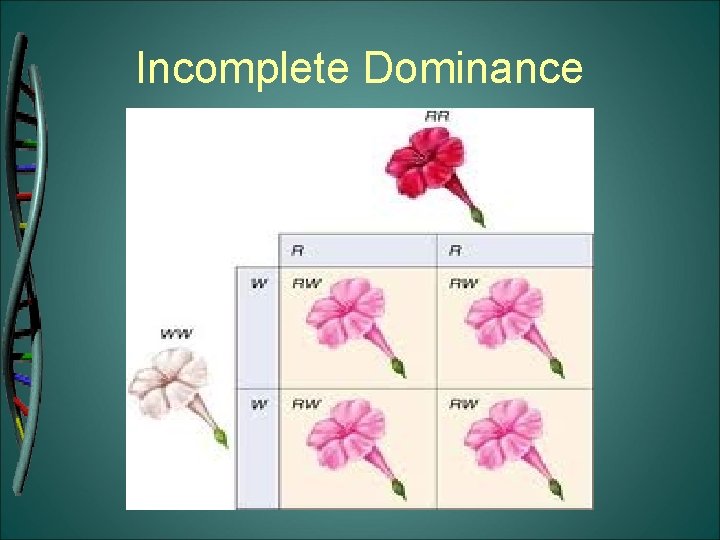
Incomplete Dominance • Cases in which one allele is not completely dominant over another are called Incomplete Dominance • The heterozygous phenotype is somewhere in between the two Homozygous Phenotype
Incomplete Dominance
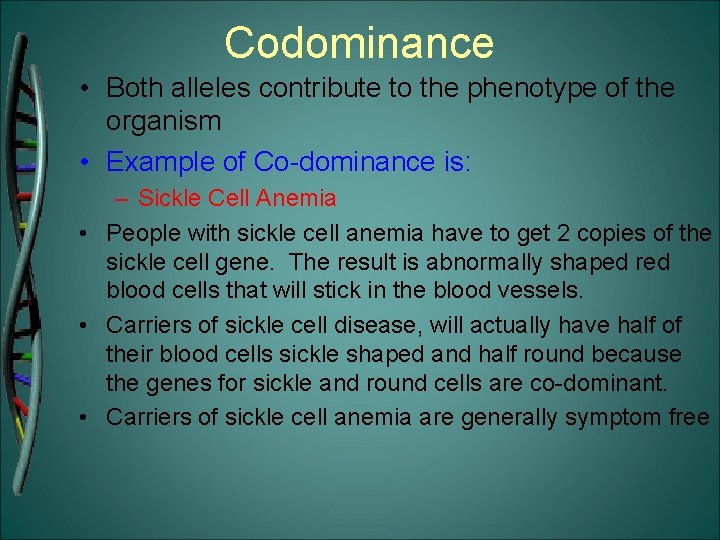
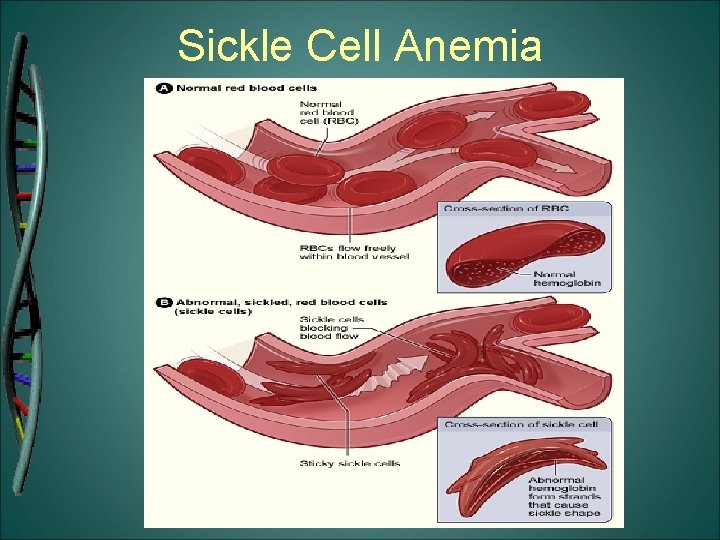
Codominance • Both alleles contribute to the phenotype of the organism • Example of Co-dominance is: – Sickle Cell Anemia • People with sickle cell anemia have to get 2 copies of the sickle cell gene. The result is abnormally shaped red blood cells that will stick in the blood vessels. • Carriers of sickle cell disease, will actually have half of their blood cells sickle shaped and half round because the genes for sickle and round cells are co-dominant. • Carriers of sickle cell anemia are generally symptom free
Sickle Cell Anemia
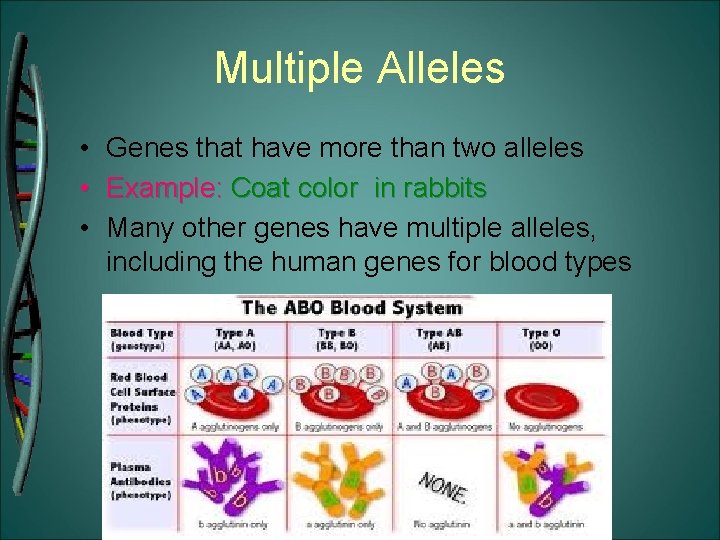
Multiple Alleles • Genes that have more than two alleles • Example: Coat color in rabbits • Many other genes have multiple alleles, including the human genes for blood types
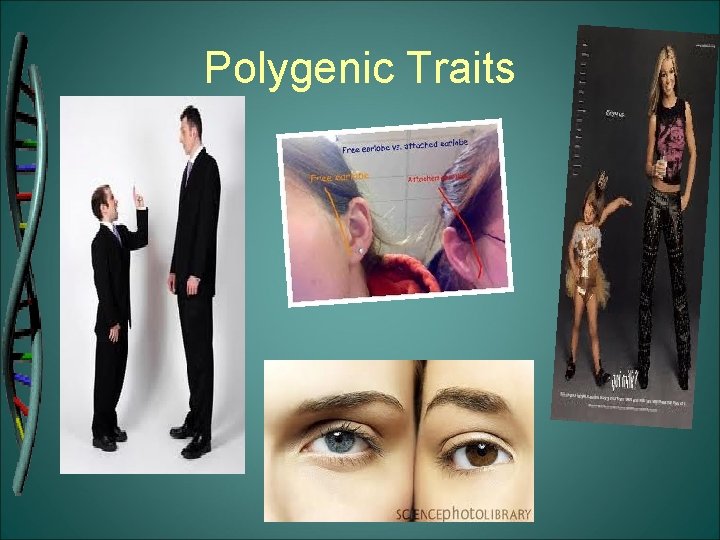
Polygenic Traits • Many traits are produced by the interaction of several genes. • Traits controlled by two or more genes are said to be : Polygenic traits – “Having many Genes”
Polygenic Traits
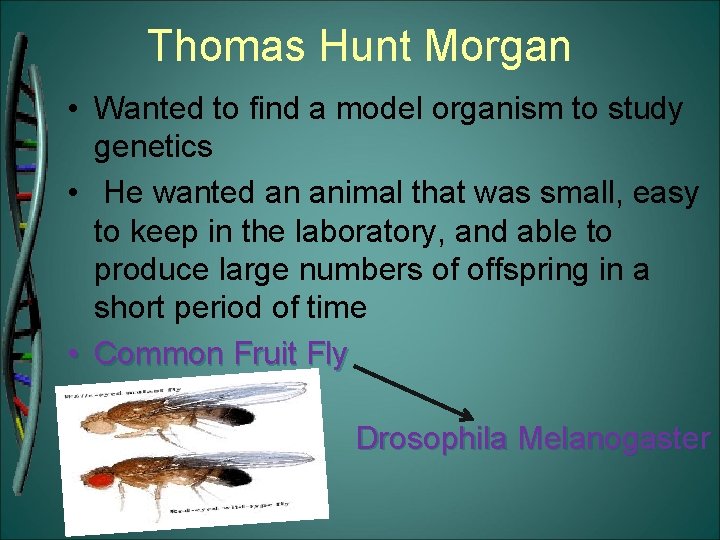
Thomas Hunt Morgan • Wanted to find a model organism to study genetics • He wanted an animal that was small, easy to keep in the laboratory, and able to produce large numbers of offspring in a short period of time • Common Fruit Fly Drosophila Melanogaster
Thomas Hunt Morgan • He could breed a new generation of flies every 14 days • Single pair of flies could produce as many as 100 offspring • Ideal organism for genetics
Meiosis • Mendel’s principles of genetics require at least two things • 1 st – Each organism must inherit a single copy of every gene from both its “parents” two complete sets of genes
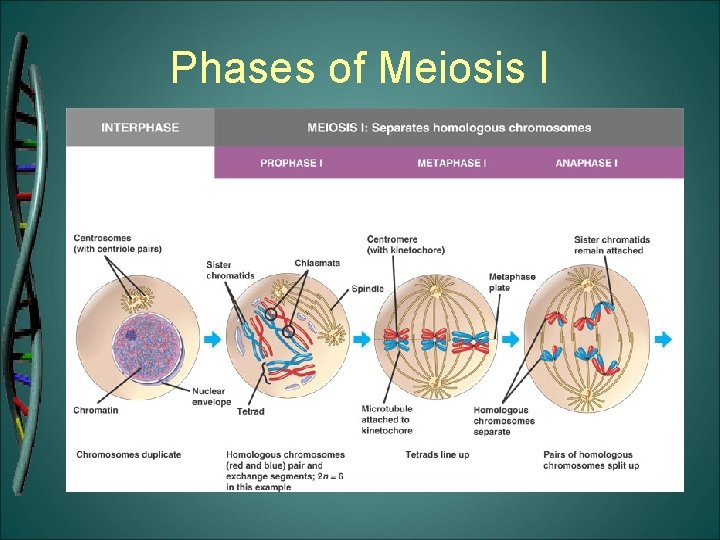
Phases of Meiosis I
Meiosis • 2 nd • When an organism produces its own gametes, those two sets of genes must be separated from each other so that each gamete contains just one set of genes
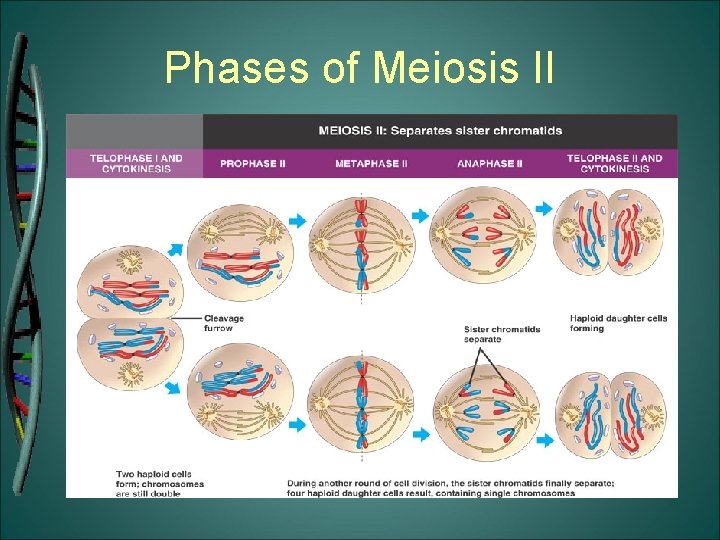
Phases of Meiosis II
Homologous • Each of the 4 Chromosomes that came from the male parent has a corresponding chromosome from the female parent • Cell that contains both sets of homologous chromosomes are said to be Diploid –”two sets” represented by 2 n • Drosophila – Diploid # is 8 2 n=8
Meiosis • Gametes of sexually reproducing organisms contain only a single set of chromosomes. • Such cells are called Haploid – “One Set” Drosophila N=4
Meiosis • process of reduction division in which the number of chromosomes per cell is cut in half through the separation of Homologous Chromosomes in a Diploid Cell • Two Distinct Phases: – 1 st Meiotic Division Meiosis I – 2 nd Meiotic Division Meiosis II
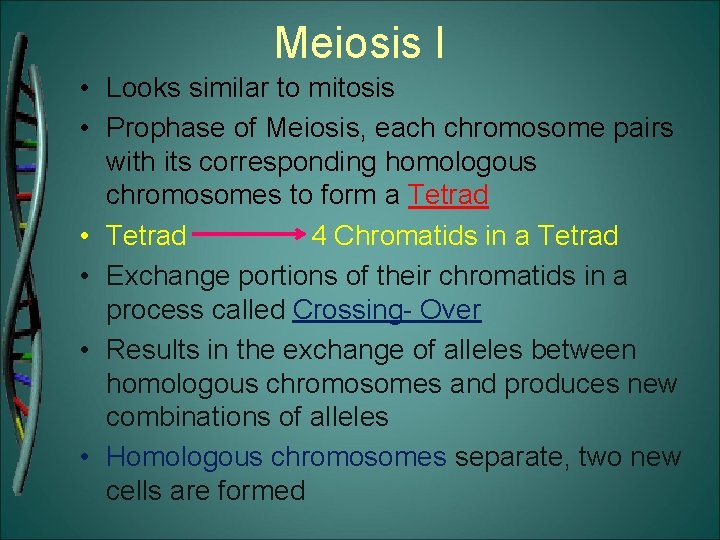
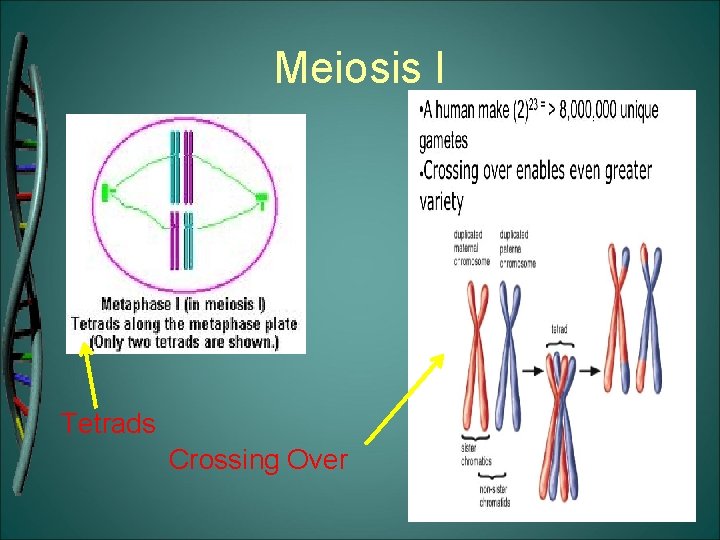
Meiosis I • Looks similar to mitosis • Prophase of Meiosis, each chromosome pairs with its corresponding homologous chromosomes to form a Tetrad • Tetrad 4 Chromatids in a Tetrad • Exchange portions of their chromatids in a process called Crossing- Over • Results in the exchange of alleles between homologous chromosomes and produces new combinations of alleles • Homologous chromosomes separate, two new cells are formed
Meiosis I Tetrads Crossing Over
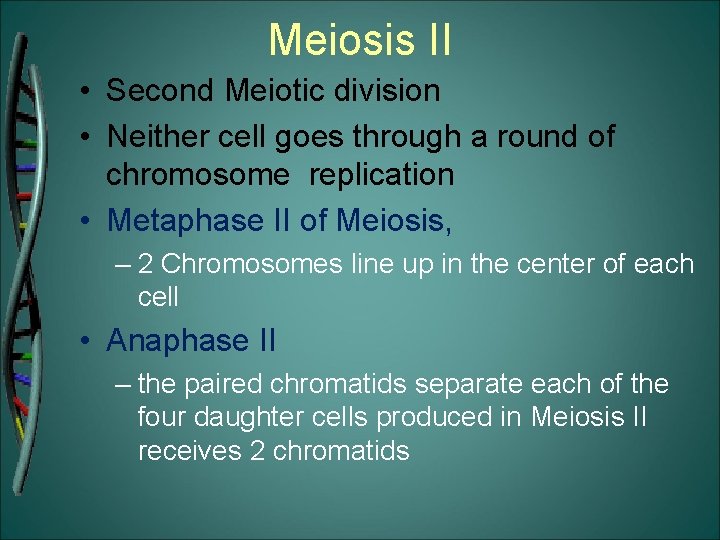
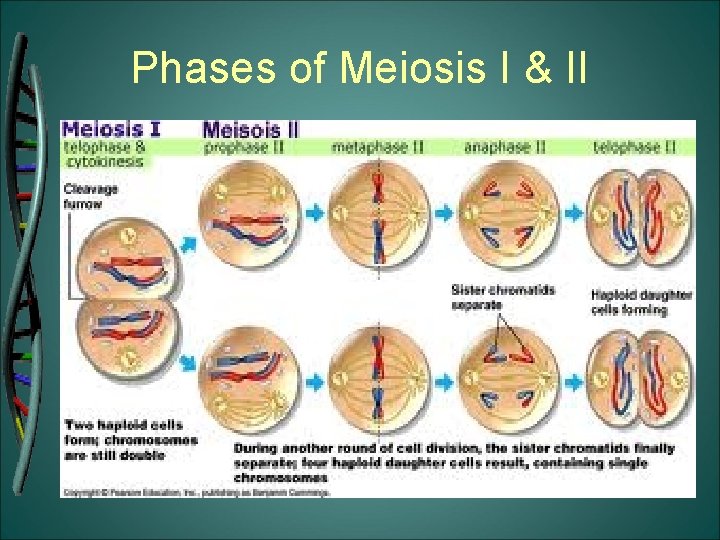
Meiosis II • Second Meiotic division • Neither cell goes through a round of chromosome replication • Metaphase II of Meiosis, – 2 Chromosomes line up in the center of each cell • Anaphase II – the paired chromatids separate each of the four daughter cells produced in Meiosis II receives 2 chromatids
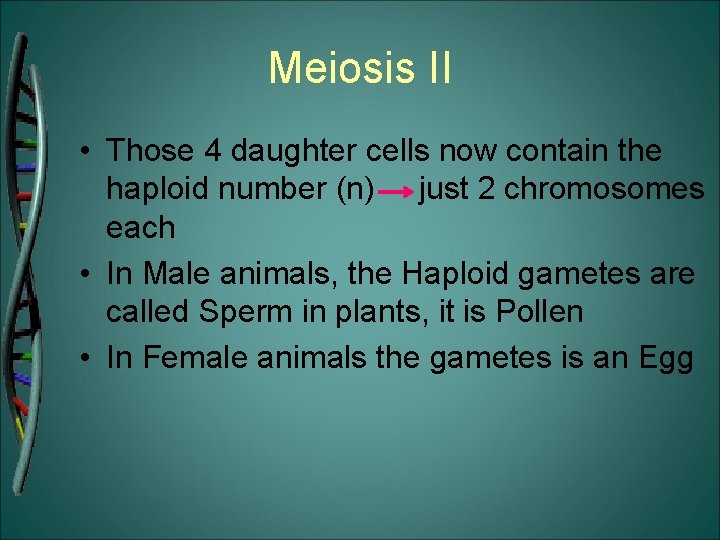
Meiosis II • Those 4 daughter cells now contain the haploid number (n) just 2 chromosomes each • In Male animals, the Haploid gametes are called Sperm in plants, it is Pollen • In Female animals the gametes is an Egg
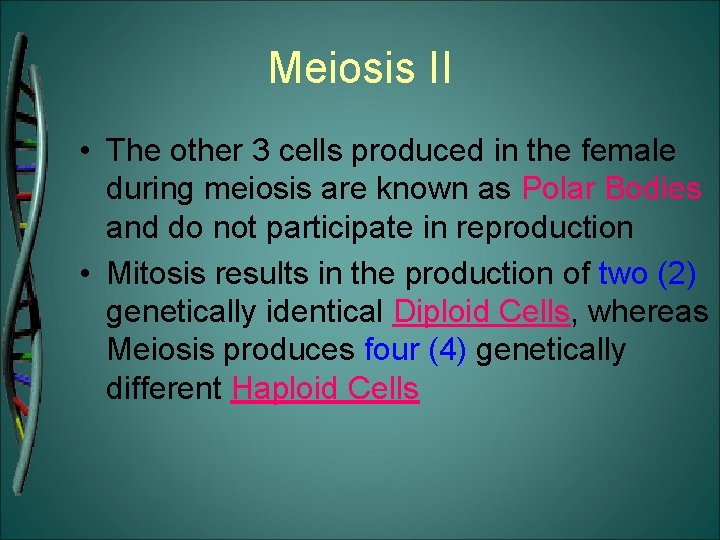
Meiosis II • The other 3 cells produced in the female during meiosis are known as Polar Bodies and do not participate in reproduction • Mitosis results in the production of two (2) genetically identical Diploid Cells, whereas Meiosis produces four (4) genetically different Haploid Cells
Phases of Meiosis I & II
Chapter 11 Questions 1. During which phase of Meiosis would you expect to find the formation of a Tetrad? 2. What is Self- Pollination? 3. What is a Hybrid? 4. What does the Principle of Dominances state? 5. What does the postulate of Segregation state?
Chapter 11 Questions 6. What is the difference between homozygous and heterozygous? 7. What is the difference between genotype and phenotype? 8. How does the Principle of Independent Assortment affect a dihybrid cross? (Rr. Tt x Rr. Tt) 9. What is the difference in Incomplete Dominance and Codominance? Give Examples-Explain!!!!!
Chapter 11 Questions 10. What is the difference in Multiple Alleles and Polygenic traits? (Give Examples- Explain!!!) 11. What does Homologous mean? 12. What is the difference in the haploid# and the diploid#? 13. What is Crossing Over?
Chapter 11 Questions 14. What is the difference in the 1 st Meiotic Division and the 2 nd Meiotic Division? 15. List the events and phases of both Meiosis I & II. 16. What is the difference in results between Mitosis & Meiosis?