
Chapter 11 Intermolecular forces according to Google Images
- Slides: 28
Chapter 11 Intermolecular forces according to Google Images: Ch 11 Page 467 1
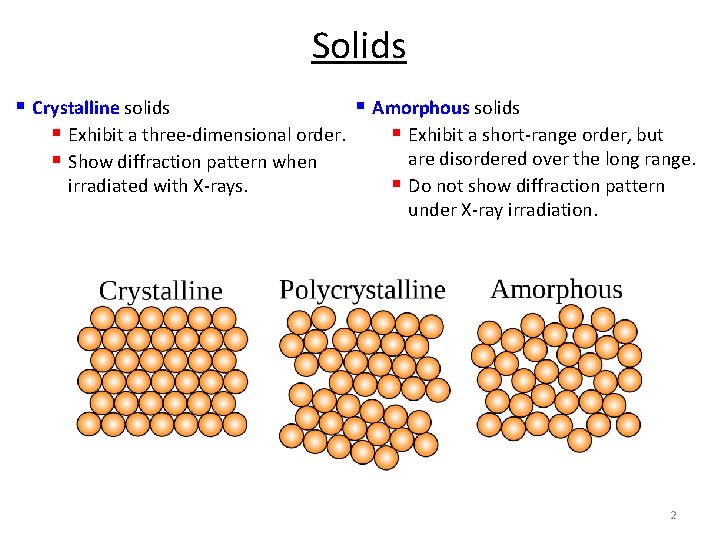
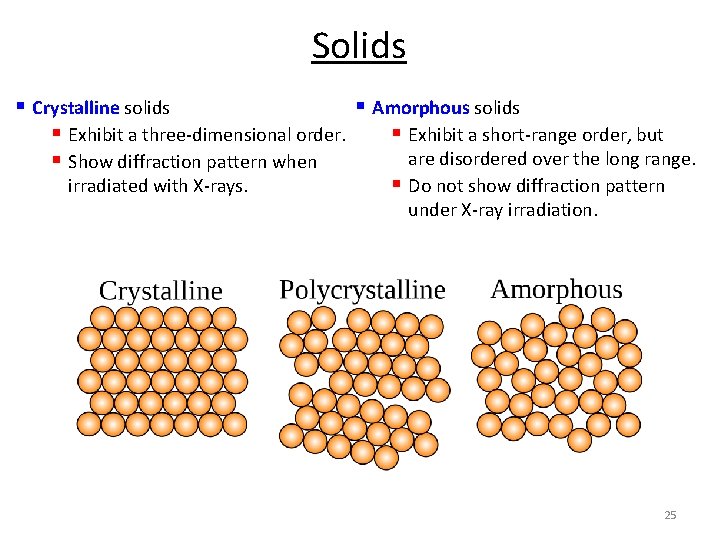
Solids § Crystalline solids § Amorphous solids § Exhibit a three-dimensional order. § Exhibit a short-range order, but are disordered over the long range. § Show diffraction pattern when irradiated with X-rays. § Do not show diffraction pattern under X-ray irradiation. 2
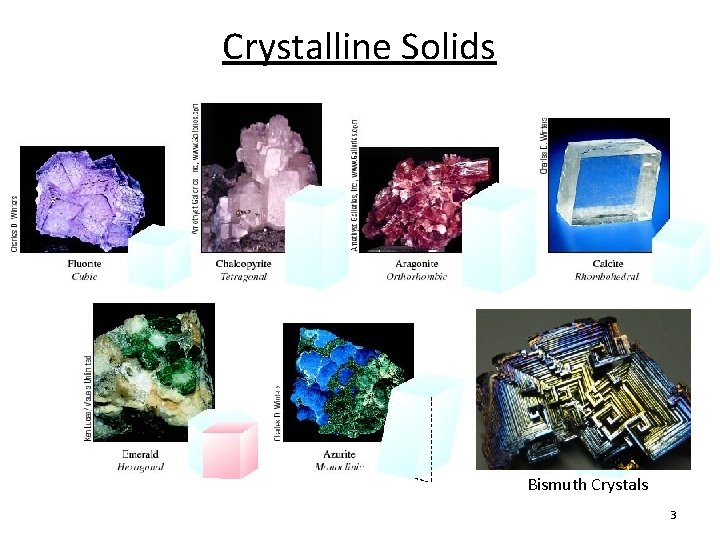
Crystalline Solids Bismuth Crystals 3
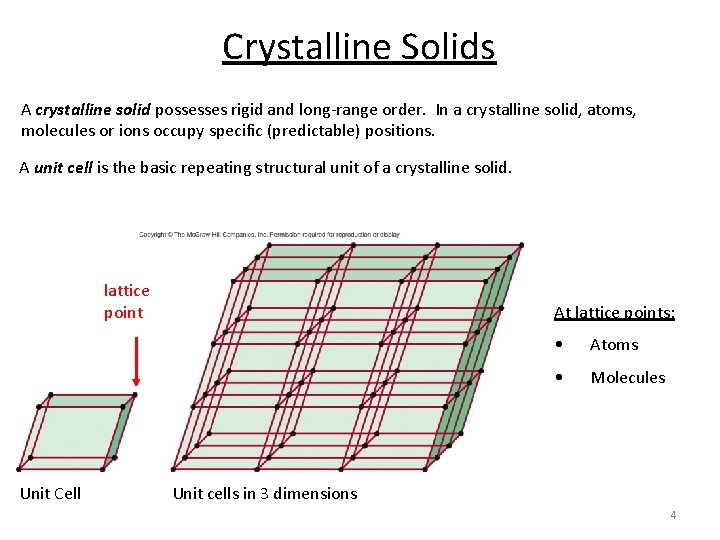
Crystalline Solids A crystalline solid possesses rigid and long-range order. In a crystalline solid, atoms, molecules or ions occupy specific (predictable) positions. A unit cell is the basic repeating structural unit of a crystalline solid. lattice point Unit Cell At lattice points: • Atoms • Molecules Unit cells in 3 dimensions 4
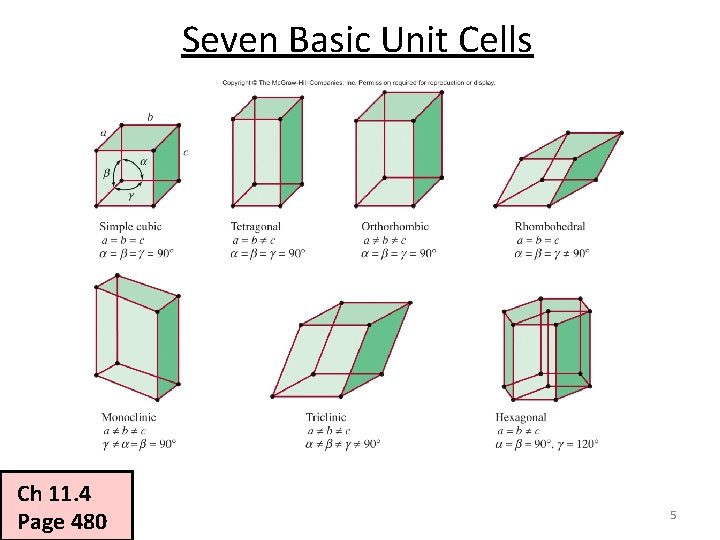
Seven Basic Unit Cells Ch 11. 4 Page 480 5
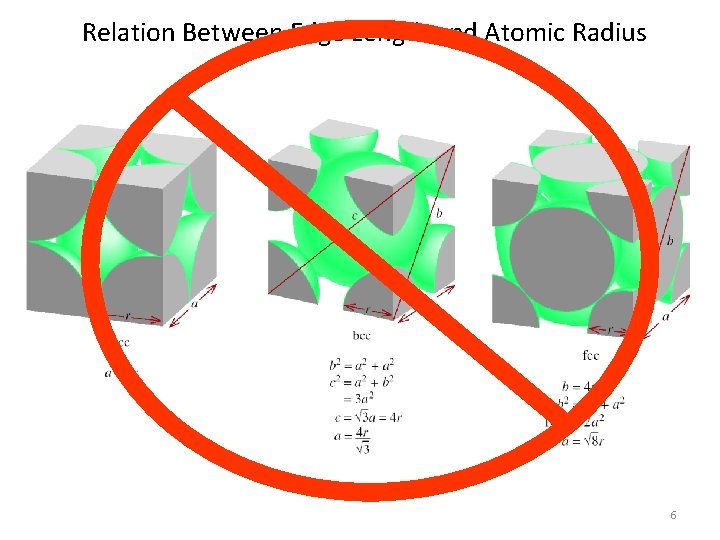
Relation Between Edge Length and Atomic Radius 6
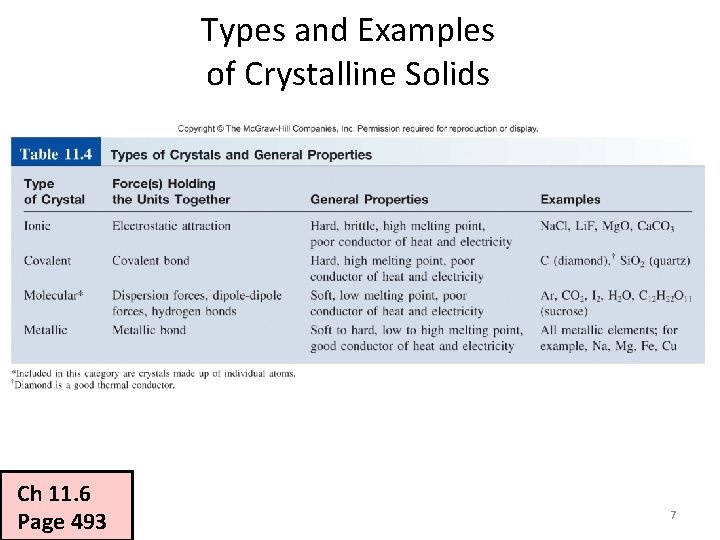
Types and Examples of Crystalline Solids Ch 11. 6 Page 493 7
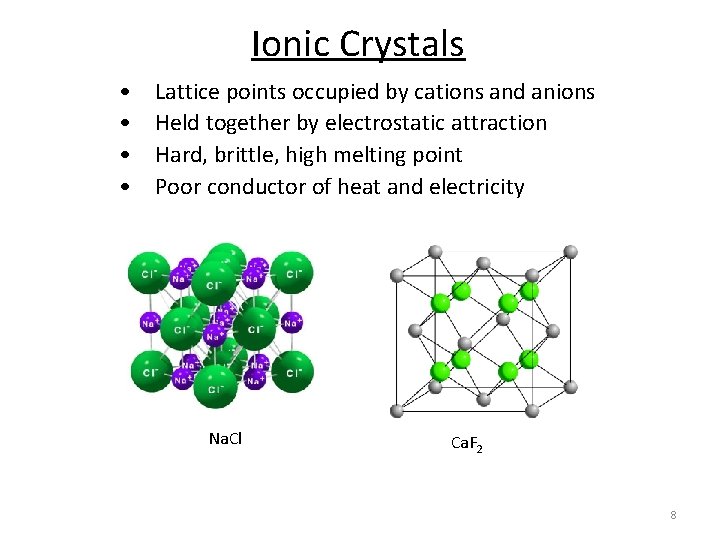
Ionic Crystals • • Lattice points occupied by cations and anions Held together by electrostatic attraction Hard, brittle, high melting point Poor conductor of heat and electricity Na. Cl Ca. F 2 8
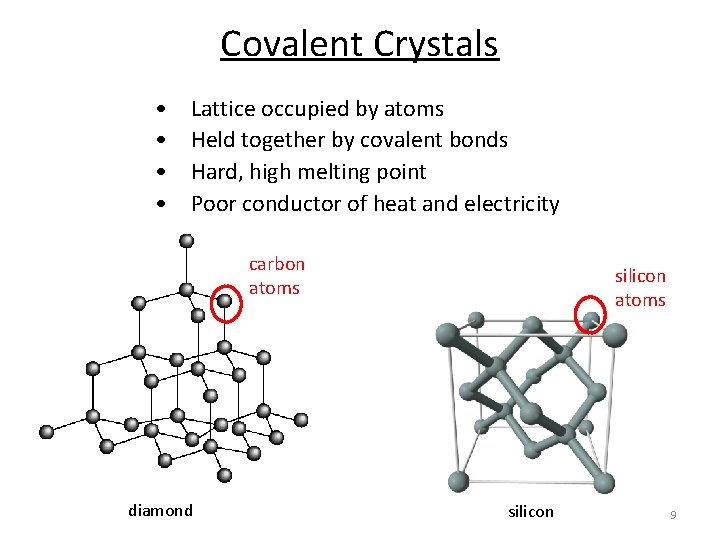
Covalent Crystals • • Lattice occupied by atoms Held together by covalent bonds Hard, high melting point Poor conductor of heat and electricity carbon atoms diamond silicon atoms silicon 9
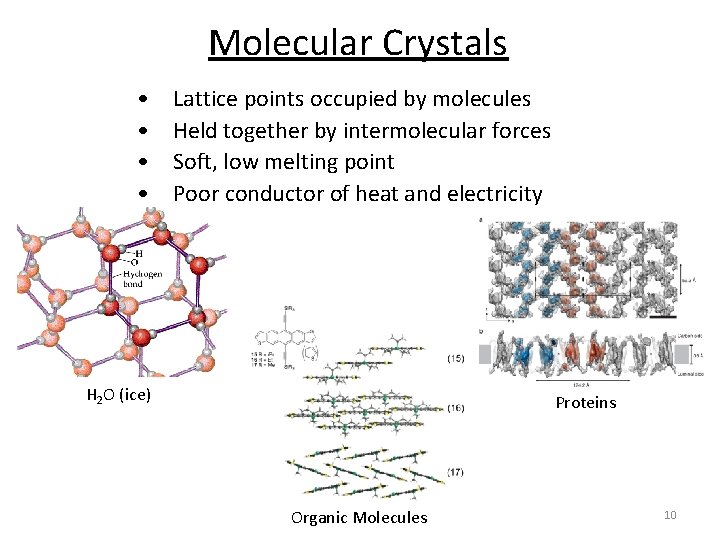
Molecular Crystals • • Lattice points occupied by molecules Held together by intermolecular forces Soft, low melting point Poor conductor of heat and electricity H 2 O (ice) Proteins Organic Molecules 10
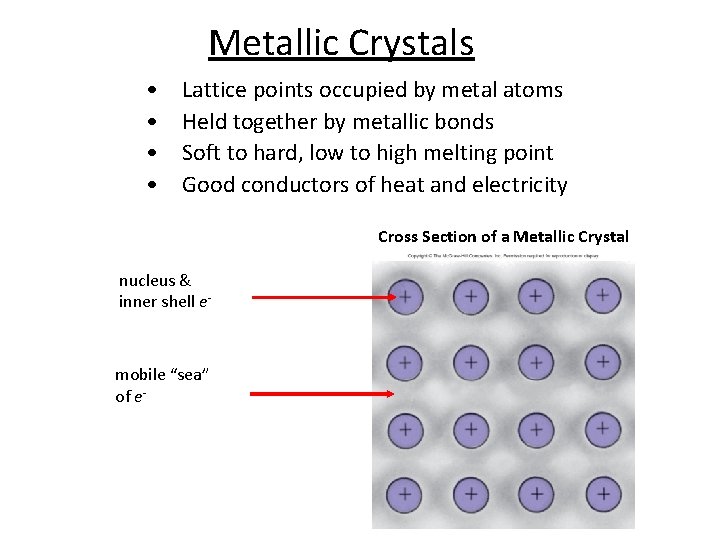
Metallic Crystals • • Lattice points occupied by metal atoms Held together by metallic bonds Soft to hard, low to high melting point Good conductors of heat and electricity Cross Section of a Metallic Crystal nucleus & inner shell e- mobile “sea” of e-
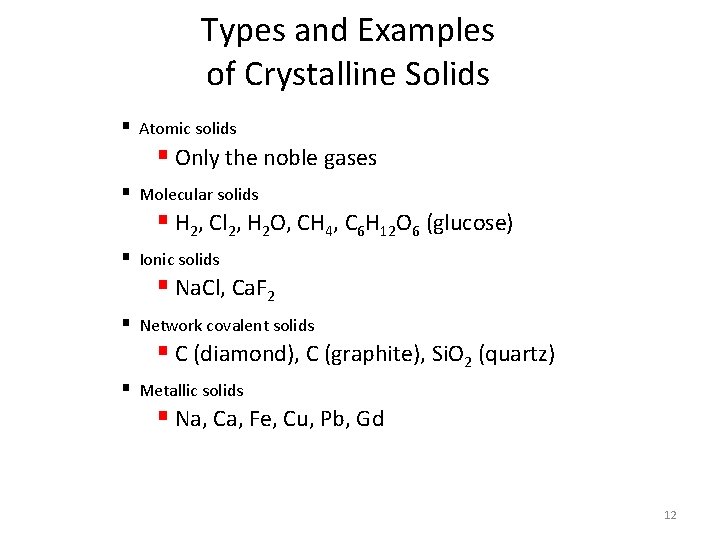
Types and Examples of Crystalline Solids § Atomic solids § Only the noble gases § Molecular solids § H 2, Cl 2, H 2 O, CH 4, C 6 H 12 O 6 (glucose) § Ionic solids § Na. Cl, Ca. F 2 § Network covalent solids § C (diamond), C (graphite), Si. O 2 (quartz) § Metallic solids § Na, Ca, Fe, Cu, Pb, Gd 12
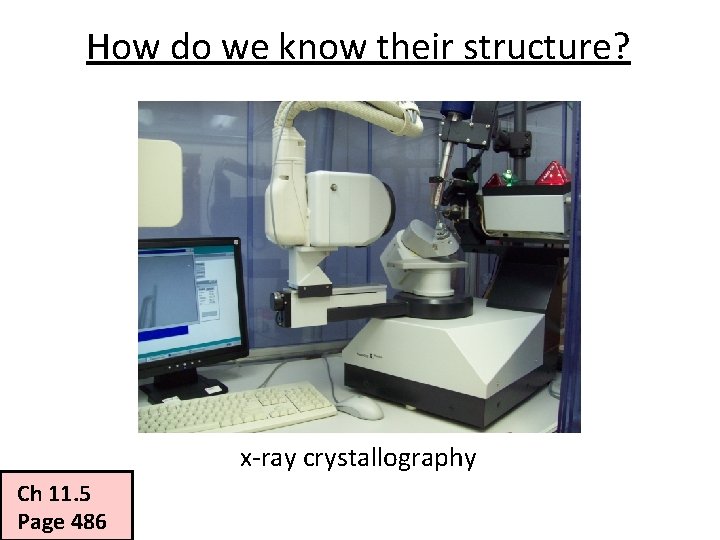
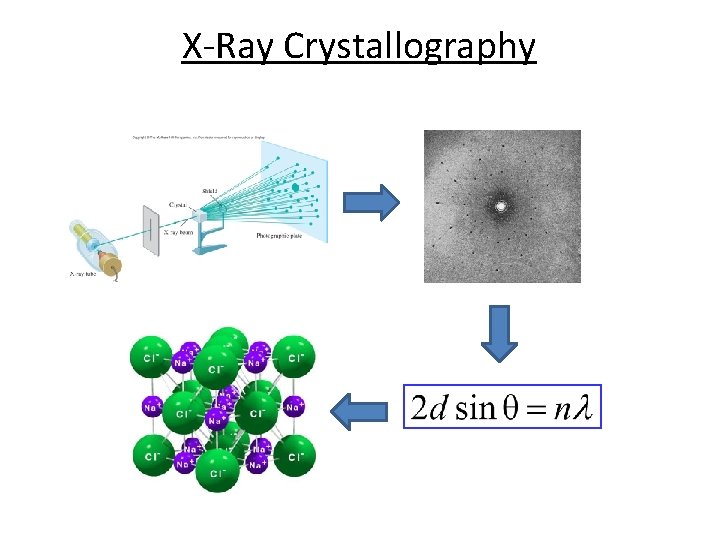
How do we know their structure? x-ray crystallography Ch 11. 5 Page 486
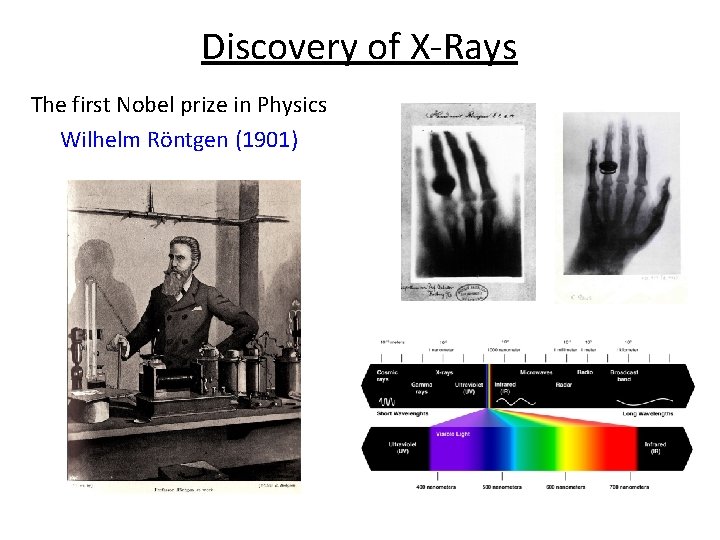
Discovery of X-Rays The first Nobel prize in Physics Wilhelm Röntgen (1901)
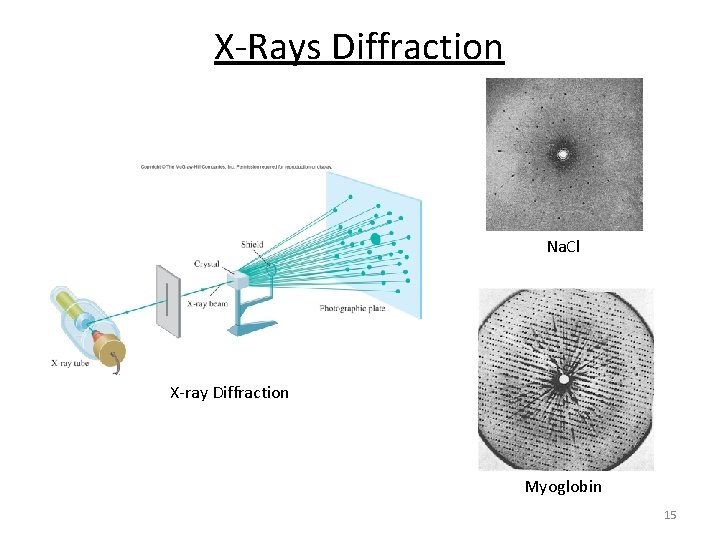
X-Rays Diffraction Na. Cl X-ray Diffraction Myoglobin 15
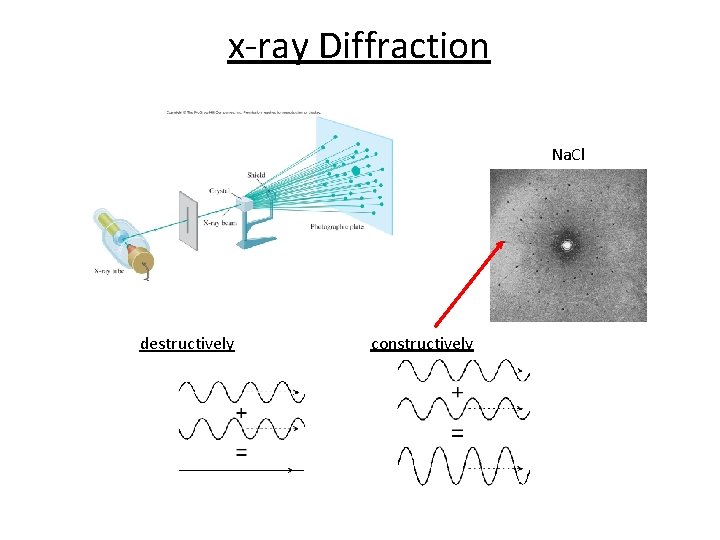
x-ray Diffraction Na. Cl destructively constructively
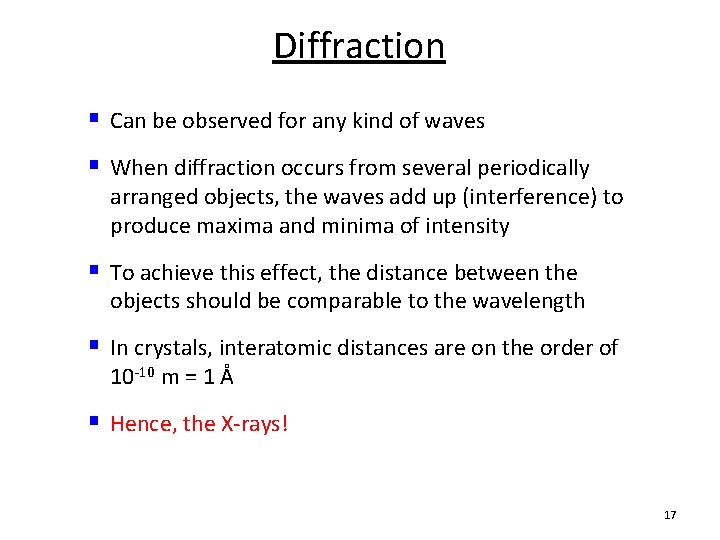
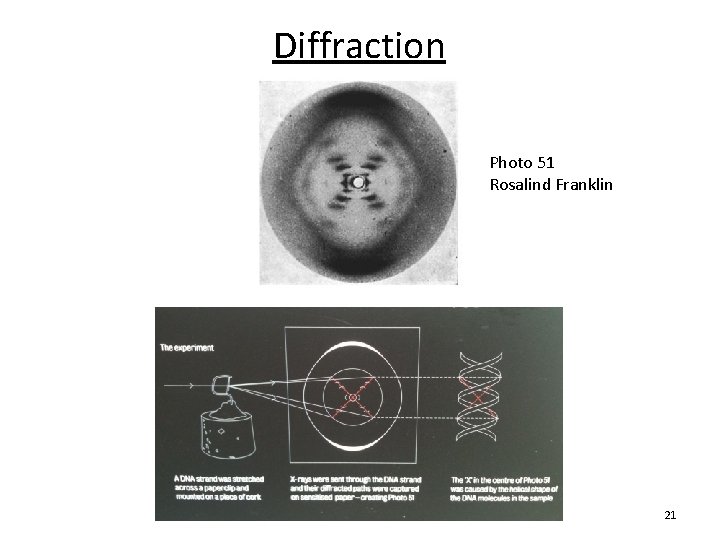
Diffraction § Can be observed for any kind of waves § When diffraction occurs from several periodically arranged objects, the waves add up (interference) to produce maxima and minima of intensity § To achieve this effect, the distance between the objects should be comparable to the wavelength § In crystals, interatomic distances are on the order of 10 -10 m = 1 Å § Hence, the X-rays! 17
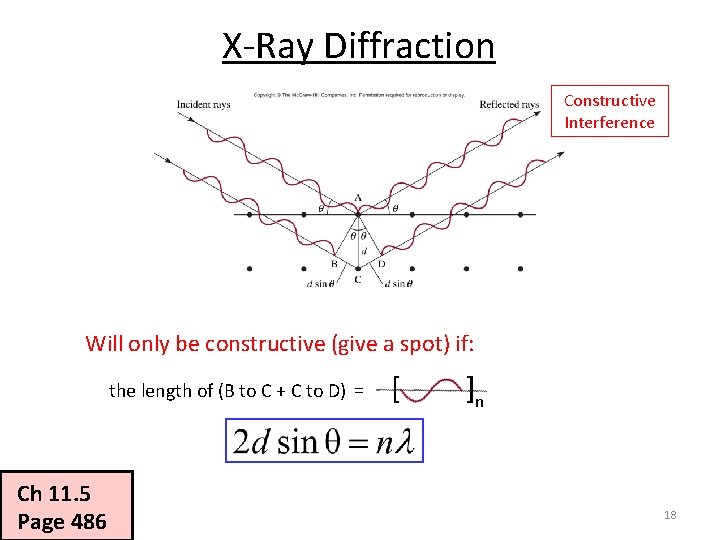
X-Ray Diffraction Constructive Interference Will only be constructive (give a spot) if: the length of (B to C + C to D) = Ch 11. 5 Page 486 [ ]n 18
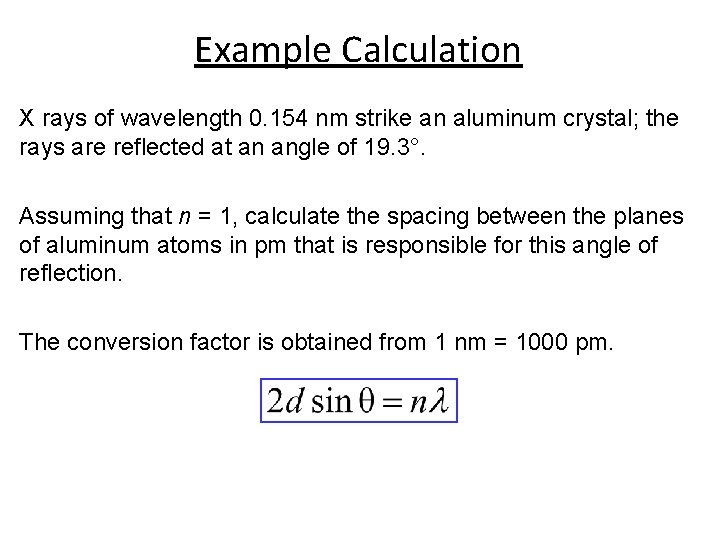
Example Calculation X rays of wavelength 0. 154 nm strike an aluminum crystal; the rays are reflected at an angle of 19. 3°. Assuming that n = 1, calculate the spacing between the planes of aluminum atoms in pm that is responsible for this angle of reflection. The conversion factor is obtained from 1 nm = 1000 pm.
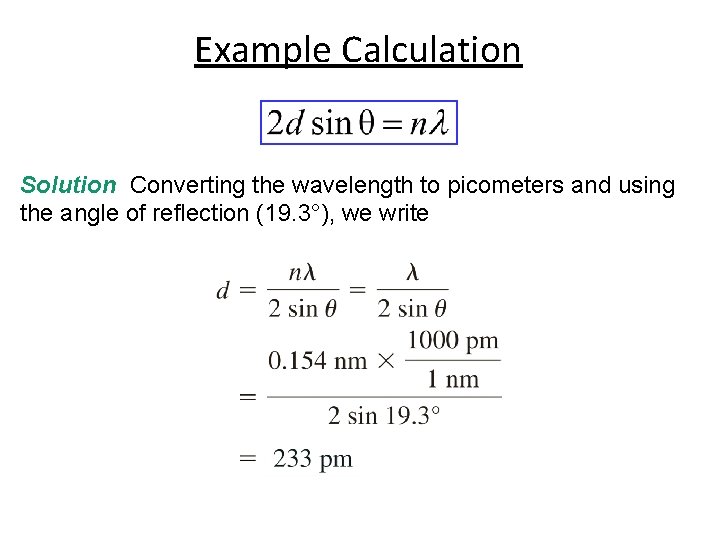
Example Calculation Solution Converting the wavelength to picometers and using the angle of reflection (19. 3°), we write
Diffraction Photo 51 Rosalind Franklin 21
X-Ray Crystallography
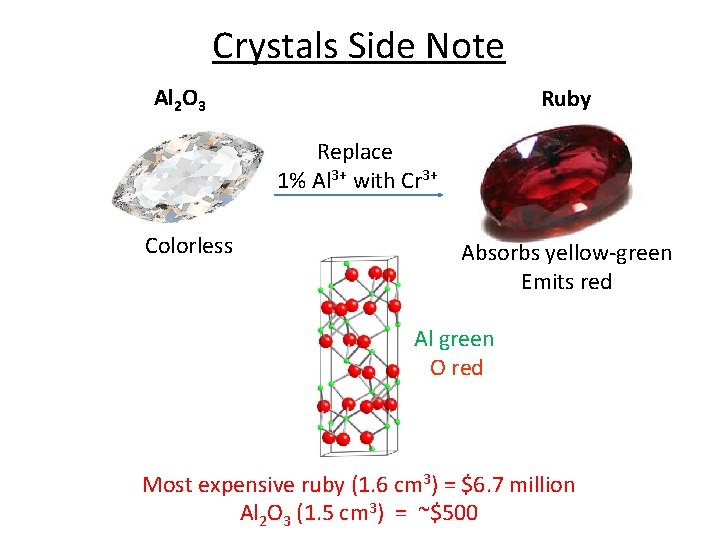
Crystals Side Note Al 2 O 3 Ruby Replace 1% Al 3+ with Cr 3+ Colorless Absorbs yellow-green Emits red Al green O red Most expensive ruby (1. 6 cm 3) = $6. 7 million Al 2 O 3 (1. 5 cm 3) = ~$500
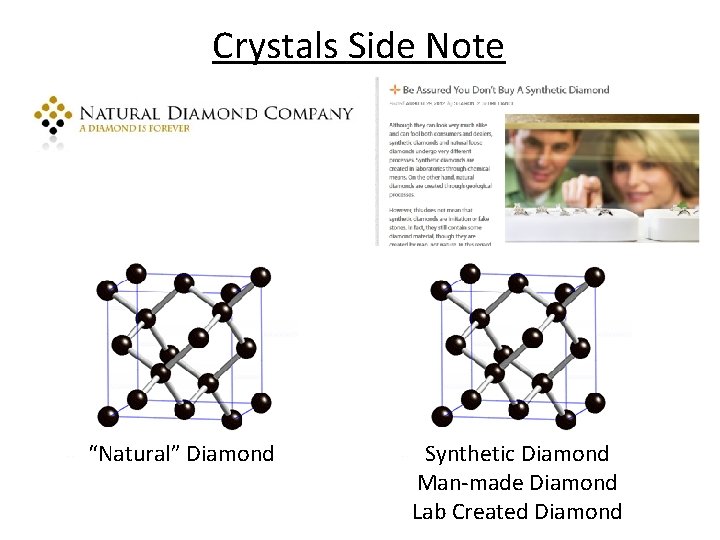
Crystals Side Note “Natural” Diamond Synthetic Diamond Man-made Diamond Lab Created Diamond
Solids § Crystalline solids § Amorphous solids § Exhibit a three-dimensional order. § Exhibit a short-range order, but are disordered over the long range. § Show diffraction pattern when irradiated with X-rays. § Do not show diffraction pattern under X-ray irradiation. 25
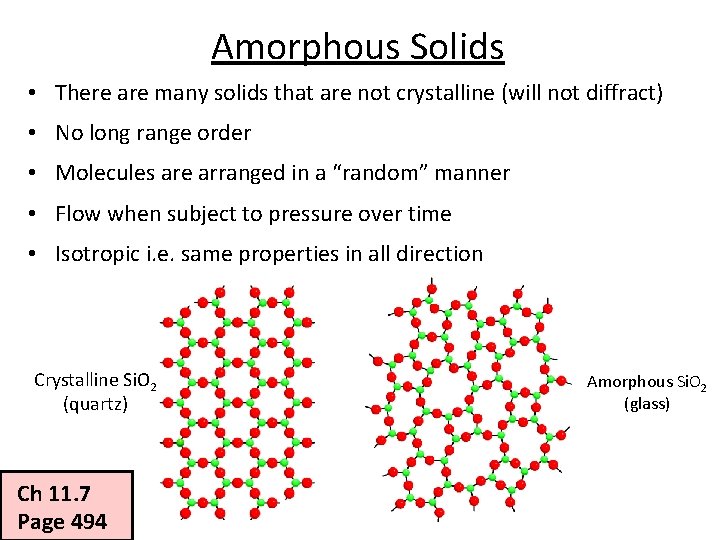
Amorphous Solids • There are many solids that are not crystalline (will not diffract) • No long range order • Molecules are arranged in a “random” manner • Flow when subject to pressure over time • Isotropic i. e. same properties in all direction Crystalline Si. O 2 (quartz) Ch 11. 7 Page 494 Amorphous Si. O 2 (glass)
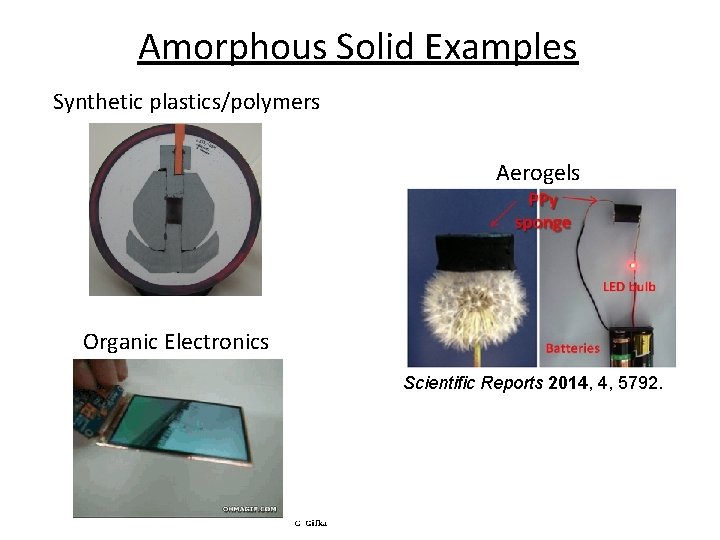
Amorphous Solid Examples Synthetic plastics/polymers Aerogels Organic Electronics Scientific Reports 2014, 4, 5792.
Chapter 11 Intermolecular forces according to Google Images: Ch 11 Page 467 28