
Chapter 11 Instruction Sets Addressing Modes and Formats


- Slides: 38
Chapter 11 Instruction Sets: Addressing Modes and Formats
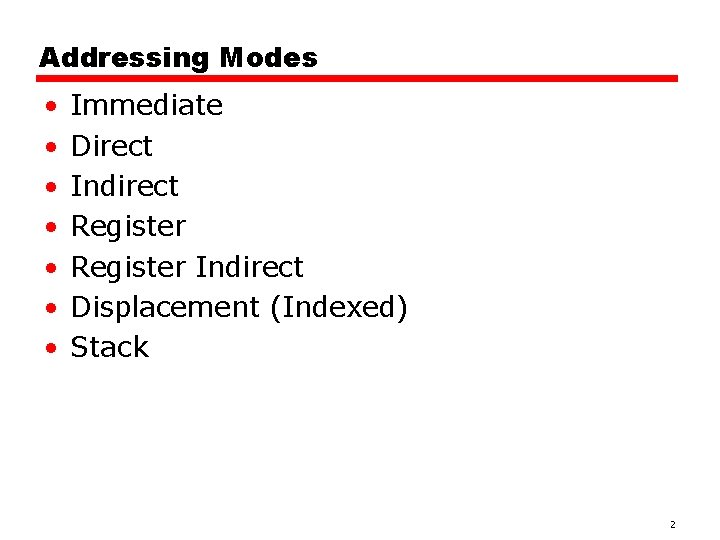
Addressing Modes • • Immediate Direct Indirect Register Indirect Displacement (Indexed) Stack 2
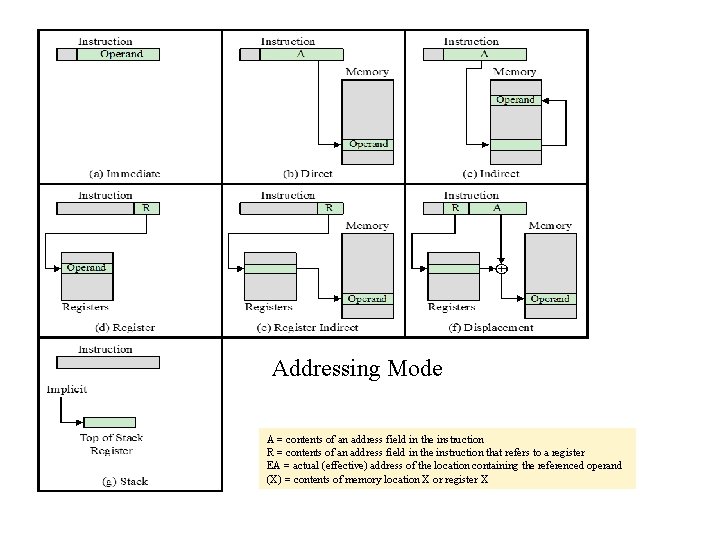
• Addressing Mode A = contents of an address field in the instruction R = contents of an address field in the instruction that refers to a register EA = actual (effective) address of the location containing the referenced operand (X) = contents of memory location X or register X
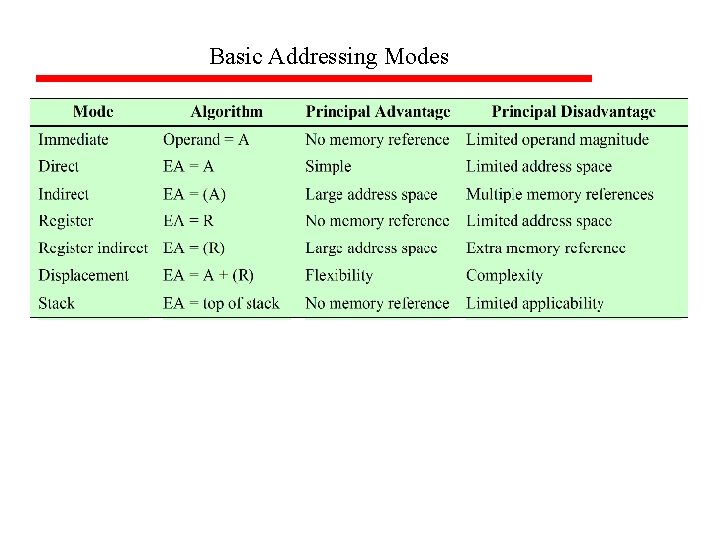
Basic Addressing Modes •
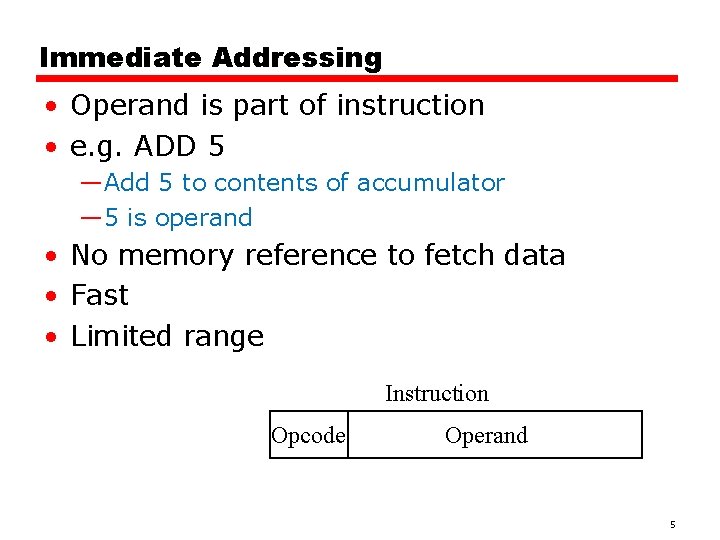
Immediate Addressing • Operand is part of instruction • e. g. ADD 5 —Add 5 to contents of accumulator — 5 is operand • No memory reference to fetch data • Fast • Limited range Instruction Opcode Operand 5
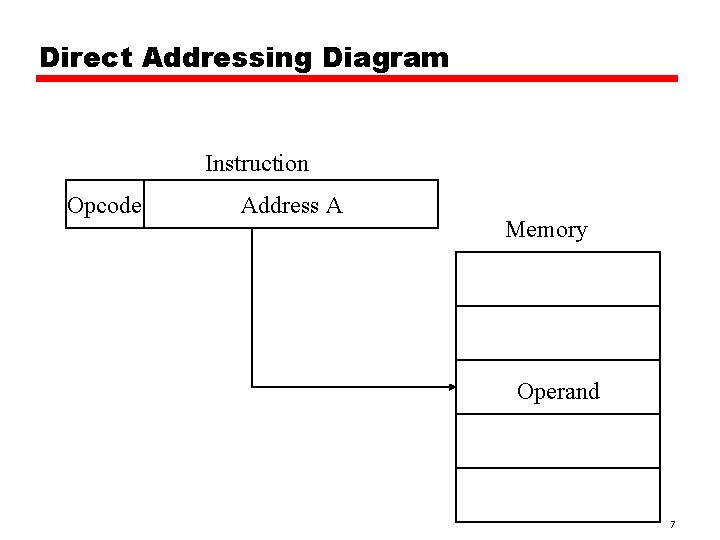
Direct Addressing • Address field contains address of operand • Effective address (EA) = address field (A) • e. g. ADD A —Add contents of cell A to accumulator —Look in memory at address A for operand • Single memory reference to access data • No additional calculations to work out effective address • Limited address space 6
Direct Addressing Diagram Instruction Opcode Address A Memory Operand 7
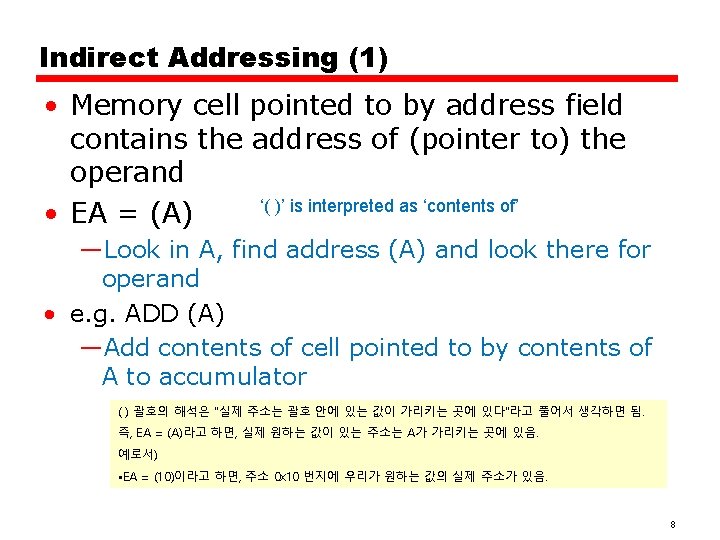
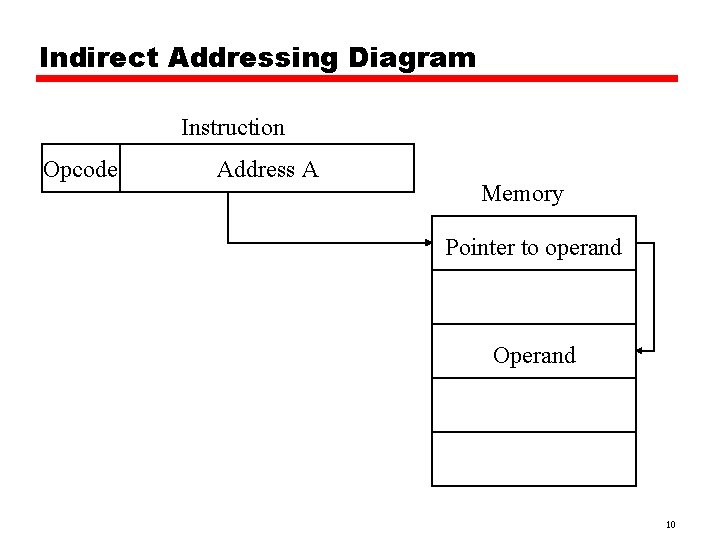
Indirect Addressing (1) • Memory cell pointed to by address field contains the address of (pointer to) the operand ‘( )’ is interpreted as ‘contents of’ • EA = (A) —Look in A, find address (A) and look there for operand • e. g. ADD (A) —Add contents of cell pointed to by contents of A to accumulator ( ) 괄호의 해석은 "실제 주소는 괄호 안에 있는 값이 가리키는 곳에 있다"라고 풀어서 생각하면 됨. 즉, EA = (A)라고 하면, 실제 원하는 값이 있는 주소는 A가 가리키는 곳에 있음. 예로서) • EA = (10)이라고 하면, 주소 0 x 10 번지에 우리가 원하는 값의 실제 주소가 있음. 8
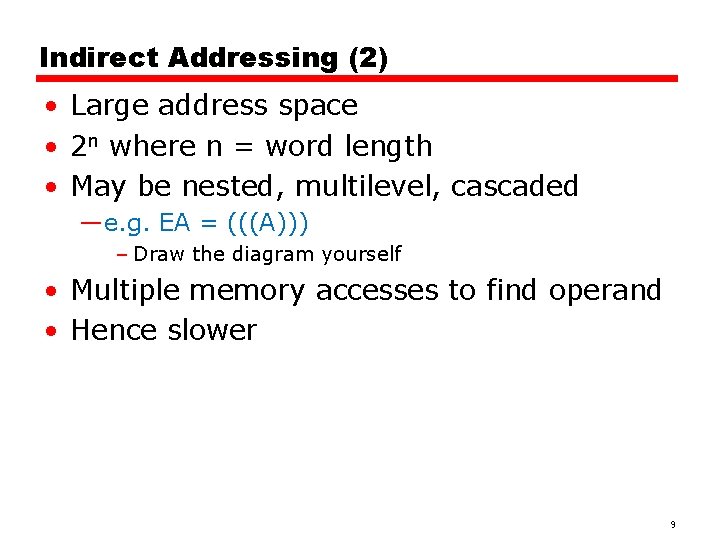
Indirect Addressing (2) • Large address space • 2 n where n = word length • May be nested, multilevel, cascaded —e. g. EA = (((A))) – Draw the diagram yourself • Multiple memory accesses to find operand • Hence slower 9
Indirect Addressing Diagram Instruction Opcode Address A Memory Pointer to operand Operand 10
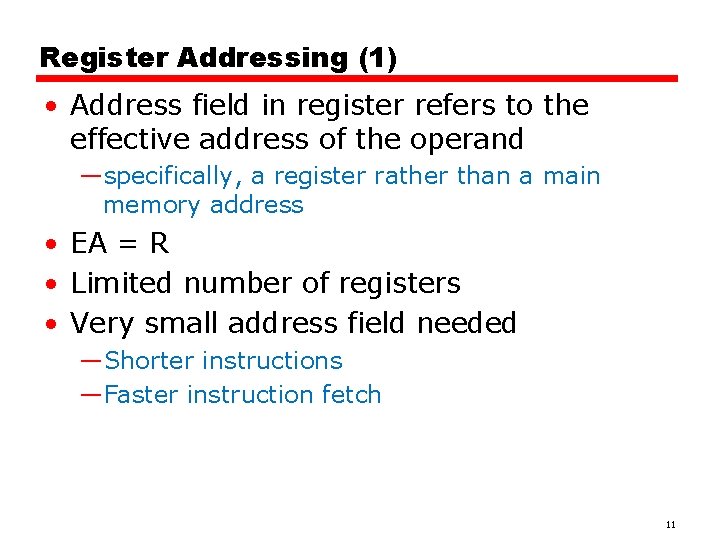
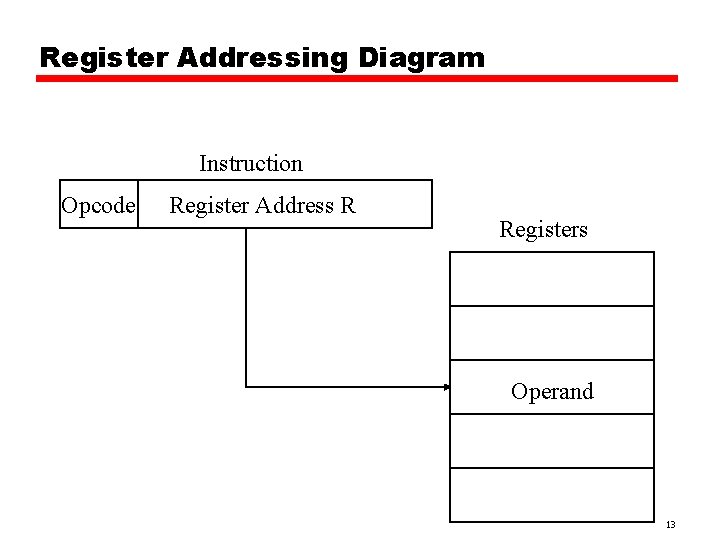
Register Addressing (1) • Address field in register refers to the effective address of the operand —specifically, a register rather than a main memory address • EA = R • Limited number of registers • Very small address field needed —Shorter instructions —Faster instruction fetch 11
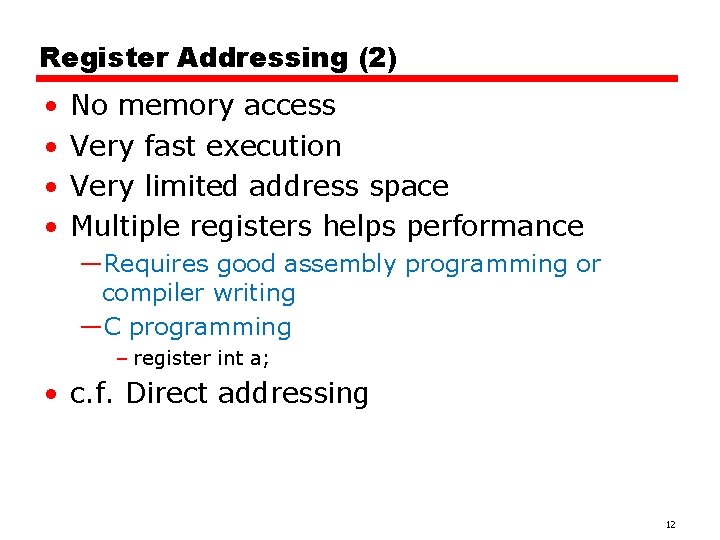
Register Addressing (2) • • No memory access Very fast execution Very limited address space Multiple registers helps performance —Requires good assembly programming or compiler writing —C programming – register int a; • c. f. Direct addressing 12
Register Addressing Diagram Instruction Opcode Register Address R Registers Operand 13
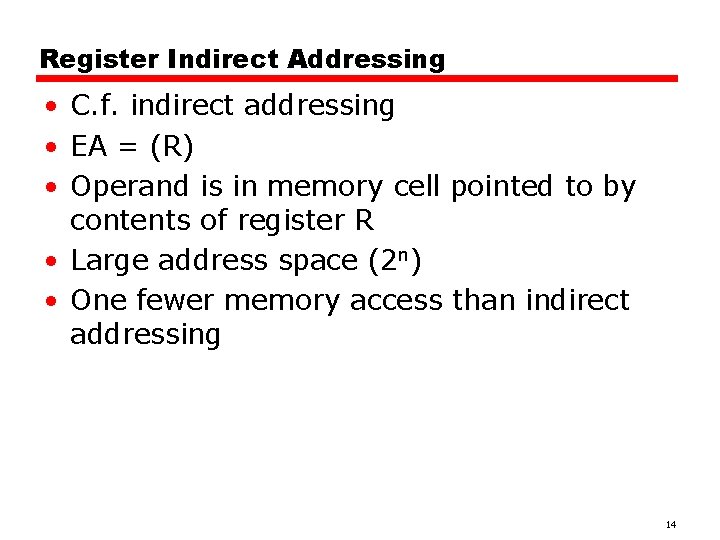
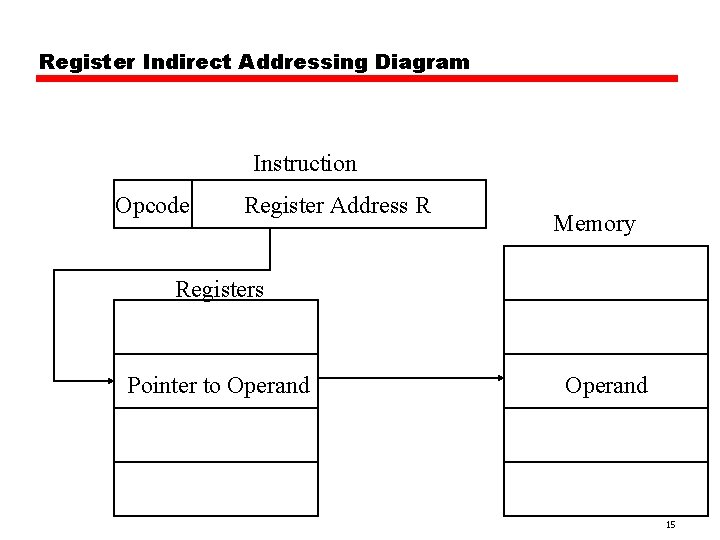
Register Indirect Addressing • C. f. indirect addressing • EA = (R) • Operand is in memory cell pointed to by contents of register R • Large address space (2 n) • One fewer memory access than indirect addressing 14
Register Indirect Addressing Diagram Instruction Opcode Register Address R Memory Registers Pointer to Operand 15
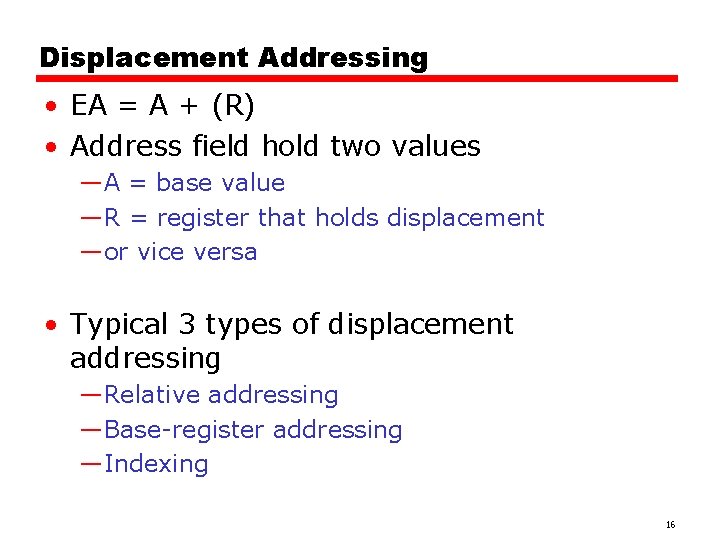
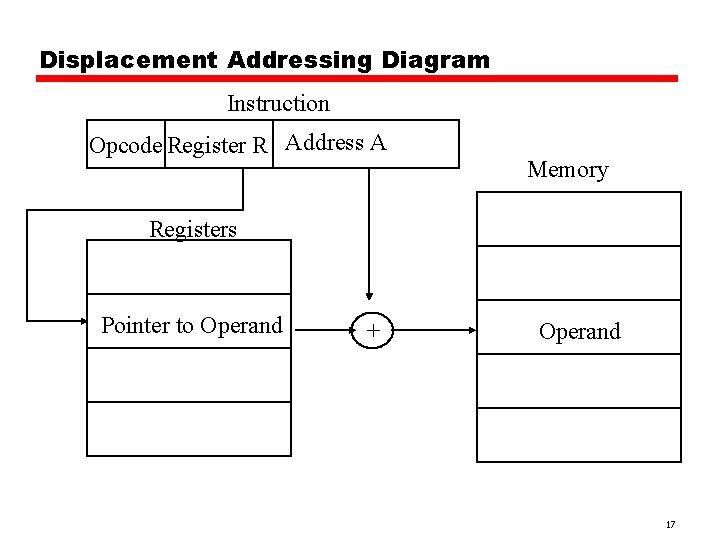
Displacement Addressing • EA = A + (R) • Address field hold two values —A = base value —R = register that holds displacement —or vice versa • Typical 3 types of displacement addressing —Relative addressing —Base-register addressing —Indexing 16
Displacement Addressing Diagram Instruction Opcode Register R Address A Memory Registers Pointer to Operand + Operand 17
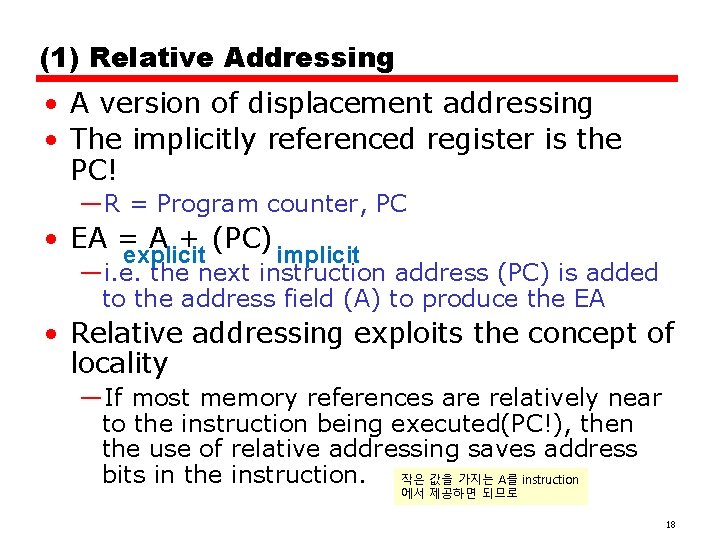
(1) Relative Addressing • A version of displacement addressing • The implicitly referenced register is the PC! —R = Program counter, PC • EA = A + (PC) explicit implicit —i. e. the next instruction address (PC) is added to the address field (A) to produce the EA • Relative addressing exploits the concept of locality —If most memory references are relatively near to the instruction being executed(PC!), then the use of relative addressing saves address bits in the instruction. 작은 값을 가지는 A를 instruction 에서 제공하면 되므로 18
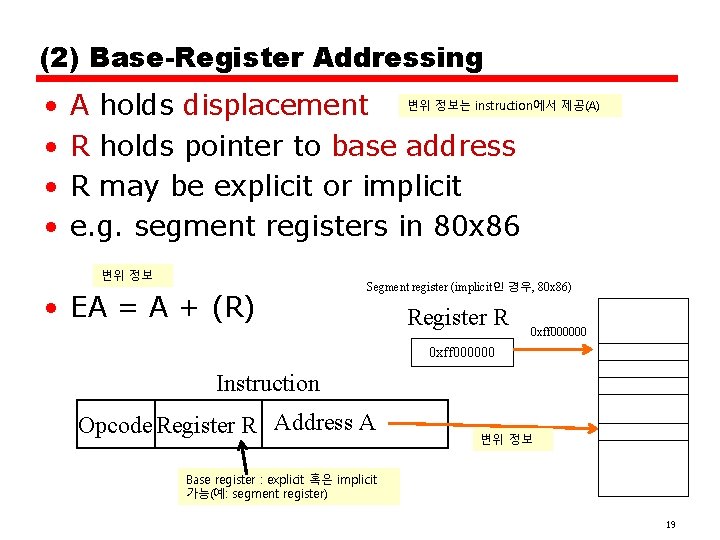
(2) Base-Register Addressing • • A holds displacement 변위 정보는 instruction에서 제공(A) R holds pointer to base address R may be explicit or implicit e. g. segment registers in 80 x 86 변위 정보 • EA = A + (R) Segment register (implicit인 경우, 80 x 86) Register R 0 xff 000000 Instruction Opcode Register R Address A 변위 정보 Base register : explicit 혹은 implicit 가능(예: segment register) 19
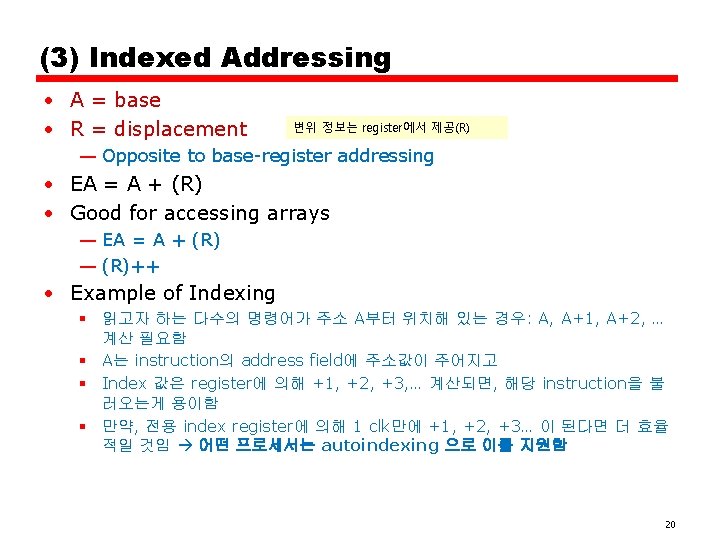
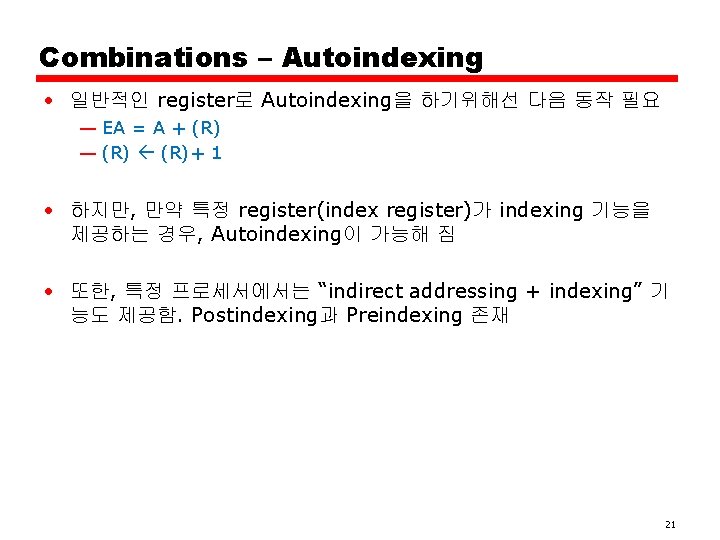
Combinations – Autoindexing • 일반적인 register로 Autoindexing을 하기위해선 다음 동작 필요 — EA = A + (R) — (R)+ 1 • 하지만, 만약 특정 register(index register)가 indexing 기능을 제공하는 경우, Autoindexing이 가능해 짐 • 또한, 특정 프로세서에서는 “indirect addressing + indexing” 기 능도 제공함. Postindexing과 Preindexing 존재 21
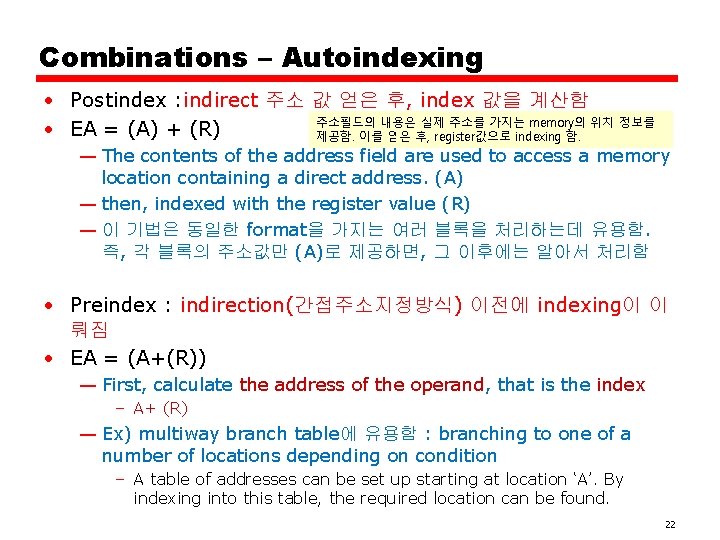
Combinations – Autoindexing • Postindex : indirect 주소 값 얻은 후, index 값을 계산함 주소필드의 내용은 실제 주소를 가지는 memory의 위치 정보를 • EA = (A) + (R) 제공함. 이를 얻은 후, register값으로 indexing 함. — The contents of the address field are used to access a memory location containing a direct address. (A) — then, indexed with the register value (R) — 이 기법은 동일한 format을 가지는 여러 블록을 처리하는데 유용함. 즉, 각 블록의 주소값만 (A)로 제공하면, 그 이후에는 알아서 처리함 • Preindex : indirection(간접주소지정방식) 이전에 indexing이 이 뤄짐 • EA = (A+(R)) — First, calculate the address of the operand, that is the index – A+ (R) — Ex) multiway branch table에 유용함 : branching to one of a number of locations depending on condition – A table of addresses can be set up starting at location ‘A’. By indexing into this table, the required location can be found. 22
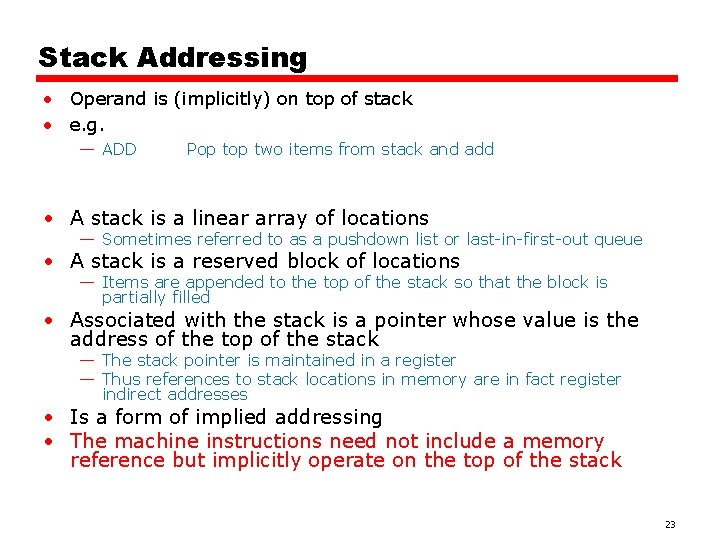
Stack Addressing • Operand is (implicitly) on top of stack • e. g. — ADD Pop two items from stack and add • A stack is a linear array of locations — Sometimes referred to as a pushdown list or last-in-first-out queue • A stack is a reserved block of locations — Items are appended to the top of the stack so that the block is partially filled • Associated with the stack is a pointer whose value is the address of the top of the stack — The stack pointer is maintained in a register — Thus references to stack locations in memory are in fact register indirect addresses • Is a form of implied addressing • The machine instructions need not include a memory reference but implicitly operate on the top of the stack 23
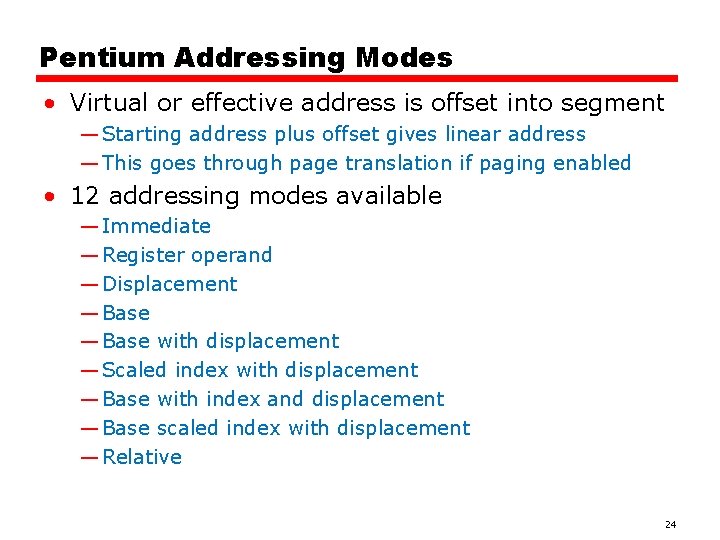
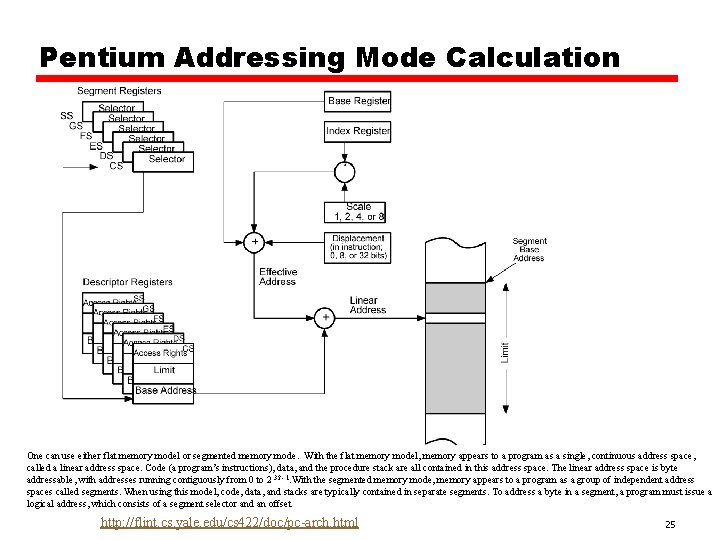
Pentium Addressing Modes • Virtual or effective address is offset into segment — Starting address plus offset gives linear address — This goes through page translation if paging enabled • 12 addressing modes available — Immediate — Register operand — Displacement — Base with displacement — Scaled index with displacement — Base with index and displacement — Base scaled index with displacement — Relative 24
Pentium Addressing Mode Calculation One can use either flat memory model or segmented memory mode. With the flat memory model, memory appears to a program as a single, continuous address space, called a linear address space. Code (a program’s instructions), data, and the procedure stack are all contained in this address space. The linear address space is byte addressable, with addresses running contiguously from 0 to 2 32 - 1. With the segmented memory mode, memory appears to a program as a group of independent address spaces called segments. When using this model, code, data, and stacks are typically contained in separate segments. To address a byte in a segment, a program must issue a logical address, which consists of a segment selector and an offset http: //flint. cs. yale. edu/cs 422/doc/pc-arch. html 25
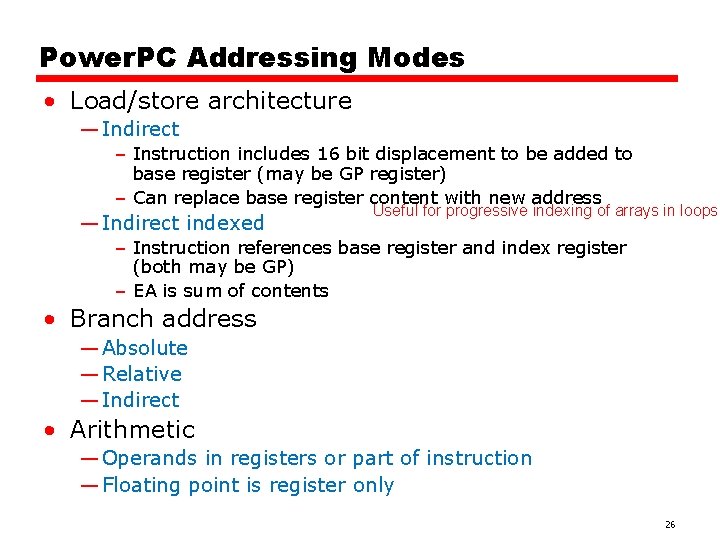
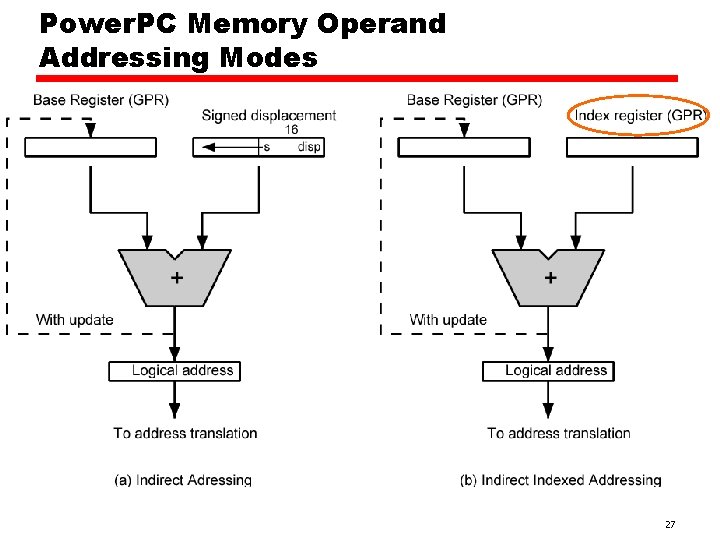
Power. PC Addressing Modes • Load/store architecture — Indirect – Instruction includes 16 bit displacement to be added to base register (may be GP register) – Can replace base register content with new address — Indirect indexed Useful for progressive indexing of arrays in loops – Instruction references base register and index register (both may be GP) – EA is sum of contents • Branch address — Absolute — Relative — Indirect • Arithmetic — Operands in registers or part of instruction — Floating point is register only 26
Power. PC Memory Operand Addressing Modes 27
Instruction Formats • • Layout of bits in an instruction Includes opcode Includes (implicit or explicit) operand(s) Usually more than one instruction format in an instruction set 28
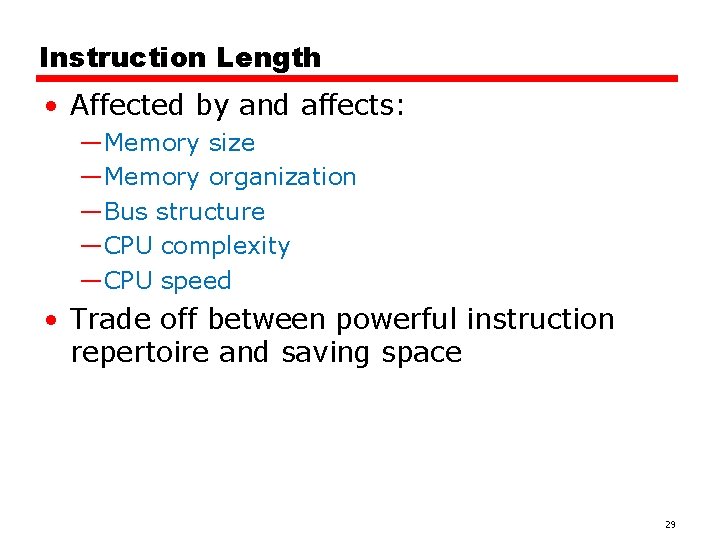
Instruction Length • Affected by and affects: —Memory size —Memory organization —Bus structure —CPU complexity —CPU speed • Trade off between powerful instruction repertoire and saving space 29
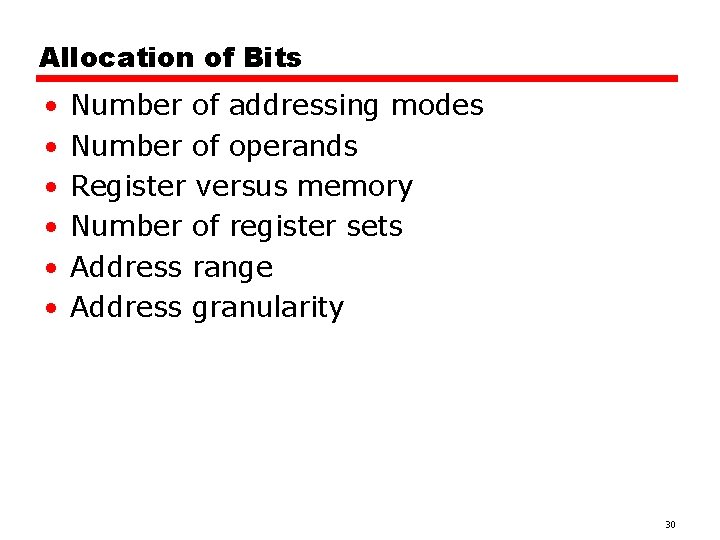
Allocation of Bits • • • Number of addressing modes Number of operands Register versus memory Number of register sets Address range Address granularity 30
Q&A
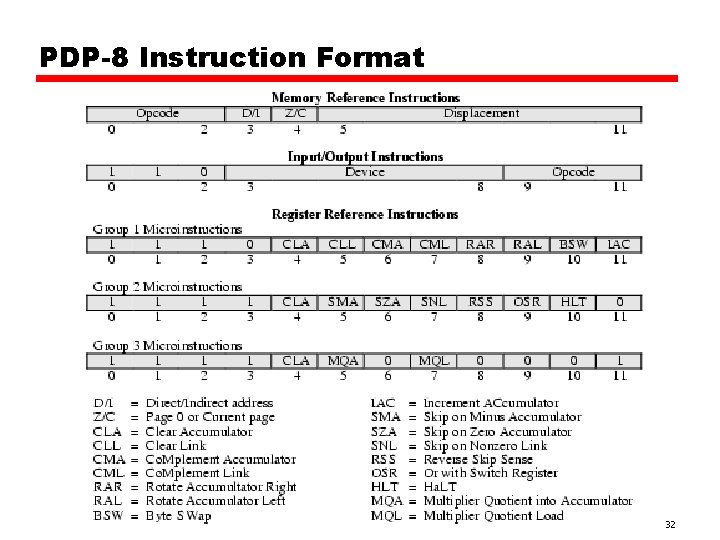
PDP-8 Instruction Format 32
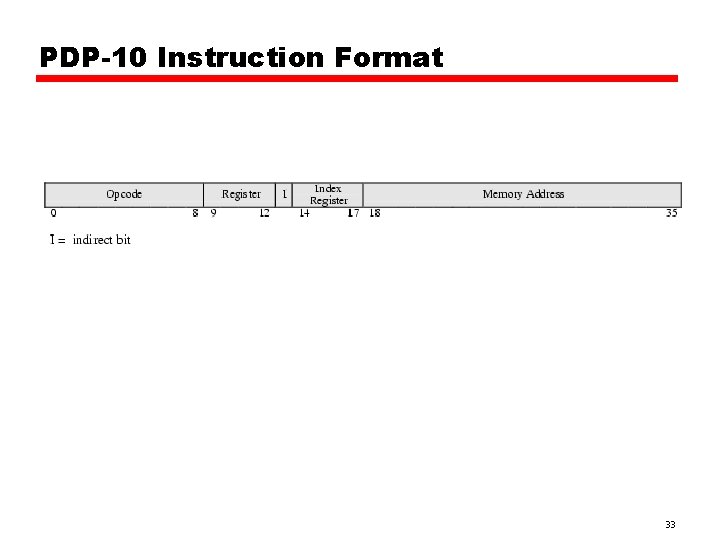
PDP-10 Instruction Format 33
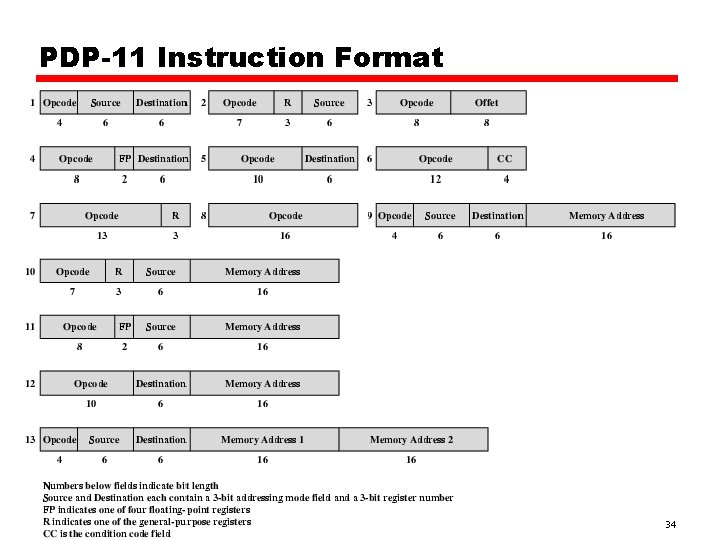
PDP-11 Instruction Format 34
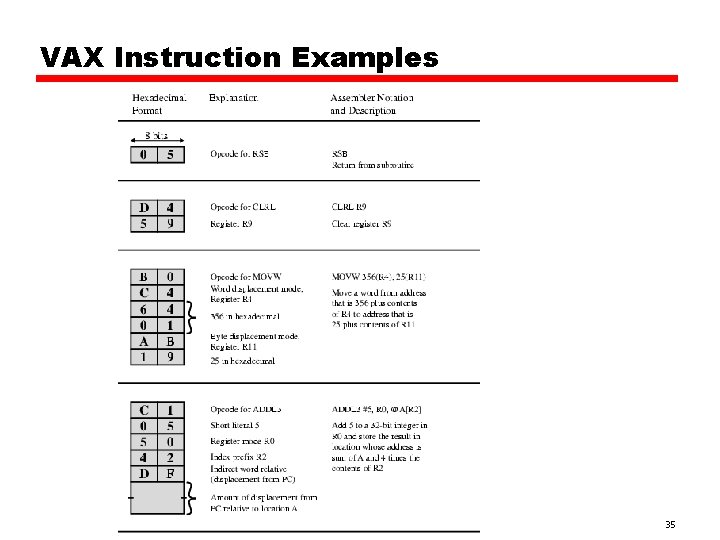
VAX Instruction Examples 35
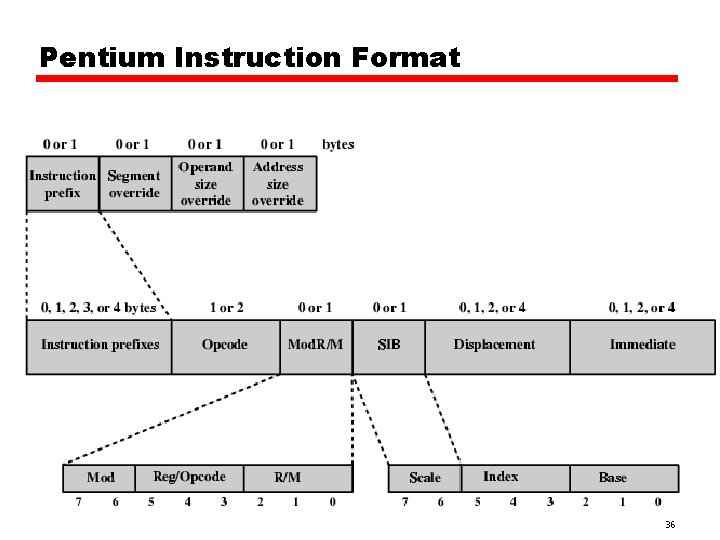
Pentium Instruction Format 36
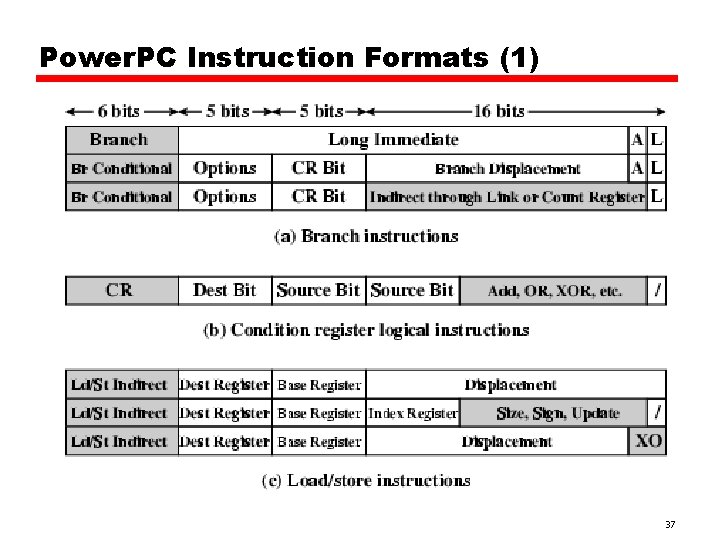
Power. PC Instruction Formats (1) 37
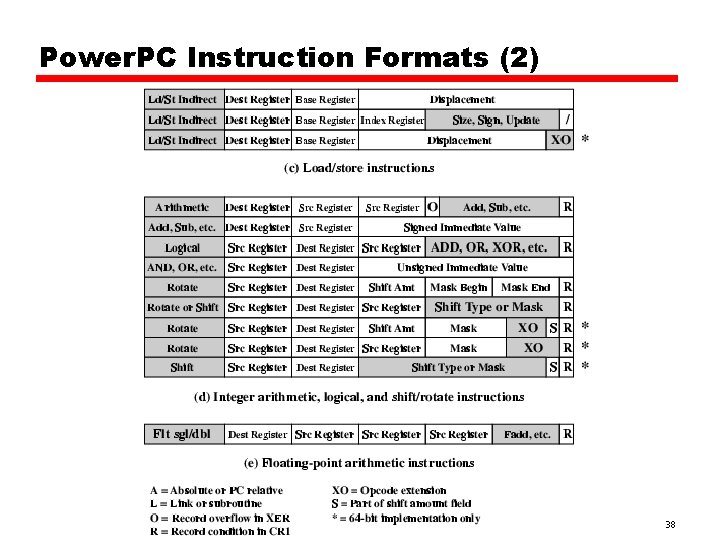
Power. PC Instruction Formats (2) 38