
Chapter 11 Innovation and the Strategy of the
- Slides: 13
Chapter 11: Innovation and the Strategy of the firm
Limit § Profit maximum –cant explain the individual innovation project § Traditional economic theory largely ignore the complication of world science and technology § Infinite gradation-people and firm strategies are always changing § External environment changing(world science and technology) very fast Within these limits, the firm has a range of options and alternative strategies(depend on their resource, history, management attitudes, luck). But the hazards and risks when the firms attempt any major change in world technology are always present. yet not to innovate is to die. This chapter classifies some possible strategies, and discusses them in relation to R&D , and other innovative activities of the firm.
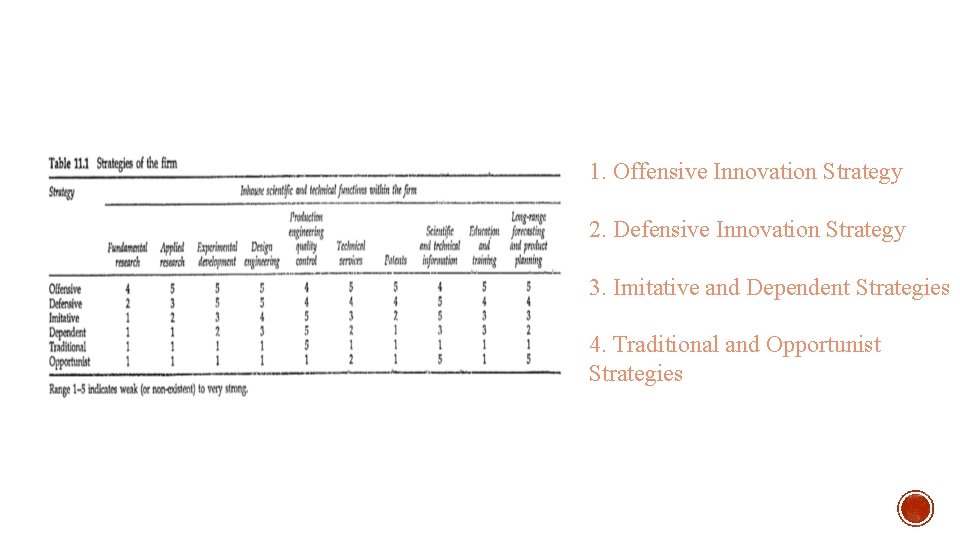
1. Offensive Innovation Strategy 2. Defensive Innovation Strategy 3. Imitative and Dependent Strategies 4. Traditional and Opportunist Strategies
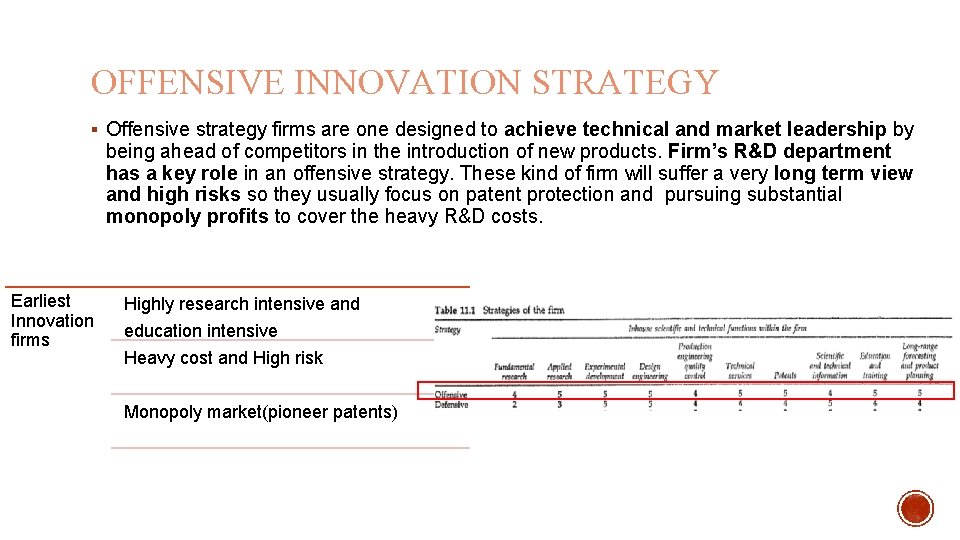
OFFENSIVE INNOVATION STRATEGY § Offensive strategy firms are one designed to achieve technical and market leadership by being ahead of competitors in the introduction of new products. Firm’s R&D department has a key role in an offensive strategy. These kind of firm will suffer a very long term view and high risks so they usually focus on patent protection and pursuing substantial monopoly profits to cover the heavy R&D costs. Earliest Innovation firms Highly research intensive and education intensive Heavy cost and High risk Monopoly market(pioneer patents)
§ Argue about Inhouse fundamental research Leave fundamental research to universities? The performance of fundamental research is often a valuable means of access to new and old knowledge generated outside the firm, as well as a source of new ideas within the firm. The truth is some of the most successful offensive innovations were partly based on inhouse fundamental research. § Experimental development work Including design engineering on the one hand (strong problem-solving capacity in designing, building and testing prototypes and pilot plants-heaviest expenditures and need to seek patent protection) and applied research on the other.
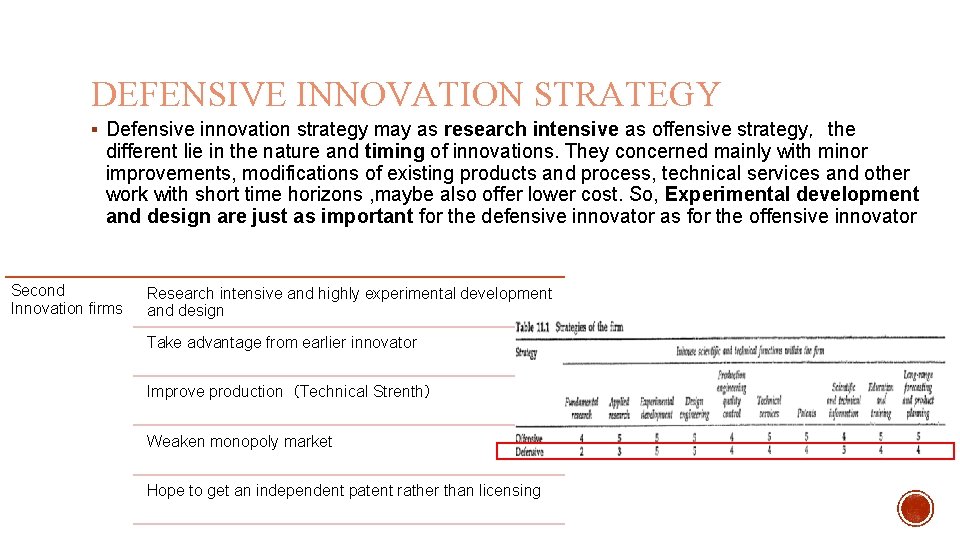
DEFENSIVE INNOVATION STRATEGY § Defensive innovation strategy may as research intensive as offensive strategy,the different lie in the nature and timing of innovations. They concerned mainly with minor improvements, modifications of existing products and process, technical services and other work with short time horizons , maybe also offer lower cost. So, Experimental development and design are just as important for the defensive innovator as for the offensive innovator Second Innovation firms Research intensive and highly experimental development and design Take advantage from earlier innovator Improve production(Technical Strenth) Weaken monopoly market Hope to get an independent patent rather than licensing
The strategy which a firm is able or willing to pursue is strongly influenced by its national environment and government policy. § European: since the war have generally been unable or unwilling to attempt offensive innovations in the semiconductor industry and their role has been almost entirely defensive. § Many firms in the offensive group are US firms, while most firm in the developing countries are imitative, dependent or traditional. § Japan: since 1990 Japanese firms strategy move from traditional to imitative then to defensive and offensive innovations. Because Japanese national policy has been designed to facilitate this progression.
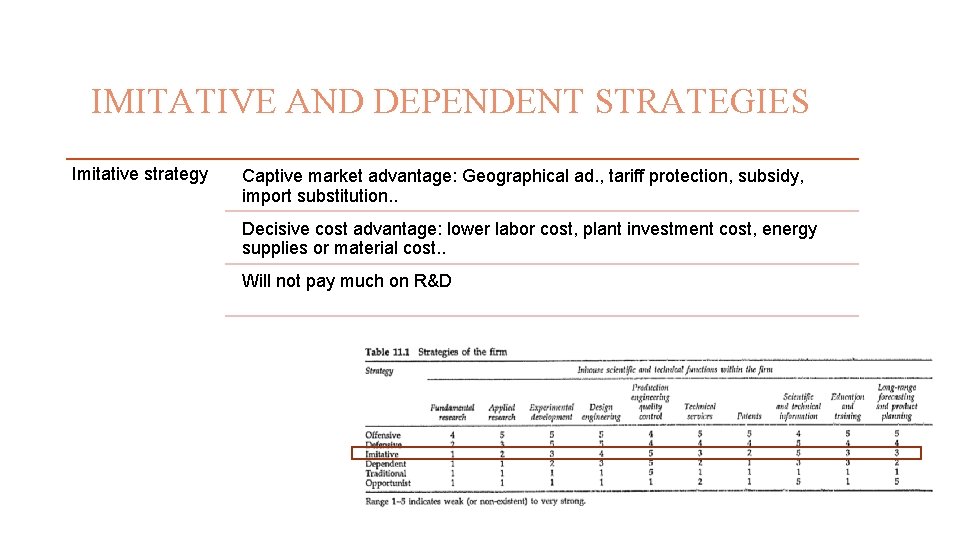
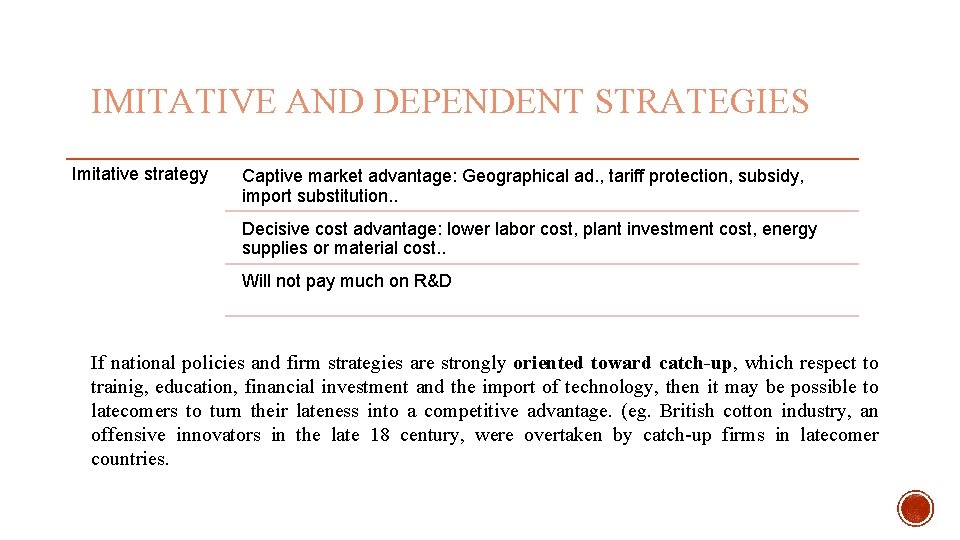
IMITATIVE AND DEPENDENT STRATEGIES Imitative strategy Captive market advantage: Geographical ad. , tariff protection, subsidy, import substitution. . Decisive cost advantage: lower labor cost, plant investment cost, energy supplies or material cost. . Will not pay much on R&D
IMITATIVE AND DEPENDENT STRATEGIES Imitative strategy Captive market advantage: Geographical ad. , tariff protection, subsidy, import substitution. . Decisive cost advantage: lower labor cost, plant investment cost, energy supplies or material cost. . Will not pay much on R&D If national policies and firm strategies are strongly oriented toward catch-up, which respect to trainig, education, financial investment and the import of technology, then it may be possible to latecomers to turn their lateness into a competitive advantage. (eg. British cotton industry, an offensive innovators in the late 18 century, were overtaken by catch-up firms in latecomer countries.
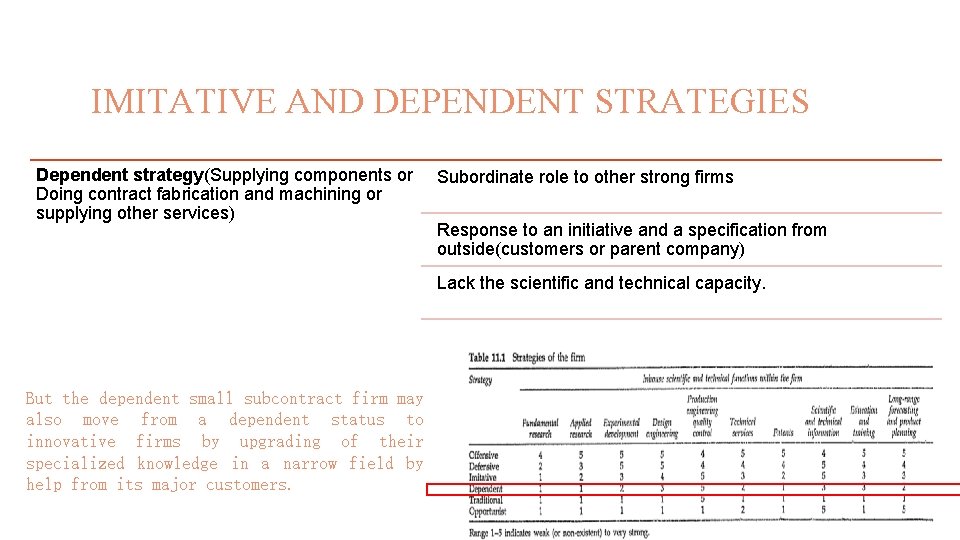
IMITATIVE AND DEPENDENT STRATEGIES Dependent strategy(Supplying components or Doing contract fabrication and machining or supplying other services) Subordinate role to other strong firms Response to an initiative and a specification from outside(customers or parent company) Lack the scientific and technical capacity. But the dependent small subcontract firm may also move from a dependent status to innovative firms by upgrading of their specialized knowledge in a narrow field by help from its major customers.
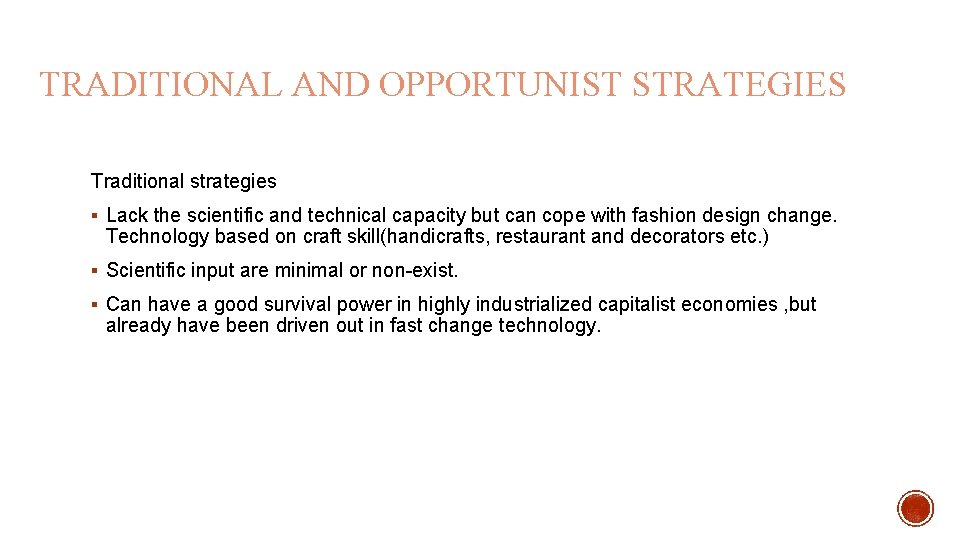
TRADITIONAL AND OPPORTUNIST STRATEGIES Traditional strategies § Lack the scientific and technical capacity but can cope with fashion design change. Technology based on craft skill(handicrafts, restaurant and decorators etc. ) § Scientific input are minimal or non-exist. § Can have a good survival power in highly industrialized capitalist economies , but already have been driven out in fast change technology.
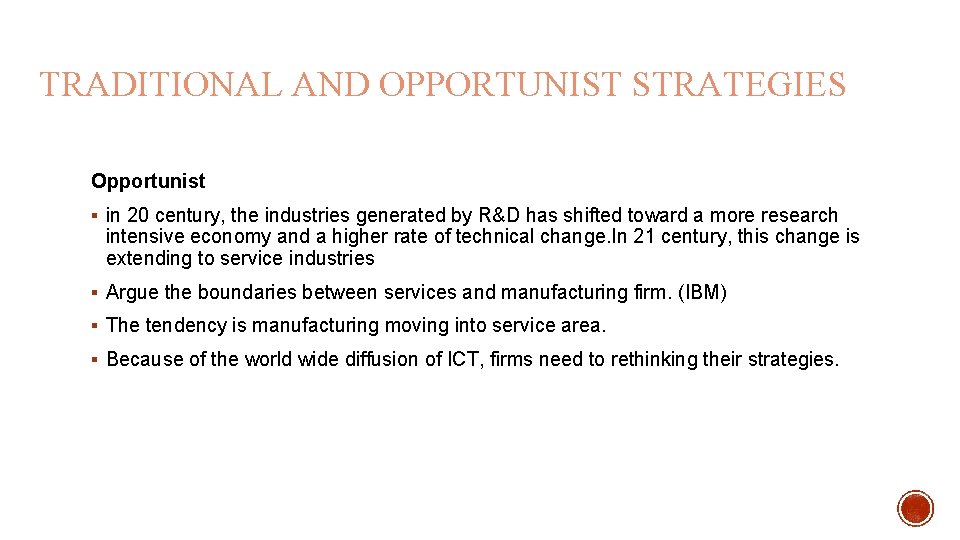
TRADITIONAL AND OPPORTUNIST STRATEGIES Opportunist § in 20 century, the industries generated by R&D has shifted toward a more research intensive economy and a higher rate of technical change. In 21 century, this change is extending to service industries § Argue the boundaries between services and manufacturing firm. (IBM) § The tendency is manufacturing moving into service area. § Because of the world wide diffusion of ICT, firms need to rethinking their strategies.
CONCLUSION