
Chapter 11 Inheritance and Composition C Programming Program
- Slides: 38
Chapter 11 Inheritance and Composition C++ Programming: Program Design Including Data Structures, Eighth Edition 1
Objectives (1 of 2) • In this chapter, you will: • • • Learn about inheritance Learn about derived and base classes Explore how to redefine the member functions of a base class Examine how the constructors of base and derived classes work Learn how the destructors of base and derived classes work © 2018 Cengage Learning. All Rights Reserved. May not be copied, scanned, or duplicated, in whole or in part, except for use as permitted in a license distributed with a certain product or service or otherwise on a password-protected website for classroom 2
Objectives (2 of 2) • • • Learn how to construct the header file of a derived class Become aware of stream classes hierarchy Explore three types of inheritance: public, protected, and private Learn about composition (aggregation) Become familiar with the three basic principles of object-oriented design © 2018 Cengage Learning. All Rights Reserved. May not be copied, scanned, or duplicated, in whole or in part, except for use as permitted in a license distributed with a certain product or service or otherwise on a password-protected website for classroom 3
Introduction • Two common ways to relate two classes in a meaningful way are: • Inheritance (“is-a” relationship) • Composition or aggregation: (“has-a” relationship) © 2018 Cengage Learning. All Rights Reserved. May not be copied, scanned, or duplicated, in whole or in part, except for use as permitted in a license distributed with a certain product or service or otherwise on a password-protected website for classroom 4
Inheritance (1 of 5) • Inheritance is an “is-a” relationship • Example: “every employee is a person” • Inheritance allows creation of new classes from existing classes • Derived classes: new classes created from the existing classes • Base class: the original class • A derived class inherits the properties of its base classes © 2018 Cengage Learning. All Rights Reserved. May not be copied, scanned, or duplicated, in whole or in part, except for use as permitted in a license distributed with a certain product or service or otherwise on a password-protected website for classroom 5
Inheritance (2 of 5) • Inheritance helps reduce software development complexity • Single inheritance: derived class has a single base class • Multiple inheritance: derived class has more than one base class • Public inheritance: all public members of base class are inherited as public members by derived class © 2018 Cengage Learning. All Rights Reserved. May not be copied, scanned, or duplicated, in whole or in part, except for use as permitted in a license distributed with a certain product or service or otherwise on a password-protected website for classroom 6
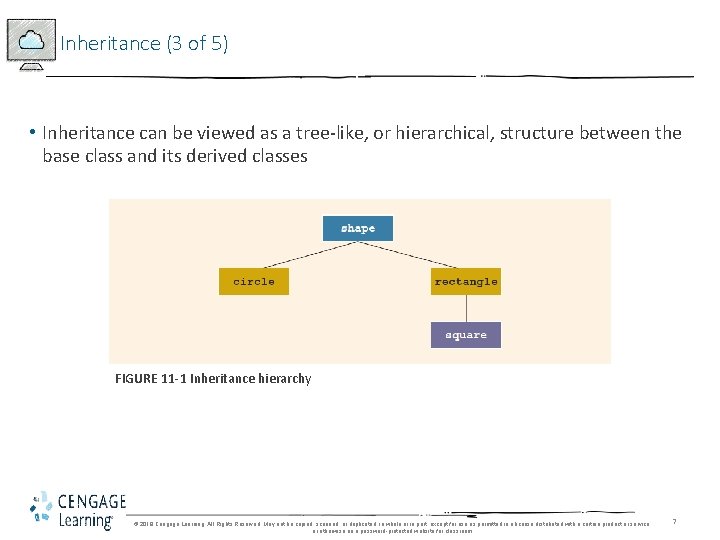
Inheritance (3 of 5) • Inheritance can be viewed as a tree-like, or hierarchical, structure between the base class and its derived classes FIGURE 11 -1 Inheritance hierarchy © 2018 Cengage Learning. All Rights Reserved. May not be copied, scanned, or duplicated, in whole or in part, except for use as permitted in a license distributed with a certain product or service or otherwise on a password-protected website for classroom 7
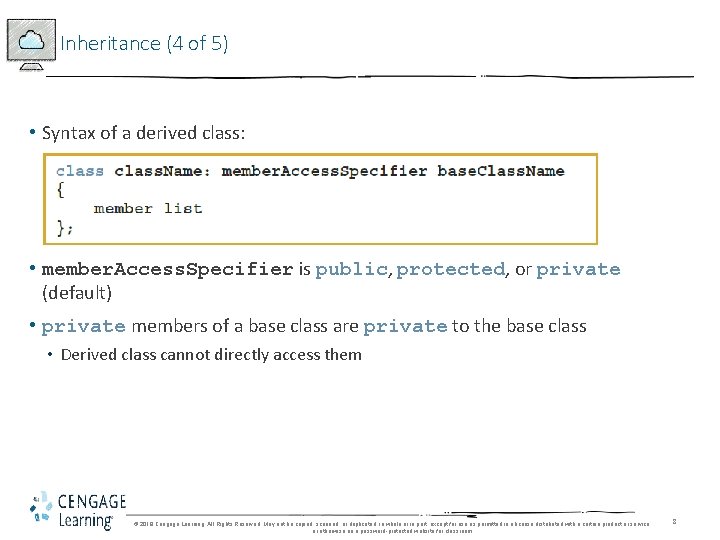
Inheritance (4 of 5) • Syntax of a derived class: • member. Access. Specifier is public, protected, or private (default) • private members of a base class are private to the base class • Derived class cannot directly access them © 2018 Cengage Learning. All Rights Reserved. May not be copied, scanned, or duplicated, in whole or in part, except for use as permitted in a license distributed with a certain product or service or otherwise on a password-protected website for classroom 8
Inheritance (5 of 5) • public members of the base class can be inherited as public or private members • The derived class can include additional members (data and/or functions) • The derived class can redefine public member functions of the base class • Applies only to the objects of the derived class • All member variables of the base class are also member variables of the derived class © 2018 Cengage Learning. All Rights Reserved. May not be copied, scanned, or duplicated, in whole or in part, except for use as permitted in a license distributed with a certain product or service or otherwise on a password-protected website for classroom 9
Redefining (Overriding) Member Functions of the Base Class (1 of 3) • To redefine a public member function: • The corresponding function in the derived class must have the same name, number, and types of parameters • If the derived class overrides a public member function of the base class, then to call the base class function, specify the: • Name of the base class • Scope resolution operator (: : ) • Function name with appropriate parameter list © 2018 Cengage Learning. All Rights Reserved. May not be copied, scanned, or duplicated, in whole or in part, except for use as permitted in a license distributed with a certain product or service or otherwise on a password-protected website for classroom 10
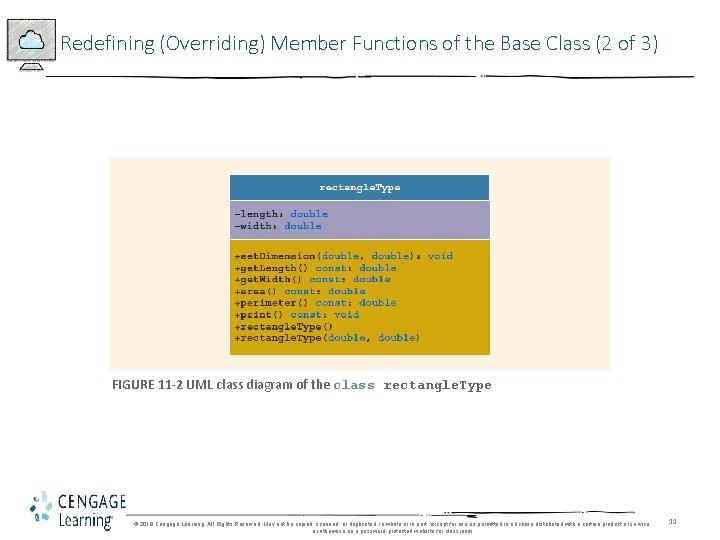
Redefining (Overriding) Member Functions of the Base Class (2 of 3) FIGURE 11 -2 UML class diagram of the class rectangle. Type © 2018 Cengage Learning. All Rights Reserved. May not be copied, scanned, or duplicated, in whole or in part, except for use as permitted in a license distributed with a certain product or service or otherwise on a password-protected website for classroom 11
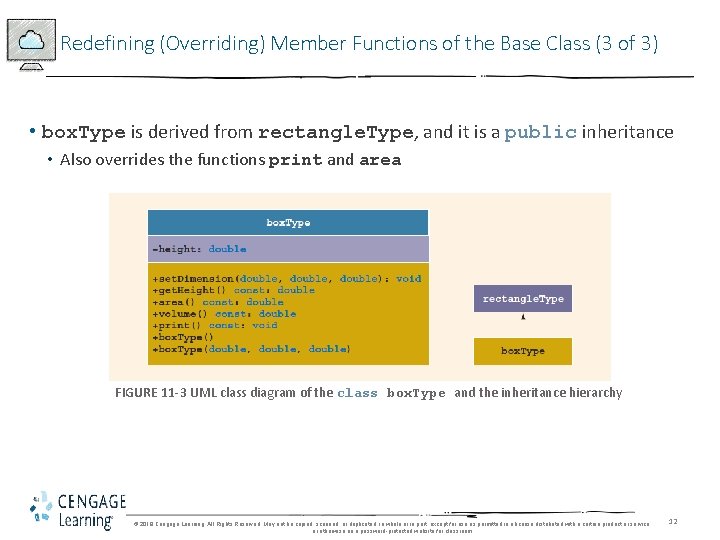
Redefining (Overriding) Member Functions of the Base Class (3 of 3) • box. Type is derived from rectangle. Type, and it is a public inheritance • Also overrides the functions print and area FIGURE 11 -3 UML class diagram of the class box. Type and the inheritance hierarchy © 2018 Cengage Learning. All Rights Reserved. May not be copied, scanned, or duplicated, in whole or in part, except for use as permitted in a license distributed with a certain product or service or otherwise on a password-protected website for classroom 12
Constructors of Derived and Base Classes • A derived class constructor cannot directly access private members of the base class • Can directly initialize only public member variables of the base class • When a derived object is declared, it must execute one of the base class constructors • A call to the base class constructor is specified in the heading of the derived class constructor definition © 2018 Cengage Learning. All Rights Reserved. May not be copied, scanned, or duplicated, in whole or in part, except for use as permitted in a license distributed with a certain product or service or otherwise on a password-protected website for classroom 13
Destructors in a Derived Class • Destructors deallocate dynamic memory allocated by the objects of a class • When a derived class object goes out of scope • Automatically invokes its destructor • When the destructor of the derived class executes • Automatically invokes the destructor of the base class © 2018 Cengage Learning. All Rights Reserved. May not be copied, scanned, or duplicated, in whole or in part, except for use as permitted in a license distributed with a certain product or service or otherwise on a password-protected website for classroom 14
Header File of a Derived Class • To define new classes, create new header files • To create new derived classes, include commands that specify where the base class definitions can be found • Definitions of the member functions can be placed in a separate file © 2018 Cengage Learning. All Rights Reserved. May not be copied, scanned, or duplicated, in whole or in part, except for use as permitted in a license distributed with a certain product or service or otherwise on a password-protected website for classroom 15
Multiple Inclusions of a Header File • Use the preprocessor command (#include) to include a header file in a program • The preprocessor processes the program before it is compiled • To avoid multiple inclusions of a file in a program, use certain preprocessor commands in the header file © 2018 Cengage Learning. All Rights Reserved. May not be copied, scanned, or duplicated, in whole or in part, except for use as permitted in a license distributed with a certain product or service or otherwise on a password-protected website for classroom 16
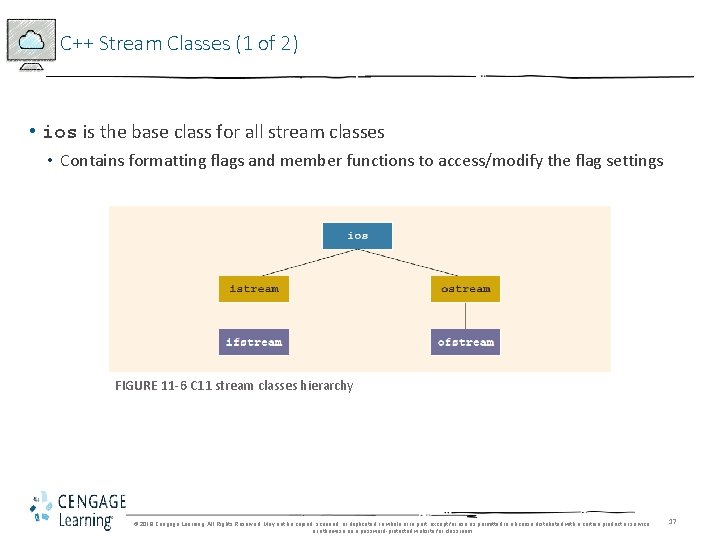
C++ Stream Classes (1 of 2) • ios is the base class for all stream classes • Contains formatting flags and member functions to access/modify the flag settings FIGURE 11 -6 C 11 stream classes hierarchy © 2018 Cengage Learning. All Rights Reserved. May not be copied, scanned, or duplicated, in whole or in part, except for use as permitted in a license distributed with a certain product or service or otherwise on a password-protected website for classroom 17
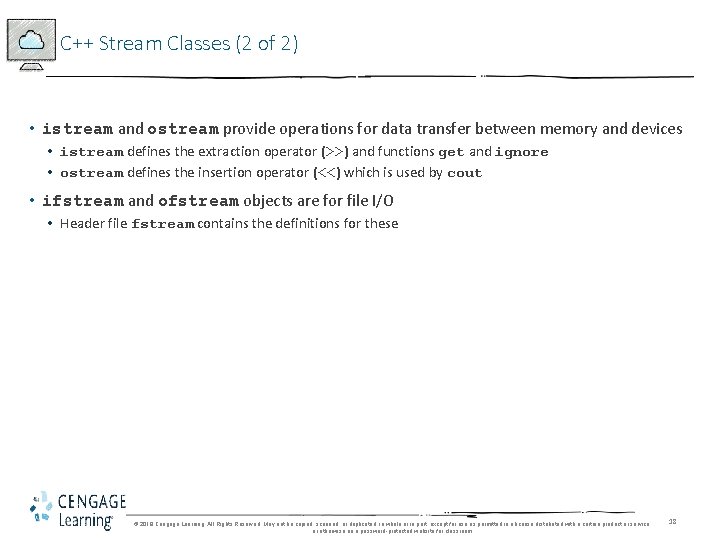
C++ Stream Classes (2 of 2) • istream and ostream provide operations for data transfer between memory and devices • istream defines the extraction operator (>>) and functions get and ignore • ostream defines the insertion operator (<<) which is used by cout • ifstream and ofstream objects are for file I/O • Header file fstream contains the definitions for these © 2018 Cengage Learning. All Rights Reserved. May not be copied, scanned, or duplicated, in whole or in part, except for use as permitted in a license distributed with a certain product or service or otherwise on a password-protected website for classroom 18
Protected Members of a Class • A derived class cannot directly access private members of it base class • To give it direct access, declare that member as protected © 2018 Cengage Learning. All Rights Reserved. May not be copied, scanned, or duplicated, in whole or in part, except for use as permitted in a license distributed with a certain product or service or otherwise on a password-protected website for classroom 19
Inheritance as public, protected, or private (1 of 3) • Assume class B is derived from class A with • class B: member. Access. Specifier A • If member. Access. Specifier is public: • public members of A are public in B and can be directly accessed in class B • protected members of A are protected in B and can be directly accessed by member functions (and friend functions) of B • private members of A are hidden in B and can be accessed only through public or protected members of A © 2018 Cengage Learning. All Rights Reserved. May not be copied, scanned, or duplicated, in whole or in part, except for use as permitted in a license distributed with a certain product or service or otherwise on a password-protected website for classroom 20
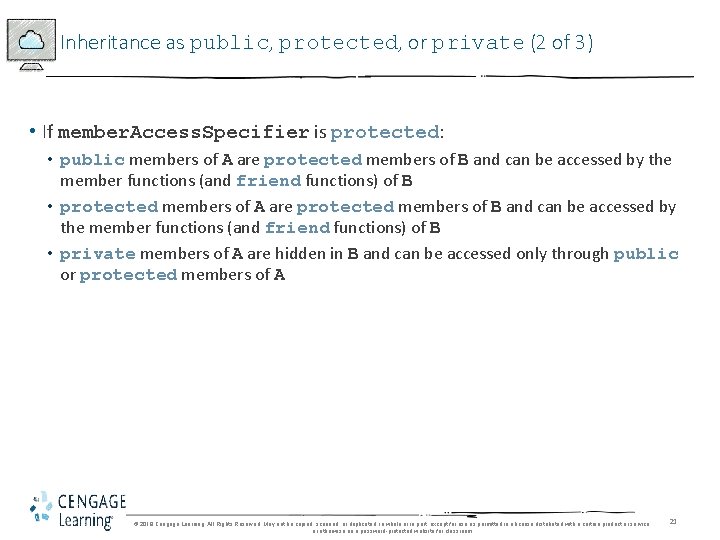
Inheritance as public, protected, or private (2 of 3) • If member. Access. Specifier is protected: • public members of A are protected members of B and can be accessed by the member functions (and friend functions) of B • protected members of A are protected members of B and can be accessed by the member functions (and friend functions) of B • private members of A are hidden in B and can be accessed only through public or protected members of A © 2018 Cengage Learning. All Rights Reserved. May not be copied, scanned, or duplicated, in whole or in part, except for use as permitted in a license distributed with a certain product or service or otherwise on a password-protected website for classroom 21
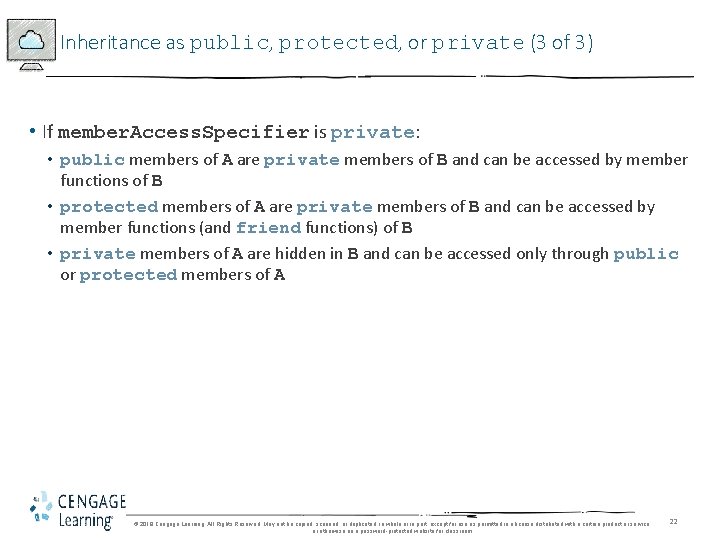
Inheritance as public, protected, or private (3 of 3) • If member. Access. Specifier is private: • public members of A are private members of B and can be accessed by member functions of B • protected members of A are private members of B and can be accessed by member functions (and friend functions) of B • private members of A are hidden in B and can be accessed only through public or protected members of A © 2018 Cengage Learning. All Rights Reserved. May not be copied, scanned, or duplicated, in whole or in part, except for use as permitted in a license distributed with a certain product or service or otherwise on a password-protected website for classroom 22
Composition (Aggregation) (1 of 2) • In composition, one or more member(s) of a class are objects of another class type • Composition (aggregation) is a “has-a” relation • Arguments to the constructor of a member-object are specified in the heading part of the definition of the constructor © 2018 Cengage Learning. All Rights Reserved. May not be copied, scanned, or duplicated, in whole or in part, except for use as permitted in a license distributed with a certain product or service or otherwise on a password-protected website for classroom 23
Composition (Aggregation) (2 of 2) • Member-objects of a class are constructed in the order they are declared • Not in the order listed in the constructor’s member initialization list • They are constructed before the containing class objects are constructed © 2018 Cengage Learning. All Rights Reserved. May not be copied, scanned, or duplicated, in whole or in part, except for use as permitted in a license distributed with a certain product or service or otherwise on a password-protected website for classroom 24
Object-Oriented Design (OOD) and Object-Oriented Programming (OOP) (1 of 5) • The fundamental principles of object-oriented design (OOD) are: • Encapsulation: combines data and operations on data in a single unit • Inheritance: creates new objects (classes) from existing objects (classes) • Polymorphism: the ability to use the same expression to denote different operations © 2018 Cengage Learning. All Rights Reserved. May not be copied, scanned, or duplicated, in whole or in part, except for use as permitted in a license distributed with a certain product or service or otherwise on a password-protected website for classroom 25
OOD and OOP (2 of 5) • In OOD: • Object is a fundamental entity • Debug at the class level • A program is a collection of interacting objects • OOD encourages code reuse • Object-oriented programming (OOP) implements OOD © 2018 Cengage Learning. All Rights Reserved. May not be copied, scanned, or duplicated, in whole or in part, except for use as permitted in a license distributed with a certain product or service or otherwise on a password-protected website for classroom 26
OOD and OOP (3 of 5) • C++ supports OOP through the use of classes • A function name and operators can be overloaded • A polymorphic function or operator has many forms • Example: division with floating point and division with integer operands © 2018 Cengage Learning. All Rights Reserved. May not be copied, scanned, or duplicated, in whole or in part, except for use as permitted in a license distributed with a certain product or service or otherwise on a password-protected website for classroom 27
OOD and OOP (4 of 5) • Templates provide parametric polymorphism • C++ provides virtual functions to implement polymorphism in an inheritance hierarchy • Allows run-time selection of appropriate member functions • Objects are created when class variables are declared • Objects interact with each other via function calls © 2018 Cengage Learning. All Rights Reserved. May not be copied, scanned, or duplicated, in whole or in part, except for use as permitted in a license distributed with a certain product or service or otherwise on a password-protected website for classroom 28
OOD and OOP (5 of 5) • Every object has an internal state and an external state • Private members form the internal state • Public members form the external state • Only the object can manipulate its internal state © 2018 Cengage Learning. All Rights Reserved. May not be copied, scanned, or duplicated, in whole or in part, except for use as permitted in a license distributed with a certain product or service or otherwise on a password-protected website for classroom 29
Identifying Classes, Objects, and Operations (1 of 5) • To find classes, begin with a problem description and identify all nouns and verbs • From the list of nouns choose the classes • From the list of verbs choose the operations • Suppose we want to write a program that calculates and prints the volume and surface area of a cylinder © 2018 Cengage Learning. All Rights Reserved. May not be copied, scanned, or duplicated, in whole or in part, except for use as permitted in a license distributed with a certain product or service or otherwise on a password-protected website for classroom 30
Identifying Classes, Objects, and Operations (2 of 5) • State this problem as follows: • Write a program to input the dimensions of a cylinder and calculate and print the surface area and volume • Nouns are bold and verbs are italic • From the list of nouns, one can visualize a cylinder as a class (cylinder. Type) from which we can create many cylinder objects of various dimensions © 2018 Cengage Learning. All Rights Reserved. May not be copied, scanned, or duplicated, in whole or in part, except for use as permitted in a license distributed with a certain product or service or otherwise on a password-protected website for classroom 31
Identifying Classes, Objects, and Operations (3 of 5) • These nouns are characteristics of a cylinder, so they will not be classes: • Dimensions • Surface area • Volume • Next, determine three pieces of information about this class: • Operations that an object can perform • Operations that can be performed on an object • Information that an object must maintain © 2018 Cengage Learning. All Rights Reserved. May not be copied, scanned, or duplicated, in whole or in part, except for use as permitted in a license distributed with a certain product or service or otherwise on a password-protected website for classroom 32
Identifying Classes, Objects, and Operations (4 of 5) • From the verbs, list possible operations that an object of that class can perform, or have performed, on itself • For the cylinder. Type class: - Input - Calculate - Print • Dimensions of the cylinder represent the class’s data © 2018 Cengage Learning. All Rights Reserved. May not be copied, scanned, or duplicated, in whole or in part, except for use as permitted in a license distributed with a certain product or service or otherwise on a password-protected website for classroom 33
Identifying Classes, Objects, and Operations (5 of 5) • Identifying classes via nouns and verbs from problem descriptions is not the only technique possible • There are several other OOD techniques in the literature © 2018 Cengage Learning. All Rights Reserved. May not be copied, scanned, or duplicated, in whole or in part, except for use as permitted in a license distributed with a certain product or service or otherwise on a password-protected website for classroom 34
Quick Review (1 of 4) • Inheritance and composition are meaningful ways to relate two or more classes • Inheritance is an “is-a” relation • Single inheritance: a derived class is derived from one class, called the base class • Multiple inheritance: a derived class is derived from more than one base class • Composition is a “has-a” relation © 2018 Cengage Learning. All Rights Reserved. May not be copied, scanned, or duplicated, in whole or in part, except for use as permitted in a license distributed with a certain product or service or otherwise on a password-protected website for classroom 35
Quick Review (2 of 4) • private members of a base class are private to the base class • public members of a base class can be inherited either as public or private • A derived class can redefine function members of a base class • Redefinition applies only to objects of derived class © 2018 Cengage Learning. All Rights Reserved. May not be copied, scanned, or duplicated, in whole or in part, except for use as permitted in a license distributed with a certain product or service or otherwise on a password-protected website for classroom 36
Quick Review (3 of 4) • A call to a base class constructor (with parameters) is specified in the heading of the definition of the derived class constructor • When initializing object of a derived class, the base class constructor is executed first • In composition (aggregation): • A class member is an object of another class • A call to constructor of member objects is specified in heading of the definition of class’s constructor © 2018 Cengage Learning. All Rights Reserved. May not be copied, scanned, or duplicated, in whole or in part, except for use as permitted in a license distributed with a certain product or service or otherwise on a password-protected website for classroom 37
Quick Review (4 of 4) • Three basic principles of OOD: • Encapsulation • Inheritance • Polymorphism • To find classes: • Describe the problem • Choose classes from the list of nouns • Choose operations from the list of verbs © 2018 Cengage Learning. All Rights Reserved. May not be copied, scanned, or duplicated, in whole or in part, except for use as permitted in a license distributed with a certain product or service or otherwise on a password-protected website for classroom 38