
Chapter 11 Identifying Causation Learning Objectives Explain how
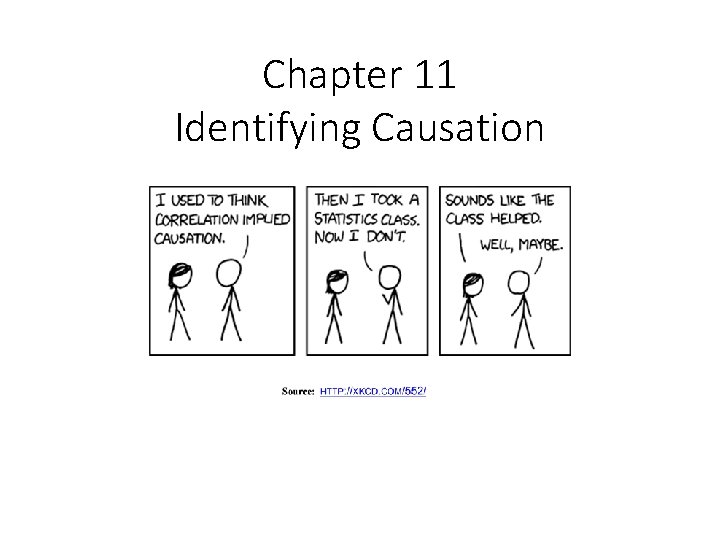
Chapter 11 Identifying Causation
Learning Objectives • Explain how correlation differs from causation in regression models • Learn the three sources of the endogeneity problem and how they cause assumption CR 5 to fail • Learn about some solutions to the endogeneity problem

Why Causality • Does joining a union or getting more education raise workers’ earnings? • Do immigrants reduce wages and employment for native workers? • Do good roads make economies grow faster? • Does economic growth make civil wars less likely? • Do smaller class sizes help kids learn more? • Do welfare payments to poor women make their kids better educated and well-fed? • What makes some nations rich and others poor?
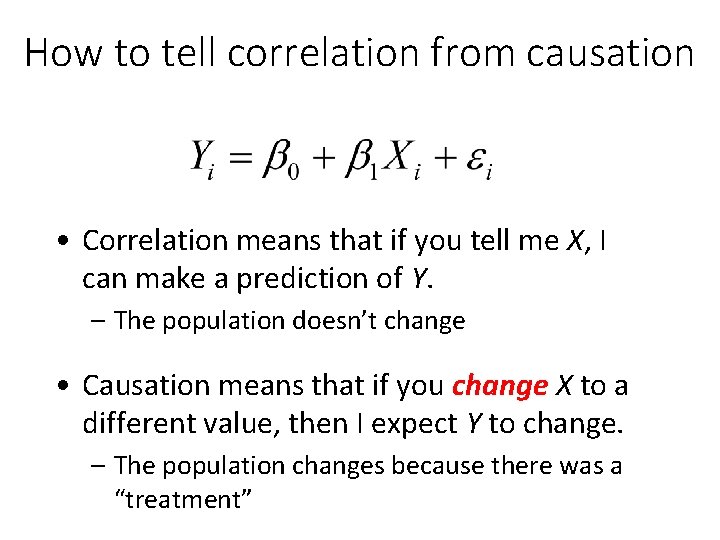
How to tell correlation from causation • Correlation means that if you tell me X, I can make a prediction of Y. – The population doesn’t change • Causation means that if you change X to a different value, then I expect Y to change. – The population changes because there was a “treatment”
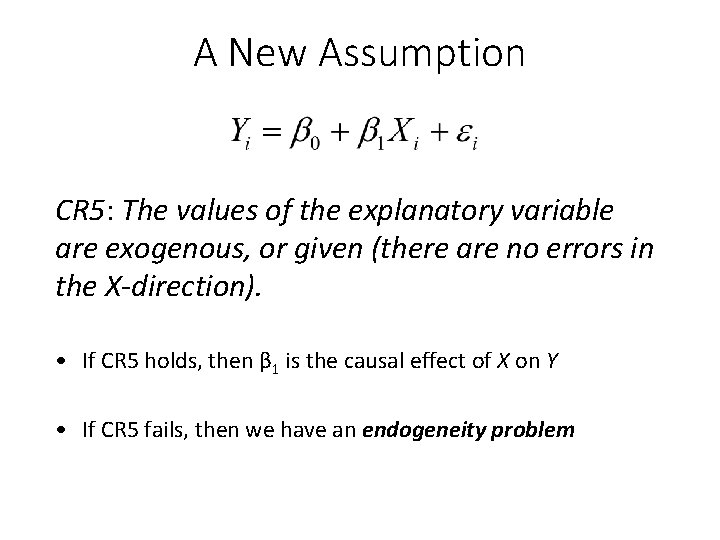
A New Assumption CR 5: The values of the explanatory variable are exogenous, or given (there are no errors in the X-direction). • If CR 5 holds, then β 1 is the causal effect of X on Y • If CR 5 fails, then we have an endogeneity problem
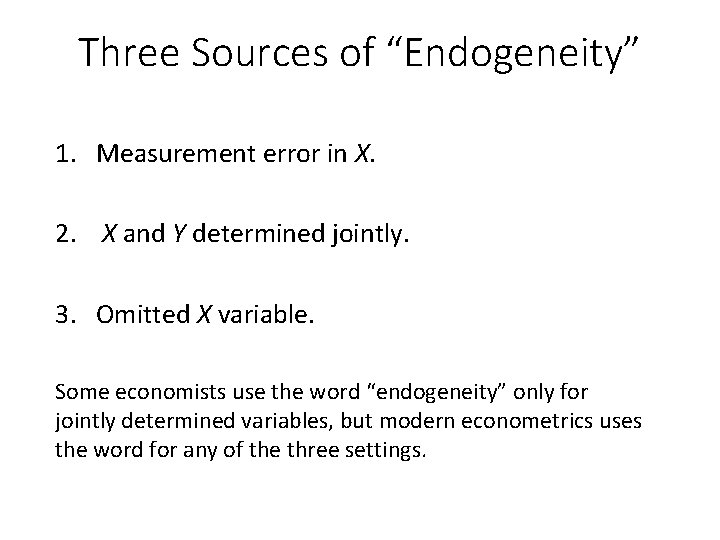
Three Sources of “Endogeneity” 1. Measurement error in X. 2. X and Y determined jointly. 3. Omitted X variable. Some economists use the word “endogeneity” only for jointly determined variables, but modern econometrics uses the word for any of the three settings.
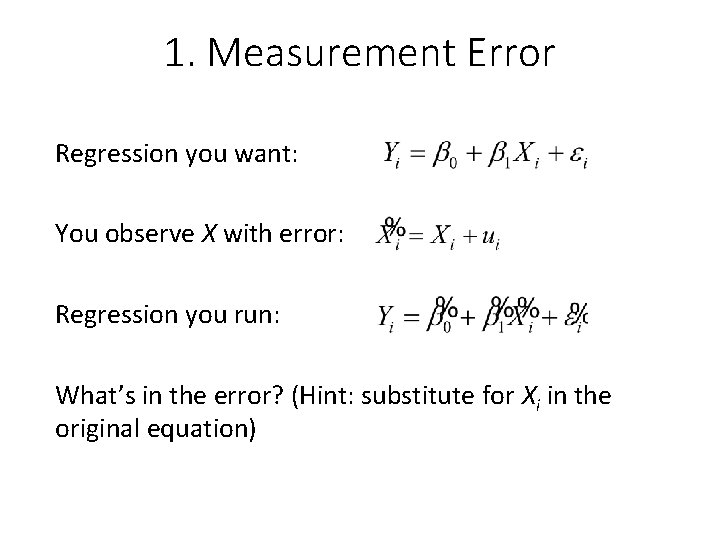
1. Measurement Error Regression you want: You observe X with error: Regression you run: What’s in the error? (Hint: substitute for Xi in the original equation)
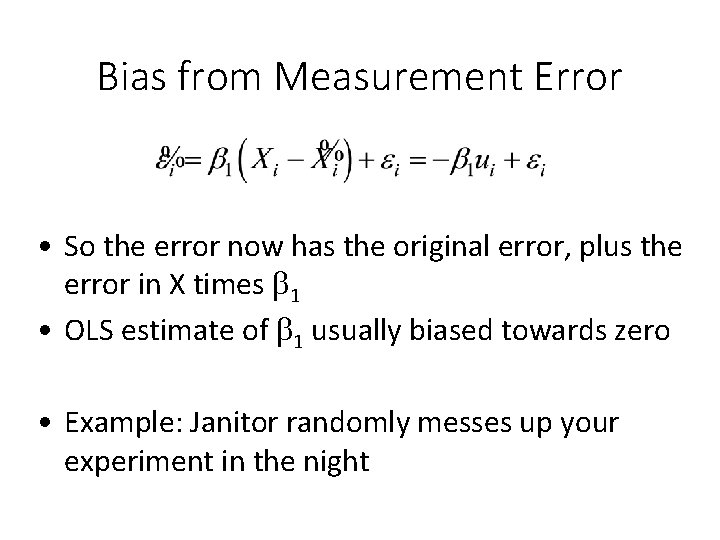
Bias from Measurement Error • So the error now has the original error, plus the error in X times 1 • OLS estimate of 1 usually biased towards zero • Example: Janitor randomly messes up your experiment in the night
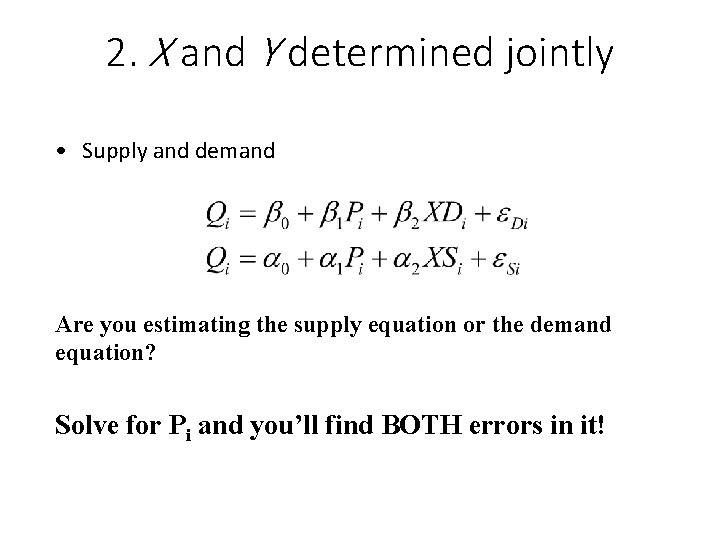
2. X and Y determined jointly • Supply and demand Are you estimating the supply equation or the demand equation? Solve for Pi and you’ll find BOTH errors in it!
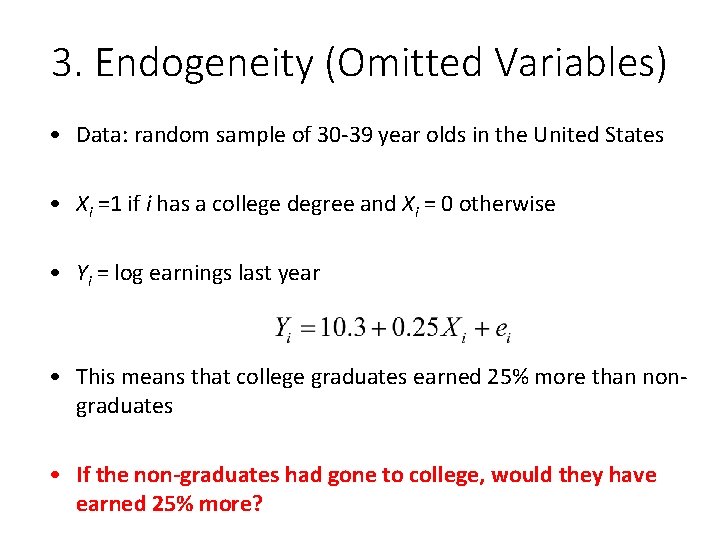
3. Endogeneity (Omitted Variables) • Data: random sample of 30 -39 year olds in the United States • Xi =1 if i has a college degree and Xi = 0 otherwise • Yi = log earnings last year • This means that college graduates earned 25% more than nongraduates • If the non-graduates had gone to college, would they have earned 25% more?
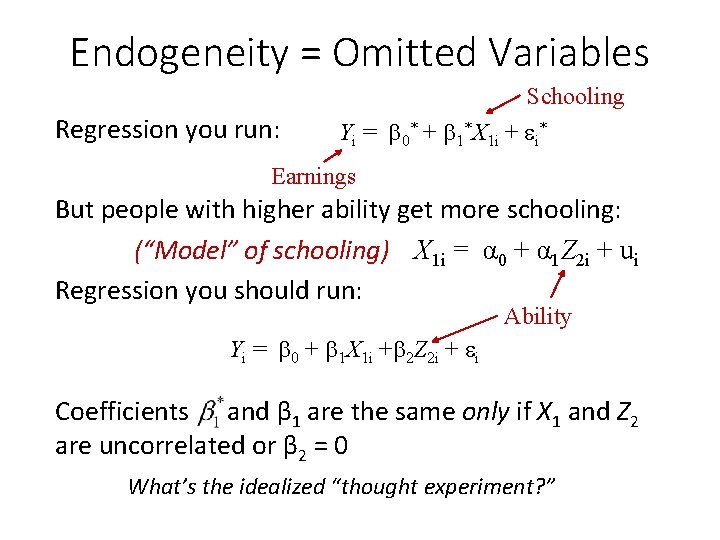
Endogeneity = Omitted Variables Schooling Regression you run: Yi = 0* + 1*X 1 i + i* Earnings But people with higher ability get more schooling: (“Model” of schooling) X 1 i = α 0 + α 1 Z 2 i + ui Regression you should run: Ability Yi = 0 + 1 X 1 i + 2 Z 2 i + i Coefficients and β 1 are the same only if X 1 and Z 2 are uncorrelated or β 2 = 0 What’s the idealized “thought experiment? ”
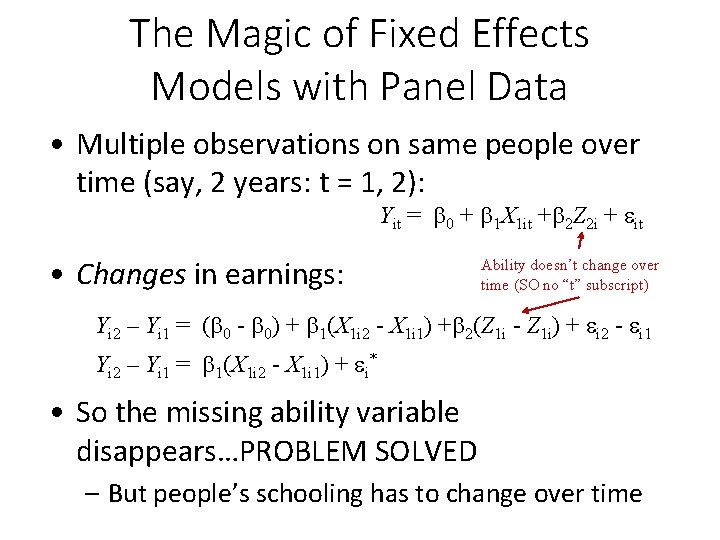
The Magic of Fixed Effects Models with Panel Data • Multiple observations on same people over time (say, 2 years: t = 1, 2): Yit = 0 + 1 X 1 it + 2 Z 2 i + it • Changes in earnings: Ability doesn’t change over time (SO no “t” subscript) Yi 2 – Yi 1 = ( 0 - 0) + 1(X 1 i 2 - X 1 i 1) + 2(Z 1 i - Z 1 i) + i 2 - i 1 Yi 2 – Yi 1 = 1(X 1 i 2 - X 1 i 1) + i* • So the missing ability variable disappears…PROBLEM SOLVED – But people’s schooling has to change over time
What We Learned • Correlation means that if you tell me X, I can make a prediction of Y. • Causation means that if you change X to a different value, then I expect Y to change. • The three sources of “endogeneity” are (i) measurement error, (ii) simultaneity, and (iii) omitted variables. • Measurement error in X variables usually (but not always) leads to coefficient estimates that are smaller than they should be (biased toward zero). Proxy variables can help reduce measurement error bias. • Simultaneity means that X and Y cause each other. • Fixed-effects estimation can mitigate the omitted variables problem in panel data (but only for time-invariant omitted variables)
- Slides: 13