
Chapter 11 Hypothesis Tests Two Related Samples Overview



- Slides: 24
Chapter 11 Hypothesis Tests: Two Related Samples
Overview u Learning objectives u Vocabulary lesson again u Introduce t test for related samples u Advantages and disadvantages u An example u Review questions 2
Learning Objectives u Difference between independent-measures & related-samples experimental design u Difference between repeated-measures & matched-subjects experimental design u Compute t test for dependent groups u Advantages and disadvantages u Measures of effect size 3
Vocabulary u Related-samples t statistic Repeated- measures design u Matched-samples design u Difference scores (estimated standard error of D-bar) u Individual differences u Carry-over effects 4
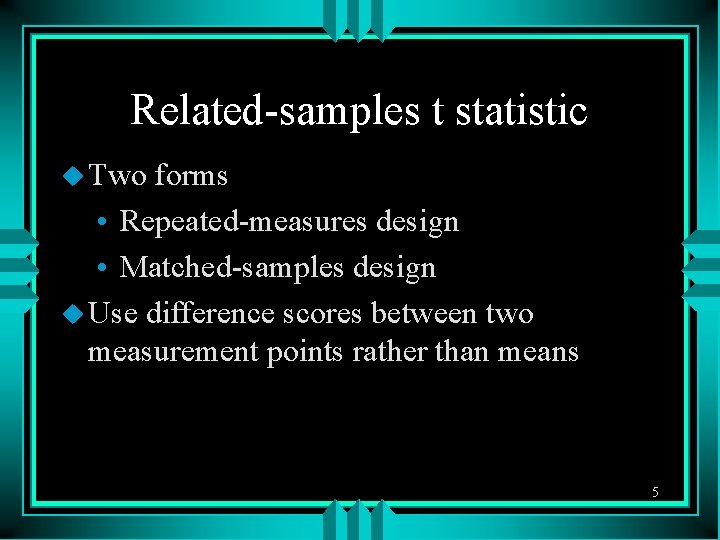
Related-samples t statistic u Two forms • Repeated-measures design • Matched-samples design u Use difference scores between two measurement points rather than means 5
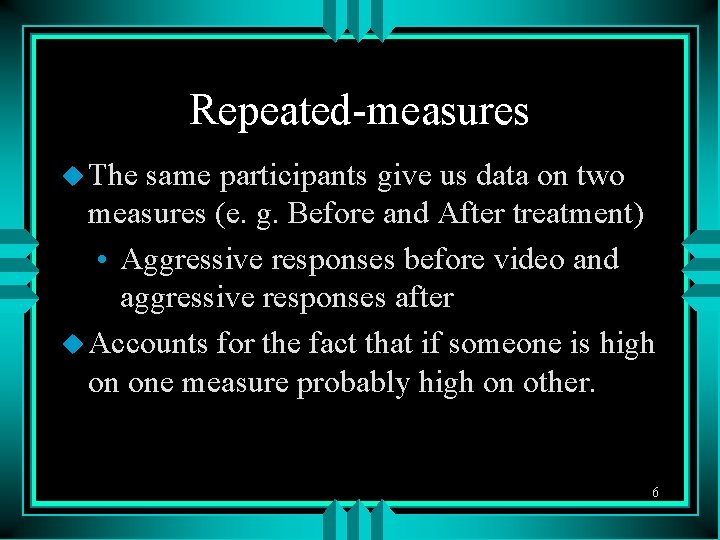
Repeated-measures u The same participants give us data on two measures (e. g. Before and After treatment) • Aggressive responses before video and aggressive responses after u Accounts for the fact that if someone is high on one measure probably high on other. 6
Matched-samples u Individuals in one group are matched to individuals in a second sample • Matching based on variables thought to be relevant to the study • Not always perfect match u Also called matched pairs or pairwise t test 7
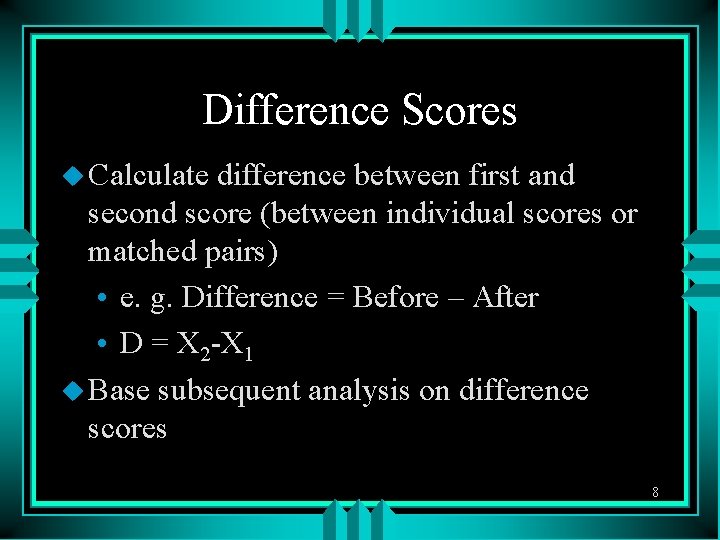
Difference Scores u Calculate difference between first and second score (between individual scores or matched pairs) • e. g. Difference = Before – After • D = X 2 -X 1 u Base subsequent analysis on difference scores 8
The Formulas 9
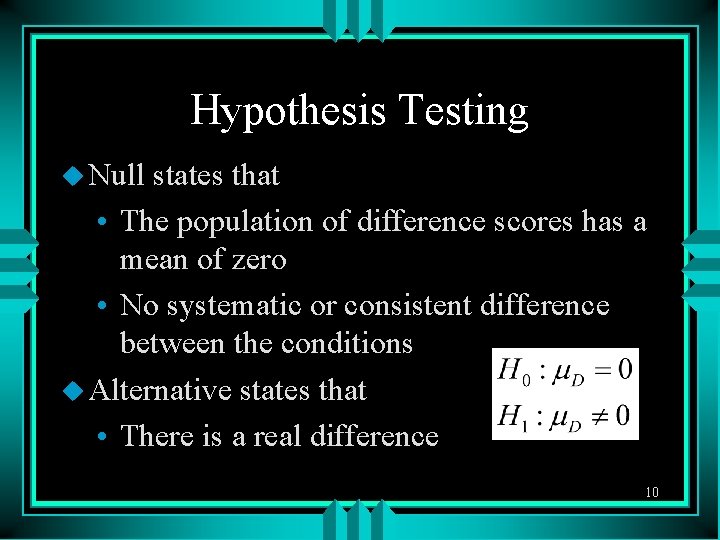
Hypothesis Testing u Null states that • The population of difference scores has a mean of zero • No systematic or consistent difference between the conditions u Alternative states that • There is a real difference 10
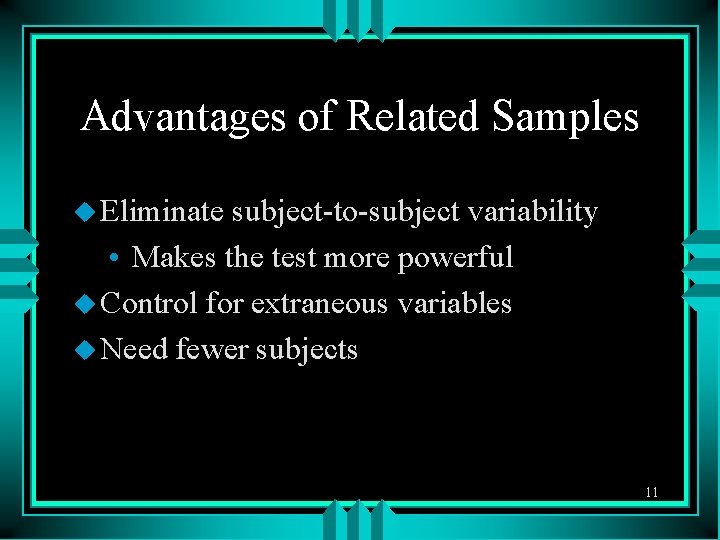
Advantages of Related Samples u Eliminate subject-to-subject variability • Makes the test more powerful u Control for extraneous variables u Need fewer subjects 11
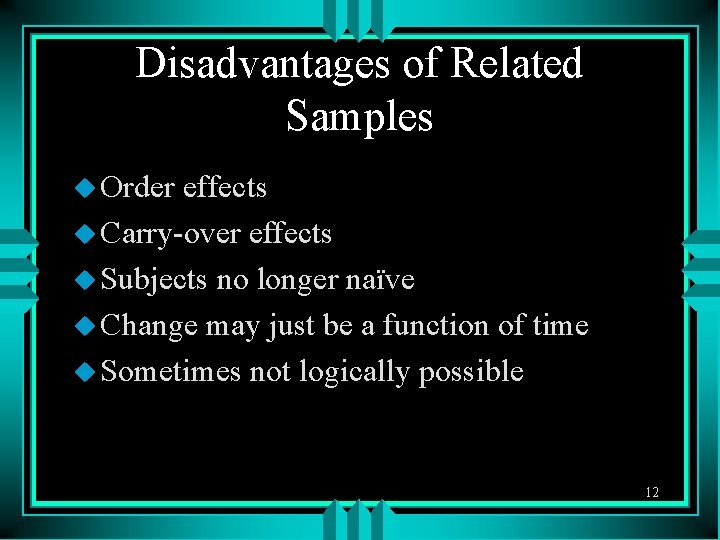
Disadvantages of Related Samples u Order effects u Carry-over effects u Subjects no longer naïve u Change may just be a function of time u Sometimes not logically possible 12
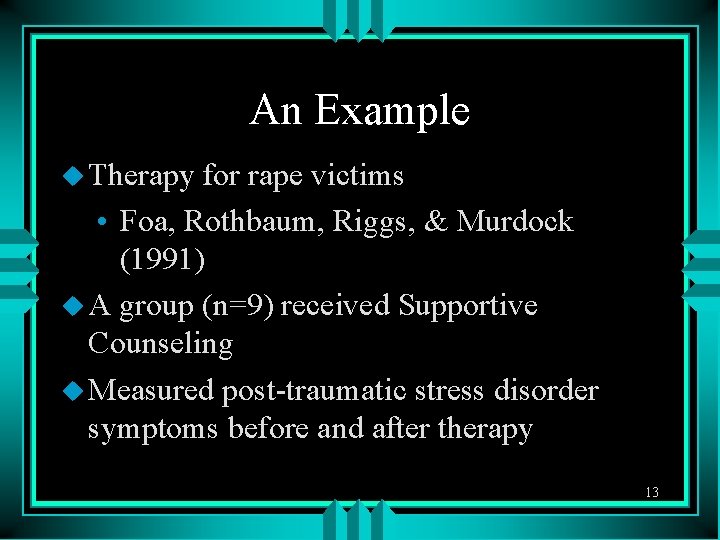
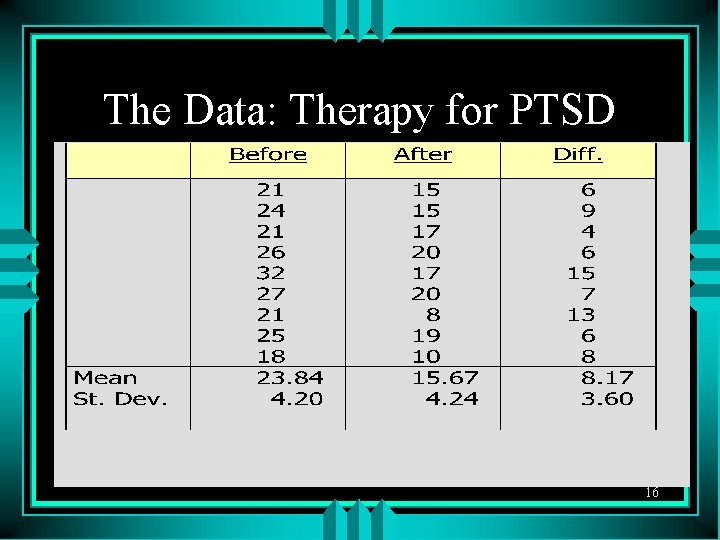
An Example u Therapy for rape victims • Foa, Rothbaum, Riggs, & Murdock (1991) u A group (n=9) received Supportive Counseling u Measured post-traumatic stress disorder symptoms before and after therapy 13
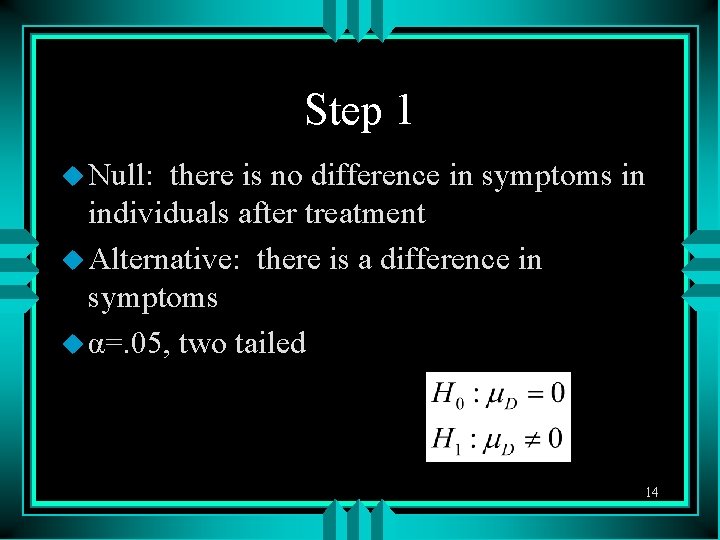
Step 1 u Null: there is no difference in symptoms in individuals after treatment u Alternative: there is a difference in symptoms u α=. 05, two tailed 14
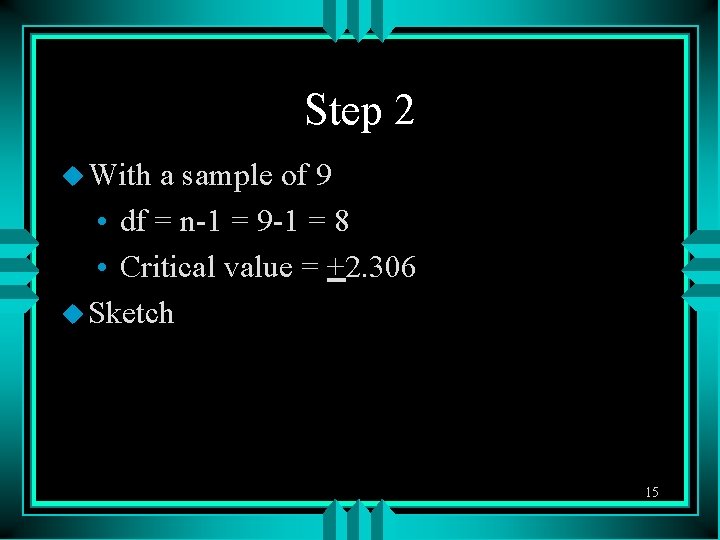
Step 2 u With a sample of 9 • df = n-1 = 9 -1 = 8 • Critical value = +2. 306 u Sketch 15
The Data: Therapy for PTSD 16
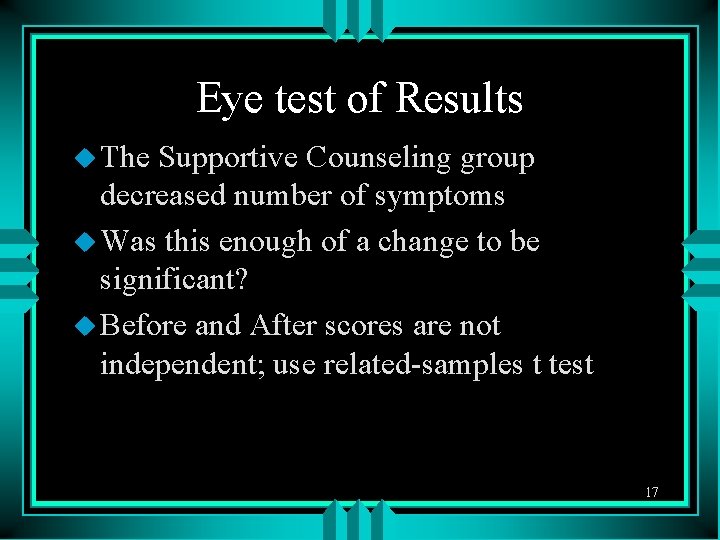
Eye test of Results u The Supportive Counseling group decreased number of symptoms u Was this enough of a change to be significant? u Before and After scores are not independent; use related-samples t test 17
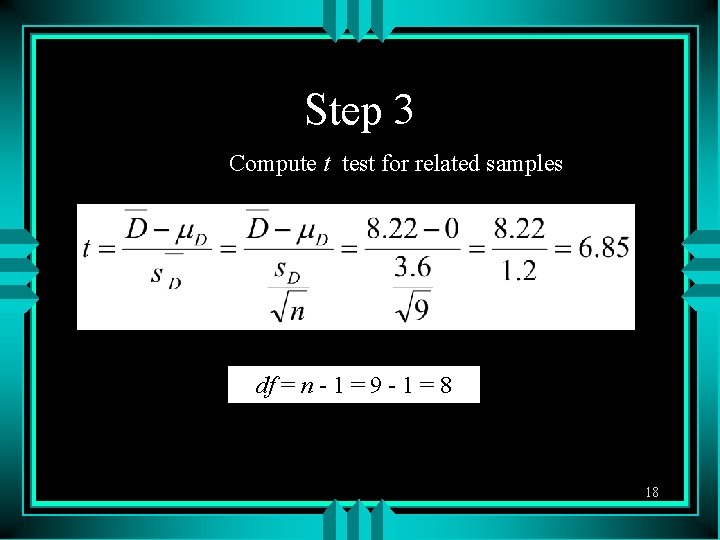
Step 3 Compute t test for related samples df = n - 1 = 9 - 1 = 8 18
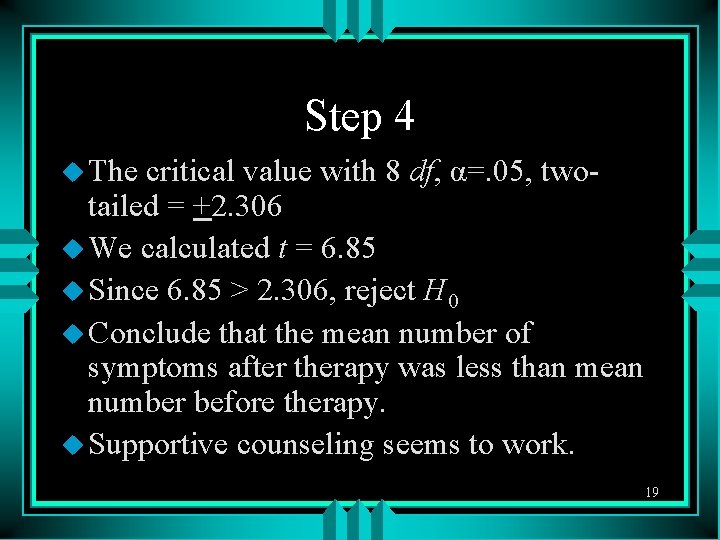
Step 4 u The critical value with 8 df, α=. 05, twotailed = +2. 306 u We calculated t = 6. 85 u Since 6. 85 > 2. 306, reject H 0 u Conclude that the mean number of symptoms after therapy was less than mean number before therapy. u Supportive counseling seems to work. 19
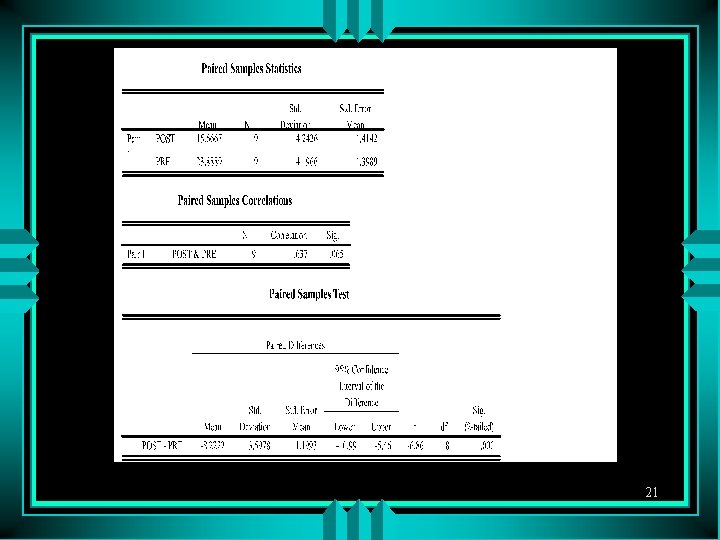
SPSS u Next slide shows SPSS Printout • Similar printout from other software • Results match ours 20
21
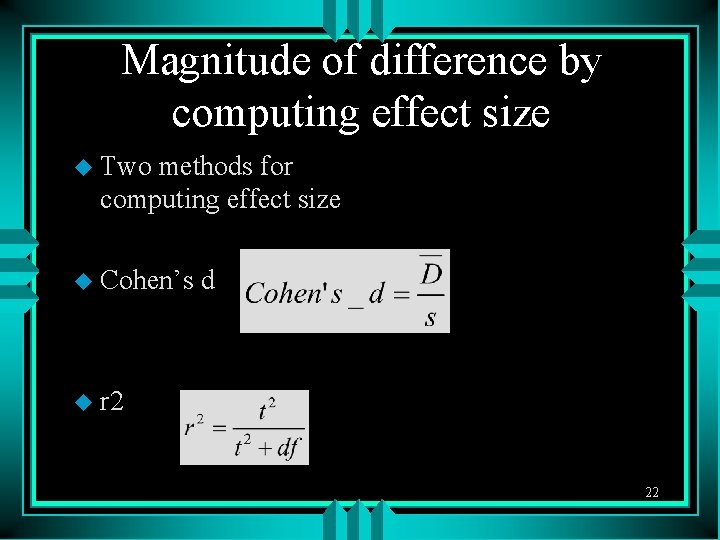
Magnitude of difference by computing effect size u Two methods for computing effect size u Cohen’s d u r 2 22
Review Questions u Why do we say that the two sets of measures are not independent? u What are other names for “related samples? ” u How do we calculate difference scores? • What happens if we subtract before from after instead of after from before? 23 Cont.
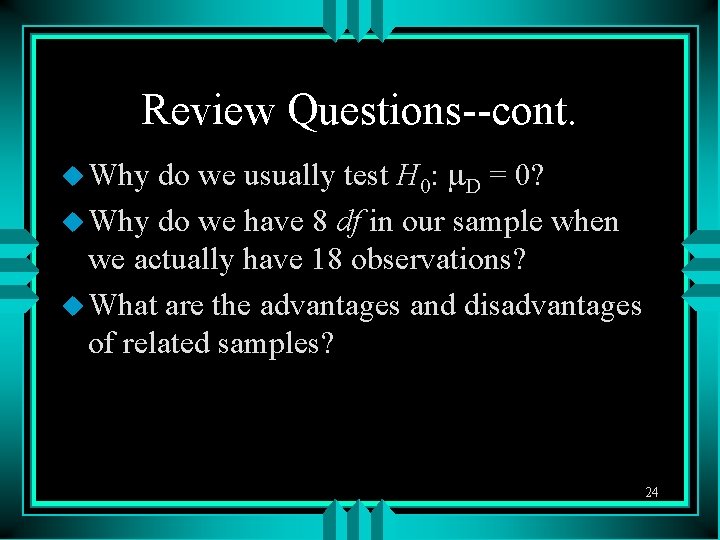
Review Questions--cont. do we usually test H 0: m. D = 0? u Why do we have 8 df in our sample when we actually have 18 observations? u What are the advantages and disadvantages of related samples? u Why 24