
Chapter 11 Human Resource Management Chapter 11 Stephen
- Slides: 7
Chapter 11 Human Resource Management Chapter 11, Stephen P. Robbins, Mary Coulter, and Nancy Langton, Management, Ninth Canadian Edition Copyright © 2009 Pearson Education Canada 1
Learning Outline After you read this chapter you should know the following learning objectives: • #1: Does managing human resources well make a difference? • #2: How does the external environment affect human resource planning? • #3: How do organizations assess their human resource needs? Chapter 11, Stephen P. Robbins, Mary Coulter, and Nancy Langton, Management, Ninth Canadian Edition Copyright © 2009 Pearson Education Canada 2
Learning Outline After you read this chapter you should know the following learning objectives: • #4: How do organizations identify and select competent employees? • #5: How do organizations help employees adapt and stay up-to-date? • #6: What can organizations do to help employees achieve high performance over their careers? Chapter 11, Stephen P. Robbins, Mary Coulter, and Nancy Langton, Management, Ninth Canadian Edition Copyright © 2009 Pearson Education Canada 3
Learning Outline After you read this chapter you should know the following learning objectives: • #7: How do compensation and benefits motivate employees? • #8: How are careers managed? • #9: What are some current issues in human resource management? Chapter 11, Stephen P. Robbins, Mary Coulter, and Nancy Langton, Management, Ninth Canadian Edition Copyright © 2009 Pearson Education Canada 4
The Importance of Human Resources Management (HRM) • Necessary part of the organizing function of management – Selecting, training, and evaluating the workforce • An important strategic tool – HRM helps establish an organization’s sustainable competitive advantage. • Adds value to the firm – High performance work practices lead to both high individual and high organizational performance. Chapter 11, Stephen P. Robbins, Mary Coulter, and Nancy Langton, Management, Ninth Canadian Edition Copyright © 2009 Pearson Education Canada 5
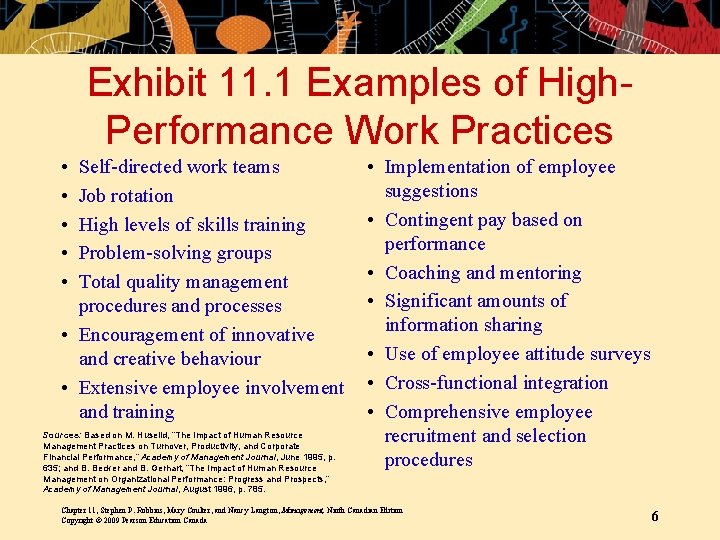
Exhibit 11. 1 Examples of High. Performance Work Practices • • • Self-directed work teams Job rotation High levels of skills training Problem-solving groups Total quality management procedures and processes • Encouragement of innovative and creative behaviour • Extensive employee involvement and training Sources: Based on M. Huselid, “The Impact of Human Resource Management Practices on Turnover, Productivity, and Corporate Financial Performance, ” Academy of Management Journal, June 1995, p. 635; and B. Becker and B. Gerhart, “The Impact of Human Resource Management on Organizational Performance: Progress and Prospects, ” Academy of Management Journal, August 1996, p. 785. • Implementation of employee suggestions • Contingent pay based on performance • Coaching and mentoring • Significant amounts of information sharing • Use of employee attitude surveys • Cross-functional integration • Comprehensive employee recruitment and selection procedures Chapter 11, Stephen P. Robbins, Mary Coulter, and Nancy Langton, Management, Ninth Canadian Edition Copyright © 2009 Pearson Education Canada 6
Human Resources for Non-HR Managers • Small vs. large organizations – Large organizations have HR function. – Smaller organizations may rely on managers to handle HR issues. • All managers need to be aware of federal and provincial legislation and company policies. Chapter 11, Stephen P. Robbins, Mary Coulter, and Nancy Langton, Management, Ninth Canadian Edition Copyright © 2009 Pearson Education Canada 7