
Chapter 11 How Muscles Function the Big Picture
Chapter 11: How Muscles Function: the Big Picture Joseph E. Muscolino, DC Copyright © 2011, 2007 by Mosby, Inc. , an affiliate of Elsevier Inc. All rights reserved. 1
Reflection 2 Copyright © 2011, 2007 by Mosby, Inc. , an affiliate of Elsevier Inc. All rights reserved. 2
Lesson 11. 1 Objectives • Define the key terms of this chapter and state the meanings of the word origins of this chapter. • Explain the “big picture” of how a muscle creates motion of a body part at a joint. • Define and relate the terms concentric contraction and mover to the big picture of how a muscle creates joint motion. Copyright © 2011, 2007 by Mosby, Inc. , an affiliate of Elsevier Inc. All rights reserved. 3
Lesson 11. 1 Objectives (cont’d. ) • Explain why a muscle that contracts either succeeds or does not succeed in shortening toward the middle. • Using the terms fixed and mobile, describe and give an example of each of the three scenarios that can occur when a muscle concentrically contracts (i. e. , contracts and shortens). Copyright © 2011, 2007 by Mosby, Inc. , an affiliate of Elsevier Inc. All rights reserved. 4

Lesson 11. 1 Objectives (cont’d. ) • List the three things that must be stated when fully describing a joint action. • Describe and give an example of a reverse action. • Explain what factors determine which attachment of a muscle moves when a muscle concentrically contracts. Copyright © 2011, 2007 by Mosby, Inc. , an affiliate of Elsevier Inc. All rights reserved. 5
Lesson 11. 1 Objectives (cont’d. ) • List and explain the importance of each of the steps of the five -step approach to learning muscles. • Describe how to use the rubber band exercise to help learn the action(s) of a muscle. Copyright © 2011, 2007 by Mosby, Inc. , an affiliate of Elsevier Inc. All rights reserved. 6
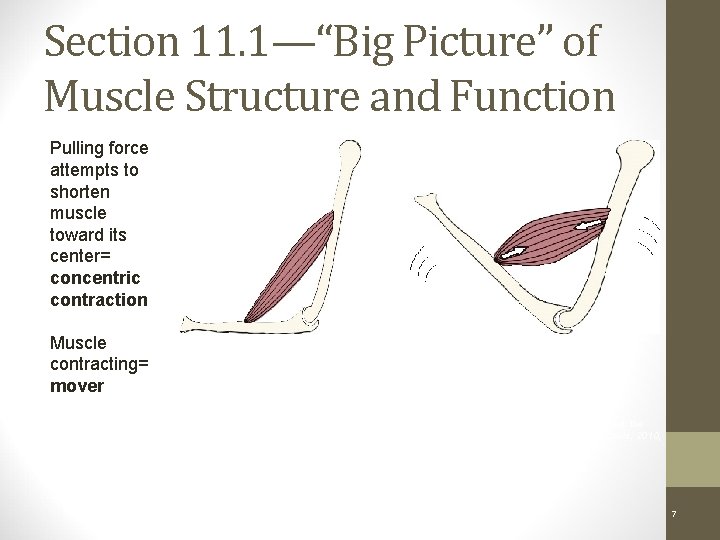
Section 11. 1—“Big Picture” of Muscle Structure and Function Pulling force attempts to shorten muscle toward its center= concentric contraction Muscle contracting= mover Figure 11 -1 From Muscolino JE: The muscular system manual: the skeletal muscles of the human body , ed 3, St Louis, 2010, Mosby Figure 11 -2 From Muscolino JE: The muscular system manual: the skeletal muscles of the human body , ed 3, St Louis, 2010, Mosby Copyright © 2011, 2007 by Mosby, Inc. , an affiliate of Elsevier Inc. All rights reserved. 7
Section 11. 1—“Big Picture” of Muscle Structure and Function (cont’d. ) Muscle Contraction: • Concentric contraction- muscle contracts and shortens • Eccentric contraction- muscle contracts and lengthens • Isometric contraction- muscle contracts and stays the same length Copyright © 2011, 2007 by Mosby, Inc. , an affiliate of Elsevier Inc. All rights reserved. 8
Section 11. 1—“Big Picture” of Muscle Structure and Function (cont’d. ) Success in Shortening of Muscle: • Strength of the pulling force • Force necessary to move body part(s) Copyright © 2011, 2007 by Mosby, Inc. , an affiliate of Elsevier Inc. All rights reserved. 9

Section 11. 2—What Happens When a Muscle Contracts and Shortens? Figure 11 -3 Scenario 1 Scenario 2 If attachment moves = mobile Scenario 3 From Muscolino JE: The muscular system manual: the skeletal does not move = fixed muscles of the human body , ed 3, St Louis, 2010, Mosby Copyright © 2011, 2007 by Mosby, Inc. , an affiliate of Elsevier Inc. All rights reserved. 10
Section 11. 2—What Happens When a Muscle Contracts and Shortens? (cont’d. ) Required Information for Naming a Joint Action: • Type of motion that has occurred • Name of body part that has moved • Name of joint where movement has occurred Copyright © 2011, 2007 by Mosby, Inc. , an affiliate of Elsevier Inc. All rights reserved. 11

Section 11. 2—What Happens When a Muscle Contracts and Shortens? (cont’d. ) Figure 11 -4 Figure 11 -5 A Brachialis: concentric contraction From Muscolino JE: The muscular system, ed 3, St Louis, 2010, Mosbymanual: the skeletal muscles of the human body From Muscolino JE: The muscular system manual: the skeletal muscles of the human body , ed 3, St Louis, 2010, Mosby Copyright © 2011, 2007 by Mosby, Inc. , an affiliate of Elsevier Inc. All rights reserved. 12

Section 11. 2—What Happens When a Muscle Contracts and Shortens? (cont’d. ) Figure 11 -4 Reverse Action From Muscolino JE: The muscular system manual: the skeletal muscles of the human body , ed 3, St Louis, 2010, Mosby Figure 11 -5 B From Muscolino JE: The muscular system manual: the skeletal muscles of the human body , ed 3, St Louis, 2010, Mosby Copyright © 2011, 2007 by Mosby, Inc. , an affiliate of Elsevier Inc. All rights reserved. 13
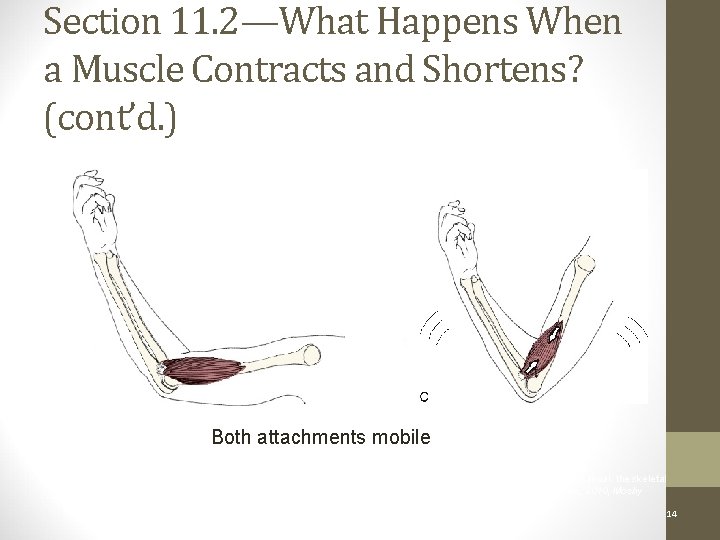
Section 11. 2—What Happens When a Muscle Contracts and Shortens? (cont’d. ) Figure 11 -4 Figure 11 -5 B Both attachments mobile From Muscolino JE: The muscular system manual: the skeletal muscles of the human body , ed 3, St Louis, 2010, Mosby Copyright © 2011, 2007 by Mosby, Inc. , an affiliate of Elsevier Inc. All rights reserved. 14
Section 11. 2—What Happens When a Muscle Contracts and Shortens? (cont’d. ) Factors Affecting which Attachment Moves: • Relative weight of body parts • Fixators (stabilizers)- CNS directs another muscle to stop or “fix” one of the muscles. Copyright © 2011, 2007 by Mosby, Inc. , an affiliate of Elsevier Inc. All rights reserved. 15
Section 11. 3—Five-Step Approach to Learning Muscles • • • Step 1: Examine name of muscle Step 2: Learn location of muscle Step 3: Figure out actions of muscle Step 4: Learn muscle’s specific attachments Step 5: Determine muscle’s relationship to other parts of the body Copyright © 2011, 2007 by Mosby, Inc. , an affiliate of Elsevier Inc. All rights reserved. 16
Section 11. 3—Five-Step Approach to Learning Muscles (cont’d. ) Step 3: Figure out Actions of Muscle: • What joint does the muscle cross? • Ex: coracobrachialis crosses shoulder joint, we know it must have an action at the shoulder joint • Where does the muscle cross the joint? (anteriorly, posteriorly, medially, laterally) • How does the muscle cross the joint? (fibers vertical or horizontal) Copyright © 2011, 2007 by Mosby, Inc. , an affiliate of Elsevier Inc. All rights reserved. 17
Section 11. 4—Rubber Band Exercise • Place the ends of the rubber band at the muscle attachment sites. • Hold the mobile end with one hand, and have the client hold the fixed end. • Orient the rubber band so it follows the direction of the fibers. • With your free hand, pull one end of the rubber band toward the other attachment of the rubber band. Copyright © 2011, 2007 by Mosby, Inc. , an affiliate of Elsevier Inc. All rights reserved. 18
Lesson 11. 2 Objectives • Describe the importance of understanding the direction of fibers and/or the line of pull of a muscle relative to the joint that it crosses. • Explain the importance (relative to determining the possible actions of a muscle) of evaluating each of the three scenarios. Copyright © 2011, 2007 by Mosby, Inc. , an affiliate of Elsevier Inc. All rights reserved. 19
Lesson 11. 2 Objectives (cont’d. ) • Explain how a muscle that has more than one action can contract, and yet only one or some of its actions occur. • Explain how understanding functional mover groups of muscles can help one learn the actions of muscles. Copyright © 2011, 2007 by Mosby, Inc. , an affiliate of Elsevier Inc. All rights reserved. 20
Section 11. 5—Lines of Pull of a Muscle Scenarios for One-Joint Muscles: One-joint muscle- if it only crosses one joint • Scenario 1: A muscle with one line of pull in a cardinal plane • Scenario 2: A muscle with one line of pull in an oblique plane • Scenario 3: A muscle that has more than one line of pull Copyright © 2011, 2007 by Mosby, Inc. , an affiliate of Elsevier Inc. All rights reserved. 21
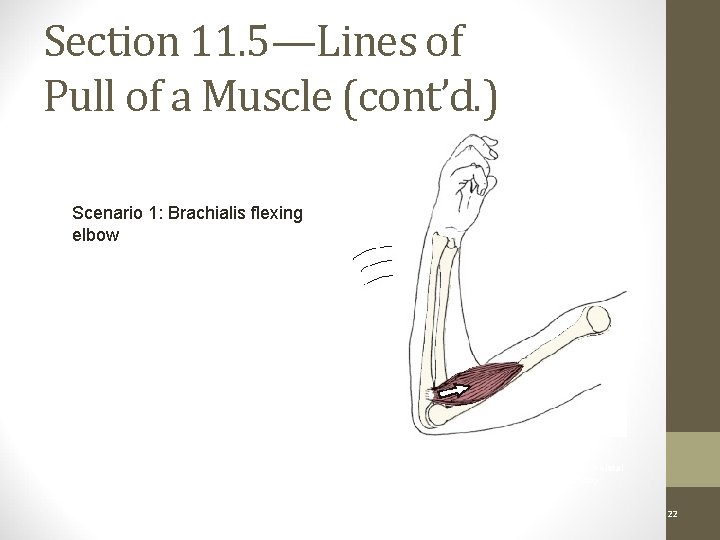
Section 11. 5—Lines of Pull of a Muscle (cont’d. ) Scenario 1: Brachialis flexing elbow Scenario 1: Figure 11 -6 From Muscolino JE: The muscular system manual: the skeletal muscles of the human body , ed 3, St Louis, 2010, Mosby Copyright © 2011, 2007 by Mosby, Inc. , an affiliate of Elsevier Inc. All rights reserved. 22
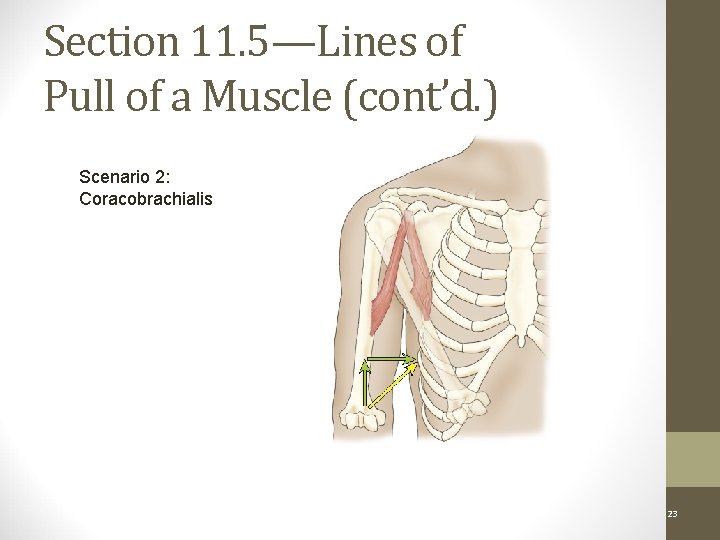
Section 11. 5—Lines of Pull of a Muscle (cont’d. ) Scenario 2: Coracobrachialis Scenario 2: Figure 11 -7 Copyright © 2011, 2007 by Mosby, Inc. , an affiliate of Elsevier Inc. All rights reserved. 23
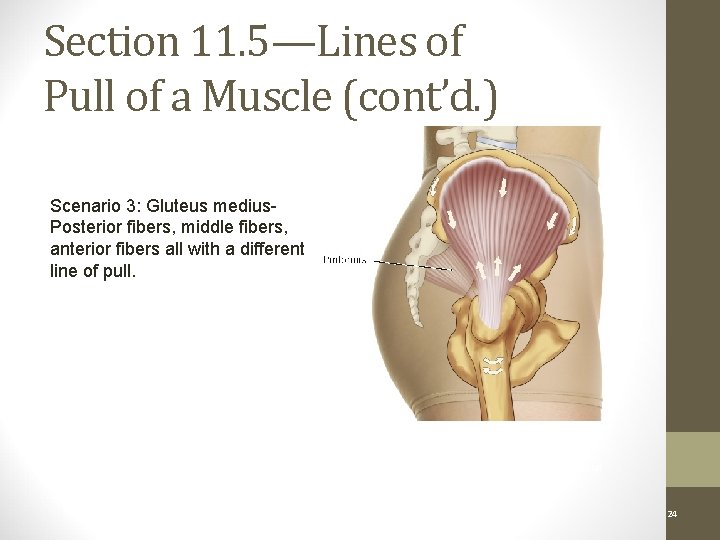
Section 11. 5—Lines of Pull of a Muscle (cont’d. ) Scenario 3: Gluteus medius. Posterior fibers, middle fibers, anterior fibers all with a different line of pull. Scenario 3: Figure 11 -8 From Muscolino JE: The muscular system manual: the skeletal muscles of the human body, ed 3, St Louis, 2010, Mosby Copyright © 2011, 2007 by Mosby, Inc. , an affiliate of Elsevier Inc. All rights reserved. 24
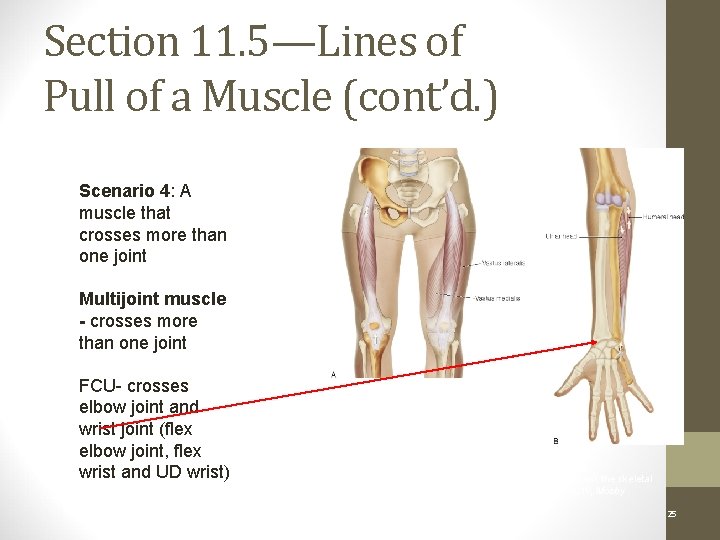
Section 11. 5—Lines of Pull of a Muscle (cont’d. ) Scenario 4: A muscle that crosses more than one joint Scenario for Multijoint Muscles: Multijoint muscle - crosses more than one joint FCU- crosses elbow joint and wrist joint (flex elbow joint, flex wrist and UD wrist) Figure 11 -9 From Muscolino JE: The muscular system manual: the skeletal muscles of the human body, ed 3, St Louis, 2010, Mosby Copyright © 2011, 2007 by Mosby, Inc. , an affiliate of Elsevier Inc. All rights reserved. 25
Section 11. 5—Lines of Pull of a Muscle (cont’d. ) Can Muscles Choose Their Actions? - No. contract when ordered by CNS • Number of lines of pull- only contract one line of pull • Examples: • Trapezius (upper, middle, lower) • Deltoid • Gluteus medius Copyright © 2011, 2007 by Mosby, Inc. , an affiliate of Elsevier Inc. All rights reserved. 26
Section 11. 6—Functional Group Approach to Learning Muscle Actions Functional Groups (shares the same function): • Group muscles based on their roles • Ex: Flexors of elbow joint • biceps, pronator teres, FCR • Uniaxial hinge • Anterior muscles flex and posterior extend • Use instead of five-step approach Copyright © 2011, 2007 by Mosby, Inc. , an affiliate of Elsevier Inc. All rights reserved. 27
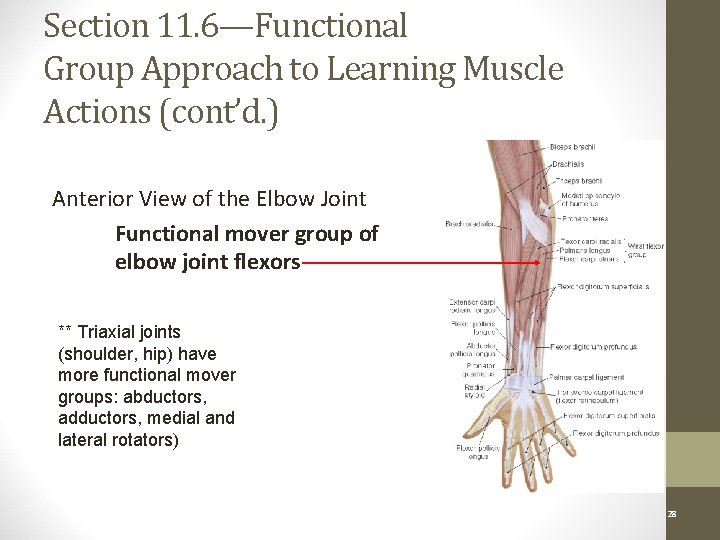
Section 11. 6—Functional Group Approach to Learning Muscle Actions (cont’d. ) Anterior View of the Elbow Joint Functional mover group of elbow joint flexors ** Triaxial joints (shoulder, hip) have more functional mover groups: abductors, adductors, medial and lateral rotators) Figure 11 -10 From Muscolino JE: The muscular system manual: the skeletal muscles of the human body, ed 3, St Louis, 2010, Mosby Copyright © 2011, 2007 by Mosby, Inc. , an affiliate of Elsevier Inc. All rights reserved. 28
Section 11. 7—Determining Functional Groups Functional Mover Groups: • Sagittal plane- flexion and extension • Frontal plane- lateral flexion, abduction, adduction • Transverse plane- muscles may not be located together in one structural group • more difficult to determine • look at how it wraps around the body part it attaches • Ex: right pectoralis major and right latissimus dorsi medially rotate arm and wrap around the humerus in the same manner Copyright © 2011, 2007 by Mosby, Inc. , an affiliate of Elsevier Inc. All rights reserved. 29
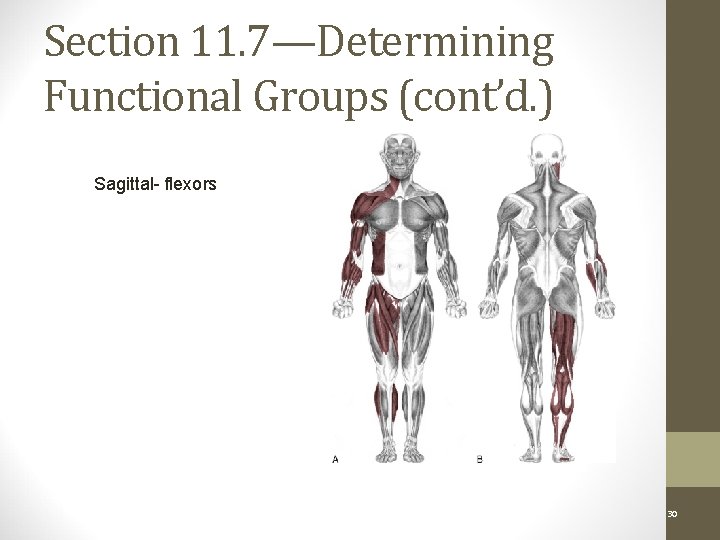
Section 11. 7—Determining Functional Groups (cont’d. ) Sagittal Plane: Sagittal- flexors Figure 11 -11 Copyright © 2011, 2007 by Mosby, Inc. , an affiliate of Elsevier Inc. All rights reserved. 30
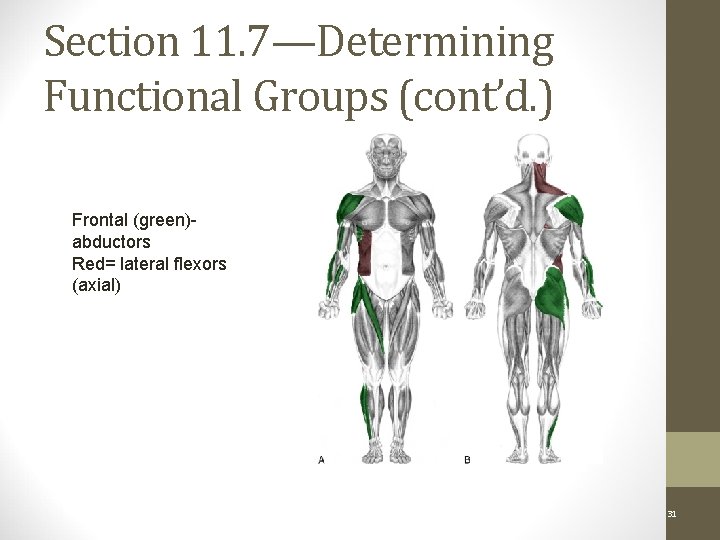
Section 11. 7—Determining Functional Groups (cont’d. ) Frontal Plane: Frontal (green)abductors Red= lateral flexors (axial) Figure 11 -12 Copyright © 2011, 2007 by Mosby, Inc. , an affiliate of Elsevier Inc. All rights reserved. 31
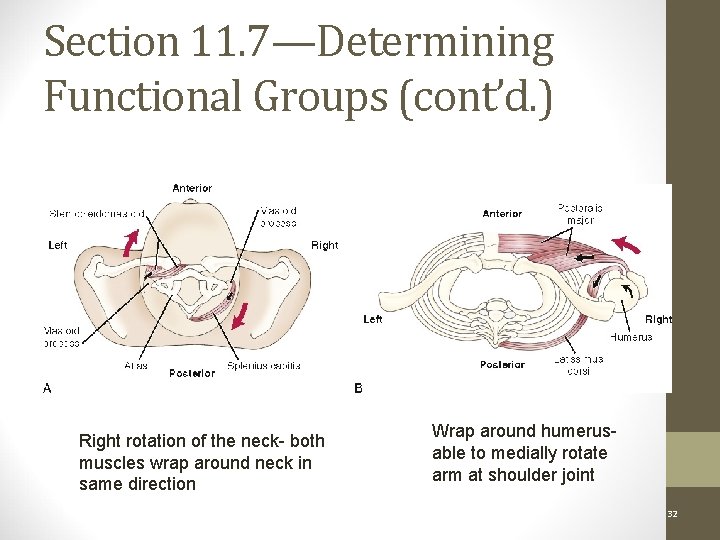
Section 11. 7—Determining Functional Groups (cont’d. ) Transverse Plane: Figure 11 -13 Right rotation of the neck- both muscles wrap around neck in same direction Wrap around humerusable to medially rotate arm at shoulder joint Copyright © 2011, 2007 by Mosby, Inc. , an affiliate of Elsevier Inc. All rights reserved. 32
Lesson 11. 3 Objectives • Describe the meanings of the terms on-axis and off-axis, and explain how the off-axis attachment method can be used to determine a muscle’s rotation action. • State how the long axis of a bone can be determined. Copyright © 2011, 2007 by Mosby, Inc. , an affiliate of Elsevier Inc. All rights reserved. 33
Lesson 11. 3 Objectives (cont’d. ) • Give an example of and explain how a muscle can create an action at a joint that it does not cross. • Give an example of and explain how a muscle’s action can change when the position of the body changes. Copyright © 2011, 2007 by Mosby, Inc. , an affiliate of Elsevier Inc. All rights reserved. 34
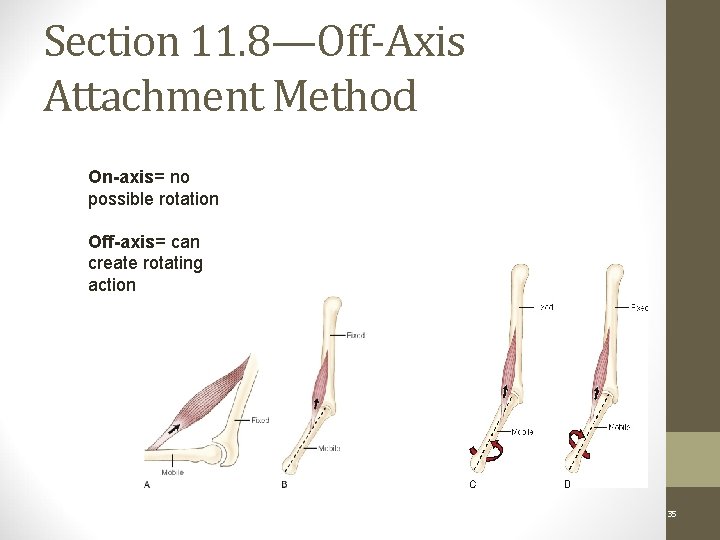
Section 11. 8—Off-Axis Attachment Method On-Axis On-axis= no Attachment: possible rotation Off-axis= can create rotating action Figure 11 -14 Copyright © 2011, 2007 by Mosby, Inc. , an affiliate of Elsevier Inc. All rights reserved. 35
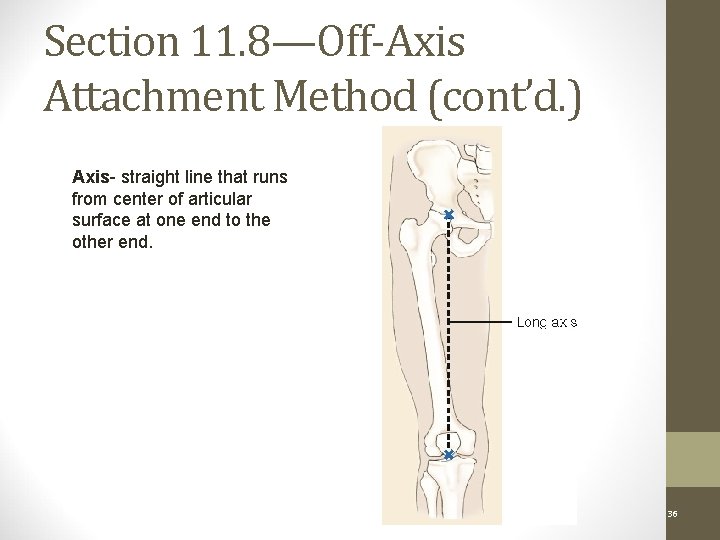
Section 11. 8—Off-Axis Attachment Method (cont’d. ) Long Axis of Bone: Axis- straight line that runs from center of articular surface at one end to the other end. Copyright © 2011, 2007 by Mosby, Inc. , an affiliate of Elsevier Inc. All rights reserved. 36
Section 11. 9—Transferring the Force of a Muscle’s Contraction Action at Joint That Muscle Doesn’t Cross: • Force of muscle’s contraction is transferred to another joint • Usually when distal end of an extremity is fixed • Ex: Lateral rotators of humerus causes humerus to rotate, elbow joint does not allow rotation= force transferred to ulna (crosses over radius) because of a fixed radius. (reverse action) Copyright © 2011, 2007 by Mosby, Inc. , an affiliate of Elsevier Inc. All rights reserved. 37
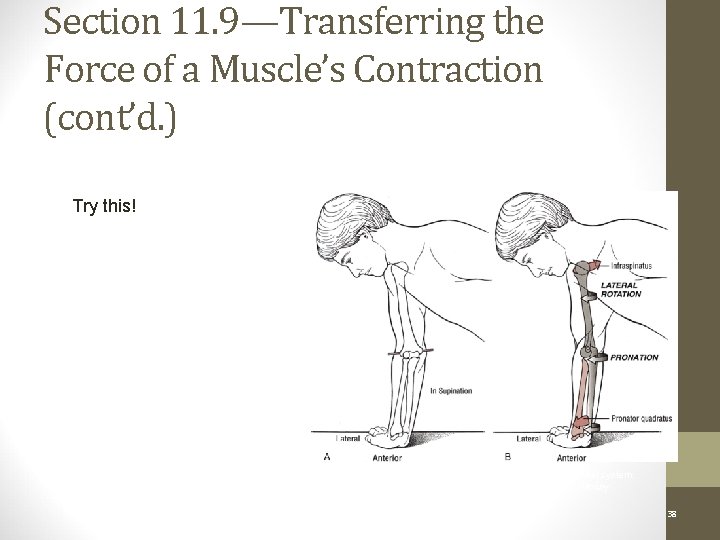
Section 11. 9—Transferring the Force of a Muscle’s Contraction (cont’d. ) Try this! Example 1: Figure 11 -15 Modified from Neumann DA: Kinesiology of the musculoskeletal system: foundations for physical rehabilitation, ed 2, St Louis, 2010, Mosby Copyright © 2011, 2007 by Mosby, Inc. , an affiliate of Elsevier Inc. All rights reserved. 38
Section 11. 10—Muscle Actions That Change • Muscle action dependent on line of pull relative to joint it crosses • Relationship between muscle and joint can change if position of joint changes • Anatomic action= muscles action when in anatomic position Copyright © 2011, 2007 by Mosby, Inc. , an affiliate of Elsevier Inc. All rights reserved. 39
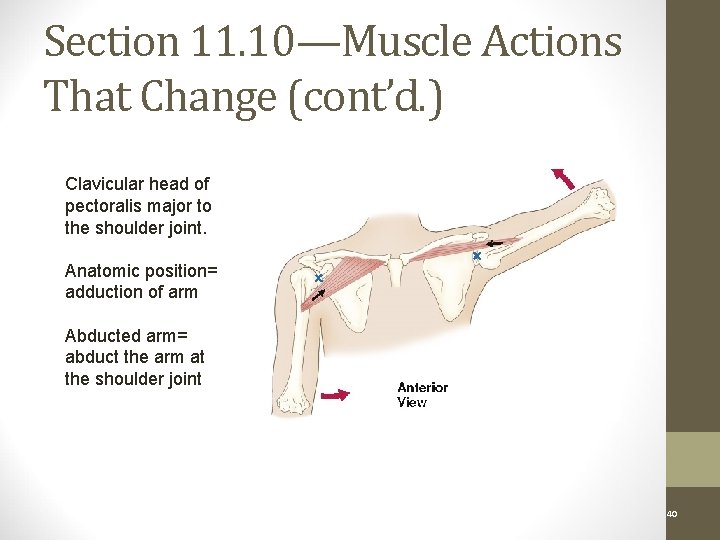
Section 11. 10—Muscle Actions That Change (cont’d. ) Example 1: Clavicular head of pectoralis major to the shoulder joint. Anatomic position= adduction of arm Abducted arm= abduct the arm at the shoulder joint Figure 11 -17 Copyright © 2011, 2007 by Mosby, Inc. , an affiliate of Elsevier Inc. All rights reserved. 40
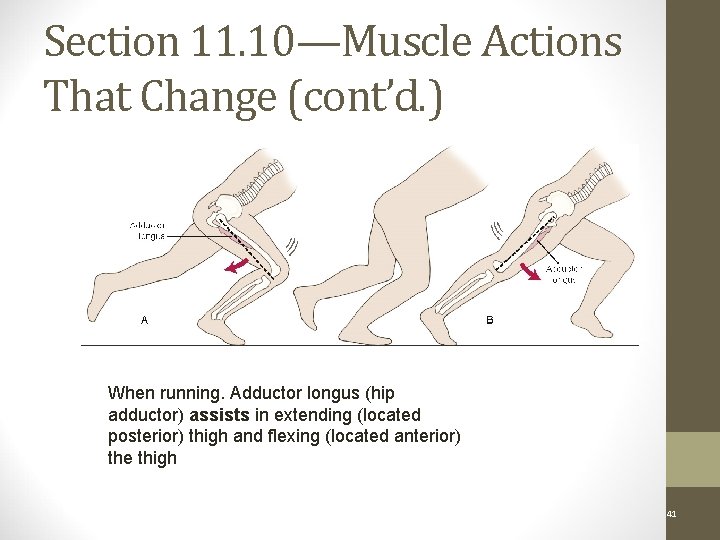
Section 11. 10—Muscle Actions That Change (cont’d. ) Example 2: When running. Adductor longus (hip adductor) assists in extending (located Figure 11 -18 anterior) posterior) thigh and flexing (located the thigh (Modeled from Neumann DA: Kinesiology of the musculoskeletal system: foundations for physical rehabilitation, ed 2, St Louis, 2010, Mosby. ) Copyright © 2011, 2007 by Mosby, Inc. , an affiliate of Elsevier Inc. All rights reserved. 41
- Slides: 41