
Chapter 11 Heat November 4 Specific heat 11
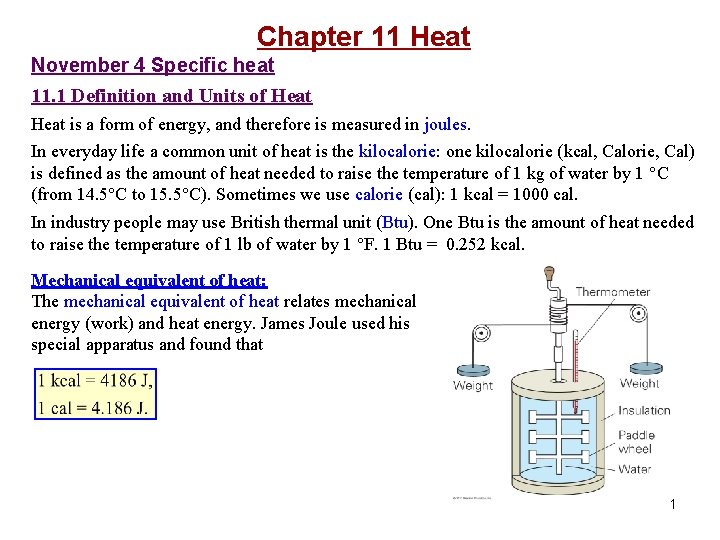
Chapter 11 Heat November 4 Specific heat 11. 1 Definition and Units of Heat is a form of energy, and therefore is measured in joules. In everyday life a common unit of heat is the kilocalorie: one kilocalorie (kcal, Calorie, Cal) is defined as the amount of heat needed to raise the temperature of 1 kg of water by 1 °C (from 14. 5°C to 15. 5°C). Sometimes we use calorie (cal): 1 kcal = 1000 cal. In industry people may use British thermal unit (Btu). One Btu is the amount of heat needed to raise the temperature of 1 lb of water by 1 °F. 1 Btu = 0. 252 kcal. Mechanical equivalent of heat: The mechanical equivalent of heat relates mechanical energy (work) and heat energy. James Joule used his special apparatus and found that 1
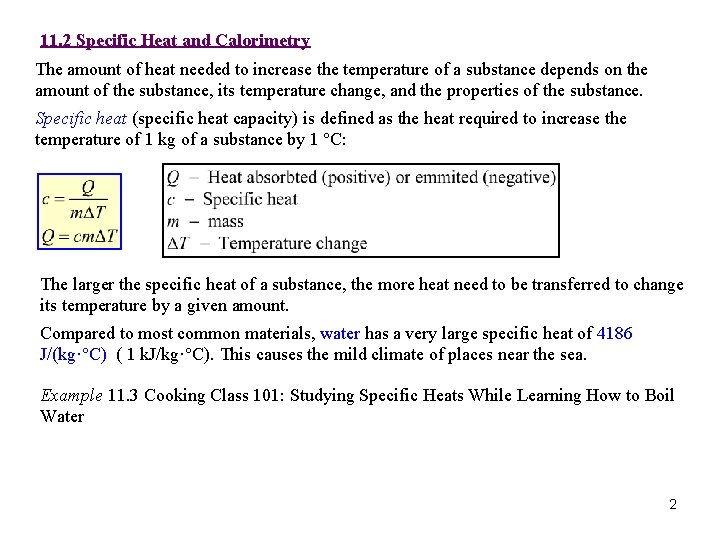
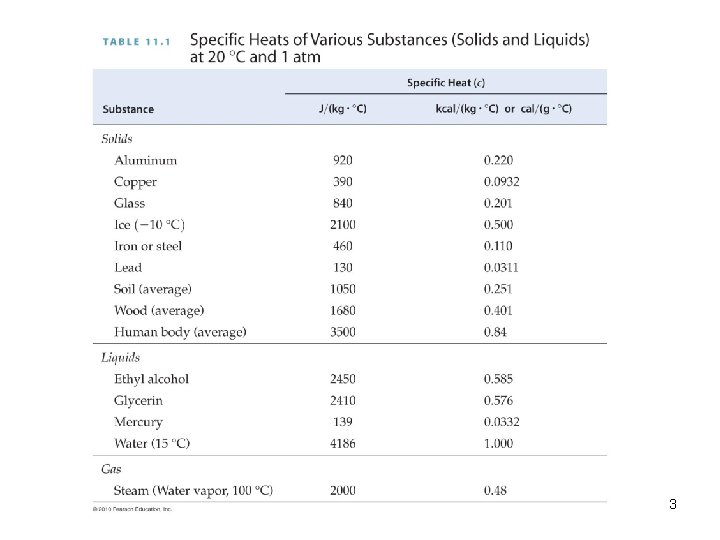
11. 2 Specific Heat and Calorimetry The amount of heat needed to increase the temperature of a substance depends on the amount of the substance, its temperature change, and the properties of the substance. Specific heat (specific heat capacity) is defined as the heat required to increase the temperature of 1 kg of a substance by 1 °C: The larger the specific heat of a substance, the more heat need to be transferred to change its temperature by a given amount. Compared to most common materials, water has a very large specific heat of 4186 J/(kg·°C) ( 1 k. J/kg·°C). This causes the mild climate of places near the sea. Example 11. 3 Cooking Class 101: Studying Specific Heats While Learning How to Boil Water 2
3
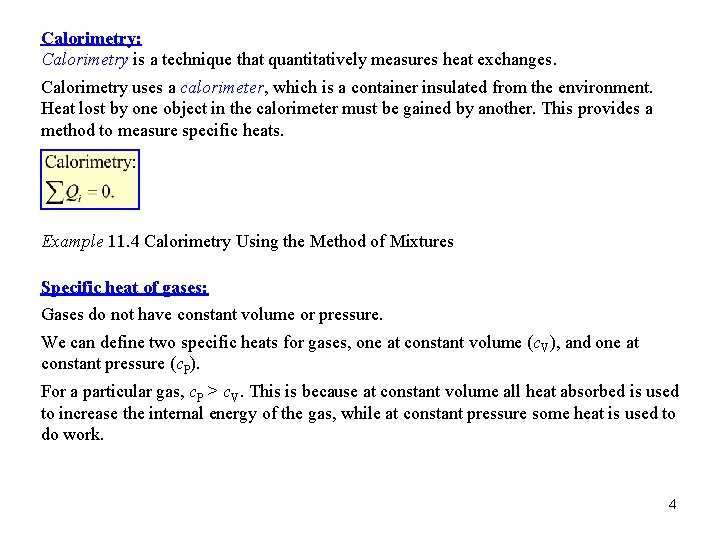
Calorimetry: Calorimetry is a technique that quantitatively measures heat exchanges. Calorimetry uses a calorimeter, which is a container insulated from the environment. Heat lost by one object in the calorimeter must be gained by another. This provides a method to measure specific heats. Example 11. 4 Calorimetry Using the Method of Mixtures Specific heat of gases: Gases do not have constant volume or pressure. We can define two specific heats for gases, one at constant volume (c. V), and one at constant pressure (c. P). For a particular gas, c. P > c. V. This is because at constant volume all heat absorbed is used to increase the internal energy of the gas, while at constant pressure some heat is used to do work. 4

Read: Ch 11: 1 -2 Homework: Ch 11: E 4, 6, 17 Due: November 15 5
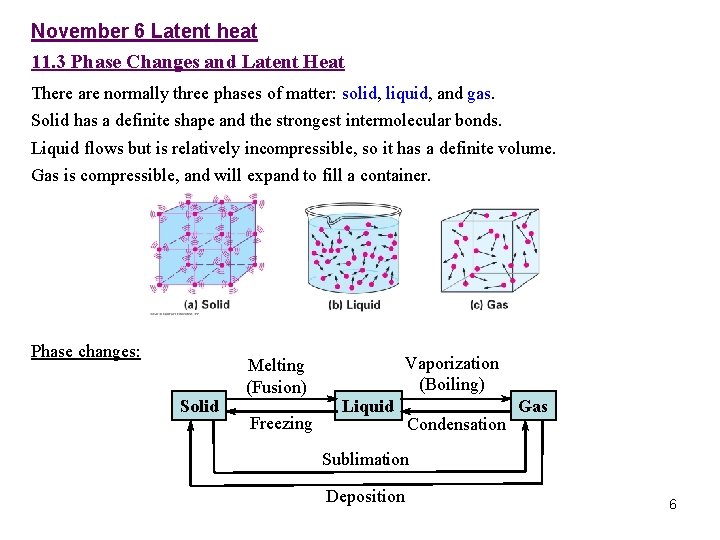
November 6 Latent heat 11. 3 Phase Changes and Latent Heat There are normally three phases of matter: solid, liquid, and gas. Solid has a definite shape and the strongest intermolecular bonds. Liquid flows but is relatively incompressible, so it has a definite volume. Gas is compressible, and will expand to fill a container. Phase changes: Solid Melting (Fusion) Freezing Vaporization (Boiling) Liquid Condensation Gas Sublimation Deposition 6
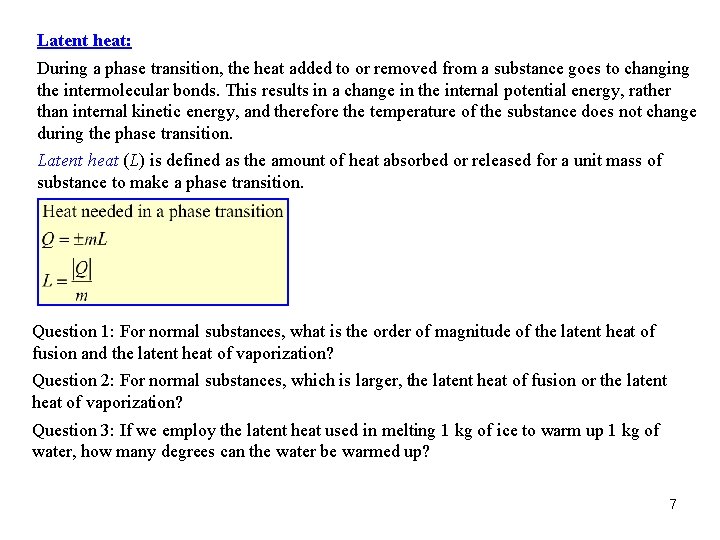
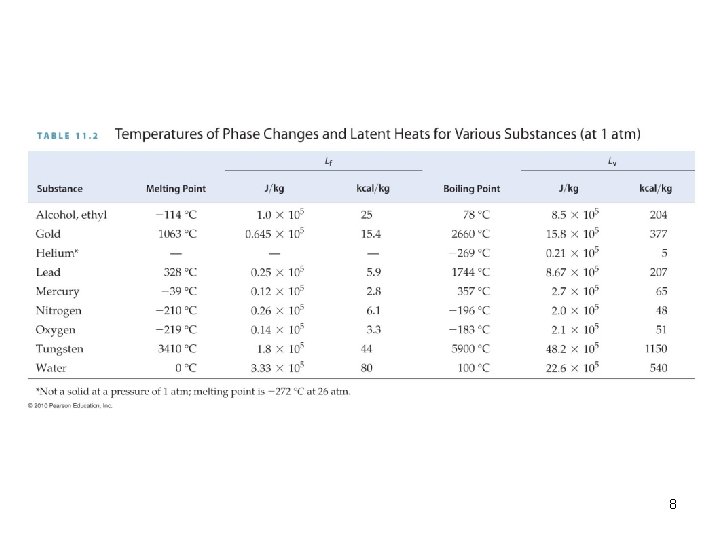
Latent heat: During a phase transition, the heat added to or removed from a substance goes to changing the intermolecular bonds. This results in a change in the internal potential energy, rather than internal kinetic energy, and therefore the temperature of the substance does not change during the phase transition. Latent heat (L) is defined as the amount of heat absorbed or released for a unit mass of substance to make a phase transition. Question 1: For normal substances, what is the order of magnitude of the latent heat of fusion and the latent heat of vaporization? Question 2: For normal substances, which is larger, the latent heat of fusion or the latent heat of vaporization? Question 3: If we employ the latent heat used in melting 1 kg of ice to warm up 1 kg of water, how many degrees can the water be warmed up? 7
8
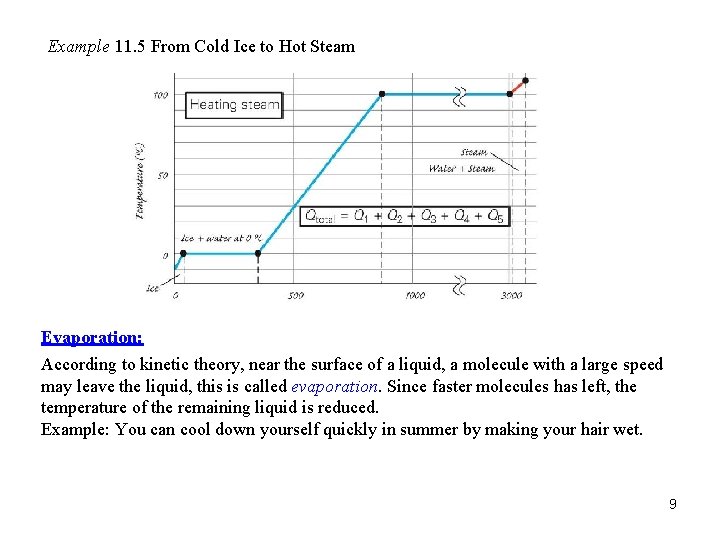
Example 11. 5 From Cold Ice to Hot Steam Evaporation: According to kinetic theory, near the surface of a liquid, a molecule with a large speed may leave the liquid, this is called evaporation. Since faster molecules has left, the temperature of the remaining liquid is reduced. Example: You can cool down yourself quickly in summer by making your hair wet. 9

Read: Ch 11: 3 Homework: Ch 11: E 25, 26, 28 Due: November 15 10
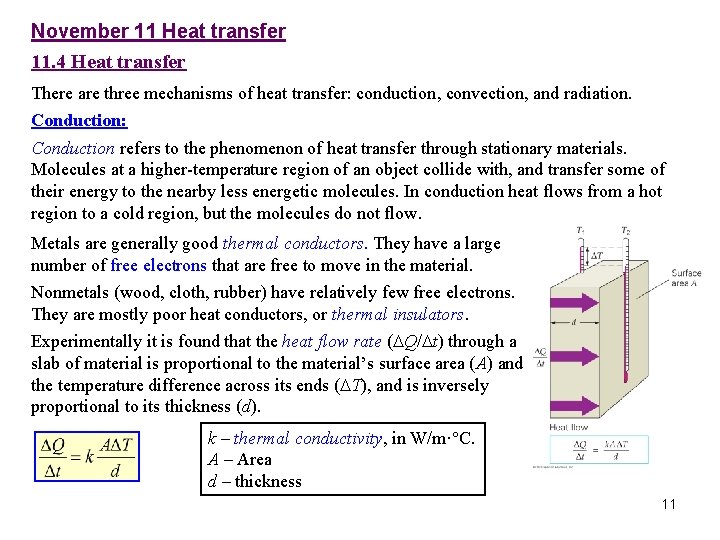
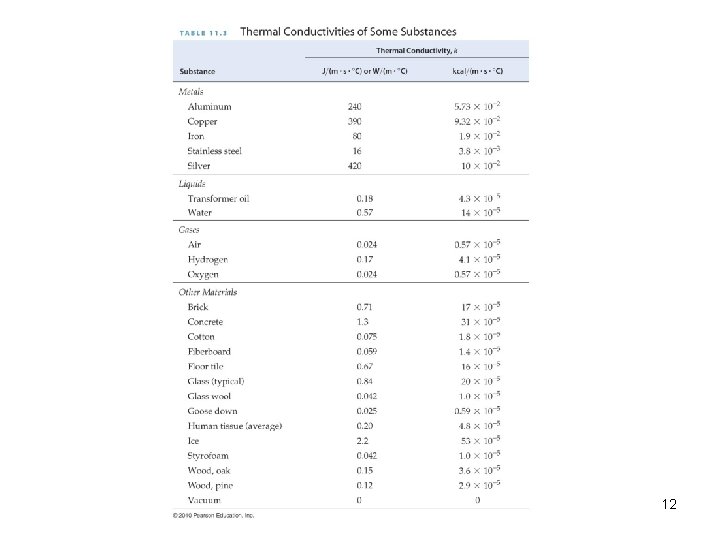
November 11 Heat transfer 11. 4 Heat transfer There are three mechanisms of heat transfer: conduction, convection, and radiation. Conduction: Conduction refers to the phenomenon of heat transfer through stationary materials. Molecules at a higher-temperature region of an object collide with, and transfer some of their energy to the nearby less energetic molecules. In conduction heat flows from a hot region to a cold region, but the molecules do not flow. Metals are generally good thermal conductors. They have a large number of free electrons that are free to move in the material. Nonmetals (wood, cloth, rubber) have relatively few free electrons. They are mostly poor heat conductors, or thermal insulators. Experimentally it is found that the heat flow rate (DQ/Dt) through a slab of material is proportional to the material’s surface area (A) and the temperature difference across its ends (DT), and is inversely proportional to its thickness (d). k – thermal conductivity, in W/m·°C. A – Area d – thickness 11
12
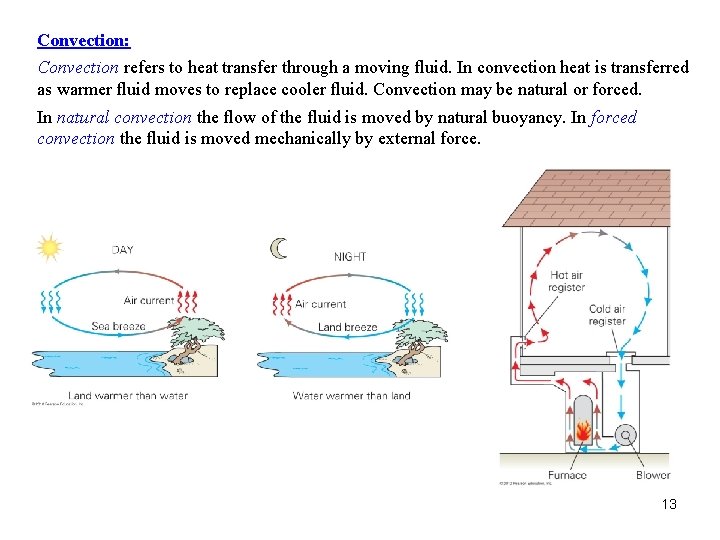
Convection: Convection refers to heat transfer through a moving fluid. In convection heat is transferred as warmer fluid moves to replace cooler fluid. Convection may be natural or forced. In natural convection the flow of the fluid is moved by natural buoyancy. In forced convection the fluid is moved mechanically by external force. 13
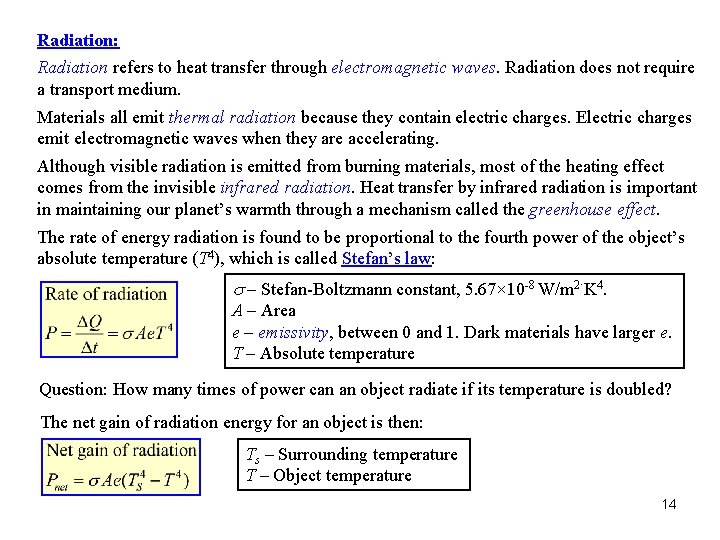
Radiation: Radiation refers to heat transfer through electromagnetic waves. Radiation does not require a transport medium. Materials all emit thermal radiation because they contain electric charges. Electric charges emit electromagnetic waves when they are accelerating. Although visible radiation is emitted from burning materials, most of the heating effect comes from the invisible infrared radiation. Heat transfer by infrared radiation is important in maintaining our planet’s warmth through a mechanism called the greenhouse effect. The rate of energy radiation is found to be proportional to the fourth power of the object’s absolute temperature (T 4), which is called Stefan’s law: s – Stefan-Boltzmann constant, 5. 67× 10 -8 W/m 2·K 4. A – Area e – emissivity, between 0 and 1. Dark materials have larger e. T – Absolute temperature Question: How many times of power can an object radiate if its temperature is doubled? The net gain of radiation energy for an object is then: Ts – Surrounding temperature T – Object temperature 14

Read: Ch 11: 4 Homework: Ch 11: E 43, 54 Due: November 22 15
- Slides: 15