
Chapter 11 Groups and Social Media CONSUMER BEHAVIOR
Chapter 11 Groups and Social Media CONSUMER BEHAVIOR, 11 e Michael R. Solomon
Chapter Objectives When you finish this chapter, you should understand why: 1. 2. 3. Others, especially those who possess some kind of social power, often influence us. We seek out others who share our interests in products or services. We are motivated to buy or use products in order to be consistent with what other people do.

Chapter Objectives (continued) 4. 5. 6. 7. Certain people are especially likely to influence others’ product choices. The things that other consumers tell us about products (good and bad) are often more influential than the advertising we see. Online technologies are accelerating the impact of word-of-mouth communication. Social media are changing the way companies and consumers interact.
Power of Influence Other people and groups, especially those who possess some kind of social power, often influence us. o We belong to or admire many different groups, and a desire for them to accept us often drives our purchase decisions. Individuals or groups whose opinions or behavior is particularly important to consumers are reference groups. o Serve as a frame of reference
5
10/3/2020 6
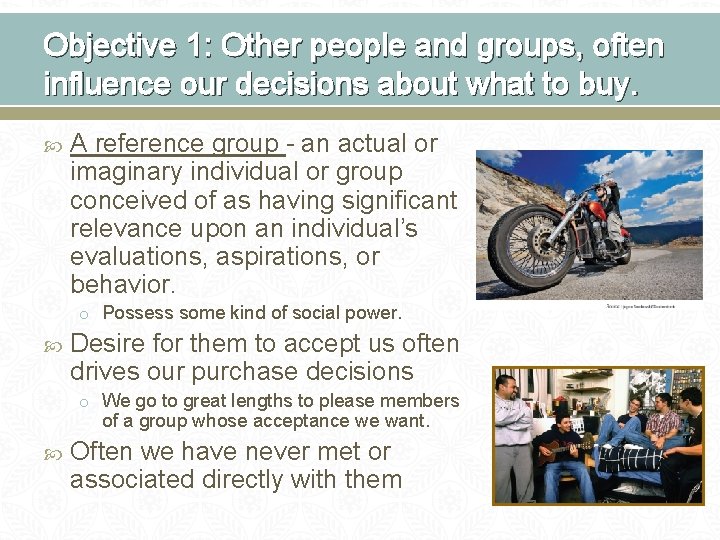
Objective 1: Other people and groups, often influence our decisions about what to buy. A reference group - an actual or imaginary individual or group conceived of as having significant relevance upon an individual’s evaluations, aspirations, or behavior. o Possess some kind of social power. Desire for them to accept us often drives our purchase decisions o We go to great lengths to please members of a group whose acceptance we want. Often we have never met or associated directly with them
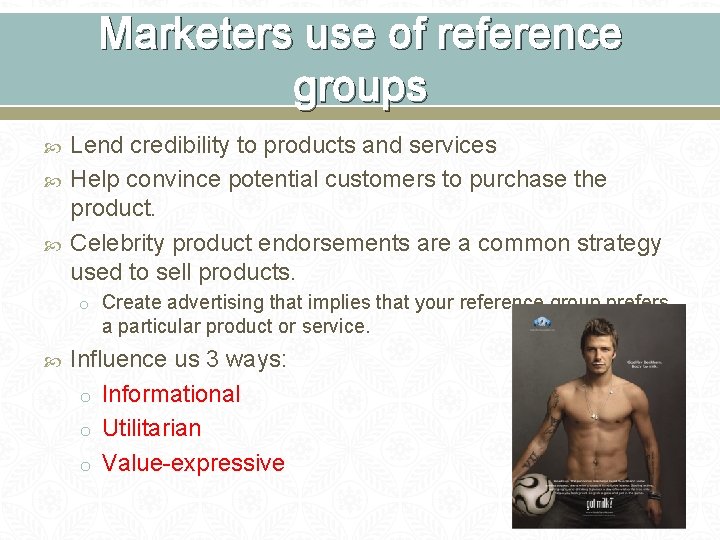
Marketers use of reference groups Lend credibility to products and services Help convince potential customers to purchase the product. Celebrity product endorsements are a common strategy used to sell products. o Create advertising that implies that your reference group prefers a particular product or service. Influence us 3 ways: o Informational o Utilitarian o Value-expressive
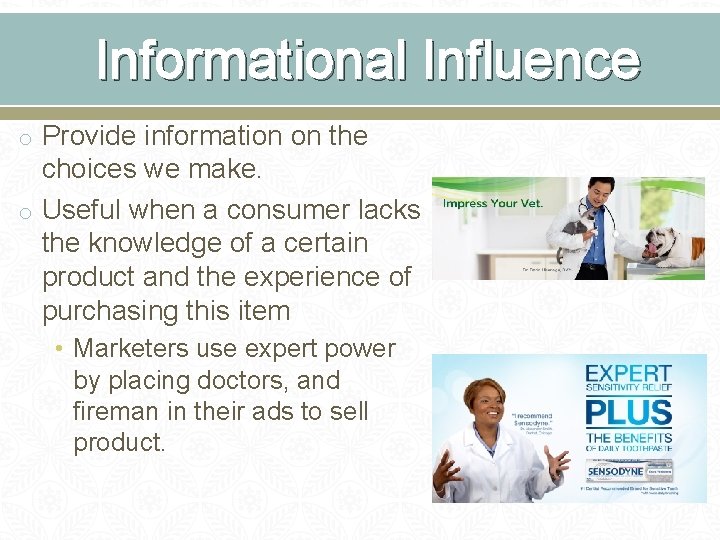
Informational Influence o Provide information on the choices we make. o Useful when a consumer lacks the knowledge of a certain product and the experience of purchasing this item • Marketers use expert power by placing doctors, and fireman in their ads to sell product.
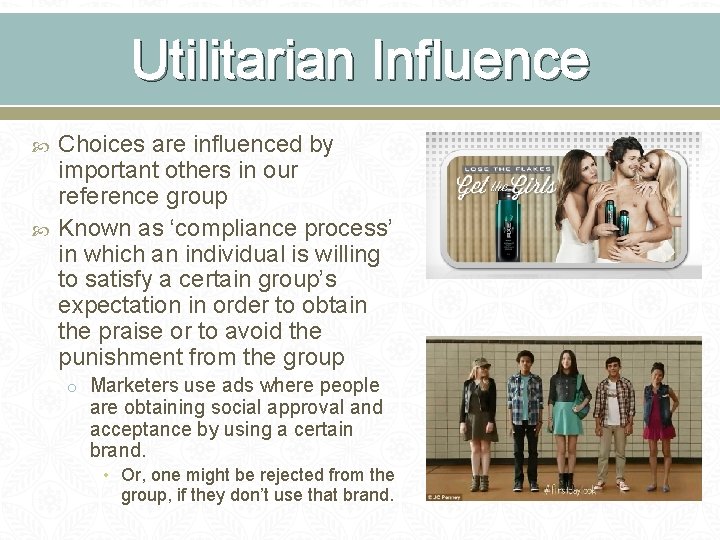
Utilitarian Influence Choices are influenced by important others in our reference group Known as ‘compliance process’ in which an individual is willing to satisfy a certain group’s expectation in order to obtain the praise or to avoid the punishment from the group o Marketers use ads where people are obtaining social approval and acceptance by using a certain brand. • Or, one might be rejected from the group, if they don’t use that brand.
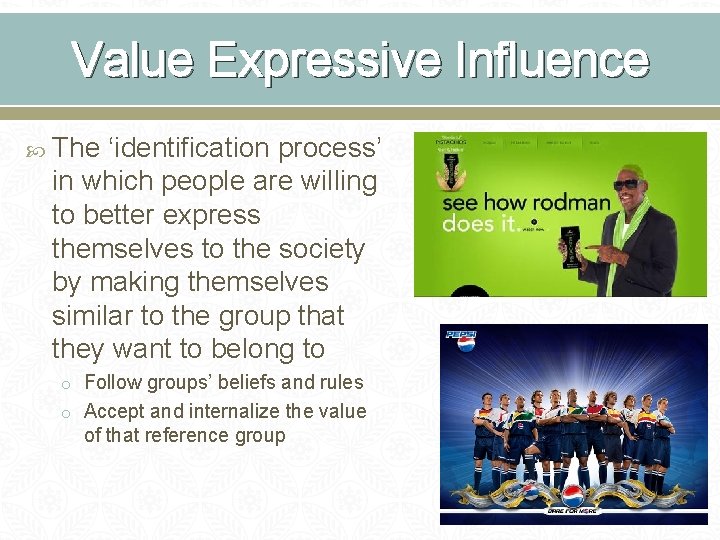
Value Expressive Influence The ‘identification process’ in which people are willing to better express themselves to the society by making themselves similar to the group that they want to belong to o Follow groups’ beliefs and rules o Accept and internalize the value of that reference group
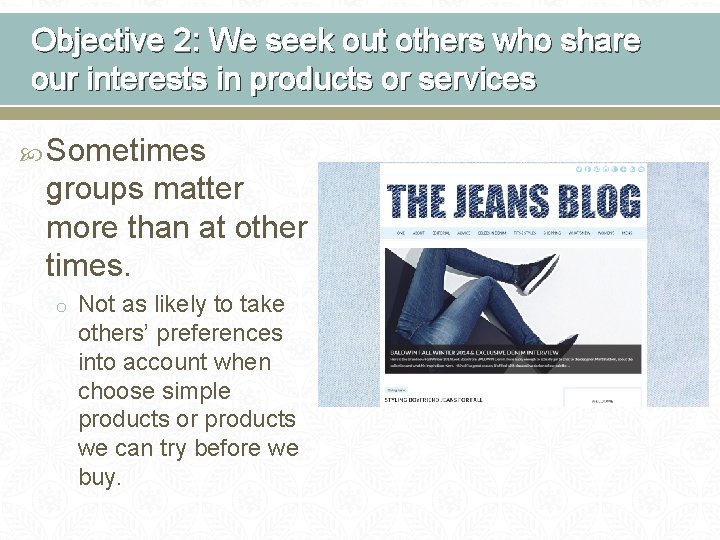
Objective 2: We seek out others who share our interests in products or services Sometimes groups matter more than at other times. o Not as likely to take others’ preferences into account when choose simple products or products we can try before we buy.
10/3/2020 14
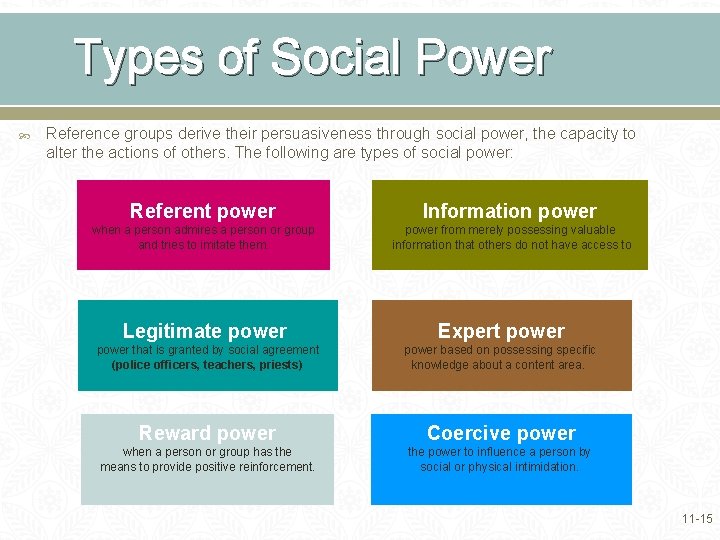
Types of Social Power Reference groups derive their persuasiveness through social power, the capacity to alter the actions of others. The following are types of social power: Referent power Information power when a person admires a person or group and tries to imitate them. power from merely possessing valuable information that others do not have access to Legitimate power Expert power that is granted by social agreement (police officers, teachers, priests) power based on possessing specific knowledge about a content area. Reward power Coercive power when a person or group has the means to provide positive reinforcement. the power to influence a person by social or physical intimidation. 11 -15
Types of Reference Groups Reference group may be used loosely to identify external influence that provides social cues. o We like others who share our names or initials better than those who do not. Some individuals are more powerful than others are and affect a broader range of our consumption decisions. o Parents are among individuals in a reference group that helps set and enforce fundamental standards of conduct (normative influence). o Decisions about specific brands or activities are affected (e. g. , a club that you belong to) is called comparative influence
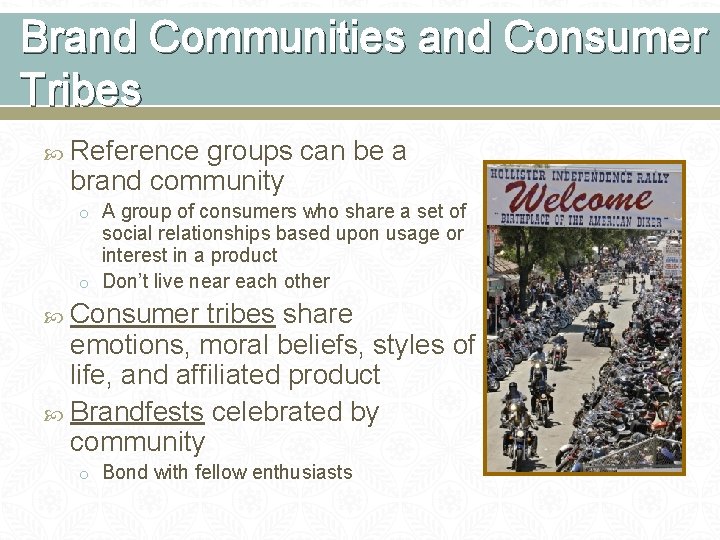
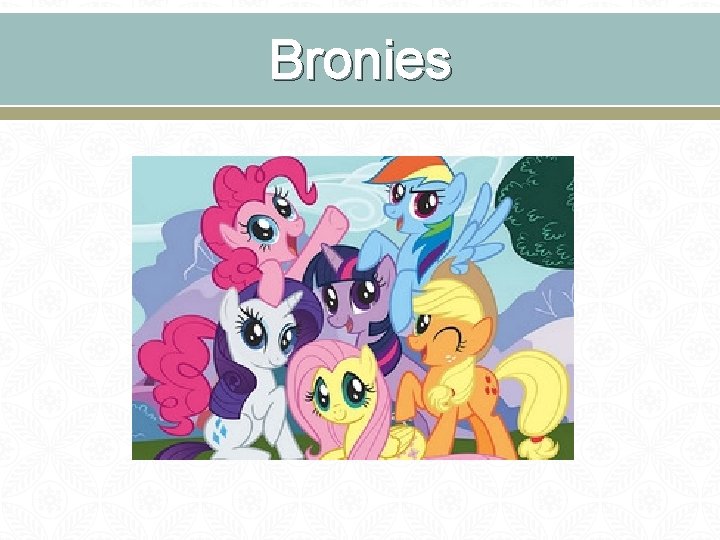
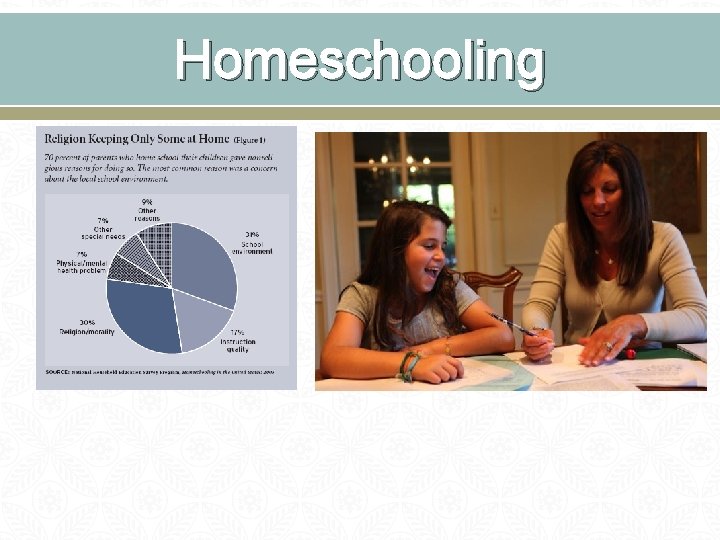
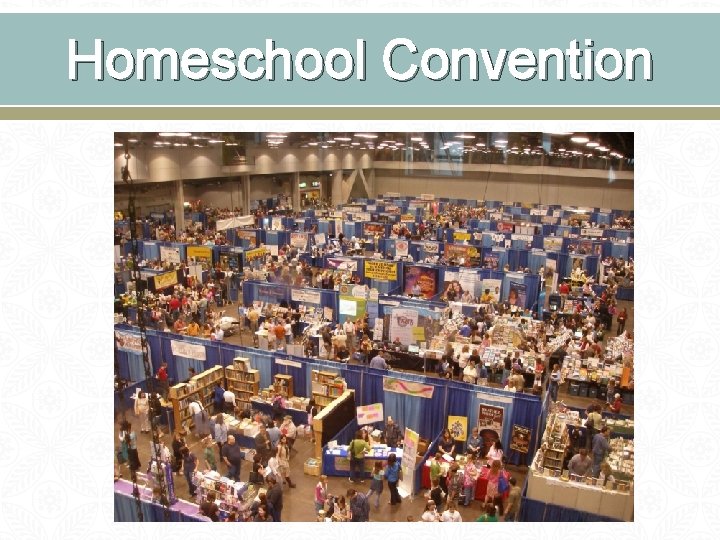
Brand Communities and Consumer Tribes Reference groups can be a brand community o A group of consumers who share a set of social relationships based upon usage or interest in a product o Don’t live near each other Consumer tribes share emotions, moral beliefs, styles of life, and affiliated product Brandfests celebrated by community o Bond with fellow enthusiasts
Bronies
Homeschooling
Homeschool Convention
Both Membership and Aspirational Reference Groups effect our behavior Membership reference groups o People the consumer actually knows o Advertisers use “ordinary people” Aspirational reference groups o People the consumer doesn’t know but admire o Advertisers use celebrity spokespeople 11 -21
Positive versus Negative Reference Groups Reference groups exert either a positive or a negative influence on consumption behaviors. o Avoidance groups are groups from which the consumers wish to distance themselves. o Antibrand communities: rally around a celebrity, store, or brand—but in this case they’re united by their disdain for it o Justin Beiber o Nike products 11 -23
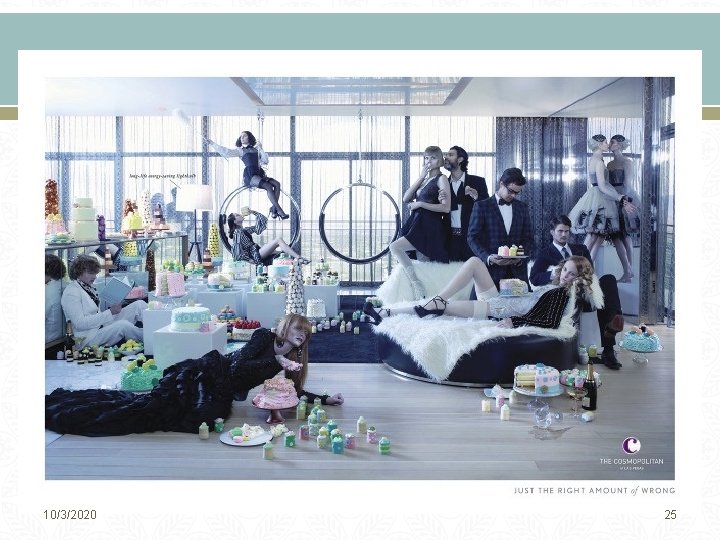
Consumers Do It in Groups People in larger groups have fewer constraints on behavior. We get away with more when we are in a group Deindividuation: individual identities become submerged within a group Social loafing: people don’t devote as much to a task when their contribution is part of a larger group Risky shift: group members show a greater willingness to consider riskier alternatives following group discussion than if members made their own decisions 11 -24
10/3/2020 25
Objective 3: Conformity is a change in beliefs or actions as a reaction to real or imagined group pressure o We are motivated to buy or use products in order to be consistent with what other people do. We conform to the desires of others for two basic reasons: o (1) informational social influence o (2) normative social influence
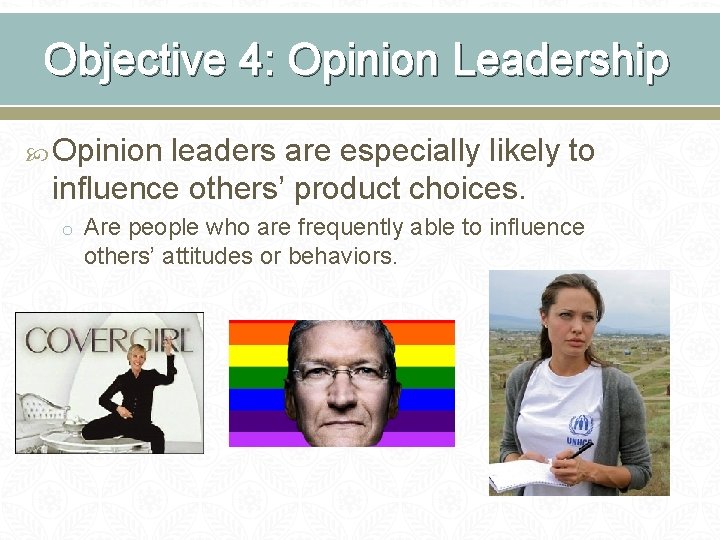
Objective 4: Opinion Leadership Opinion leaders are especially likely to influence others’ product choices. o Are people who are frequently able to influence others’ attitudes or behaviors.
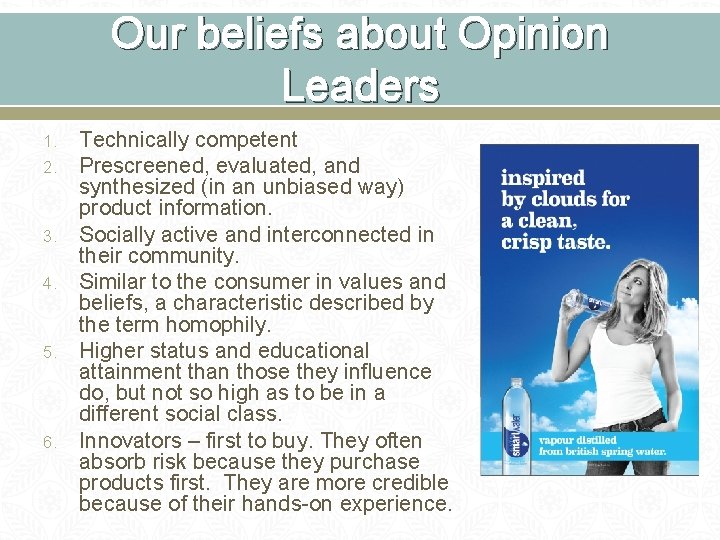
Our beliefs about Opinion Leaders 1. 2. 3. 4. 5. 6. Technically competent Prescreened, evaluated, and synthesized (in an unbiased way) product information. Socially active and interconnected in their community. Similar to the consumer in values and beliefs, a characteristic described by the term homophily. Higher status and educational attainment than those they influence do, but not so high as to be in a different social class. Innovators – first to buy. They often absorb risk because they purchase products first. They are more credible because of their hands-on experience.
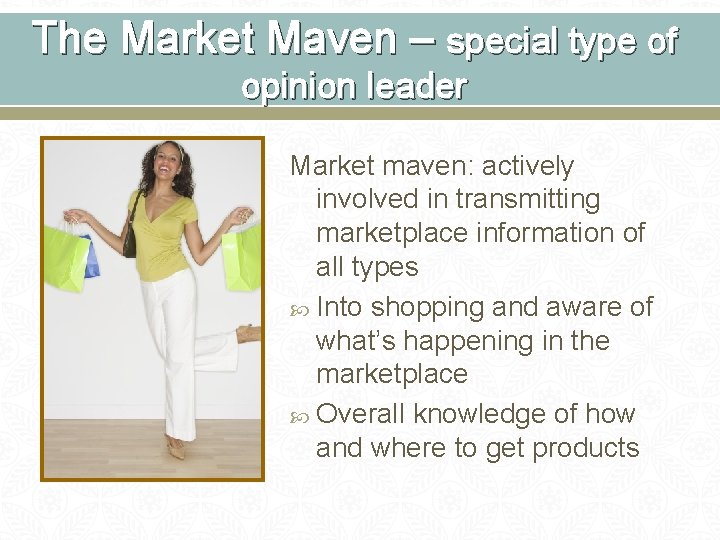
The Market Maven – special type of opinion leader Market maven: actively involved in transmitting marketplace information of all types Into shopping and aware of what’s happening in the marketplace Overall knowledge of how and where to get products
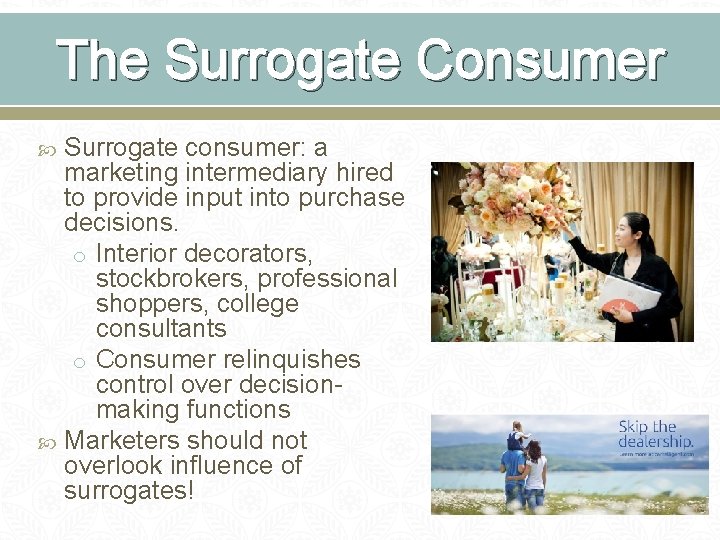
The Surrogate Consumer Surrogate consumer: a marketing intermediary hired to provide input into purchase decisions. o Interior decorators, stockbrokers, professional shoppers, college consultants o Consumer relinquishes control over decisionmaking functions Marketers should not overlook influence of surrogates!
Word-of-Mouth Communication WOM is product information transmitted by individuals to individuals More reliable form of marketing Social pressure to conform Influences two-thirds of all sales We rely upon WOM in later stages of product adoption Powerful when we are unfamiliar with product category 11 -33
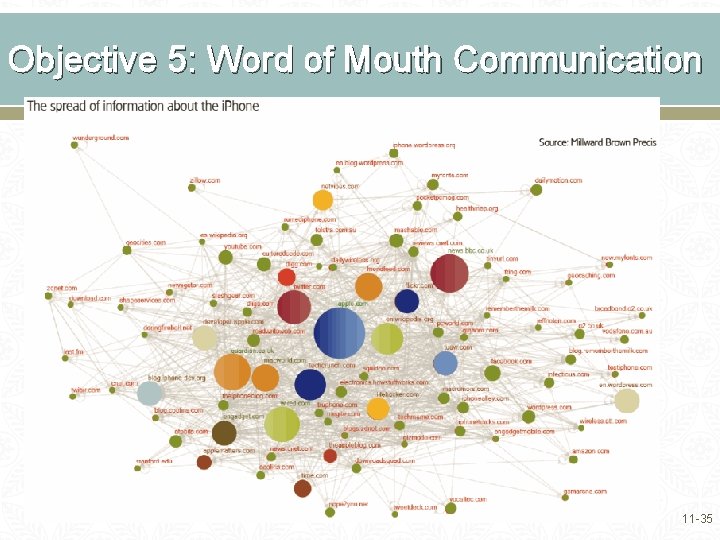
Objective 5: Word of Mouth Communication 11 -35
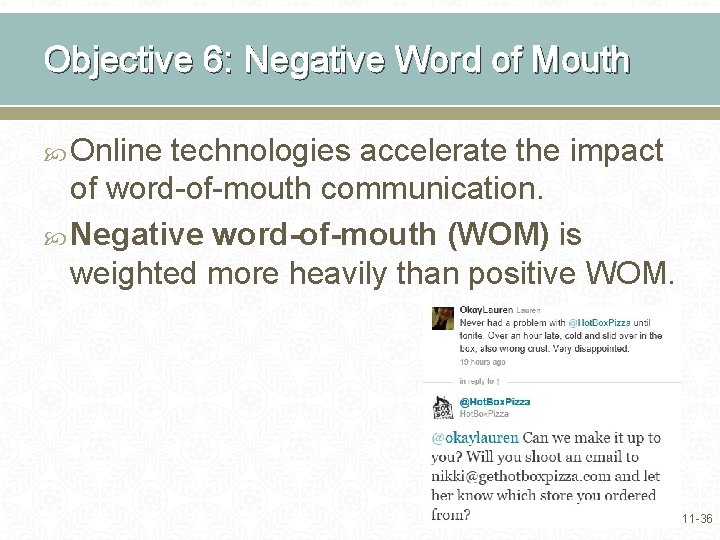
Objective 6: Negative Word of Mouth Online technologies accelerate the impact of word-of-mouth communication. Negative word-of-mouth (WOM) is weighted more heavily than positive WOM. 11 -36
Negative WOM and Power of Rumors Injustice Identity Agency 11 -37
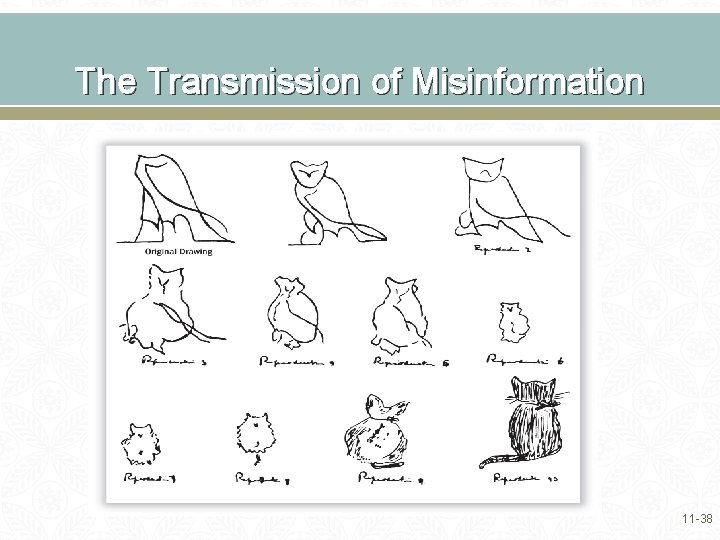
The Transmission of Misinformation 11 -38

10/3/2020 39
Objective 7: Social Networks Social media are changing the way companies and consumers interact. Social networking, where members post information and make contact with others who share similar interests and opinions, changes the way we think about marketing. o As Web 2. 0 continues to develop, companies and consumers increasingly interact directly. o The wisdom of crowds’ perspective argues that under the right circumstances, groups are smarter than the smartest people in them are. o If this is true, it implies that large numbers of consumers can predict successful products. 11 -40
Characteristics of Online Communities Conversation Presence Collective interest Democracy Behavioral standards Participation Crowd power Network effect 11 -41
Chapter Summary WOM communication about products, especially from opinion leaders, may be more influential than information from marketers. Web 2. 0 accelerates the speed of delivery and the power of WOM communication. Copyright © 2013 Pearson Education, Inc. publishing as Prentice Hall 11 -42
- Slides: 38