
Chapter 11 Glass Objectives 1 of 2 Understand
Chapter 11 Glass
Objectives (1 of 2) • Understand explain the unique properties of glass as a still-life subject. • Draw clear glass objects accurately by rendering their shape and interior reflections, any objects seen through the glass, and any objects reflected in the glass.
Objectives (2 of 2) • Draw colored glass objects with their proper local color and the shading that gives them volume. • Draw clear and opaque or translucent liquids held in a glass object, accurately rendering the way such liquids transmit or reflect surrounding objects.
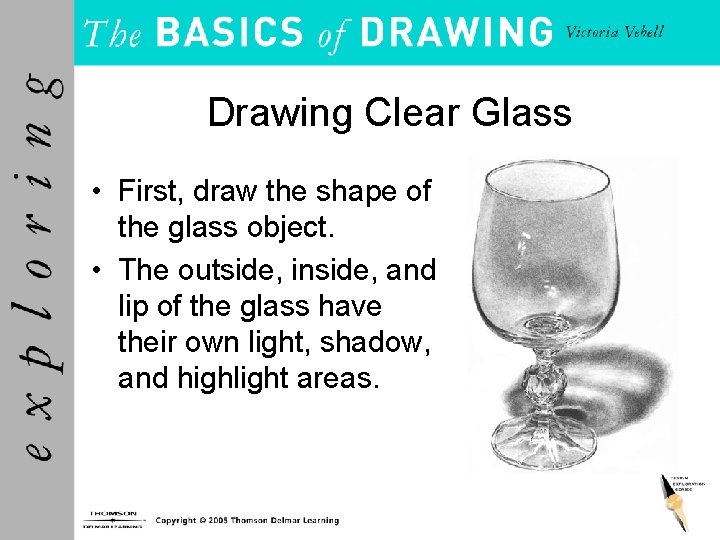
Drawing Clear Glass • First, draw the shape of the glass object. • The outside, inside, and lip of the glass have their own light, shadow, and highlight areas.

Seeing through Glass • Curved glass distorts whatever is seen through it. – More curvature = greater distortion • Designs (like the stem) distort even more. • There also reflections in glass.
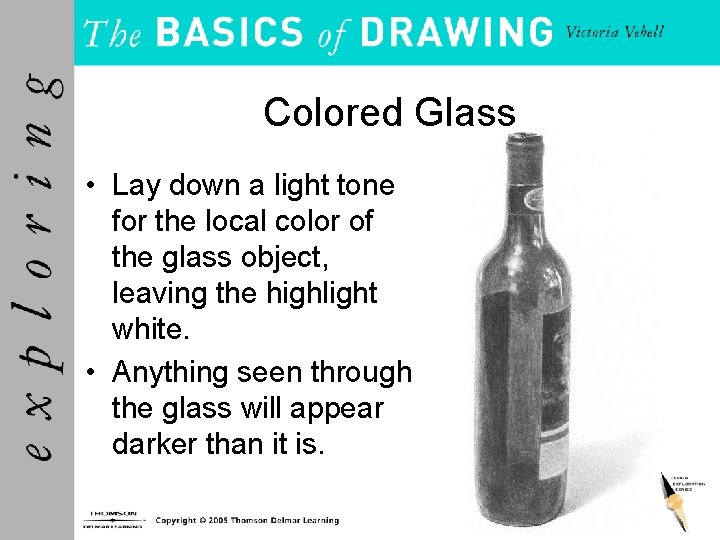
Colored Glass • Lay down a light tone for the local color of the glass object, leaving the highlight white. • Anything seen through the glass will appear darker than it is.
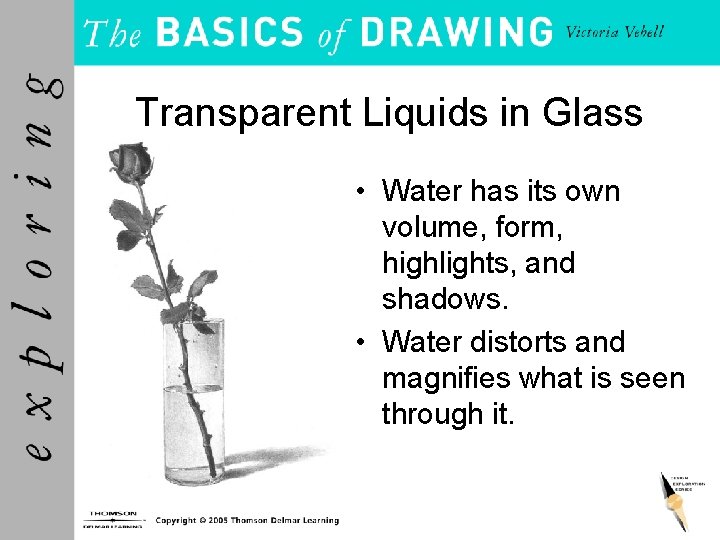
Transparent Liquids in Glass • Water has its own volume, form, highlights, and shadows. • Water distorts and magnifies what is seen through it.
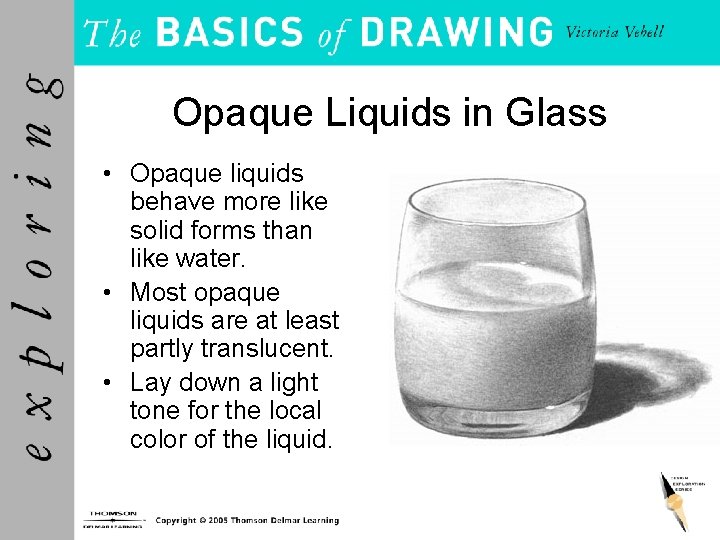
Opaque Liquids in Glass • Opaque liquids behave more like solid forms than like water. • Most opaque liquids are at least partly translucent. • Lay down a light tone for the local color of the liquid.
Summary (1 of 2) • In a transparent object, you can see its interior surface, objects placed behind it, and reflections on its surface. • Begin every drawing of a glass object by drawing its basic shape. • Curved glass surfaces distort the objects you see through them.
Summary (2 of 2) • Clear liquids magnify and distort objects seen through them. • For colored glass or colored liquid in a glass object, put a tone over the whole area to represent the local color. • Opaque liquids act almost like solid objects, but may transmit some light.
- Slides: 10