
Chapter 11 Foundations of Control Chapter 11 Stephen
- Slides: 44
Chapter 11 Foundations of Control Chapter 11, Stephen P. Robbins, Mary Coulter, and Nancy Langton, Fundamentals of Management, Fifth Canadian Edition Copyright © 2008 Pearson Education Canada 11 -1
LEARNING OUTLINE Follow this Learning Outline as you read and study this chapter • What Is Control? – Define control – Discuss the reasons why control is important – Explain the planning-controlling link – Contrast the three approaches to designing control systems Chapter 11, Stephen P. Robbins, Mary Coulter, and Nancy Langton, Fundamentals of Management, Fifth Canadian Edition Copyright © 2008 Pearson Education Canada 11 -2
LEARNING OUTLINE (cont’d) Follow this Learning Outline as you read and study this chapter • The Organization’s Culture – Describe the seven dimensions of organizational culture – Discuss the impact of strong culture on organizations and managers – Explain the source of an organization’s culture and how that culture continues – Describe how culture is transmitted to employees Chapter 11, Stephen P. Robbins, Mary Coulter, and Nancy Langton, Fundamentals of Management, Fifth Canadian Edition Copyright © 2008 Pearson Education Canada 11 -3
LEARNING OUTLINE (cont’d) Follow this Learning Outline as you read and study this chapter • The Control Process – Describe three steps in the control process – Explain the three courses of action managers can take in controlling – Explain why what is measured is more critical than how it’s measured Chapter 11, Stephen P. Robbins, Mary Coulter, and Nancy Langton, Fundamentals of Management, Fifth Canadian Edition Copyright © 2008 Pearson Education Canada 11 -4
LEARNING OUTLINE (cont’d) Follow this Learning Outline as you read and study this chapter • Controlling for Organizational Performance – Define organizational performance – Describe the most frequently used measures of organizational performance • Tools for Organizational Performance – Contrast feedforward, concurrent, and feedback controls – Explain the types of financial and information controls managers can use – Describe how balanced scorecards and benchmarking are used in controlling Chapter 11, Stephen P. Robbins, Mary Coulter, and Nancy Langton, Fundamentals of Management, Fifth Canadian Edition Copyright © 2008 Pearson Education Canada 11 -5
LEARNING OUTLINE (cont’d) Follow this Learning Outline as you read and study this chapter • Current Issues in Control – Describe how managers may have to adjust controls for cross-cultural differences – Discuss the types of workplace concerns managers face and how they can address those concerns – Discuss what corporate governance is and how it’s changing Chapter 11, Stephen P. Robbins, Mary Coulter, and Nancy Langton, Fundamentals of Management, Fifth Canadian Edition Copyright © 2008 Pearson Education Canada 11 -6
What Is Control? • Control – The process of monitoring activities to ensure that they are being accomplished as planned and of correcting any significant deviations • Importance of Control – To ensure that activities are completed in ways that lead to accomplishment of organizational goals Chapter 11, Stephen P. Robbins, Mary Coulter, and Nancy Langton, Fundamentals of Management, Fifth Canadian Edition Copyright © 2008 Pearson Education Canada 11 -7
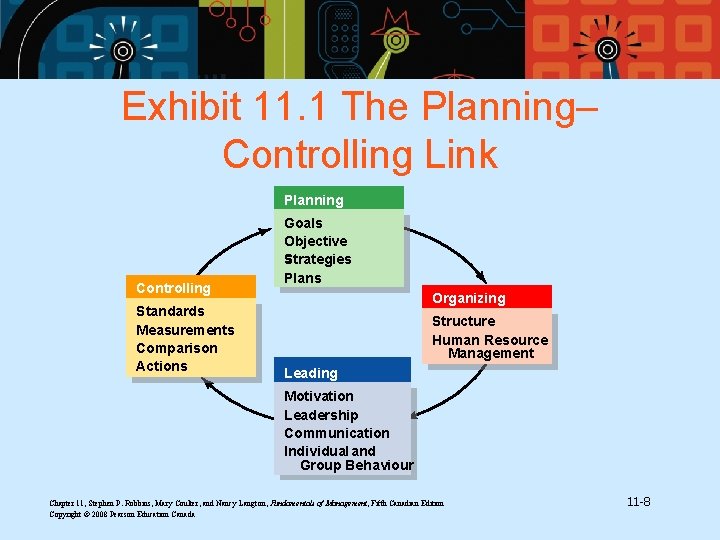
Exhibit 11. 1 The Planning– Controlling Link Planning Controlling Standards Measurements Comparison Actions Goals Objective s trategies S Plans Organizing Structure Human Resource Management Leading Motivation Leadership Communication Individual and Group Behaviour Chapter 11, Stephen P. Robbins, Mary Coulter, and Nancy Langton, Fundamentals of Management, Fifth Canadian Edition Copyright © 2008 Pearson Education Canada 11 -8
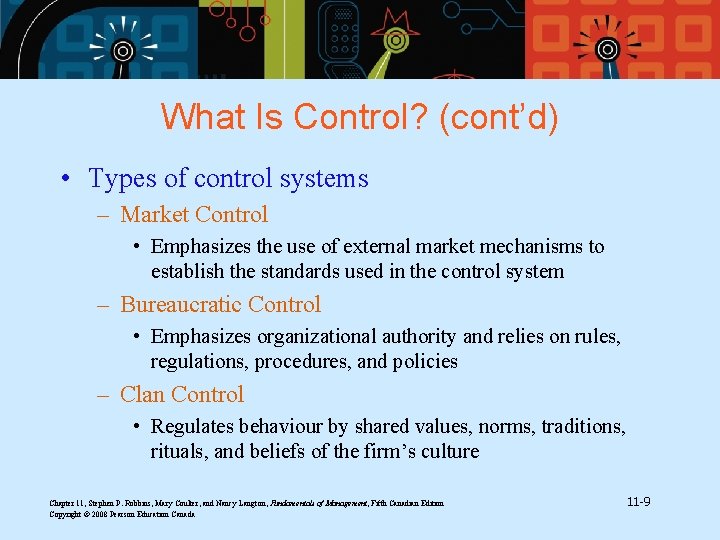
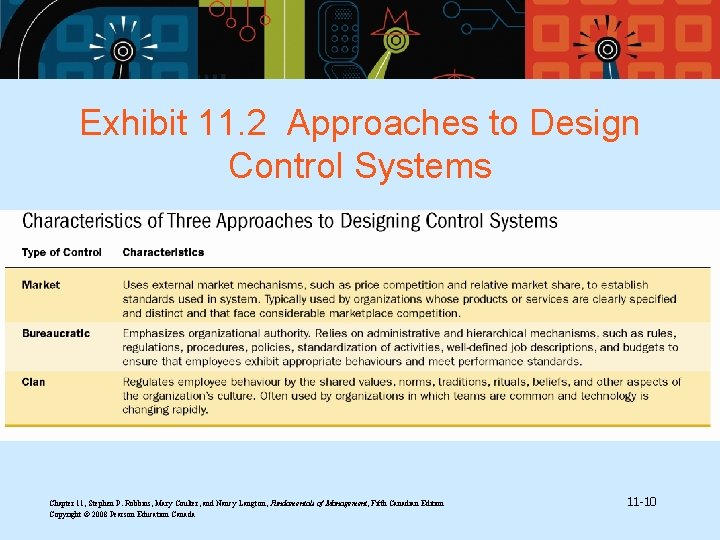
What Is Control? (cont’d) • Types of control systems – Market Control • Emphasizes the use of external market mechanisms to establish the standards used in the control system – Bureaucratic Control • Emphasizes organizational authority and relies on rules, regulations, procedures, and policies – Clan Control • Regulates behaviour by shared values, norms, traditions, rituals, and beliefs of the firm’s culture Chapter 11, Stephen P. Robbins, Mary Coulter, and Nancy Langton, Fundamentals of Management, Fifth Canadian Edition Copyright © 2008 Pearson Education Canada 11 -9
Exhibit 11. 2 Approaches to Design Control Systems Chapter 11, Stephen P. Robbins, Mary Coulter, and Nancy Langton, Fundamentals of Management, Fifth Canadian Edition Copyright © 2008 Pearson Education Canada 11 -10
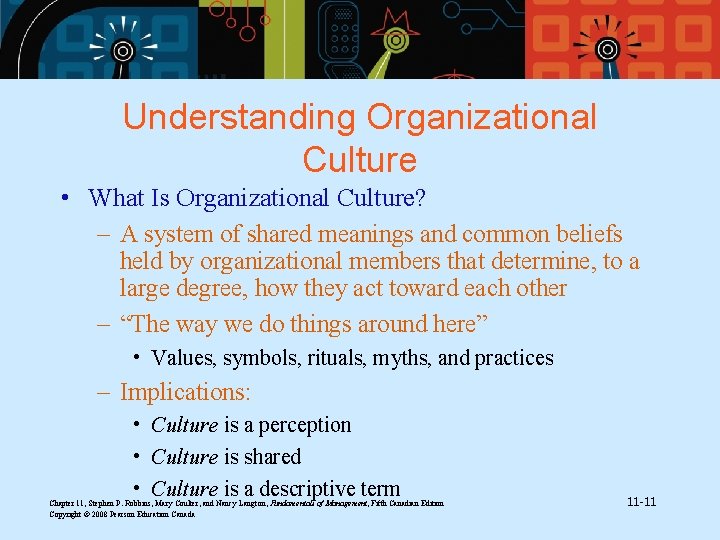
Understanding Organizational Culture • What Is Organizational Culture? – A system of shared meanings and common beliefs held by organizational members that determine, to a large degree, how they act toward each other – “The way we do things around here” • Values, symbols, rituals, myths, and practices – Implications: • Culture is a perception • Culture is shared • Culture is a descriptive term Chapter 11, Stephen P. Robbins, Mary Coulter, and Nancy Langton, Fundamentals of Management, Fifth Canadian Edition Copyright © 2008 Pearson Education Canada 11 -11
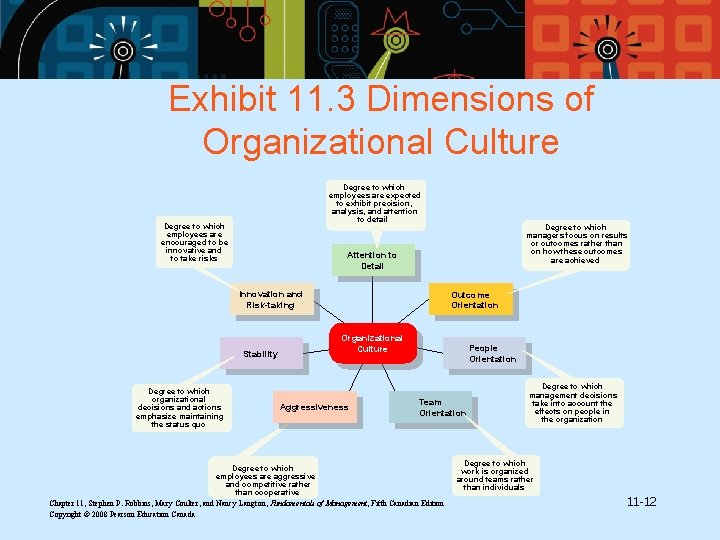
Exhibit 11. 3 Dimensions of Organizational Culture Degree to which employees are expected to exhibit precision, analysis, and attention to detail Degree to which employees are encouraged to be innovative and to take risks Attention to Detail Innovation and Risk-taking Stability Degree to which organizational decisions and actions emphasize maintaining the status quo Degree to which managers focus on results or outcomes rather than on how these outcomes are achieved Outcome Orientation Organizational Culture Aggressiveness People Orientation Team Orientation Degree to which employees are aggressive and competitive rather than cooperative Chapter 11, Stephen P. Robbins, Mary Coulter, and Nancy Langton, Fundamentals of Management, Fifth Canadian Edition Copyright © 2008 Pearson Education Canada Degree to which management decisions take into account the effects on people in the organization Degree to which work is organized around teams rather than individuals 11 -12
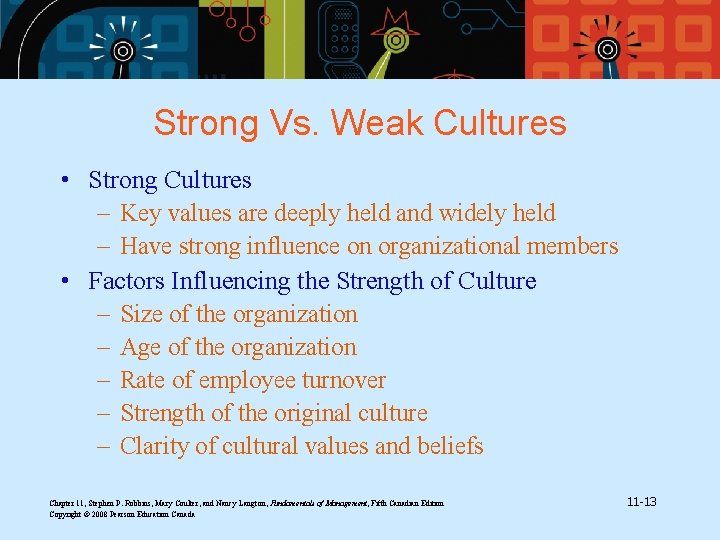
Strong Vs. Weak Cultures • Strong Cultures – Key values are deeply held and widely held – Have strong influence on organizational members • Factors Influencing the Strength of Culture – Size of the organization – Age of the organization – Rate of employee turnover – Strength of the original culture – Clarity of cultural values and beliefs Chapter 11, Stephen P. Robbins, Mary Coulter, and Nancy Langton, Fundamentals of Management, Fifth Canadian Edition Copyright © 2008 Pearson Education Canada 11 -13
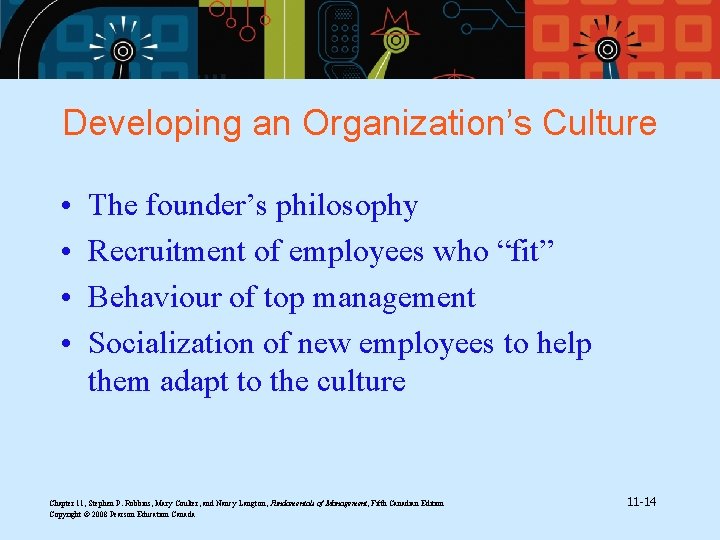
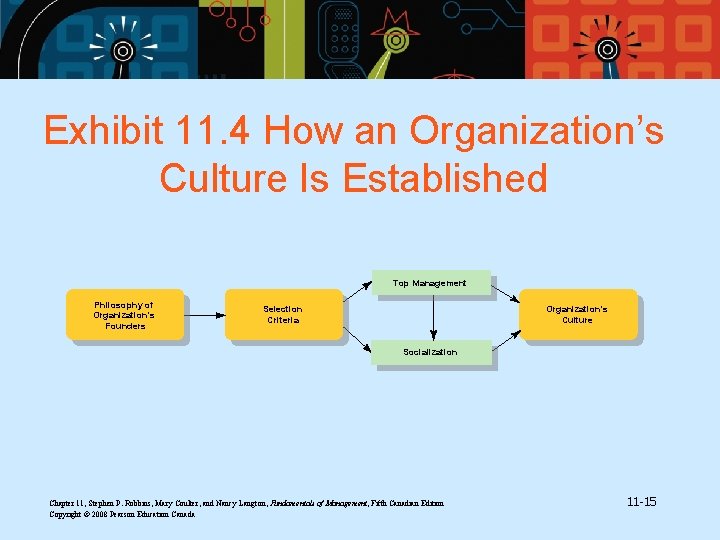
Developing an Organization’s Culture • • The founder’s philosophy Recruitment of employees who “fit” Behaviour of top management Socialization of new employees to help them adapt to the culture Chapter 11, Stephen P. Robbins, Mary Coulter, and Nancy Langton, Fundamentals of Management, Fifth Canadian Edition Copyright © 2008 Pearson Education Canada 11 -14
Exhibit 11. 4 How an Organization’s Culture Is Established Top Management Philosophy of Organization's Founders Selection Criteria Organization's Culture Socialization Chapter 11, Stephen P. Robbins, Mary Coulter, and Nancy Langton, Fundamentals of Management, Fifth Canadian Edition Copyright © 2008 Pearson Education Canada 11 -15
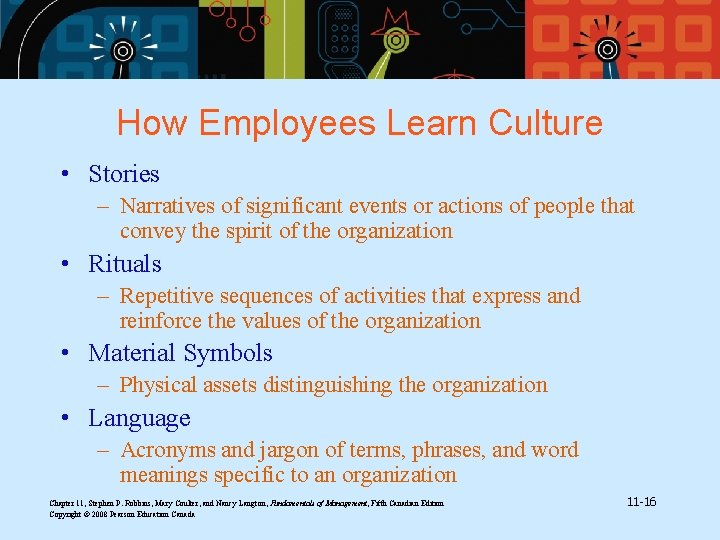
How Employees Learn Culture • Stories – Narratives of significant events or actions of people that convey the spirit of the organization • Rituals – Repetitive sequences of activities that express and reinforce the values of the organization • Material Symbols – Physical assets distinguishing the organization • Language – Acronyms and jargon of terms, phrases, and word meanings specific to an organization Chapter 11, Stephen P. Robbins, Mary Coulter, and Nancy Langton, Fundamentals of Management, Fifth Canadian Edition Copyright © 2008 Pearson Education Canada 11 -16
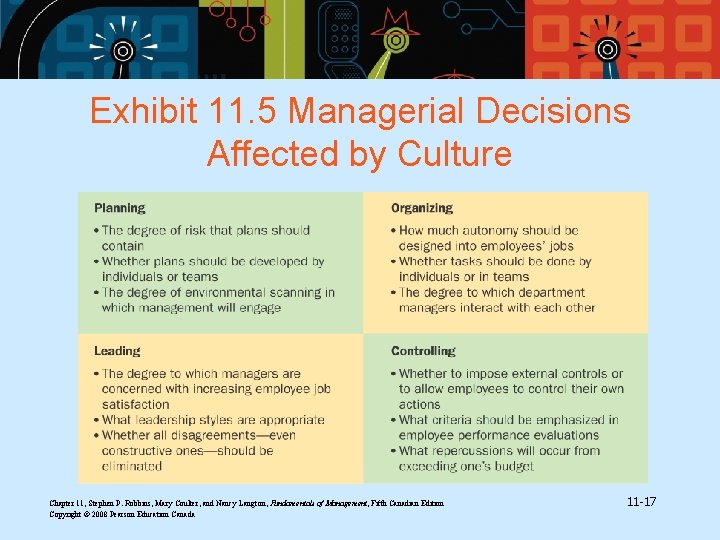
Exhibit 11. 5 Managerial Decisions Affected by Culture Chapter 11, Stephen P. Robbins, Mary Coulter, and Nancy Langton, Fundamentals of Management, Fifth Canadian Edition Copyright © 2008 Pearson Education Canada 11 -17
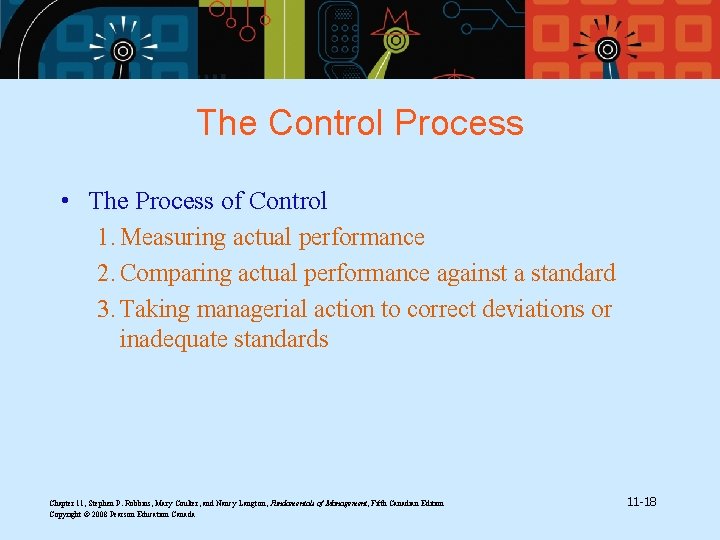
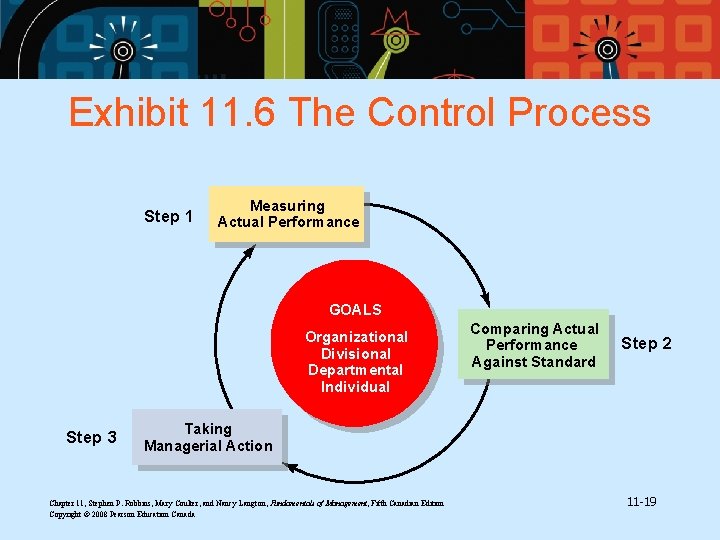
The Control Process • The Process of Control 1. Measuring actual performance 2. Comparing actual performance against a standard 3. Taking managerial action to correct deviations or inadequate standards Chapter 11, Stephen P. Robbins, Mary Coulter, and Nancy Langton, Fundamentals of Management, Fifth Canadian Edition Copyright © 2008 Pearson Education Canada 11 -18
Exhibit 11. 6 The Control Process Step 1 Measuring Actual Performance GOALS Organizational Divisional Departmental Individual Step 3 Comparing Actual Performance Against Standard Step 2 Taking Managerial Action Chapter 11, Stephen P. Robbins, Mary Coulter, and Nancy Langton, Fundamentals of Management, Fifth Canadian Edition Copyright © 2008 Pearson Education Canada 11 -19
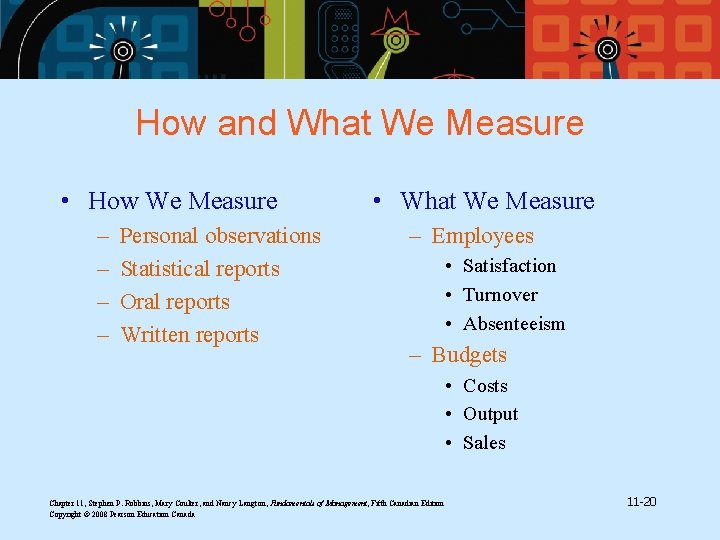
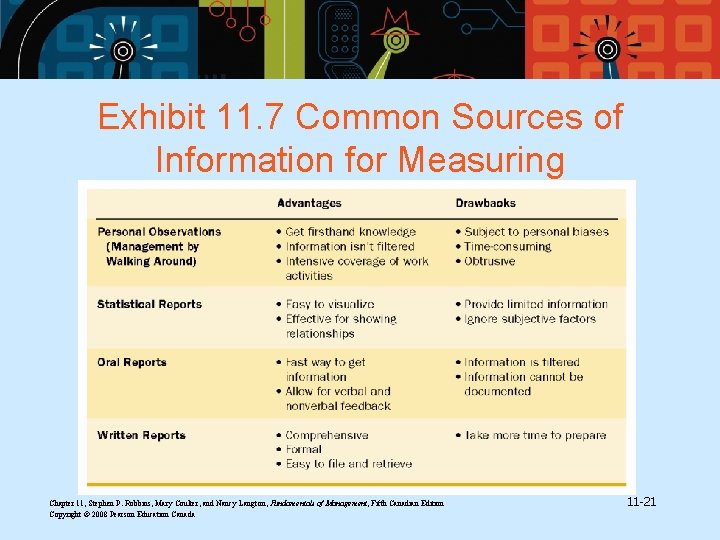
How and What We Measure • How We Measure – – Personal observations Statistical reports Oral reports Written reports • What We Measure – Employees • Satisfaction • Turnover • Absenteeism – Budgets • Costs • Output • Sales Chapter 11, Stephen P. Robbins, Mary Coulter, and Nancy Langton, Fundamentals of Management, Fifth Canadian Edition Copyright © 2008 Pearson Education Canada 11 -20
Exhibit 11. 7 Common Sources of Information for Measuring Performance Chapter 11, Stephen P. Robbins, Mary Coulter, and Nancy Langton, Fundamentals of Management, Fifth Canadian Edition Copyright © 2008 Pearson Education Canada 11 -21
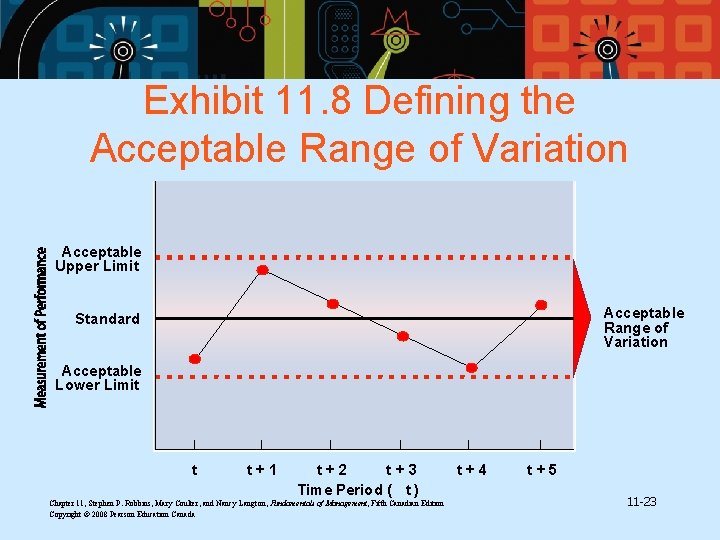
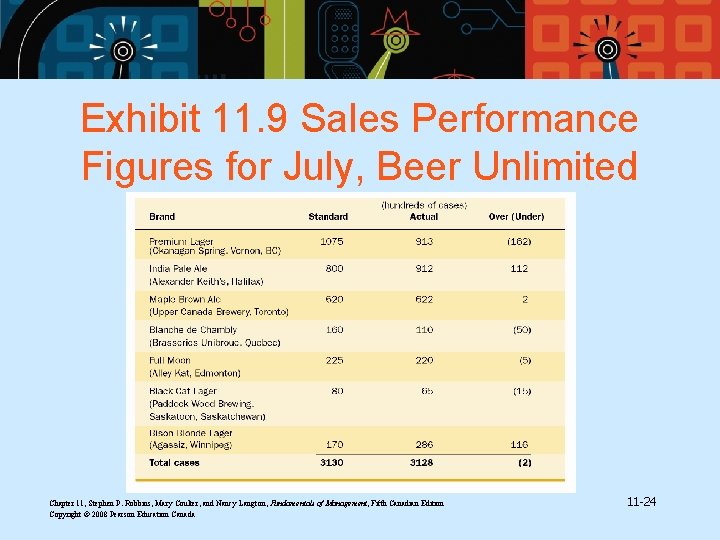
Comparing Actual Performance Against Standard • Determining the degree of variation between actual performance and the standard – Significance of variation is determined by: • The acceptable range of variation from the standard (forecast or budget) • The size (large or small) and direction (over or under) of the variation from the standard Chapter 11, Stephen P. Robbins, Mary Coulter, and Nancy Langton, Fundamentals of Management, Fifth Canadian Edition Copyright © 2008 Pearson Education Canada 11 -22
Exhibit 11. 8 Defining the Acceptable Range of Variation Acceptable Upper Limit Acceptable Range of Variation Standard Acceptable Lower Limit t t+1 t+2 t+3 Time Period ( t ) Chapter 11, Stephen P. Robbins, Mary Coulter, and Nancy Langton, Fundamentals of Management, Fifth Canadian Edition Copyright © 2008 Pearson Education Canada t+4 t+5 11 -23
Exhibit 11. 9 Sales Performance Figures for July, Beer Unlimited Chapter 11, Stephen P. Robbins, Mary Coulter, and Nancy Langton, Fundamentals of Management, Fifth Canadian Edition Copyright © 2008 Pearson Education Canada 11 -24
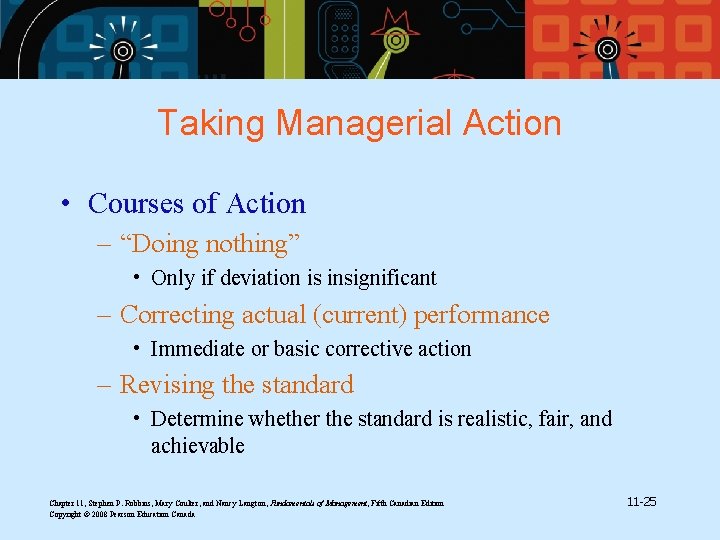
Taking Managerial Action • Courses of Action – “Doing nothing” • Only if deviation is insignificant – Correcting actual (current) performance • Immediate or basic corrective action – Revising the standard • Determine whether the standard is realistic, fair, and achievable Chapter 11, Stephen P. Robbins, Mary Coulter, and Nancy Langton, Fundamentals of Management, Fifth Canadian Edition Copyright © 2008 Pearson Education Canada 11 -25
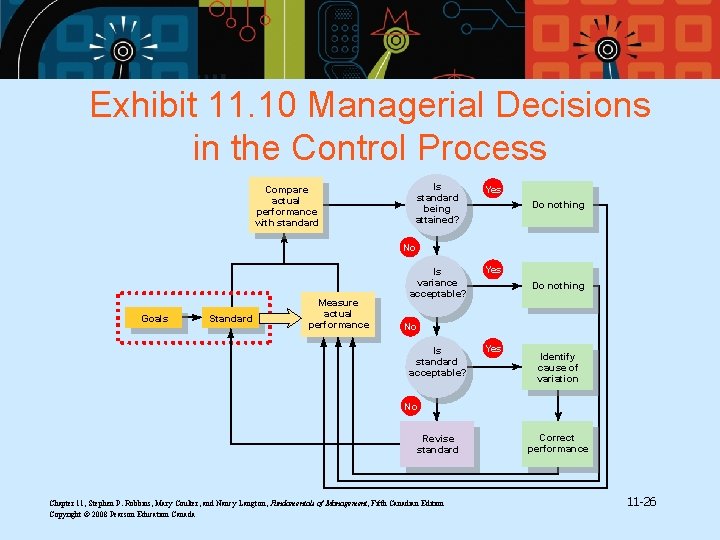
Exhibit 11. 10 Managerial Decisions in the Control Process Compare actual performance with standard Is standard being attained? Yes Do nothing No Goals Standard Measure actual performance Is variance acceptable? Yes Do nothing No Is standard acceptable? Yes Identify cause of variation No Revise standard Chapter 11, Stephen P. Robbins, Mary Coulter, and Nancy Langton, Fundamentals of Management, Fifth Canadian Edition Copyright © 2008 Pearson Education Canada Correct performance 11 -26
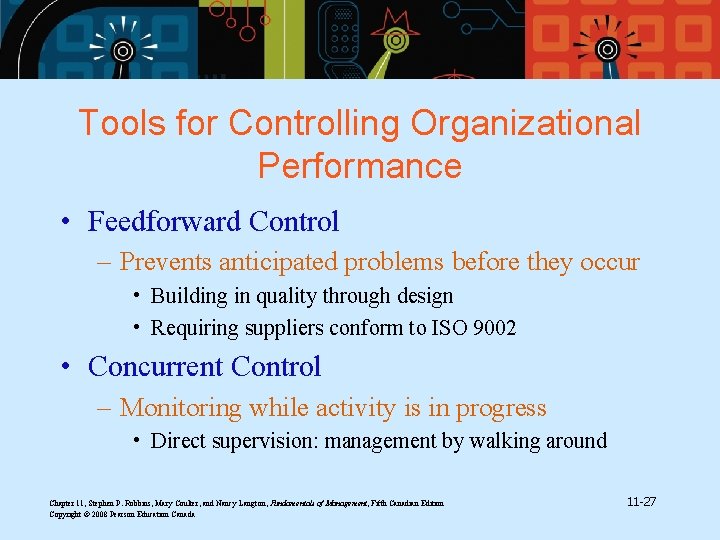
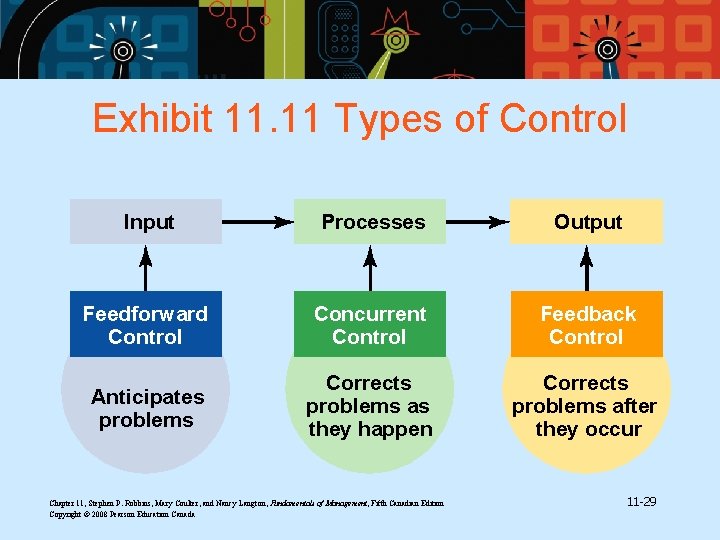
Tools for Controlling Organizational Performance • Feedforward Control – Prevents anticipated problems before they occur • Building in quality through design • Requiring suppliers conform to ISO 9002 • Concurrent Control – Monitoring while activity is in progress • Direct supervision: management by walking around Chapter 11, Stephen P. Robbins, Mary Coulter, and Nancy Langton, Fundamentals of Management, Fifth Canadian Edition Copyright © 2008 Pearson Education Canada 11 -27
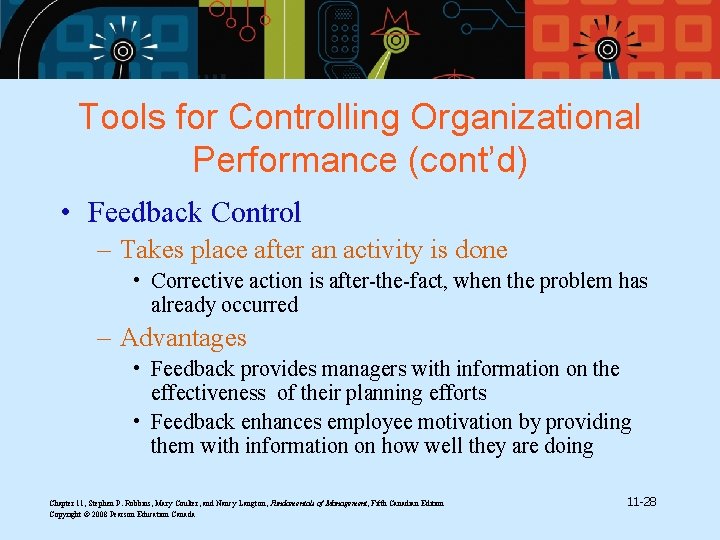
Tools for Controlling Organizational Performance (cont’d) • Feedback Control – Takes place after an activity is done • Corrective action is after-the-fact, when the problem has already occurred – Advantages • Feedback provides managers with information on the effectiveness of their planning efforts • Feedback enhances employee motivation by providing them with information on how well they are doing Chapter 11, Stephen P. Robbins, Mary Coulter, and Nancy Langton, Fundamentals of Management, Fifth Canadian Edition Copyright © 2008 Pearson Education Canada 11 -28
Exhibit 11. 11 Types of Control Input Processes Output Feedforward Control Concurrent Control Feedback Control Anticipates problems Corrects problems as they happen Corrects problems after they occur Chapter 11, Stephen P. Robbins, Mary Coulter, and Nancy Langton, Fundamentals of Management, Fifth Canadian Edition Copyright © 2008 Pearson Education Canada 11 -29
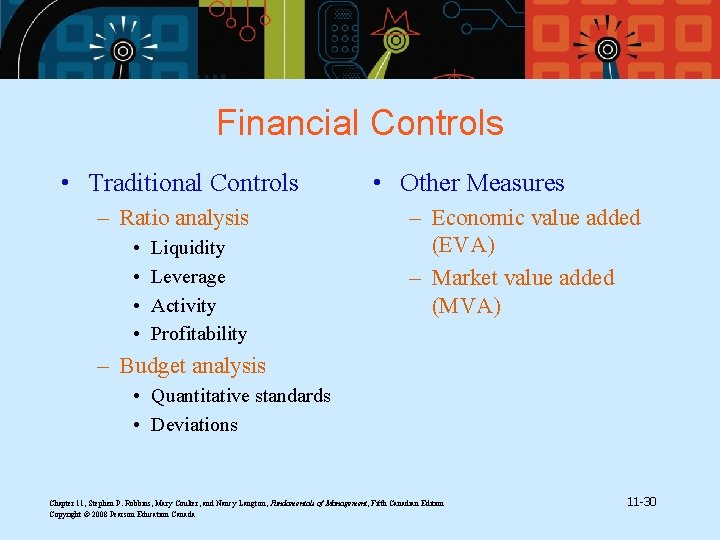
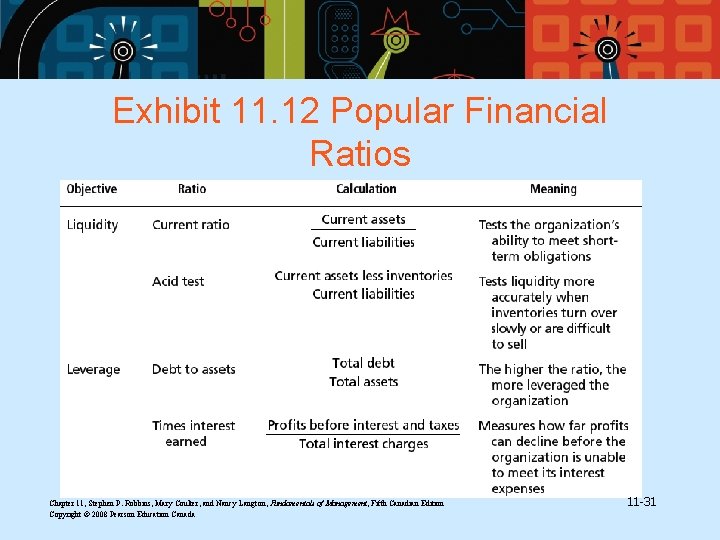
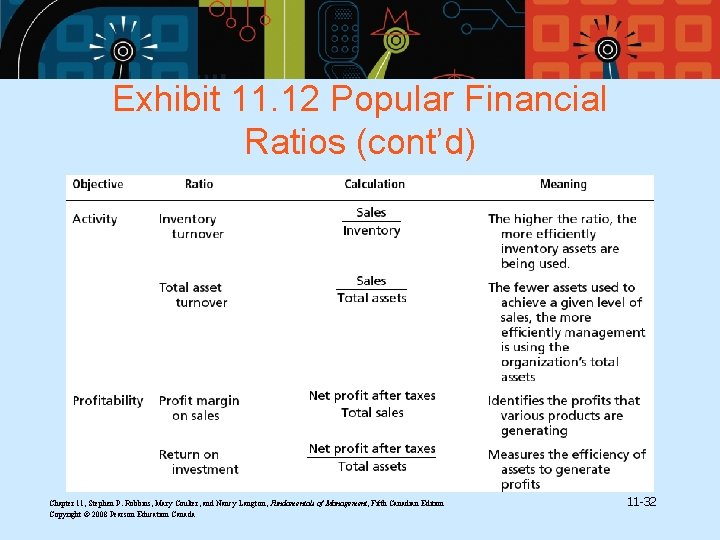
Financial Controls • Traditional Controls – Ratio analysis • • Liquidity Leverage Activity Profitability • Other Measures – Economic value added (EVA) – Market value added (MVA) – Budget analysis • Quantitative standards • Deviations Chapter 11, Stephen P. Robbins, Mary Coulter, and Nancy Langton, Fundamentals of Management, Fifth Canadian Edition Copyright © 2008 Pearson Education Canada 11 -30
Exhibit 11. 12 Popular Financial Ratios Chapter 11, Stephen P. Robbins, Mary Coulter, and Nancy Langton, Fundamentals of Management, Fifth Canadian Edition Copyright © 2008 Pearson Education Canada 11 -31
Exhibit 11. 12 Popular Financial Ratios (cont’d) Chapter 11, Stephen P. Robbins, Mary Coulter, and Nancy Langton, Fundamentals of Management, Fifth Canadian Edition Copyright © 2008 Pearson Education Canada 11 -32
Financial Controls (cont’d) • Other Measures – Economic value added (EVA) • How much value is created by what a company does with its assets, less any capital investments in those assets: the rate of return earned over and above the cost of capital Chapter 11, Stephen P. Robbins, Mary Coulter, and Nancy Langton, Fundamentals of Management, Fifth Canadian Edition Copyright © 2008 Pearson Education Canada 11 -33
Financial Controls (cont’d) • Other Measures (cont’d) – Market value added (MVA) • The value that the stock market places on a firm’s past and expected capital investment projects • If the firm’s market value (its stock and debt) exceeds the value of its invest capital (its equity and retained earnings), then managers have created wealth Chapter 11, Stephen P. Robbins, Mary Coulter, and Nancy Langton, Fundamentals of Management, Fifth Canadian Edition Copyright © 2008 Pearson Education Canada 11 -34
Controlling Organizational Performance • Balanced Scorecard – A measurement tool that uses goals set by managers in four areas to measure a company’s performance: • • Financial Customer Internal processes People/innovation/growth assets Chapter 11, Stephen P. Robbins, Mary Coulter, and Nancy Langton, Fundamentals of Management, Fifth Canadian Edition Copyright © 2008 Pearson Education Canada 11 -35
Information Controls • Management Information Systems (MIS) – A system used to provide management with needed information on a regular basis • Data: an unorganized collection of raw, unanalyzed facts (e. g. , unsorted list of customer names) • Information: data that has been analyzed and organized such that it has value and relevance to managers Chapter 11, Stephen P. Robbins, Mary Coulter, and Nancy Langton, Fundamentals of Management, Fifth Canadian Edition Copyright © 2008 Pearson Education Canada 11 -36
Benchmarking of Best Practices • Benchmarking – The search for the best practices among competitors or noncompetitors that lead to their superior performance – A control tool for identifying and measuring specific performance gaps and areas for improvement Chapter 11, Stephen P. Robbins, Mary Coulter, and Nancy Langton, Fundamentals of Management, Fifth Canadian Edition Copyright © 2008 Pearson Education Canada 11 -37
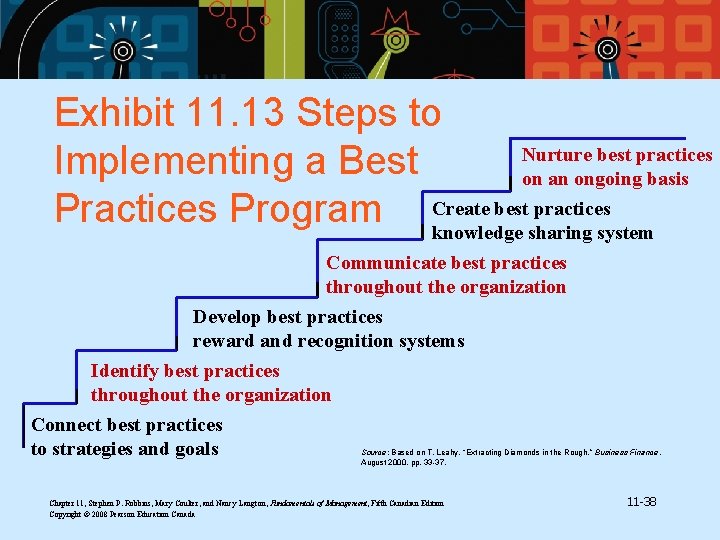
Exhibit 11. 13 Steps to Nurture best practices Implementing a Best on an ongoing basis best practices Program Create knowledge sharing system Communicate best practices throughout the organization Develop best practices reward and recognition systems Identify best practices throughout the organization Connect best practices to strategies and goals Source: Based on T. Leahy, “Extracting Diamonds in the Rough, ” Business Finance, August 2000, pp. 33 -37. Chapter 11, Stephen P. Robbins, Mary Coulter, and Nancy Langton, Fundamentals of Management, Fifth Canadian Edition Copyright © 2008 Pearson Education Canada 11 -38
Current Issues in Control • Cross-cultural Issues – The use of technology to increase direct corporate control of local operations – Legal constraints on corrective actions in foreign countries – Difficulty with the comparability of data collected from operations in different countries Chapter 11, Stephen P. Robbins, Mary Coulter, and Nancy Langton, Fundamentals of Management, Fifth Canadian Edition Copyright © 2008 Pearson Education Canada 11 -39
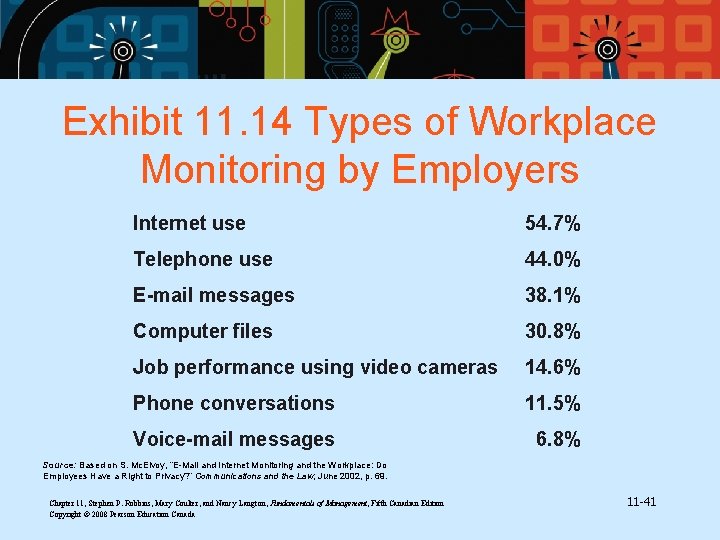
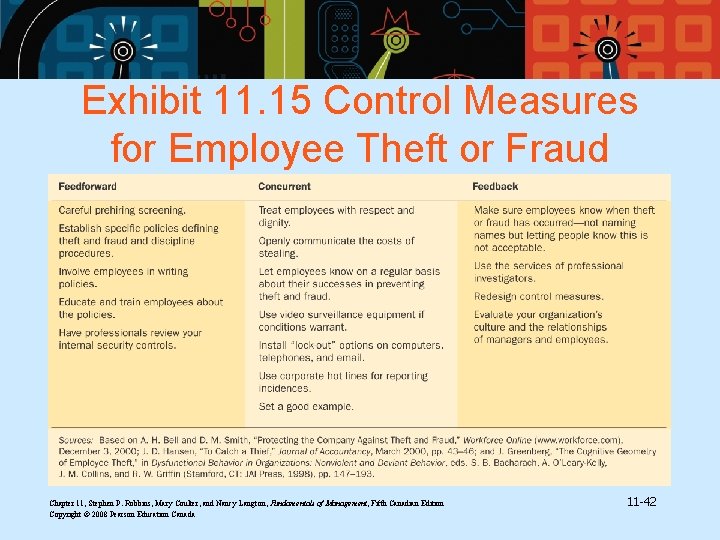
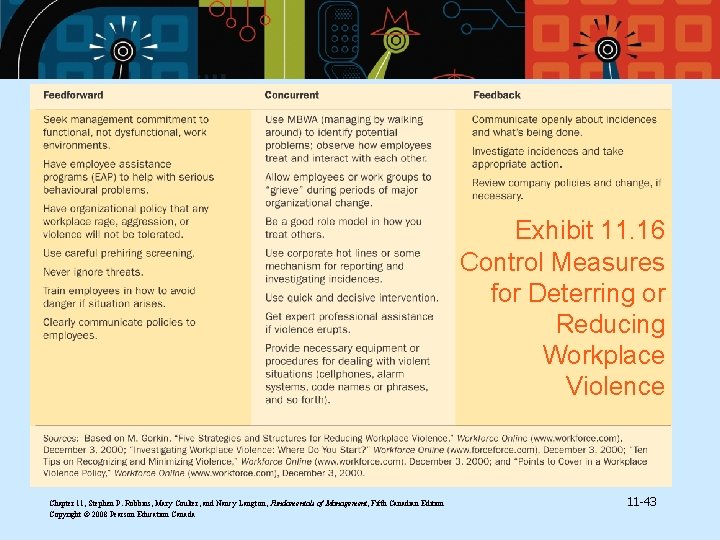
Current Issues in Control (cont’d) • Workplace Concerns – Privacy versus monitoring: • E-mail, telephone, computer, and Internet usage can all be monitored – Employee theft • The unauthorized taking of company property by employees for their personal use – Violence • Anger, rage, and violence in the workplace is affecting employee productivity Chapter 11, Stephen P. Robbins, Mary Coulter, and Nancy Langton, Fundamentals of Management, Fifth Canadian Edition Copyright © 2008 Pearson Education Canada 11 -40
Exhibit 11. 14 Types of Workplace Monitoring by Employers Internet use 54. 7% Telephone use 44. 0% E-mail messages 38. 1% Computer files 30. 8% Job performance using video cameras 14. 6% Phone conversations 11. 5% Voice-mail messages 6. 8% Source: Based on S. Mc. Elvoy, “E-Mail and Internet Monitoring and the Workplace: Do Employees Have a Right to Privacy? ” Communications and the Law, June 2002, p. 69. Chapter 11, Stephen P. Robbins, Mary Coulter, and Nancy Langton, Fundamentals of Management, Fifth Canadian Edition Copyright © 2008 Pearson Education Canada 11 -41
Exhibit 11. 15 Control Measures for Employee Theft or Fraud Chapter 11, Stephen P. Robbins, Mary Coulter, and Nancy Langton, Fundamentals of Management, Fifth Canadian Edition Copyright © 2008 Pearson Education Canada 11 -42
Exhibit 11. 16 Control Measures for Deterring or Reducing Workplace Violence Chapter 11, Stephen P. Robbins, Mary Coulter, and Nancy Langton, Fundamentals of Management, Fifth Canadian Edition Copyright © 2008 Pearson Education Canada 11 -43
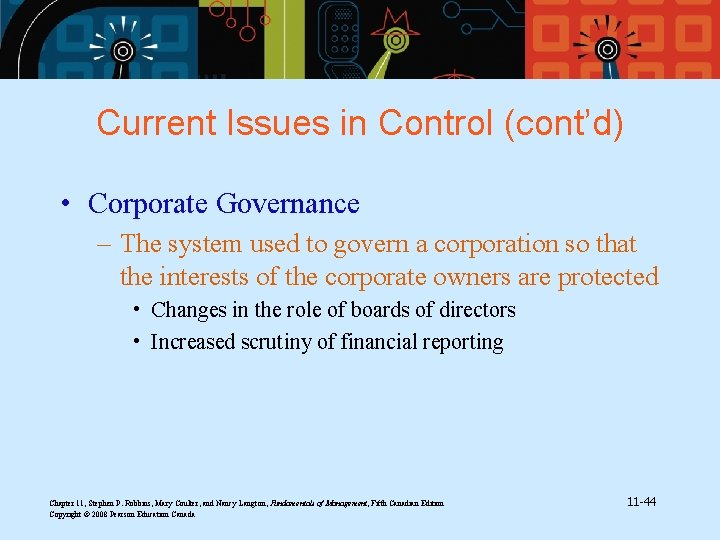
Current Issues in Control (cont’d) • Corporate Governance – The system used to govern a corporation so that the interests of the corporate owners are protected • Changes in the role of boards of directors • Increased scrutiny of financial reporting Chapter 11, Stephen P. Robbins, Mary Coulter, and Nancy Langton, Fundamentals of Management, Fifth Canadian Edition Copyright © 2008 Pearson Education Canada 11 -44