
Chapter 11 Fish and mammals Zebrafish are becoming
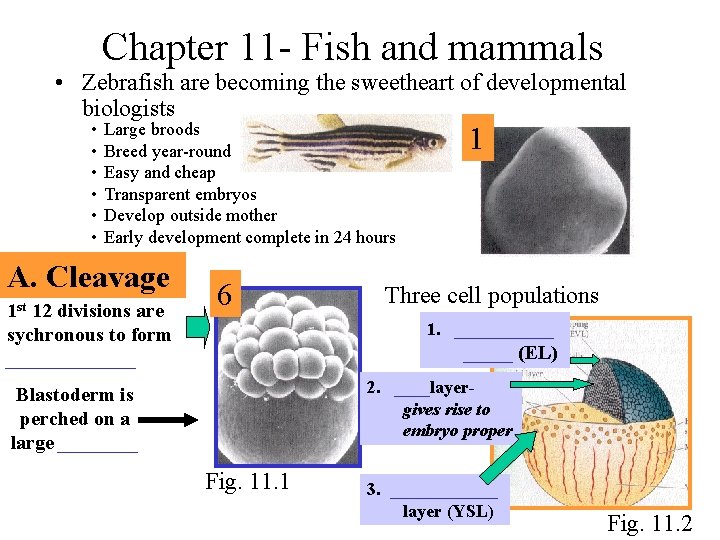
Chapter 11 - Fish and mammals • Zebrafish are becoming the sweetheart of developmental biologists • • • Large broods Breed year-round Easy and cheap Transparent embryos Develop outside mother Early development complete in 24 hours A. Cleavage 1 st 12 divisions are sychronous to form _______ 6 1 Three cell populations 1. _____ (EL) 2. ____layergives rise to embryo proper Blastoderm is perched on a large ____ Fig. 11. 1 3. ______ layer (YSL) Fig. 11. 2
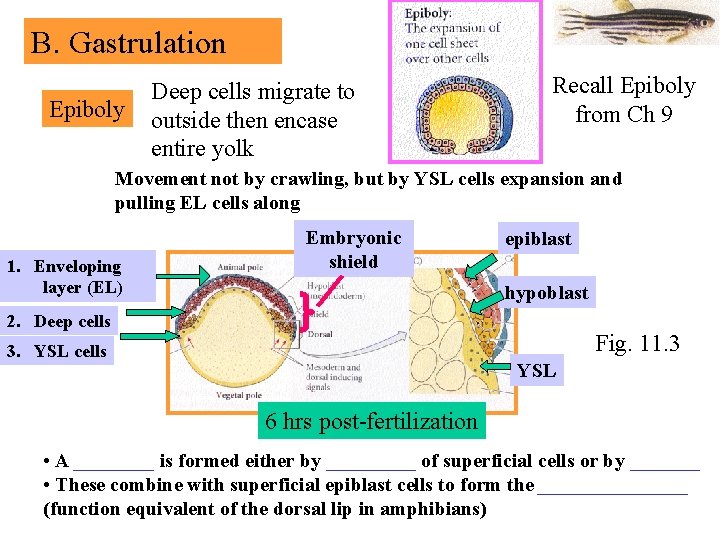
B. Gastrulation Epiboly Deep cells migrate to outside then encase entire yolk Recall Epiboly from Ch 9 Movement not by crawling, but by YSL cells expansion and pulling EL cells along 1. Enveloping layer (EL) Embryonic shield epiblast hypoblast 2. Deep cells Fig. 11. 3 3. YSL cells YSL 6 hrs post-fertilization • A ____ is formed either by _____ of superficial cells or by _______ • These combine with superficial epiblast cells to form the ________ (function equivalent of the dorsal lip in amphibians)
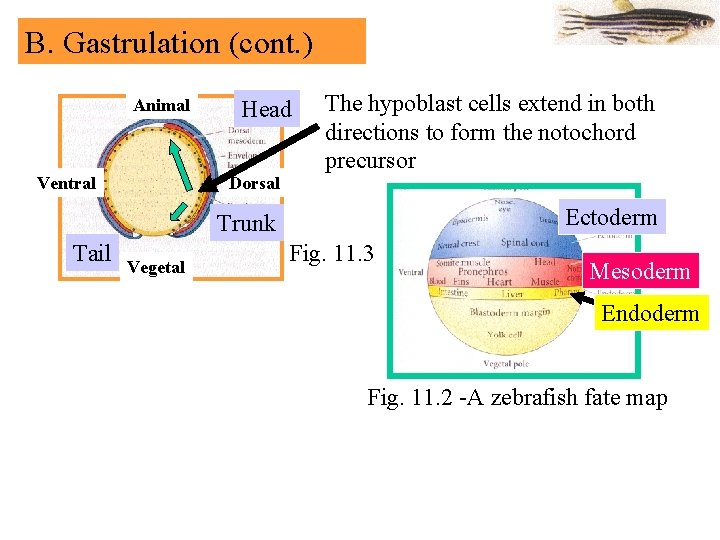
B. Gastrulation (cont. ) Animal Ventral Head Dorsal The hypoblast cells extend in both directions to form the notochord precursor Ectoderm Trunk Tail Vegetal Fig. 11. 3 Mesoderm Endoderm Fig. 11. 2 -A zebrafish fate map
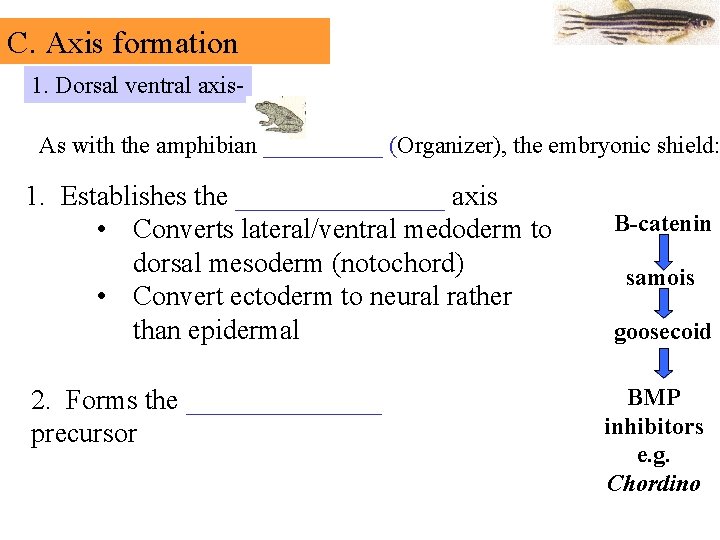
C. Axis formation 1. Dorsal ventral axis- As with the amphibian _____ (Organizer), the embryonic shield: 1. Establishes the ________ axis • Converts lateral/ventral medoderm to dorsal mesoderm (notochord) • Convert ectoderm to neural rather than epidermal 2. Forms the _______ precursor B-catenin samois goosecoid BMP inhibitors e. g. Chordino
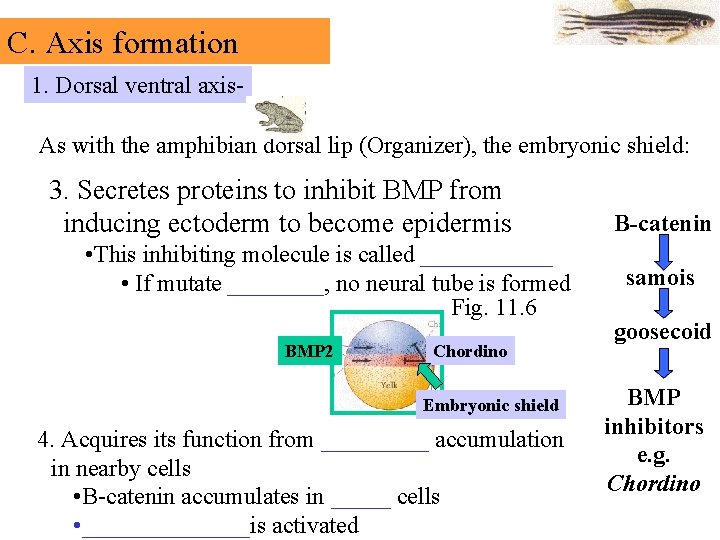
C. Axis formation 1. Dorsal ventral axis. As with the amphibian dorsal lip (Organizer), the embryonic shield: 3. Secretes proteins to inhibit BMP from inducing ectoderm to become epidermis • This inhibiting molecule is called ______ • If mutate ____, no neural tube is formed Fig. 11. 6 BMP 2 Chordino Embryonic shield 4. Acquires its function from _____ accumulation in nearby cells • B-catenin accumulates in _____ cells • _______is activated B-catenin samois goosecoid BMP inhibitors e. g. Chordino
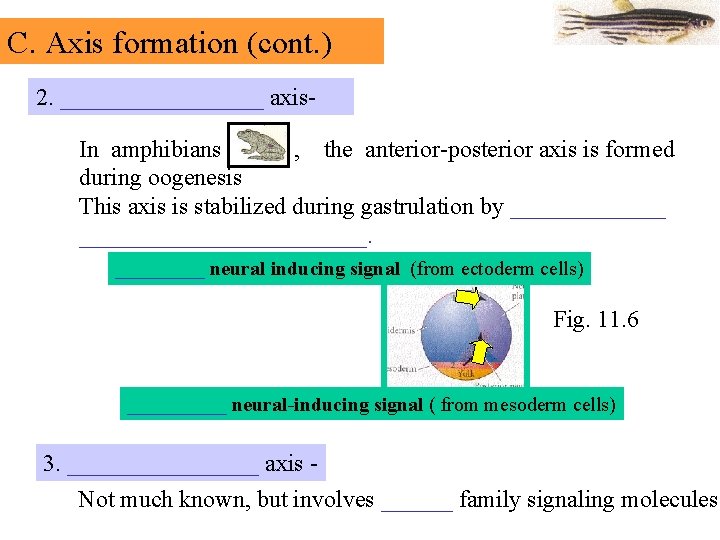
C. Axis formation (cont. ) 2. _________ axis. In amphibians , the anterior-posterior axis is formed during oogenesis This axis is stabilized during gastrulation by ___________________ neural inducing signal (from ectoderm cells) Fig. 11. 6 _____ neural-inducing signal ( from mesoderm cells) 3. ________ axis Not much known, but involves ______ family signaling molecules
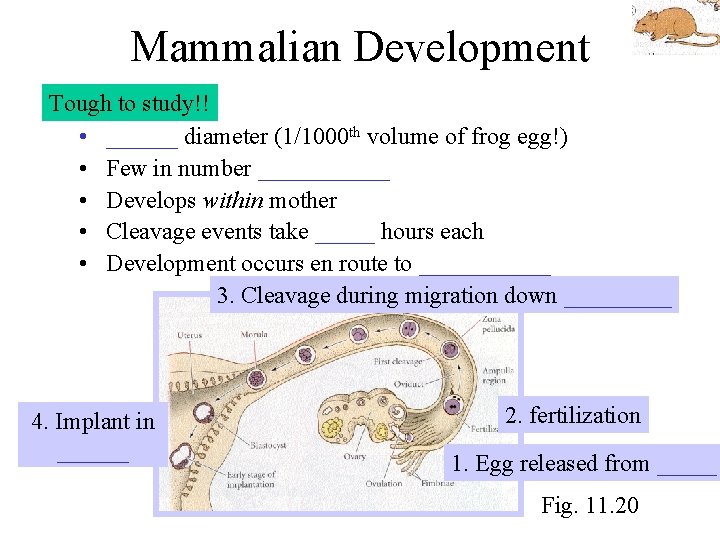
Mammalian Development Tough to study!! • ______ diameter (1/1000 th volume of frog egg!) • Few in number ______ • Develops within mother • Cleavage events take _____ hours each • Development occurs en route to ______ 3. Cleavage during migration down _____ 4. Implant in ______ 2. fertilization 1. Egg released from _____ Fig. 11. 20
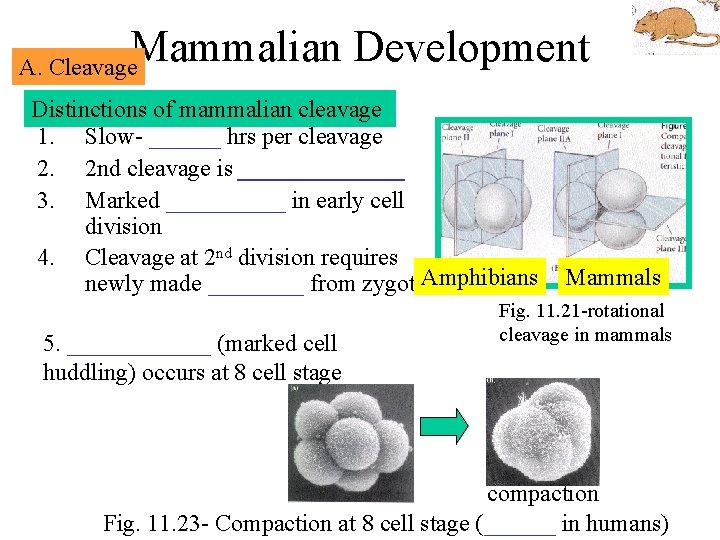
Mammalian Development A. Cleavage Distinctions of mammalian cleavage 1. Slow- ______ hrs per cleavage 2. 2 nd cleavage is _______ 3. Marked _____ in early cell division 4. Cleavage at 2 nd division requires newly made ____ from zygote. Amphibians 5. ______ (marked cell huddling) occurs at 8 cell stage Mammals Fig. 11. 21 -rotational cleavage in mammals compaction Fig. 11. 23 - Compaction at 8 cell stage (______ in humans)
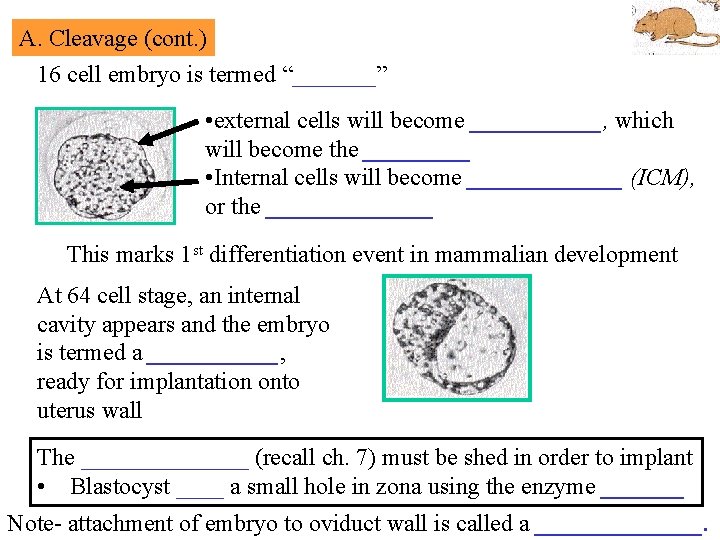
A. Cleavage (cont. ) 16 cell embryo is termed “_______” • external cells will become ______, which will become the _____ • Internal cells will become _______ (ICM), or the _______ This marks 1 st differentiation event in mammalian development At 64 cell stage, an internal cavity appears and the embryo is termed a ______, ready for implantation onto uterus wall The _______ (recall ch. 7) must be shed in order to implant • Blastocyst ____ a small hole in zona using the enzyme _______ Note- attachment of embryo to oviduct wall is called a _______.
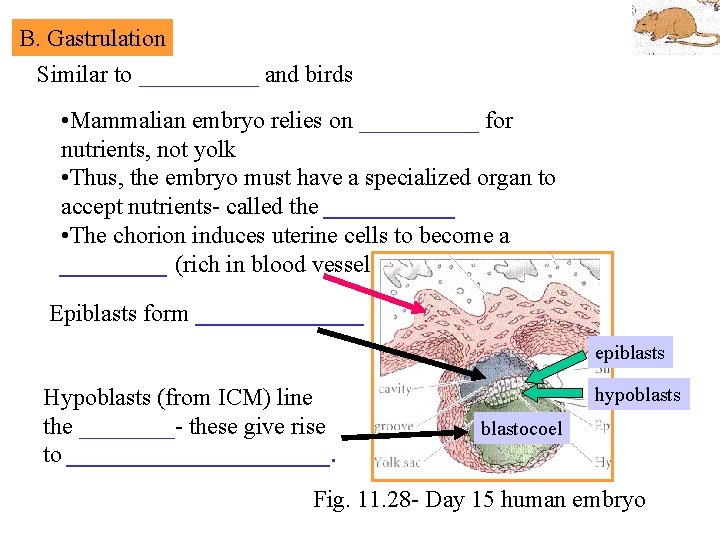
B. Gastrulation Similar to _____ and birds • Mammalian embryo relies on _____ for nutrients, not yolk • Thus, the embryo must have a specialized organ to accept nutrients- called the ______ • The chorion induces uterine cells to become a _____ (rich in blood vessels) Epiblasts form _______ epiblasts Hypoblasts (from ICM) line the ____- these give rise to ___________. hypoblasts blastocoel Fig. 11. 28 - Day 15 human embryo
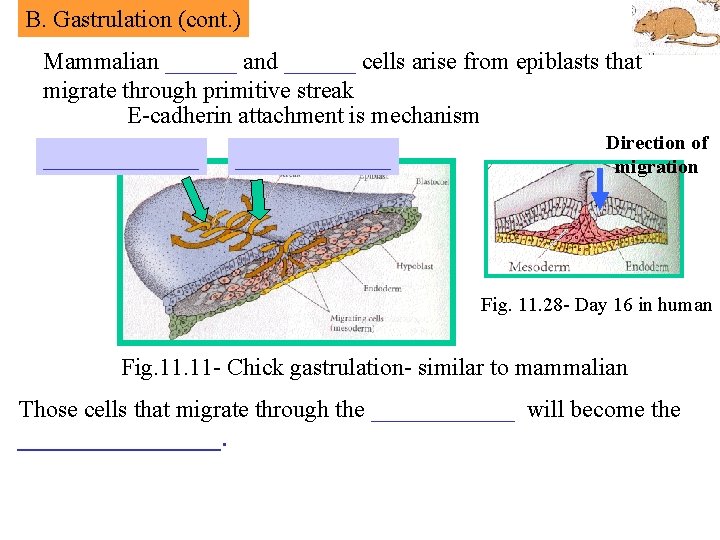
B. Gastrulation (cont. ) Mammalian ______ and ______ cells arise from epiblasts that migrate through primitive streak E-cadherin attachment is mechanism _____________ Direction of migration Fig. 11. 28 - Day 16 in human Fig. 11 - Chick gastrulation- similar to mammalian Those cells that migrate through the ______ will become the _________.
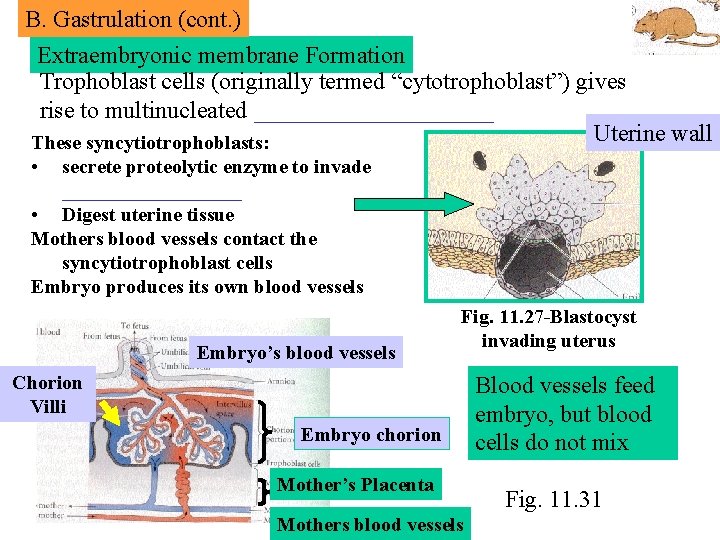
B. Gastrulation (cont. ) Extraembryonic membrane Formation Trophoblast cells (originally termed “cytotrophoblast”) gives rise to multinucleated __________ Uterine wall These syncytiotrophoblasts: • secrete proteolytic enzyme to invade _________ • Digest uterine tissue Mothers blood vessels contact the syncytiotrophoblast cells Embryo produces its own blood vessels Embryo’s blood vessels Fig. 11. 27 -Blastocyst invading uterus Chorion Villi Embryo chorion Mother’s Placenta Mothers blood vessels Blood vessels feed embryo, but blood cells do not mix Fig. 11. 31
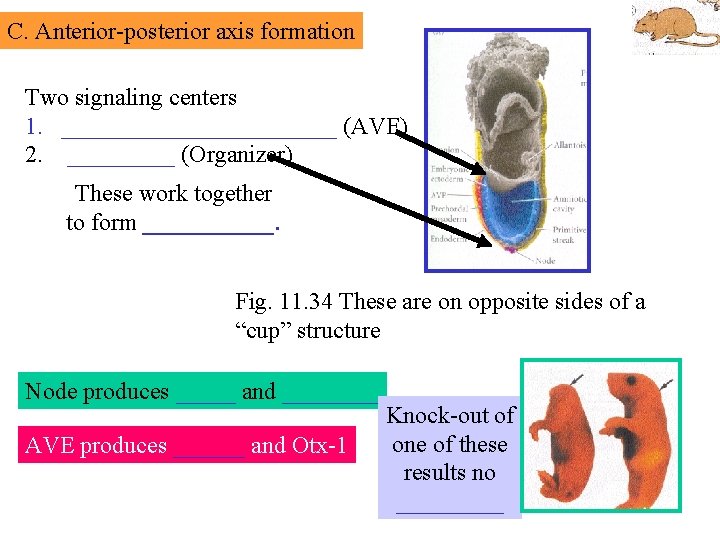
C. Anterior-posterior axis formation Two signaling centers 1. ____________ (AVE) 2. _____ (Organizer) These work together to form ______. Fig. 11. 34 These are on opposite sides of a “cup” structure Node produces _____ and ____ AVE produces ______ and Otx-1 Knock-out of one of these results no _____
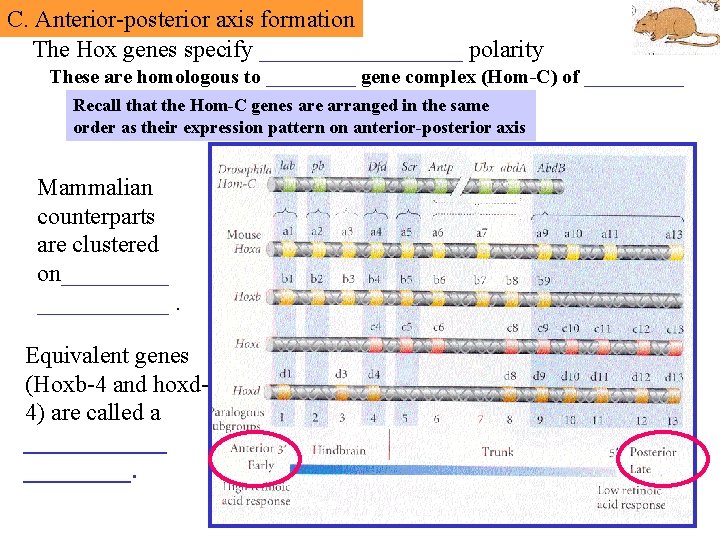
C. Anterior-posterior axis formation The Hox genes specify _________ polarity These are homologous to _____ gene complex (Hom-C) of _____ Recall that the Hom-C genes are arranged in the same order as their expression pattern on anterior-posterior axis Mammalian counterparts are clustered on______. Equivalent genes (Hoxb-4 and hoxd 4) are called a ______.
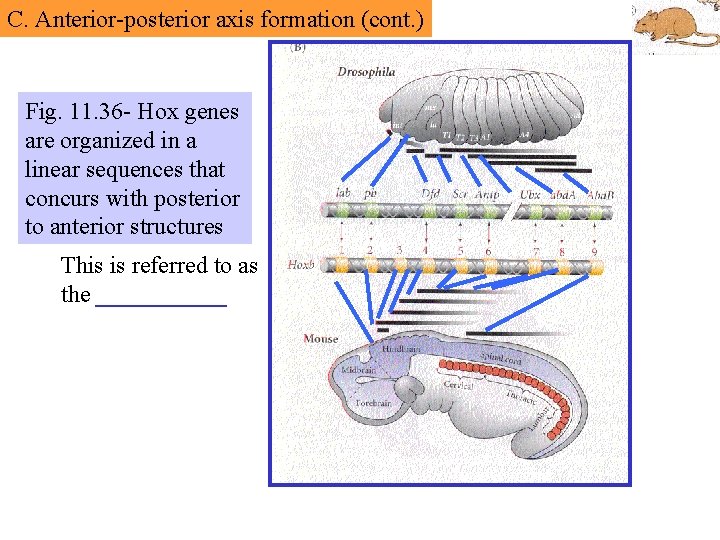
C. Anterior-posterior axis formation (cont. ) Fig. 11. 36 - Hox genes are organized in a linear sequences that concurs with posterior to anterior structures This is referred to as the ______
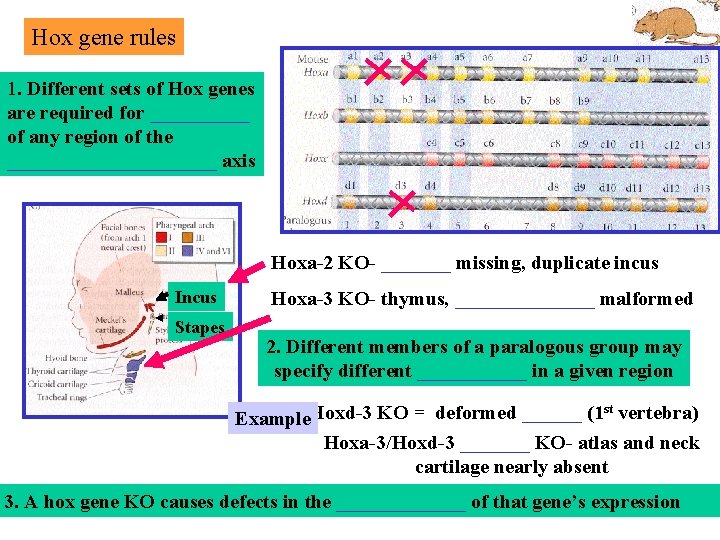
Hox gene rules 1. Different sets of Hox genes are required for _____ of any region of the ___________ axis Hoxa-2 KO- _______ missing, duplicate incus Incus Stapes Hoxa-3 KO- thymus, _______ malformed 2. Different members of a paralogous group may specify different ______ in a given region st Example. Hoxd-3 KO = deformed ______ (1 vertebra) Hoxa-3/Hoxd-3 _______ KO- atlas and neck cartilage nearly absent 3. A hox gene KO causes defects in the _______ of that gene’s expression
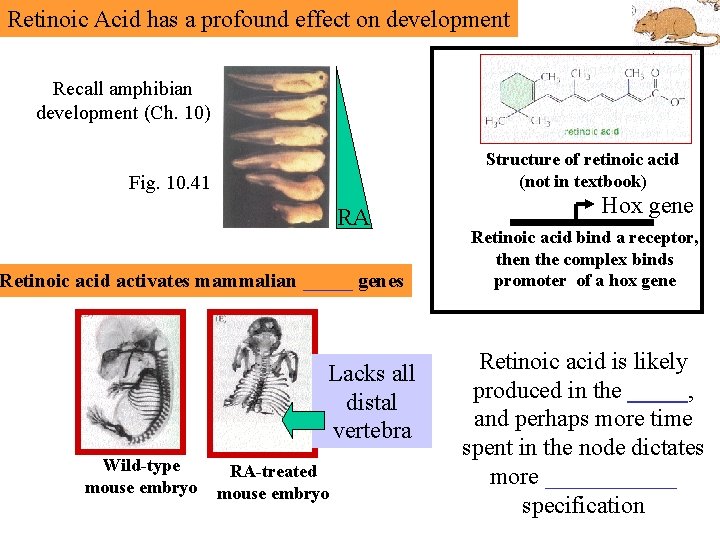
Retinoic Acid has a profound effect on development Recall amphibian development (Ch. 10) Structure of retinoic acid (not in textbook) Fig. 10. 41 RA Retinoic acid activates mammalian _____ genes Lacks all distal vertebra Wild-type mouse embryo RA-treated mouse embryo Hox gene Retinoic acid bind a receptor, then the complex binds promoter of a hox gene Retinoic acid is likely produced in the _____, and perhaps more time spent in the node dictates more ______ specification
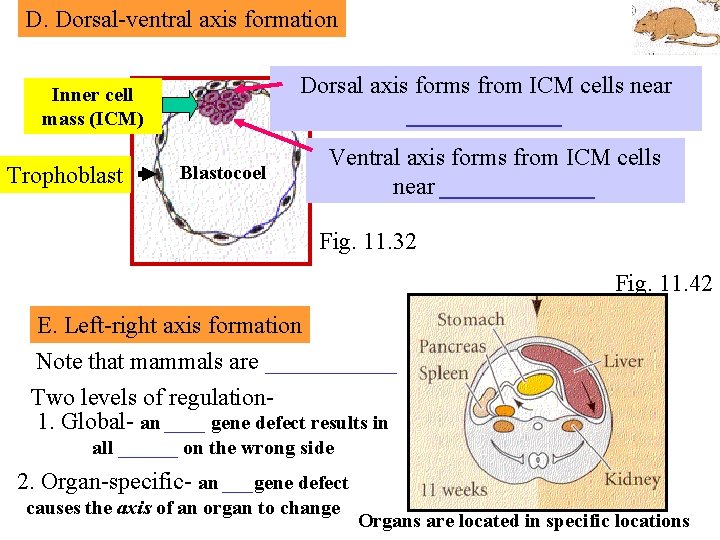
D. Dorsal-ventral axis formation Dorsal axis forms from ICM cells near _______ Inner cell mass (ICM) Trophoblast Blastocoel Ventral axis forms from ICM cells near _______ Fig. 11. 32 Fig. 11. 42 E. Left-right axis formation Note that mammals are ______ Two levels of regulation 1. Global- an ____ gene defect results in all ______ on the wrong side 2. Organ-specific- an ___gene defect causes the axis of an organ to change Organs are located in specific locations
- Slides: 18