
Chapter 11 Exterior Design Factors Introduction House design
- Slides: 21
Chapter 11 Exterior Design Factors
Introduction • House design does not stop once room arrangements are determined – Exterior must also be considered – Often a client has a certain style in mind that dictates layout of floor plan
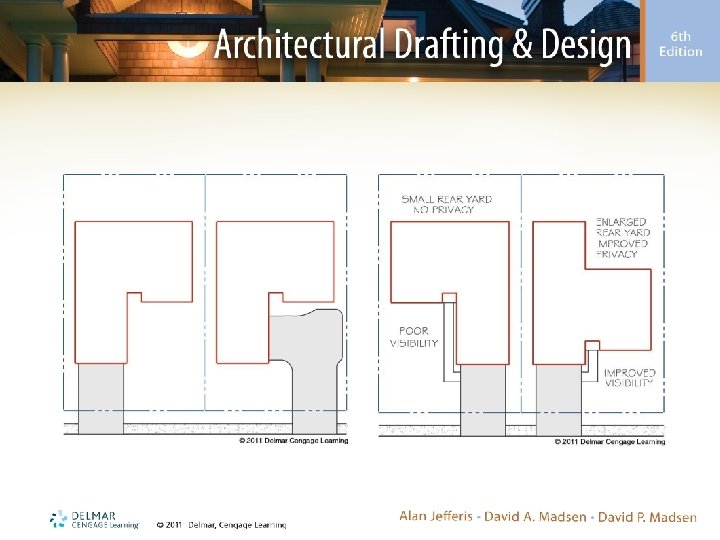
Site Considerations • Site factors affect house design – Neighborhood • High value houses in a neighborhood with lower value houses will have poor resale value – Review boards • Keep values of neighborhood uniform – Access • The narrower the lot, the more access will affect the location of the entry and garage
Elements of Design • Line – Provides a sense of direction or movement in the design of a structure and helps relate it to the site and natural surroundings • May be curved, horizontal, vertical, or diagonal • Can accent or disguise features
Elements of Design (cont’d. ) • Form – Lines are used to produce forms or shapes • Rectangles, squares, circles, ovals, and ellipses are the most common shapes found in structures • Typically three-dimensional • Proportions between them are important – Form of a structure should be dictated by its function
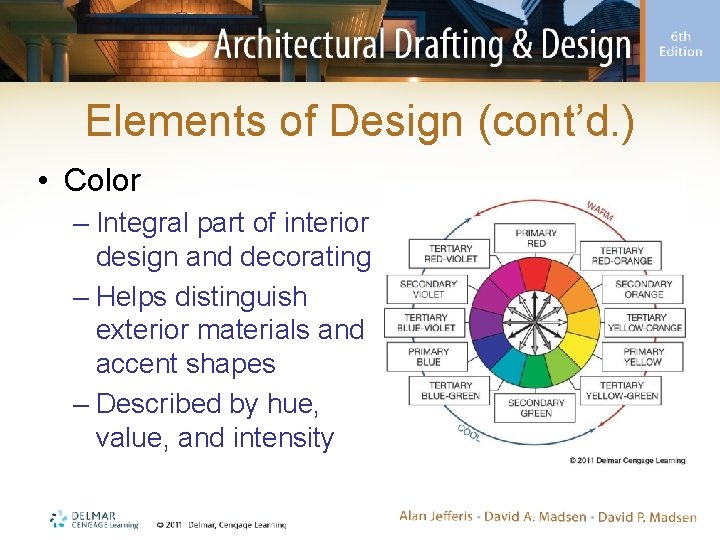
Elements of Design (cont’d. ) • Color – Integral part of interior design and decorating – Helps distinguish exterior materials and accent shapes – Described by hue, value, and intensity
Elements of Design (cont’d. ) • Texture – Roughness or smoothness of an object – Important in selecting materials • Rough surfaces give feelings of strength, security, and an illusion of reduced height • Smooth surfaces create a sense of luxury, gives an illusion of increased height, reflects more light and makes colors seem brighter
Principles of Design • Rhythm – Leads the eye through the design from one place to another in an orderly fashion – Can be created by a gradual change in materials, shape, and color • Gradation in materials could be from rough to smooth • Gradation in shape from large to small • Gradation in color from dark to light
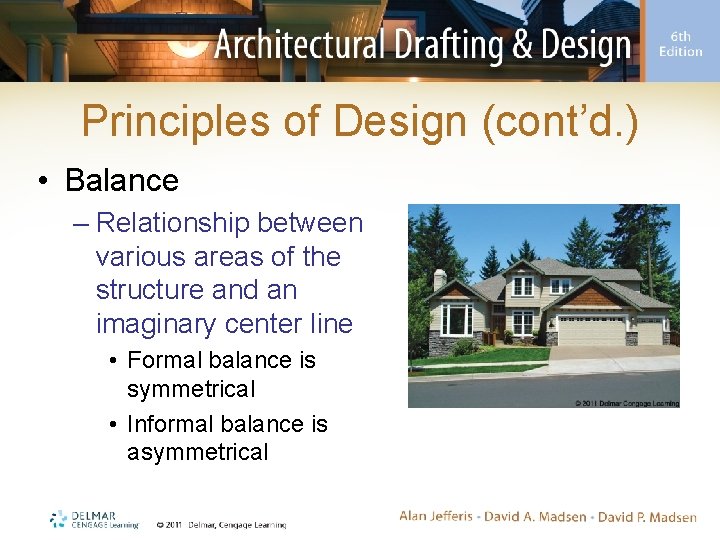
Principles of Design (cont’d. ) • Balance – Relationship between various areas of the structure and an imaginary center line • Formal balance is symmetrical • Informal balance is asymmetrical
Principles of Design (cont’d. ) • Proportion – Related to size and balance – Rectangles using the proportions 2: 3, 3: 5, and 5: 8 are generally considered very pleasing • Unity – Relates to rhythm, balance, and proportion – Ties a structure together with a common design or decorating pattern
Floor Plan Styles • Single level – Most common style – Provides stair-free access to all rooms – Easy to maintain • Split level – Combines features of a one- and two-story – Best suited to sloping sites – May be split from side to side or front to back
Floor Plan Styles (cont’d. ) • Daylight basement – One-story over a basement or garage, or two complete living levels – Well suited for a sloping lot • Two-story – Many options for those who don’t mind stairs – Provides maximum building area at a lower cost per square foot than other styles
Floor Plan Styles (cont’d. ) • Dormer – Allows an upper level usually half of square footage of lower floor – Best suited to an exterior style that incorporates a steep roof • Multilevel – Possibilities for floor levels are endless – Site topography and living habits dictate style
Exterior Styles • Colonial – Second-floor living area same size as first-floor – Colonial influences: • • Georgian Saltbox Garrison Cape Cod Federal Greek revival Southern colonial
Exterior Styles (cont’d. ) • English – Fashioned after houses built in England prior to early 1800 s • English Tudor • English cottage • Dutch – Major difference was a broad two-level roof with flared eaves slightly rounded into barn-like gambrel shapes
Exterior Styles (cont’d. ) • French colonial – French Provincial – French Normandy – French plantation – French mansard – Second Empire • Spanish – One story constructed of adobe or plaster
Exterior Styles (cont’d. ) • Italian – Italianate – Italian villa • Victorian – Gothic – Second Empire – Folk – Queen Anne
Exterior Styles (cont’d. ) • American Foursquare – Simplicity • Farmhouse – Two-story construction surrounded by a covered, wraparound porch • Prairie – Low horizontal lines, one-story projections, lowpitched hipped roofs, and large overhanging eaves
Exterior Styles (cont’d. ) • Bungalow – Open, balanced but asymmetrical floor plans • Craftsman – Asymmetrical, free-flowing, two-story layouts • Ranch – One-story, rambling layout • Contemporary – Does not denote any special style of house
Exterior Styles (cont’d. ) • Trends: – Open, informal spaces – Fewer hallways and bonus rooms – Spacious laundry rooms and ample storage – Accessibility – Spacious garages – Sliding partitions – Outdoor living