
Chapter 11 Elements and Chemical Bonds Lesson 1
Chapter 11: Elements and Chemical Bonds
Lesson 1: Electrons & Energy Levels Vocab words: chemical bond, valence electron, electron dot diagram
What are Chemical Bonds? Pure elements are rare. Atoms of different elements chemically combine and form compounds. __________ make up most of the matter around you. Chemical bonds hold them together. A is a force that holds two or more atoms together.
Electrons and Energy The areas around which the electrons move around the nucleus are called ___________. If an electron has the least amount of energy, where are they located? � ______ to the nucleus or the lowest energy level If an electron has the greatest amount of energy, where are they located? � _______ away or the highest energy level
Electrons and Bonding The electrons closest to the nucleus of the same atom have a ________to that nucleus. The electrons farther away nucleus are ____ attracted to it. These outermost electrons can easily be attracted to the nucleus of other atoms. This attraction between the ______ of an atom and the _______ of another is what causes
Valence Electrons A is an outermost electron of an atom that participates in chemical bonding. � These electrons are the ______ electrons involved in chemical bonding. Lewis dot diagram can help you predict how an atom will bond with other atoms. The ___________ is often the number of bonds an atom can form.
Stable and Unstable Atoms with one to seven valence electrons are chemically _______. �Atoms with unpaired dots are _____. �They form bonds with other atoms. �They become more stable by forming bonds. �When an atom forms a bond, it gains, loses, or shares _________ with other atoms.
Lesson 3: Ionic and Metallic Bonds Vocab words: ion, ionic bond, metallic bond
Understanding Ions When an _______and _____bond, they do not share electrons. � Instead one or more valence electrons ______ from the metal atom to the nonmetal atom. � The atoms then bond and form a chemically stable compound. When an atom loses or gains a valence electron, it becomes an. � An ion is an atom that is no ___________ because it has lost or gained valence electrons.
Losing Valence Electrons Metal atoms, such as sodium, become more stable when they lose valence electrons and form a chemical bond with a nonmetal. How many electrons would sodium have if it lost an electron? _____ : the electrons in the ____________level are now the new valence electrons. Sodium now has ____ in its outer shell and is chemically _____like neon
Gaining Valence Electrons �Nonmetal atoms tends to _______ valence electrons from metal atoms. �Atoms with _____ VE gain (nonmetals) to become stable. �Atoms with _____ VE lose (metals). They are left with a filled energy level.
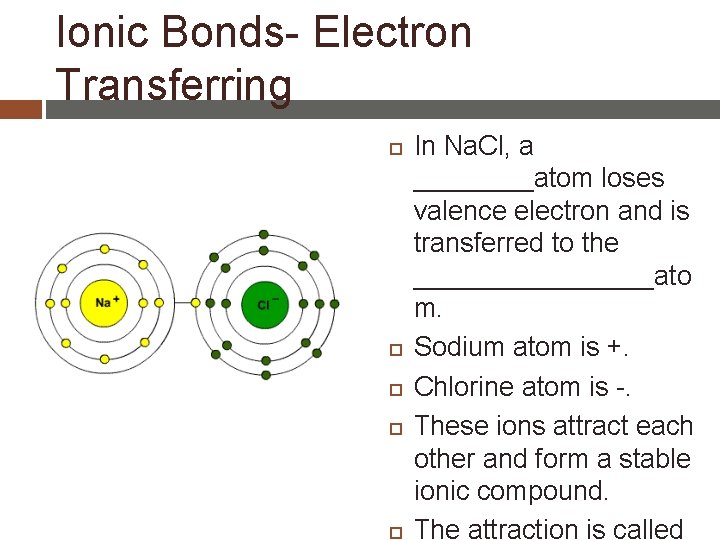
Ionic Bonds- Electron Transferring In Na. Cl, a ____atom loses valence electron and is transferred to the ________ato m. Sodium atom is +. Chlorine atom is -. These ions attract each other and form a stable ionic compound. The attraction is called
Polyatomic Ions made of more than 1 atom. They act as a single atom. Ex: SO 42 - ______ NAMING IONIC COMPOUNDS � Positive ion (_______ ) comes first followed by the negative ion (_____). � If the negative ion is an element- ______ending Mg. O: ________
Ionic Compound Ionic compounds characteristics: � usually _______and _____at room temperature � High melting and boiling points � Many dissolve in water Therefore, water that contains a dissolved ionic compound is a good _______of electricity. An electrical charge can pass _______________.
Let’s Compare! Covalent Compounds _____electron s Between two or more ________ Form molecules Create covalent compounds (water) full of molecules Ionic Compounds _________ __electrons Between a nonmetal and _______ Form ions not molecules Create ionic compounds full of oppositely charged ions held together by
Lesson 2: Compounds, Chemical Formulas, and Covalent Bonds Vocab words: covalent bonds, molecule, polar molecule, chemical formula
Covalent Bonds- Electron Sharing Atoms can become stable by sharing electrons. _______ bond together by the sharing. A is a chemical bond formed when two atoms share one or more pairs of valence electrons. The atoms then form a stable covalent compound.
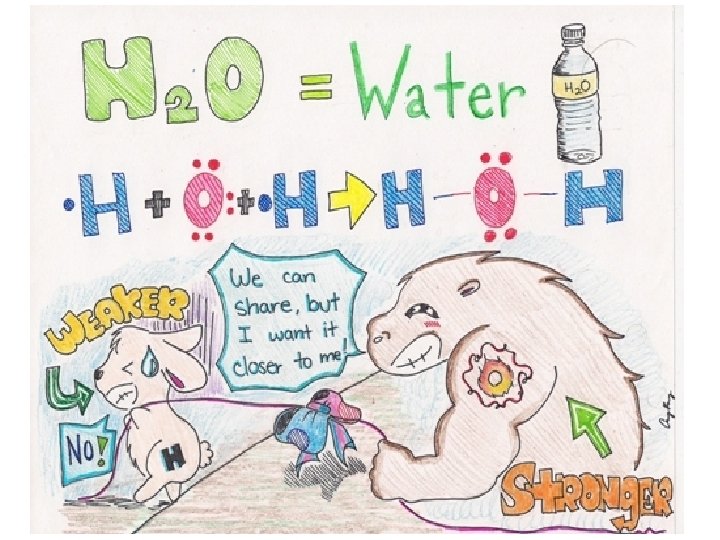
Hydrogen and Oxygen Hydrogen and oxygen � Hydrogen has one valence electron � Oxygen has six valence electron Atoms are stable with ____: this is considered a noble gas arrangement. This is also called the _________ To become stable, oxygen atom forms ______ bonds and hydrogen atom forms ______ bond (only two valence electrons)
Stable An oxygen atom and each hydrogen atom ____ the electrons, and form two ______bonds to become stable covalent compound. � Each bond contains _______ : one from the H atom and one from the O atom � The valence electrons count for ________ in the bond. � Hydrogen has ______and oxygen has _____since it bonds with two hydrogen atoms.

Double and Triple Covalent Bonds _____covalent- 2 atoms share _____ pair of valence electrons. � Carbon dioxide ____covalent- 2 atoms share _____pairs of valence electrons. _____covalent- 2 atoms share ______pairs of valence electrons.
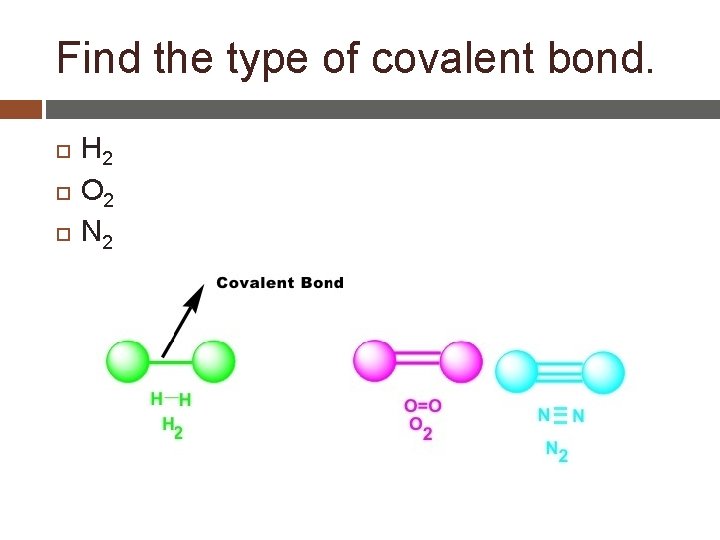
Find the type of covalent bond. H 2 O 2 N 2
Molecules and Properties A is a group of atoms held together by covalent bonding that acts as an independent unit. � Table sugar (C 12 H 22 O 11) is a covalent compound. � Weaker bonds than Ionic � Low melting and boiling points � Poor conductors of electricity
Water and Other Polar Molecules In a covalent bond, one atom can attract the shared electrons more _____ than the other atom can. �In a water molecule, the ______atom attracts the shared electrons more strongly than the hydrogen atom does. �Shared electrons are pulled _____ to the oxygen atom �Oxygen atom has a partial ____charge �Hydrogen atom has a partial _______charge
Continued… A molecule that has a partial positive end a partial negative end because of unequal sharing of electrons is a. Soap is _______ on one end and _______on the other. Soap attracts the polar end of ______and the nonpolar end of ______.
Nonpolar Molecules H 2 is a nonpolar molecule Two hydrogen atoms are _______, their attraction for the shared electrons is _____ A nonpolar compound ___________ in a polar compound, but will in other nonpolar compounds. _____(nonpolar) will not dissolve in water (polar)
Chemical Formulas A is a group of chemical symbols and numbers that represent the elements and the number of atoms of each element that make up a compound. � Lists the elements in a compound � A subscript shows the number of atoms of each element
- Slides: 27