
Chapter 11 DQ 35 CAAT Presented by Diana
Chapter 11 DQ 35 CAAT Presented by: Diana Tai Ivan Chen Ronnie Lee Wilson Wong
Background Client: • Wholesale cosmetics distributor with an inventory of thousands of individual items • Keep inventory in its own distribution centre and 2 public warehouses • Inventory computer file is maintained on a computer disk
Background Auditor: • A computer cartridge of the data on the inventory file on the date of the physical count • A general-purpose computer software package
Scope of Audit Work Audit Procedure: • Planning/Compliance test/Substantive testing/Reporting Assumption: • Planning and Compliance test have performed and obtain satisfactory result • Focus will be on substantive testing on balance and transaction only
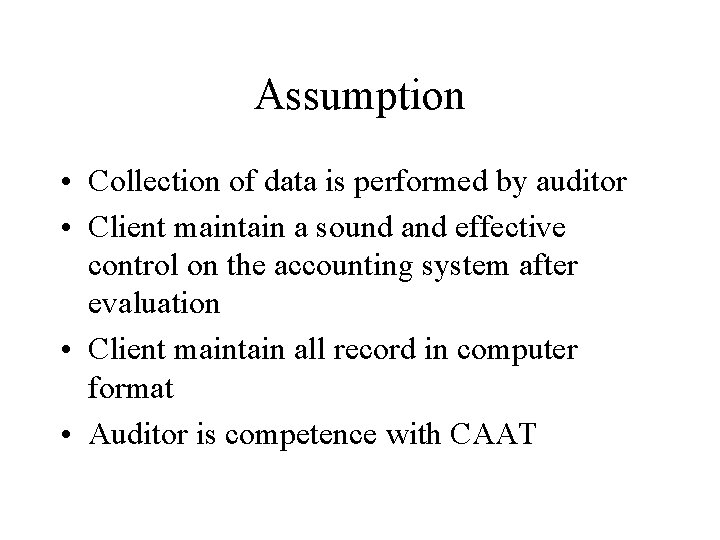
Assumption • Collection of data is performed by auditor • Client maintain a sound and effective control on the accounting system after evaluation • Client maintain all record in computer format • Auditor is competence with CAAT
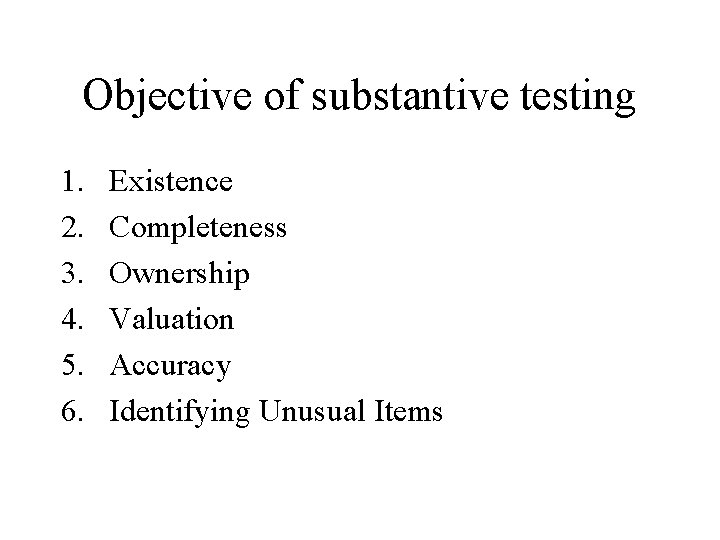
Objective of substantive testing 1. 2. 3. 4. 5. 6. Existence Completeness Ownership Valuation Accuracy Identifying Unusual Items
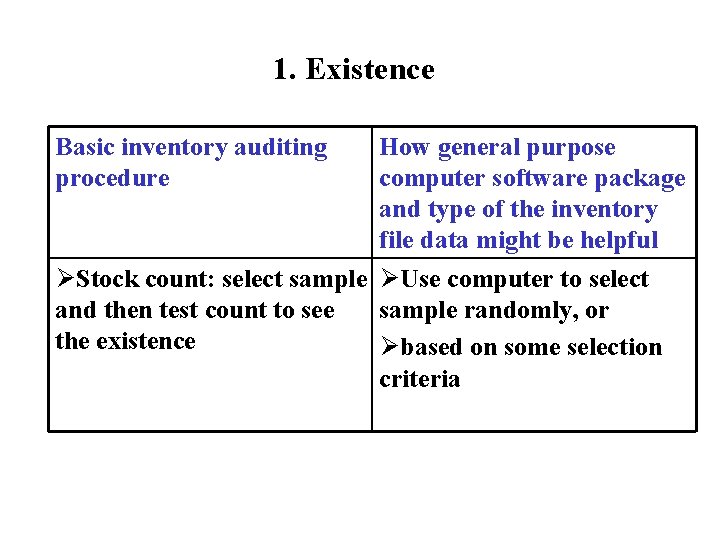
1. Existence Basic inventory auditing procedure How general purpose computer software package and type of the inventory file data might be helpful ØStock count: select sample ØUse computer to select and then test count to see sample randomly, or the existence Øbased on some selection criteria
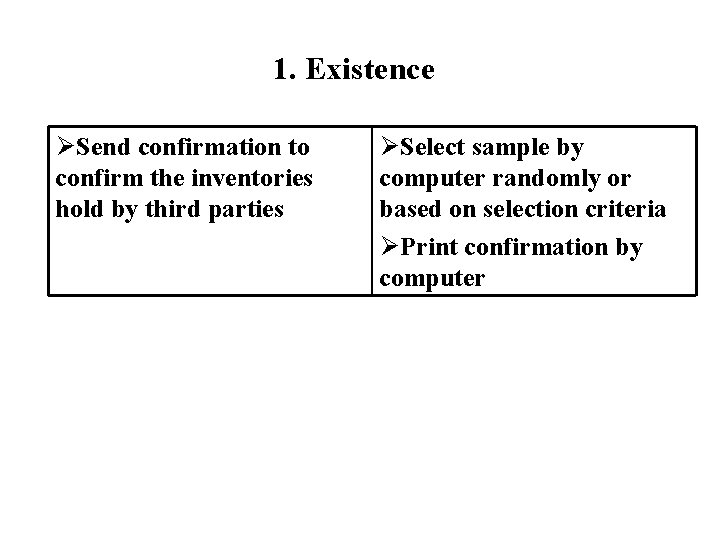
1. Existence ØSend confirmation to confirm the inventories hold by third parties ØSelect sample by computer randomly or based on selection criteria ØPrint confirmation by computer
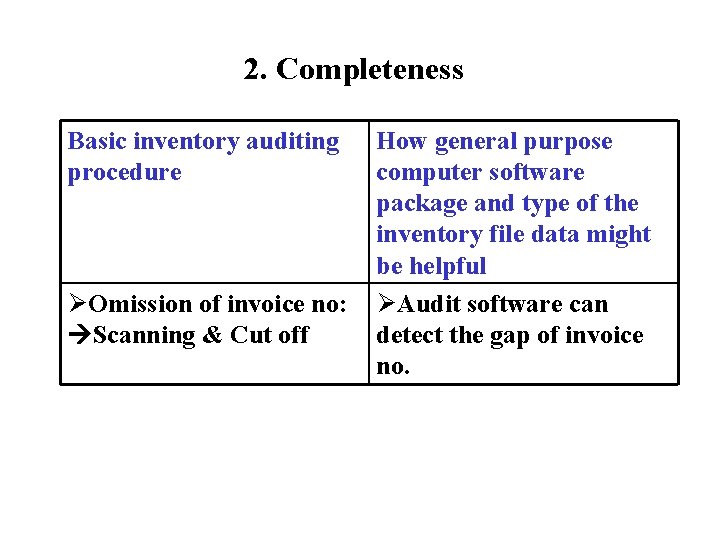
2. Completeness Basic inventory auditing procedure ØOmission of invoice no: Scanning & Cut off How general purpose computer software package and type of the inventory file data might be helpful ØAudit software can detect the gap of invoice no.
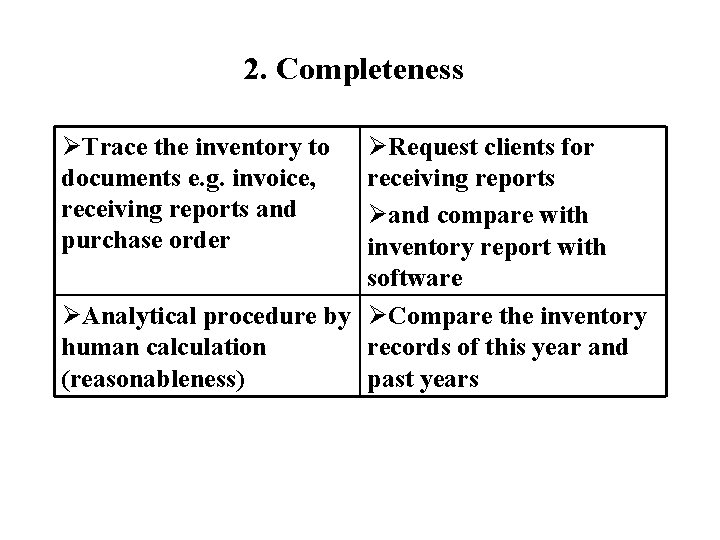
2. Completeness ØTrace the inventory to documents e. g. invoice, receiving reports and purchase order ØRequest clients for receiving reports Øand compare with inventory report with software ØAnalytical procedure by ØCompare the inventory human calculation records of this year and (reasonableness) past years
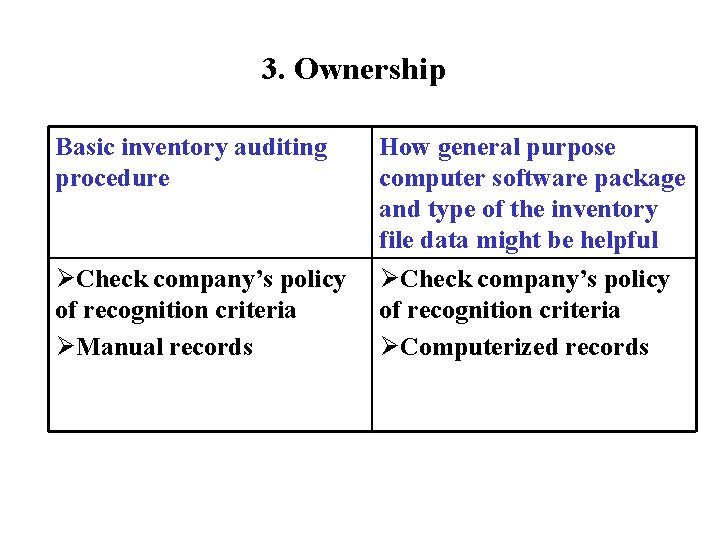
3. Ownership Basic inventory auditing procedure ØCheck company’s policy of recognition criteria ØManual records How general purpose computer software package and type of the inventory file data might be helpful ØCheck company’s policy of recognition criteria ØComputerized records
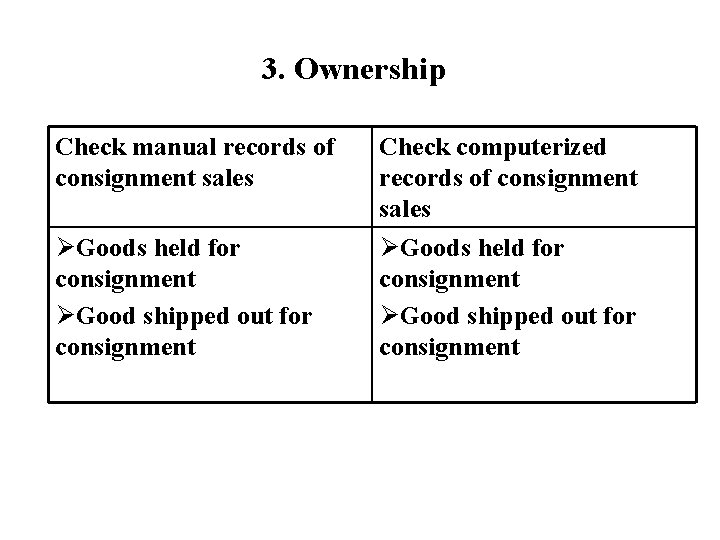
3. Ownership Check manual records of consignment sales ØGoods held for consignment ØGood shipped out for consignment Check computerized records of consignment sales ØGoods held for consignment ØGood shipped out for consignment
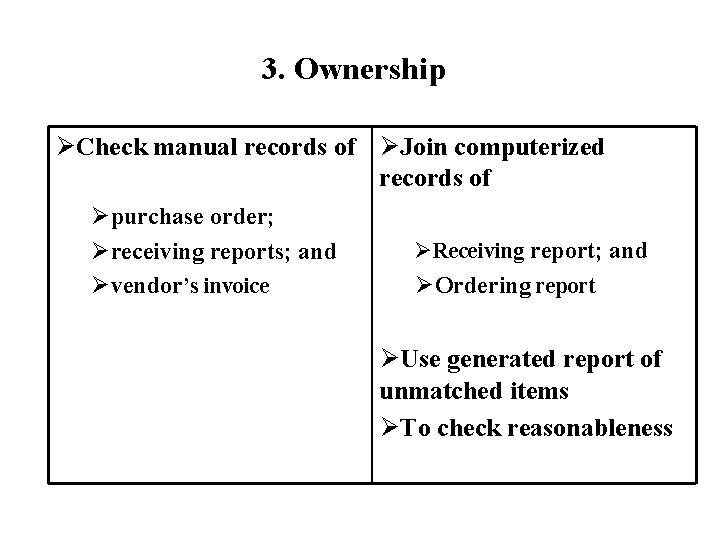
3. Ownership ØCheck manual records of ØJoin computerized records of Øpurchase order; Øreceiving reports; and Øvendor’s invoice ØReceiving report; and ØOrdering report ØUse generated report of unmatched items ØTo check reasonableness
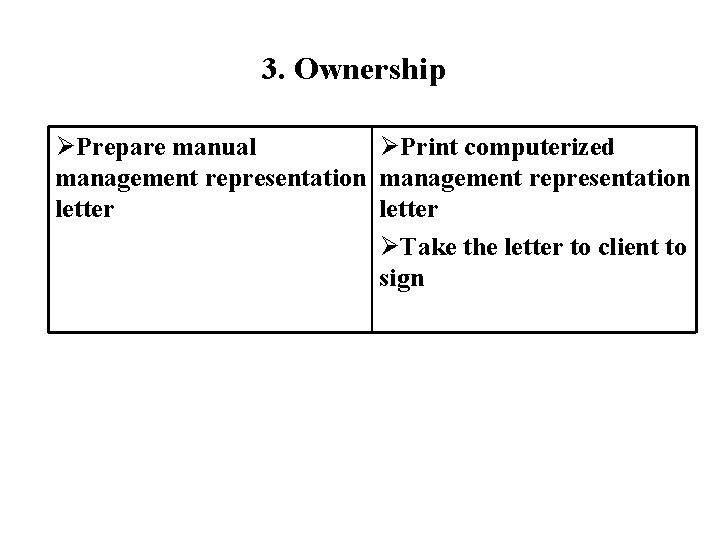
3. Ownership ØPrepare manual ØPrint computerized management representation letter ØTake the letter to client to sign
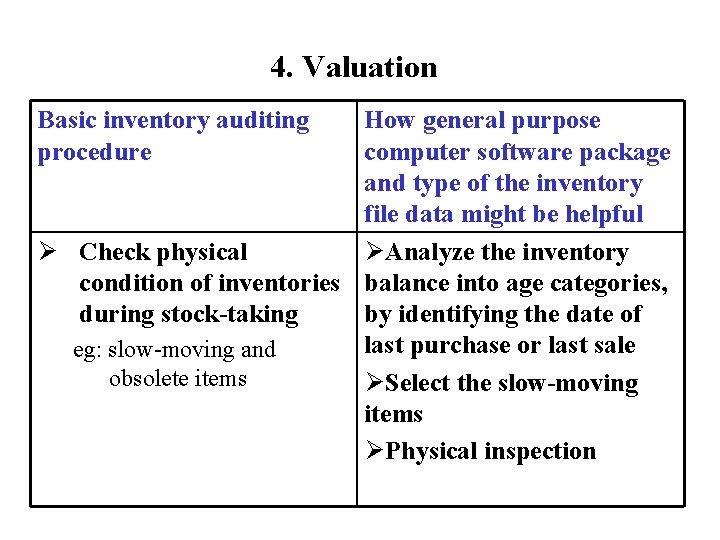
4. Valuation Basic inventory auditing procedure How general purpose computer software package and type of the inventory file data might be helpful Ø Check physical ØAnalyze the inventory condition of inventories balance into age categories, during stock-taking by identifying the date of last purchase or last sale eg: slow-moving and obsolete items ØSelect the slow-moving items ØPhysical inspection
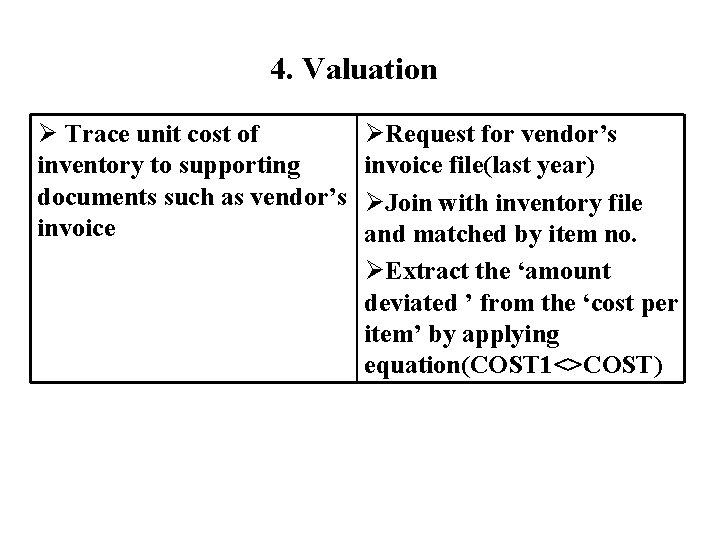
4. Valuation Ø Trace unit cost of inventory to supporting documents such as vendor’s invoice ØRequest for vendor’s invoice file(last year) ØJoin with inventory file and matched by item no. ØExtract the ‘amount deviated ’ from the ‘cost per item’ by applying equation(COST 1<>COST)
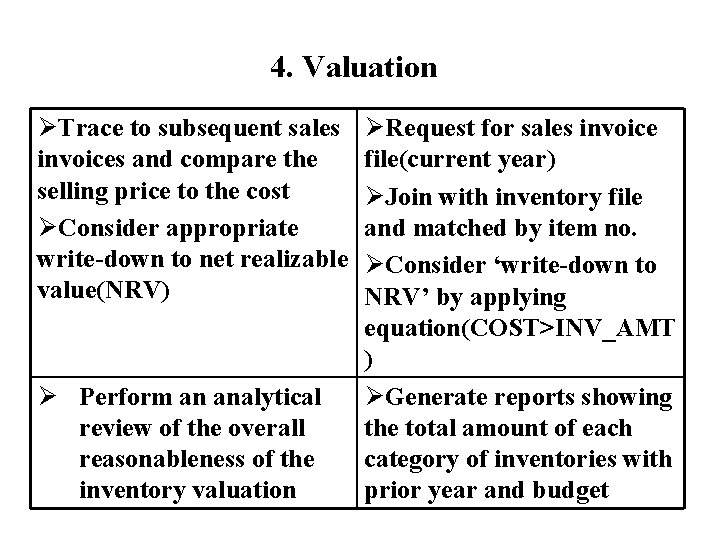
4. Valuation ØTrace to subsequent sales invoices and compare the selling price to the cost ØConsider appropriate write-down to net realizable value(NRV) Ø Perform an analytical review of the overall reasonableness of the inventory valuation ØRequest for sales invoice file(current year) ØJoin with inventory file and matched by item no. ØConsider ‘write-down to NRV’ by applying equation(COST>INV_AMT ) ØGenerate reports showing the total amount of each category of inventories with prior year and budget
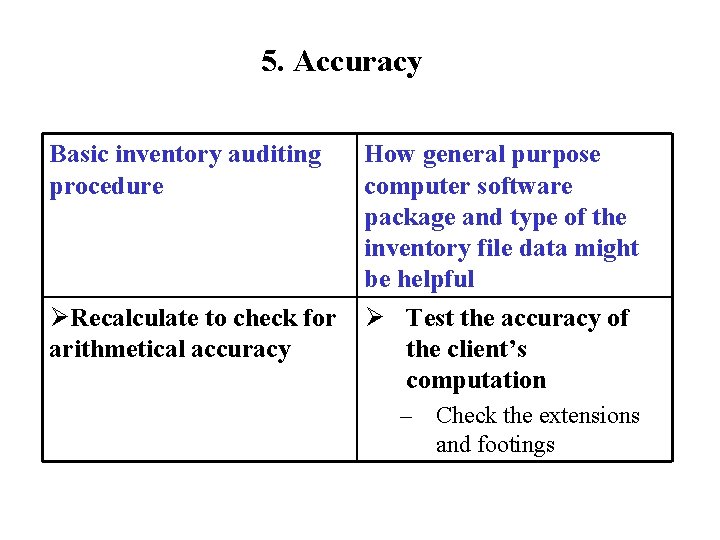
5. Accuracy Basic inventory auditing procedure ØRecalculate to check for arithmetical accuracy How general purpose computer software package and type of the inventory file data might be helpful Ø Test the accuracy of the client’s computation – Check the extensions and footings
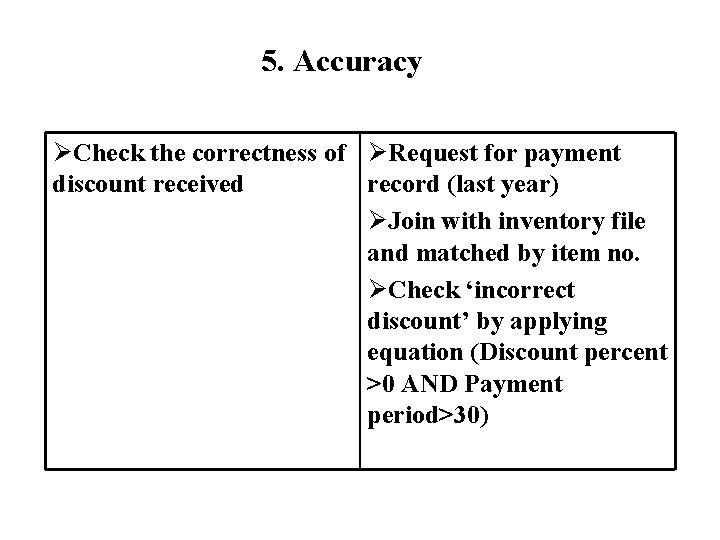
5. Accuracy ØCheck the correctness of ØRequest for payment discount received record (last year) ØJoin with inventory file and matched by item no. ØCheck ‘incorrect discount’ by applying equation (Discount percent >0 AND Payment period>30)
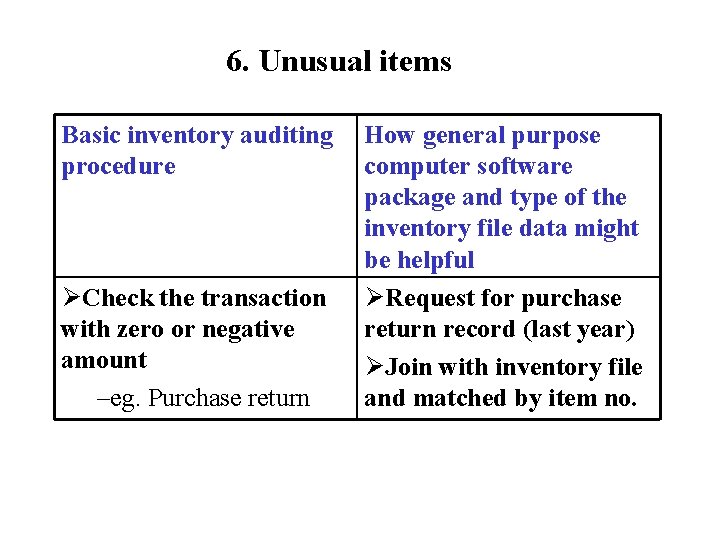
6. Unusual items Basic inventory auditing procedure ØCheck the transaction with zero or negative amount –eg. Purchase return How general purpose computer software package and type of the inventory file data might be helpful ØRequest for purchase return record (last year) ØJoin with inventory file and matched by item no.
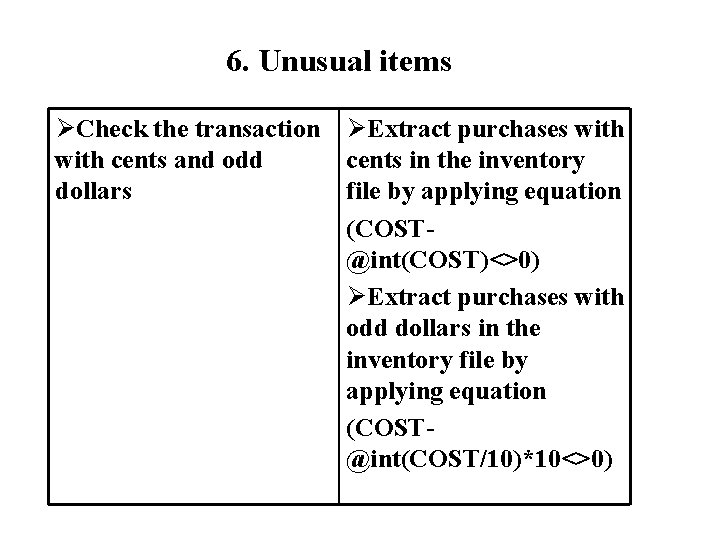
6. Unusual items ØCheck the transaction ØExtract purchases with cents and odd cents in the inventory dollars file by applying equation (COST@int(COST)<>0) ØExtract purchases with odd dollars in the inventory file by applying equation (COST@int(COST/10)*10<>0)
Conclusion Advantage of CAAT: • Time saving • Accurate result is obtain • Objectivity in random sampling • Audit work done can easily transfer internationally to other branches when necessary
Conclusion Limitation of CAAT: • Program compatibility of document format • Competence of Auditors Common concern of traditional and CAAT audit: • Evaluation of True and Fairness of inventory account is base on auditors’ professional judgment
- Slides: 23