
Chapter 11 DNA The Genetic Material P 217
- Slides: 41
Chapter 11 • DNA: The Genetic Material • P. 217 -234 1
11. 1 The Discovery of Transformation • Chromosomes contain the hereditary information, and they are comprised of two types of macromolecules, proteins and DNA; but which one is the stuff of genes? – the answer was discovered from a variety of different experiments, all of which shared the same basic design • if you separate the DNA in an individual’s chromosomes from the protein, which of the two materials is able to change another individual’s genes? 2
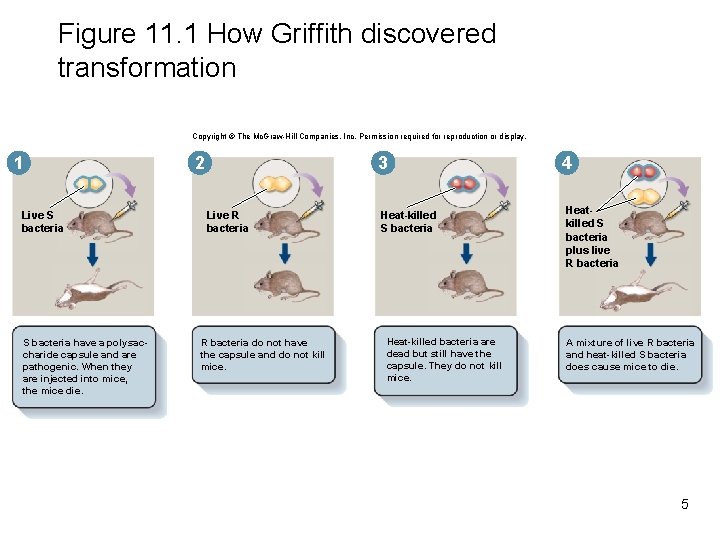
Frederick Griffith - • Frederick Griffith in 1928 experimented with pathogenic (disease-causing) bacteria – he experimented with two strains of Streptococcus pneumoniae • the virulent strain, called the S form, was coated with a polysaccharide capsule and caused infected mice to die of blood poisoning • a mutant form, called the R form, lacked the capsule and was nonvirulent 3
• Griffith determined that when dead bacteria of the S form were injected into mice, the mice remained healthy • But, when Griffith injected mice with a mixture of dead S bacteria and live bacteria of the R form, the mice unexpectedly died – the R form bacteria had been transformed into the virulent S variety 4
Figure 11. 1 How Griffith discovered transformation Copyright © The Mc. Graw-Hill Companies, Inc. Permission required for reproduction or display. 1 Live S bacteria have a polysaccharide capsule and are pathogenic. When they are injected into mice, the mice die. 2 3 Live R bacteria do not have the capsule and do not kill mice. Heat-killed S bacteria Heat-killed bacteria are dead but still have the capsule. They do not kill mice. 4 Heatkilled S bacteria plus live R bacteria A mixture of live R bacteria and heat-killed S bacteria does cause mice to die. 5
11. 2 Experiments Identifying DNA as the Genetic Material • The agent responsible for transforming Streptococcus went undiscovered until a classic series of experiments by Oswald Avery and his coworkers Colin Mac. Leod and Maclyn Mc. Carty – they also worked with Streptococcus strains, both dead S and live R, but were able to remove first nearly 99. 98% of the protein – they found that the transforming principle was not reduced by the removal of the protein 6
• The Avery team discovered that the transforming principle resembled DNA in several ways – same chemistry and behavior as DNA – not affected by lipid and protein extraction – not destroyed by protein- or RNA-digesting enzymes – was destroyed by DNA-digesting enzymes • Based on this overwhelming evidence, the Avery team concluded that the hereditary material was DNA 7
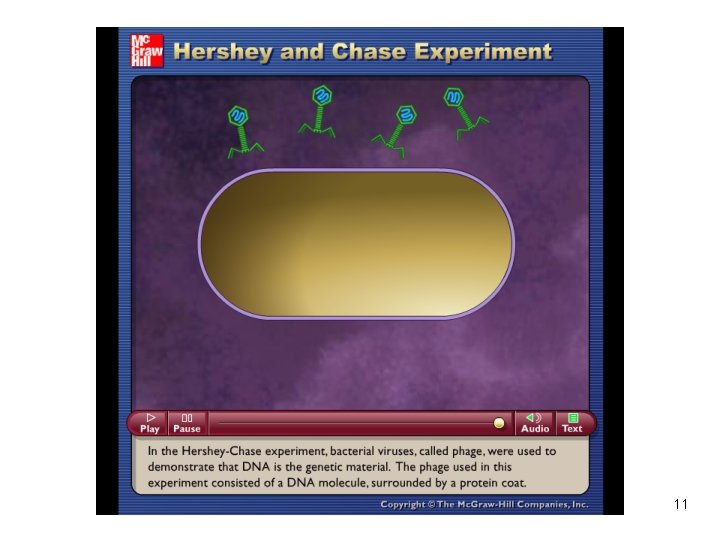
• Alfred Hershey and Martha Chase provided the final experimental evidence that pointed to DNA as the hereditary material – the team studied viruses that infect bacteria – the structure of these viruses is very simple: a core of DNA surrounded by a coat of protein – the viruses attach themselves to the surface of bacteria cells and inject their genes into the interior • the infected bacterial cell is then forced to make hundreds of new viruses, which then burst out of the cell to infect new cells 8
• Hershey and Chase used radioactive isotopes to “label” or tag the DNA and the protein of the viruses – some viruses were grown so that their DNA contained radioactive phosphorous (32 P) – other viruses were grown so that their protein coats contained radioactive sulfur (35 S) 9
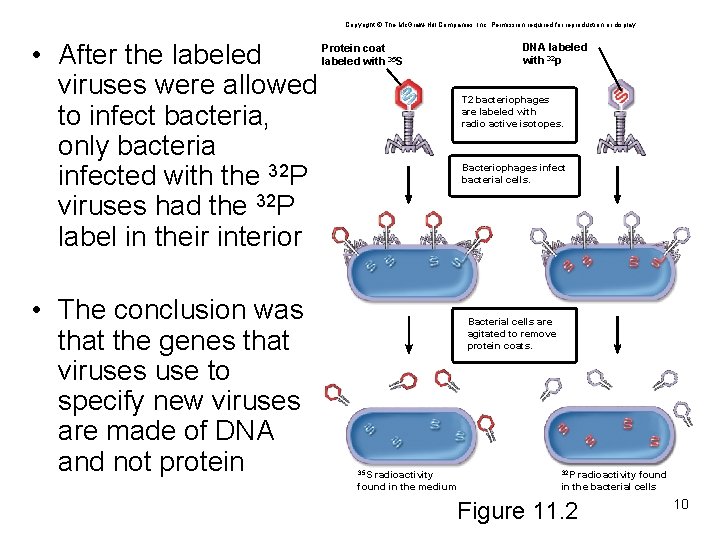
Copyright © The Mc. Graw-Hill Companies, Inc. Permission required for reproduction or display. • After the labeled viruses were allowed to infect bacteria, only bacteria infected with the 32 P viruses had the 32 P label in their interior • The conclusion was that the genes that viruses use to specify new viruses are made of DNA and not protein Protein coat labeled with 35 S DNA labeled with 32 p T 2 bacteriophages are labeled with radio active isotopes. Bacteriophages infect bacterial cells. Bacterial cells are agitated to remove protein coats. 35 S radioactivity found in the medium 32 P radioactivity found in the bacterial cells Figure 11. 2 10
Please note that due to differing operating systems, some animations will not appear until the presentation is viewed in Presentation Mode (Slide Show view). You may see blank slides in the “Normal” or “Slide Sorter” views. All animations will appear after viewing in Presentation Mode and playing each animation. Most animations will require the latest version of the Flash Player, which is available at http: //get. adobe. com/flashplayer. 11
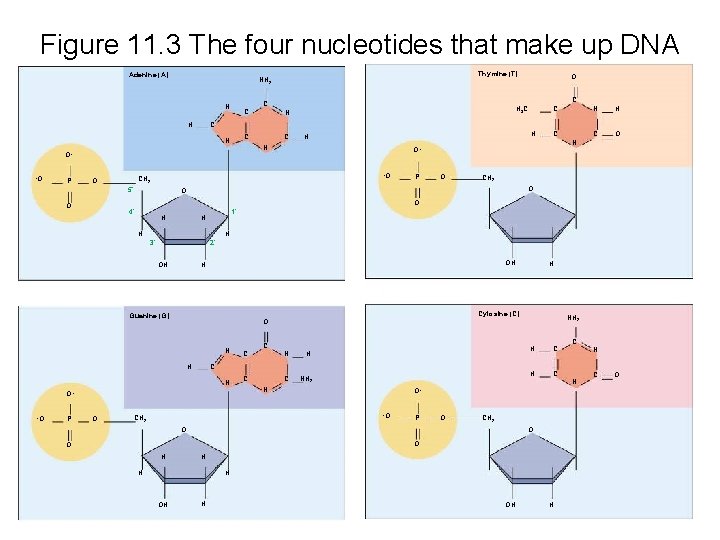
11. 3 Discovering the Structure of DNA – review • In order to understand how DNA functioned as the molecules that stored heredity, researchers needed to understand the structure of DNA – DNA is comprised of subunits called nucleotides – each DNA nucleotide has three parts • a central deoxyribose sugar • a phosphate group • an organic base 12
• Nucleotides differ with regards to their bases – large bases (purines) with double-ring structure • either adenine (A) or guanine (G) – small bases (pyrimidines) with single rings • either cytosine (C) or thymine (T) – Edwin Chargaff noted that DNA molecules always had equal amounts of purines and pyrimidines • Chargaff’s rule suggested that DNA had a regular structure – the amount of A always equaled the amount of T – the amount of C always equaled the amount of G 13
Figure 11. 3 The four nucleotides that make up DNA Adenine (A) N H C C N H C H H N C C O N O– –O P O CH 2 O O 4′ H 1′ H H H 3′ 2′ OH H OH NH 2 O N H C C N H C NH 2 C N O– O H Cytosine (C) Guanine (G) P H 3 C N CH 2 O 5′ –O C C C O– P O C N –O Thymine (T) NH 2 C N C H C C N N C O O– –O CH 2 H P O CH 2 O O H H OH H 14
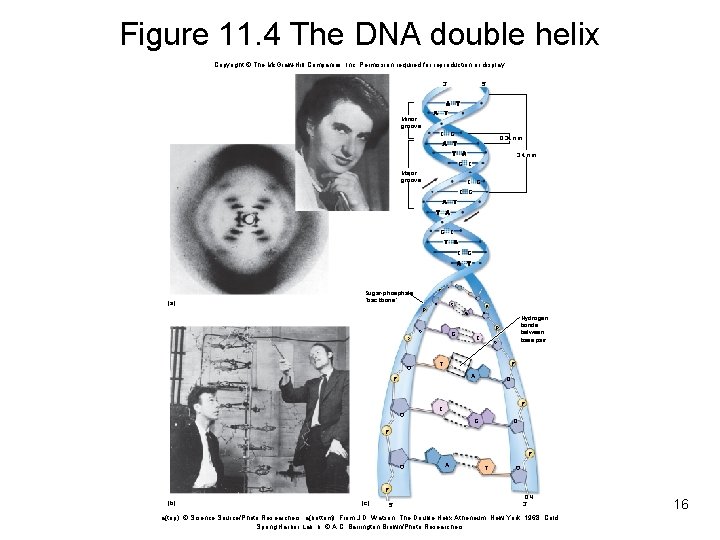
• Rosalind Franklin’s work in 1953 using X-ray diffraction showed that DNA had a regular structure that was shaped like a corkscrew, or helix • Francis Crick and James Watson elaborated on the discoveries of Franklin and Chargaff and deduced that the structure of DNA was a double helix – two strands of DNA bound together by hydrogen bonds between the bases – because a purine of one strand binds to a pyrimidine on the other strand to form a base pair, the molecule keeps a constant thickness 15
Figure 11. 4 The DNA double helix Copyright © The Mc. Graw-Hill Companies, Inc. Permission required for reproduction or display. 3′ 5′ Minor groove C G 0. 34 nm 3. 4 nm G C Major groove C G G C C G O (a) P Sugar-phosphate "backbone" O O C P O O C O T P A P O Hydrogen bonds between base pair P G P O P G O P C O G P P O A T O P (b) (c) 5′ OH 3′ a(top): © Science Source/Photo Researchers; a(bottom): From J. D. Watson, The Double Helix Atheneum, New York, 1968. Cold Spring Harbor Lab; b: © A. C. Barrington Brown/Photo Researchers 16
Remember! How the DNA Molecule Copies Itself • The two strands of DNA that form the double helix DNA molecule are complementary to each other – each chain is essentially a mirror image of the other – this complementarity makes it possible for DNA to copy itself in preparation for cell division 17
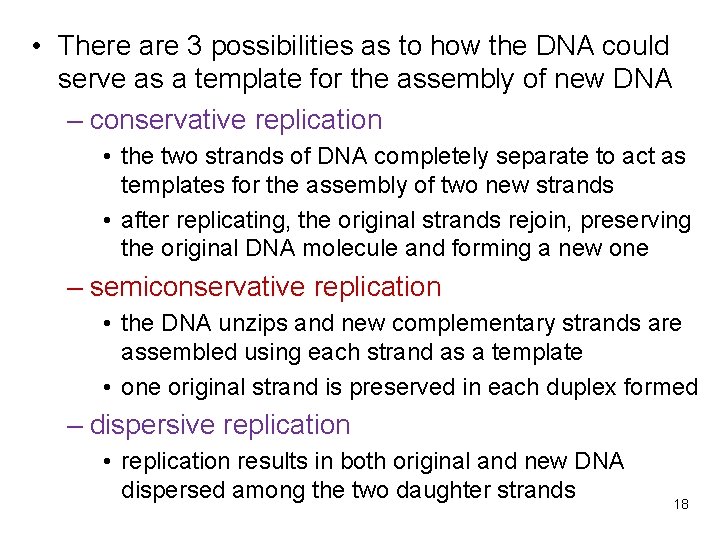
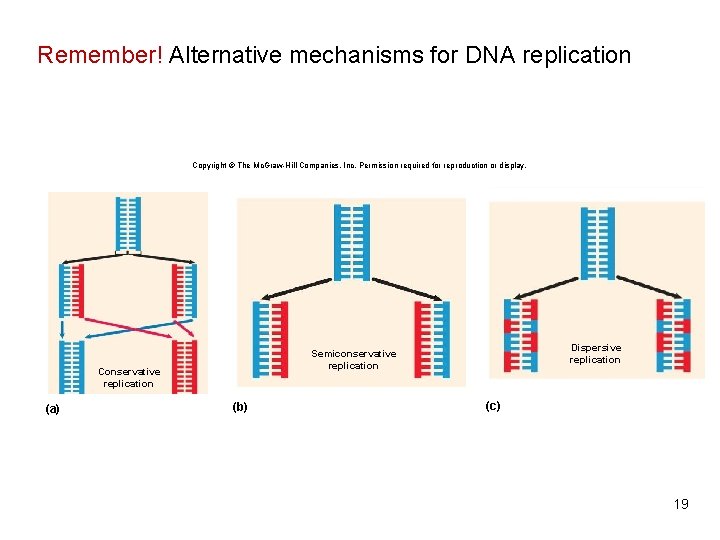
• There are 3 possibilities as to how the DNA could serve as a template for the assembly of new DNA – conservative replication • the two strands of DNA completely separate to act as templates for the assembly of two new strands • after replicating, the original strands rejoin, preserving the original DNA molecule and forming a new one – semiconservative replication • the DNA unzips and new complementary strands are assembled using each strand as a template • one original strand is preserved in each duplex formed – dispersive replication • replication results in both original and new DNA dispersed among the two daughter strands 18
Remember! Alternative mechanisms for DNA replication Copyright © The Mc. Graw-Hill Companies, Inc. Permission required for reproduction or display. Conservative replication (a) Dispersive replication Semiconservative replication (b) (c) 19
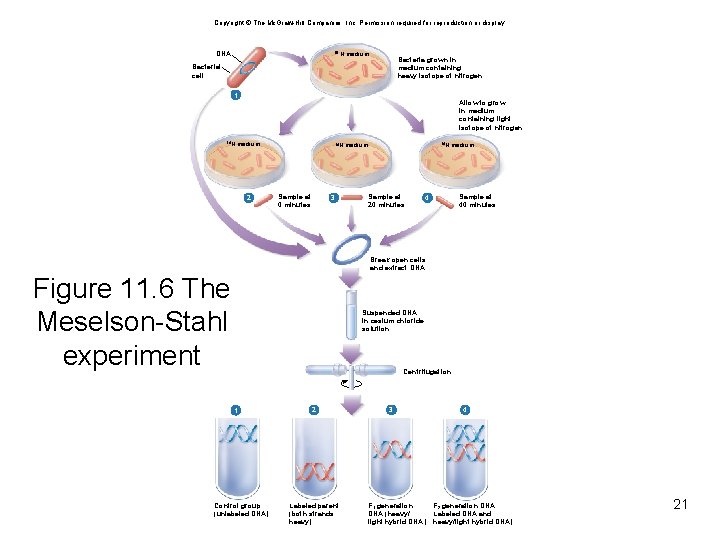
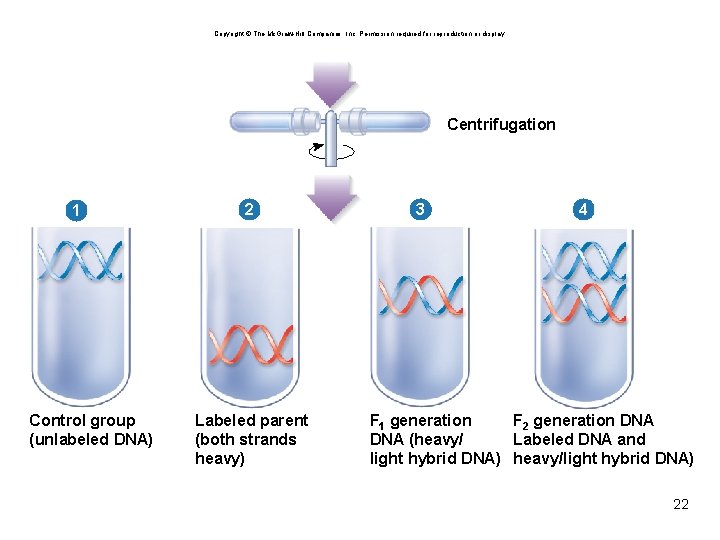
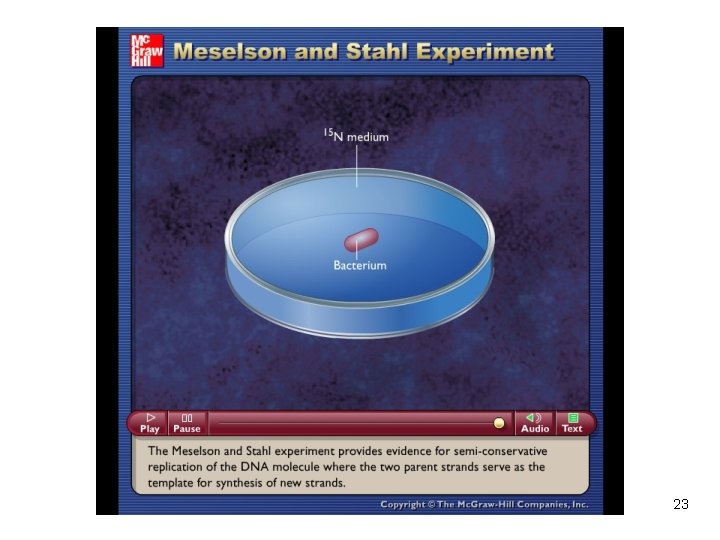
11. 4 How the DNA Molecule Copies Itself • Matthew Meselson and Franklin Stahl tested, in 1958, the three alternative hypotheses for the replication of DNA – they used radioactive isotopes of N to label DNA at different stages of replication – they found that DNA replication was semiconservative 20
Copyright © The Mc. Graw-Hill Companies, Inc. Permission required for reproduction or display. DNA 15 N medium Bacteria grown in medium containing heavy isotope of nitrogen Bacterial cell 1 14 N Allow to grow in medium containing light isotope of nitrogen medium 2 14 N Sample at 0 minutes 3 14 N medium Sample at 20 minutes medium Sample at 40 minutes 4 Break open cells and extract DNA Figure 11. 6 The Meselson-Stahl experiment Suspended DNA in cesium chloride solution Centrifugation 1 Control group (unlabeled DNA) 2 Labeled parent (both strands heavy) 3 F 1 generation DNA (heavy/ light hybrid DNA) 4 F 2 generation DNA Labeled DNA and heavy/light hybrid DNA) 21
Copyright © The Mc. Graw-Hill Companies, Inc. Permission required for reproduction or display. Centrifugation 1 Control group (unlabeled DNA) 2 Labeled parent (both strands heavy) 3 4 F 1 generation F 2 generation DNA (heavy/ Labeled DNA and light hybrid DNA) heavy/light hybrid DNA) 22
Please note that due to differing operating systems, some animations will not appear until the presentation is viewed in Presentation Mode (Slide Show view). You may see blank slides in the “Normal” or “Slide Sorter” views. All animations will appear after viewing in Presentation Mode and playing each animation. Most animations will require the latest version of the Flash Player, which is available at http: //get. adobe. com/flashplayer. 23
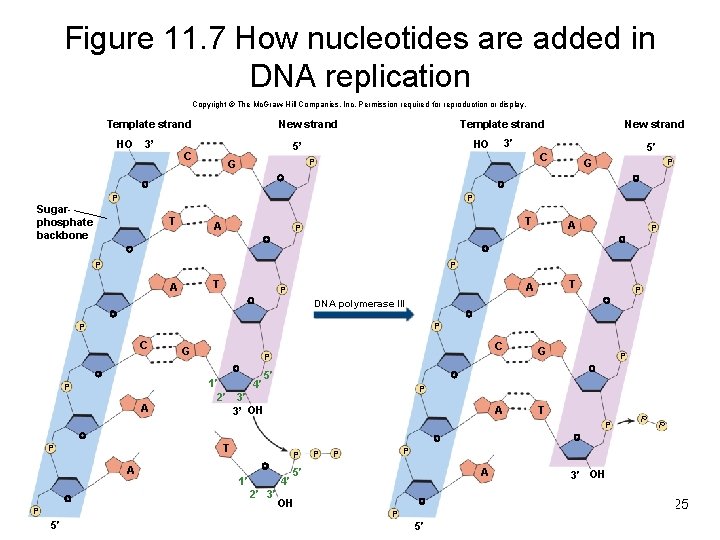
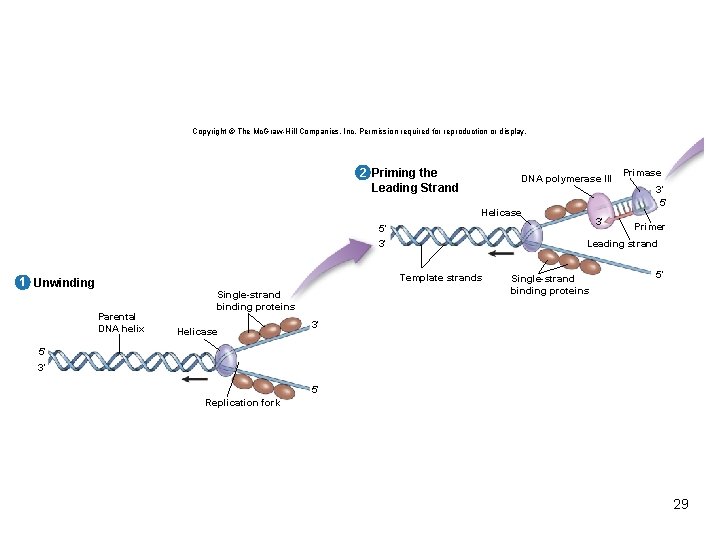
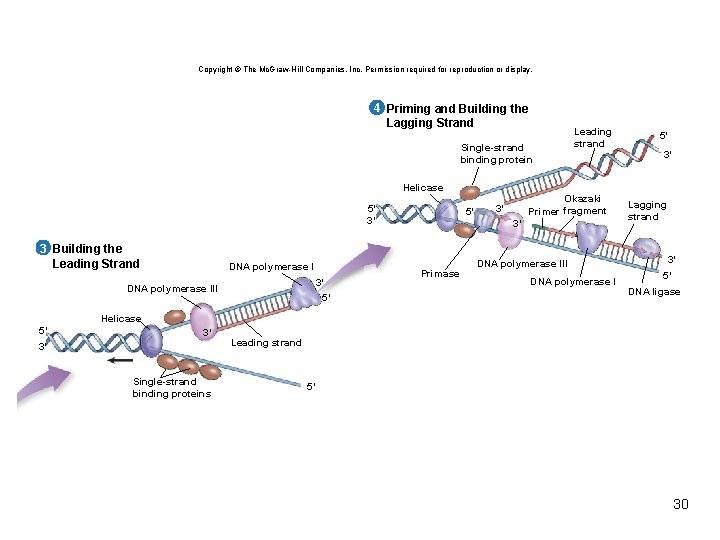
• The process of DNA replication involves several enzymes – DNA polymerase • adds the correct complementary nucleotide to the growing daughter strand • but can only add nucleotides to the 3´ end of an existing strand or primer – helicase • unwinds the DNA to expose the templates • this creates a replication fork – DNA ligase • seals fragments of DNA together 24
Figure 11. 7 How nucleotides are added in DNA replication Copyright © The Mc. Graw-Hill Companies, Inc. Permission required for reproduction or display. Template strand HO 3’ New strand Template strand C P G 5′ C P G P P Sugarphosphate backbone 3′ HO 5’ New strand T A P P T A A T P P T A P P DNA polymerase III P P C P A G P 1′ 2′ 4′ C G A T P 5′ P 3′ 3’ OH P T P A P 1′ 4′ 2′ 3′ P 5′ P P 5′ OH P A 3′ OH 25 P 5′
• At the replication fork, a primer must first be added to give a place for DNA polymerase to start – using one template, DNA polymerase adds nucleotides in a continuous fashion; this new daughter strand is called the leading strand – because the other template is a mirror image, directionality becomes a problem because DNA polymerase can build a new strand in one direction only • this second daughter strand is assembled in segments, each one beginning with a primer • the segments are joined together by DNA ligase to form the lagging strand 26
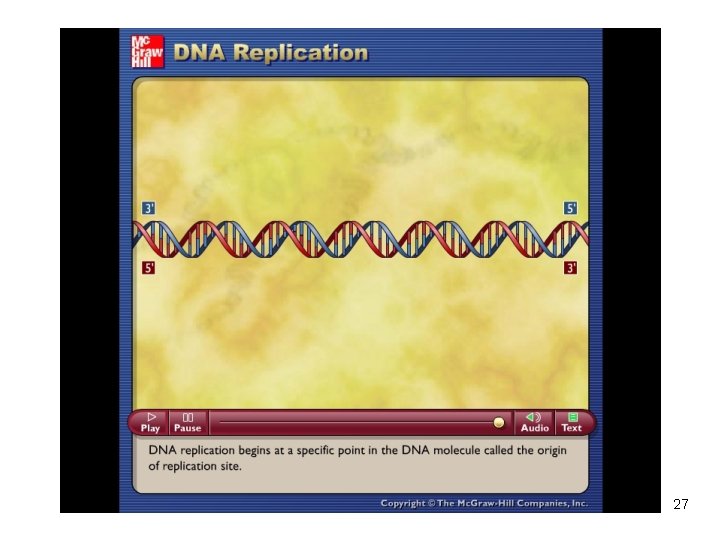
Please note that due to differing operating systems, some animations will not appear until the presentation is viewed in Presentation Mode (Slide Show view). You may see blank slides in the “Normal” or “Slide Sorter” views. All animations will appear after viewing in Presentation Mode and playing each animation. Most animations will require the latest version of the Flash Player, which is available at http: //get. adobe. com/flashplayer. 27
11. 4 How the DNA Molecule Copies Itself • Before the newly formed DNA molecules wind back into the double helix shape, the primers must be removed and the DNA fragments sealed together – DNA ligase joins the ends of the fragments of DNA to form continuous strands 28
Copyright © The Mc. Graw-Hill Companies, Inc. Permission required for reproduction or display. 2 Priming the Leading Strand DNA polymerase III Helicase 3′ 5′ 3′ Parental DNA helix Single-strand binding proteins Helicase 3′ 5′ Primer Leading strand Template strands 1 Unwinding Primase Single-strand binding proteins 5′ 3′ 5′ Replication fork 29
Copyright © The Mc. Graw-Hill Companies, Inc. Permission required for reproduction or display. 4 Priming and Building the Lagging Strand Single-strand binding protein Leading strand 5’ 3’ Helicase 5’ 3’ 3 Building the Leading Strand DNA polymerase I 3’ 5’ DNA polymerase III 5’ Okazaki Primer fragment 3’ 3’ Primase DNA polymerase III DNA polymerase I Lagging strand 3’ 5’ DNA ligase Helicase 5’ 3’ 3’ Single-strand binding proteins Leading strand 5’ 30
Please note that due to differing operating systems, some animations will not appear until the presentation is viewed in Presentation Mode (Slide Show view). You may see blank slides in the “Normal” or “Slide Sorter” views. All animations will appear after viewing in Presentation Mode and playing each animation. Most animations will require the latest version of the Flash Player, which is available at http: //get. adobe. com/flashplayer. 31
DNA repair • Because so much DNA is being replicated in the many cells of the body, there is a potential for errors to occur – DNA repair involves comparing the daughter strand to the parent DNA template to check for mistakes • the proofreading is not perfect because mutations are still possible, although rare; however, genetic variation is the raw material of evolution 32
11. 5 Mutation • There are 2 main ways in which the genetic message encoded in DNA can be altered – mutation • results from errors in replication • can involve changes, additions, or deletions to nucleotides – recombination • causes change in the position of all or part of a gene 33
• Mutations can alter the genetic message and affect protein synthesis – because most mutations occur randomly in a cell’s DNA, most mutations are detrimental – the effect of a mutation depends on the identity of the cell where it occurs • mutations in germ-line cells – these mutations will be passed to future generations – they are important for evolutionary change • mutations in somatic cells – not passed to future generations but passed to all other somatic cells derived from it 34
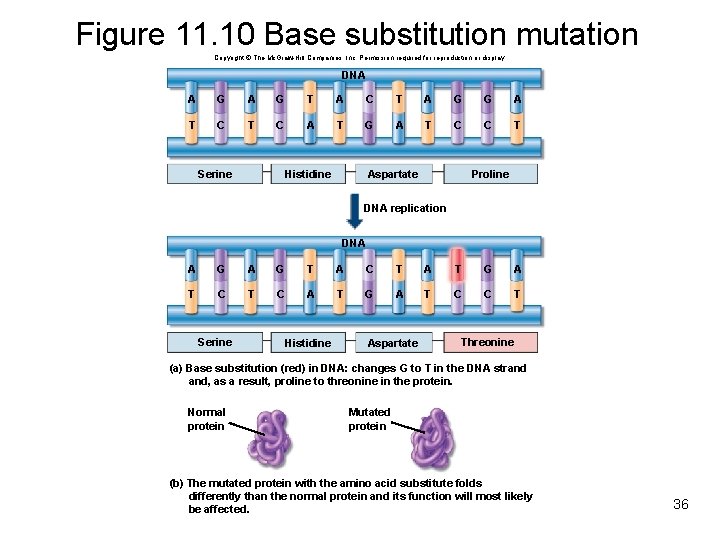
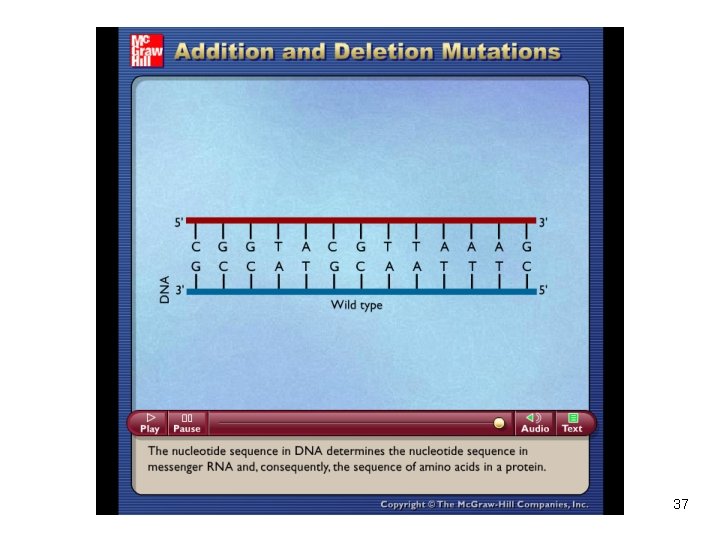
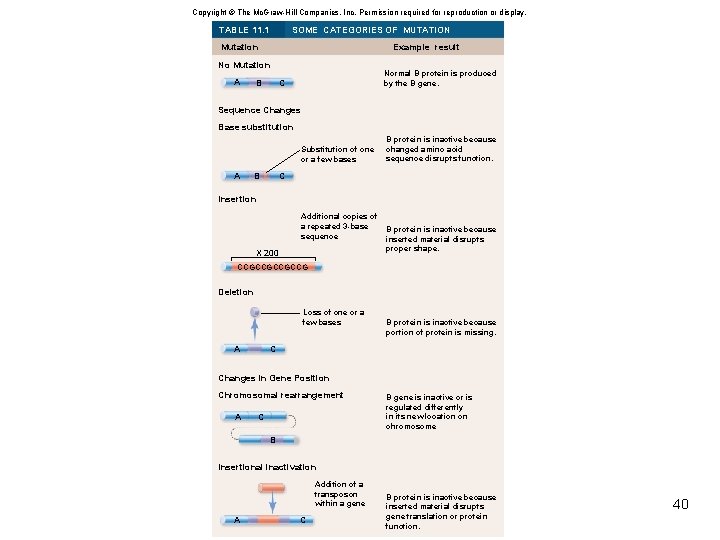
• Some mutations alter the sequence of DNA nucleotides – base substitution changes the identity of a base or bases – insertion adds a base or bases – deletion removes a base or bases • If the insertion or deletion throws the reading frame of the genetic message out of register, a frame-shift mutation results – these are extremely detrimental because the final protein intended by the message may be altered or not made 35
Figure 11. 10 Base substitution mutation Copyright © The Mc. Graw-Hill Companies, Inc. Permission required for reproduction or display. DNA A G T A C T A G G A T C A T G A T C C T Serine Histidine Aspartate Proline DNA replication DNA A G T A C T A T G A T C C T Serine Histidine Aspartate Threonine (a) Base substitution (red) in DNA: changes G to T in the DNA strand and, as a result, proline to threonine in the protein. Normal protein Mutated protein (b) The mutated protein with the amino acid substitute folds differently than the normal protein and its function will most likely be affected. 36
Please note that due to differing operating systems, some animations will not appear until the presentation is viewed in Presentation Mode (Slide Show view). You may see blank slides in the “Normal” or “Slide Sorter” views. All animations will appear after viewing in Presentation Mode and playing each animation. Most animations will require the latest version of the Flash Player, which is available at http: //get. adobe. com/flashplayer. 37
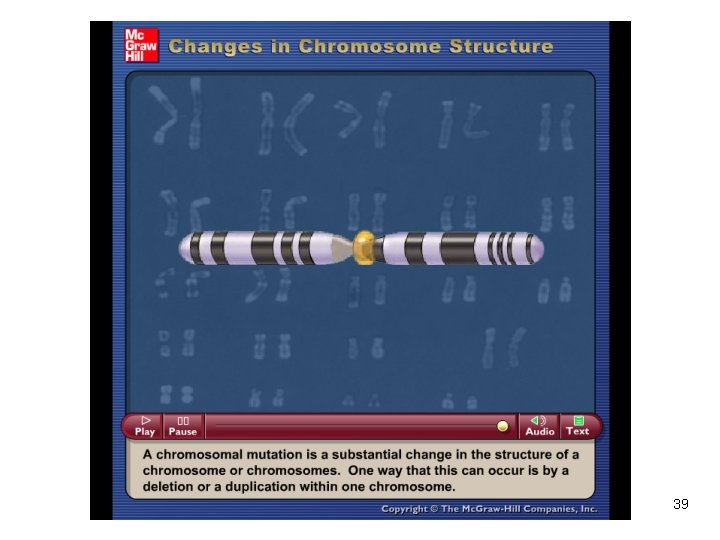
11. 5 Mutation • Some mutations affect how a genetic message is organized – transposition occurs when individual genes move from one place in the genome to another – sometimes entire regions of chromosomes may change their relative location or undergo duplication • this is called chromosomal rearrangement 38
Please note that due to differing operating systems, some animations will not appear until the presentation is viewed in Presentation Mode (Slide Show view). You may see blank slides in the “Normal” or “Slide Sorter” views. All animations will appear after viewing in Presentation Mode and playing each animation. Most animations will require the latest version of the Flash Player, which is available at http: //get. adobe. com/flashplayer. 39
Copyright © The Mc. Graw-Hill Companies, Inc. Permission required for reproduction or display. TABLE 11. 1 SOME CATEGORIES OF MUTATION Mutation Example result No Mutation A B Normal B protein is produced by the B gene. C Sequence Changes Base substitution Substitution of one or a few bases A B B protein is inactive because changed amino acid sequence disrupts function. C Insertion Additional copies of a repeated 3 -base sequence X 200 B protein is inactive because inserted material disrupts proper shape. CCGCCG Deletion Loss of one or a few bases A B protein is inactive because portion of protein is missing. C Changes in Gene Position Chromosomal rearrangement A C B gene is inactive or is regulated differently in its new location on chromosome B Insertional inactivation Addition of a transposon within a gene A C B protein is inactive because inserted material disrupts gene translation or protein function. 40
mutagens • All evolutionary change begins with alterations in the genetic message – mutation and recombination provide the raw materials for evolution • Chemicals or radiation that cause mutation are called mutagens – for example, chemicals in cigarette smoke and UV light can cause cancer 41