
Chapter 11 Discrete Optimization Models 11 1 Lumpy




![ILP Model of the Symmetric TSP • [11. 25]](https://slidetodoc.com/presentation_image_h2/b8f0cf10b1583e5f040918125bc0b09f/image-55.jpg "ILP Model of the Symmetric TSP • [11. 25]")
![ILP Model of the Asymmetric TSP • [11. 26]](https://slidetodoc.com/presentation_image_h2/b8f0cf10b1583e5f040918125bc0b09f/image-56.jpg "ILP Model of the Asymmetric TSP • [11. 26]")
![Quadratic Assignment Formulation of the TSP • Let [11. 27] s. t.](https://slidetodoc.com/presentation_image_h2/b8f0cf10b1583e5f040918125bc0b09f/image-57.jpg "Quadratic Assignment Formulation of the TSP • Let [11. 27] s. t.")
![ILP Model of Facilities Location • Let s. t. [11. 30]](https://slidetodoc.com/presentation_image_h2/b8f0cf10b1583e5f040918125bc0b09f/image-66.jpg "ILP Model of Facilities Location • Let s. t. [11. 30]")

- Slides: 88
Chapter 11 Discrete Optimization Models
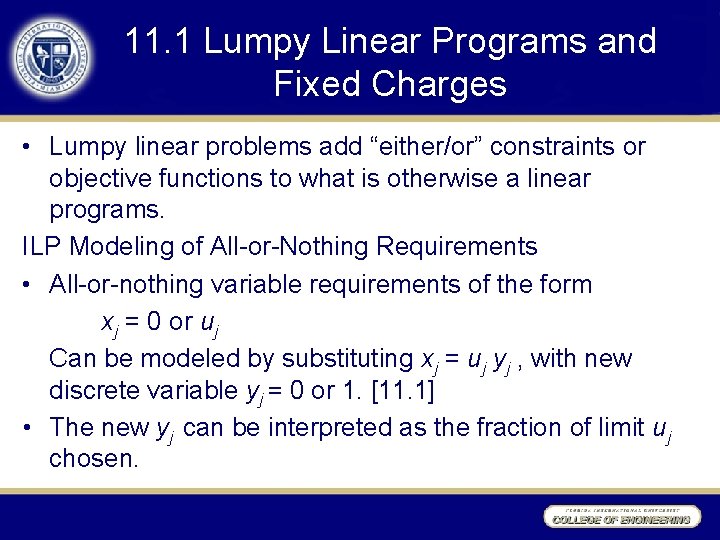
11. 1 Lumpy Linear Programs and Fixed Charges • Lumpy linear problems add “either/or” constraints or objective functions to what is otherwise a linear programs. ILP Modeling of All-or-Nothing Requirements • All-or-nothing variable requirements of the form xj = 0 or uj Can be modeled by substituting xj = uj yj , with new discrete variable yj = 0 or 1. [11. 1] • The new yj can be interpreted as the fraction of limit uj chosen.
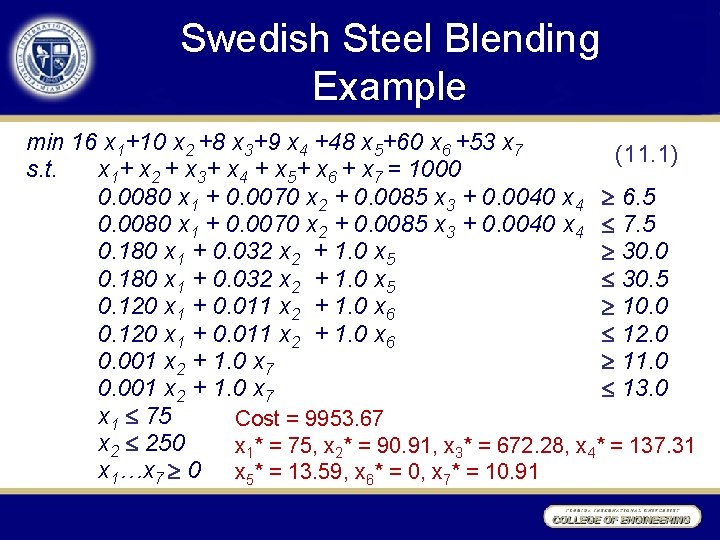
Swedish Steel Blending Example min 16 x 1+10 x 2 +8 x 3+9 x 4 +48 x 5+60 x 6 +53 x 7 (11. 1) s. t. x 1+ x 2 + x 3+ x 4 + x 5+ x 6 + x 7 = 1000 0. 0080 x 1 + 0. 0070 x 2 + 0. 0085 x 3 + 0. 0040 x 4 6. 5 0. 0080 x 1 + 0. 0070 x 2 + 0. 0085 x 3 + 0. 0040 x 4 7. 5 0. 180 x 1 + 0. 032 x 2 + 1. 0 x 5 30. 0 0. 180 x 1 + 0. 032 x 2 + 1. 0 x 5 30. 5 0. 120 x 1 + 0. 011 x 2 + 1. 0 x 6 10. 0 0. 120 x 1 + 0. 011 x 2 + 1. 0 x 6 12. 0 0. 001 x 2 + 1. 0 x 7 11. 0 0. 001 x 2 + 1. 0 x 7 13. 0 x 1 75 Cost = 9953. 67 x 2 250 x 1* = 75, x 2* = 90. 91, x 3* = 672. 28, x 4* = 137. 31 x 1…x 7 0 x 5* = 13. 59, x 6* = 0, x 7* = 10. 91
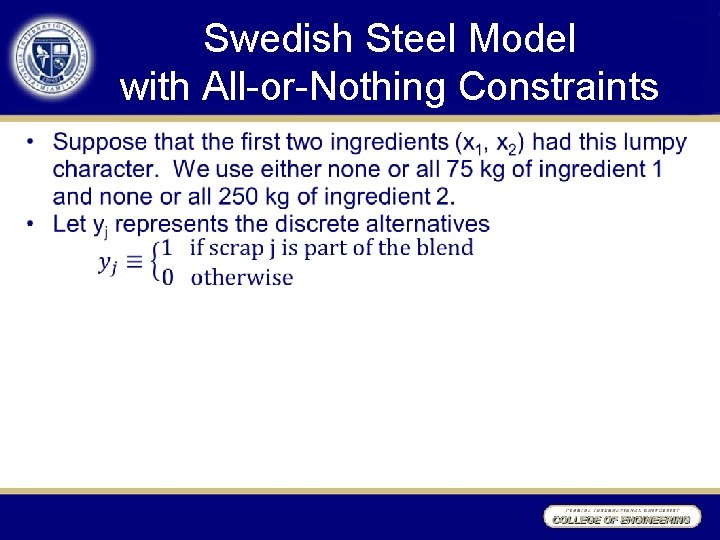
Swedish Steel Model with All-or-Nothing Constraints •
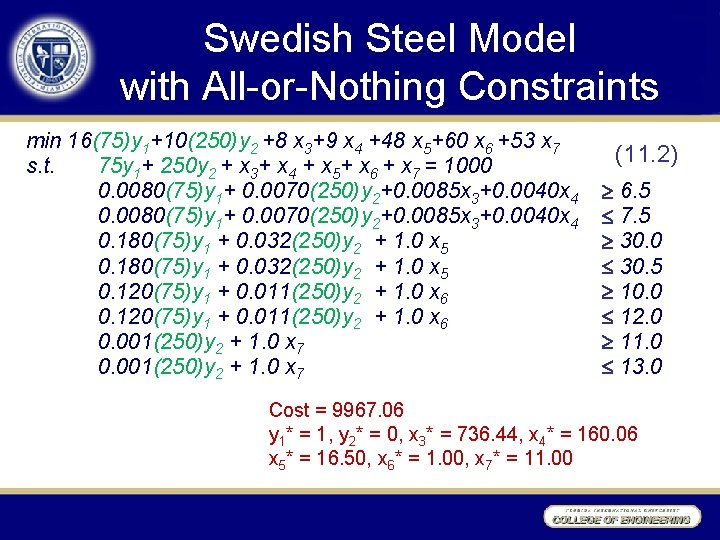
Swedish Steel Model with All-or-Nothing Constraints min 16(75)y 1+10(250)y 2 +8 x 3+9 x 4 +48 x 5+60 x 6 +53 x 7 s. t. 75 y 1+ 250 y 2 + x 3+ x 4 + x 5+ x 6 + x 7 = 1000 0. 0080(75)y 1+ 0. 0070(250)y 2+0. 0085 x 3+0. 0040 x 4 0. 180(75)y 1 + 0. 032(250)y 2 + 1. 0 x 5 0. 120(75)y 1 + 0. 011(250)y 2 + 1. 0 x 6 0. 001(250)y 2 + 1. 0 x 7 (11. 2) 6. 5 7. 5 30. 0 30. 5 10. 0 12. 0 11. 0 13. 0 Cost = 9967. 06 y 1* = 1, y 2* = 0, x 3* = 736. 44, x 4* = 160. 06 x 5* = 16. 50, x 6* = 1. 00, x 7* = 11. 00
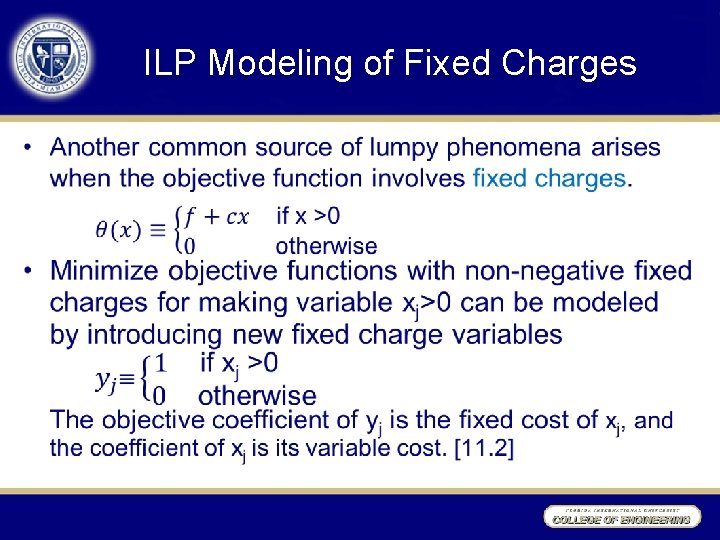
ILP Modeling of Fixed Charges •
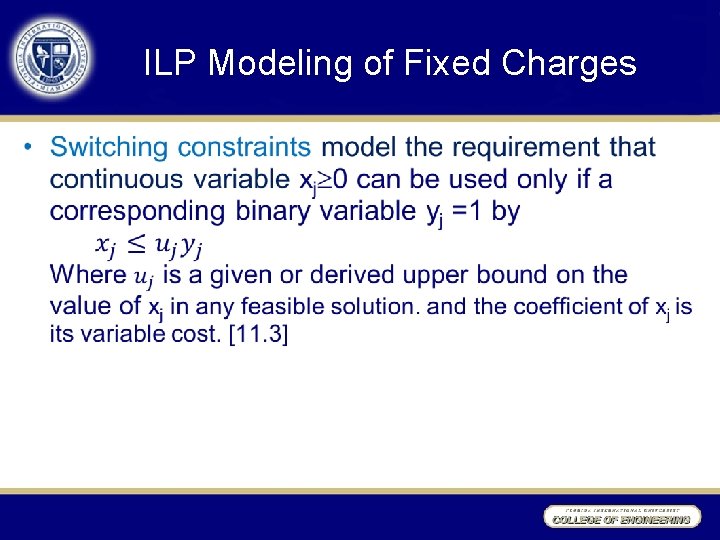
ILP Modeling of Fixed Charges •
Swedish Steel Model with Fixed Charges •
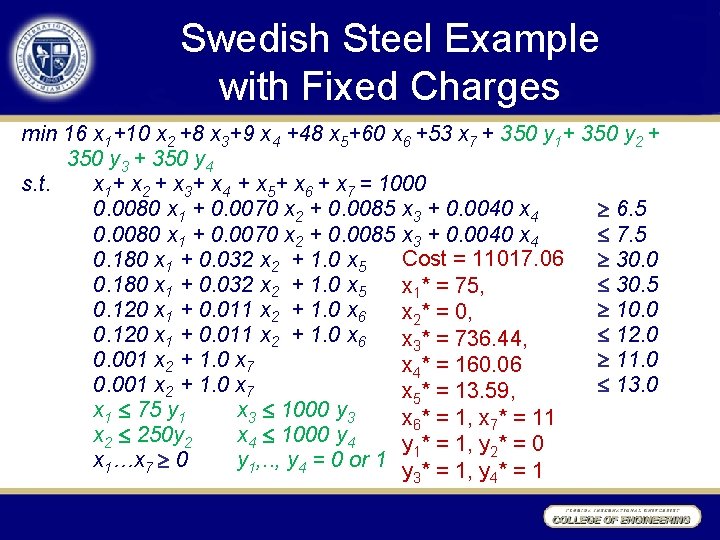
Swedish Steel Example with Fixed Charges min 16 x 1+10 x 2 +8 x 3+9 x 4 +48 x 5+60 x 6 +53 x 7 + 350 y 1+ 350 y 2 + 350 y 3 + 350 y 4 s. t. x 1+ x 2 + x 3+ x 4 + x 5+ x 6 + x 7 = 1000 0. 0080 x 1 + 0. 0070 x 2 + 0. 0085 x 3 + 0. 0040 x 4 6. 5 0. 0080 x 1 + 0. 0070 x 2 + 0. 0085 x 3 + 0. 0040 x 4 7. 5 Cost = 11017. 06 0. 180 x 1 + 0. 032 x 2 + 1. 0 x 5 30. 0 0. 180 x 1 + 0. 032 x 2 + 1. 0 x 5 30. 5 x 1* = 75, 0. 120 x 1 + 0. 011 x 2 + 1. 0 x 6 10. 0 x 2* = 0, 0. 120 x 1 + 0. 011 x 2 + 1. 0 x 6 12. 0 x 3* = 736. 44, 0. 001 x 2 + 1. 0 x 7 11. 0 x 4* = 160. 06 0. 001 x 2 + 1. 0 x 7 13. 0 x 5* = 13. 59, x 1 75 y 1 x 3 1000 y 3 x 6* = 1, x 7* = 11 x 2 250 y 2 x 4 1000 y 4 y 1* = 1, y 2* = 0 x 1…x 7 0 y 1, . . , y 4 = 0 or 1 y * = 1, y * = 1 3 4
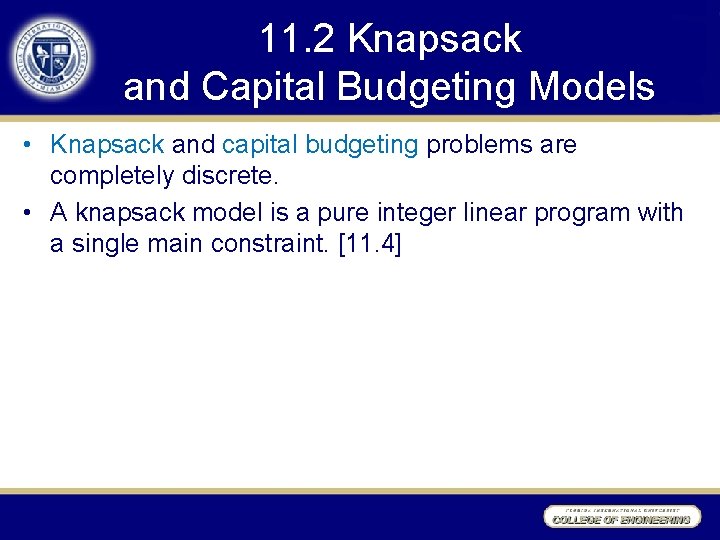
11. 2 Knapsack and Capital Budgeting Models • Knapsack and capital budgeting problems are completely discrete. • A knapsack model is a pure integer linear program with a single main constraint. [11. 4]
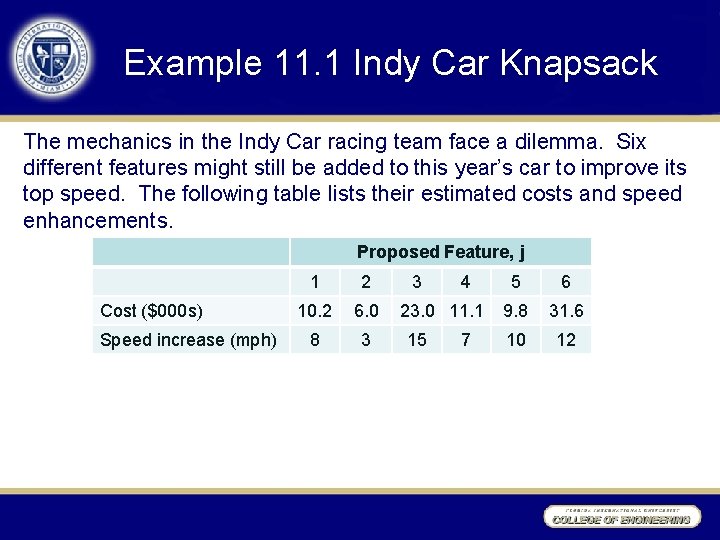
Example 11. 1 Indy Car Knapsack The mechanics in the Indy Car racing team face a dilemma. Six different features might still be added to this year’s car to improve its top speed. The following table lists their estimated costs and speed enhancements. Proposed Feature, j Cost ($000 s) Speed increase (mph) 1 2 10. 2 6. 0 8 3 3 4 23. 0 11. 1 15 7 5 6 9. 8 31. 6 10 12
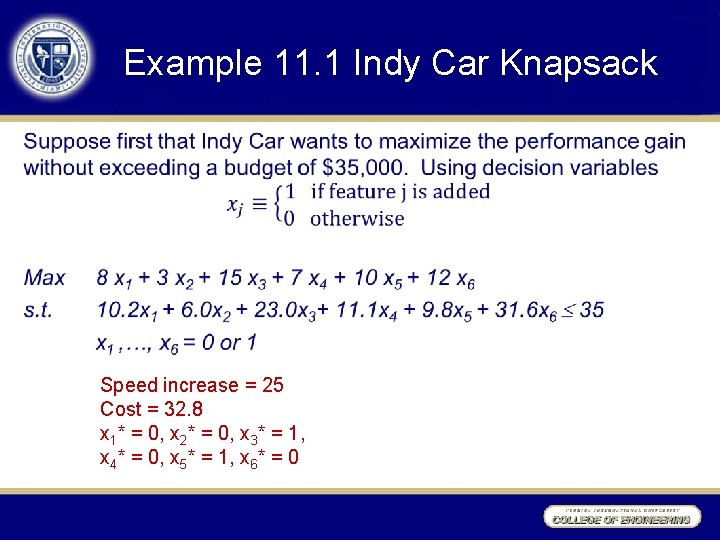
Example 11. 1 Indy Car Knapsack • Speed increase = 25 Cost = 32. 8 x 1* = 0, x 2* = 0, x 3* = 1, x 4* = 0, x 5* = 1, x 6* = 0
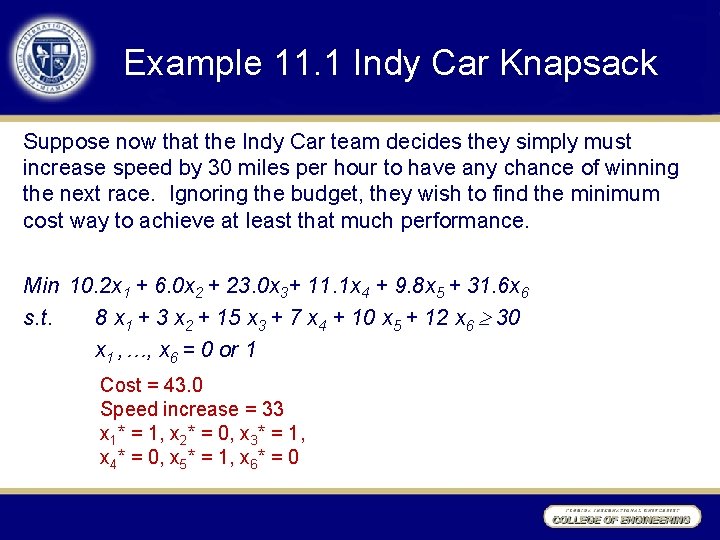
Example 11. 1 Indy Car Knapsack Suppose now that the Indy Car team decides they simply must increase speed by 30 miles per hour to have any chance of winning the next race. Ignoring the budget, they wish to find the minimum cost way to achieve at least that much performance. Min 10. 2 x 1 + 6. 0 x 2 + 23. 0 x 3+ 11. 1 x 4 + 9. 8 x 5 + 31. 6 x 6 s. t. 8 x 1 + 3 x 2 + 15 x 3 + 7 x 4 + 10 x 5 + 12 x 6 30 x 1 , …, x 6 = 0 or 1 Cost = 43. 0 Speed increase = 33 x 1* = 1, x 2* = 0, x 3* = 1, x 4* = 0, x 5* = 1, x 6* = 0
Capital Budgeting Models • The typical maximize form of a knapsack problem has a single main constraint enforcing a budget. • Capital budgeting models (or multi-dimensional knapsack) select a maximum value collection of project, investments, and so on, subject to limitations on budgets or other resources consumed. [11. 5]
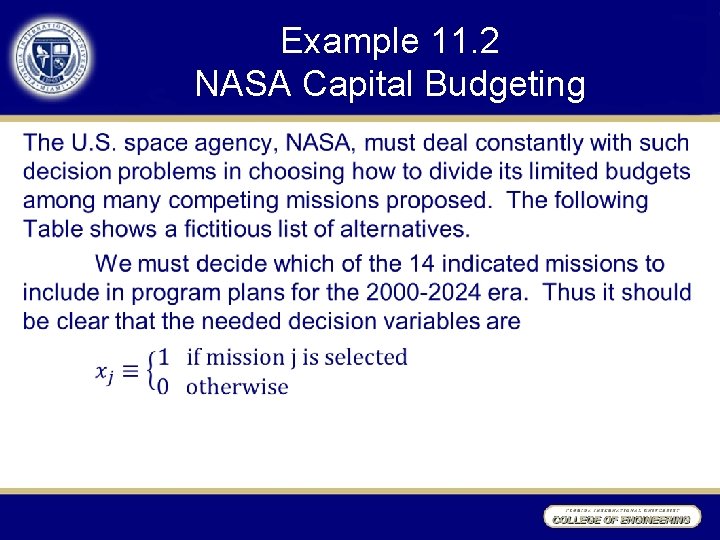
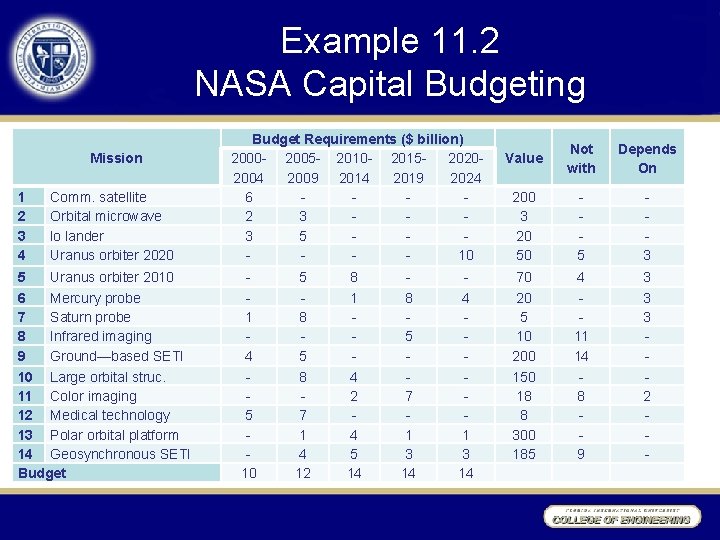
Example 11. 2 NASA Capital Budgeting •
Example 11. 2 NASA Capital Budgeting Mission Budget Requirements ($ billion) 2000 - 2005 - 2010 - 201520202004 2009 2014 2019 2024 6 2 3 3 5 10 Value Not with Depends On 200 3 20 50 5 3 1 2 3 4 Comm. satellite Orbital microwave lo lander Uranus orbiter 2020 5 Uranus orbiter 2010 - 5 8 - - 70 4 3 6 7 8 9 Mercury probe Saturn probe Infrared imaging Ground—based SETI 1 4 8 5 1 - 8 5 - 4 - 20 5 10 200 11 14 3 3 - 5 10 8 7 1 4 12 4 5 14 7 1 3 14 150 18 8 300 185 8 9 2 - 10 Large orbital struc. 11 Color imaging 12 Medical technology 13 Polar orbital platform 14 Geosynchronous SETI Budget
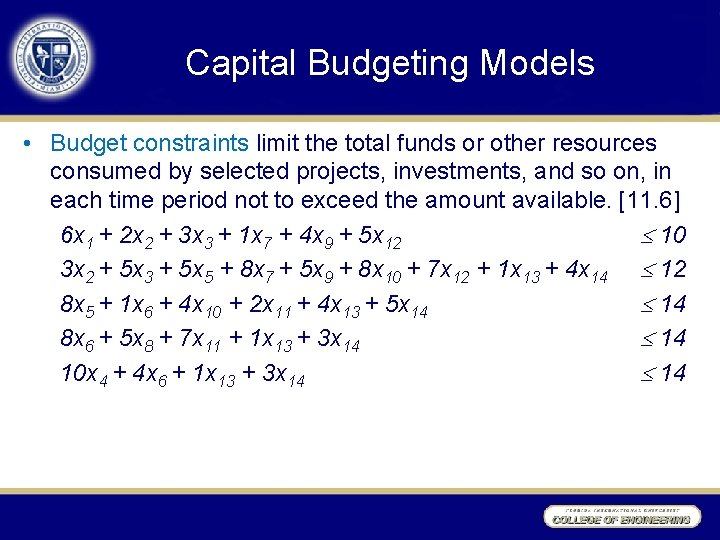
Capital Budgeting Models • Budget constraints limit the total funds or other resources consumed by selected projects, investments, and so on, in each time period not to exceed the amount available. [11. 6] 6 x 1 + 2 x 2 + 3 x 3 + 1 x 7 + 4 x 9 + 5 x 12 10 3 x 2 + 5 x 3 + 5 x 5 + 8 x 7 + 5 x 9 + 8 x 10 + 7 x 12 + 1 x 13 + 4 x 14 12 8 x 5 + 1 x 6 + 4 x 10 + 2 x 11 + 4 x 13 + 5 x 14 8 x 6 + 5 x 8 + 7 x 11 + 1 x 13 + 3 x 14 10 x 4 + 4 x 6 + 1 x 13 + 3 x 14
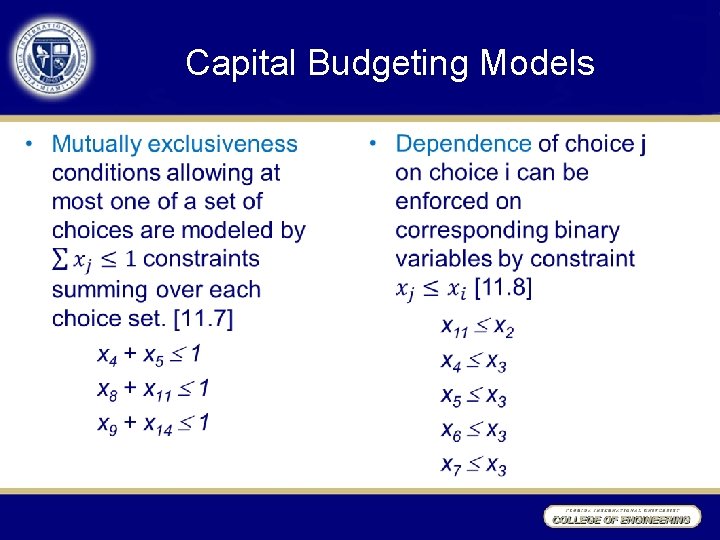
Capital Budgeting Models •
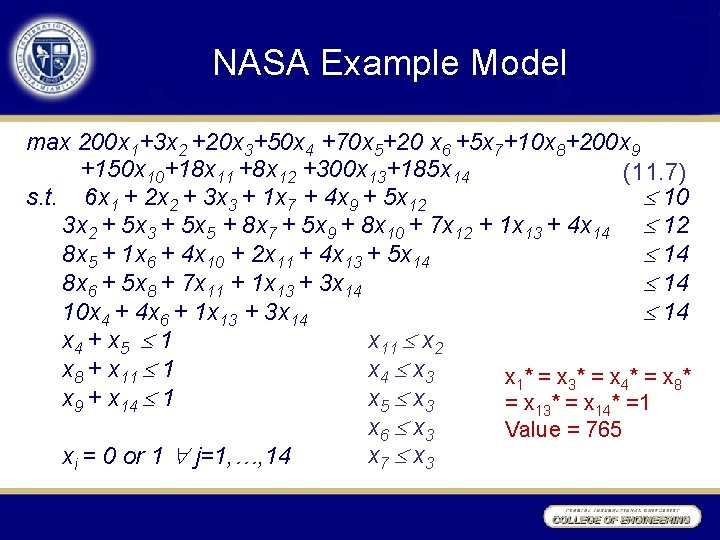
NASA Example Model max 200 x 1+3 x 2 +20 x 3+50 x 4 +70 x 5+20 x 6 +5 x 7+10 x 8+200 x 9 +150 x 10+18 x 11 +8 x 12 +300 x 13+185 x 14 (11. 7) s. t. 6 x 1 + 2 x 2 + 3 x 3 + 1 x 7 + 4 x 9 + 5 x 12 10 3 x 2 + 5 x 3 + 5 x 5 + 8 x 7 + 5 x 9 + 8 x 10 + 7 x 12 + 1 x 13 + 4 x 14 12 8 x 5 + 1 x 6 + 4 x 10 + 2 x 11 + 4 x 13 + 5 x 14 8 x 6 + 5 x 8 + 7 x 11 + 1 x 13 + 3 x 14 10 x 4 + 4 x 6 + 1 x 13 + 3 x 14 x 11 x 2 x 4 + x 5 1 x 4 x 3 x 8 + x 11 1 x 1* = x 3* = x 4* = x 8* x 5 x 3 x 9 + x 14 1 = x 13* = x 14* =1 x 6 x 3 Value = 765 x 7 x 3 xi = 0 or 1 j=1, …, 14
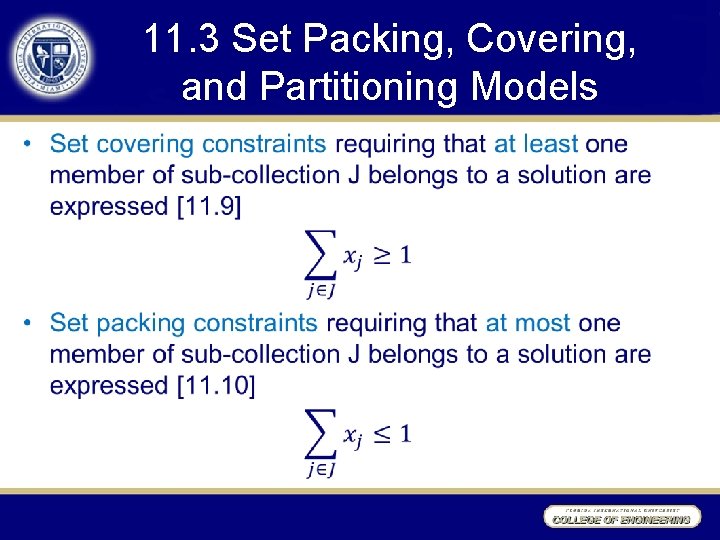
11. 3 Set Packing, Covering, and Partitioning Models •
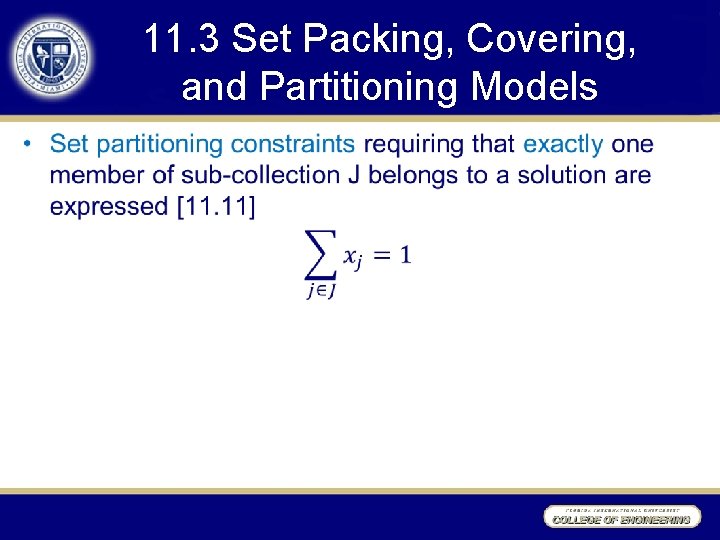
11. 3 Set Packing, Covering, and Partitioning Models •
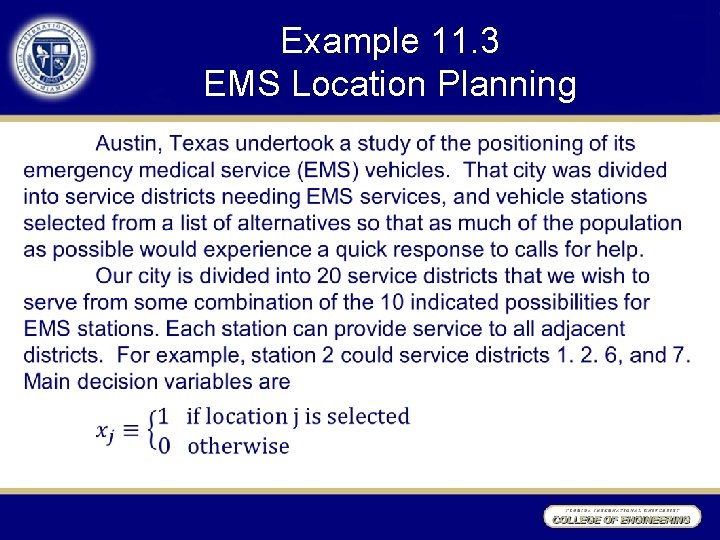
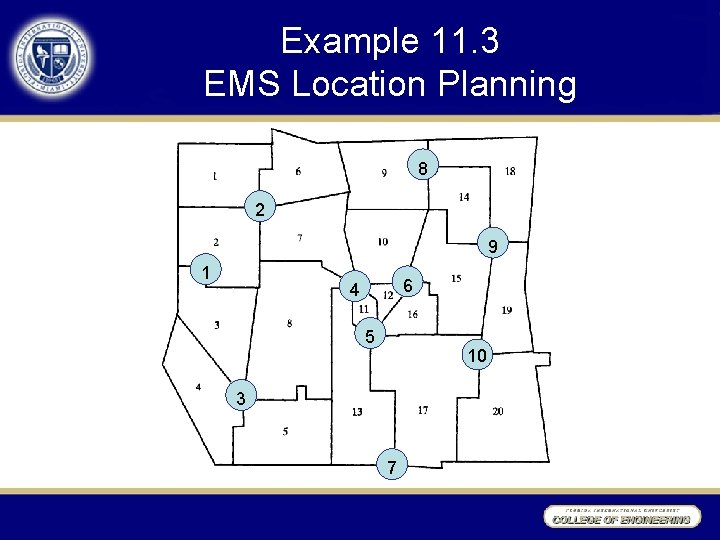
Example 11. 3 EMS Location Planning •
Example 11. 3 EMS Location Planning 8 2 9 1 6 4 5 10 3 7
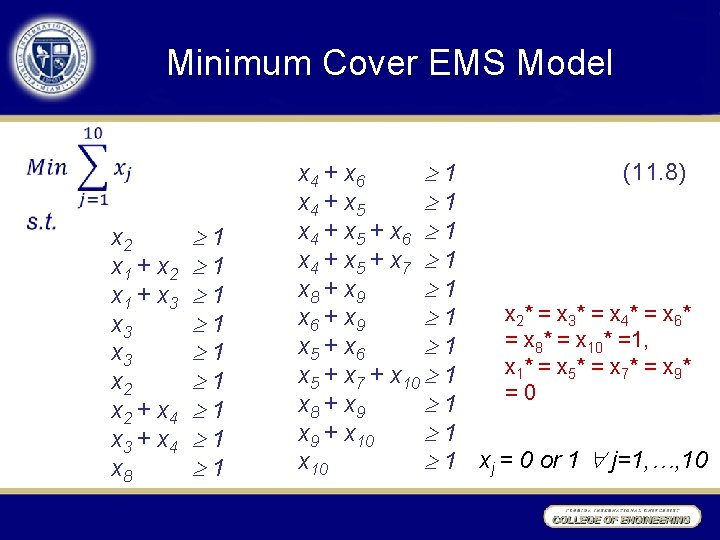
Minimum Cover EMS Model • x 2 x 1 + x 3 x 3 x 2 + x 4 x 3 + x 4 x 8 1 1 1 1 1 (11. 8) x 4 + x 6 1 x 4 + x 5 + x 6 1 x 4 + x 5 + x 7 1 x 8 + x 9 1 x 2* = x 3* = x 4* = x 6* x 6 + x 9 1 = x 8* = x 10* =1, x 5 + x 6 1 x 1* = x 5* = x 7* = x 9* x 5 + x 7 + x 10 1 =0 x 8 + x 9 1 x 9 + x 10 1 x 10 1 xj = 0 or 1 j=1, …, 10
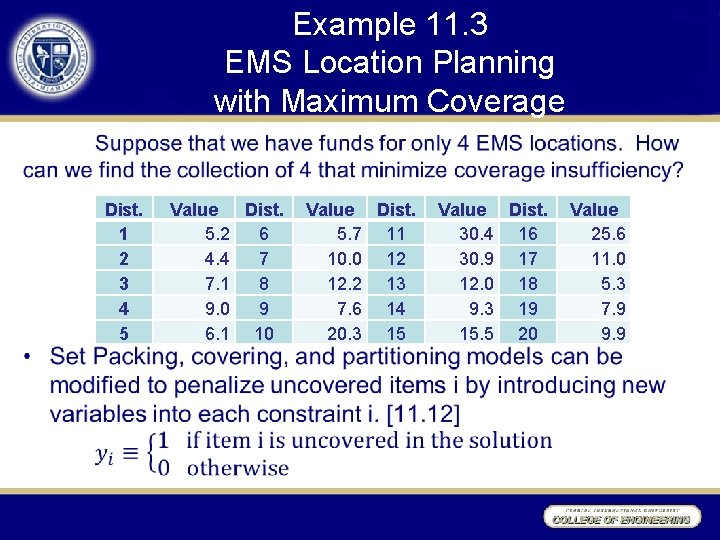
Example 11. 3 EMS Location Planning with Maximum Coverage • Dist. 1 2 3 4 5 Value Dist. 5. 2 6 4. 4 7 7. 1 8 9. 0 9 6. 1 10 Value Dist. 5. 7 11 10. 0 12 12. 2 13 7. 6 14 20. 3 15 Value Dist. 30. 4 16 30. 9 17 12. 0 18 9. 3 19 15. 5 20 Value 25. 6 11. 0 5. 3 7. 9 9. 9
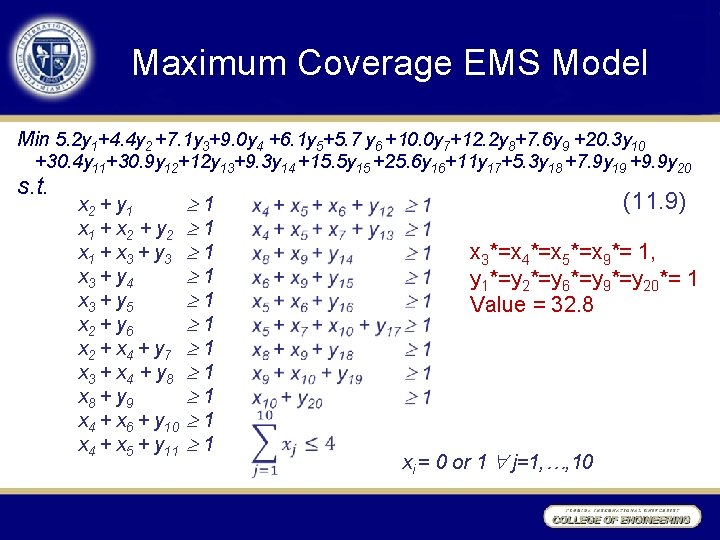
Maximum Coverage EMS Model Min 5. 2 y 1+4. 4 y 2 +7. 1 y 3+9. 0 y 4 +6. 1 y 5+5. 7 y 6 +10. 0 y 7+12. 2 y 8+7. 6 y 9 +20. 3 y 10 +30. 4 y 11+30. 9 y 12+12 y 13+9. 3 y 14 +15. 5 y 15 +25. 6 y 16+11 y 17+5. 3 y 18 +7. 9 y 19 +9. 9 y 20 s. t. x 2 + y 1 x 1 + x 2 + y 2 x 1 + x 3 + y 3 x 3 + y 4 x 3 + y 5 x 2 + y 6 x 2 + x 4 + y 7 x 3 + x 4 + y 8 x 8 + y 9 x 4 + x 6 + y 10 x 4 + x 5 + y 11 1 1 1 (11. 9) x 3*=x 4*=x 5*=x 9*= 1, y 1*=y 2*=y 6*=y 9*=y 20*= 1 Value = 32. 8 xi = 0 or 1 j=1, …, 10
Column Generation Models • Column generation approaches deal with complex combinatorial problems by first enumerating a sequence of columns representing viable solutions to parts of the problem, and then solving a set of partitioning (or covering or packing) model to select an optimal collection of these alternatives fulfilling all problem requirements. [11. 13]
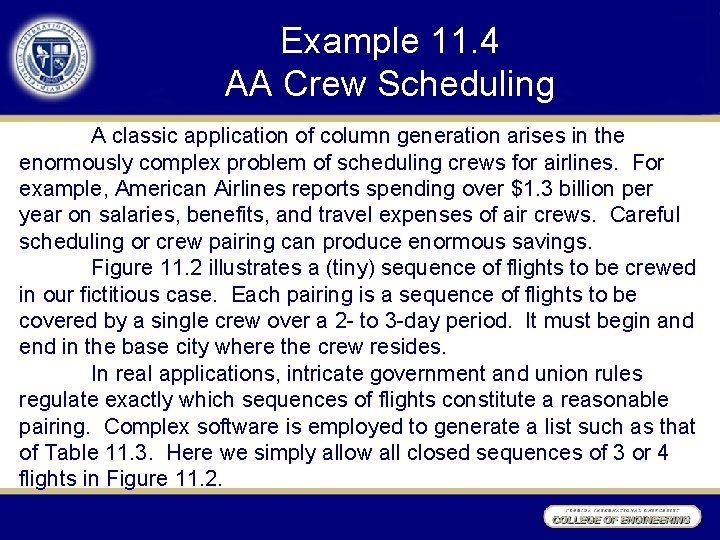
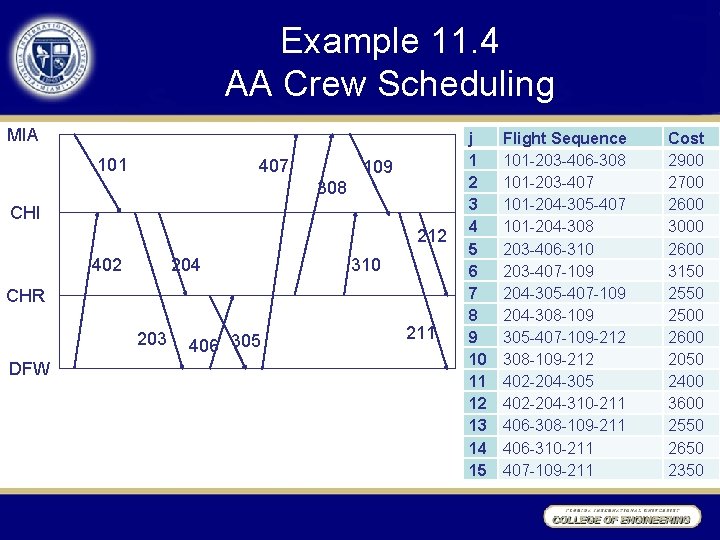
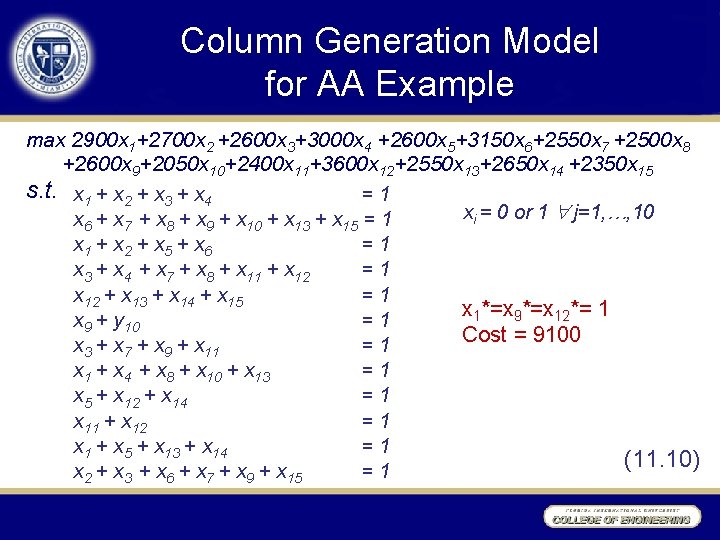
Example 11. 4 AA Crew Scheduling A classic application of column generation arises in the enormously complex problem of scheduling crews for airlines. For example, American Airlines reports spending over $1. 3 billion per year on salaries, benefits, and travel expenses of air crews. Careful scheduling or crew pairing can produce enormous savings. Figure 11. 2 illustrates a (tiny) sequence of flights to be crewed in our fictitious case. Each pairing is a sequence of flights to be covered by a single crew over a 2 - to 3 -day period. It must begin and end in the base city where the crew resides. In real applications, intricate government and union rules regulate exactly which sequences of flights constitute a reasonable pairing. Complex software is employed to generate a list such as that of Table 11. 3. Here we simply allow all closed sequences of 3 or 4 flights in Figure 11. 2. Pairing
Example 11. 4 AA Crew Scheduling MIA 101 407 109 308 CHI 212 402 204 310 CHR 203 DFW 406 305 211 j 1 2 3 4 5 6 7 8 9 10 11 12 13 14 15 Flight Sequence 101 -203 -406 -308 101 -203 -407 101 -204 -305 -407 101 -204 -308 203 -406 -310 203 -407 -109 204 -305 -407 -109 204 -308 -109 305 -407 -109 -212 308 -109 -212 402 -204 -305 402 -204 -310 -211 406 -308 -109 -211 406 -310 -211 407 -109 -211 Cost 2900 2700 2600 3000 2600 3150 2500 2600 2050 2400 3600 2550 2650 2350
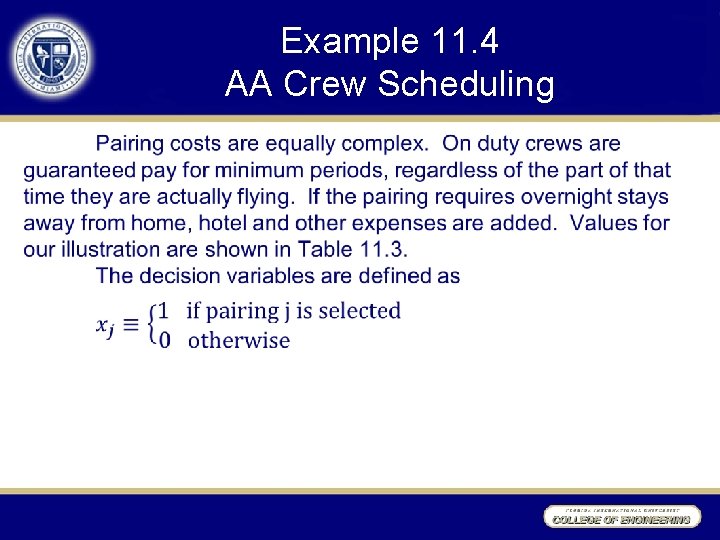
Example 11. 4 AA Crew Scheduling •
Column Generation Model for AA Example max 2900 x 1+2700 x 2 +2600 x 3+3000 x 4 +2600 x 5+3150 x 6+2550 x 7 +2500 x 8 +2600 x 9+2050 x 10+2400 x 11+3600 x 12+2550 x 13+2650 x 14 +2350 x 15 s. t. x 1 + x 2 + x 3 + x 4 =1 xi = 0 or 1 j=1, …, 10 x 6 + x 7 + x 8 + x 9 + x 10 + x 13 + x 15 = 1 x 1 + x 2 + x 5 + x 6 =1 x 3 + x 4 + x 7 + x 8 + x 11 + x 12 =1 x 12 + x 13 + x 14 + x 15 =1 x 1*=x 9*=x 12*= 1 x 9 + y 10 =1 Cost = 9100 x 3 + x 7 + x 9 + x 11 =1 x 1 + x 4 + x 8 + x 10 + x 13 =1 x 5 + x 12 + x 14 =1 x 11 + x 12 =1 x 1 + x 5 + x 13 + x 14 =1 (11. 10) x 2 + x 3 + x 6 + x 7 + x 9 + x 15 =1
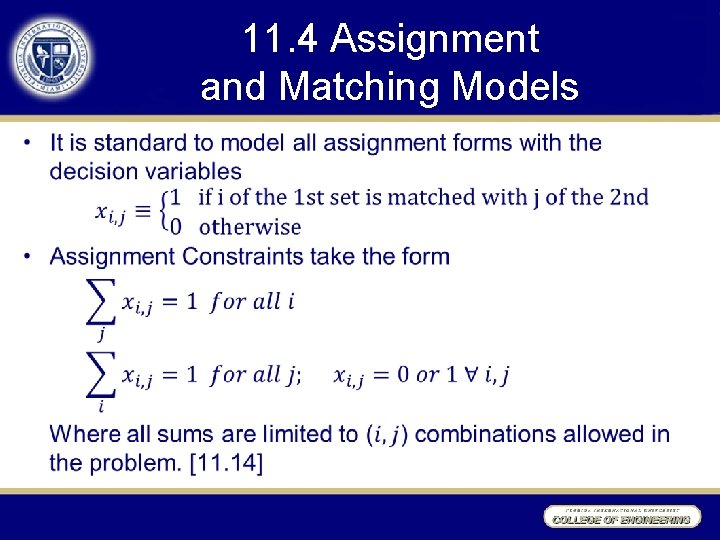
11. 4 Assignment and Matching Models •
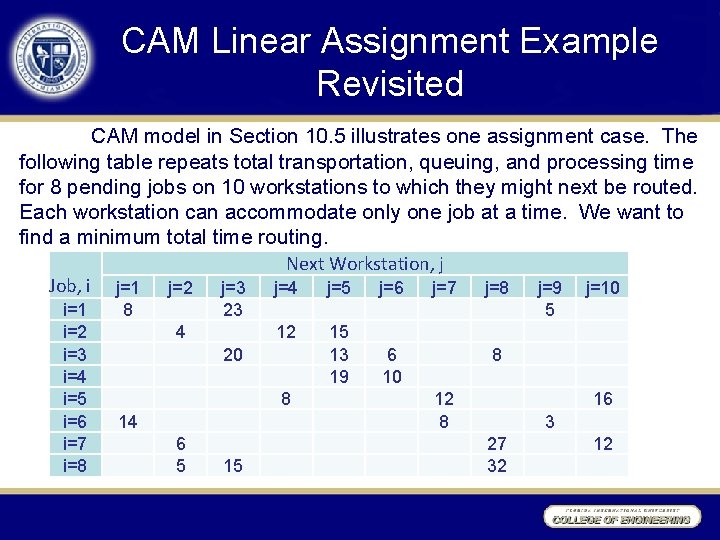
CAM Linear Assignment Example Revisited CAM model in Section 10. 5 illustrates one assignment case. The following table repeats total transportation, queuing, and processing time for 8 pending jobs on 10 workstations to which they might next be routed. Each workstation can accommodate only one job at a time. We want to find a minimum total time routing. Next Workstation, j Job, i j=1 j=2 j=3 j=4 j=5 j=6 j=7 j=8 j=9 j=10 i=1 i=2 i=3 i=4 i=5 i=6 i=7 i=8 8 23 4 5 12 20 8 14 6 5 15 15 13 19 6 10 8 12 8 16 3 27 32 12
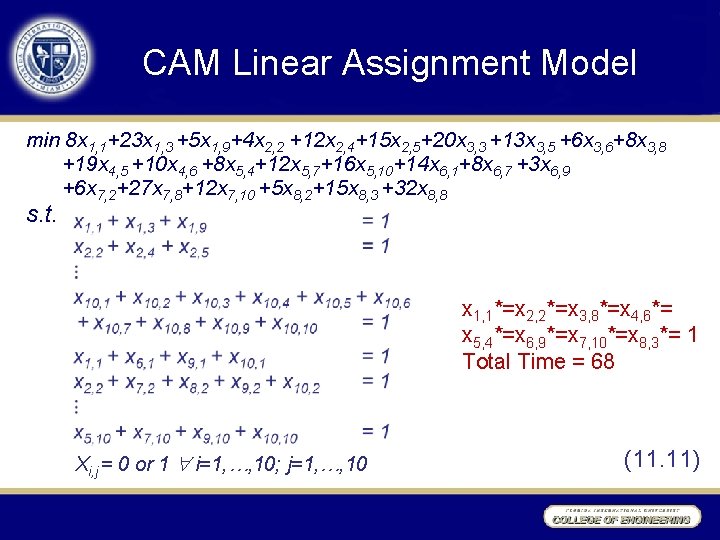
CAM Linear Assignment Model min 8 x 1, 1+23 x 1, 3 +5 x 1, 9+4 x 2, 2 +12 x 2, 4+15 x 2, 5+20 x 3, 3 +13 x 3, 5 +6 x 3, 6+8 x 3, 8 +19 x 4, 5 +10 x 4, 6 +8 x 5, 4+12 x 5, 7+16 x 5, 10+14 x 6, 1+8 x 6, 7 +3 x 6, 9 +6 x 7, 2+27 x 7, 8+12 x 7, 10 +5 x 8, 2+15 x 8, 3 +32 x 8, 8 s. t. x 1, 1*=x 2, 2*=x 3, 8*=x 4, 6*= x 5, 4*=x 6, 9*=x 7, 10*=x 8, 3*= 1 Total Time = 68 Xi, j = 0 or 1 i=1, …, 10; j=1, …, 10 (11. 11)
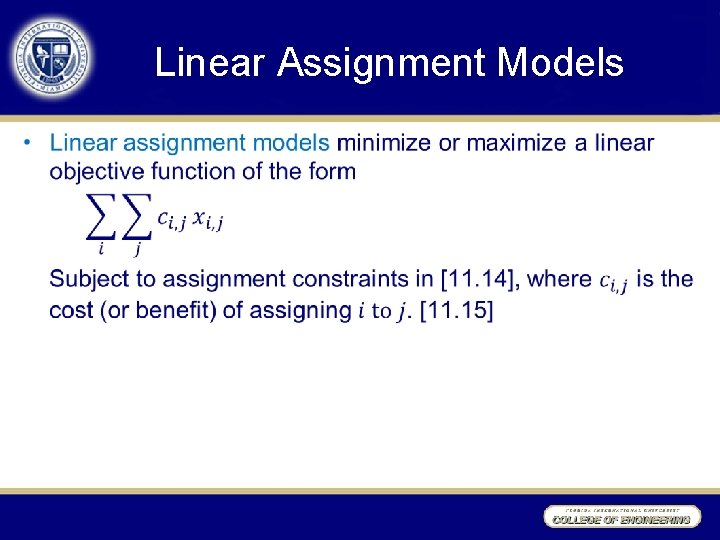
Linear Assignment Models •
Quadratic Assignment Models •
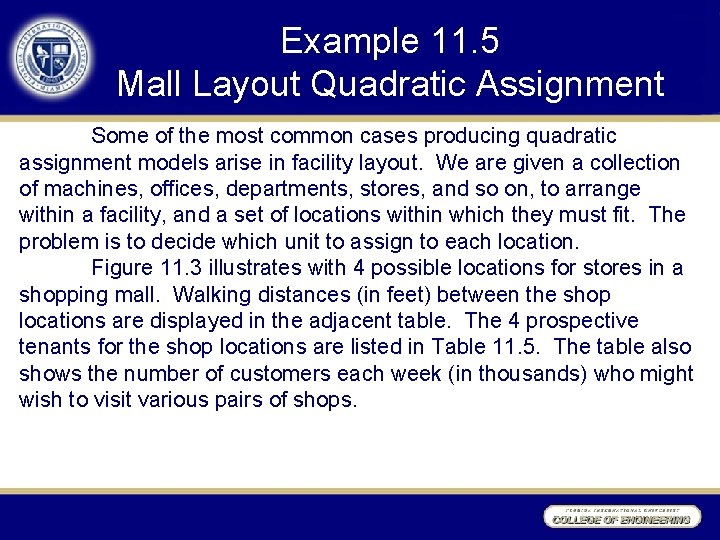
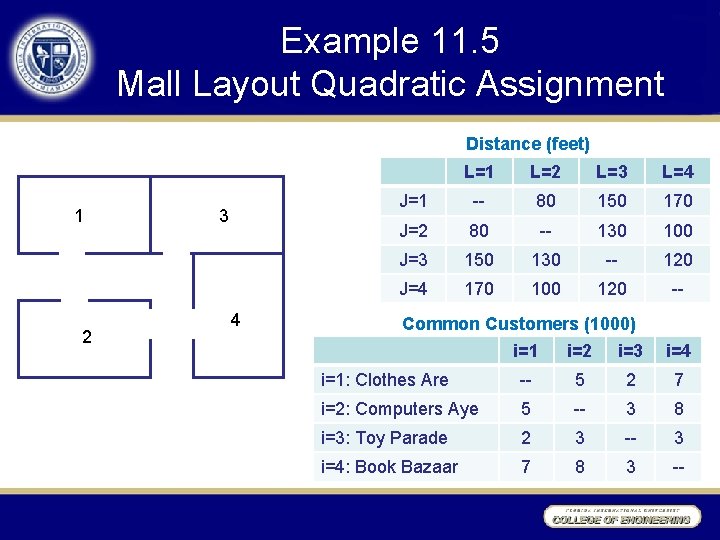
Example 11. 5 Mall Layout Quadratic Assignment Some of the most common cases producing quadratic assignment models arise in facility layout. We are given a collection of machines, offices, departments, stores, and so on, to arrange within a facility, and a set of locations within which they must fit. The problem is to decide which unit to assign to each location. Figure 11. 3 illustrates with 4 possible locations for stores in a shopping mall. Walking distances (in feet) between the shop locations are displayed in the adjacent table. The 4 prospective tenants for the shop locations are listed in Table 11. 5. The table also shows the number of customers each week (in thousands) who might wish to visit various pairs of shops.
Example 11. 5 Mall Layout Quadratic Assignment Distance (feet) 1 2 3 4 L=1 L=2 L=3 L=4 J=1 -- 80 150 170 J=2 80 -- 130 100 J=3 150 130 -- 120 J=4 170 100 120 -- Common Customers (1000) i=1 i=2 i=3 i=4 i=1: Clothes Are -- 5 2 7 i=2: Computers Aye 5 -- 3 8 i=3: Toy Parade 2 3 -- 3 i=4: Book Bazaar 7 8 3 --
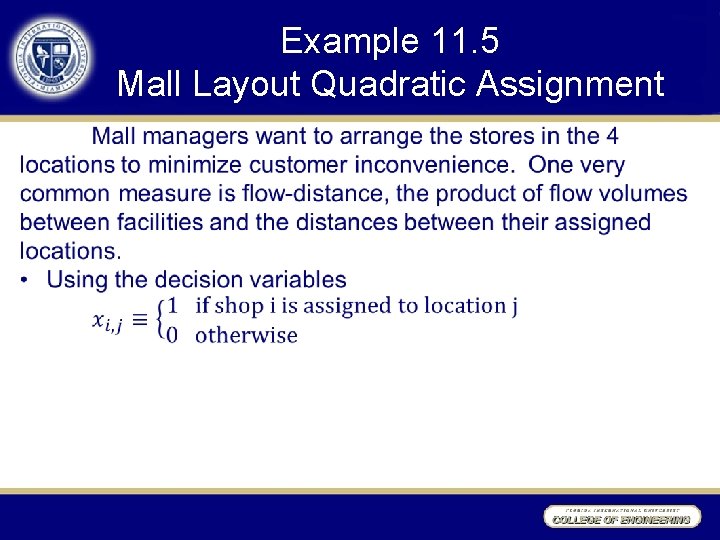
Example 11. 5 Mall Layout Quadratic Assignment •
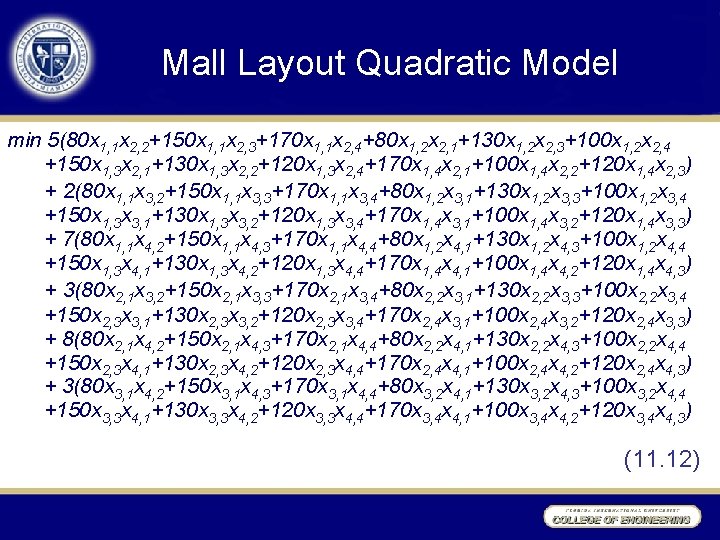
Mall Layout Quadratic Model min 5(80 x 1, 1 x 2, 2+150 x 1, 1 x 2, 3+170 x 1, 1 x 2, 4+80 x 1, 2 x 2, 1+130 x 1, 2 x 2, 3+100 x 1, 2 x 2, 4 +150 x 1, 3 x 2, 1+130 x 1, 3 x 2, 2+120 x 1, 3 x 2, 4+170 x 1, 4 x 2, 1+100 x 1, 4 x 2, 2+120 x 1, 4 x 2, 3) + 2(80 x 1, 1 x 3, 2+150 x 1, 1 x 3, 3+170 x 1, 1 x 3, 4+80 x 1, 2 x 3, 1+130 x 1, 2 x 3, 3+100 x 1, 2 x 3, 4 +150 x 1, 3 x 3, 1+130 x 1, 3 x 3, 2+120 x 1, 3 x 3, 4+170 x 1, 4 x 3, 1+100 x 1, 4 x 3, 2+120 x 1, 4 x 3, 3) + 7(80 x 1, 1 x 4, 2+150 x 1, 1 x 4, 3+170 x 1, 1 x 4, 4+80 x 1, 2 x 4, 1+130 x 1, 2 x 4, 3+100 x 1, 2 x 4, 4 +150 x 1, 3 x 4, 1+130 x 1, 3 x 4, 2+120 x 1, 3 x 4, 4+170 x 1, 4 x 4, 1+100 x 1, 4 x 4, 2+120 x 1, 4 x 4, 3) + 3(80 x 2, 1 x 3, 2+150 x 2, 1 x 3, 3+170 x 2, 1 x 3, 4+80 x 2, 2 x 3, 1+130 x 2, 2 x 3, 3+100 x 2, 2 x 3, 4 +150 x 2, 3 x 3, 1+130 x 2, 3 x 3, 2+120 x 2, 3 x 3, 4+170 x 2, 4 x 3, 1+100 x 2, 4 x 3, 2+120 x 2, 4 x 3, 3) + 8(80 x 2, 1 x 4, 2+150 x 2, 1 x 4, 3+170 x 2, 1 x 4, 4+80 x 2, 2 x 4, 1+130 x 2, 2 x 4, 3+100 x 2, 2 x 4, 4 +150 x 2, 3 x 4, 1+130 x 2, 3 x 4, 2+120 x 2, 3 x 4, 4+170 x 2, 4 x 4, 1+100 x 2, 4 x 4, 2+120 x 2, 4 x 4, 3) + 3(80 x 3, 1 x 4, 2+150 x 3, 1 x 4, 3+170 x 3, 1 x 4, 4+80 x 3, 2 x 4, 1+130 x 3, 2 x 4, 3+100 x 3, 2 x 4, 4 +150 x 3, 3 x 4, 1+130 x 3, 3 x 4, 2+120 x 3, 3 x 4, 4+170 x 3, 4 x 4, 1+100 x 3, 4 x 4, 2+120 x 3, 4 x 4, 3) (11. 12)
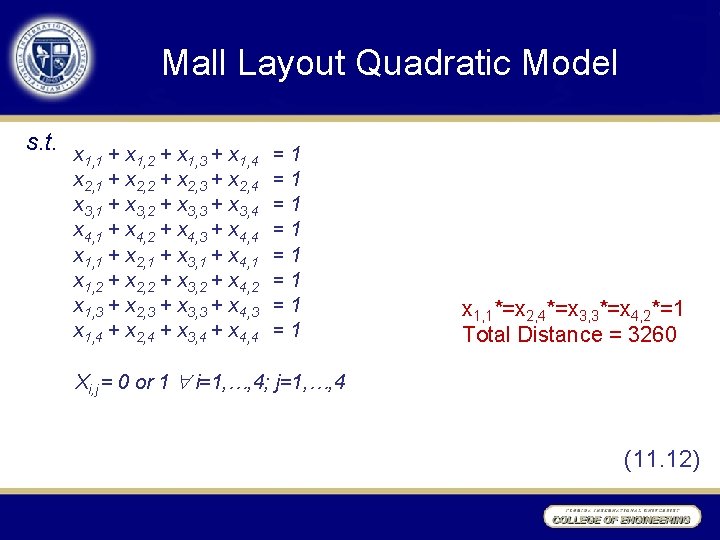
Mall Layout Quadratic Model s. t. x + x + x = 1 1, 2 1, 3 1, 4 x 2, 1 + x 2, 2 + x 2, 3 + x 2, 4 x 3, 1 + x 3, 2 + x 3, 3 + x 3, 4 x 4, 1 + x 4, 2 + x 4, 3 + x 4, 4 x 1, 1 + x 2, 1 + x 3, 1 + x 4, 1 x 1, 2 + x 2, 2 + x 3, 2 + x 4, 2 x 1, 3 + x 2, 3 + x 3, 3 + x 4, 3 x 1, 4 + x 2, 4 + x 3, 4 + x 4, 4 =1 =1 x 1, 1*=x 2, 4*=x 3, 3*=x 4, 2*=1 Total Distance = 3260 Xi, j = 0 or 1 i=1, …, 4; j=1, …, 4 (11. 12)
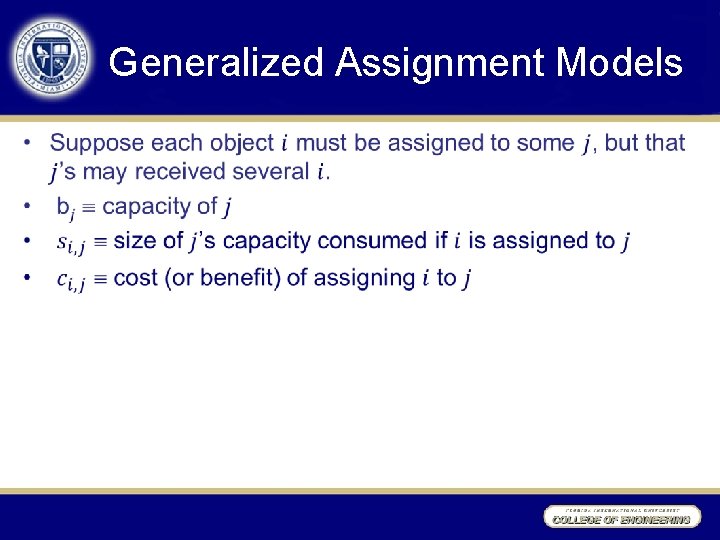
Generalized Assignment Models •
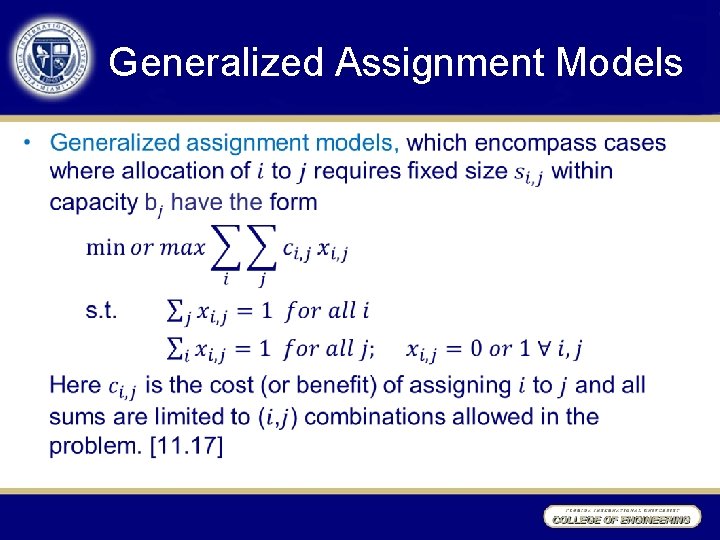
Generalized Assignment Models •
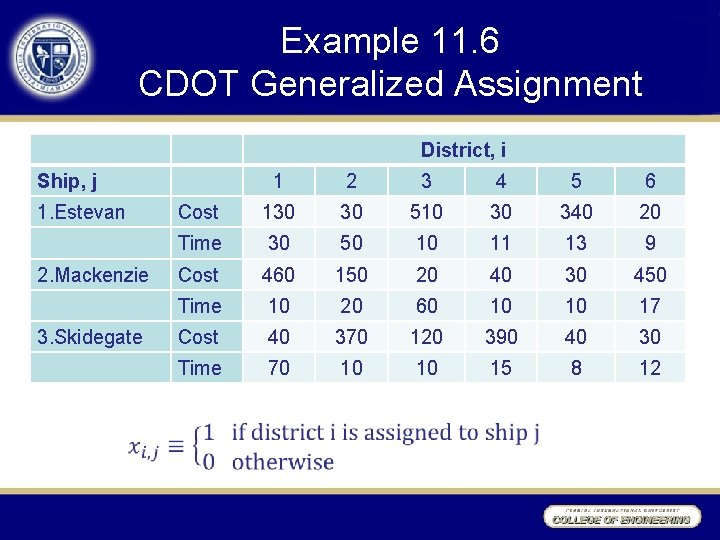
Example 11. 6 CDOT Generalized Assignment The Canadian Department of Transportation encountered a problem of the generalized assignment form when reviewing their allocation of coast guard ships on Canada’s Pacific coast. The ships maintain such navigational aids as lighthouses and buoys. Each of the districts along the coast is assigned to one of a smaller number of coast guard ships. Since the ships have different home bases and different equipment and operating costs, the time and cost for assigning any district varies considerably among the ships. The task is to find a minimum cost assignment. Table 11. 6 shows data for our (fictitious) version of the problem. Three ships-the Estevan, the Mackenzie, and the Skidegate--are available to serve 6 districts. Entries in the table show the number of weeks each ship would require to maintain aides in each district, together with the annual cost (in thousands of Canadian dollars). Each ship is available SG weeks per year.
Example 11. 6 CDOT Generalized Assignment District, i Ship, j 1. Estevan 2. Mackenzie 3. Skidegate 1 2 3 4 5 6 Cost 130 30 510 30 340 20 Time 30 50 10 11 13 9 Cost 460 150 20 40 30 450 Time 10 20 60 10 10 17 Cost 40 370 120 390 40 30 Time 70 10 10 15 8 12
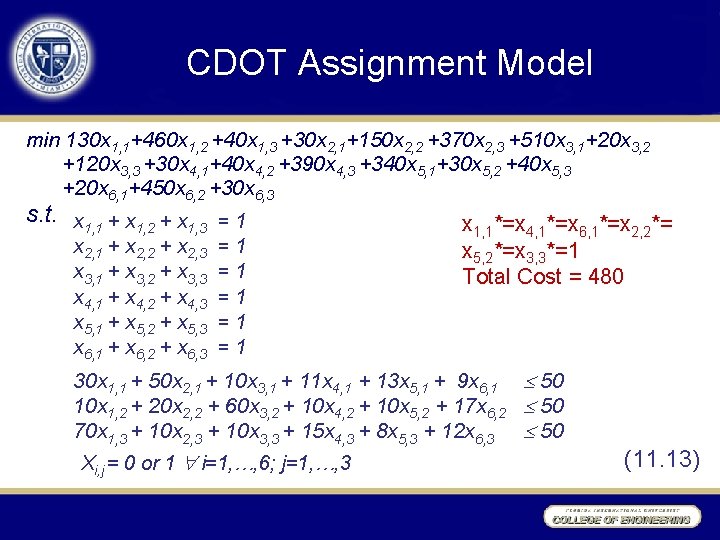
CDOT Assignment Model min 130 x 1, 1+460 x 1, 2 +40 x 1, 3 +30 x 2, 1+150 x 2, 2 +370 x 2, 3 +510 x 3, 1+20 x 3, 2 +120 x 3, 3 +30 x 4, 1+40 x 4, 2 +390 x 4, 3 +340 x 5, 1+30 x 5, 2 +40 x 5, 3 +20 x 6, 1+450 x 6, 2 +30 x 6, 3 s. t. x 1, 1 + x 1, 2 + x 1, 3 = 1 x 2, 1 + x 2, 2 + x 2, 3 x 3, 1 + x 3, 2 + x 3, 3 x 4, 1 + x 4, 2 + x 4, 3 x 5, 1 + x 5, 2 + x 5, 3 x 6, 1 + x 6, 2 + x 6, 3 =1 =1 =1 x 1, 1*=x 4, 1*=x 6, 1*=x 2, 2*= x 5, 2*=x 3, 3*=1 Total Cost = 480 30 x 1, 1 + 50 x 2, 1 + 10 x 3, 1 + 11 x 4, 1 + 13 x 5, 1 + 9 x 6, 1 50 10 x 1, 2 + 20 x 2, 2 + 60 x 3, 2 + 10 x 4, 2 + 10 x 5, 2 + 17 x 6, 2 50 70 x 1, 3 + 10 x 2, 3 + 10 x 3, 3 + 15 x 4, 3 + 8 x 5, 3 + 12 x 6, 3 50 Xi, j = 0 or 1 i=1, …, 6; j=1, …, 3 (11. 13)
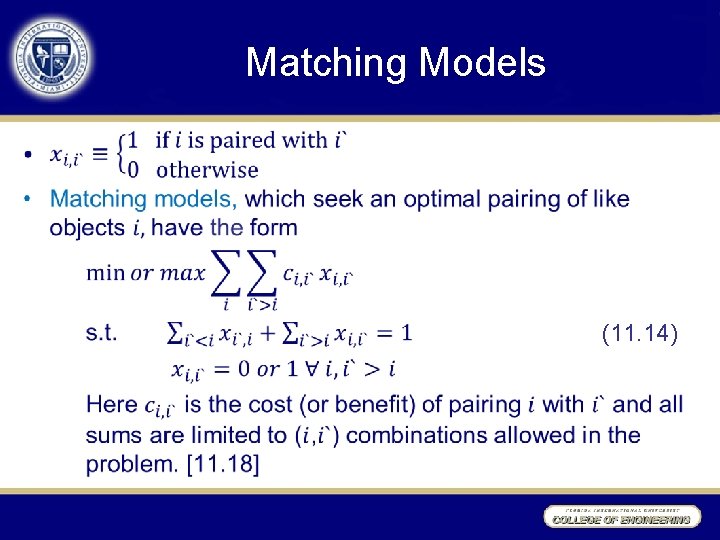
Matching Models • (11. 14)
Example 11. 7 Superfi Speaker Matching We may illustrate matching with the task faced by fictitious high-fidelity speaker manufacturer Superfi sells its speakers in pairs. Even though the manufacturing process maintains the most rigid quality standards, any two speakers produced will still interfere slightly with each other when connected to the same stereo system. To improve its product quality even more, Superfi has measured the distortion dw for each pair of speakers in the current lot. They wish to determine how to pair the speakers so that total distortion is minimized. Notice that any two speakers may be paired. There is no distinction between large and small, or left and right.
Tractability of Assignment and Matching Models • Linear assignment models are highly tractable because they can be viewed as network flow problems, and thus as special cases of linear programming. Even more efficient specialpurpose algorithms exist. [11. 19] • It is very difficult to compute global optima in quadratic assignment models because the nonlinear objective function precludes even the ILP method of Sections 12. 2 to 12. 5. Improving search heuristics like those of Sections 12. 6 and 12. 7 are usually applied. [11. 20]
Tractability of Assignment and Matching Models • Generalized assignment models, which are ILPs, can be solved in moderate size by the methods of Sections 12. 2 to 12. 5. Still, they are far less tractable than the linear assignment case. [11. 21] • Matching models are more difficult to solve than linear assignment case but efficient special-purpose algorithms are known that can solve quite large instances. [11. 22]
11. 5 Traveling Salesman and Routing Models •
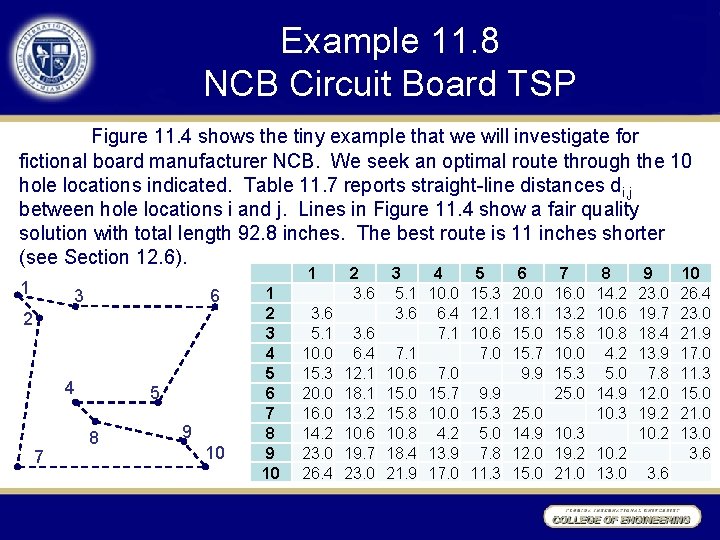
Example 11. 8 NCB Circuit Board TSP Figure 11. 4 shows the tiny example that we will investigate for fictional board manufacturer NCB. We seek an optimal route through the 10 hole locations indicated. Table 11. 7 reports straight-line distances di, j between hole locations i and j. Lines in Figure 11. 4 show a fair quality solution with total length 92. 8 inches. The best route is 11 inches shorter (see Section 12. 6). 1 1 3 6 2 4 7 5 8 9 10 1 2 3 4 5 6 7 8 9 10 3. 6 5. 1 10. 0 15. 3 20. 0 16. 0 14. 2 23. 0 26. 4 2 3. 6 6. 4 12. 1 18. 1 13. 2 10. 6 19. 7 23. 0 3 4 5 5. 1 10. 0 15. 3 3. 6 6. 4 12. 1 7. 1 10. 6 7. 1 7. 0 10. 6 7. 0 15. 7 9. 9 15. 8 10. 0 15. 3 10. 8 4. 2 5. 0 18. 4 13. 9 7. 8 21. 9 17. 0 11. 3 6 20. 0 18. 1 15. 0 15. 7 9. 9 7 16. 0 13. 2 15. 8 10. 0 15. 3 25. 0 8 14. 2 10. 6 10. 8 4. 2 5. 0 14. 9 10. 3 25. 0 14. 9 10. 3 12. 0 19. 2 10. 2 15. 0 21. 0 13. 0 9 23. 0 19. 7 18. 4 13. 9 7. 8 12. 0 19. 2 10. 2 3. 6 10 26. 4 23. 0 21. 9 17. 0 11. 3 15. 0 21. 0 13. 0 3. 6
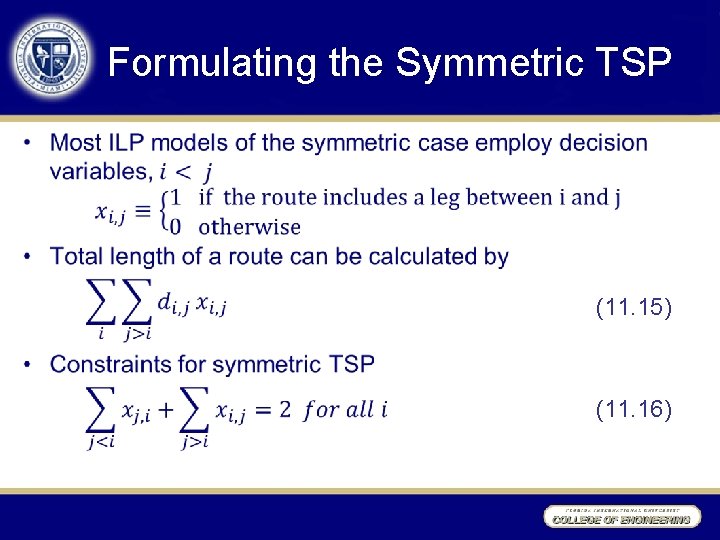
Formulating the Symmetric TSP • (11. 15) (11. 16)
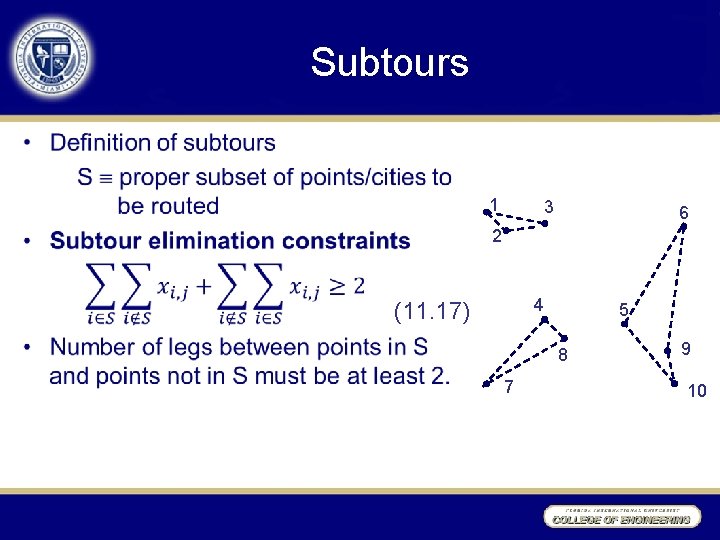
Subtours • 1 3 6 2 4 (11. 17) 5 8 7 9 10
ILP Model of the Symmetric TSP • [11. 25]
ILP Model of the Asymmetric TSP • [11. 26]
Quadratic Assignment Formulation of the TSP • Let [11. 27] s. t.
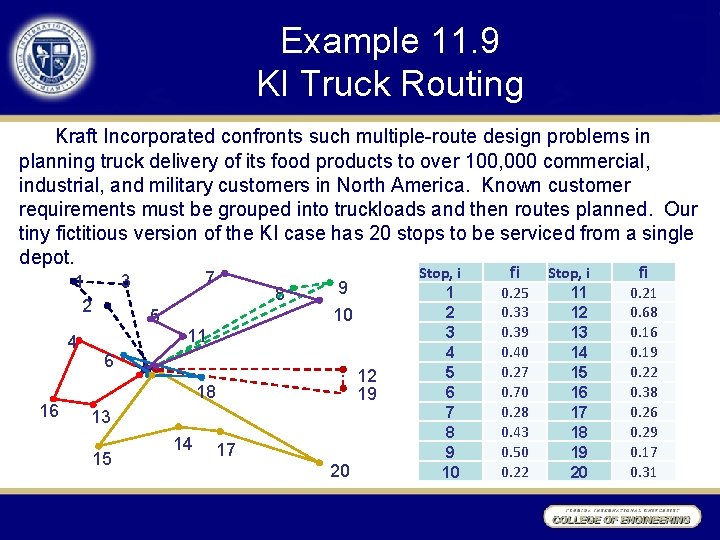
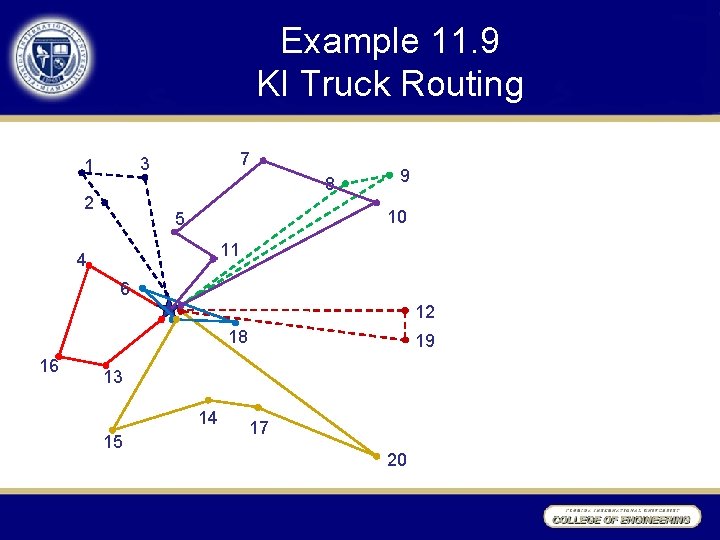
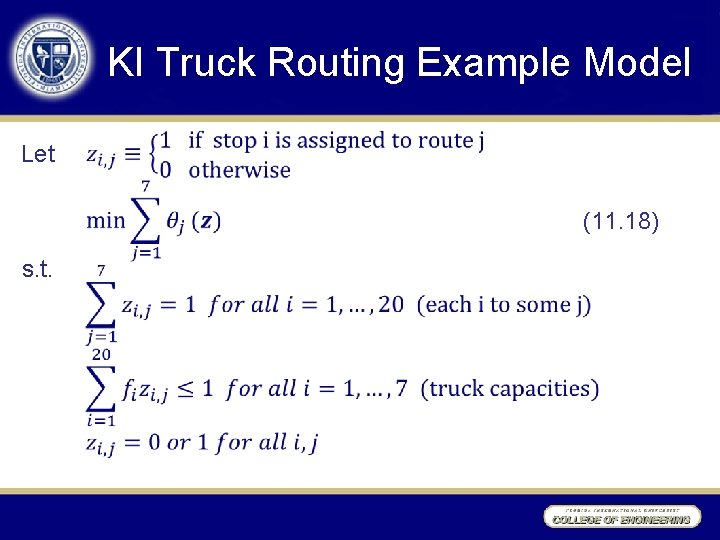
Example 11. 9 KI Truck Routing Kraft Incorporated confronts such multiple-route design problems in planning truck delivery of its food products to over 100, 000 commercial, industrial, and military customers in North America. Known customer requirements must be grouped into truckloads and then routes planned. Our tiny fictitious version of the KI case has 20 stops to be serviced from a single depot. 4 16 7 3 1 2 5 8 9 10 11 6 12 19 18 13 15 14 17 20 Stop, i 1 2 3 4 5 6 7 8 9 10 fi 0. 25 0. 33 0. 39 0. 40 0. 27 0. 70 0. 28 0. 43 0. 50 0. 22 Stop, i 11 12 13 14 15 16 17 18 19 20 fi 0. 21 0. 68 0. 16 0. 19 0. 22 0. 38 0. 26 0. 29 0. 17 0. 31
Example 11. 9 KI Truck Routing 7 3 1 8 2 9 10 5 11 4 6 12 18 16 19 13 14 15 17 20
KI Truck Routing Example Model • Let (11. 18) s. t.
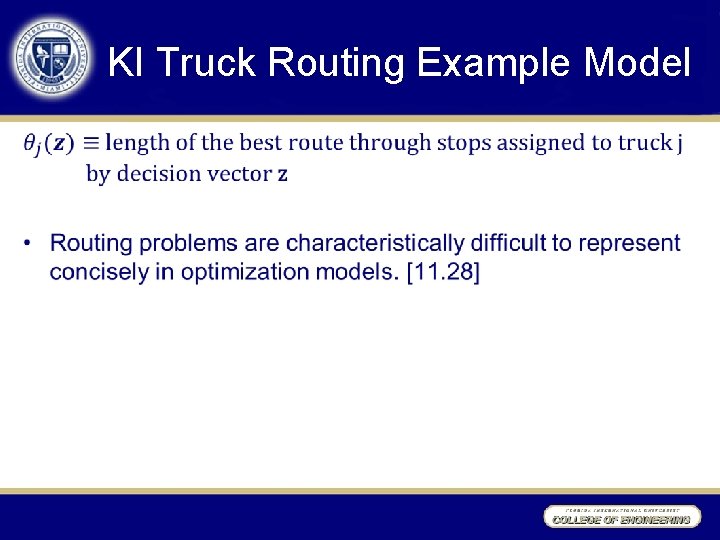
KI Truck Routing Example Model •
11. 6 Facility Location and Network Design Models • Fixed charges can be modeled with new binary variables and switching constraints. Facility Location and Network Design are common cases of fixed charges. Facility Location Models • Facility/plant/warehouse location models choose which of a proposed list of facilities to open in order to service specified customer demands at minimum total cost. [11. 29]
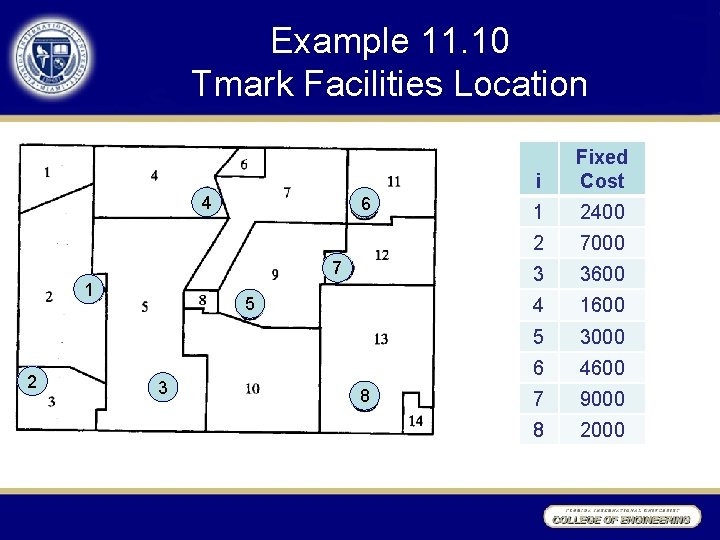
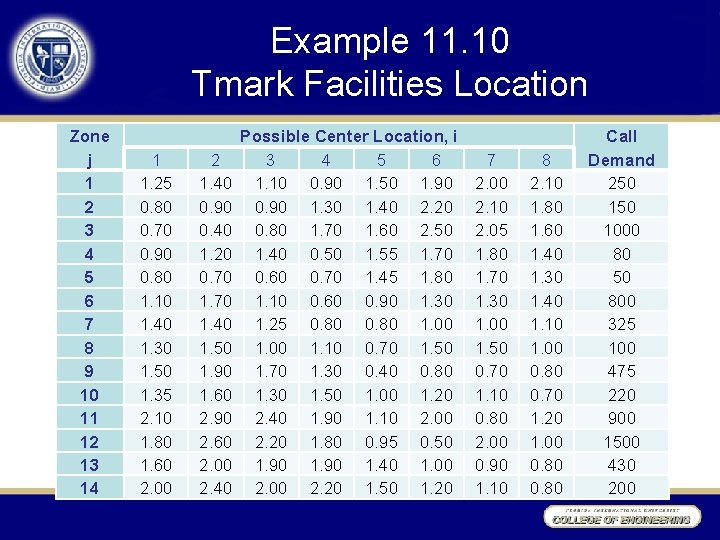
Example 11. 10 Tmark Facilities Location AT&T has confronted many facility location problems in recommending sites for the toll-free call-in centers of its telemarketing customers. Such centers handle telephone reservations and orders arising in many geographic zones. Since telephone rates vary dramatically depending on the zone of call origin and the location of the receiving center, site selection is extremely important. A well-designed system should minimize the total of call charges and center setup costs. Our version of this scenario will involve fictional firm Tmark. Figure 11. 7 shows the 8 sites under consideration for Tmark’s catalog order centers embedded in a map of the 14 calling zones. Table 11. 9 shows corresponding unit calling charges, ri, j, from each zone j to various centers i, and the zone’s anticipated call load, dj. Any Tmark center selected can handle between 1500 and 5000 call units per day. However, their fixed costs of operation vary significantly because of differences in labor and real estate prices. Estimated daily fixed cost, fi, for the 8 centers are displayed in Figure 11. 7.
Example 11. 10 Tmark Facilities Location 4 6 7 1 2 5 3 8 i Fixed Cost 1 2400 2 7000 3 3600 4 1600 5 3000 6 4600 7 9000 8 2000
Example 11. 10 Tmark Facilities Location Zone j 1 2 3 4 5 6 7 8 9 10 11 12 13 14 1 1. 25 0. 80 0. 70 0. 90 0. 80 1. 10 1. 40 1. 30 1. 50 1. 35 2. 10 1. 80 1. 60 2. 00 2 1. 40 0. 90 0. 40 1. 20 0. 70 1. 40 1. 50 1. 90 1. 60 2. 90 2. 60 2. 00 2. 40 Possible Center Location, i 3 4 5 6 1. 10 0. 90 1. 50 1. 90 0. 90 1. 30 1. 40 2. 20 0. 80 1. 70 1. 60 2. 50 1. 40 0. 50 1. 55 1. 70 0. 60 0. 70 1. 45 1. 80 1. 10 0. 60 0. 90 1. 30 1. 25 0. 80 1. 00 1. 10 0. 70 1. 50 1. 70 1. 30 0. 40 0. 80 1. 30 1. 50 1. 00 1. 20 2. 40 1. 90 1. 10 2. 00 2. 20 1. 80 0. 95 0. 50 1. 90 1. 40 1. 00 2. 20 1. 50 1. 20 7 2. 00 2. 10 2. 05 1. 80 1. 70 1. 30 1. 00 1. 50 0. 70 1. 10 0. 80 2. 00 0. 90 1. 10 8 2. 10 1. 80 1. 60 1. 40 1. 30 1. 40 1. 10 1. 00 0. 80 0. 70 1. 20 1. 00 0. 80 Call Demand 250 1000 80 50 800 325 100 475 220 900 1500 430 200
ILP Model of Facilities Location • Let s. t. [11. 30]
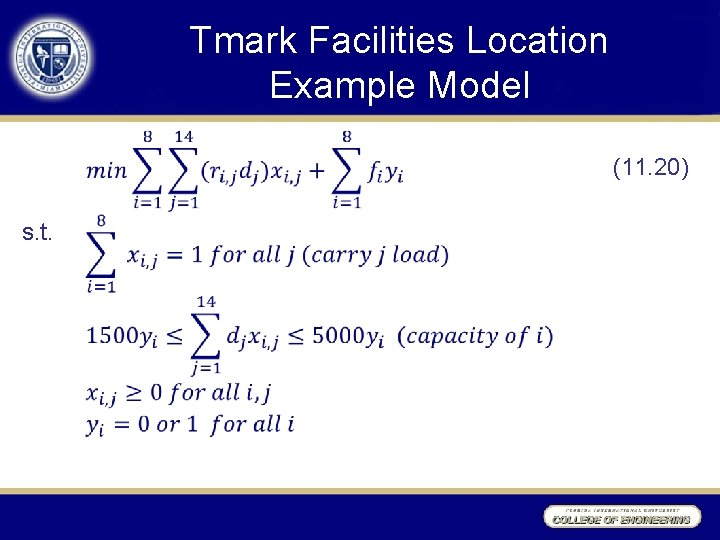
Tmark Facilities Location Example Model • s. t. (11. 20)
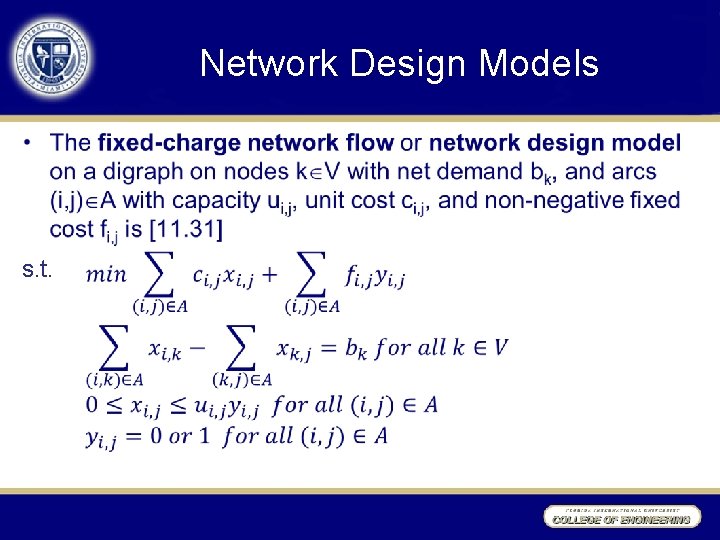
Network Design Models • s. t.
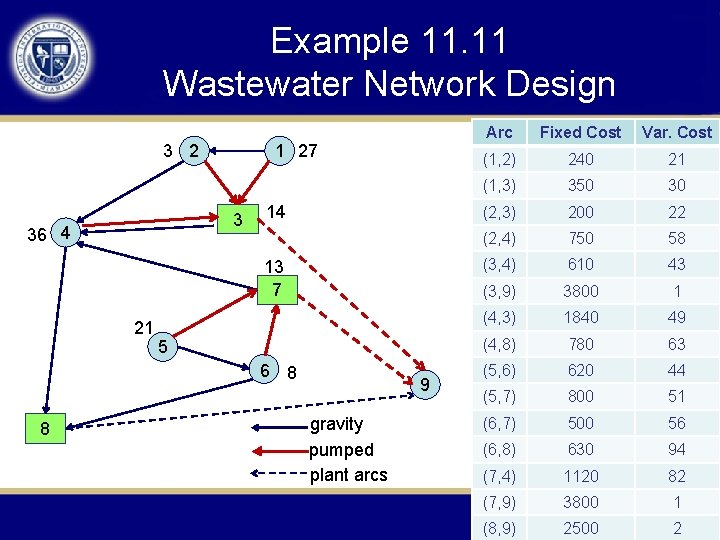
Example 11. 11 Wastewater Network Design Network design applications may involve telecommunications, electricity, water, gas, coal slurry, or any other substance that flows in a network. We illustrate with an application involving regional wastewater (sewer) networks. As new areas develop around major cities, entire networks of collector sewers and treatment plants must be constructed to service growing population. Figure 11. 8 displays our particular (fictional) instance. Nodes 1 to 8 of the network represent population centers where smaller sewers feed into the main regional network, and locations where treatment plants might be built. Wastewater loads are roughly proportional to population, so the inflows indicated at nodes represent population units (in thousands).
Example 11. 11 Wastewater Network Design Arcs joining nodes 1 to 8 show possible routes for main collector sewers. Most follow the topology in gravity flow, but one pumped line (4. 3) is included. A large part of the construction cost for either type of line is fixed: right-of-way acquisition, trenching, and so on. Still, the cost of a line also grows with the number of population units carried, because greater flows imply larger-diameter pipes. The table in Figure 11. 8 shows the fixed and variable cost for each arc in thousand of dollars. Treatment plant costs actually occur at nodes—here nodes 3, 7, and 8. Figure 11. 8 illustrates, however, that such costs can be modeled on arcs by introducing an artificial “supersink" node 9. Costs shown for arcs (3, 9), (7. 9), and (8, 9) capture the fixed and variable expense of plant construction as flows depart the network.
Example 11. 11 Wastewater Network Design 3 2 1 27 3 36 4 14 13 7 21 5 6 8 8 9 gravity pumped plant arcs Arc Fixed Cost Var. Cost (1, 2) 240 21 (1, 3) 350 30 (2, 3) 200 22 (2, 4) 750 58 (3, 4) 610 43 (3, 9) 3800 1 (4, 3) 1840 49 (4, 8) 780 63 (5, 6) 620 44 (5, 7) 800 51 (6, 7) 500 56 (6, 8) 630 94 (7, 4) 1120 82 (7, 9) 3800 1 (8, 9) 2500 2
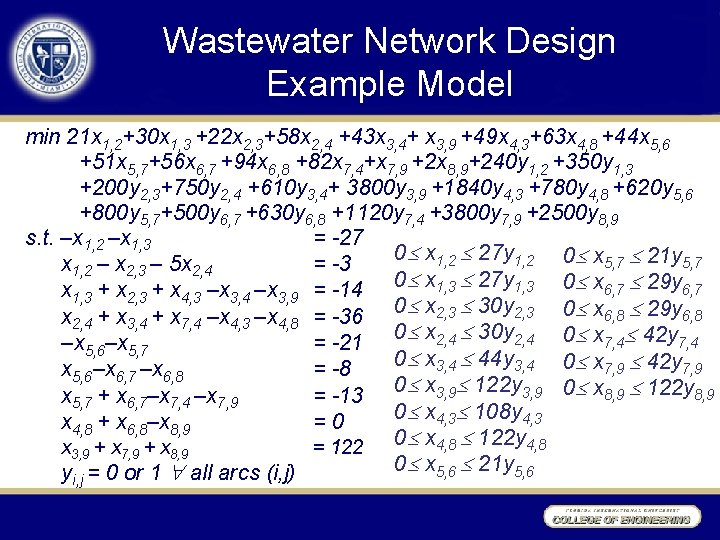
Wastewater Network Design Example Model min 21 x 1, 2+30 x 1, 3 +22 x 2, 3+58 x 2, 4 +43 x 3, 4+ x 3, 9 +49 x 4, 3+63 x 4, 8 +44 x 5, 6 +51 x 5, 7+56 x 6, 7 +94 x 6, 8 +82 x 7, 4+x 7, 9 +2 x 8, 9+240 y 1, 2 +350 y 1, 3 +200 y 2, 3+750 y 2, 4 +610 y 3, 4+ 3800 y 3, 9 +1840 y 4, 3 +780 y 4, 8 +620 y 5, 6 +800 y 5, 7+500 y 6, 7 +630 y 6, 8 +1120 y 7, 4 +3800 y 7, 9 +2500 y 8, 9 s. t. –x 1, 2 –x 1, 3 = -27 0 x 1, 2 27 y 1, 2 0 x 5, 7 21 y 5, 7 x 1, 2 – x 2, 3 – 5 x 2, 4 = -3 x 1, 3 + x 2, 3 + x 4, 3 –x 3, 4 –x 3, 9 = -14 0 x 1, 3 27 y 1, 3 0 x 6, 7 29 y 6, 7 x 2, 4 + x 3, 4 + x 7, 4 –x 4, 3 –x 4, 8 = -36 0 x 2, 3 30 y 2, 3 0 x 6, 8 29 y 6, 8 –x 5, 6–x 5, 7 = -21 0 x 2, 4 30 y 2, 4 0 x 7, 4 42 y 7, 4 0 x 3, 4 44 y 3, 4 0 x 7, 9 42 y 7, 9 x 5, 6–x 6, 7 –x 6, 8 = -8 x 5, 7 + x 6, 7–x 7, 4 –x 7, 9 = -13 0 x 3, 9 122 y 3, 9 0 x 8, 9 122 y 8, 9 0 x 4, 3 108 y 4, 3 x 4, 8 + x 6, 8–x 8, 9 =0 0 x 4, 8 122 y 4, 8 x 3, 9 + x 7, 9 + x 8, 9 = 122 0 x 5, 6 21 y 5, 6 y = 0 or 1 all arcs (i, j) i, j
11. 7 Processor Scheduling and Sequencing Models Single-Processor Scheduling Problems • Single-processor (or single-machine) scheduling problems seek an optimal sequence in which to complete a given collection of jobs on a single processor that can accommodate only one job at a time. [11. 32]
Example 11. 12 Nifty Notes Single-Machine Scheduling We begin with the binder scheduling problem confronting a fictitious Nifty Notes copy shop. Just before the start of each semester, professors at the nearby university supply Nifty Notes with a single original of their class handouts, a projection of the class enrollment, and a due date by which copies should be available. Then the Nifty Notes staff must rush to print and bind the required number of copies before each class begins. During the busy period each semester, Nifty Notes operates its single binding station 24 hours per day. Table 11. 10 shows process times, release times, and due dates for the jobs j = 1, . . . , 6 now pending at the binder. : We wish to choose an optimal sequence in which to accomplish these jobs. No more than one can be in process at a time; and once started. a job must be completed before another can begin.
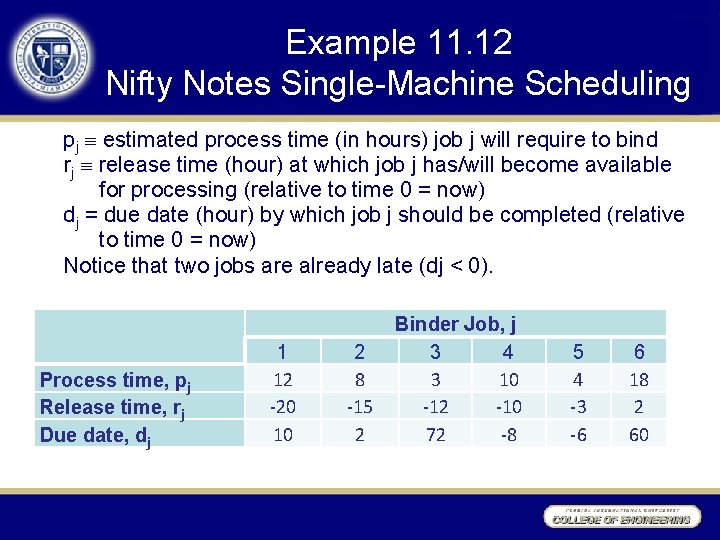
Example 11. 12 Nifty Notes Single-Machine Scheduling pj estimated process time (in hours) job j will require to bind rj release time (hour) at which job j has/will become available for processing (relative to time 0 = now) dj = due date (hour) by which job j should be completed (relative to time 0 = now) Notice that two jobs are already late (dj < 0). Process time, pj Release time, rj Due date, dj 1 12 -20 10 2 8 -15 2 Binder Job, j 3 4 3 10 -12 -10 72 -8 5 4 -3 -6 6 18 2 60
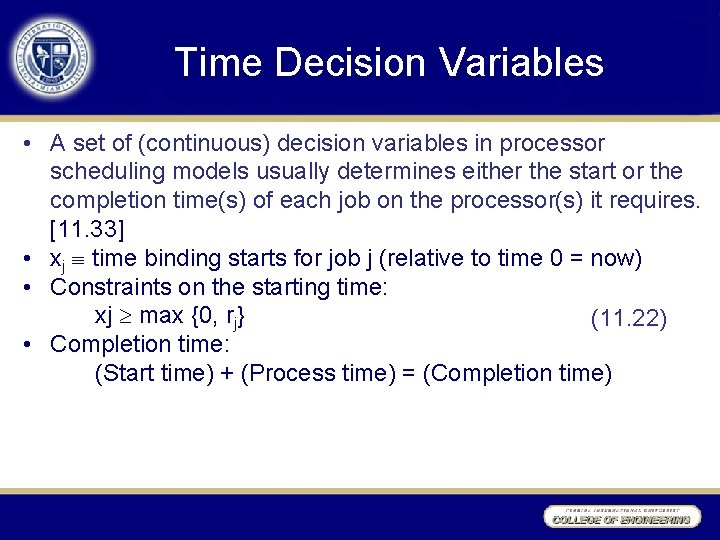
Time Decision Variables • A set of (continuous) decision variables in processor scheduling models usually determines either the start or the completion time(s) of each job on the processor(s) it requires. [11. 33] • xj time binding starts for job j (relative to time 0 = now) • Constraints on the starting time: xj max {0, rj} (11. 22) • Completion time: (Start time) + (Process time) = (Completion time)
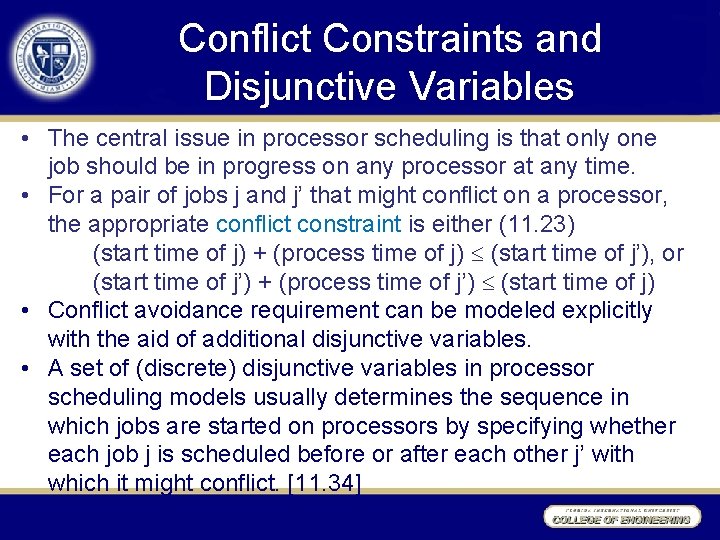
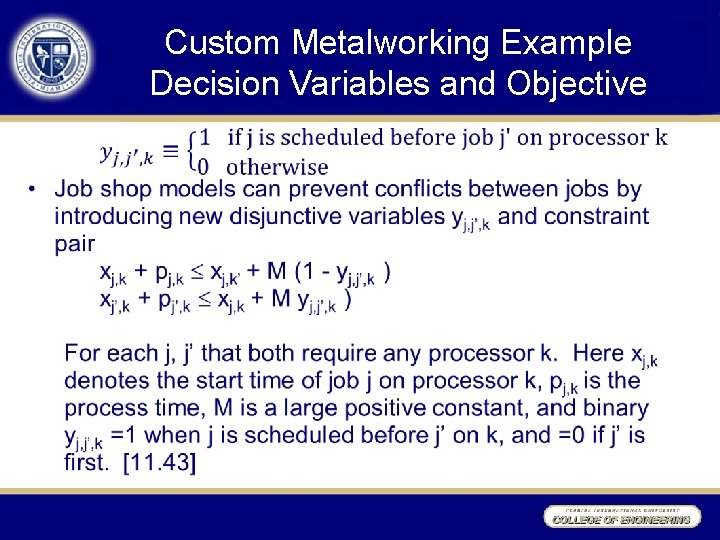
Conflict Constraints and Disjunctive Variables • The central issue in processor scheduling is that only one job should be in progress on any processor at any time. • For a pair of jobs j and j’ that might conflict on a processor, the appropriate conflict constraint is either (11. 23) (start time of j) + (process time of j) (start time of j’), or (start time of j’) + (process time of j’) (start time of j) • Conflict avoidance requirement can be modeled explicitly with the aid of additional disjunctive variables. • A set of (discrete) disjunctive variables in processor scheduling models usually determines the sequence in which jobs are started on processors by specifying whether each job j is scheduled before or after each other j’ with which it might conflict. [11. 34]
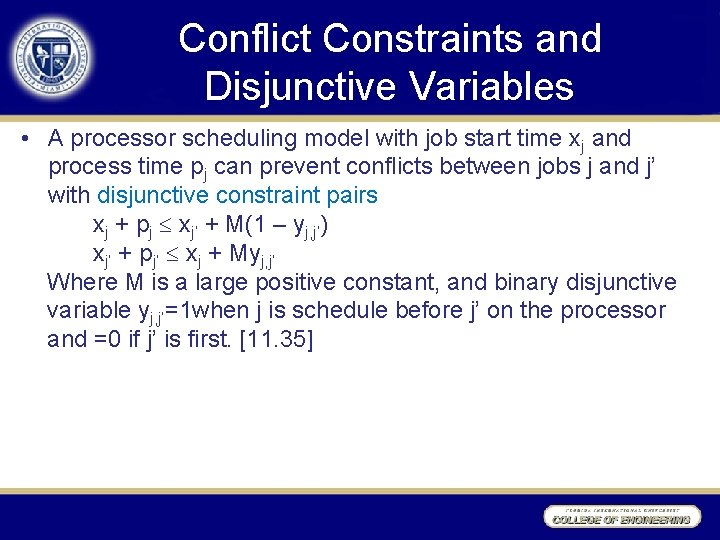
Conflict Constraints and Disjunctive Variables • A processor scheduling model with job start time xj and process time pj can prevent conflicts between jobs j and j’ with disjunctive constraint pairs xj + pj xj’ + M(1 – yj, j’) xj’ + pj’ xj + Myj, j’ Where M is a large positive constant, and binary disjunctive variable yj, j’=1 when j is schedule before j’ on the processor and =0 if j’ is first. [11. 35]
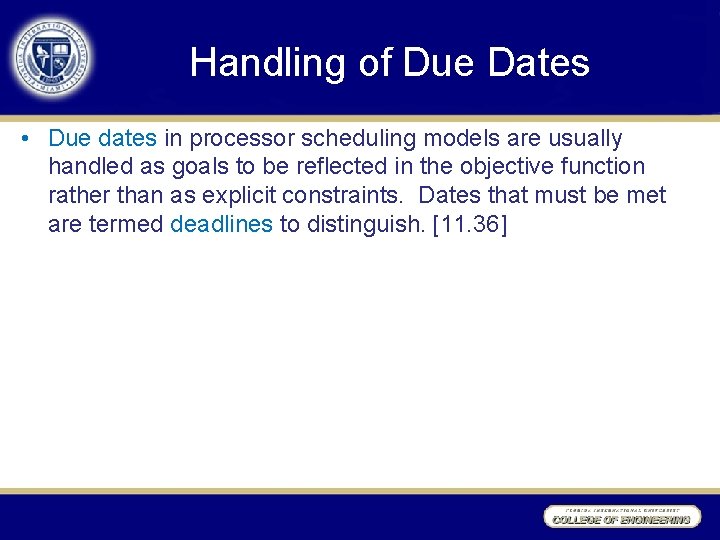
Handling of Due Dates • Due dates in processor scheduling models are usually handled as goals to be reflected in the objective function rather than as explicit constraints. Dates that must be met are termed deadlines to distinguish. [11. 36]
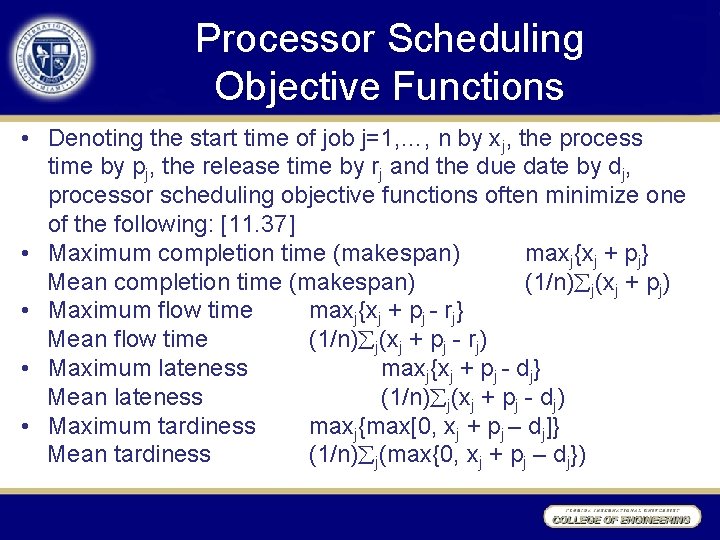
Processor Scheduling Objective Functions • Denoting the start time of job j=1, …, n by xj, the process time by pj, the release time by rj and the due date by dj, processor scheduling objective functions often minimize one of the following: [11. 37] • Maximum completion time (makespan) maxj{xj + pj} Mean completion time (makespan) (1/n) j(xj + pj) • Maximum flow time maxj{xj + pj - rj} Mean flow time (1/n) j(xj + pj - rj) • Maximum lateness maxj{xj + pj - dj} Mean lateness (1/n) j(xj + pj - dj) • Maximum tardiness maxj{max[0, xj + pj – dj]} Mean tardiness (1/n) j(max{0, xj + pj – dj})
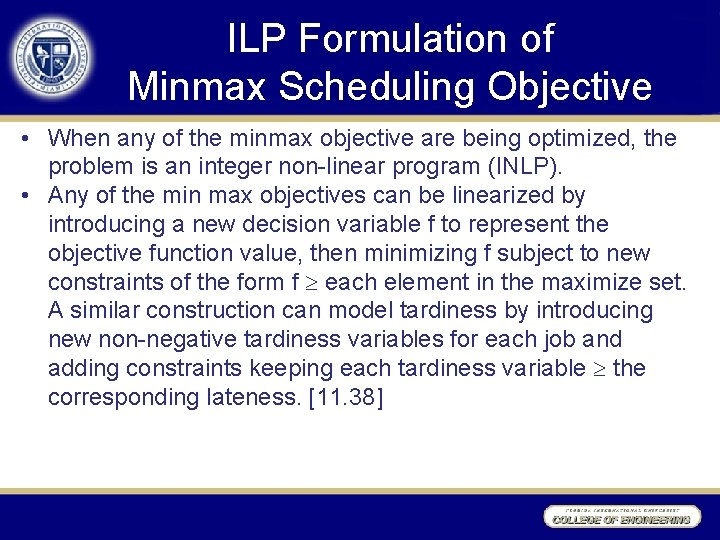
ILP Formulation of Minmax Scheduling Objective • When any of the minmax objective are being optimized, the problem is an integer non-linear program (INLP). • Any of the min max objectives can be linearized by introducing a new decision variable f to represent the objective function value, then minimizing f subject to new constraints of the form f each element in the maximize set. A similar construction can model tardiness by introducing new non-negative tardiness variables for each job and adding constraints keeping each tardiness variable the corresponding lateness. [11. 38]
Equivalences among Scheduling Objective Functions • The mean completion time, mean flow time, and mean lateness scheduling objective functions are equivalent in the sense that an optimal schedule for one is also optimal for the others. [11. 39] • An optimal schedule for the maximum lateness objective function is also optimal for maximum tardiness. [11. 40]
Job Shop Scheduling • Job shop scheduling problems seek an optimal schedule for a given collection of jobs, each of which requires a known sequence of processors that can accommodate only one job at a time. [11. 41]
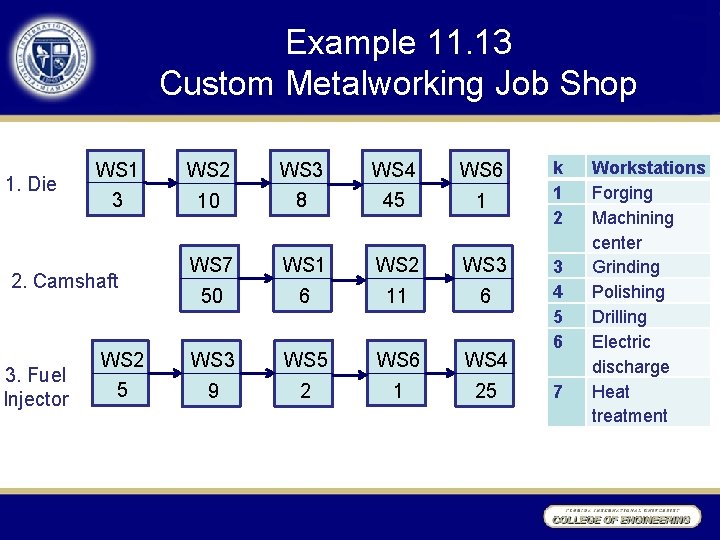
Example 11. 13 Custom Metalworking Job Shop We illustrate job shop scheduling with a fictitious Custom Metalworking company which fabricates prototype metal parts for a nearby engine manufacturer. Figure 11. 9 provides details on the 3 jobs waiting to be scheduled. First is a die requiring work on a sequence of 5 workstations: 1 (forging), then 2 (machining), then 3 (grinding), then 4 (polishing), and finally, 6 (electric discharge cutting). Job 2 is a cam shaft requiring 4 stations, and job 3 a fuel injector requiring 5 steps. Numbers in boxes indicate process times Pj, k process time (in minutes) of job j on processor k For example, job 1 requires 45 minutes at polishing workstation 4. Any of the objective function forms in [11. 37] could be appropriate for Custom Metalworking’s scheduling. We will assume that the company wants to complete all 3 jobs as soon as possible (minimize maximum completion), so that workers can leave for a holiday.
Example 11. 13 Custom Metalworking Job Shop 1. Die WS 1 WS 2 WS 3 WS 4 WS 6 3 10 8 45 1 WS 7 WS 1 WS 2 WS 3 50 6 11 6 WS 2 WS 3 WS 5 WS 6 WS 4 5 9 2 1 25 2. Camshaft 3. Fuel Injector k 1 2 3 4 5 6 7 Workstations Forging Machining center Grinding Polishing Drilling Electric discharge Heat treatment
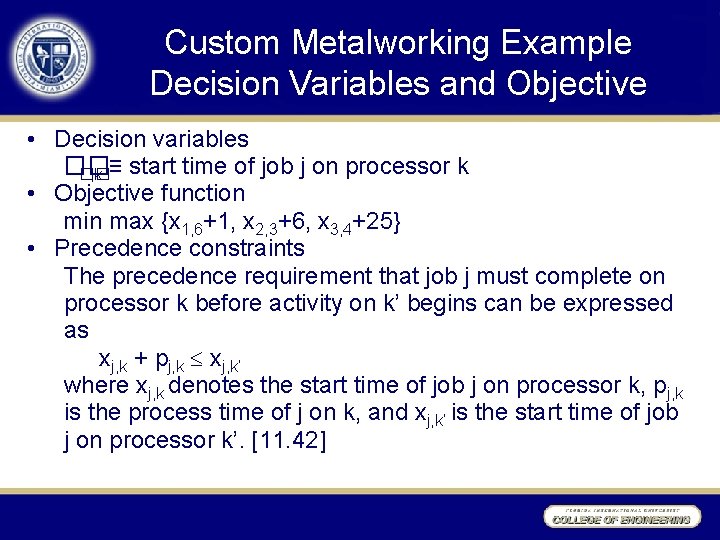
Custom Metalworking Example Decision Variables and Objective • Decision variables �� �� , k ≡ start time of job j on processor k • Objective function min max {x 1, 6+1, x 2, 3+6, x 3, 4+25} • Precedence constraints The precedence requirement that job j must complete on processor k before activity on k’ begins can be expressed as xj, k + pj, k xj, k’ where xj, k denotes the start time of job j on processor k, pj, k is the process time of j on k, and xj, k’ is the start time of job j on processor k’. [11. 42]
Custom Metalworking Example Decision Variables and Objective •
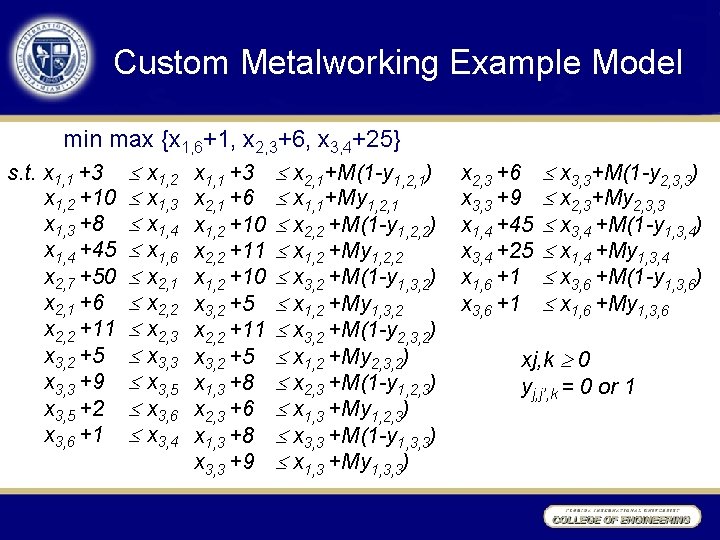
Custom Metalworking Example Model min max {x 1, 6+1, x 2, 3+6, x 3, 4+25} s. t. x 1, 1 +3 x 1, 2 x 1, 1 +3 x 2, 1+M(1 -y 1, 2, 1) x 1, 2 +10 x 1, 3 x 2, 1 +6 x 1, 1+My 1, 2, 1 x 1, 3 +8 x 1, 4 x 1, 2 +10 x 2, 2 +M(1 -y 1, 2, 2) x 1, 4 +45 x 1, 6 x 2, 2 +11 x 1, 2 +My 1, 2, 2 x 2, 7 +50 x 2, 1 x 1, 2 +10 x 3, 2 +M(1 -y 1, 3, 2) x 2, 1 +6 x 2, 2 x 3, 2 +5 x 1, 2 +My 1, 3, 2 x 2, 2 +11 x 2, 3 x 2, 2 +11 x 3, 2 +M(1 -y 2, 3, 2) x 3, 2 +5 x 3, 3 x 3, 2 +5 x 1, 2 +My 2, 3, 2) x 3, 3 +9 x 3, 5 x 1, 3 +8 x 2, 3 +M(1 -y 1, 2, 3) x 3, 5 +2 x 3, 6 x 2, 3 +6 x 1, 3 +My 1, 2, 3) x 3, 6 +1 x 3, 4 x 1, 3 +8 x 3, 3 +M(1 -y 1, 3, 3) x 3, 3 +9 x 1, 3 +My 1, 3, 3) x 2, 3 +6 x 3, 3 +9 x 1, 4 +45 x 3, 4 +25 x 1, 6 +1 x 3, 6 +1 x 3, 3+M(1 -y 2, 3, 3) x 2, 3+My 2, 3, 3 x 3, 4 +M(1 -y 1, 3, 4) x 1, 4 +My 1, 3, 4 x 3, 6 +M(1 -y 1, 3, 6) x 1, 6 +My 1, 3, 6 xj, k 0 yj, j’, k = 0 or 1