
Chapter 11 Designing Case Studies Doing Research in

- Slides: 14
Chapter 11: Designing Case Studies Doing Research in the Real World by David E. Grace Stephanie Moore
Case Studies “A case study is a research strategy which is focuses on gaining an understanding of the dynamic present within single settings” (Eisenhardt, 266) “relationship between a phenomenon and the context in which it is occurring” (Yin, 267) Case: the phenominan being studies Explores: • subjects and issues where relationships are ambiguous of uncertain • Relationship between phenomenon and real-life context • Casual relationships vs descriptive Needs • theological position and defined research question to focus research • Ability to interpret answers • Combines a variety of data collection methods (ie archives, interviews, surveys, and participant observation Stephanie Moore
When to use Case Study Case studies • Answers a How or Why question • Add to understanding and extend experience • Increase conviction on a topic • Generates date that develops theory Possible contexts • Evaluation of training program, • Organization performance, • project design, implementation, • policy analysis, • relationships b/w sectors or organizations Stephanie Moore
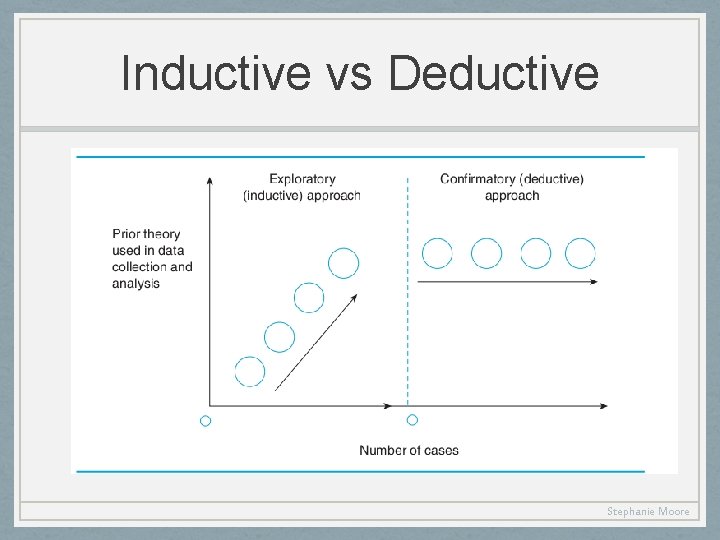
Inductive vs Deductive Screen Shot 2016 -05 -23 at 2. 48. 15 P Stephanie Moore
Limitations • Questions of reliability, objectivity, and legitimacy • dangerous/difficult to generalize form single case • Time consuming and produce lots documentation • Results of a case study can not be assumed to generalized across larger population (as would be possible with experimental design) Stephanie Moore
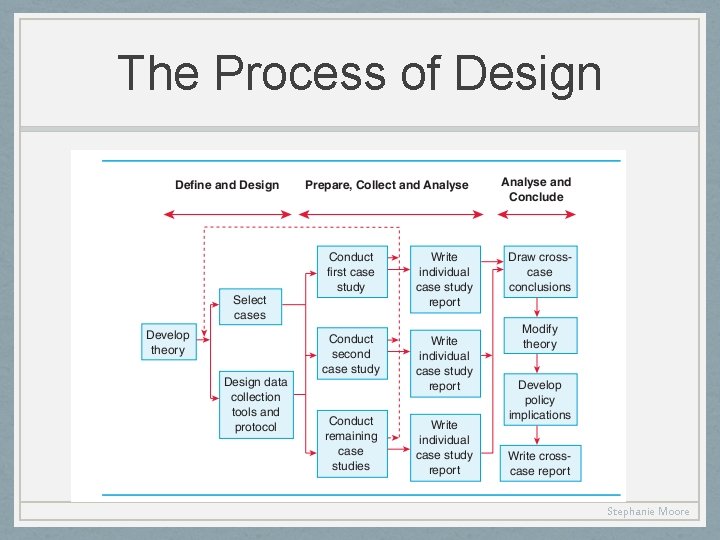
The Process of Design Stephanie Moore
1) Define: Develop a Theoretical Stance Building theory from research • Topic is relatively new or there need to inject fresh perspective into well known theme • Start with theoretical framework based on past research Literature Review • Provisional hypothesis or questions development, • Discover past research • identifying revival hypothesizes Stephanie Moore
Design Case Study Select Cases • random selection unhelpful • polar of extreme types • Important that phenomenon is “transparently observable” • 4 -10 cases are ideal to generate theory and the volume is manageable Designing unit of analysis • Ensure unit matches research objectives (ie process vs look or functionality) Stephanie Moore
Analyze and Conclude Multiple Case • Each study is it its own study Conduct within study analysis/detailed write up for each site to identify unique patterns • Converging evidence: data from one study replicates data from another • multiple pieces of evidence add to clearer overall picture Negative instance: are helpful. They lead to continual revision of hypothesis and reveal Stephanie Moore
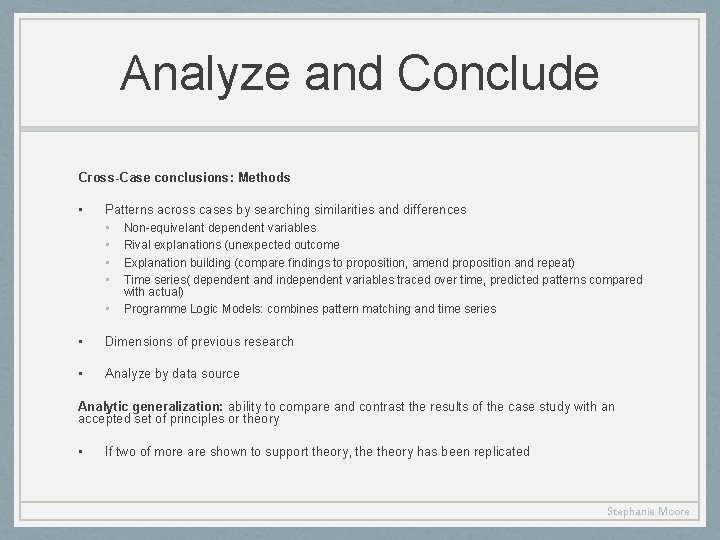
Analyze and Conclude Cross-Case conclusions: Methods • Patterns across cases by searching similarities and differences • Non-equivelant dependent variables • Rival explanations (unexpected outcome • Explanation building (compare findings to proposition, amend proposition and repeat) • Time series( dependent and independent variables traced over time, predicted patterns compared • with actual) Programme Logic Models: combines pattern matching and time series • Dimensions of previous research • Analyze by data source Analytic generalization: ability to compare and contrast the results of the case study with an accepted set of principles or theory • If two of more are shown to support theory, theory has been replicated Stephanie Moore
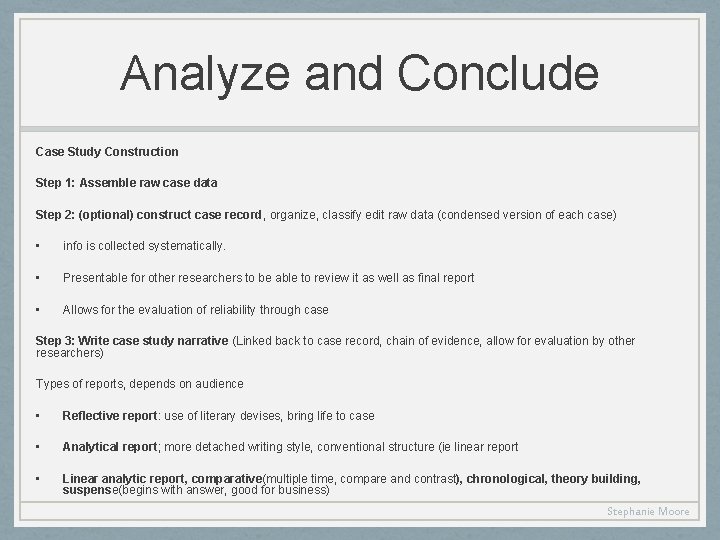
Analyze and Conclude Case Study Construction Step 1: Assemble raw case data Step 2: (optional) construct case record, organize, classify edit raw data (condensed version of each case) • info is collected systematically. • Presentable for other researchers to be able to review it as well as final report • Allows for the evaluation of reliability through case Step 3: Write case study narrative (Linked back to case record, chain of evidence, allow for evaluation by other researchers) Types of reports, depends on audience • Reflective report: use of literary devises, bring life to case • Analytical report; more detached writing style, conventional structure (ie linear report • Linear analytic report, comparative(multiple time, compare and contrast), chronological, theory building, suspense(begins with answer, good for business) Stephanie Moore
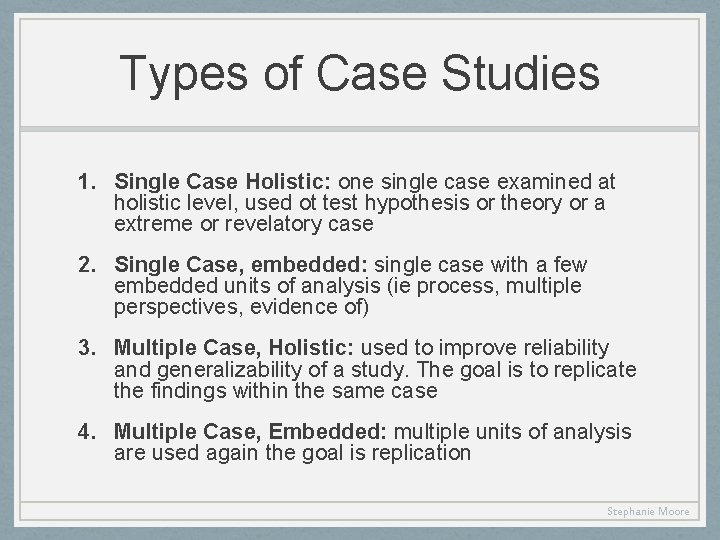
Types of Case Studies 1. Single Case Holistic: one single case examined at holistic level, used ot test hypothesis or theory or a extreme or revelatory case 2. Single Case, embedded: single case with a few embedded units of analysis (ie process, multiple perspectives, evidence of) 3. Multiple Case, Holistic: used to improve reliability and generalizability of a study. The goal is to replicate the findings within the same case 4. Multiple Case, Embedded: multiple units of analysis are used again the goal is replication Stephanie Moore
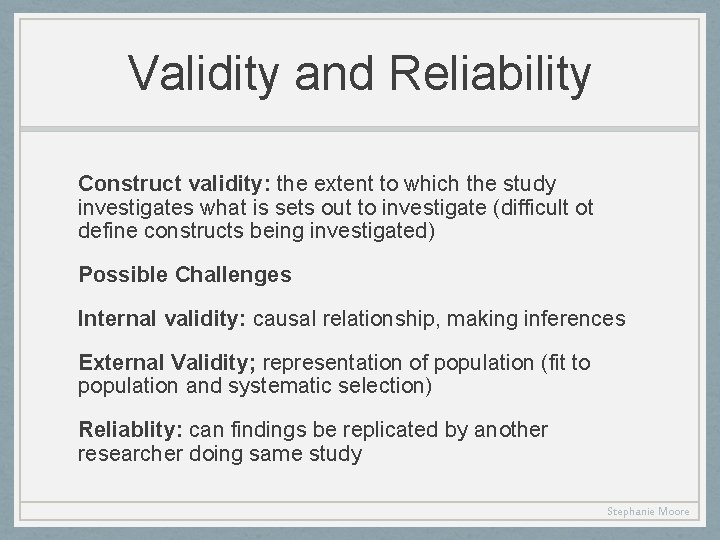
Validity and Reliability Construct validity: the extent to which the study investigates what is sets out to investigate (difficult ot define constructs being investigated) Possible Challenges Internal validity: causal relationship, making inferences External Validity; representation of population (fit to population and systematic selection) Reliablity: can findings be replicated by another researcher doing same study Stephanie Moore
Analysis Methods • analysis based on theoretical proposition (make choices about what is worth investigating and what to ignore • Develop descriptive framework for findings (no obvious framework, identify types of cases for further analysis • Explaination building Stephanie Moore