
Chapter 11 Death Manner Mechanism Cause and Time


- Slides: 38
Chapter 11 Death: Manner, Mechanism, Cause, and Time By the end of this chapter you will be able to: l explain the development of livor, rigor, and algor l l mortis following death use evidence of these to estimate time of death use evidence on stomach contents to estimate time of death use insect evidence to estimate time of death explain how environmental factors can affect the estimated time of death All Rights Reserved South-Western / Cengage Learning © 2009 1 Forensic Science: Fundamentals & Investigations, Chapter 11
BIG Ideas!! l l 2 Death is a process rather than an instant event, so it is sometimes difficult to pinpoint the precise moment a person dies. There are 4 ways a person can die. (ND, AD, SD, HD) An Autopsy is performed by a medical examiner trying to determine the cause and time of death. (Coroner) Factors that help determine the cause and time of death are: livor, rigor and algor mortis, intestinal and stomach contents, changes in the eye following death, stages of decomposition, and the presence and life stage of insects. Forensic Science: Fundamentals & Investigations, Chapter 11
Death The Manner of Death l The manner of death can be natural, accidental, l l 3 suicidal, homicidal, or undetermined. Sometimes it is difficult to determine the manner of death. The most common manner of death is natural. Where did the phrase, “saved by the bell” originate? Manner of death, if ruled a homicide, must be proven in court Forensic Science: Fundamentals & Investigations, Chapter 11
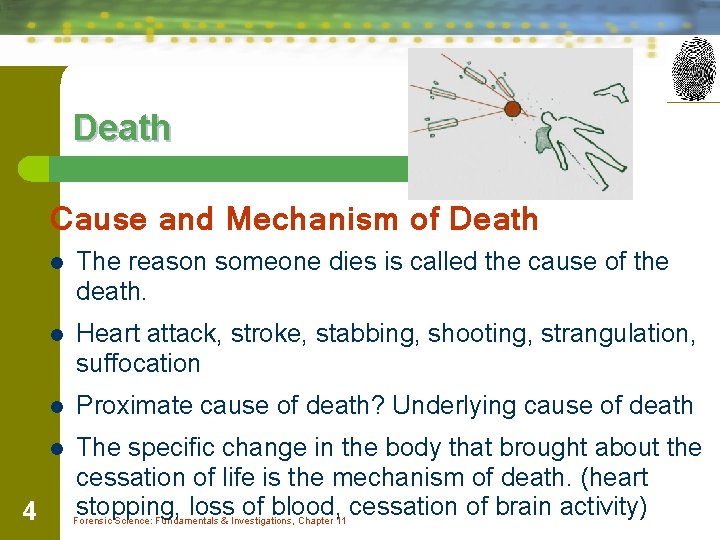
Death Cause and Mechanism of Death 4 l The reason someone dies is called the cause of the death. l Heart attack, stroke, stabbing, shooting, strangulation, suffocation l Proximate cause of death? Underlying cause of death l The specific change in the body that brought about the cessation of life is the mechanism of death. (heart stopping, loss of blood, cessation of brain activity) Forensic Science: Fundamentals & Investigations, Chapter 11
Time of Death may link a suspect to a crime or exonerate them Livor Mortis-Color of Death l After death, red blood cells break down, they turn a bluish-purple. l With decomposition, blood seeps down and settles in the lower parts of a body. Lividity=pooling of blood in the body l The discoloration that accompanies this becomes permanent after 8 hours. Can reveal the position of the body during the first 8 hours( transport or movement of the body after two hours) l Warmth accelerates the process. 5 Forensic Science: Fundamentals & Investigations, Chapter 11
Quick Quiz 1. 2. 3. 4. 5. 6. 7. 8. 9. 10. 6 Why is it difficult to pinpoint the precise TOD? List 4 ways a person may die. (letters) How is an ME different from a coroner? What is meant by “manner of death”? What is the most common manner of death? Give an example of a Cause of Death. Give an example of a mechanism of death. The color of death is called __ mortis. What is lividity? What would dual lividity tell an ME? Forensic Science: Fundamentals & Investigations, Chapter 11
Time of Death—Algor Mortis (death heat) The Chill of Death l In death a body no longer generates warmth and l l 7 begins to cool down. To find the standard temperature of a corpse, a thermometer is inserted into the liver. Body heat is lost at about 1 to 1. 5 degrees an hour. (After 12 hours, it lose. 7 degrees an hour) Time of death determined by temperature calculations is expressed as a range of time. What other factors can increase or decrease the loss of heat? Forensic Science: Fundamentals & Investigations, Chapter 11
Time of Death—Rigor Mortis (death stiffness) The Rigidity of Death l l l 8 At death, skeletal muscles cannot relax. Without oxygen, calcium accumulates in these muscles. The muscles become stiff. (starts within two hours of death) This starts in the head and works its way down to the legs. After about 15 hours, the muscle fibers begin to dissolve, and softening begins. Forensic Science: Fundamentals & Investigations, Chapter 11
Time of Death—Rigor Mortis l At 12 hours after death, the body is at its most rigid state. l If a body has no visible signs of rigor, it probably has been dead less than 2 hours or more than 48. l If the body exhibits rigor only in the head and neck, the time of death is just over 2 hours. l This stiffness will have disappeared for the most part after 36 hours. 9 Forensic Science: Fundamentals & Investigations, Chapter 11
Time of Death—Rigor Mortis Many factors affect when rigor mortis sets in and how long it lasts: – – – 10 – Ambient temperature The weight of the body The body’s clothing or lack of it Any illness the person had at the time of death The level of physical activity at the time of death Sun exposure Use the tables on p. 314 and 315 to help with the activity 11. 1 Forensic Science: Fundamentals & Investigations, Chapter 11
Time of Death—Stomach and Intestinal Contents Based on these specifics, give an estimate for each of these on how much time has passed since the meal was eaten: 1. Food is still present in the stomach. 2. The stomach is empty but food is found in the small intestine. 3. The small intestine is empty but waste is present in the large intestine. 11 Forensic Science: Fundamentals & Investigations, Chapter 11
Time of Death—Stomach and Intestinal Contents It takes 4 -6 hours for the stomach to empty following a meal. q It takes 12 hours for the small intestine to empty q It takes 24 hours after the meal for the contents to be emptied from the large intestine. So: food in the stomach=0 -2 hours after last meal if the stomach is empty, but is still in the small intestine=4 -6 hours after last meal if small intestine is empty, but waste are still in large 12 intestine=12 or more hours after last meal q Forensic Science: Fundamentals & Investigations, Chapter 11
Time of Death—Stages of Decomposition (p. 316 -317) Choose: A. Within 2 days. B. After 4 days. C. Within 6 -10 days. 1. 2. 3. 4. 5. 6. 7. 8. 9. 13 Fluids begin to leak from body openings as cell membranes rupture. Discoloration of the face. The skin sloughs off. The skin blisters. Green and purplish staining from blood decomposition. The corpse bloats. Eyeballs and other tissues liquefy. The abdomen swells. Marbling appearance on the skin. Forensic Science: Fundamentals & Investigations, Chapter 11
Time of Death—Stages of Decomposition Choose: A. Within 2 days. B. After 4 days. C. Within 6 -10 days. 1. 2. 3. 4. 5. 6. 7. 8. 9. 14 Fluids begin to leak from body openings as cell membranes rupture. C Discoloration of the face. A The skin sloughs off. C The skin blisters. B Green and purplish staining from blood decomposition. A The corpse bloats. C Eyeballs and other tissues liquefy. C The abdomen swells. B Marbling appearance on the skin. A Forensic Science: Fundamentals & Investigations, Chapter 11
Quick Quiz 1. 2. 3. 4. 5. 6. 7. 8. 15 The temperature of death is __ mortis. How much heat does a corpse lose per hour? Which organ is used to check temperature? Rigor mortis starts within ___ hour of death. All rigor is gone within ___ hours. List 2 factors that affect the rate of rigor mortis. How can stomach contents help establish the time of death? Describe 2 things that happens in decomposition between 6 -10 days after death. Forensic Science: Fundamentals & Investigations, Chapter 11
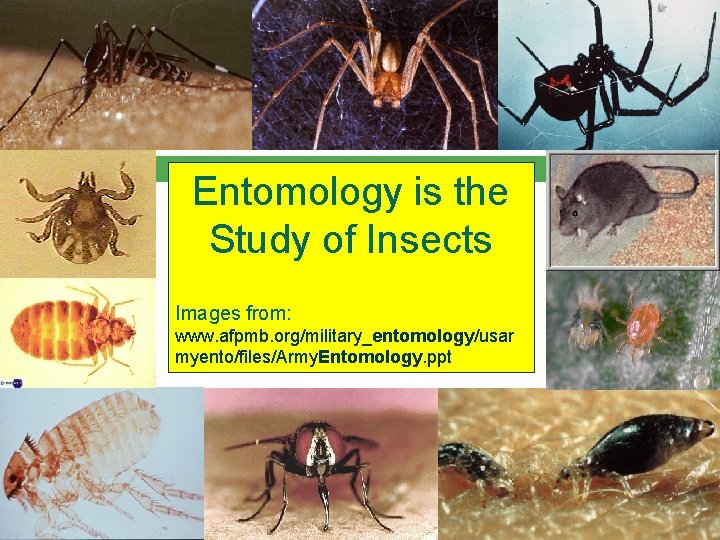
Entomology is the Study of Insects Images from: www. afpmb. org/military_entomology/usar myento/files/Army. Entomology. ppt
Insect Biology l l l Insects are the most diverse and abundant forms of life on earth. There are over a million described species- more than 2/3 of all known organisms There is more total biomass of insects than of humans. Insects undergo either incomplete or complete metamorphosis (Egg to larva to pupa to adult insect) Larva have a soft tubular body and look like worms. Fly species larvae are “maggots”
What is Forensic Entomology? l Forensic Entomology is the use of the insects and other arthropods that feed on decaying remains to aid legal investigations. – Medicolegal (criminal cases involving using insects to help with PMI)
Medicolegal Forensic Entomology l Often focuses on violent crimes – – Determination of the time (postmortem interval or PMI) or site of human death based on identification of arthropods collected from or near corpses. Cases involving possible sudden death Traffic accidents with no immediately obvious cause Possible criminal misuse of insects
Postmortem interval (PMI) l l l Forensic Entomology is used to determine time since death (the time between death and corpse discovery) This is called postmortem interval or PMI). Other uses include • • movement of the corpse manner and cause of death association of suspects with the death scene detection of toxins, drugs, or even the DNA of the victim through analysis of insect larvae.
Forensic Entomology is Applied Biology l l l If it weren’t for decomposition of all living things, our world would fill up with dead bodies. When an animal dies, female insects will be attracted to the body. They enter exposed orifices or wounds and lay eggs or larvae. A forensic entomologist: – – identifies the immature insects determines the size and development of the insects calculates the growth of the insects and passage through stages of the life cycle in laboratory compares the growth against weather conditions to estimate time of oviposition
Succession of Insects on the Corpse l Estimates of postmortem intervals based on insects present on the remains are based on: • • l l The time required for a given species to reach a particular stage of development. Comparisons of all insect species present on the remains at the time of examination. Ecological succession occurs as an unexploited habitat (like a corpse) is invaded by a series of different organisms. The first invasion is by insect species which will alter the habitat in some form by their activities. These changes make the habitat attractive to a second wave of organisms which, in turn, alter the habitat for use by yet another organisms.
Decay Rates Are Variable l l Studies of decay rates of 150 human corpses at in the Anthropological Facility in Tennessee (The Body Farm) Most important environment factors in corpse decay: • • • l Temperature Access by insects Depth of burial Other Factors • • Chemical-- embalming agent, insecticides, lime, etc. Animals disrupting the corpse
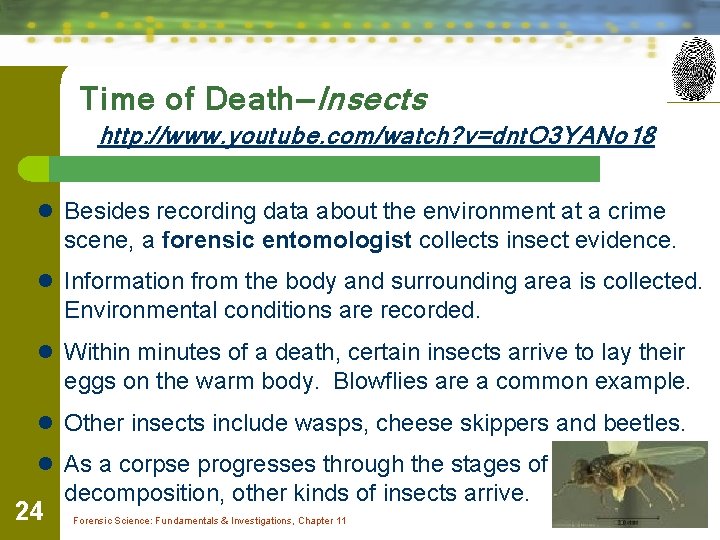
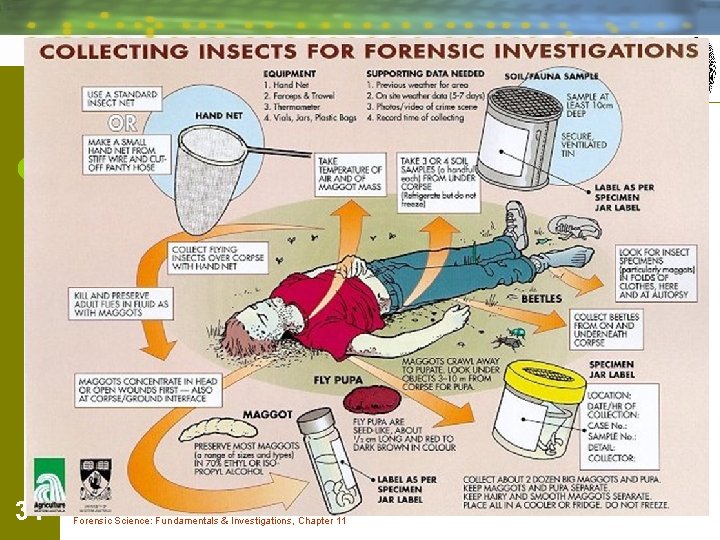
Time of Death—Insects http: //www. youtube. com/watch? v=dnt. O 3 YANo 18 l Besides recording data about the environment at a crime scene, a forensic entomologist collects insect evidence. l Information from the body and surrounding area is collected. Environmental conditions are recorded. l Within minutes of a death, certain insects arrive to lay their eggs on the warm body. Blowflies are a common example. l Other insects include wasps, cheese skippers and beetles. l As a corpse progresses through the stages of 24 decomposition, other kinds of insects arrive. Forensic Science: Fundamentals & Investigations, Chapter 11
Entomology news 25 Forensic Science: Fundamentals & Investigations, Chapter 11
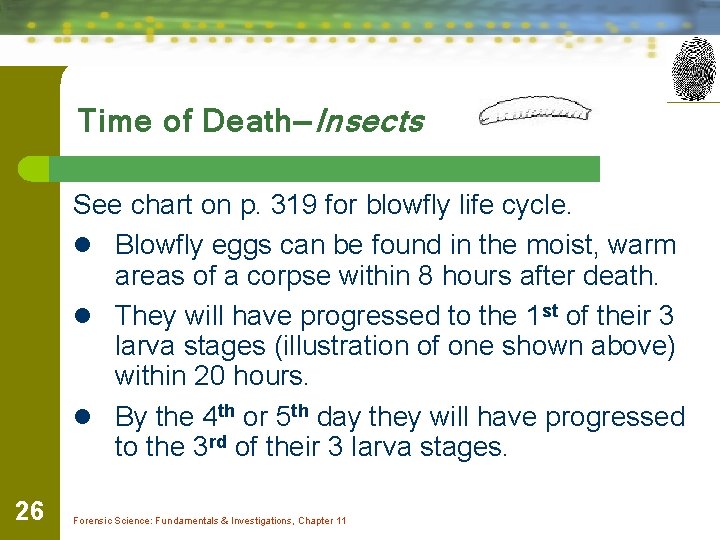
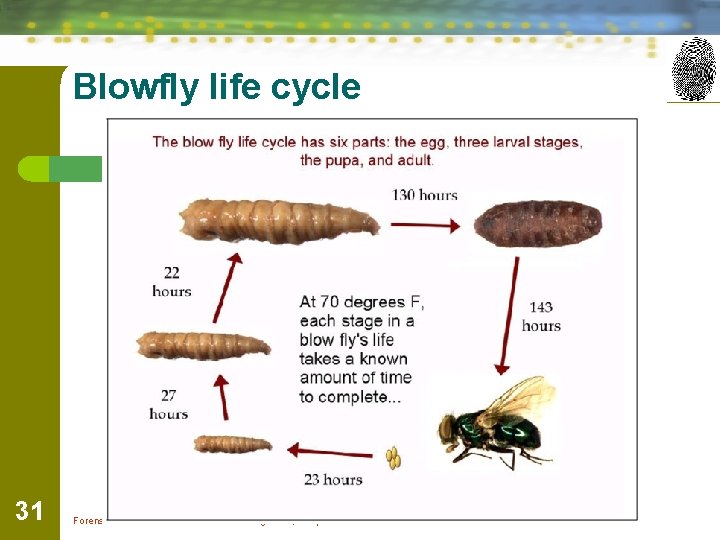
Time of Death—Insects See chart on p. 319 for blowfly life cycle. l Blowfly eggs can be found in the moist, warm areas of a corpse within 8 hours after death. l They will have progressed to the 1 st of their 3 larva stages (illustration of one shown above) within 20 hours. l By the 4 th or 5 th day they will have progressed to the 3 rd of their 3 larva stages. 26 Forensic Science: Fundamentals & Investigations, Chapter 11
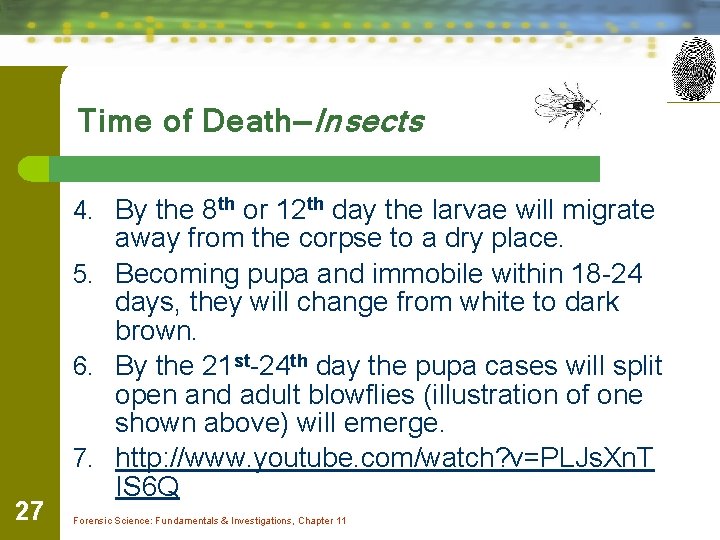
Time of Death—Insects 4. By the 8 th or 12 th day the larvae will migrate 27 away from the corpse to a dry place. 5. Becoming pupa and immobile within 18 -24 days, they will change from white to dark brown. 6. By the 21 st-24 th day the pupa cases will split open and adult blowflies (illustration of one shown above) will emerge. 7. http: //www. youtube. com/watch? v=PLJs. Xn. T IS 6 Q Forensic Science: Fundamentals & Investigations, Chapter 11
Forensic Entomologist 28 Forensic Science: Fundamentals & Investigations, Chapter 11
Time of Death—Insects l Because scientists know how long it takes for the various stages of development at given temperatures, forensics entomologists can determine when the insects arrived. l Because life cycles are affected by fluctuations in the daily environmental conditions, insect evidence cannot provide an exact time of death. l Insect evidence, nonetheless, can yield a close estimate. 29 Forensic Science: Fundamentals & Investigations, Chapter 11
Time of Death—Insects Many factors affect insect development: temperature, wind, time of day, season, exposure to elements, etc. . l Accumulated Degree Hours (ADH) l 1. Immediately preserve some insects collected 2. Raise the insects at the crime lab under the same environmental conditions 3. Record the length of time for development under the specific crime scene conditions 4. Compare the insects raised at the crime scene lab to those found at the crime scene. 30 Forensic Science: Fundamentals & Investigations, Chapter 11
Blowfly life cycle 31 Forensic Science: Fundamentals & Investigations, Chapter 11
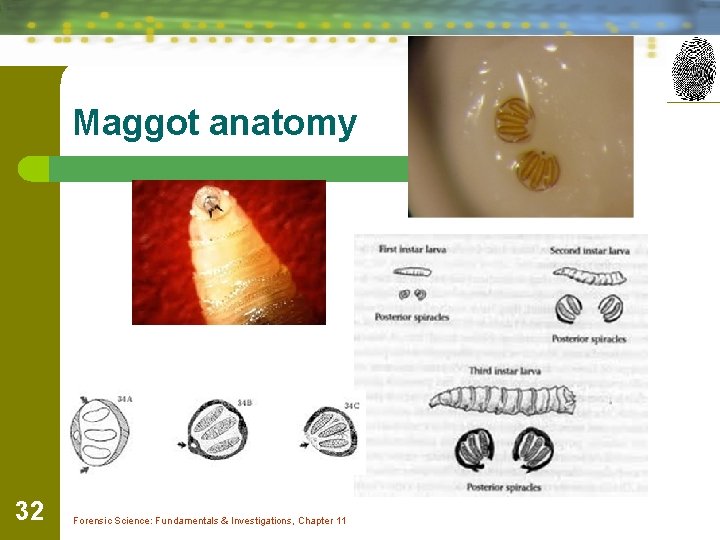
Maggot anatomy 32 Forensic Science: Fundamentals & Investigations, Chapter 11
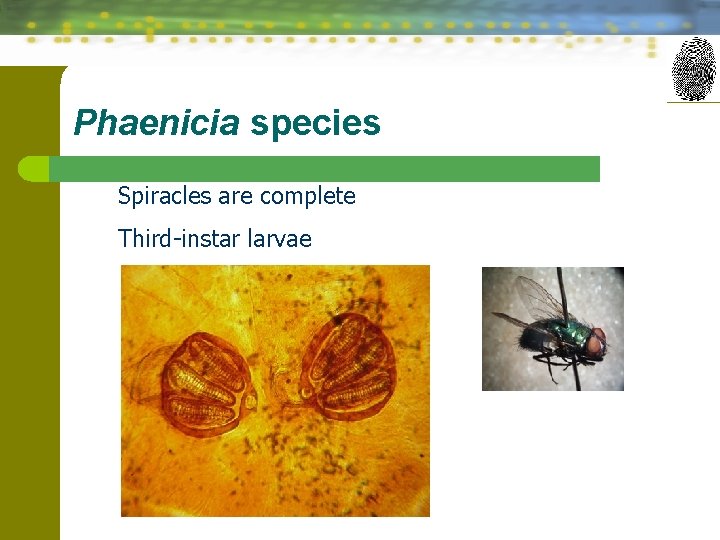
Phaenicia species Spiracles are complete Third-instar larvae
34 Forensic Science: Fundamentals & Investigations, Chapter 11
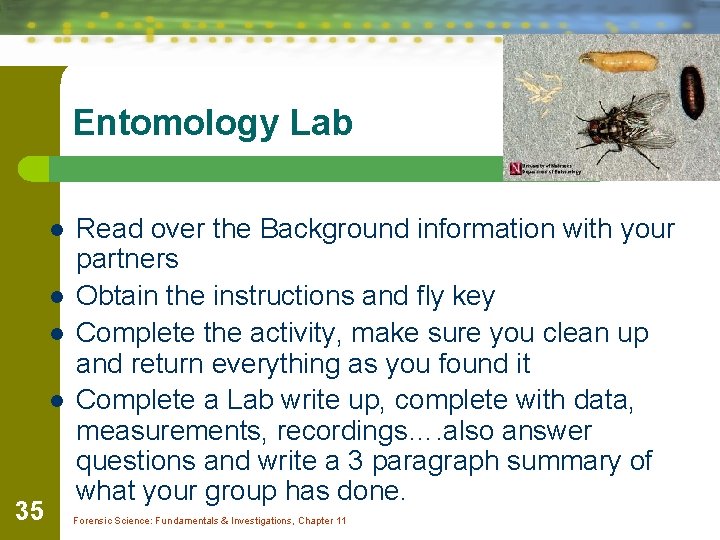
Entomology Lab l l 35 Read over the Background information with your partners Obtain the instructions and fly key Complete the activity, make sure you clean up and return everything as you found it Complete a Lab write up, complete with data, measurements, recordings…. also answer questions and write a 3 paragraph summary of what your group has done. Forensic Science: Fundamentals & Investigations, Chapter 11
Entomology Lab l 1) 2) 3) 4) 5) 6) 7) 36 Questions: (copy these down) What is medicocriminal aspect of F. E. ? How can insects be used to determine PMI? Describe an insects life cycle. How do maggots breathe? How can different larvae be identified from each other? What is ADH? How is it done? How can you research the past scene temperatures? Forensic Science: Fundamentals & Investigations, Chapter 11
. . . . Summary l A body decomposes through the 3 changes of livor, rigor, and algor mortis. l Forensic scientists use evidence from these to estimate the time of death. l They also use stomach contents and insect evidence to estimate the time of death. l It is also important to remember how environmental factors can affect the estimated time of death. 37 Forensic Science: Fundamentals & Investigations, Chapter 11
Death and Bones l l l 38 l Brown book Read Case studies on p. 321 -322 Read about Bill Bass—p. 323 Read Ch. 13 Color and label the skeleton on p. 365—in addition to the bones already labeled on the diagram --add labels to these bones: vertebrae, carpals, metacarpals, phalanges, tarsals, metatarsals, coccyx, hyoid, pubis symphysis (joint) Sketch and label the parts of the skull: p. 366(both) Forensic Science: Fundamentals & Investigations, Chapter 11