
Chapter 11 CustomerDriven Marketing Learning Objectives 1 Define
Chapter 11 Customer-Driven Marketing
Learning Objectives 1 Define marketing. 5 Explain market segmentation. 2 Discuss the evolution of the marketing concept. 6 List the steps in building a marketing strategy. 3 Summarize consumer behavior. 7 Discuss relationship marketing. 4 Describe marketing research.
What Is Marketing? � Marketing- set of processes for creating, communicating, and delivering value to customers and for managing customer relationships in ways that benefit the organization and its stakeholders. � � � Marketing begins with discovering unmet customer needs and continues with researching the potential market; producing a good or service capable of satisfying the targeted customers; and promoting, pricing, and distributing that good or service. Throughout the entire marketing process, a successful organization focuses on building customer relationships. The best marketers not only give consumers what they want but even anticipate consumers’ needs before those needs surface.
Marketing Creates Utility � Exchange process - activity in which two or more parties give something of value to each other to satisfy perceived needs. � Utility - power of a good or service to satisfy a want or need � � � Create time utility by making a good or service available when customers want to purchase it. Create place utility by making a product available in a location convenient for customers. Create ownership utility through an orderly transfer of goods and services from the seller to the buyer.
Evolution of the Marketing Concept � Production Era – “A good product will sell itself” � Sales Era – Energetic sales efforts will convince people to buy � Marketing Era – The consumer is king! Find a need and fill it. � Relationship Era – Satisfy your customers and build long term relationships � Social Era – Use the Internet and social media to market goods and services
Emergence of the Marketing Concept � Marketing concept- company-wide consumer orientation to promote long-run success. � Firm starts with analysis of customers’ needs and works backward to offer products that fulfill them.

Determining What Customers Want � Consumer behavior - actions of consumers involved in obtaining, consuming, and disposing of products and the decision processes that precede and follow these actions � � � Personal factors: needs and motives, perceptions, attitudes, self-concept External factors: economic events Business buying behavior - often includes a variety of influences from multiple decision makers
Marketing Research � Marketing research – the process of collecting and evaluating information to support marketing decision making � Data mining – computer searches of customer data to detect patterns and relationships � Business intelligence – activities and technologies for gathering, storing, and analyzing data to make better competitive decisions
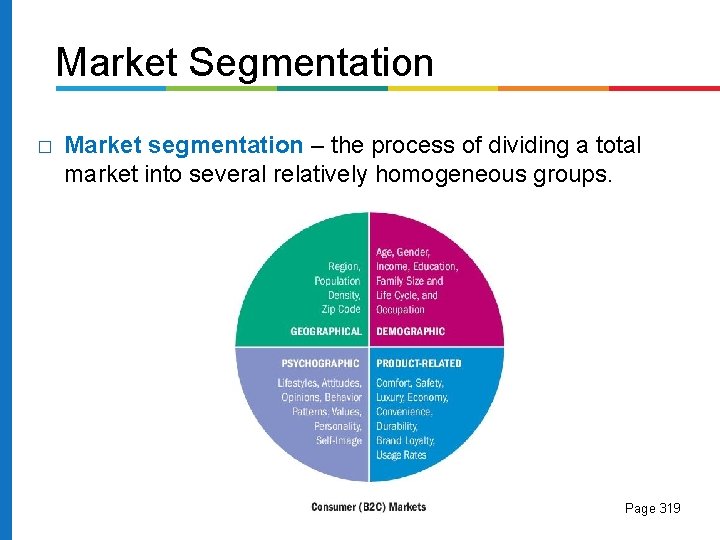
Market Segmentation � Market segmentation – the process of dividing a total market into several relatively homogeneous groups. Page 319

How Market Segmentation Works
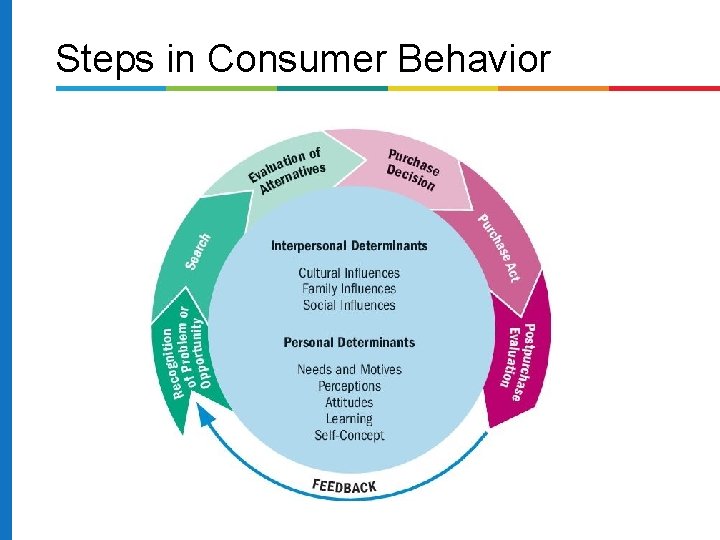
Steps in Consumer Behavior
Selecting Target Markets � Target market- group of people toward whom an organization markets its goods, services, or ideas with a strategy designed to satisfy their specific needs and preferences. � Types of Markets � � consumer (B 2 C) product: good or service that is purchased by end users business (B 2 B) product: good or service purchased to be used, either directly or indirectly, in the production of other goods for resale
Marketing Mix – the four Ps � Marketing Mix blends the four strategies to fit the needs and preferences of a specific target market. → Product strategy involves the nature of the product and its package design, brand names, trademarks, and product image. → Placement (Distribution) strategy ensures that customers receive their purchases in the proper quantities at the right times and locations. → Promotion strategy blends advertising, personal selling, sales promotion, and public relations to achieve its goals of informing, persuading, and influencing purchase decisions. → Pricing strategy is setting profitable and justifiable prices for the firm’s product offerings, sometimes subject to government scrutiny. https: //www. youtube. com/watch? v=JIirz. Tdaey 4
Relationship Marketing � Relationship marketing- developing and maintaining long-term, cost-effective exchange relationships with partners. � Consumers enter into relationships only if there is some benefit to them. � Relationship marketing seeks to achieve customer satisfaction.
Benefits of Relationship Marketing � Lower costs and higher profits for the business � Efficient targeting of best customers increases the lifetime value of a customer � Stronger relationships with business partners and opportunities to combine capabilities and resources to better accomplish goals
Tools for Nurturing Customer Relationships � 80/20 principle: frequent customers have a higher lifetime value, so businesses allocate resources accordingly � Frequency marketing: reward purchasers with cash, rebates, and other premiums (punch cards, points) � Affinity programs: solicit involvement based on common interest (sports logos)
Career Kickstart � Read Calming the Angry Customer – page 327
Comarketing & Cobranding � Comarketing – businesses jointly market each other’s products � Cobranding – when multiple companies link their names to a single product Example: Hershey’s and Betty Crocker – desserts/frostings – Reese’s, Almond Joy, Hershey’s Milk Chocolate Bars
- Slides: 18