
CHAPTER 11 Counting Methods and Probability Theory Copyright
CHAPTER 11 Counting Methods and Probability Theory Copyright © 2015, 2011, 2007 Pearson Education, Inc. Section 11. 4, Slide 1
11. 4 Fundamentals of Probability Copyright © 2015, 2011, 2007 Pearson Education, Inc. Section 11. 4, Slide 2
Objectives 1. Compute theoretical probability. 2. Compute empirical probability. Copyright © 2015, 2011, 2007 Pearson Education, Inc. Section 11. 4, Slide 3
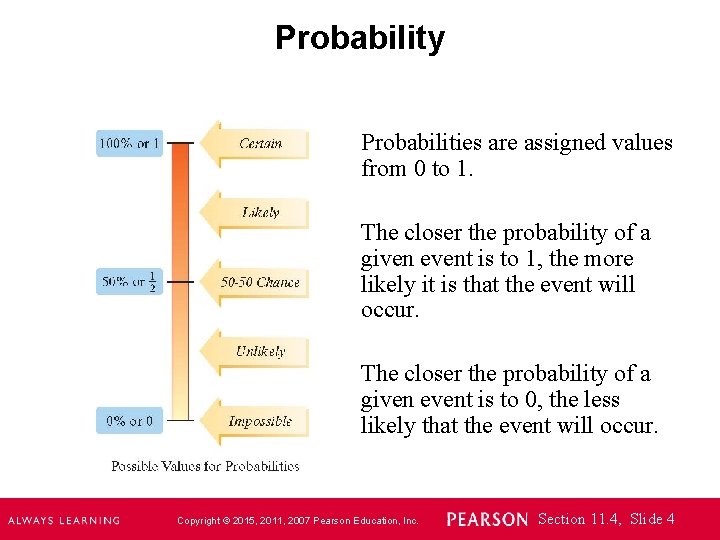
Probability Probabilities are assigned values from 0 to 1. The closer the probability of a given event is to 1, the more likely it is that the event will occur. The closer the probability of a given event is to 0, the less likely that the event will occur. Copyright © 2015, 2011, 2007 Pearson Education, Inc. Section 11. 4, Slide 4
Theoretical Probability Experiment is any occurrence for which the outcome is uncertain. Sample space is the set of all possible outcomes of an experiment , denoted by S. Event, denoted by E is any subset of a sample space. Sum of theoretical probabilities of all possible outcomes is 1. Copyright © 2015, 2011, 2007 Pearson Education, Inc. Section 11. 4, Slide 5
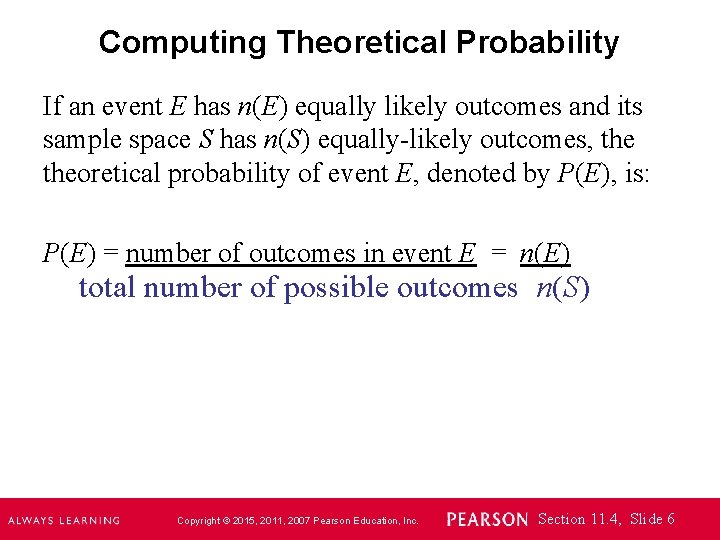
Computing Theoretical Probability If an event E has n(E) equally likely outcomes and its sample space S has n(S) equally-likely outcomes, theoretical probability of event E, denoted by P(E), is: P(E) = number of outcomes in event E = n(E) total number of possible outcomes n(S) Copyright © 2015, 2011, 2007 Pearson Education, Inc. Section 11. 4, Slide 6
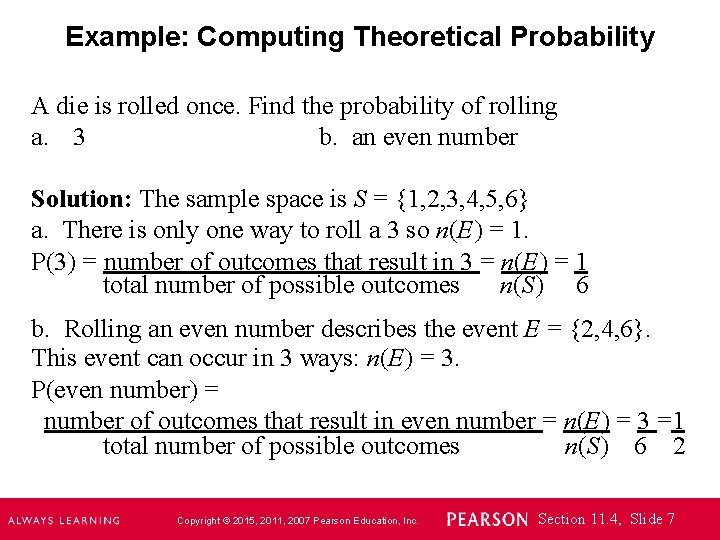
Example: Computing Theoretical Probability A die is rolled once. Find the probability of rolling a. 3 b. an even number Solution: The sample space is S = {1, 2, 3, 4, 5, 6} a. There is only one way to roll a 3 so n(E) = 1. P(3) = number of outcomes that result in 3 = n(E) = 1 total number of possible outcomes n(S) 6 b. Rolling an even number describes the event E = {2, 4, 6}. This event can occur in 3 ways: n(E) = 3. P(even number) = number of outcomes that result in even number = n(E) = 3 =1 total number of possible outcomes n(S) 6 2 Copyright © 2015, 2011, 2007 Pearson Education, Inc. Section 11. 4, Slide 7
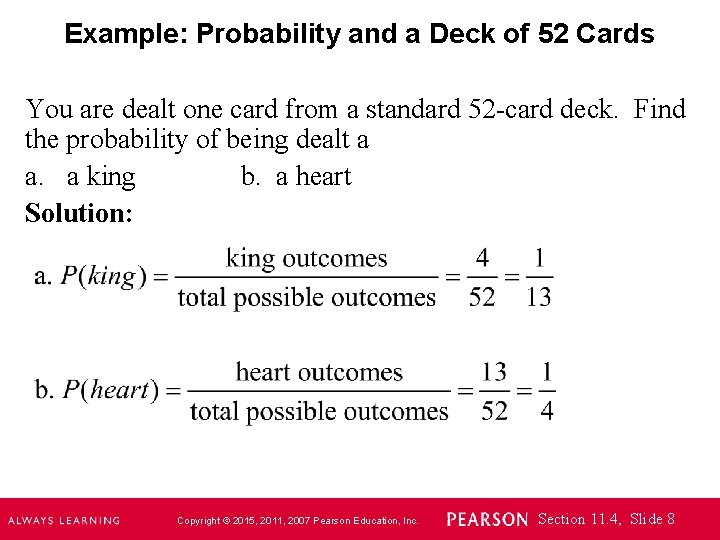
Example: Probability and a Deck of 52 Cards You are dealt one card from a standard 52 -card deck. Find the probability of being dealt a a. a king b. a heart Solution: Copyright © 2015, 2011, 2007 Pearson Education, Inc. Section 11. 4, Slide 8
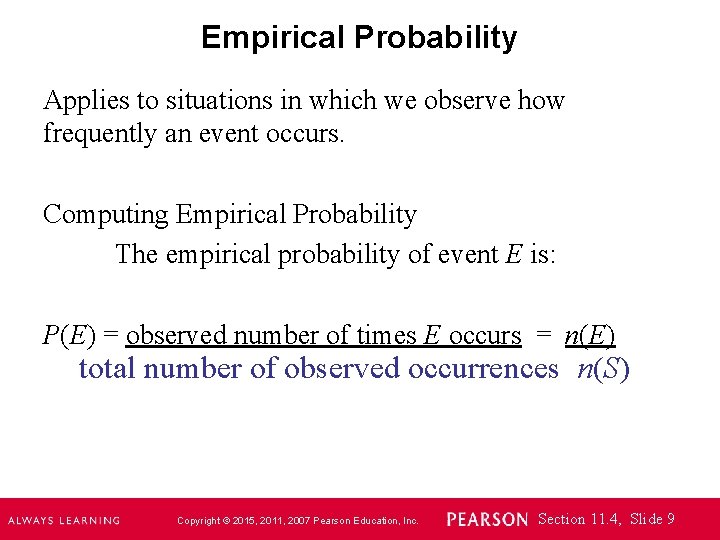
Empirical Probability Applies to situations in which we observe how frequently an event occurs. Computing Empirical Probability The empirical probability of event E is: P(E) = observed number of times E occurs = n(E) total number of observed occurrences n(S) Copyright © 2015, 2011, 2007 Pearson Education, Inc. Section 11. 4, Slide 9
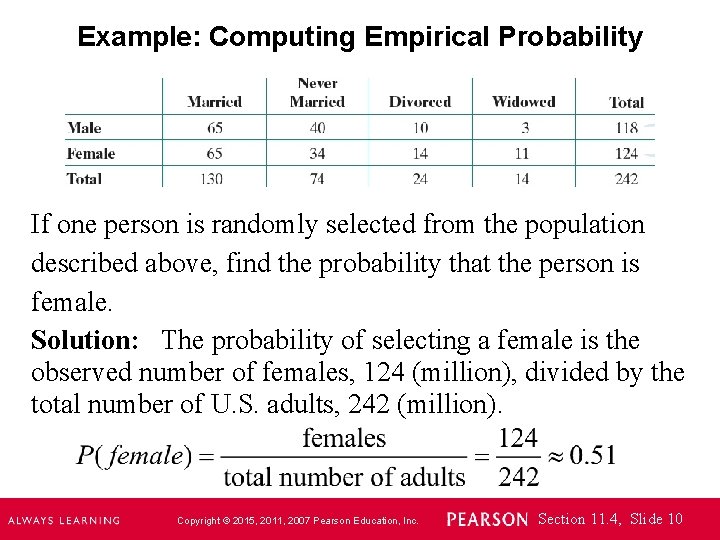
Example: Computing Empirical Probability If one person is randomly selected from the population described above, find the probability that the person is female. Solution: The probability of selecting a female is the observed number of females, 124 (million), divided by the total number of U. S. adults, 242 (million). Copyright © 2015, 2011, 2007 Pearson Education, Inc. Section 11. 4, Slide 10
- Slides: 10