
Chapter 11 Complex Inheritance and Human Heredity Chapter



- Slides: 20
Chapter 11 Complex Inheritance and Human Heredity Chapter Diagnostic Questions 1. Identify the disease characterized by the absence of melanin. A. albinism B. cystic fibrosis C. galactosemia D. Tay-Sachs
Chapter 11 Complex Inheritance and Human Heredity Chapter Diagnostic Questions 2. Under what circumstances will a recessive trait be expressed? A. A recessive allele is passed on by both parents. B. One parent passes on the recessive C. allele. The individual is heterozygous for the D. trait. The individual is homozygous dominant.
Chapter 11 Complex Inheritance and Human Heredity 11. 1 Formative Questions 3. Where do gametes come from? A. skin cells. B. the liver. C. gonads D. It is caused by acid excretion and results in sterility
Chapter 11 Complex Inheritance and Human Heredity 11. 1 Formative Questions 4. Which is the genotype of a person who is a carrier for a recessive genetic disorder? A. DD B. Dd C. dd D. d. E
Chapter 11 Complex Inheritance and Human Heredity 11. 2 Formative Questions 5. When a homozygous male animal with black fur is crossed with a homozygous female with white fur, they have offspring with gray fur. What type of inheritance does this represent? A. dosage compensation B. incomplete dominance C. multiple alleles D. sex-linked
Chapter 11 Complex Inheritance and Human Heredity 11. 1 Formative Questions 6. Albinism is a recessive condition. If an albino squirrel is born to parents that both have normal fur color, what can you conclude about the genotype of the parents? A. at least one parent is a carrier B. both parents are carriers C. both parents are homozygous recessive D. at least one parent is homozygous dominant
Chapter 11 Complex Inheritance and Human Heredity 11. 2 Formative Questions 7. Of the 23 pairs of chromosomes in human cells, one pair is the _______. A. autosomes B. centromere C. monosomes D. sex chromosomes
Chapter 11 Complex Inheritance and Human Heredity 11. 2 Formative Questions 8. Which is an example of a polygenic trait? A. blood type B. color blindness C. hemophilia D. skin color
Chapter 11 Complex Inheritance and Human Heredity 11. 3 Formative Questions 9. What does a karyotype show? A. The blood type of an individual. B. The locations of genes on a chromosome. C. The cell’s chromosomes counted and arranged in pairs. D. The phenotype of individuals in a pedigree.
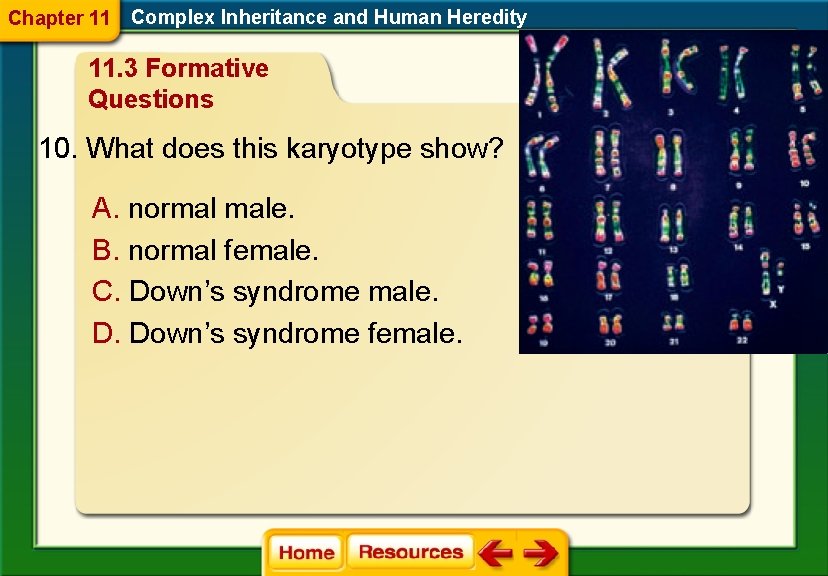
Chapter 11 Complex Inheritance and Human Heredity 11. 3 Formative Questions 10. What does this karyotype show? A. normal male. B. normal female. C. Down’s syndrome male. D. Down’s syndrome female.
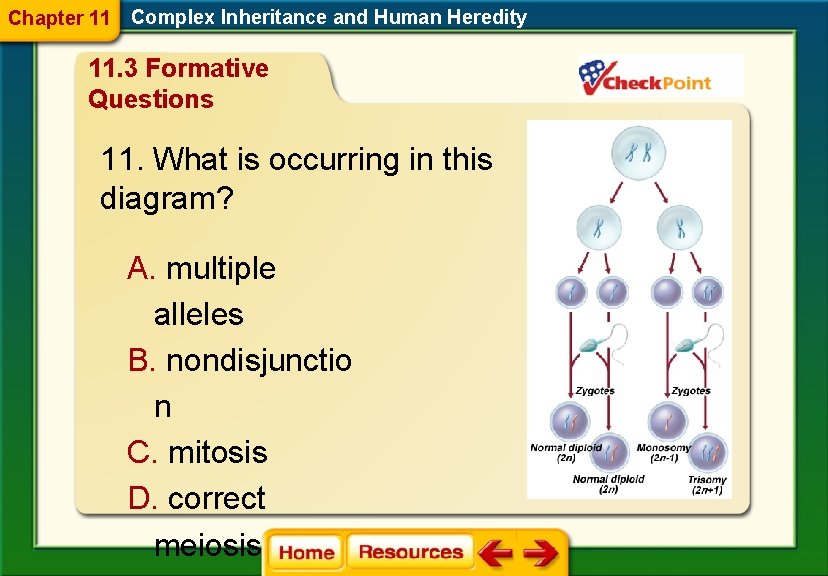
Chapter 11 Complex Inheritance and Human Heredity 11. 3 Formative Questions 11. What is occurring in this diagram? A. multiple alleles B. nondisjunctio n C. mitosis D. correct meiosis
Chapter 11 Complex Inheritance and Human Heredity 11. 3 Formative Questions 12. What condition occurs when a person’s cells have an extra copy of chromosome 21? A. Down syndrome B. Klinefelter’s syndrome C. Tay-Sachs syndrome D. Turner’s syndrome
Chapter 11 Complex Inheritance and Human Heredity Chapter Assessment Questions 13. Use the figure to describe what the top horizontal line between numbers 1 and 2 indicates. A. 1 and 2 are siblings B. 1 and 2 are parents C. 1 and 2 are offspring D. 1 and 2 are carriers
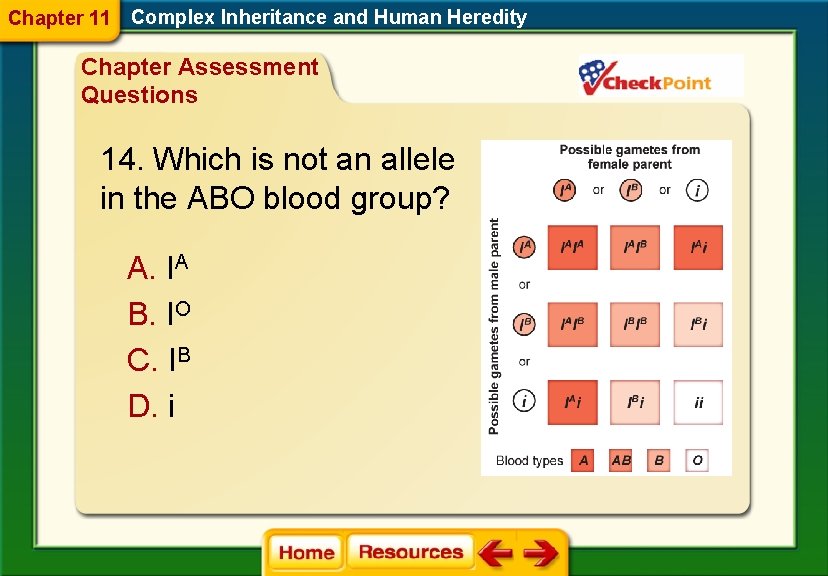
Chapter 11 Complex Inheritance and Human Heredity Chapter Assessment Questions 14. Which is not an allele in the ABO blood group? A. IA B. IO C. IB D. i
Chapter 11 Complex Inheritance and Human Heredity Standardized Test Practice 15. If a genetic disorder is caused by a dominant allele, what is the genotype of those who do not have the disorder? A. heterozygous B. homozygous dominant C. homozygous recessive
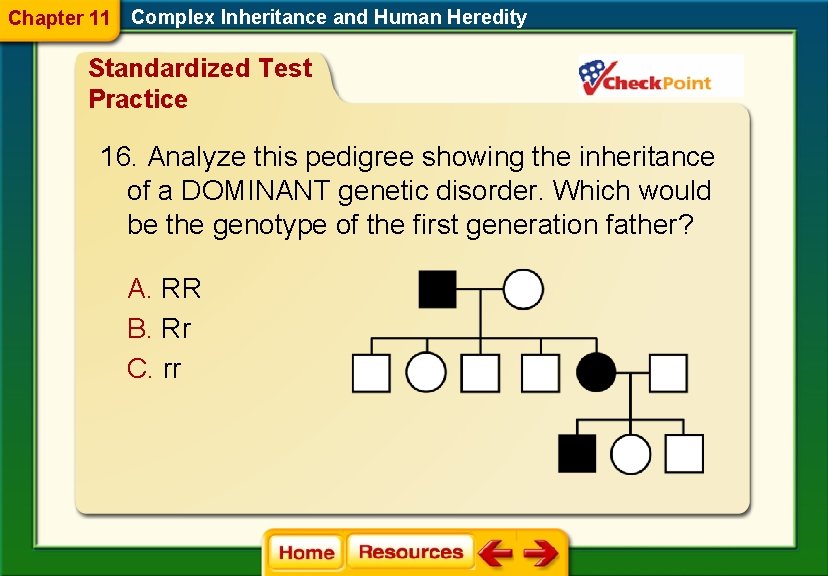
Chapter 11 Complex Inheritance and Human Heredity Standardized Test Practice 16. Analyze this pedigree showing the inheritance of a DOMINANT genetic disorder. Which would be the genotype of the first generation father? A. RR B. Rr C. rr
Chapter 11 Complex Inheritance and Human Heredity Standardized Test Practice 17. Shorthorn cattle have an allele for both red and white hair. When a red-haired cow is crossed with a white-haired bull, their calf has both red and white hairs scattered over its body. What type of inheritance does this represent? A. codominance B. dosage compensation C. epistasis D. sex-linked
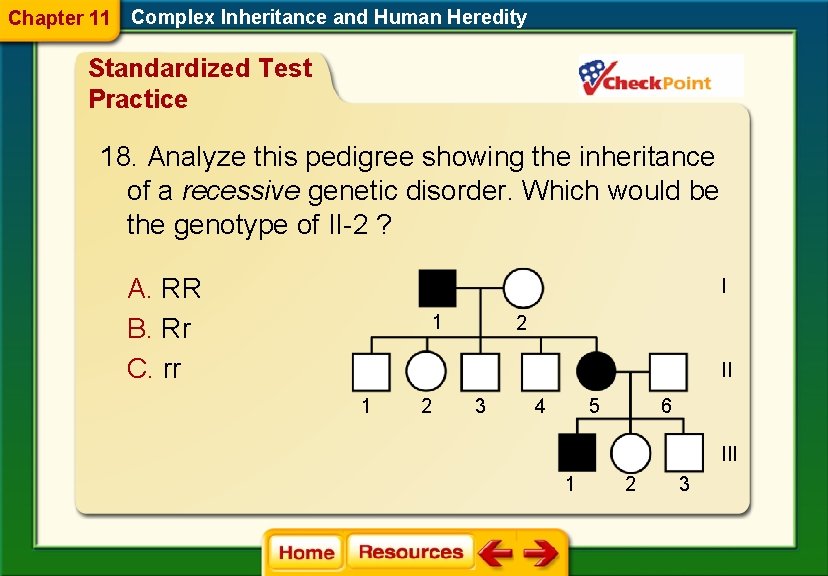
Chapter 11 Complex Inheritance and Human Heredity Standardized Test Practice 18. Analyze this pedigree showing the inheritance of a recessive genetic disorder. Which would be the genotype of II-2 ? A. RR B. Rr C. rr I 1 2 II 1 2 3 4 5 6 III 1 2 3
Chapter 11 Complex Inheritance and Human Heredity Standardized Test Practice 19. Why are males affected by recessive sexlinked traits more often than are females? A. Males have only one X chromosome. B. Males have two X chromosomes. C. Males have only one Y chromosome. D. The traits are located on the Y chromosomes.
Chapter 11 Complex Inheritance and Human Heredity Standardized Test Practice 20. A carrier of hemophilia and her husband, who is unaffected by the condition, are expecting a son. What is the probability that their son will have hemophilia? A. 25% B. 50% C. 75% D. 100%