
CHAPTER 11 Competing in the Global Economy Power
CHAPTER 11 Competing in the Global Economy Power. Point Presentation Design by Charlie Cook © Routledge © 2014 Routledge, Inc. , Taylor and Francis Group. All rights reserved.

Learning Outcomes After studying this chapter, you should be able to: 1. Compare and contrast the types of businesses in the global economy 2. Contrast U. S. business ownership and government–business relations with those in the EU, China, and Japan 3. Discuss who benefits and who pays the cost of protectionism 4. Compare and contrast types of trade barriers and explain why they are not always successful 5. Compare and contrast the World Trade Organization (WTO), World Bank, and International Monetary Fund (IMF) 6. Describe the systems of free trade that the EU has in common with the United States 7. Compare and contrast grease payments, bribes, and offsets 8. Define the key terms in this chapter © Routledge
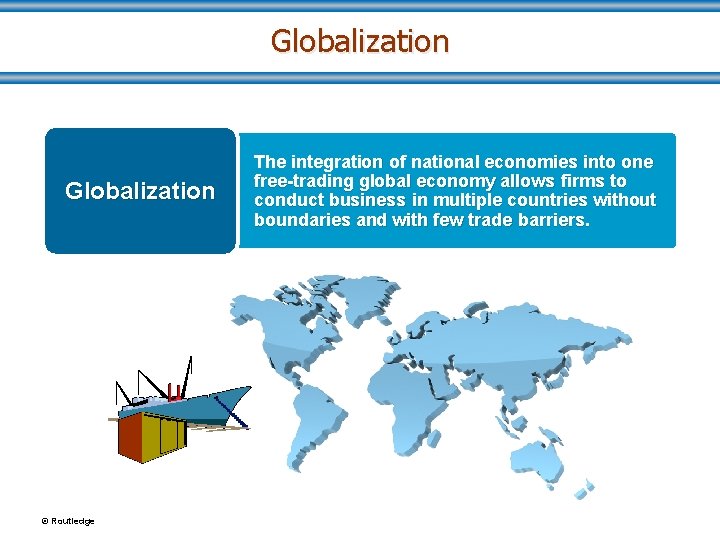
Globalization © Routledge The integration of national economies into one free-trading global economy allows firms to conduct business in multiple countries without boundaries and with few trade barriers.
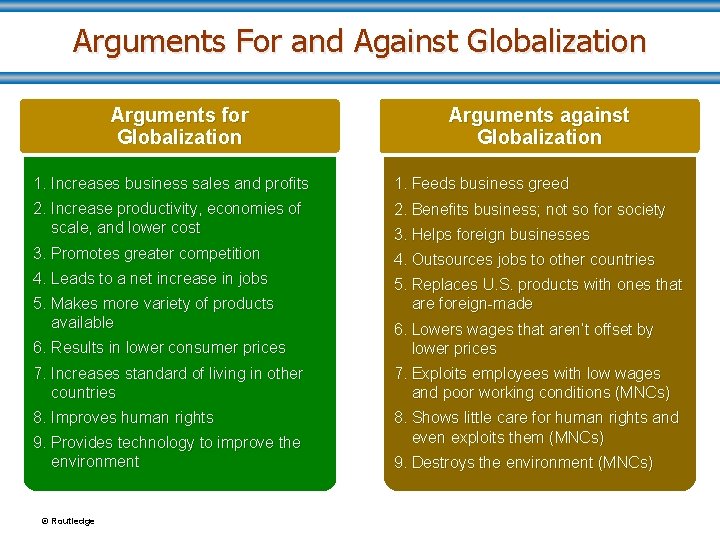
Arguments For and Against Globalization Arguments for Globalization Arguments against Globalization 1. Increases business sales and profits 2. Increase productivity, economies of scale, and lower cost 3. Promotes greater competition 1. Feeds business greed 2. Benefits business; not so for society 4. Leads to a net increase in jobs 5. Makes more variety of products available 6. Results in lower consumer prices 5. Replaces U. S. products with ones that are foreign-made 6. Lowers wages that aren’t offset by lower prices 7. Exploits employees with low wages and poor working conditions (MNCs) 8. Shows little care for human rights and even exploits them (MNCs) 9. Destroys the environment (MNCs) 7. Increases standard of living in other countries 8. Improves human rights 9. Provides technology to improve the environment © Routledge 3. Helps foreign businesses 4. Outsources jobs to other countries
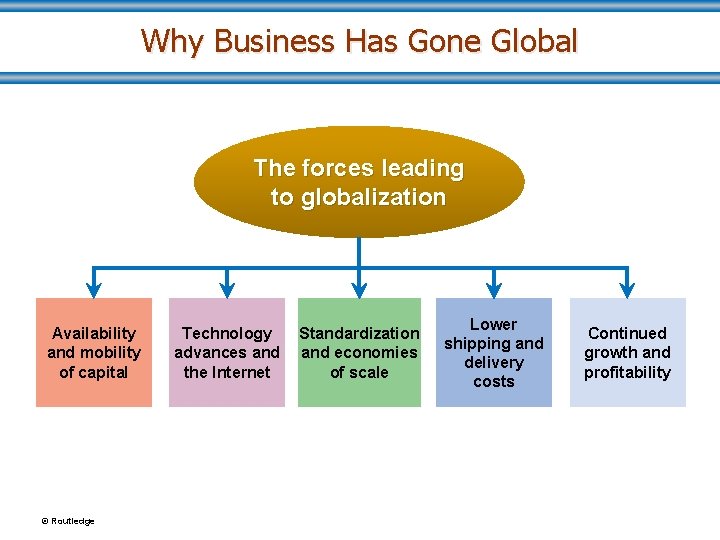
Why Business Has Gone Global The forces leading to globalization Availability and mobility of capital © Routledge Technology advances and the Internet Standardization and economies of scale Lower shipping and delivery costs Continued growth and profitability
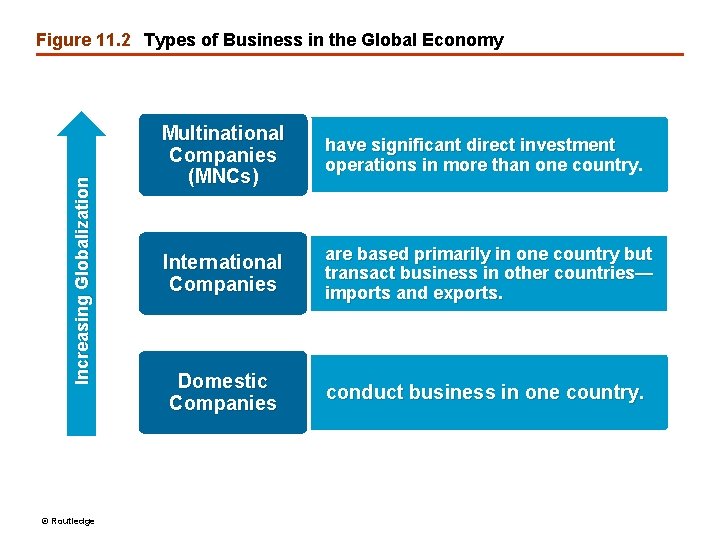
Increasing Globalization Figure 11. 2 Types of Business in the Global Economy © Routledge Multinational Companies (MNCs) have significant direct investment operations in more than one country. International Companies are based primarily in one country but transact business in other countries— imports and exports. Domestic Companies conduct business in one country.
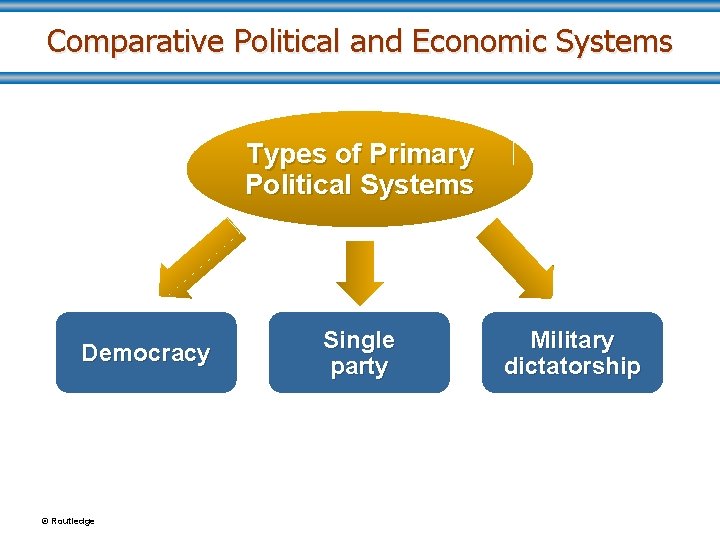
Comparative Political and Economic Systems Types of Primary Political Systems Democracy © Routledge Single party Military dictatorship
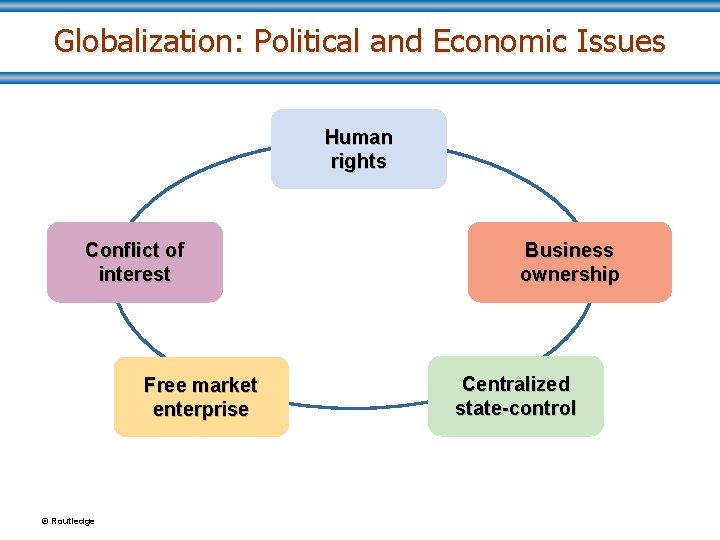
Globalization: Political and Economic Issues Human rights Conflict of interest Free market enterprise © Routledge Business ownership Centralized state-control

Issues Affecting Global Business Trade Free Trade vs. Protectionism Conflicting Laws Between Countries International Business Regulations The Politics of International Trade © Routledge
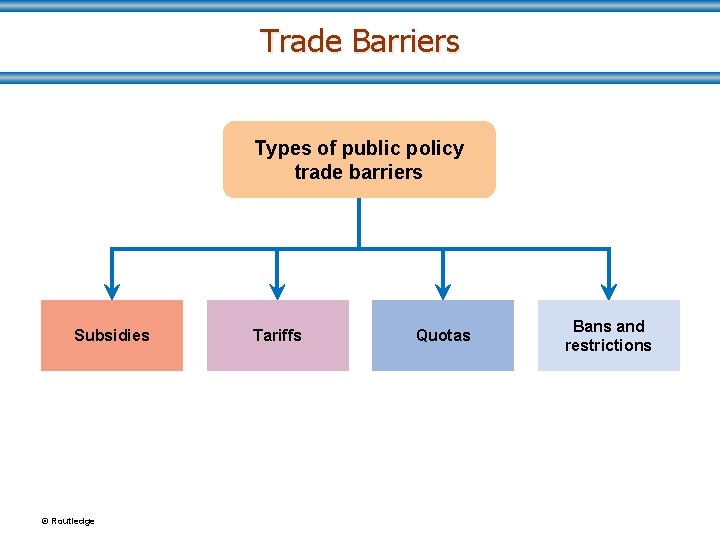
Trade Barriers Types of public policy trade barriers Subsidies © Routledge Tariffs Quotas Bans and restrictions
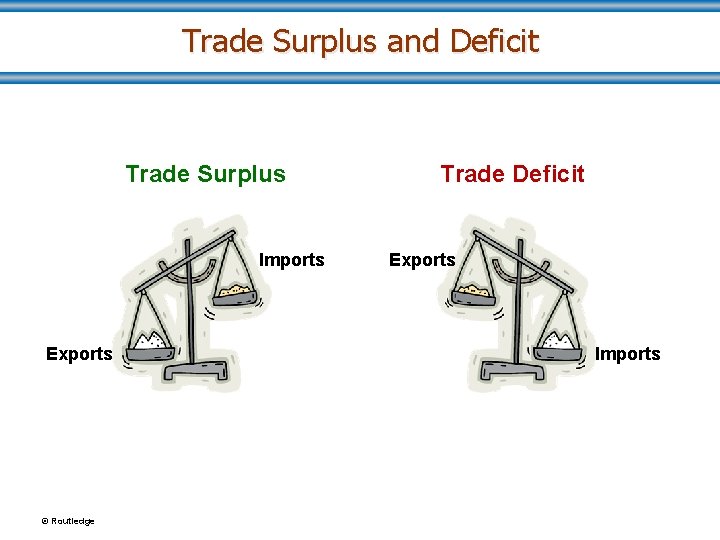
Trade Surplus and Deficit Trade Surplus Imports Exports © Routledge Trade Deficit Exports Imports
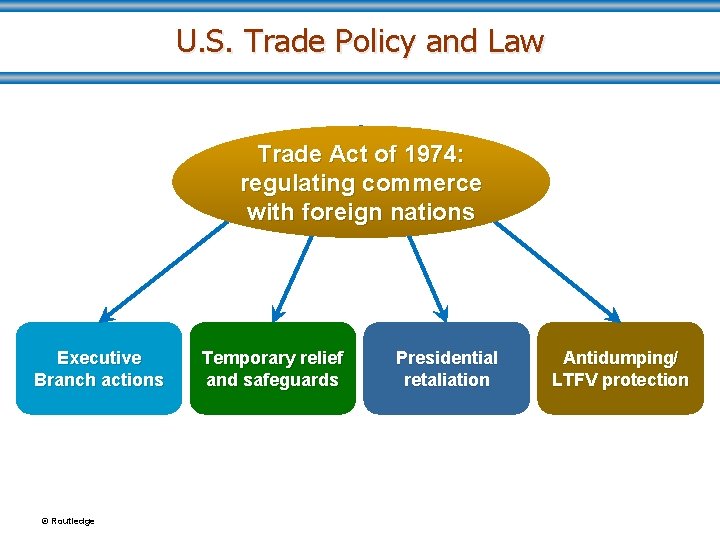
U. S. Trade Policy and Law Trade Act of 1974: regulating commerce with foreign nations Executive Branch actions © Routledge Temporary relief and safeguards Presidential retaliation Antidumping/ LTFV protection
Effective Global Business Regulations • A World Bank study recommended five major steps to effective global business regulation: 1. Simplify and deregulate competitive market business. 2. Focus on enhancing property rights. 3. Expand the use of technology. 4. Reduce court involvement in business matters. 5. Make reform a continuous process. © Routledge
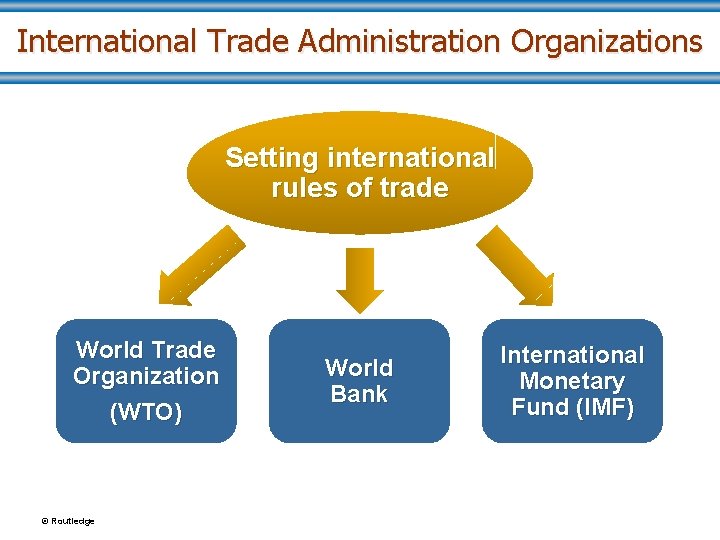
International Trade Administration Organizations Setting international rules of trade World Trade Organization (WTO) © Routledge World Bank International Monetary Fund (IMF)
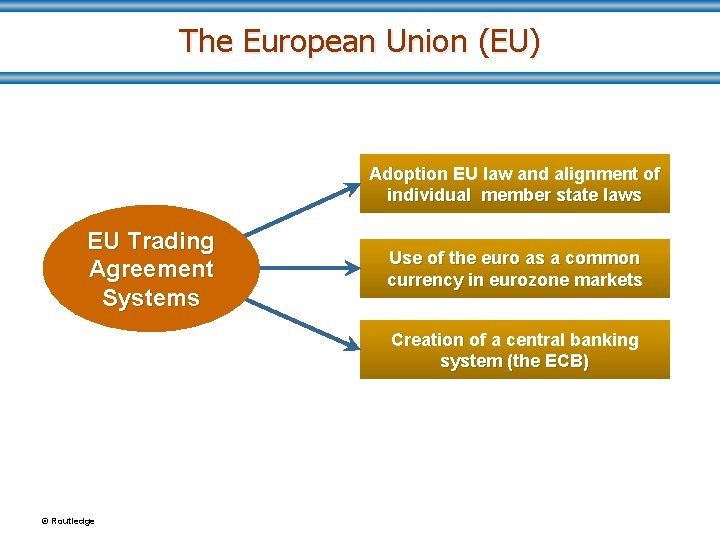
The European Union (EU) Adoption EU law and alignment of individual member state laws EU Trading Agreement Systems Use of the euro as a common currency in eurozone markets Creation of a central banking system (the ECB) © Routledge
The United States and Free Trade Agreements • North American Free Trade Agreement (NAFTA) Ø United States, Canada, and Mexico • The Dominican Republic–Central America– United States Free Trade Agreement (CAFTA -DR) Ø Costa Rica, El Salvador, Guatemala, Honduras, and Nicaragua, Dominican Republic and the United States © Routledge
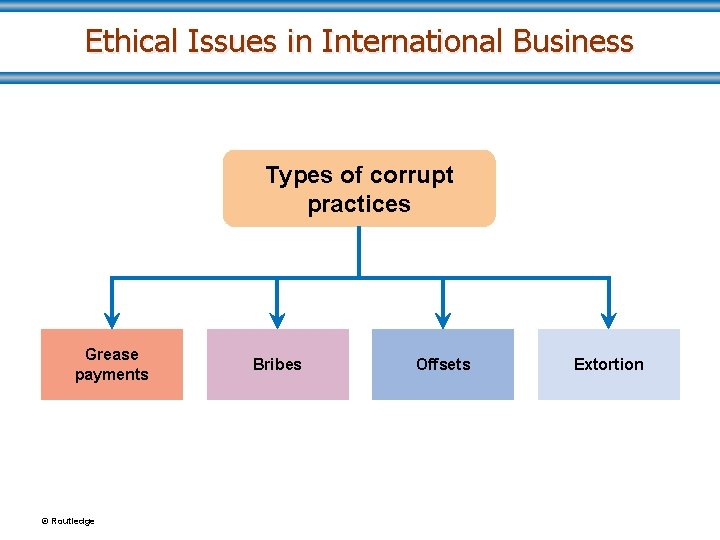
Ethical Issues in International Business Types of corrupt practices Grease payments © Routledge Bribes Offsets Extortion
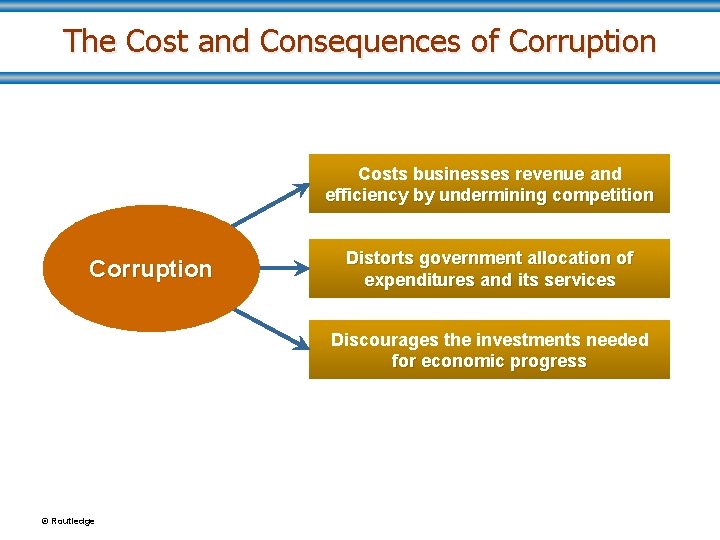
The Cost and Consequences of Corruption Costs businesses revenue and efficiency by undermining competition Corruption Distorts government allocation of expenditures and its services Discourages the investments needed for economic progress © Routledge
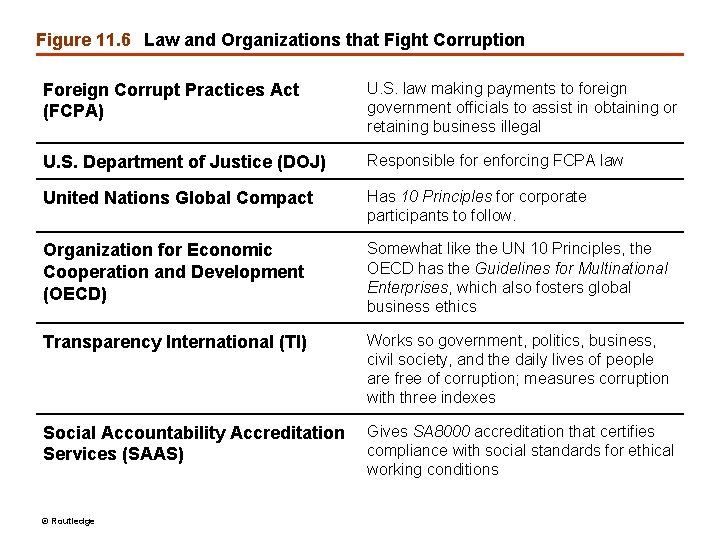
Figure 11. 6 Law and Organizations that Fight Corruption Foreign Corrupt Practices Act (FCPA) U. S. law making payments to foreign government officials to assist in obtaining or retaining business illegal U. S. Department of Justice (DOJ) Responsible for enforcing FCPA law United Nations Global Compact Has 10 Principles for corporate participants to follow. Organization for Economic Cooperation and Development (OECD) Somewhat like the UN 10 Principles, the OECD has the Guidelines for Multinational Enterprises, which also fosters global business ethics Transparency International (TI) Works so government, politics, business, civil society, and the daily lives of people are free of corruption; measures corruption with three indexes Social Accountability Accreditation Services (SAAS) Gives SA 8000 accreditation that certifies compliance with social standards for ethical working conditions © Routledge
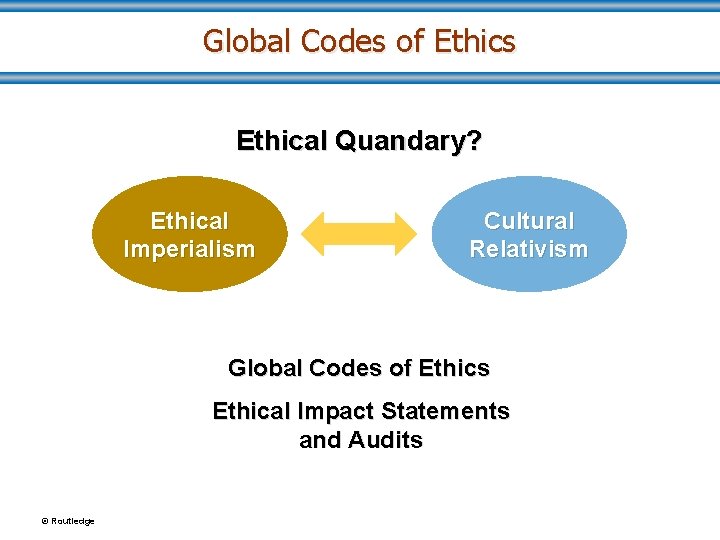
Global Codes of Ethics Ethical Quandary? Ethical Imperialism Cultural Relativism Global Codes of Ethics Ethical Impact Statements and Audits © Routledge
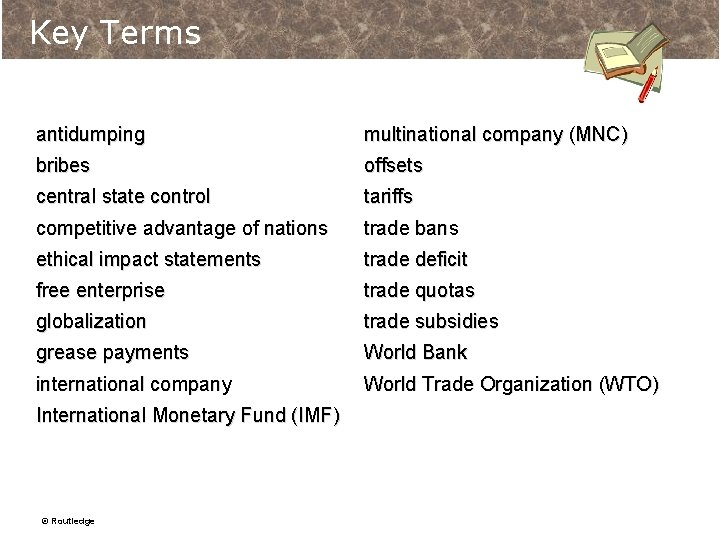
Key Terms antidumping multinational company (MNC) bribes offsets central state control tariffs competitive advantage of nations trade bans ethical impact statements trade deficit free enterprise trade quotas globalization trade subsidies grease payments World Bank international company World Trade Organization (WTO) International Monetary Fund (IMF) © Routledge
- Slides: 21