
Chapter 11 Commercial Banks Major Corporations and Federal

Chapter 11 • Commercial Banks, Major Corporations, and Federal Credit Agencies in the Money Market
11 - 3 Learning Objectives • To discover how banks and other depository institutions borrow and lend funds and supply other critical services in the money market. • To explore the nature and characteristics of commercial papers as well as the roles played by large corporations in the money market. • To learn how federal credit agencies provide financial aid to certain sectors of the economy. Mc. Graw-Hill/Irwin Money and Capital Markets, 9/e © 2006 The Mc. Graw-Hill Companies, Inc. , All Rights Reserved.

11 - 4 Learning Objectives • To see internationalization at work in the money market. Mc. Graw-Hill/Irwin Money and Capital Markets, 9/e © 2006 The Mc. Graw-Hill Companies, Inc. , All Rights Reserved.
11 - 5 Introduction • The money market supplies the cash needs of short-term borrowers and provides savers who hold temporary cash surpluses with an interest-bearing outlet for their funds. • In this chapter, we will explore how commercial banks, major corporations, and government-sponsored credit agencies contribute to the global money market. Mc. Graw-Hill/Irwin Money and Capital Markets, 9/e © 2006 The Mc. Graw-Hill Companies, Inc. , All Rights Reserved.
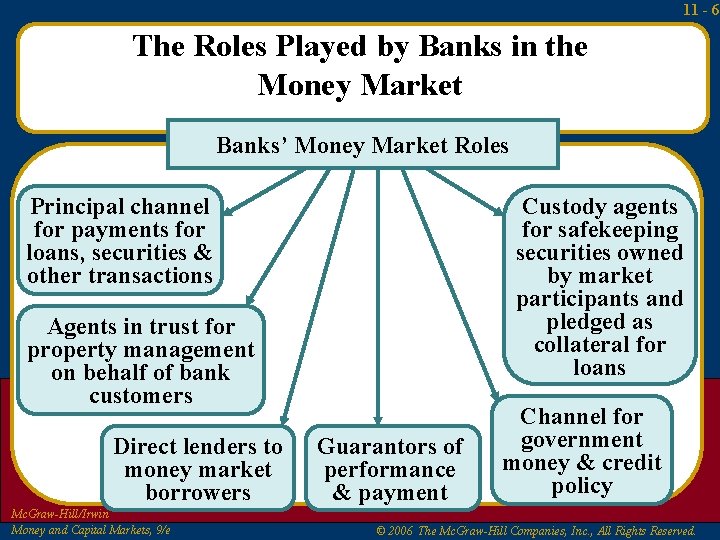
11 - 6 The Roles Played by Banks in the Money Market Banks’ Money Market Roles Principal channel for payments for loans, securities & other transactions Custody agents for safekeeping securities owned by market participants and pledged as collateral for loans Agents in trust for property management on behalf of bank customers Direct lenders to money market borrowers Mc. Graw-Hill/Irwin Money and Capital Markets, 9/e Guarantors of performance & payment Channel for government money & credit policy © 2006 The Mc. Graw-Hill Companies, Inc. , All Rights Reserved.
11 - 7 Federal Funds Provided by the Banking System • Federal funds are any monies available for immediate payment (i. e. same-day money). • They are generally transferred from one depository institution to another by simple bookkeeping entries requested via an online computer system, by wire, or by telephone. • Federal funds are the principal means of making payments in the money market. Mc. Graw-Hill/Irwin Money and Capital Markets, 9/e © 2006 The Mc. Graw-Hill Companies, Inc. , All Rights Reserved.
11 - 8 Federal Funds Provided by the Banking System • The term federal funds came about because early in the development of the market, the principal source of immediately-available money was the reserve balance that each Federal Reserve System member bank had to keep at the Federal Reserve bank in its region. • Today, the federal funds market is broader in scope – some deposits with commercial banks are also available for immediate transfer. Mc. Graw-Hill/Irwin Money and Capital Markets, 9/e © 2006 The Mc. Graw-Hill Companies, Inc. , All Rights Reserved.
11 - 9 Federal Funds Provided by the Banking System • Banks and other depository institutions must hold in a special legal reserve account liquid assets equal to a fraction of the funds deposited with them by the public. • This legal reserve requirement is calculated on a daily average basis over a two-week period, known as the reserve computation period. • The federal funds market is an indispensable tool for such daily reserve management. Mc. Graw-Hill/Irwin Money and Capital Markets, 9/e © 2006 The Mc. Graw-Hill Companies, Inc. , All Rights Reserved.
11 - 10 Federal Funds Provided by the Banking System • There are three principal segments of the Fed funds market among banks today: brokered funds nonbrokered direct loans among major banks correspondent rebookings, where smaller banks loan their excess reserves through the deposits they hold at large correspondent banks in money centers Mc. Graw-Hill/Irwin Money and Capital Markets, 9/e © 2006 The Mc. Graw-Hill Companies, Inc. , All Rights Reserved.
11 - 11 Federal Funds Provided by the Banking System • Commercial banks borrow billions of dollars each day in the federal funds market. • Most federal funds loans are either overnight transactions or continuing contracts that have no specific maturity and that can be terminated without advance notice by either party. • One-day loans carry a fixed rate of interest, but continuing contracts often do not. Mc. Graw-Hill/Irwin Money and Capital Markets, 9/e © 2006 The Mc. Graw-Hill Companies, Inc. , All Rights Reserved.
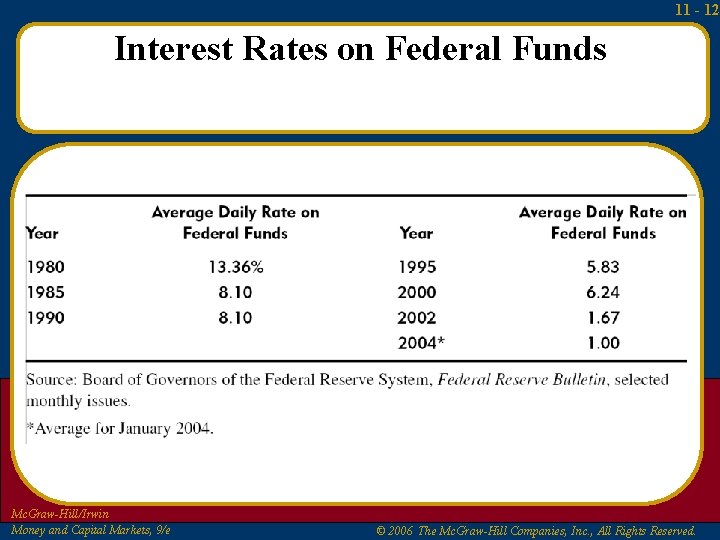
11 - 12 Interest Rates on Federal Funds Mc. Graw-Hill/Irwin Money and Capital Markets, 9/e © 2006 The Mc. Graw-Hill Companies, Inc. , All Rights Reserved.
11 - 13 Federal Funds Provided by the Banking System • Beginning 1989, the Federal Reserve has routinely set target levels for the federal funds rate, and raised or lowered those targets depending on whether it wishes to slow down borrowing and spending in the economy or speed them up. • Through daily open market operations (buying and selling securities), the Fed is able to push the funds rate in the desired direction. Mc. Graw-Hill/Irwin Money and Capital Markets, 9/e © 2006 The Mc. Graw-Hill Companies, Inc. , All Rights Reserved.
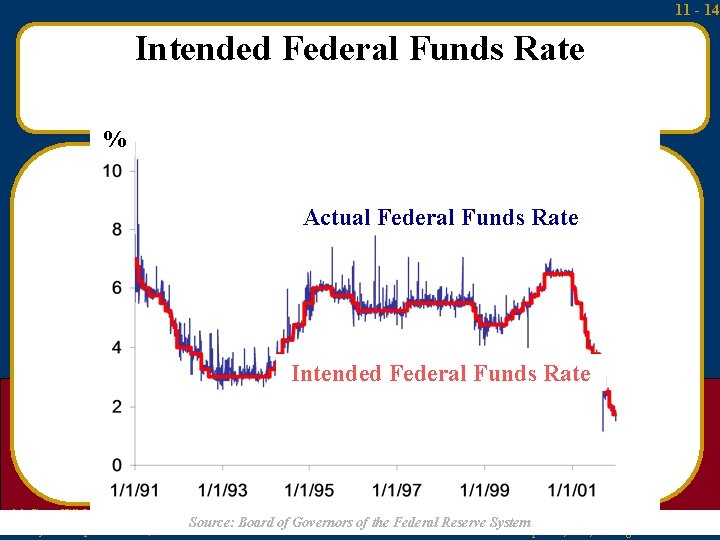
11 - 14 Intended Federal Funds Rate % Actual Federal Funds Rate Intended Federal Funds Rate Mc. Graw-Hill/Irwin Money and Capital Markets, 9/e Source: Board of Governors of the Federal Reserve System © 2006 The Mc. Graw-Hill Companies, Inc. , All Rights Reserved.
11 - 15 Negotiable Certificates of Deposit • A certificate of deposit (CD) is an interest-bearing receipt for funds left with a depository institution for a set period of time. • True money market CDs are negotiable CDs that may be sold any number of times before maturity and that carry a minimum denomination of $100, 000. • They were introduced in 1961 to attract lost deposits back into the banking system. Mc. Graw-Hill/Irwin Money and Capital Markets, 9/e © 2006 The Mc. Graw-Hill Companies, Inc. , All Rights Reserved.
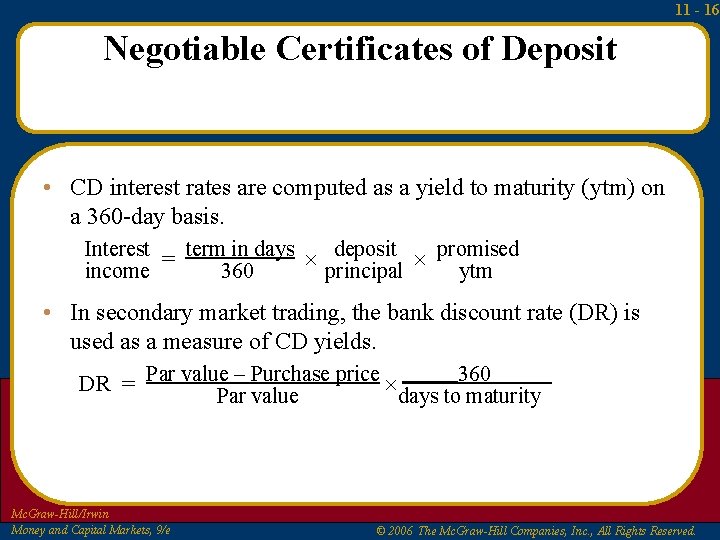
11 - 16 Negotiable Certificates of Deposit • CD interest rates are computed as a yield to maturity (ytm) on a 360 -day basis. Interest = term in days deposit promised income 360 principal ytm • In secondary market trading, the bank discount rate (DR) is used as a measure of CD yields. 360 DR = Par value – Purchase price Par value days to maturity Mc. Graw-Hill/Irwin Money and Capital Markets, 9/e . © 2006 The Mc. Graw-Hill Companies, Inc. , All Rights Reserved.
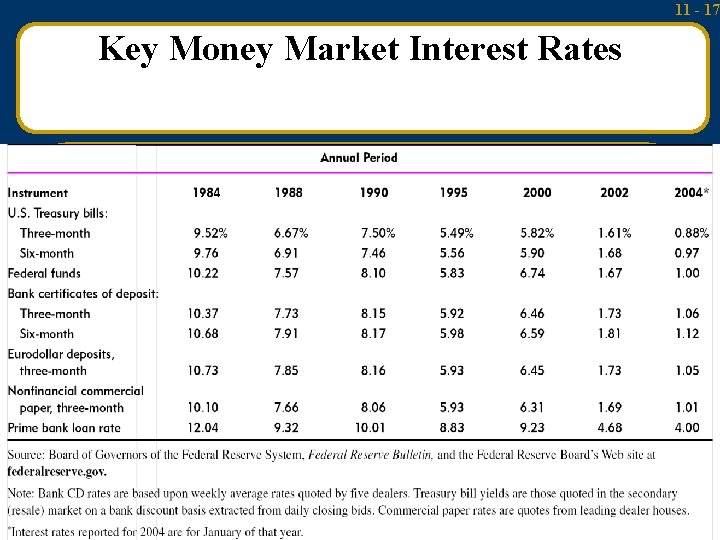
11 - 17 Key Money Market Interest Rates Mc. Graw-Hill/Irwin Money and Capital Markets, 9/e © 2006 The Mc. Graw-Hill Companies, Inc. , All Rights Reserved.
11 - 18 Negotiable Certificates of Deposit • The principal buyers of negotiable CDs include corporations, state and local governments, foreign central banks and governments, wealthy individuals, and a variety of financial institutions. • Most buyers hold CDs until they mature. However, prime-rate CDs are actively traded in the secondary market. Mc. Graw-Hill/Irwin Money and Capital Markets, 9/e © 2006 The Mc. Graw-Hill Companies, Inc. , All Rights Reserved.
11 - 19 Negotiable Certificates of Deposit • Bankers are becoming increasingly innovative in packaging CDs to meet the needs of customers. • New types of CDs include variable-rate CDs, rollover or rolypoly CDs, jumbo CDs, Yankee CDs, brokered CDs, bear and bull CDs, installment CDs, rising-rate CDs, and foreign index CDs. Mc. Graw-Hill/Irwin Money and Capital Markets, 9/e © 2006 The Mc. Graw-Hill Companies, Inc. , All Rights Reserved.
11 - 20 Eurocurrency Deposits • The Eurocurrency market has arisen because of the tremendous need worldwide for funds denominated in dollars, Euros, pounds, and other relatively stable currencies. • The Eurocurrency market represents the largest of all money markets worldwide, with total funds probably in excess of $4 trillion. Mc. Graw-Hill/Irwin Money and Capital Markets, 9/e © 2006 The Mc. Graw-Hill Companies, Inc. , All Rights Reserved.
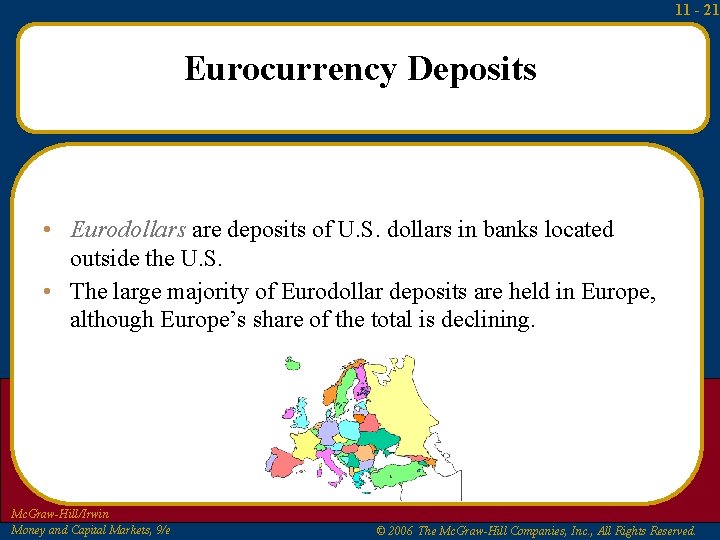
11 - 21 Eurocurrency Deposits • Eurodollars are deposits of U. S. dollars in banks located outside the U. S. • The large majority of Eurodollar deposits are held in Europe, although Europe’s share of the total is declining. Mc. Graw-Hill/Irwin Money and Capital Markets, 9/e © 2006 The Mc. Graw-Hill Companies, Inc. , All Rights Reserved.
11 - 22 Eurocurrency Deposits • Eurodollars and other Eurocurrency deposits are continually on the move in the form of loans. • They are employed to finance the import and export of goods, to supplement government tax revenues, to provide working capital for the foreign operations of multinational corporations, and to provide liquid reserves for the largest banks. Mc. Graw-Hill/Irwin Money and Capital Markets, 9/e © 2006 The Mc. Graw-Hill Companies, Inc. , All Rights Reserved.
11 - 23 Eurocurrency Deposits • When a dollar deposit is moved to a bank located outside the U. S. , that bank then holds claim to the original dollar deposit in the U. S. • When a Eurodollar loan is made, the borrower receives a claim against dollars deposited in U. S. banks. Þ Funds are merely passed from one U. S. bank to another. The total amount of dollar deposits and U. S. bank reserves remains unchanged. Mc. Graw-Hill/Irwin Money and Capital Markets, 9/e © 2006 The Mc. Graw-Hill Companies, Inc. , All Rights Reserved.
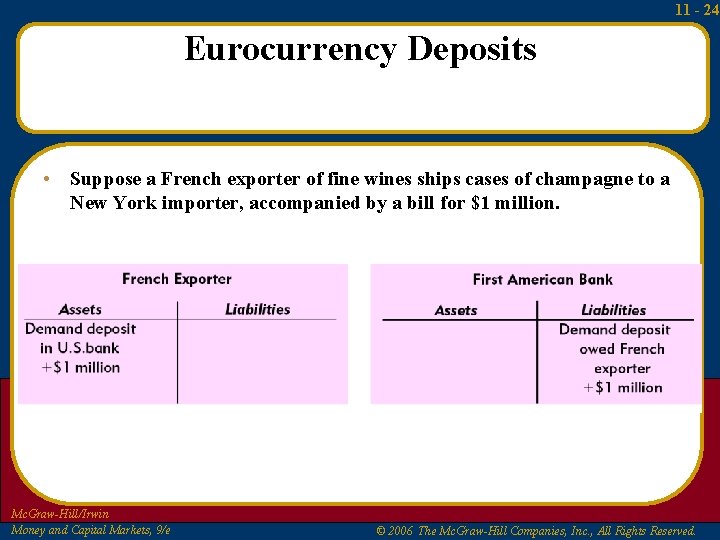
11 - 24 Eurocurrency Deposits • Suppose a French exporter of fine wines ships cases of champagne to a New York importer, accompanied by a bill for $1 million. Mc. Graw-Hill/Irwin Money and Capital Markets, 9/e © 2006 The Mc. Graw-Hill Companies, Inc. , All Rights Reserved.
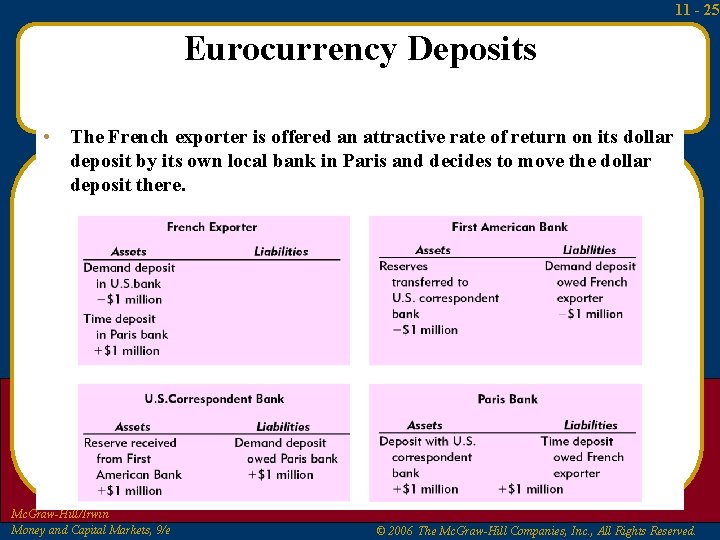
11 - 25 Eurocurrency Deposits • The French exporter is offered an attractive rate of return on its dollar deposit by its own local bank in Paris and decides to move the dollar deposit there. Mc. Graw-Hill/Irwin Money and Capital Markets, 9/e © 2006 The Mc. Graw-Hill Companies, Inc. , All Rights Reserved.
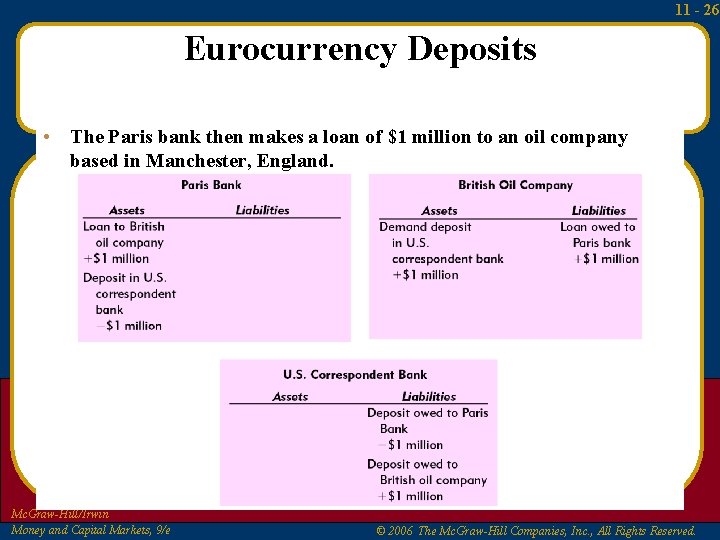
11 - 26 Eurocurrency Deposits • The Paris bank then makes a loan of $1 million to an oil company based in Manchester, England. Mc. Graw-Hill/Irwin Money and Capital Markets, 9/e © 2006 The Mc. Graw-Hill Companies, Inc. , All Rights Reserved.
11 - 27 Eurocurrency Maturities and Risks • Most Eurocurrency deposits are short-term deposits ranging from overnight to one year, although a small percentage are long-term time deposits. • Eurocurrency deposits are known to be volatile and highly sensitive to fluctuations in interest rates and currency prices. They also carry political risk and default risk. Mc. Graw-Hill/Irwin Money and Capital Markets, 9/e © 2006 The Mc. Graw-Hill Companies, Inc. , All Rights Reserved.
11 - 28 The Supply of Eurocurrency Deposits • Eurocurrency deposits come from … - foreign investment tourism balance of payments (trade) settlements interbank funds government funds large corporations’ cash balances central banks supplying or absorbing funds from the banking system Mc. Graw-Hill/Irwin Money and Capital Markets, 9/e © 2006 The Mc. Graw-Hill Companies, Inc. , All Rights Reserved.
11 - 29 Eurodollars in U. S. Domestic Bank Operations • U. S. banks draw heavily on overnight Eurodollar deposits as a means of adjusting their domestic reserve positions. • Eurodollars usually carry higher reported interest rates than many other sources of bank reserves. However, there are fewer legal restrictions on the borrowing of Eurodollars. • U. S. banks also aid their customers in acquiring Eurocurrency deposits and loans. Mc. Graw-Hill/Irwin Money and Capital Markets, 9/e © 2006 The Mc. Graw-Hill Companies, Inc. , All Rights Reserved.
11 - 30 Eurodollars in U. S. Domestic Bank Operations • Eurodollar loan rates extended by major international banks and other leading lenders have two components: the cost of acquiring the Eurocurrency deposits (usually measured by the London Interbank Offer Rate (LIBOR) on three - or six-month Eurodeposits); and a profit margin (“spread”) based on the riskiness of the loan and the intensity of competition. Mc. Graw-Hill/Irwin Money and Capital Markets, 9/e © 2006 The Mc. Graw-Hill Companies, Inc. , All Rights Reserved.
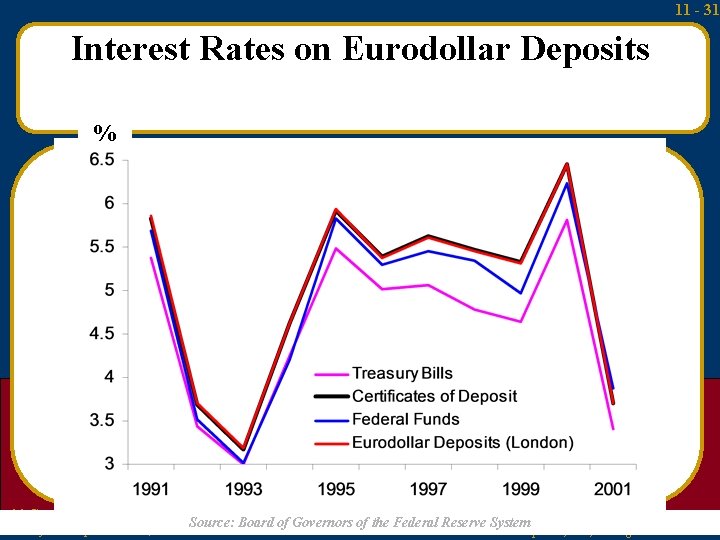
11 - 31 Interest Rates on Eurodollar Deposits % Mc. Graw-Hill/Irwin Money and Capital Markets, 9/e Source: Board of Governors of the Federal Reserve System © 2006 The Mc. Graw-Hill Companies, Inc. , All Rights Reserved.
11 - 32 Recent Innovations in the Eurocurrency Markets • Beginning in the 1980 s, the Eurocurrency market witnessed rapid growth in medium-term credit arrangements between international banks and their corporate and governmental customers. • These so-called note issuance facilities (NIFs) often span five to seven years and allow the customer to borrow in his or her own name by selling short-term IOUs (typically maturing in three to six months) to investors. Mc. Graw-Hill/Irwin Money and Capital Markets, 9/e © 2006 The Mc. Graw-Hill Companies, Inc. , All Rights Reserved.
11 - 33 Benefits and Costs of the Eurocurrency Markets Benefits • Makes possible an efficient mobilization of funds around the globe. • Encourages international cooperation among nations. • Creates a cash-management source to aid the financial operations of corporations and governments around the globe. Mc. Graw-Hill/Irwin Money and Capital Markets, 9/e © 2006 The Mc. Graw-Hill Companies, Inc. , All Rights Reserved.
11 - 34 Benefits and Costs of the Eurocurrency Markets Costs • The capacity to mobilize massive amounts of funds may contribute to instability in currency values. • Monetary and fiscal policies designed to cure domestic economic problems may not achieve their desired impact. Mc. Graw-Hill/Irwin Money and Capital Markets, 9/e © 2006 The Mc. Graw-Hill Companies, Inc. , All Rights Reserved.
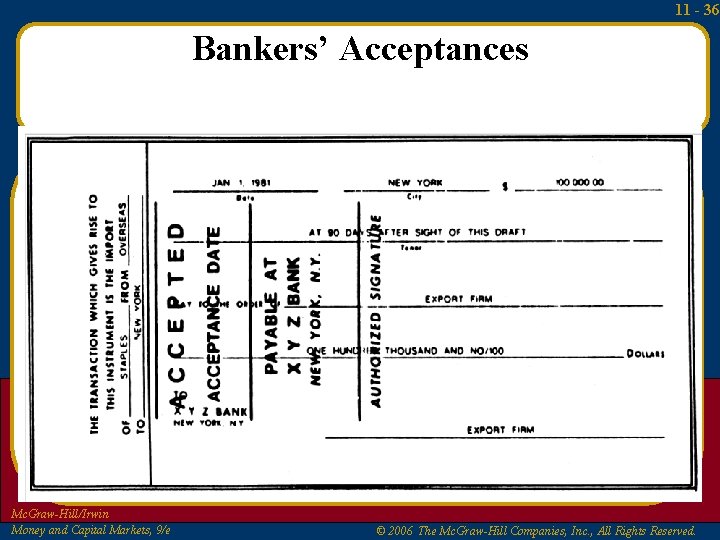
11 - 35 Bankers’ Acceptances • A bankers’ acceptance is a time draft drawn on and endorsed by an importer’s bank. • Acceptances are used in international trade because most exporters are uncertain of the credit standing of their importers. • The issuing bank unconditionally guarantees to pay the face value of the acceptance when it matures, thus shielding exporters and investors in international markets from default risk. Mc. Graw-Hill/Irwin Money and Capital Markets, 9/e © 2006 The Mc. Graw-Hill Companies, Inc. , All Rights Reserved.
11 - 36 Bankers’ Acceptances Mc. Graw-Hill/Irwin Money and Capital Markets, 9/e © 2006 The Mc. Graw-Hill Companies, Inc. , All Rights Reserved.
11 - 37 Bankers’ Acceptances • Acceptances carry maturities ranging from 30 to 270 days, with 90 days being the most common. • They are traded among financial institutions, industrial corporations, and securities dealers as a high-quality investment and source of ready cash. Mc. Graw-Hill/Irwin Money and Capital Markets, 9/e © 2006 The Mc. Graw-Hill Companies, Inc. , All Rights Reserved.
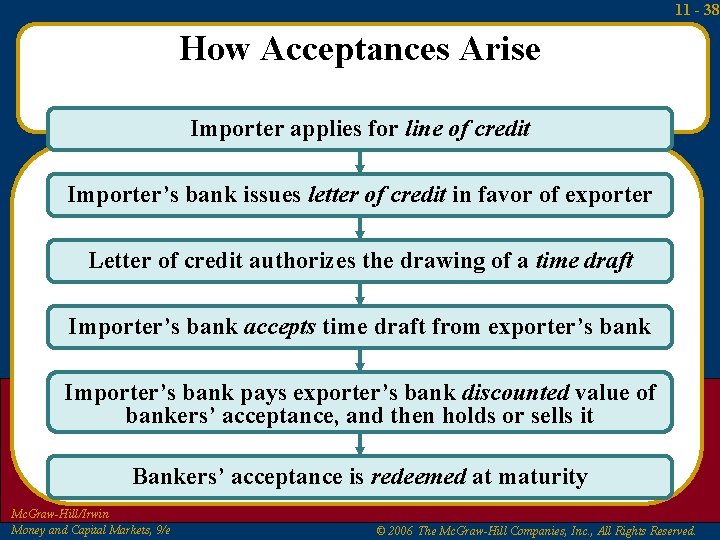
11 - 38 How Acceptances Arise Importer applies for line of credit Importer’s bank issues letter of credit in favor of exporter Letter of credit authorizes the drawing of a time draft Importer’s bank accepts time draft from exporter’s bank Importer’s bank pays exporter’s bank discounted value of bankers’ acceptance, and then holds or sells it Bankers’ acceptance is redeemed at maturity Mc. Graw-Hill/Irwin Money and Capital Markets, 9/e © 2006 The Mc. Graw-Hill Companies, Inc. , All Rights Reserved.
11 - 39 The Growth and Decline of Acceptance Financing • The volume of US$ acceptances outstanding grew rapidly, from less than $400 million in 1950, to slightly more than $7 billion in 1970, and almost $80 billion in 1984. • Then the volume declined sharply to $10 billion in 2000, as several leading export nations entered a recession, as economic problems developed in Asia, and as businesses turn to other payment and financing methods. Mc. Graw-Hill/Irwin Money and Capital Markets, 9/e © 2006 The Mc. Graw-Hill Companies, Inc. , All Rights Reserved.
11 - 40 Acceptance Rates • Acceptances do not carry a fixed rate of interest, but are sold at a discount in the open market like Treasury bills. • The yield on acceptances is usually only slightly higher than the yield on Treasury bills, and close to the negotiable CD rates offered by major banks, because of the high credit quality of the banks that issue the acceptances and CDs. Mc. Graw-Hill/Irwin Money and Capital Markets, 9/e © 2006 The Mc. Graw-Hill Companies, Inc. , All Rights Reserved.
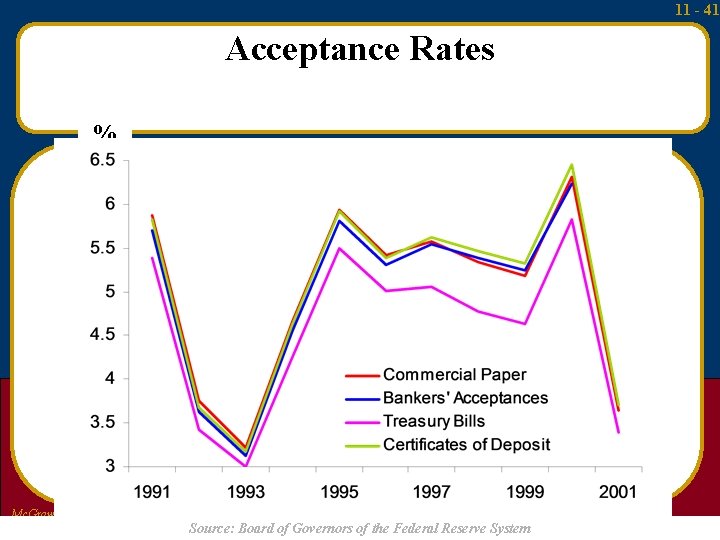
11 - 41 Acceptance Rates % Mc. Graw-Hill/Irwin Money and Capital Markets, 9/e Source: Board of Governors of the Federal Reserve System © 2006 The Mc. Graw-Hill Companies, Inc. , All Rights Reserved.
11 - 42 Prominent Investors in Acceptances • Investors in acceptances include banks, industrial corporations, money market mutual funds, local governments, federal agencies, and insurance companies. • To many investors, acceptances are a close substitute for Treasury bills, negotiable CDs, or commercial paper in terms of quality, although the acceptance market is far smaller in terms of the volume of trading. Mc. Graw-Hill/Irwin Money and Capital Markets, 9/e © 2006 The Mc. Graw-Hill Companies, Inc. , All Rights Reserved.
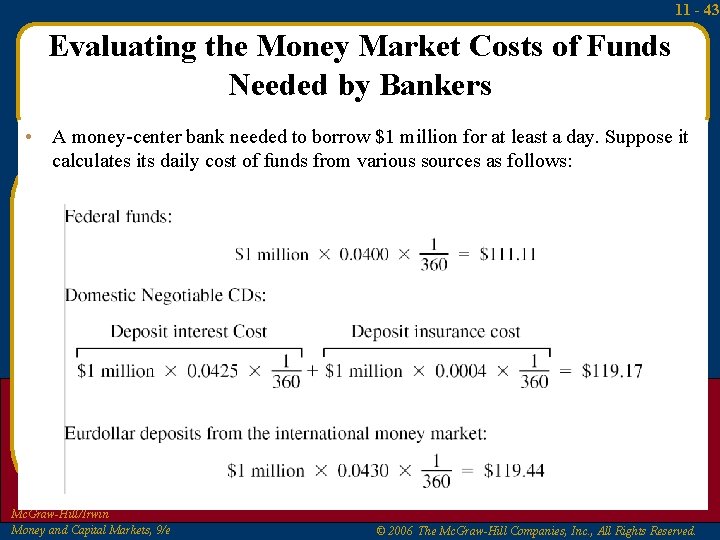
11 - 43 Evaluating the Money Market Costs of Funds Needed by Bankers • A money-center bank needed to borrow $1 million for at least a day. Suppose it calculates its daily cost of funds from various sources as follows: Mc. Graw-Hill/Irwin Money and Capital Markets, 9/e © 2006 The Mc. Graw-Hill Companies, Inc. , All Rights Reserved.
11 - 44 Evaluating the Money Market Costs of Funds Needed by Bankers • Note that a banker borrowing in the money market must consider not only the level of current money market interest rates but also expected future interest rates as well as government regulations. Mc. Graw-Hill/Irwin Money and Capital Markets, 9/e © 2006 The Mc. Graw-Hill Companies, Inc. , All Rights Reserved.
11 - 45 Bank Activity in the Money Market • In the 1960 s and 1970 s, competition forced major corporations to seek out alternative investments for their short-term funds. • Bankers thus turned to the money market for additional funds – negotiable CDs appeared and the federal funds market was broadened. • Then, as policies were tightened, many bankers turned to the Eurocurrency market and RPs backed by government securities. Mc. Graw-Hill/Irwin Money and Capital Markets, 9/e © 2006 The Mc. Graw-Hill Companies, Inc. , All Rights Reserved.
11 - 46 Bank Activity in the Money Market • All these clever bank maneuvers form part of a technique called liability management. • By varying the daily interest rates offered on CDs and other funds sources, bankers can gain a measure of control over their liabilities. - If a bank needs more funds on a given day, the bank can simply offer a higher yield on the particular money market instrument that it desires to use. Mc. Graw-Hill/Irwin Money and Capital Markets, 9/e © 2006 The Mc. Graw-Hill Companies, Inc. , All Rights Reserved.
11 - 47 Commercial Paper • Commercial paper consists of short-term, unsecured promissory notes issued by well-known and financially strong companies. • Commercial paper is traded mainly in the primary market. Opportunities for resale in the secondary market are more limited. • Commercial paper is rated prime, desirable, or satisfactory, depending on the credit standing of the issuing company. Mc. Graw-Hill/Irwin Money and Capital Markets, 9/e © 2006 The Mc. Graw-Hill Companies, Inc. , All Rights Reserved.
11 - 48 Types of Commercial Paper • There are two major types of commercial paper. • Direct paper is issued mainly by large finance companies and bank holding companies directly to the investor. • Dealer paper, or industrial paper, is issued by security dealers on behalf of their corporate customers (mainly nonfinancial companies and smaller financial companies). Mc. Graw-Hill/Irwin Money and Capital Markets, 9/e © 2006 The Mc. Graw-Hill Companies, Inc. , All Rights Reserved.
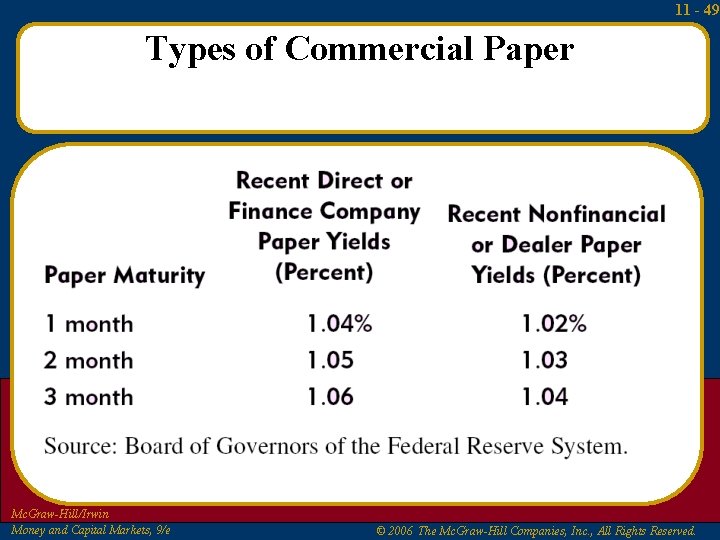
11 - 49 Types of Commercial Paper Mc. Graw-Hill/Irwin Money and Capital Markets, 9/e © 2006 The Mc. Graw-Hill Companies, Inc. , All Rights Reserved.
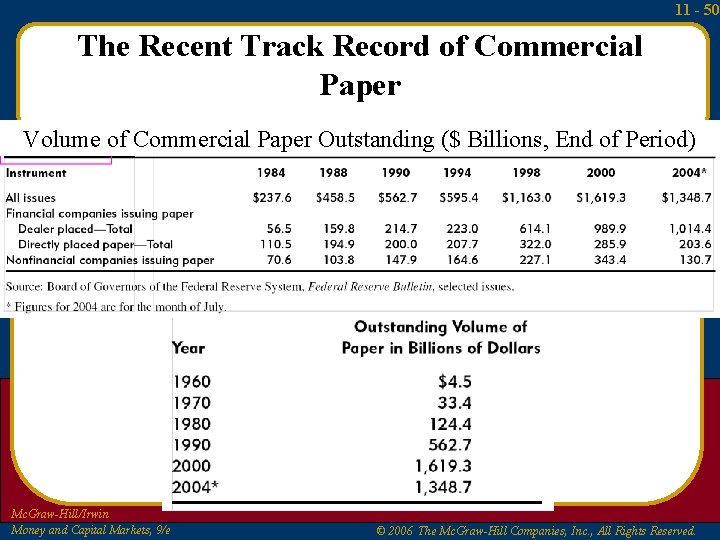
11 - 50 The Recent Track Record of Commercial Paper Volume of Commercial Paper Outstanding ($ Billions, End of Period) Mc. Graw-Hill/Irwin Money and Capital Markets, 9/e © 2006 The Mc. Graw-Hill Companies, Inc. , All Rights Reserved.
11 - 51 The Recent Track Record of Commercial Paper • The volume of commercial paper has grown rapidly due to its relatively low cost and high quality, as well as the expanding use of credit enhancements. Mc. Graw-Hill/Irwin Money and Capital Markets, 9/e © 2006 The Mc. Graw-Hill Companies, Inc. , All Rights Reserved.
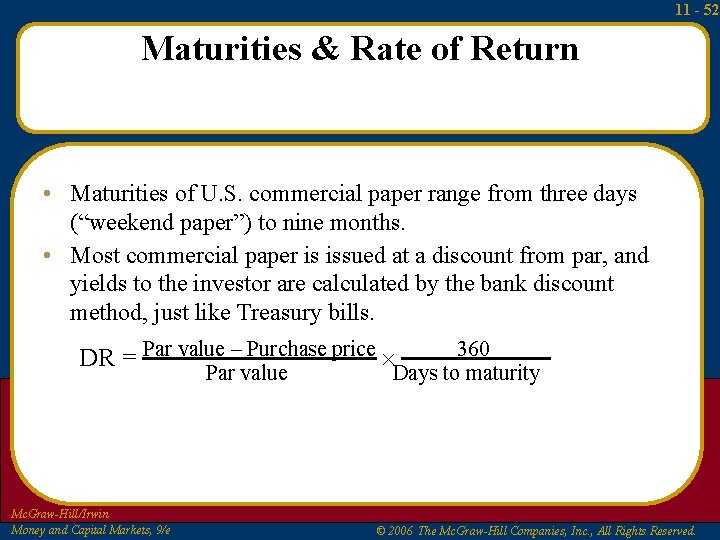
11 - 52 Maturities & Rate of Return • Maturities of U. S. commercial paper range from three days (“weekend paper”) to nine months. • Most commercial paper is issued at a discount from par, and yields to the investor are calculated by the bank discount method, just like Treasury bills. DR = Par value – Purchase price Par value Mc. Graw-Hill/Irwin Money and Capital Markets, 9/e 360 Days to maturity . © 2006 The Mc. Graw-Hill Companies, Inc. , All Rights Reserved.
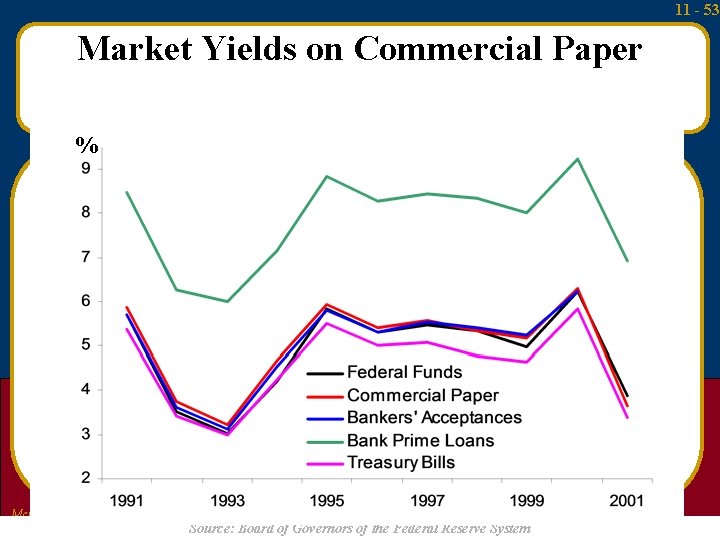
11 - 53 Market Yields on Commercial Paper % Mc. Graw-Hill/Irwin Money and Capital Markets, 9/e Source: Board of Governors of the Federal Reserve System © 2006 The Mc. Graw-Hill Companies, Inc. , All Rights Reserved.
11 - 54 Commercial Paper Advantages Relatively low interest rates Flexible interest rates - choice of dealer or direct paper Large amounts may be borrowed conveniently The ability to issue paper gives considerable leverage when negotiating with banks Mc. Graw-Hill/Irwin Money and Capital Markets, 9/e © 2006 The Mc. Graw-Hill Companies, Inc. , All Rights Reserved.
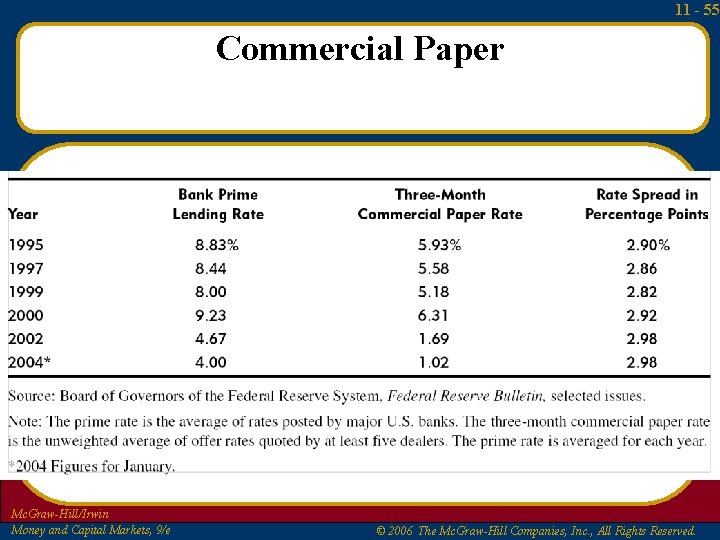
11 - 55 Commercial Paper Mc. Graw-Hill/Irwin Money and Capital Markets, 9/e © 2006 The Mc. Graw-Hill Companies, Inc. , All Rights Reserved.
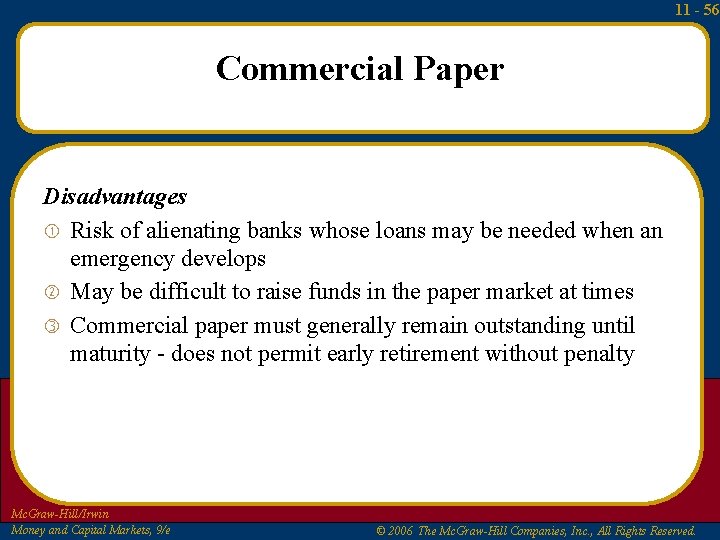
11 - 56 Commercial Paper Disadvantages Risk of alienating banks whose loans may be needed when an emergency develops May be difficult to raise funds in the paper market at times Commercial paper must generally remain outstanding until maturity - does not permit early retirement without penalty Mc. Graw-Hill/Irwin Money and Capital Markets, 9/e © 2006 The Mc. Graw-Hill Companies, Inc. , All Rights Reserved.
11 - 57 Who Buys Commercial Paper? • The most important investors in the commercial paper market include nonfinancial corporations, money market mutual funds, bank trust departments, small banks, pension funds, insurance companies, and state and local governments. • In effect, this is a market in which corporations borrow from other corporations. Mc. Graw-Hill/Irwin Money and Capital Markets, 9/e © 2006 The Mc. Graw-Hill Companies, Inc. , All Rights Reserved.
11 - 58 Continuing Innovation in the Paper Market • Innovations and extensions of the paper market include: - Master note – the investing firm agrees to take some paper each day up to an agreed-upon maximum amount - Medium-term notes – 9 -month to 10 -year notes - Asset-backed commercial paper – loans or credit receivables are pooled and paper is then issued as a claim against that pool Mc. Graw-Hill/Irwin Money and Capital Markets, 9/e © 2006 The Mc. Graw-Hill Companies, Inc. , All Rights Reserved.
11 - 59 Commercial Paper Ratings & Dealer Operations • Commercial paper is rated prime, desirable, or satisfactory, depending on the credit standing of the issuing company. • Generally, investors prefer notes bearing credit ratings from at least two rating agencies. • The market is concentrated among a handful of dealers. Top commercial paper dealers today include Citicorp, the Credit. Suisse-First Boston Corporation, Morgan Stanley Dean Witter, and Merrill Lynch. Mc. Graw-Hill/Irwin Money and Capital Markets, 9/e © 2006 The Mc. Graw-Hill Companies, Inc. , All Rights Reserved.
11 - 60 Credit Agencies in the Money Market • Certain sectors of the economy, such as agriculture, housing, small businesses, and college students, appear to have an unusually difficult time raising funds in the money and capital markets. • Beginning in 1916, the U. S. federal government created special agencies to make direct loans or guarantee private loans to these “disadvantaged” borrowers. Mc. Graw-Hill/Irwin Money and Capital Markets, 9/e © 2006 The Mc. Graw-Hill Companies, Inc. , All Rights Reserved.
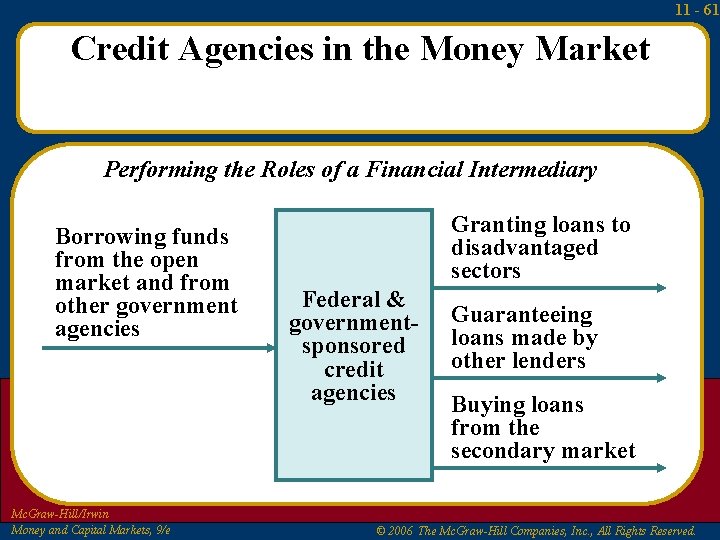
11 - 61 Credit Agencies in the Money Market Performing the Roles of a Financial Intermediary Borrowing funds from the open market and from other government agencies Mc. Graw-Hill/Irwin Money and Capital Markets, 9/e Granting loans to disadvantaged sectors Federal & governmentsponsored credit agencies Guaranteeing loans made by other lenders Buying loans from the secondary market © 2006 The Mc. Graw-Hill Companies, Inc. , All Rights Reserved.
11 - 62 Types of Federal Credit Agencies • Government-sponsored agencies are federally chartered but privately owned. Their borrowing and lending activities are not reflected in the federal government’s budget. • Examples: - Federal Farm Credit Banks (FFCB) Federal Home Loan Mortgage Corp (Freddie Mac) Student Loan Marketing Association (Sallie Mae) Financing Assistance Corporation (FAC) Mc. Graw-Hill/Irwin Money and Capital Markets, 9/e © 2006 The Mc. Graw-Hill Companies, Inc. , All Rights Reserved.
11 - 63 Types of Federal Credit Agencies • Federal agencies are legally a part of the government structure, and their borrowing and lending activities are included in the federal budget. • Examples: - Export-Import Bank (EXIM) Farmers Home Administration (FMHA) Government National Mortgage Association (Ginnie Mae) Federal Deposit Insurance Corporation (FDIC) Mc. Graw-Hill/Irwin Money and Capital Markets, 9/e © 2006 The Mc. Graw-Hill Companies, Inc. , All Rights Reserved.
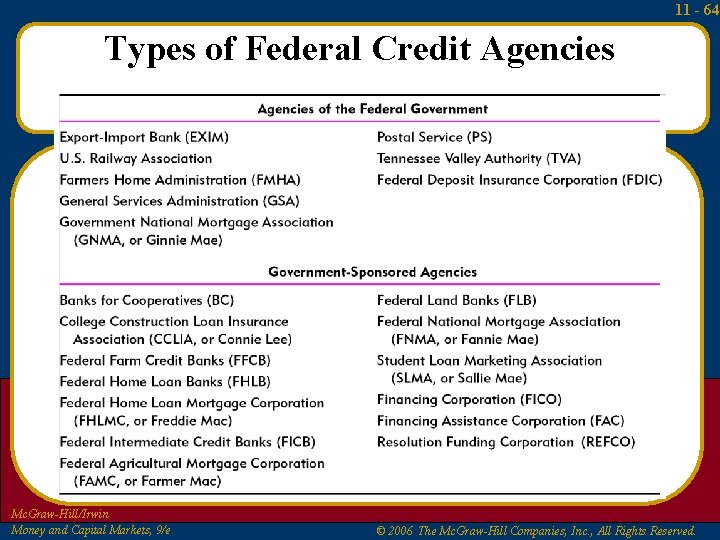
11 - 64 Types of Federal Credit Agencies Mc. Graw-Hill/Irwin Money and Capital Markets, 9/e © 2006 The Mc. Graw-Hill Companies, Inc. , All Rights Reserved.
11 - 65 Growth of the Agency Security Market • The agency market has soared in recent years, with the volume of outstanding securities climbing from about $2 billion during the 1950 s to more than $2 trillion today. • Agency securities are generally short to medium term in maturity (running out to about 10 years). Mc. Graw-Hill/Irwin Money and Capital Markets, 9/e © 2006 The Mc. Graw-Hill Companies, Inc. , All Rights Reserved.
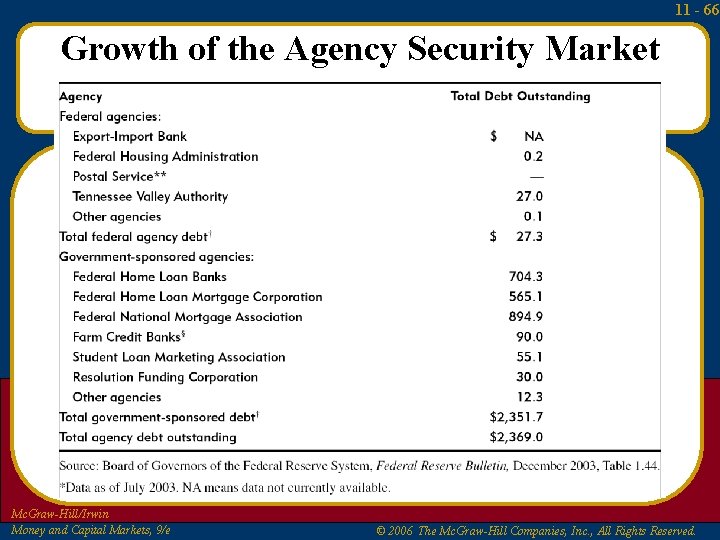
11 - 66 Growth of the Agency Security Market Mc. Graw-Hill/Irwin Money and Capital Markets, 9/e © 2006 The Mc. Graw-Hill Companies, Inc. , All Rights Reserved.
11 - 67 The Marketing of Agency Issues • The most active buyers of agency securities include banks, state and local governments, government trust funds, and the Federal Reserve System. • The Federal Reserve is authorized to conduct open market operations in agency IOUs. • Major securities dealers who handle U. S. government securities also generally trade in agency issues. Mc. Graw-Hill/Irwin Money and Capital Markets, 9/e © 2006 The Mc. Graw-Hill Companies, Inc. , All Rights Reserved.
11 - 68 Markets on the Net • ALM Professional at www. almprofessional. com • Bank Rate. com at www. bankrate. com • Board of Governors of the Federal Reserve System at www. federalreserve. gov/fomc • British Bankers Association at www. bba. com. uk • Browse Data of the Federal Reserve Board at www. economagic. com/fedbog. htm Mc. Graw-Hill/Irwin Money and Capital Markets, 9/e © 2006 The Mc. Graw-Hill Companies, Inc. , All Rights Reserved.
11 - 69 Markets on the Net • Federal Reserve Bank of Atlanta at www. frb. atlanta. org/publica • Federal Reserve Bank of New York at www. ny. frb. org • Securities and Exchange Commission at www. sec. gov • Treasury Direct at www. Treasurydirect. gov Mc. Graw-Hill/Irwin Money and Capital Markets, 9/e © 2006 The Mc. Graw-Hill Companies, Inc. , All Rights Reserved.
11 - 70 Chapter Review • Introduction • The Roles Played by Banks in the Money Market Mc. Graw-Hill/Irwin Money and Capital Markets, 9/e © 2006 The Mc. Graw-Hill Companies, Inc. , All Rights Reserved.
11 - 71 Chapter Review • Federal Funds Provided by the Banking System - The Nature of Federal Funds and Their Uses Use of the Federal Funds Market to Meet Reserve Requirements Mechanics of Federal Funds Trading Volume of Borrowings in the Funds Market Interest Rates on Federal Funds and Government Economic Policy Mc. Graw-Hill/Irwin Money and Capital Markets, 9/e © 2006 The Mc. Graw-Hill Companies, Inc. , All Rights Reserved.
11 - 72 Chapter Review • Negotiable Certificates of Deposit (CDs) Issued by Banks - Terms Attached to CDs - Buyers of CDs - New Types of CDs Mc. Graw-Hill/Irwin Money and Capital Markets, 9/e © 2006 The Mc. Graw-Hill Companies, Inc. , All Rights Reserved.
11 - 73 Chapter Review • Eurocurrency Deposits in International Banks - What is a Eurodollar? The Creation of Eurocurrency Deposits Eurocurrency Maturities and Risks The Supply of Eurocurrency Deposits Eurodollars in U. S. Domestic Bank Operations Recent Innovations in the Eurocurrency Markets Benefits and Costs of the Eurocurrency Markets Mc. Graw-Hill/Irwin Money and Capital Markets, 9/e © 2006 The Mc. Graw-Hill Companies, Inc. , All Rights Reserved.
11 - 74 Chapter Review • Bankers’ Acceptances - The Nature of Acceptances Why Acceptances Are Used in International Trade How Acceptances Arise The Growth and Decline of Acceptance Financing Acceptance Rates Prominent Investors in Acceptances Mc. Graw-Hill/Irwin Money and Capital Markets, 9/e © 2006 The Mc. Graw-Hill Companies, Inc. , All Rights Reserved.
11 - 75 Chapter Review • Evaluating the Money Market Costs of Funds Needed by Bankers • Concluding Comment on Bank Activity in the Money Market • Major Corporations in the Money Market: Commercial Paper - The Nature of Commercial Paper - Types of Commercial Paper Mc. Graw-Hill/Irwin Money and Capital Markets, 9/e © 2006 The Mc. Graw-Hill Companies, Inc. , All Rights Reserved.
11 - 76 Chapter Review • Major Corporations in the Money Market: Commercial Paper … continued - The Recent Track Record of Commercial Paper Maturities & Rate of Return on Commercial Paper Changing Yields on Paper Issues Advantages & Disadvantages Who Buys Commercial Paper? Continuing Innovation in the Paper Market Commercial Paper Ratings and Dealer Operations Mc. Graw-Hill/Irwin Money and Capital Markets, 9/e © 2006 The Mc. Graw-Hill Companies, Inc. , All Rights Reserved.
11 - 77 Chapter Review • Credit Agencies in the Money Market - Types of Federal Credit Agencies - Growth of the Agency Security Market - Characteristics and the Marketing of Agency Securities Mc. Graw-Hill/Irwin Money and Capital Markets, 9/e © 2006 The Mc. Graw-Hill Companies, Inc. , All Rights Reserved.
- Slides: 77