
Chapter 11 Chapter XX Chapter Title Diagnostic Coding

- Slides: 53
Chapter 11: Chapter XX: Chapter Title Diagnostic Coding
Learning Outcomes Cognitive Domain Note: AAMA/CAAHEP 2015 Standards are italicized. 1. Spell and define the key terms 2. Describe the relationship between coding and reimbursement 3. Name and describe the coding system used to describe diseases, injuries, and other reasons for encounters with a medical provider 4. Explain the format of the ICD-9 -CM 5. Give four examples of ways E codes are used 6. Describe how to use the most current diagnostic coding classification system 7. Describe the ICD-10 -CM/PCS version and its differences from ICD-9 Copyright © 2017 Wolters Kluwer • All Rights Reserved
Learning Outcomes (cont'd. ) Psychomotor Domain Note: AAMA/CAAHEP 2015 Standards are italicized. 1. Perform diagnostic coding (Procedure 11 -1) 2. Utilize medical necessity guidelines (Procedure 11 -1) Copyright © 2017 Wolters Kluwer • All Rights Reserved
Learning Outcomes (cont'd. ) Affective Domain Note: AAMA/CAAHEP 2015 Standards are italicized. 1. Work with physician to achieve the maximum reimbursement 2. Utilize tactful communication skills with medical providers to ensure accurate code selection Copyright © 2017 Wolters Kluwer • All Rights Reserved
Learning Outcomes (cont'd. ) ABHES Competencies 1. Apply third-party guidelines 2. Perform diagnostic and procedural coding 3. Comply with federal, state, and local health laws and regulations Copyright © 2017 Wolters Kluwer • All Rights Reserved
Introduction Coding is the assignment of a number to a verbal statement or description. It is used for health insurance claims processing. Correct coding is essential. Incorrect or incomplete information can result in nonpayment of claim and incorrect insurance data can affect a patient’s insurability. International Classification of Diseases, Ninth Revision, Clinical Modification (ICD 9 -CM: a system for transforming verbal descriptions of disease, injuries, conditions, and procedures to numeric code It is essential that the physician and medical assistant work together to achieve accurate documentation, code assignment, and reporting of diagnoses and procedures. Copyright © 2017 Wolters Kluwer • All Rights Reserved Back to Learning Outcomes
Introduction (cont’d. ) The third-party payer needs to know why a service was performed to assess medical necessity. And, the diagnosis justifies the procedure. medical necessity: a determination made by a third party that a certain service or procedure was necessary based on sound medical practice advance beneficiary notice (ABN): document that informs covered patients that Medicare may not cover a certain service and the patient will be responsible for the bill Since Medicare considers certain procedures medically necessary only at certain intervals, having the patient sign an advance beneficiary notice will ensure payment of treatments and procedures that will likely be denied by Medicare. Copyright © 2017 Wolters Kluwer • All Rights Reserved Back to Learning Outcomes
Checkpoint Question What is meant by medical necessity? Copyright © 2017 Wolters Kluwer • All Rights Reserved Back to Learning Outcomes
Checkpoint Answer Medical necessity means a particular service or procedure is reasonable. Copyright © 2017 Wolters Kluwer • All Rights Reserved Back to Learning Outcomes
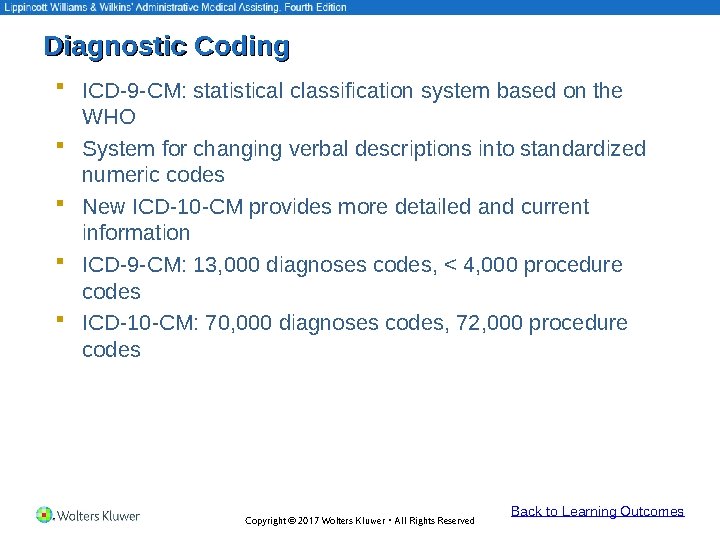
Diagnostic Coding ICD-9 -CM: statistical classification system based on the WHO System for changing verbal descriptions into standardized numeric codes New ICD-10 -CM provides more detailed and current information ICD-9 -CM: 13, 000 diagnoses codes, < 4, 000 procedure codes ICD-10 -CM: 70, 000 diagnoses codes, 72, 000 procedure codes Copyright © 2017 Wolters Kluwer • All Rights Reserved Back to Learning Outcomes
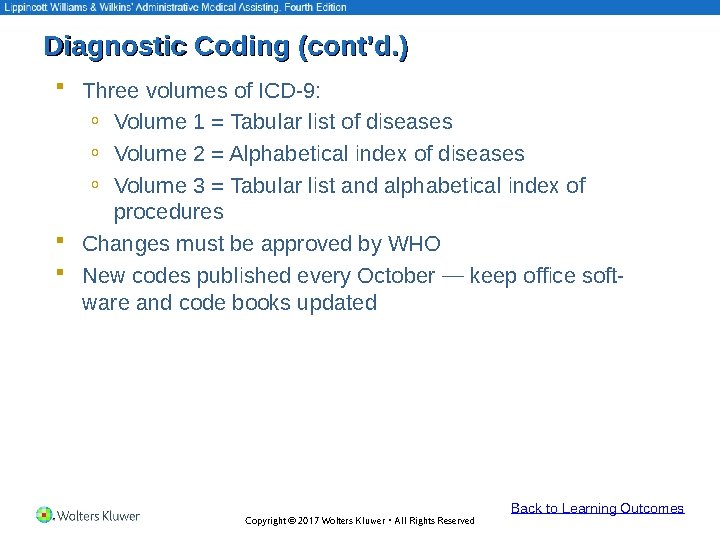
Diagnostic Coding (cont’d. ) Three volumes of ICD-9: Volume 1 = Tabular list of diseases o Volume 2 = Alphabetical index of diseases o Volume 3 = Tabular list and alphabetical index of procedures Changes must be approved by WHO New codes published every October — keep office software and code books updated o Copyright © 2017 Wolters Kluwer • All Rights Reserved Back to Learning Outcomes
Checkpoint Question What organization must approve any changes in the disease classification system? Copyright © 2017 Wolters Kluwer • All Rights Reserved Back to Learning Outcomes
Checkpoint Answer The World Health Organization must approve any changes in the coding system. Back to Learning Outcomes Copyright © 2017 Wolters Kluwer • All Rights Reserved
Diagnostic Coding (cont’d. ) Inpatient Versus Outpatient Coding Volumes 1 and 2 are used to justify physician services where services are provided in office or in hospital Outpatient services provided at: Health care provider’s office Hospital clinic Emergency department Hospital same-day surgery unit or ambulatory surgical center Observation status in hospital for short-stay Inpatient services: Patient admitted for treatment, staying for 24 hours or more Copyright © 2017 Wolters Kluwer • All Rights Reserved inpatient: a medical setting in which patients are admitted for diagnostic, radiographic, or treatment purposes outpatient: a medical setting in which patients receive care but are not admitted Back to Learning Outcomes
Diagnostic Coding (cont’d. ) Volume 3 is used by hospitals to report procedures, services, supplies, and reasons for procedures UB-04 (uniform bill) for inpatient admissions, outpatient procedures, and emergency services: o For nursing services and costs associated with running institution o Does not include physician services CMS-1500 claim form to report physician services Copyright © 2017 Wolters Kluwer • All Rights Reserved Back to Learning Outcomes
Checkpoint Question Name and give uses for the three volumes of the ICD-9 -CM. Back to Learning Outcomes Copyright © 2017 Wolters Kluwer • All Rights Reserved
Checkpoint Answer Volumes 1 and 2 of the ICD-9 -CM are used to report the diagnostic code that justifies physician services whether those services are provided in the office or in the hospital. Hospital coders use Volume 3 to report inpatient procedures, services, and supplies, as well as the reasons for the services. Copyright © 2017 Wolters Kluwer • All Rights Reserved Back to Learning Outcomes
The Diagnostic Codebook Coding books available from several publishers: Ingenix o Medicode o AMA Classification system available as part of medical software packages For accuracy—always use most current codes: o Important to update codes on superbills or other forms o Millions of dollars lost due to incorrect code on form not updated o To become an expert medical coder, you need general knowledge of human anatomy and medical terminology. Copyright © 2017 Wolters Kluwer • All Rights Reserved Back to Learning Outcomes
Checkpoint Question How often is the ICD-CM updated? When is the use of the new codes required? Copyright © 2017 Wolters Kluwer • All Rights Reserved Back to Learning Outcomes
Checkpoint Answer ICD-CM is updated annually, published in late summer and effective every October 1 st. Copyright © 2017 Wolters Kluwer • All Rights Reserved Back to Learning Outcomes
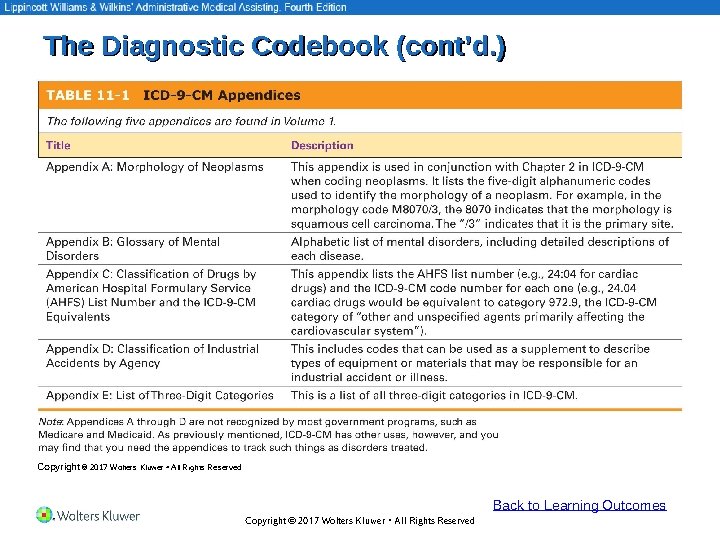
The Diagnostic Codebook (cont’d. ) Tabular List of Diseases Classification of conditions and injuries by code number 17 chapters in ICD-9 -CM; 21 chapters in ICD-10 -CM Grouped by etiology and body systems o Each chapter is assigned a range of code numbers o Three-digit codes = general disease o Fourth digit = further breaks down category o Fifth digit = highest specificity o Always used to code condition to highest definition Includes 5 appendices Copyright © 2017 Wolters Kluwer • All Rights Reserved Etiology: cause of disease Truncated coding: diagnosis coding that is not done at the highest level available for a particular diagnosis or problem Back to Learning Outcomes
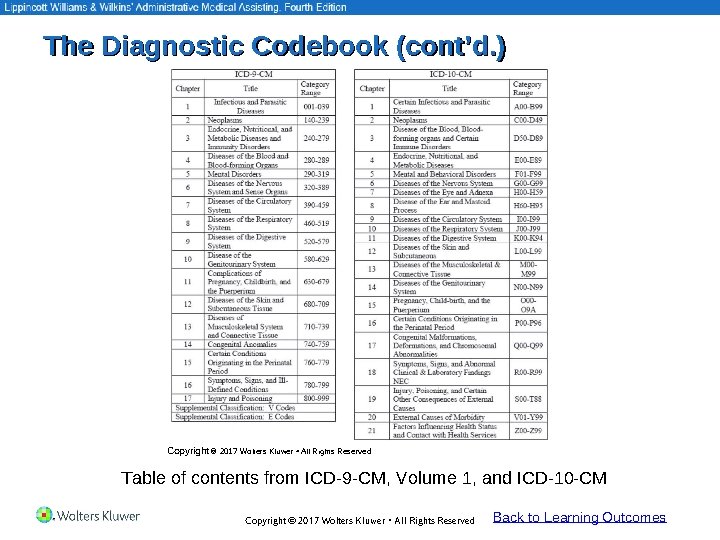
The Diagnostic Codebook (cont’d. ) Copyright © 2017 Wolters Kluwer • All Rights Reserved Table of contents from ICD-9 -CM, Volume 1, and ICD-10 -CM Copyright © 2017 Wolters Kluwer • All Rights Reserved Back to Learning Outcomes
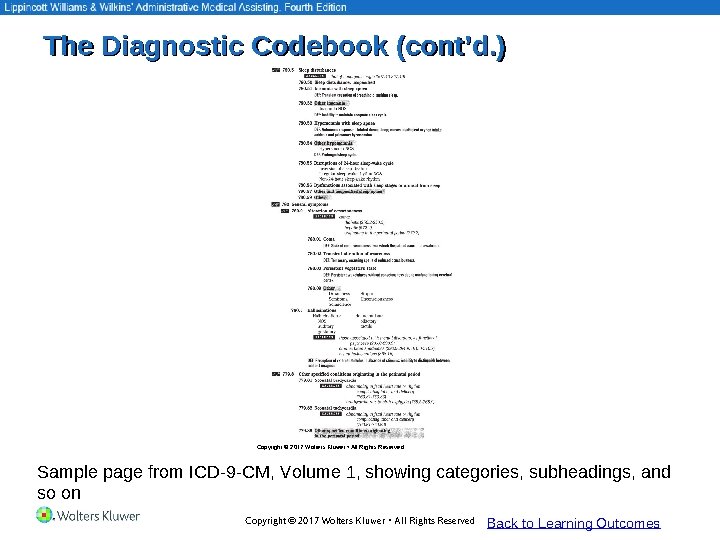
The Diagnostic Codebook (cont’d. ) Copyright © 2017 Wolters Kluwer • All Rights Reserved Sample page from ICD-9 -CM, Volume 1, showing categories, subheadings, and so on Copyright © 2017 Wolters Kluwer • All Rights Reserved Back to Learning Outcomes
The Diagnostic Codebook (cont’d. ) Copyright © 2017 Wolters Kluwer • All Rights Reserved Back to Learning Outcomes Copyright © 2017 Wolters Kluwer • All Rights Reserved
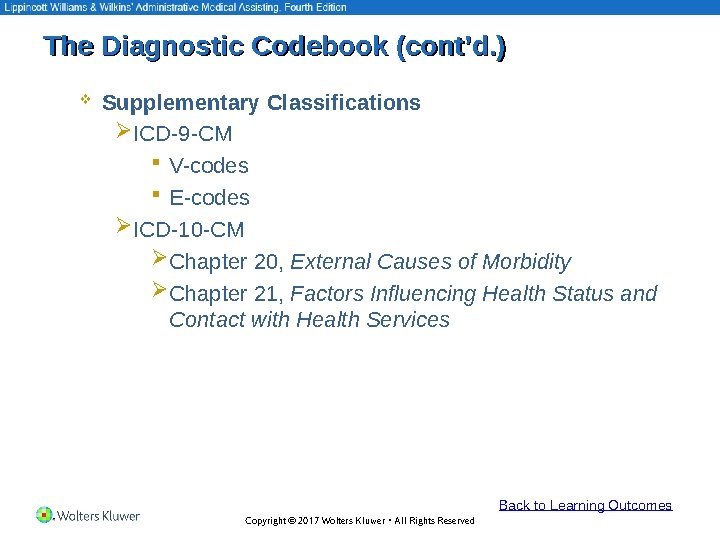
The Diagnostic Codebook (cont’d. ) Supplementary Classifications ICD-9 -CM V-codes E-codes ICD-10 -CM Chapter 20, External Causes of Morbidity Chapter 21, Factors Influencing Health Status and Contact with Health Services Back to Learning Outcomes Copyright © 2017 Wolters Kluwer • All Rights Reserved
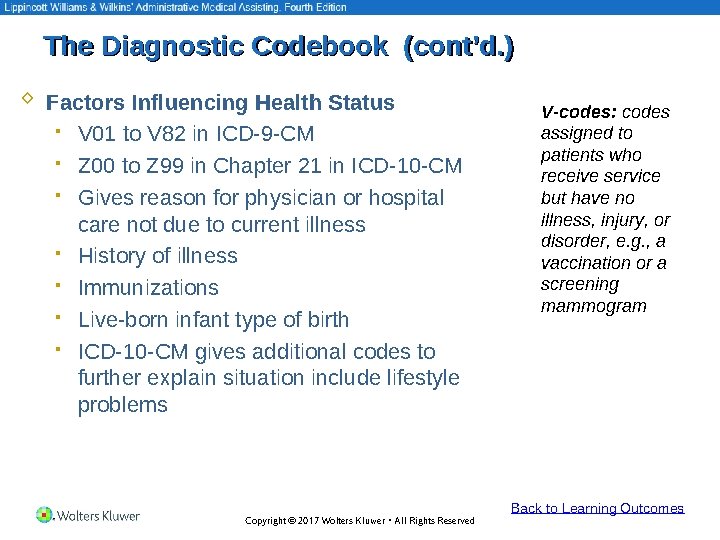
The Diagnostic Codebook (cont’d. ) Factors Influencing Health Status V 01 to V 82 in ICD-9 -CM Z 00 to Z 99 in Chapter 21 in ICD-10 -CM Gives reason for physician or hospital care not due to current illness History of illness Immunizations Live-born infant type of birth ICD-10 -CM gives additional codes to further explain situation include lifestyle problems Copyright © 2017 Wolters Kluwer • All Rights Reserved V-codes: codes assigned to patients who receive service but have no illness, injury, or disorder, e. g. , a vaccination or a screening mammogram Back to Learning Outcomes
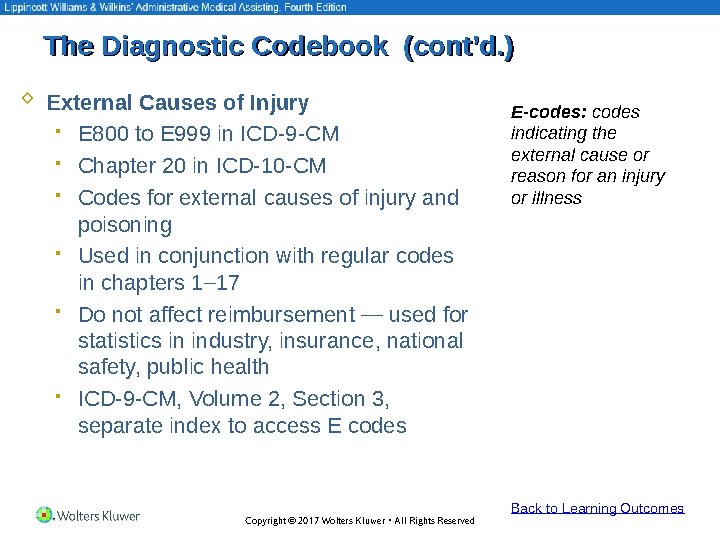
The Diagnostic Codebook (cont’d. ) External Causes of Injury E 800 to E 999 in ICD-9 -CM Chapter 20 in ICD-10 -CM Codes for external causes of injury and poisoning Used in conjunction with regular codes in chapters 1– 17 Do not affect reimbursement — used for statistics in industry, insurance, national safety, public health ICD-9 -CM, Volume 2, Section 3, separate index to access E codes Copyright © 2017 Wolters Kluwer • All Rights Reserved E-codes: codes indicating the external cause or reason for an injury or illness Back to Learning Outcomes
Checkpoint Question List four reasons for using supplemental codes. Back to Learning Outcomes Copyright © 2017 Wolters Kluwer • All Rights Reserved
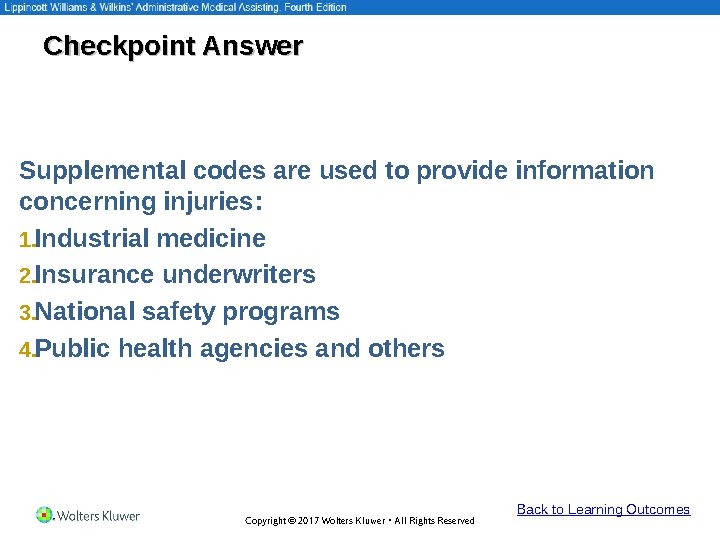
Checkpoint Answer Supplemental codes are used to provide information concerning injuries: 1. Industrial medicine 2. Insurance underwriters 3. National safety programs 4. Public health agencies and others Copyright © 2017 Wolters Kluwer • All Rights Reserved Back to Learning Outcomes
The Diagnostic Codebook (cont’d. ) Alphabetic Index of Diseases Arranged by condition ICD-9 -CM has 3 sections; ICD-10 -CM has replaced section 3 with chapter 20 o Section 1: • Alphabetic Index to Diseases and Injuries • Main terms along with codes • Must cross-reference or check tabular list to ensure correctness • System of exceptions cross-reference: notation in a file telling that a record is stored elsewhere and giving the reference; verification to another source; checking the tabular list against the alphabetic list in ICD-9 coding You must not accept a number as the correct code without a cross-reference or check of the tabular list. Back to Learning Outcomes Copyright © 2017 Wolters Kluwer • All Rights Reserved
The Diagnostic Codebook (cont’d. ) o Section 2: Table of Drugs and Chemicals • Includes drugs, toxins, chemical agents o Section 3: • Alphabetic Index to External Causes of Injuries and Poisonings • Accidents, injuries, and violence • Not used for medical diagnoses — supplement the diagnosis to give clearer picture • Should not be used alone • Back to Learning Outcomes Copyright © 2017 Wolters Kluwer • All Rights Reserved
Checkpoint Question What are supplemental codes to classify Factors Influencing Health Status used for? Copyright © 2017 Wolters Kluwer • All Rights Reserved Back to Learning Outcomes
Checkpoint Answer Supplementary codes to classify Factors Influencing Health Status are used to report reasons for receiving services other than illness. Copyright © 2017 Wolters Kluwer • All Rights Reserved Back to Learning Outcomes
The Diagnostic Codebook (cont’d. ) Inpatient Coding Tabular List and Alphabetic Index of Procedures Used for inpatient facilities Based on anatomy, not to surgical specialty Includes miscellaneous diagnostic and therapeutic procedures Two-digit codes with two-decimal digits Replaced by ICD-10 -PCS Copyright © 2017 Wolters Kluwer • All Rights Reserved Back to Learning Outcomes
Locating the Appropriate Code Using the Diagnostic Coding Conventions are standardized and must be strictly followed Main Term Choose main term within diagnostic notes – often an eponym Find the condition, not the location Copyright © 2017 Wolters Kluwer • All Rights Reserved conventions: general notes, symbols, typeface, format, and punctuation that direct and guide the coder to the most complete and accurate ICD 9 code eponym: word derived from a personal name, e. g. , Alzheimer disease main term: words in a multiple-word diagnosis that a coder should locate in the alphabetic listing. They represent the condition (not the location to be coded. Back to Learning Outcomes
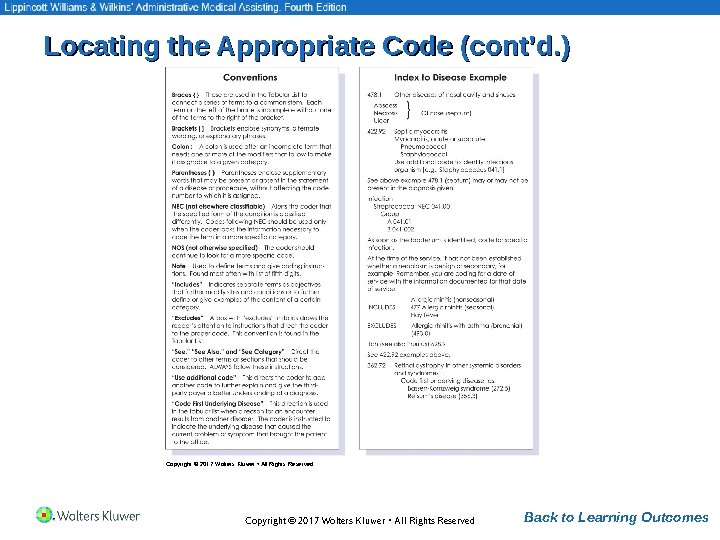
Locating the Appropriate Code (cont’d. ) Conventions used in diagnostic coding Copyright © 2017 Wolters Kluwer • All Rights Reserved Back to Learning Outcomes
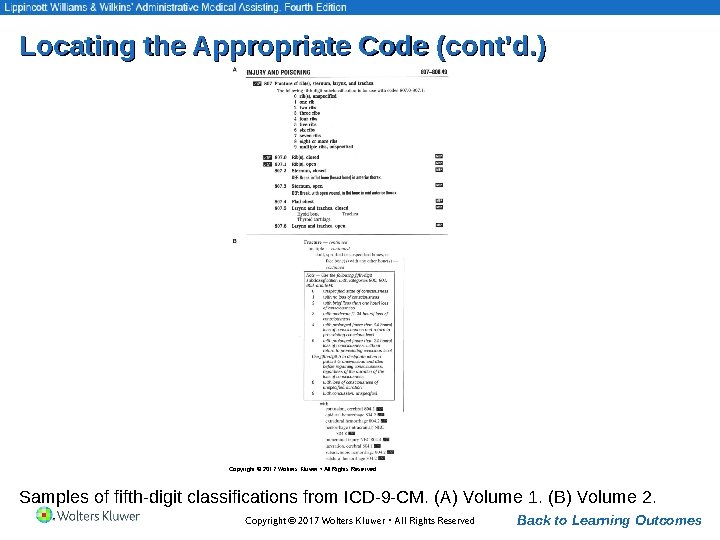
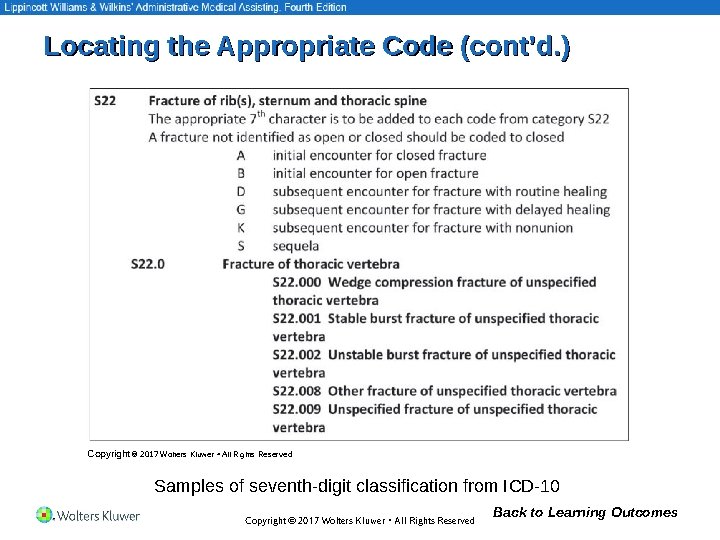
Locating the Appropriate Code (cont’d. ) Additional Digits In many cases a fourth digit has been added to provide more specificity Others also have fifth digit ICD-9 -CM codes requiring a fifth digit are identified in both volumes 1 and 2 ICD-10 -CM may have 4 to 7 additional digits Copyright © 2017 Wolters Kluwer • All Rights Reserved specificity: relating to a definite result Back to Learning Outcomes
Locating the Appropriate Code (cont’d. ) Copyright © 2017 Wolters Kluwer • All Rights Reserved Samples of fifth-digit classifications from ICD-9 -CM. (A) Volume 1. (B) Volume 2. Copyright © 2017 Wolters Kluwer • All Rights Reserved Back to Learning Outcomes
Locating the Appropriate Code (cont’d. ) Copyright © 2017 Wolters Kluwer • All Rights Reserved Samples of seventh-digit classification from ICD-10 Copyright © 2017 Wolters Kluwer • All Rights Reserved Back to Learning Outcomes
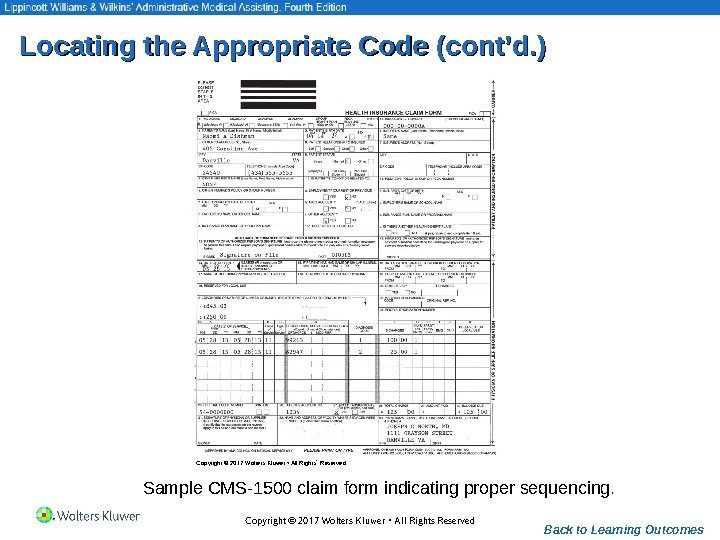
Locating the Appropriate Code (cont’d. ) Primary Codes Primary diagnosis in outpatient coding Primary code listed first on the CMS-1500 When More Than One Code Is Used Necessary to convey accurate picture of the patient’s total condition If any condition is related to or affects treatment, should be listed as supplementary information Multiple codes should be sequenced Allows 12 different diagnostic codes primary diagnosis: the condition or chief complaint that brings a person to a medical facility for treatment When patients have more than one diagnosis, it is necessary to convey an accurate picture of the patient’s total condition. Copyright © 2017 Wolters Kluwer • All Rights Reserved Back to Learning Outcomes
Locating the Appropriate Code (cont’d. ) Copyright © 2017 Wolters Kluwer • All Rights` Reserved Sample CMS-1500 claim form indicating proper sequencing. Copyright © 2017 Wolters Kluwer • All Rights Reserved Back to Learning Outcomes
Locating the Appropriate Code (cont’d. ) Late Effects Code late affects with current complaint first, then original cause second Key words defining late effects “late” “due to an old injury” “due to a previous illness/injury” “due to an illness or injury occurring a year or more ago” “sequela of …” “as a result of…” “resulting from …” Copyright © 2017 Wolters Kluwer • All Rights Reserved late effects: conditions that result from another condition. For example, leftsided paralysis may be a late effect of a stroke Back to Learning Outcomes
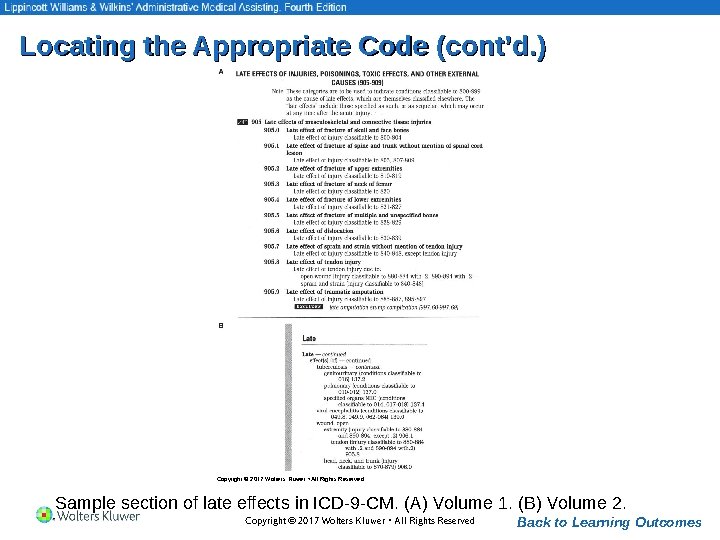
Locating the Appropriate Code (cont’d. ) Copyright © 2017 Wolters Kluwer • All Rights Reserved Sample section of late effects in ICD-9 -CM. (A) Volume 1. (B) Volume 2. Copyright © 2017 Wolters Kluwer • All Rights Reserved Back to Learning Outcomes
Locating the Appropriate Code (cont’d. ) Coding Suspected Conditions Inpatient setting — coders list conditions after testing is complete Outpatient-coder reports reason for visit as it occurs First visit is “headache MRI ordered for: o “Rule out” o “Suspected” o “Probable” Not accurate to code visit as “brain tumor” before it is confirmed Symptom code In outpatient settings, the coder reports the reason for the patient visit as it occurs. Copyright © 2017 Wolters Kluwer • All Rights Reserved Back to Learning Outcomes
Checkpoint Question When coding a visit on a date before a definitive diagnosis is made, what is coded? Back to Learning Outcomes Copyright © 2017 Wolters Kluwer • All Rights Reserved
Checkpoint Answer Before a definitive diagnosis is assigned to a patient, services must be coded with the patient’s symptoms at the time he or she was seen. Copyright © 2017 Wolters Kluwer • All Rights Reserved Back to Learning Outcomes
Locating the Appropriate Code (cont’d. ) Documentation Requirements Code based on patient’s medical documentation If not in the chart, didn’t happen Audits compare codes used with patient documentation Audits ensure compliance and detect fraud audit: a review of an account; inspection of records to determine compliance and to detect fraud As discussed throughout this chapter, you should choose the code assigned to any given claim for a service or procedure based on the documentation available in the patient’s record at the time of the service. Back to Learning Outcomes Copyright © 2017 Wolters Kluwer • All Rights Reserved
The Future of Diagnostic Coding: International Classification of Diseases, Clinical Modification, Tenth Revision Scheduled to be implemented on October 1, 2015 WHO has revised ICD to improve data quality Includes more codes and will be used by every type of health care provider for all encounters, including hospice and home health care Codes are alphanumeric Index similar to that of ICD-9 -CM Two new chapters added: o Disorders of eye Basic knowledge of ICD-9 -CM will prove invaluable Copyright © 2017 Wolters Kluwer • All Rights Reserved Back to Learning Outcomes
The Future of Diagnostic Coding: International Classification of Diseases, Clinical Modification, Tenth Revision (cont’d. ) Conventions Many conventions will not change One difference is “Excludes” notes — ICD-10 uses two: o “Excludes 1” means not coded here and does not allow for exceptions o “Excludes 2” indicates that if medical documentation supports both conditions, both may be coded Placeholder “X” Some disorders will require a 7 th character in ICD-10 -CM Some will have no 5 th or 6 th, and “X” is used as a placeholder Back to Learning Outcomes Copyright © 2017 Wolters Kluwer • All Rights Reserved
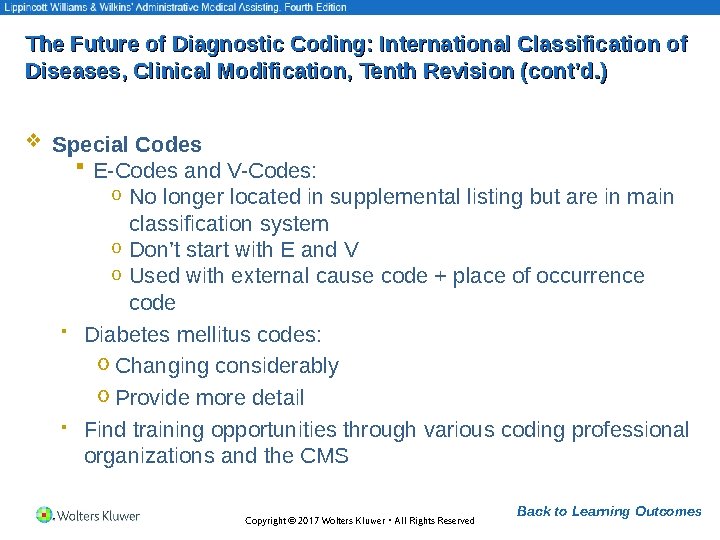
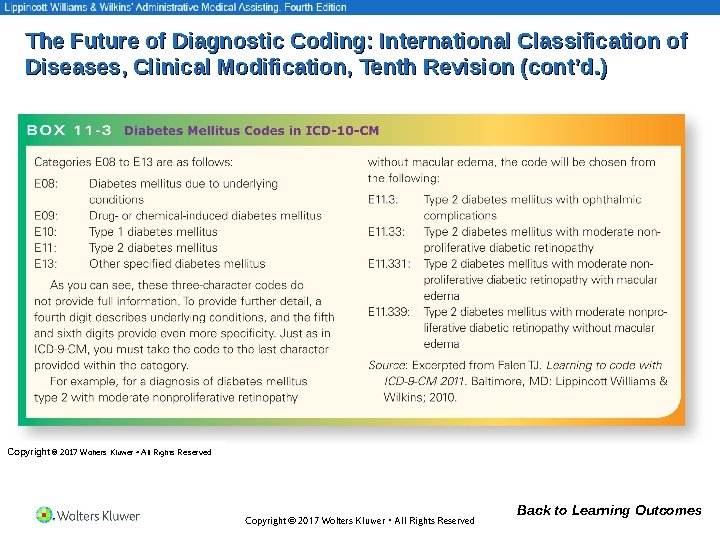
The Future of Diagnostic Coding: International Classification of Diseases, Clinical Modification, Tenth Revision (cont’d. ) Special Codes E-Codes and V-Codes: o No longer located in supplemental listing but are in main classification system o Don’t start with E and V o Used with external cause code + place of occurrence code Diabetes mellitus codes: o Changing considerably o Provide more detail Find training opportunities through various coding professional organizations and the CMS Copyright © 2017 Wolters Kluwer • All Rights Reserved Back to Learning Outcomes
The Future of Diagnostic Coding: International Classification of Diseases, Clinical Modification, Tenth Revision (cont’d. ) Copyright © 2017 Wolters Kluwer • All Rights Reserved Back to Learning Outcomes
Checkpoint Question How will the implementation of ICD-10 -CM improve the coding of reasons for services? Copyright © 2017 Wolters Kluwer • All Rights Reserved Back to Learning Outcomes
Checkpoint Answer In ICD-10 -CM, the longer combination of numbers and letters allows for expanding of the system as new technologies are discovered and used. The codes will also provide more information which will enhance efficiency and accuracy. Copyright © 2017 Wolters Kluwer • All Rights Reserved Back to Learning Outcomes