
CHAPTER 11 CELL GROWTH DIVISION Section 1 Cell
- Slides: 56
CHAPTER 11 CELL GROWTH & DIVISION
Section 1: Cell Growth I. Cells are microscopic A. Why must cells be so small? 1. If cells continue to grow larger and larger… a. The demands of the cell’s DNA increase b. The cell is less efficient at moving wastes out and nutrients in i. Cells require oxygen, water, and foodwhich is transported across the cell membrane.
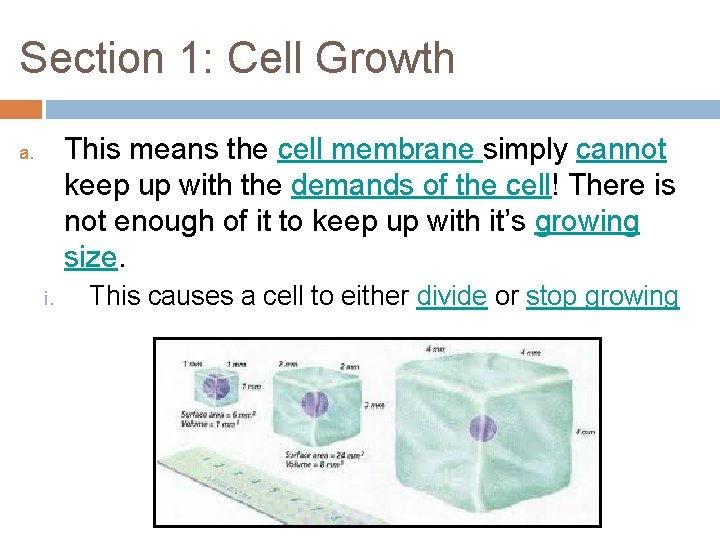
Section 1: Cell Growth Cells also need to get rid of wasteswhich is exported out of the cell through the membrane. iii. Larger cells need more nutrients, and make more waste! As a cell grows, its volume increases (cytoplasm) much faster than its surface area (membrane). ii. 2.
Section 1: Cell Growth This means the cell membrane simply cannot keep up with the demands of the cell! There is not enough of it to keep up with it’s growing size. a. i. This causes a cell to either divide or stop growing
Section 1: Cell Growth II. A. Types of Reproduction There are 2 types of reproduction: 1. Asexual Reproduction a. b. In single-celled and multicellular organisms The new cell is identical to the parent cell
Section 1: Cell Growth 2. Sexual Reproduction a. b. In single-celled and multicellular organisms The new cell is a combination from two parent cells
Section 1: Cell Growth III. A. B. Types of Cell Division There are 3 types of cell division, depending on the type of cell: 1. Binary fission (prokaryotic) 2. Mitosis (eukaryotic) 3. Meiosis (eukaryotic) Recall that prokaryotic cells (bacteria) do not have a nucleus. Eukaryotic cells do have a nucleus.
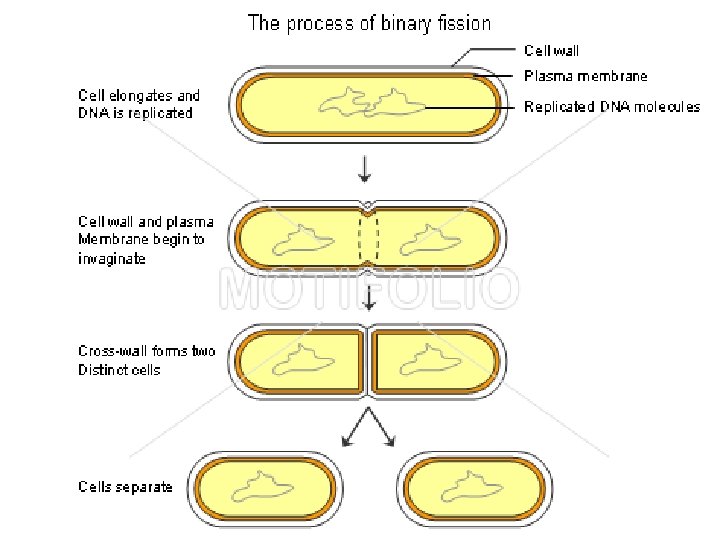
Section 1: Cell Growth Cell division in Prokaryotic Cells A. Binary Fission 1. A type of asexual reproduction a. Reproduction in which one original organism makes an identical copy of itself. IV.
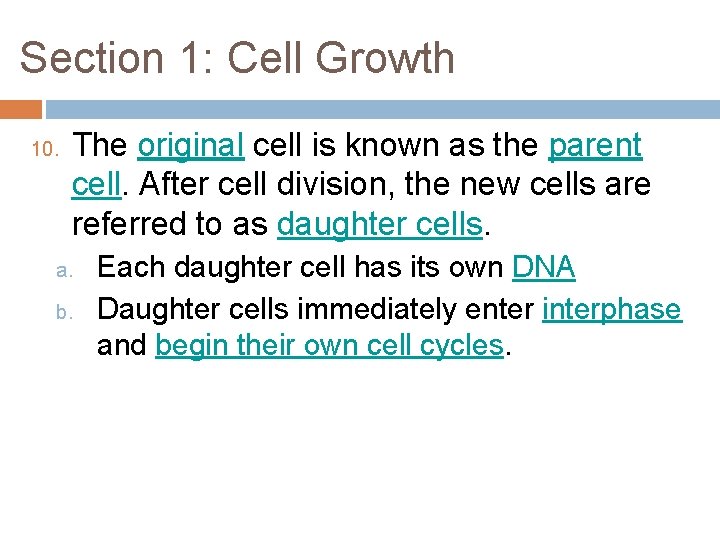
Section 1: Cell Growth 2. One organism divides into two identical cells 1. The original cell is called a parent cell 2. The new cells are called daughter cells
Section 1: Cell Growth
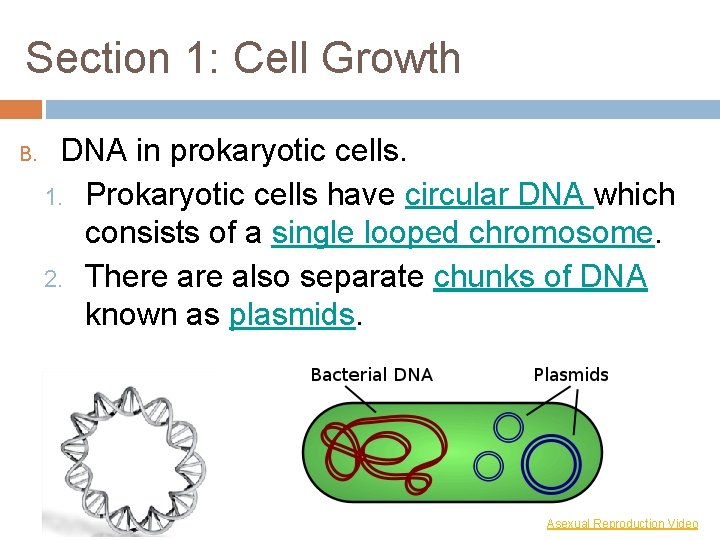
Section 1: Cell Growth B. DNA in prokaryotic cells. 1. Prokaryotic cells have circular DNA which consists of a single looped chromosome. 2. There also separate chunks of DNA known as plasmids. Asexual Reproduction Video
Section 1: Cell Growth V. A. B. Cell division in eukaryotic cells Because bacteria are single-celled organisms, reproduction and cell division are the same thing in prokaryotes. However, in eukaryotic cells, reproduction and cell division have different purposes: 1. Cell division asexual reproduction to make more identical cells a. Mitosis
Section 1: Cell Growth 2. Reproduction sexual reproduction to create offspring (new cells) a. Meiosis b. Sexual reproduction combines genetic material from two different individuals to create a new organism.
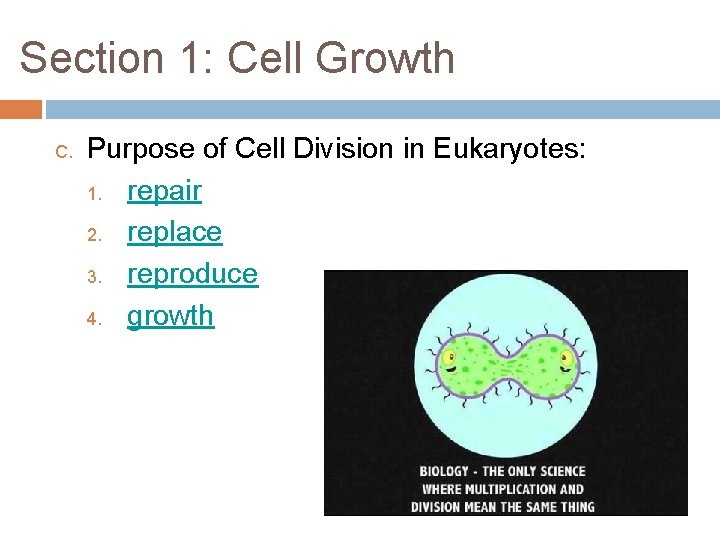
Section 1: Cell Growth C. Purpose of Cell Division in Eukaryotes: 1. repair 2. replace 3. reproduce 4. growth
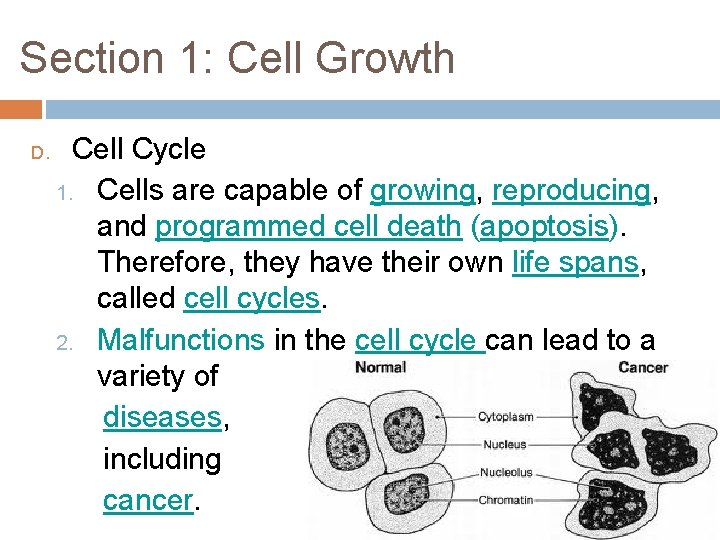
Section 1: Cell Growth D. Cell Cycle 1. Cells are capable of growing, reproducing, and programmed cell death (apoptosis). Therefore, they have their own life spans, called cell cycles. 2. Malfunctions in the cell cycle can lead to a variety of diseases, including cancer.
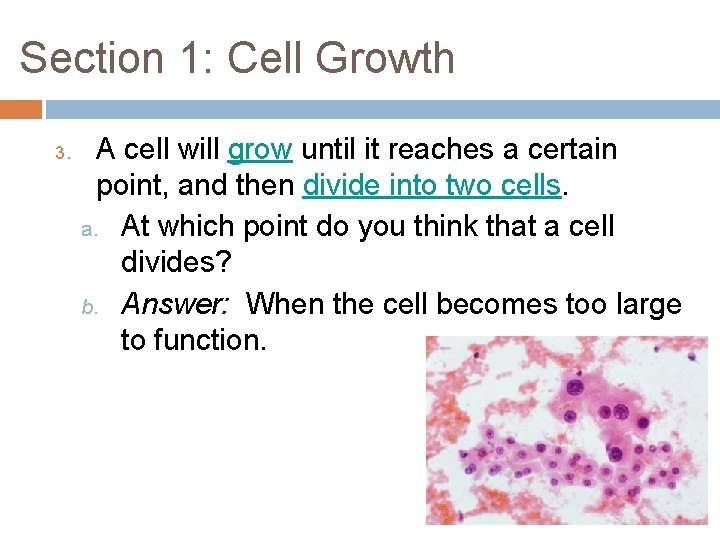
Section 1: Cell Growth 3. A cell will grow until it reaches a certain point, and then divide into two cells. a. At which point do you think that a cell divides? b. Answer: When the cell becomes too large to function.
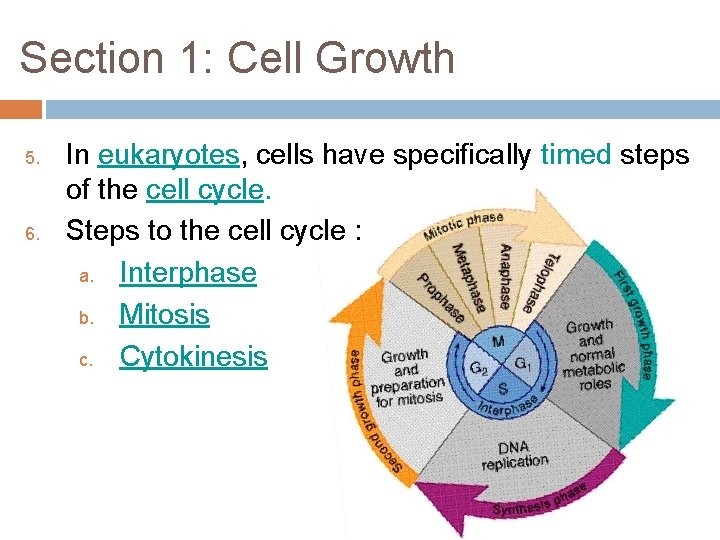
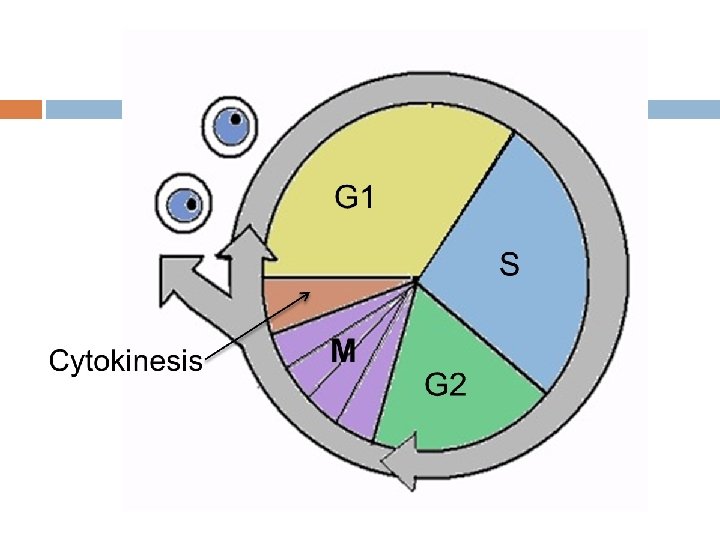
Section 1: Cell Growth 5. 6. In eukaryotes, cells have specifically timed steps of the cell cycle. Steps to the cell cycle : a. Interphase b. Mitosis c. Cytokinesis
Section 1: Cell Growth 7. INTERPHASE a. the longest part of the cell cycle. b. It is broken down into three sub-phases: G 1, S, and G 2. i. First growth (G 1): During this phase the cell is carrying out routine functions and making new proteins & organelles. 1) The largest part of the cell cycle, takes the most time.
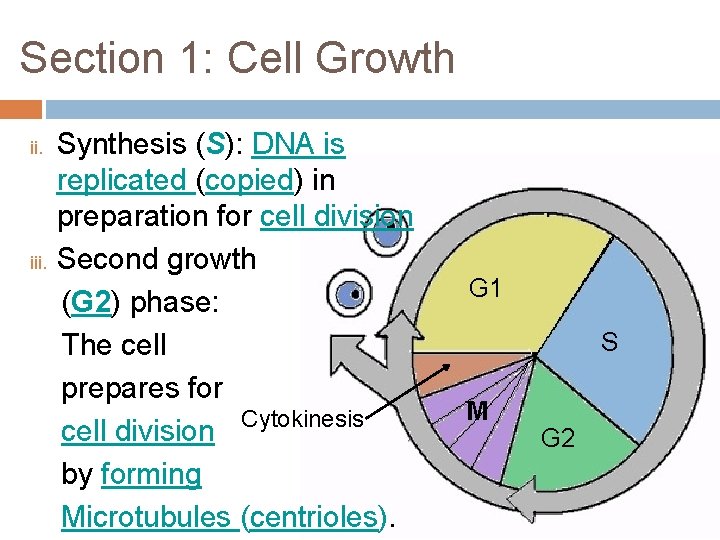
Section 1: Cell Growth ii. iii. Synthesis (S): DNA is replicated (copied) in preparation for cell division Second growth (G 2) phase: The cell prepares for Cytokinesis cell division by forming Microtubules (centrioles). G 1 S M G 2
Section 1: Cell Growth 8. 9. MITOSIS: a. The process in which two nuclei are formed, each with an identical set of chromosomes. i. There are 4 phases, or steps, of mitosis. CYTOKINESIS: a. The cell splits in half to form two new cells, each with its own nuclei and DNA. b. Organelles and cytoplasm divide.
Section 1: Cell Growth 10. The original cell is known as the parent cell. After cell division, the new cells are referred to as daughter cells. a. b. Each daughter cell has its own DNA Daughter cells immediately enter interphase and begin their own cell cycles.
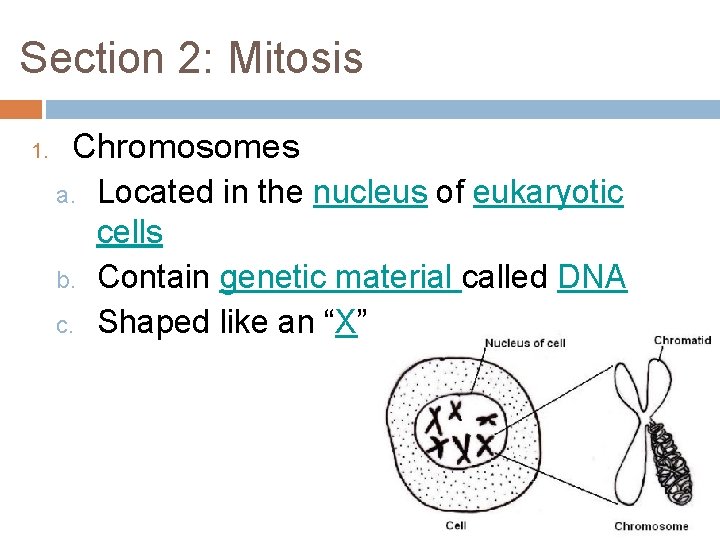
Section 2: Mitosis 1. Chromosomes a. b. c. Located in the nucleus of eukaryotic cells Contain genetic material called DNA Shaped like an “X”
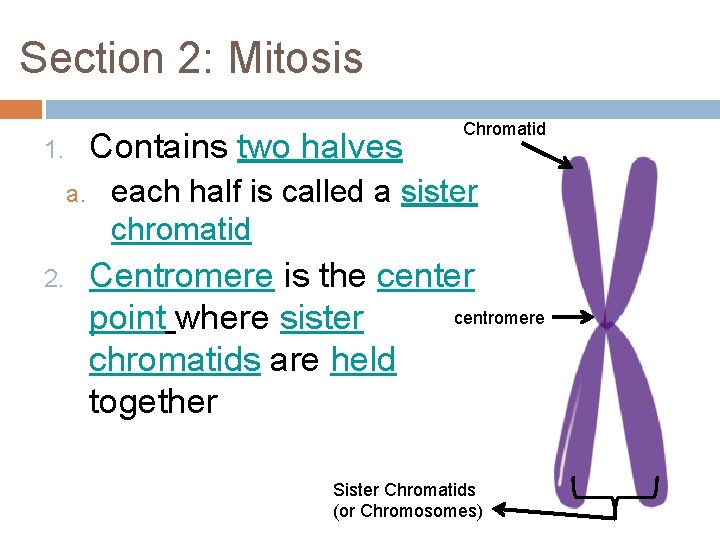
Section 2: Mitosis Contains two halves 1. a. 2. Chromatid each half is called a sister chromatid Centromere is the center centromere point where sister chromatids are held together Sister Chromatids (or Chromosomes)
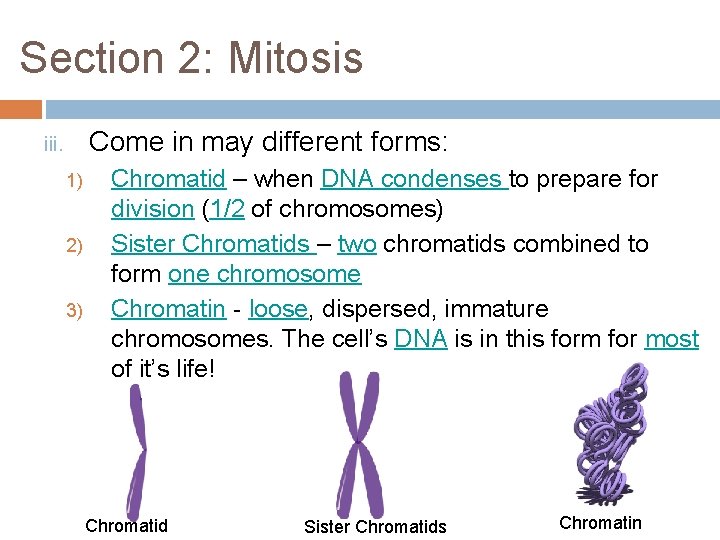
Section 2: Mitosis Come in may different forms: iii. 1) 2) 3) Chromatid – when DNA condenses to prepare for division (1/2 of chromosomes) Sister Chromatids – two chromatids combined to form one chromosome Chromatin - loose, dispersed, immature chromosomes. The cell’s DNA is in this form for most of it’s life! Chromatid Sister Chromatids Chromatin
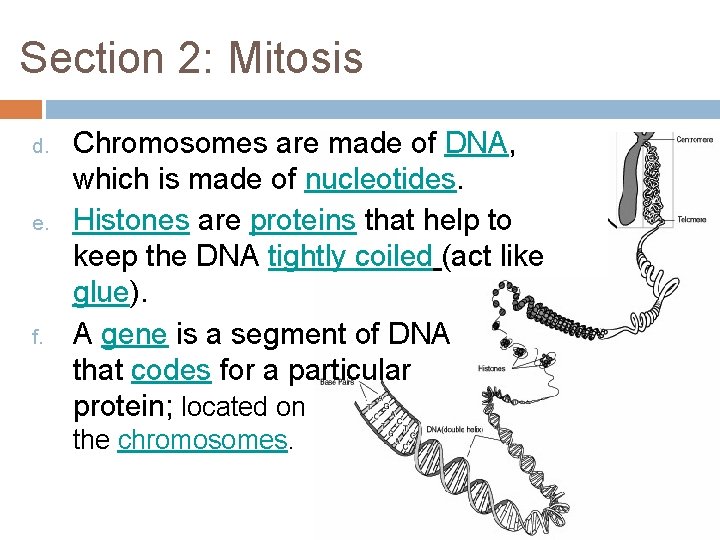
Section 2: Mitosis d. e. f. Chromosomes are made of DNA, which is made of nucleotides. Histones are proteins that help to keep the DNA tightly coiled (act like glue). A gene is a segment of DNA that codes for a particular protein; located on the chromosomes.
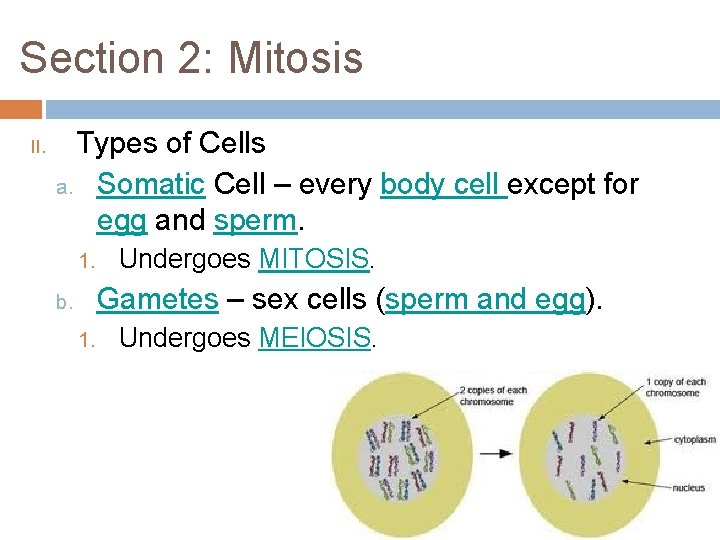
Section 2: Mitosis II. Types of Cells a. Somatic Cell – every body cell except for egg and sperm. 1. Undergoes MITOSIS. Gametes – sex cells (sperm and egg). b. 1. Undergoes MEIOSIS.
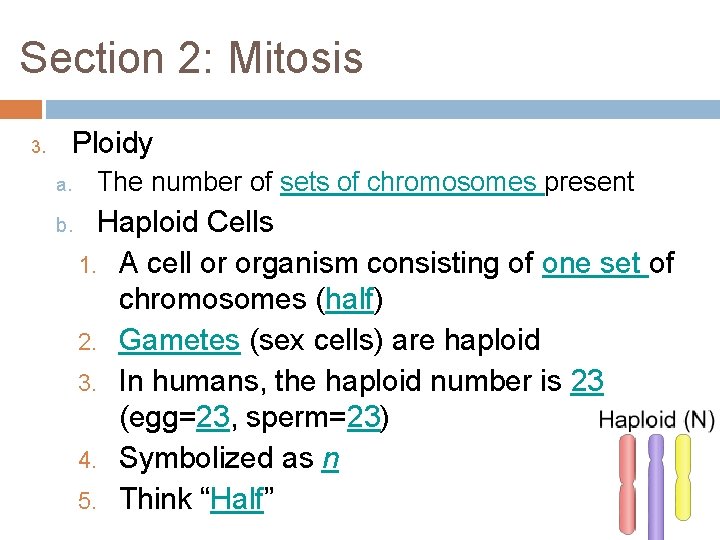
Section 2: Mitosis 3. Ploidy a. b. The number of sets of chromosomes present Haploid Cells 1. A cell or organism consisting of one set of chromosomes (half) 2. Gametes (sex cells) are haploid 3. In humans, the haploid number is 23 (egg=23, sperm=23) 4. Symbolized as n 5. Think “Half”
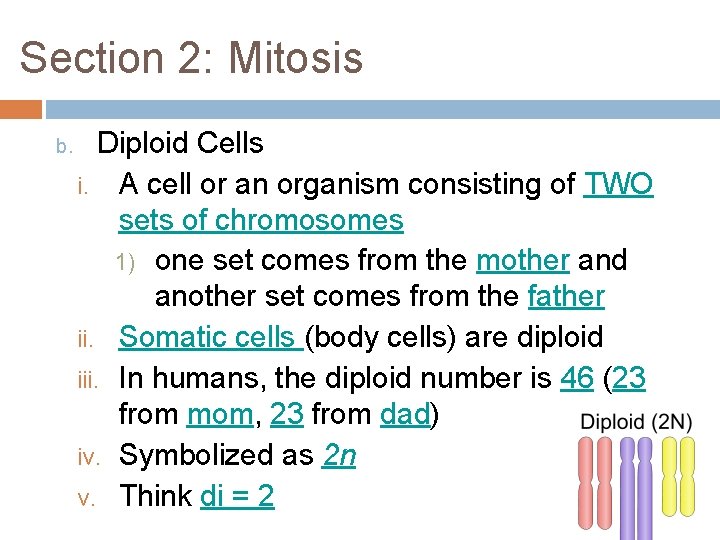
Section 2: Mitosis b. Diploid Cells i. A cell or an organism consisting of TWO sets of chromosomes 1) one set comes from the mother and another set comes from the father ii. Somatic cells (body cells) are diploid iii. In humans, the diploid number is 46 (23 from mom, 23 from dad) iv. Symbolized as 2 n v. Think di = 2
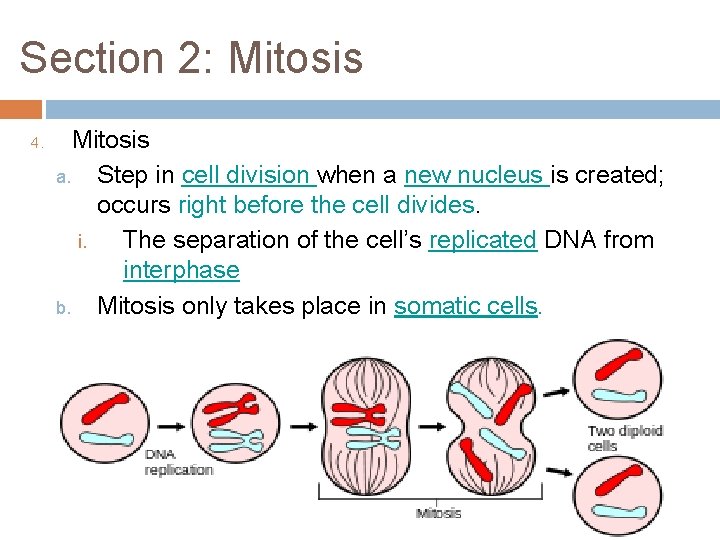
Section 2: Mitosis 4. Mitosis a. Step in cell division when a new nucleus is created; occurs right before the cell divides. i. The separation of the cell’s replicated DNA from interphase b. Mitosis only takes place in somatic cells.
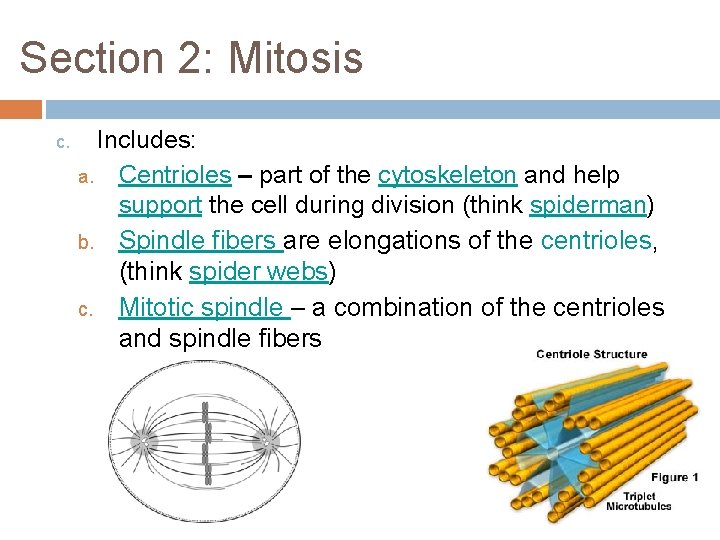
Section 2: Mitosis c. Includes: a. Centrioles – part of the cytoskeleton and help support the cell during division (think spiderman) b. Spindle fibers are elongations of the centrioles, (think spider webs) c. Mitotic spindle – a combination of the centrioles and spindle fibers
Section 2: Mitosis is a 4 -stage process in which two identical nuclei are created before cell division d. e. There are 4 steps to Mitosis: 1. Prophase 2. Metaphase 3. Anaphase 4. Telophase 5. You can remember these (including interphase) by remembering: IPMAT
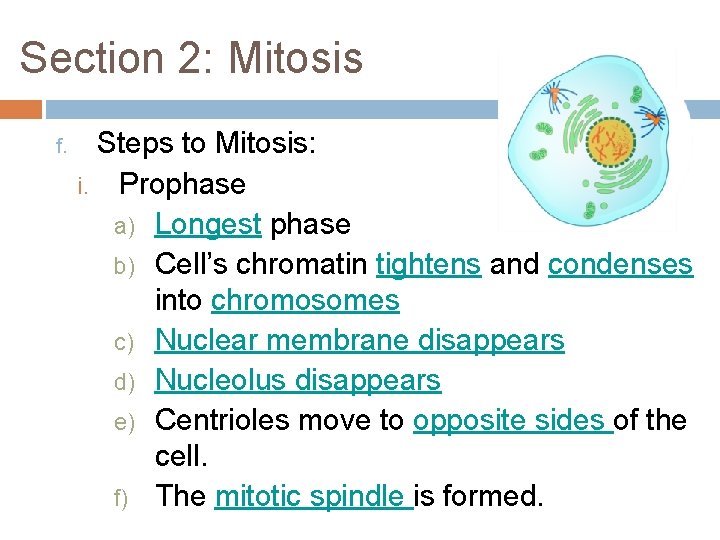
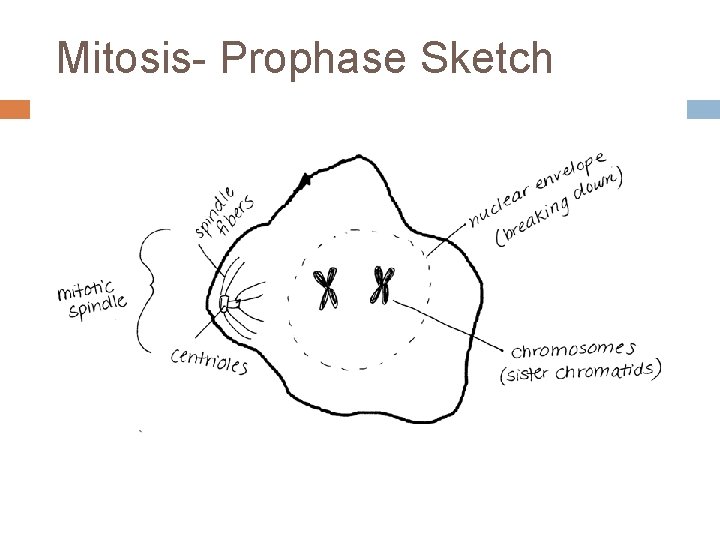
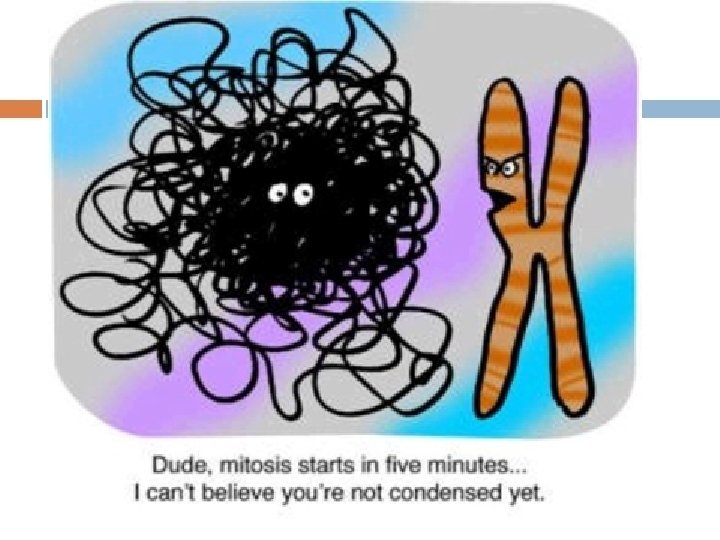
Section 2: Mitosis f. Steps to Mitosis: i. Prophase a) Longest phase b) Cell’s chromatin tightens and condenses into chromosomes c) Nuclear membrane disappears d) Nucleolus disappears e) Centrioles move to opposite sides of the cell. f) The mitotic spindle is formed.
Mitosis- Prophase Sketch
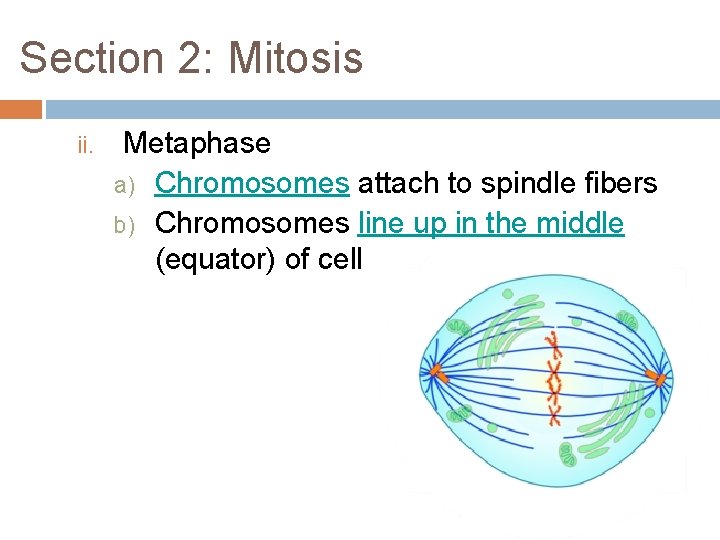
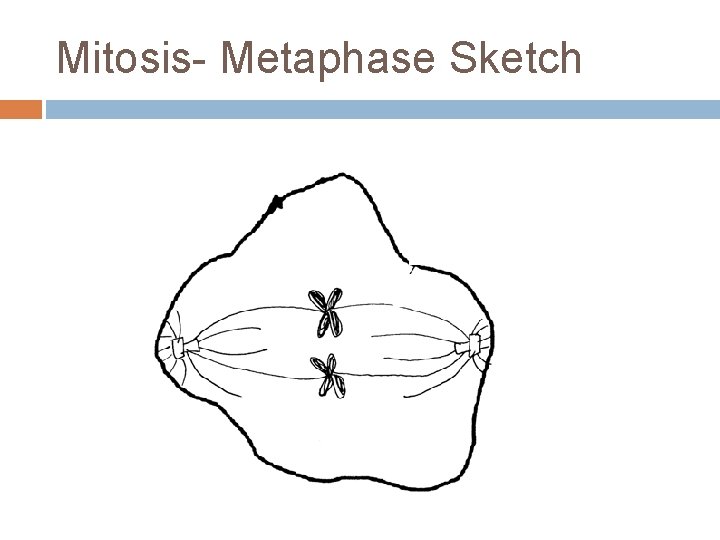
Section 2: Mitosis ii. Metaphase a) Chromosomes attach to spindle fibers b) Chromosomes line up in the middle (equator) of cell
Mitosis- Metaphase Sketch
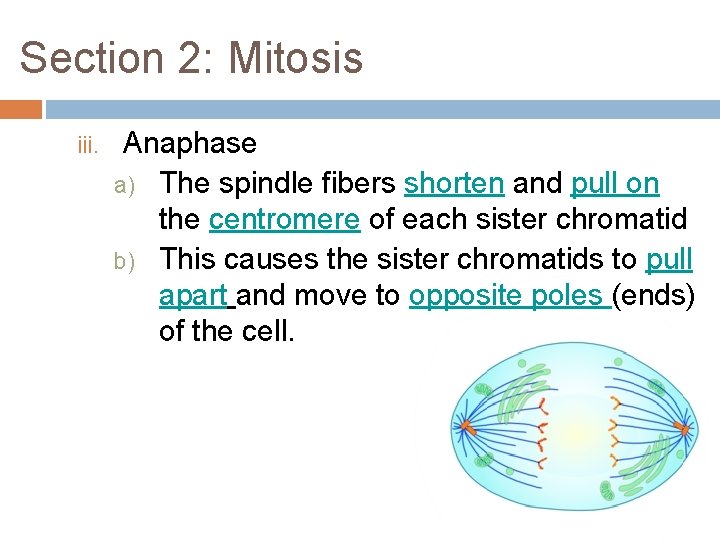
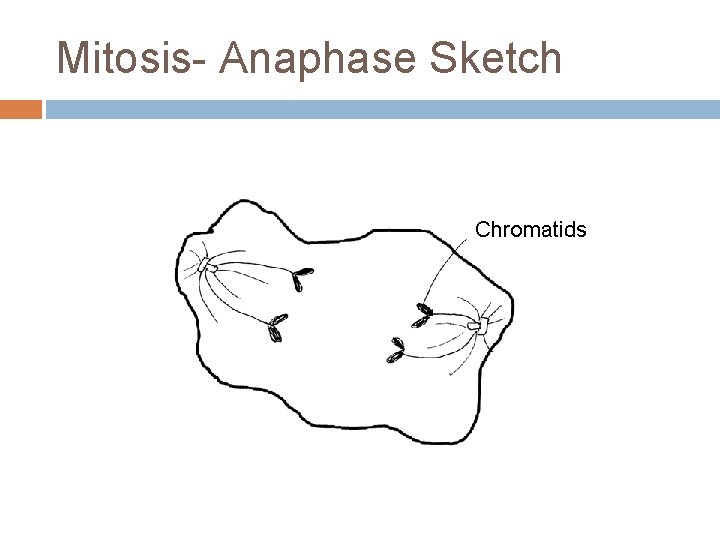
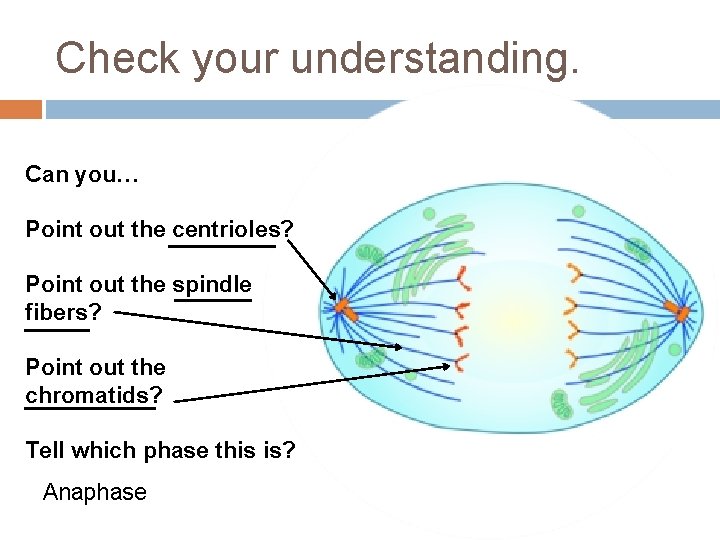
Section 2: Mitosis iii. Anaphase a) The spindle fibers shorten and pull on the centromere of each sister chromatid b) This causes the sister chromatids to pull apart and move to opposite poles (ends) of the cell.
Mitosis- Anaphase Sketch Chromatids
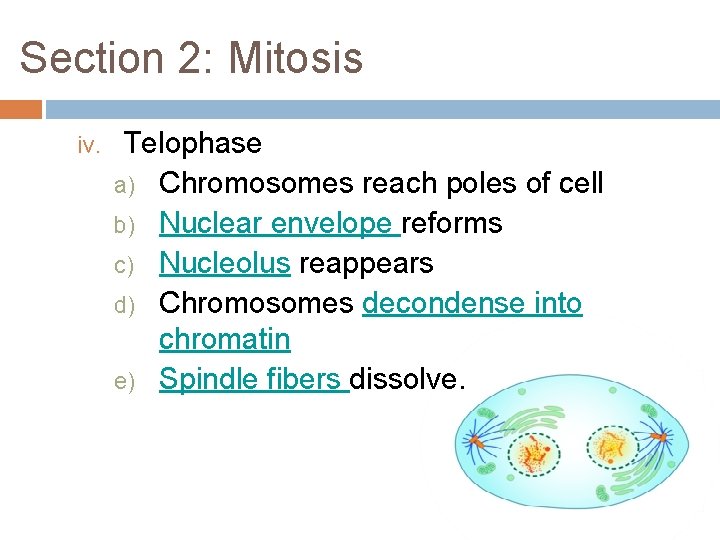
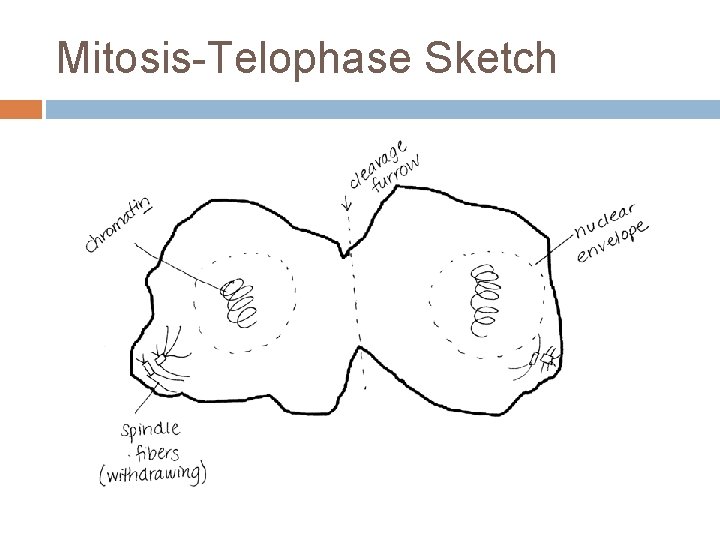
Section 2: Mitosis iv. Telophase a) Chromosomes reach poles of cell b) Nuclear envelope reforms c) Nucleolus reappears d) Chromosomes decondense into chromatin e) Spindle fibers dissolve.
Mitosis-Telophase Sketch
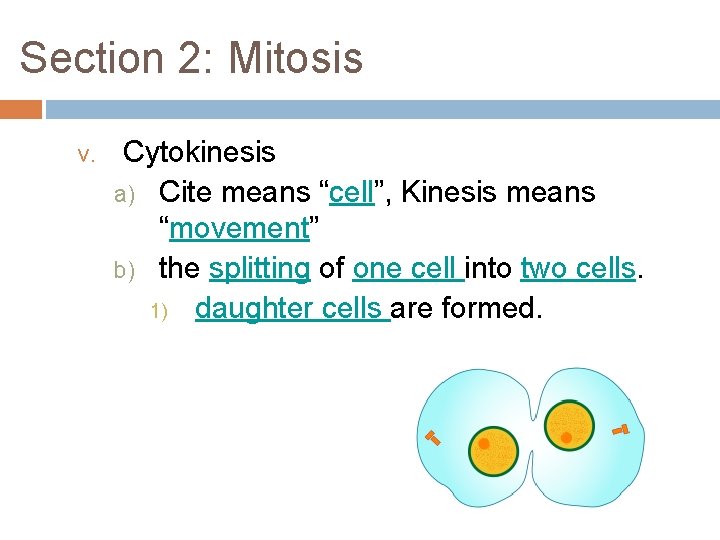
Section 2: Mitosis v. Cytokinesis a) Cite means “cell”, Kinesis means “movement” b) the splitting of one cell into two cells. 1) daughter cells are formed.
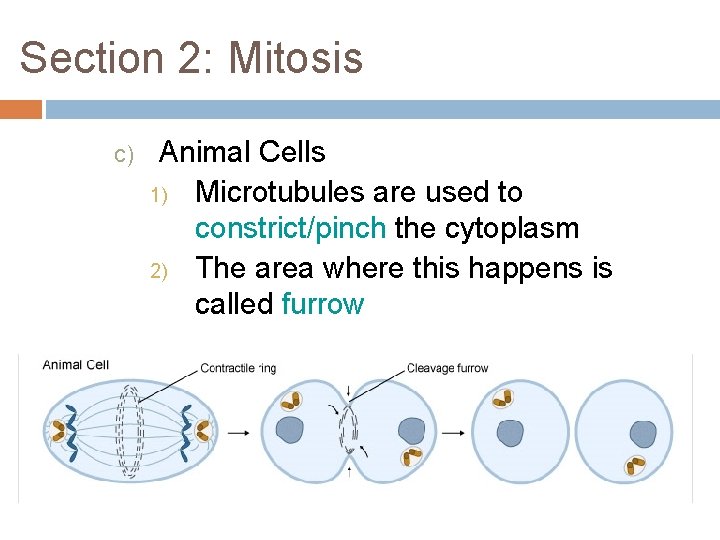
Section 2: Mitosis c) Animal Cells 1) Microtubules are used to constrict/pinch the cytoplasm 2) The area where this happens is called furrow
Check your understanding. Can you… Point out the centrioles? Point out the spindle fibers? Point out the chromatids? Tell which phase this is? Anaphase
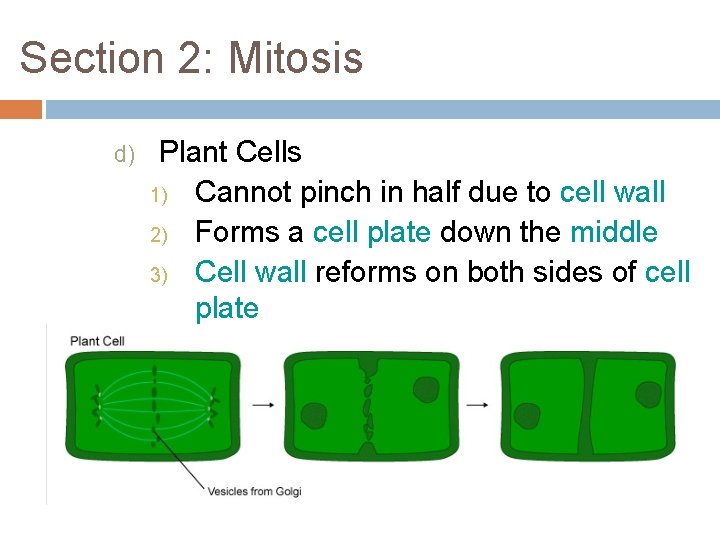
Section 2: Mitosis d) Plant Cells 1) Cannot pinch in half due to cell wall 2) Forms a cell plate down the middle 3) Cell wall reforms on both sides of cell plate
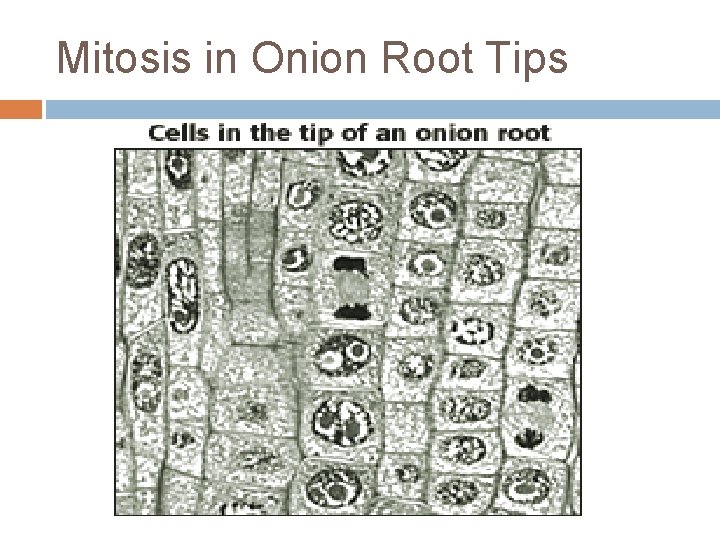
Mitosis in Onion Root Tips
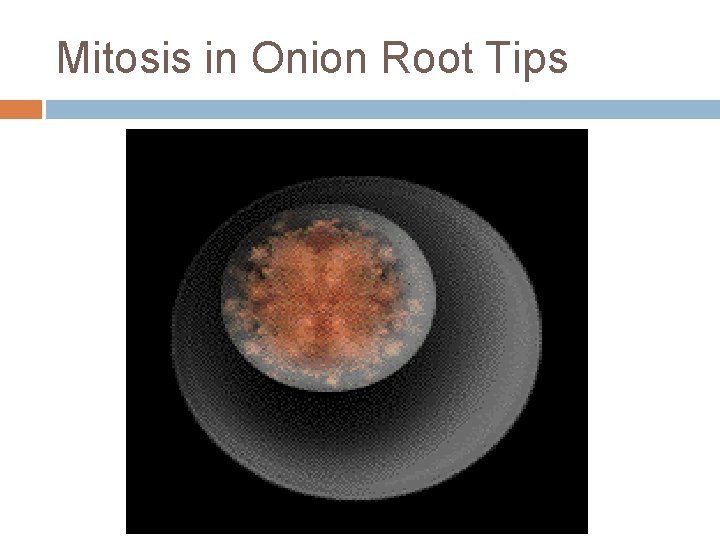
Mitosis in Onion Root Tips
Mitosis https: //www. youtube. com/watch? v=Vl. N 7 K 1 -9 QB 0
CHAPTER 9 SECTION 3: CELL REGULATION
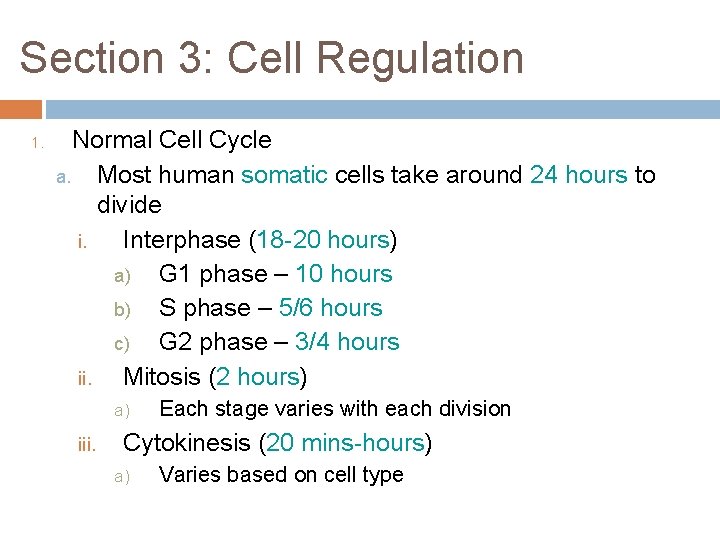
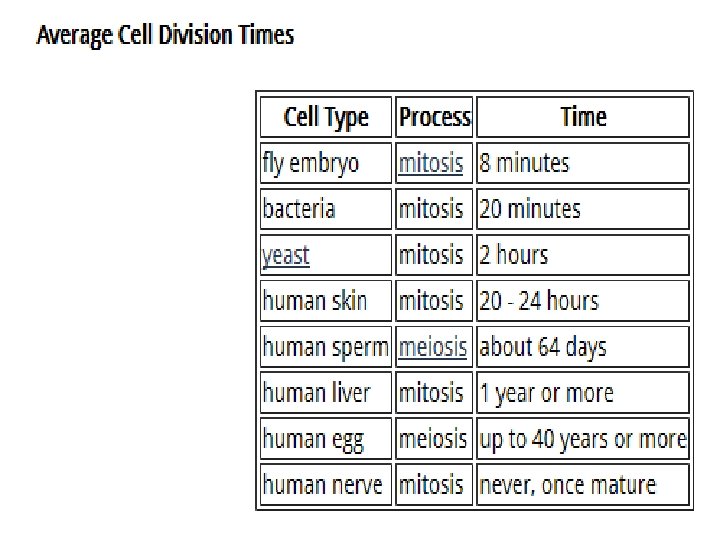
Section 3: Cell Regulation 1. Normal Cell Cycle a. Most human somatic cells take around 24 hours to divide i. Interphase (18 -20 hours) a) G 1 phase – 10 hours b) S phase – 5/6 hours c) G 2 phase – 3/4 hours ii. Mitosis (2 hours) a) iii. Each stage varies with each division Cytokinesis (20 mins-hours) a) Varies based on cell type
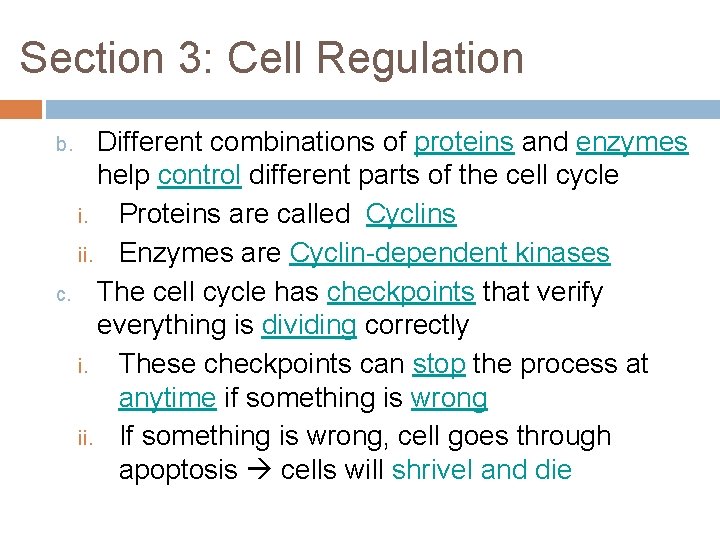
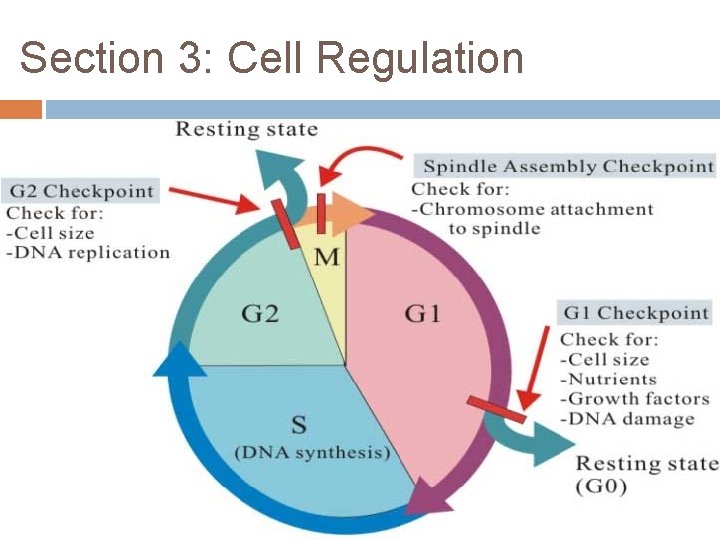
Section 3: Cell Regulation Different combinations of proteins and enzymes help control different parts of the cell cycle i. Proteins are called Cyclins ii. Enzymes are Cyclin-dependent kinases c. The cell cycle has checkpoints that verify everything is dividing correctly i. These checkpoints can stop the process at anytime if something is wrong ii. If something is wrong, cell goes through apoptosis cells will shrivel and die b.
Section 3: Cell Regulation
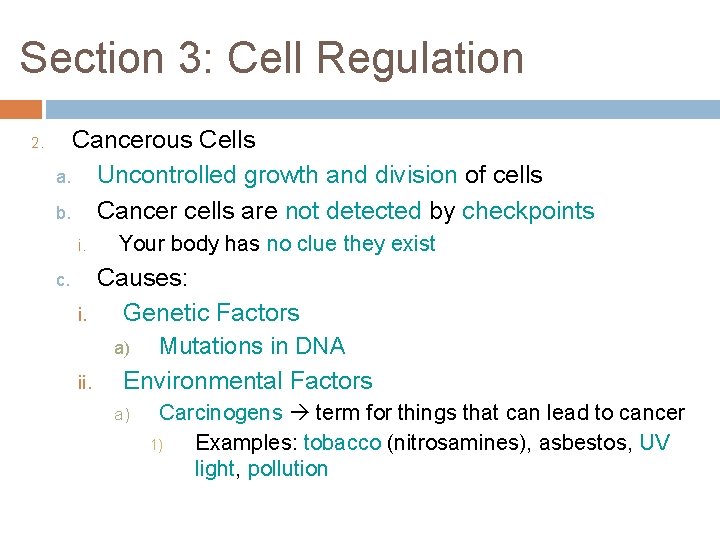
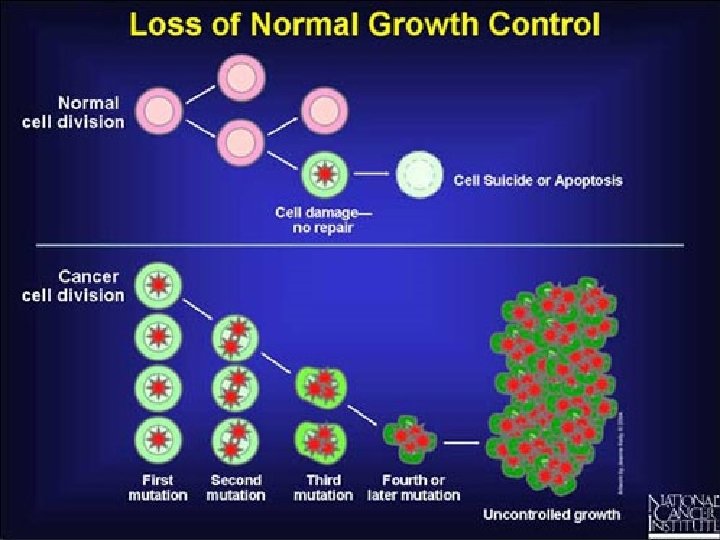
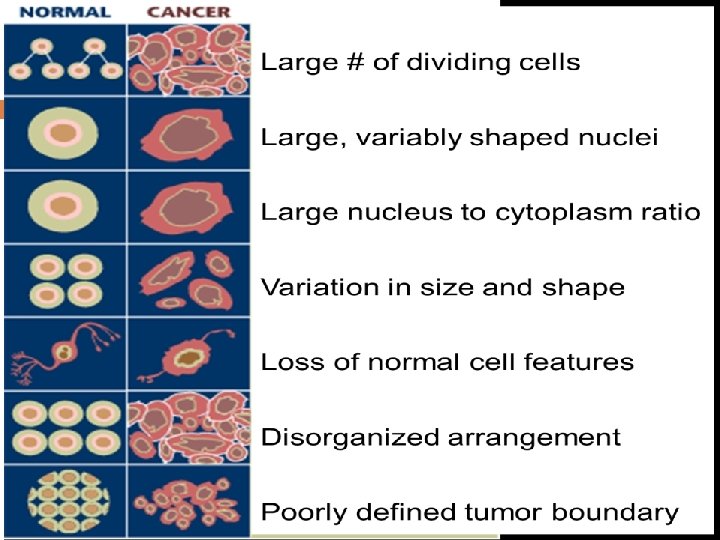
Section 3: Cell Regulation 2. Cancerous Cells a. Uncontrolled growth and division of cells b. Cancer cells are not detected by checkpoints i. c. Your body has no clue they exist Causes: i. Genetic Factors a) Mutations in DNA ii. Environmental Factors a) Carcinogens term for things that can lead to cancer 1) Examples: tobacco (nitrosamines), asbestos, UV light, pollution