
Chapter 11 Care of the Pediatric Patient Copyright

- Slides: 42
Chapter 11 Care of the Pediatric Patient Copyright © 2010 Wolters Kluwer Health | Lippincott Williams & Wilkins
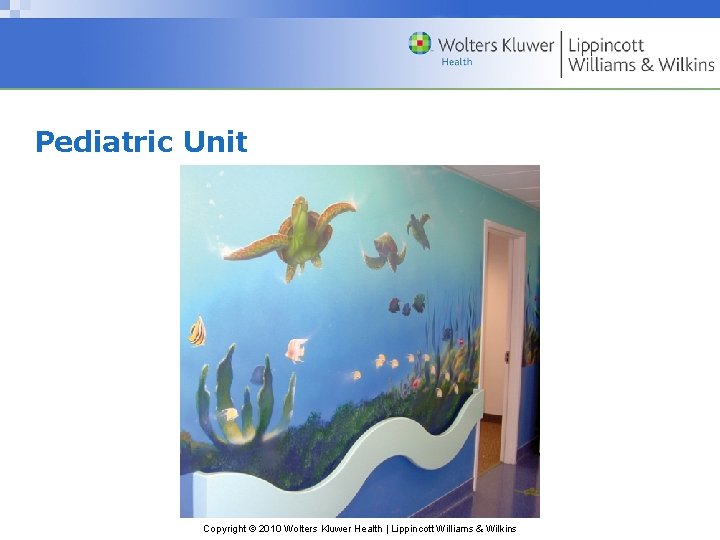
Pediatric Unit • Usually decorated in child-friendly colors and designs • Most have central activity areas • Most have accommodations for rooming-in • Often meals (“parent trays”) can be ordered so the family caregiver and the child can eat together Copyright © 2010 Wolters Kluwer Health | Lippincott Williams & Wilkins
Pediatric Unit Copyright © 2010 Wolters Kluwer Health | Lippincott Williams & Wilkins
Effects of Hospitalization on the Child and Family Children often become stressed when separated from family caregivers and go through three stages: • Protest • Despair • Denial Copyright © 2010 Wolters Kluwer Health | Lippincott Williams & Wilkins
Fears of the Hospitalized Child • Pain • Punishment • Mutilation • Death Copyright © 2010 Wolters Kluwer Health | Lippincott Williams & Wilkins
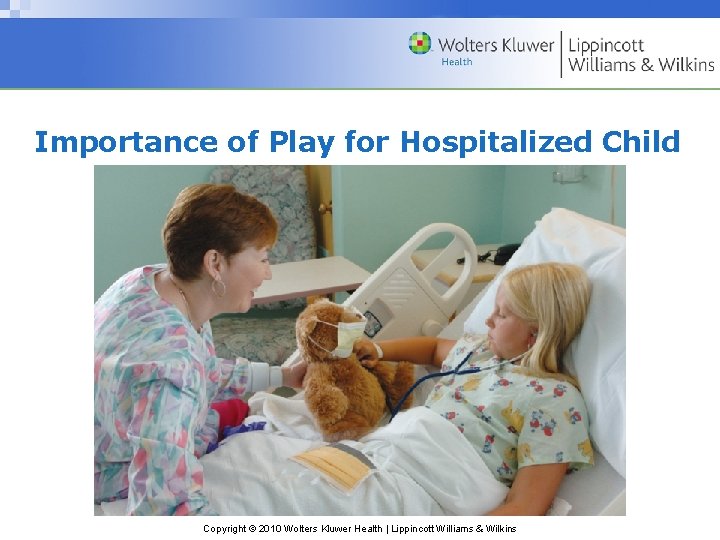
Importance of Play for Hospitalized Child Copyright © 2010 Wolters Kluwer Health | Lippincott Williams & Wilkins
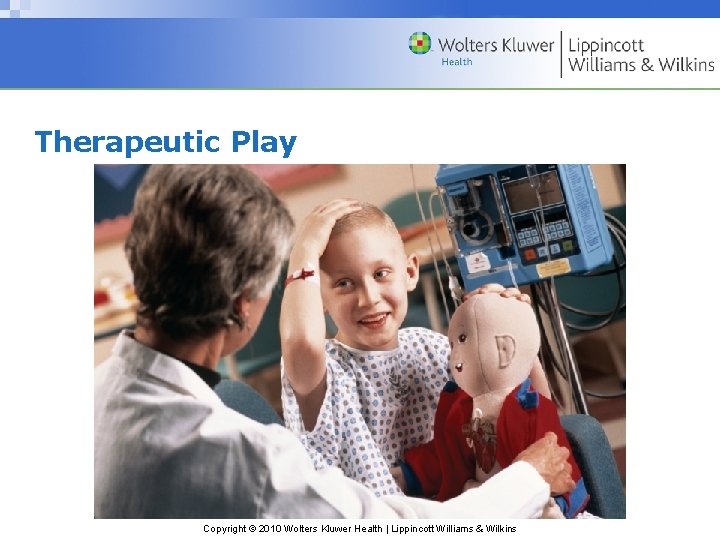
Therapeutic Play Copyright © 2010 Wolters Kluwer Health | Lippincott Williams & Wilkins
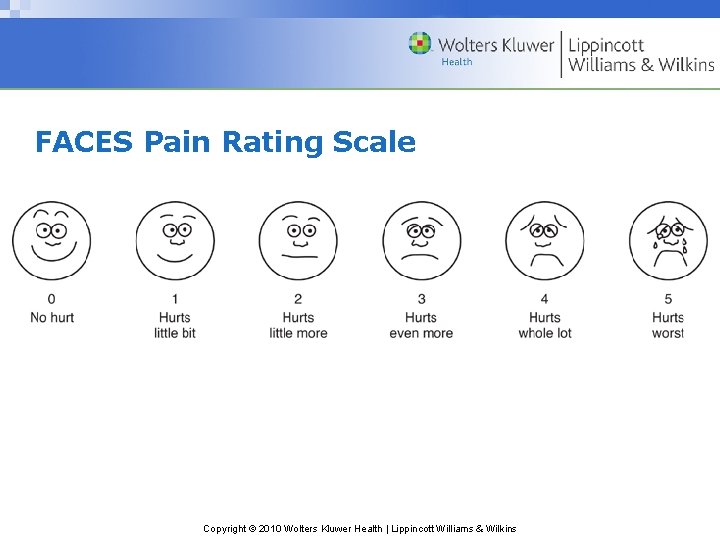
FACES Pain Rating Scale Copyright © 2010 Wolters Kluwer Health | Lippincott Williams & Wilkins
Minimizing a Child’s Pain • Repositioning and the use of supportive devices • Massage or gentle touch • Smaller children may be comforted by being held or rocked • Activities: talking, playing, listening to music, or watching television Copyright © 2010 Wolters Kluwer Health | Lippincott Williams & Wilkins
The Role of the Nursing Assistant in Caring for Pediatric Patients • Consider developmental stage • Assist with nutrition • Assist with elimination • Assist with procedures • Assist with restraints • Assist with transport Copyright © 2010 Wolters Kluwer Health | Lippincott Williams & Wilkins
Care of a Restrained Pediatric Patient • Restraints, especially when used on small children, are extremely dangerous • Make sure to check on a child who is restrained frequently (at least every 10 minutes) • Remove the restraint and stay with the patient for a short period of time every 2 hours Copyright © 2010 Wolters Kluwer Health | Lippincott Williams & Wilkins
Copyright © 2010 Wolters Kluwer Health | Lippincott Williams & Wilkins
Common Disorders Affecting Children • Congenital disorders • Trauma • Infectious disease • Chronic illness and developmental disabilities • Cancer Copyright © 2010 Wolters Kluwer Health | Lippincott Williams & Wilkins
Common Respiratory Disorders • Respiratory syncytial virus (RSV) – Most common in 6 months to 2 years – Antibiotics are not effective – Produces thick mucous that plugs bronchioles • Croup – Viral or bacterial infection of URT – Causes a harsh, bark-like cough – Usually children under 3 years Copyright © 2010 Wolters Kluwer Health | Lippincott Williams & Wilkins
Common Respiratory Disorders • Epiglottitis – Form of croup caused by a bacteria – Causes swelling of the glottis • Asthma – Affects the bronchi and bonchioles – May be triggered by allergies, smoke or weather • Cystic fibrosis – Genetic disorder – Mucous is extremely thick Copyright © 2010 Wolters Kluwer Health | Lippincott Williams & Wilkins
Care of a Child With Respiratory Disorders Observations that should immediately be reported to the nurse: • The child is having difficulty breathing • The child’s lips appear blue (cyanosis) • There is a change in the child’s vital signs • The child is becoming restless Copyright © 2010 Wolters Kluwer Health | Lippincott Williams & Wilkins
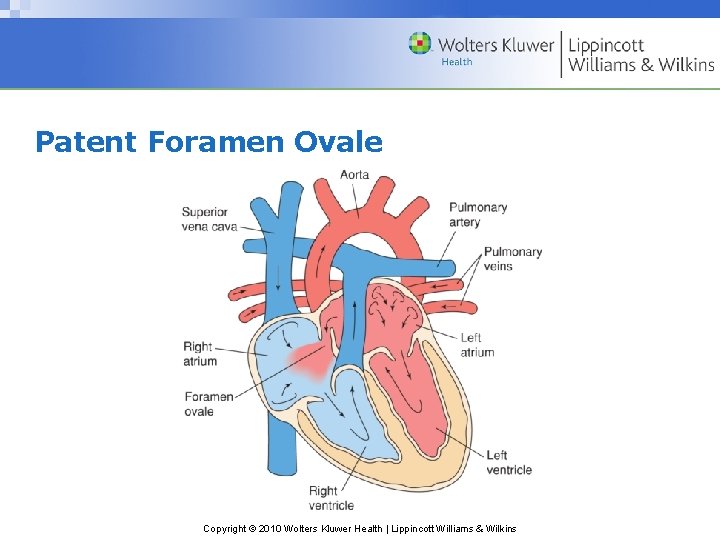
Common Cardiovascular Disorders • Septal anomalies – Affects the wall of the heart, occurs during development • Patent foramen ovale • Small opening allows blood that enters rt atrium to pass to the left atrium • Blood bypasses the lungs • Ventricular septal defect • Small opening in ventricle allows blood to pass from left ventricle to rt ventricle Copyright © 2010 Wolters Kluwer Health | Lippincott Williams & Wilkins
Patent Foramen Ovale Copyright © 2010 Wolters Kluwer Health | Lippincott Williams & Wilkins
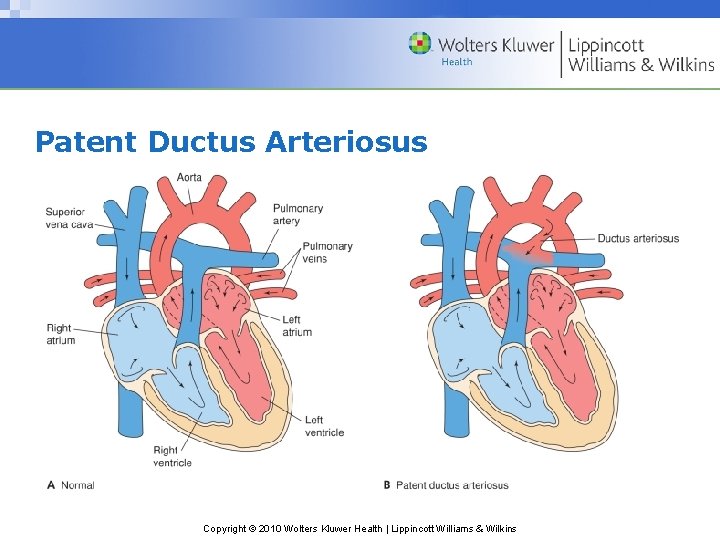
Common Cardiovascular Disorders (cont) • Disorders of the great vessels – Patent ductus arteriosus • Oxygenqated blood flows from aorta into pulomonary artery • May require surgery if signs and symptoms – Coarctation of the aorta • Aorta becomes narrow before leaving the lt ventricle • Cause extra work on ventricle to pump blood • Can lead to congestive heart failure Copyright © 2010 Wolters Kluwer Health | Lippincott Williams & Wilkins
Patent Ductus Arteriosus Copyright © 2010 Wolters Kluwer Health | Lippincott Williams & Wilkins
Common Cardiovascular Disorders – Tetrology of Fallot • Four heart anomalies • Requires open heart surgery before the age of 1 – Transposition of the great arteries • Pulmonary artery and aorta are switched • Causes less o 2 to be pumped to the body Copyright © 2010 Wolters Kluwer Health | Lippincott Williams & Wilkins
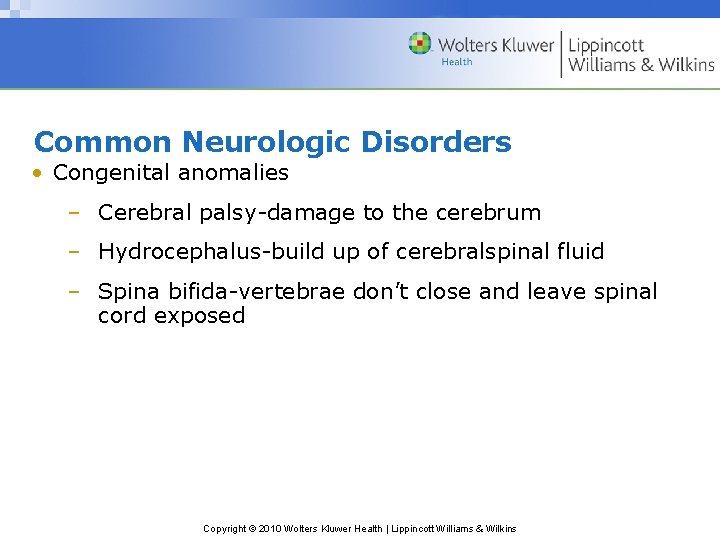
Common Neurologic Disorders • Congenital anomalies – Cerebral palsy-damage to the cerebrum – Hydrocephalus-build up of cerebralspinal fluid – Spina bifida-vertebrae don’t close and leave spinal cord exposed Copyright © 2010 Wolters Kluwer Health | Lippincott Williams & Wilkins
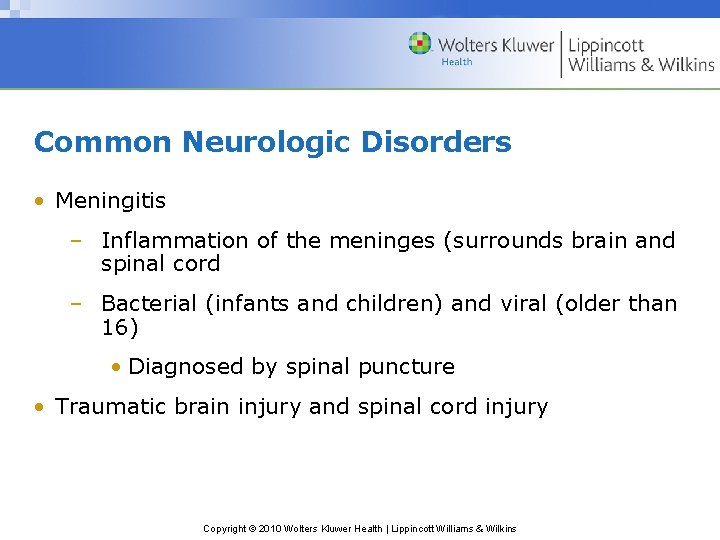
Common Neurologic Disorders • Meningitis – Inflammation of the meninges (surrounds brain and spinal cord – Bacterial (infants and children) and viral (older than 16) • Diagnosed by spinal puncture • Traumatic brain injury and spinal cord injury Copyright © 2010 Wolters Kluwer Health | Lippincott Williams & Wilkins
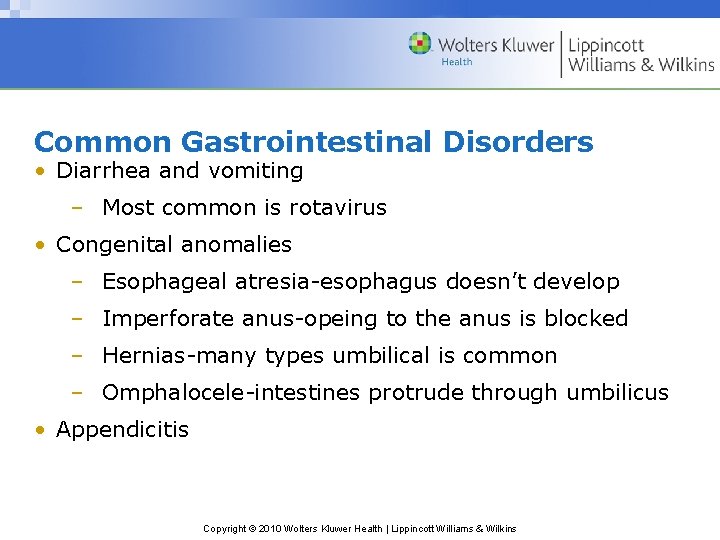
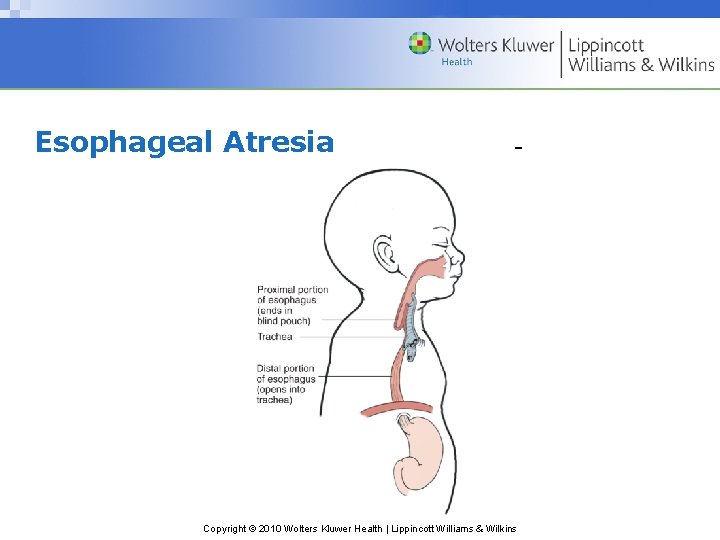
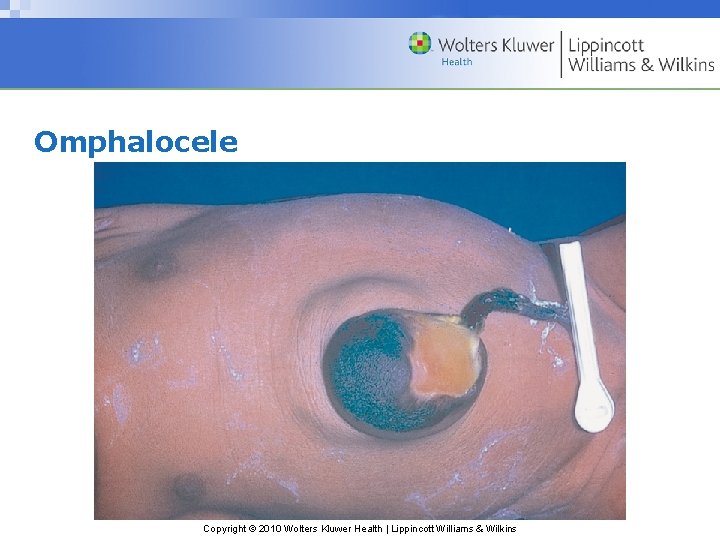
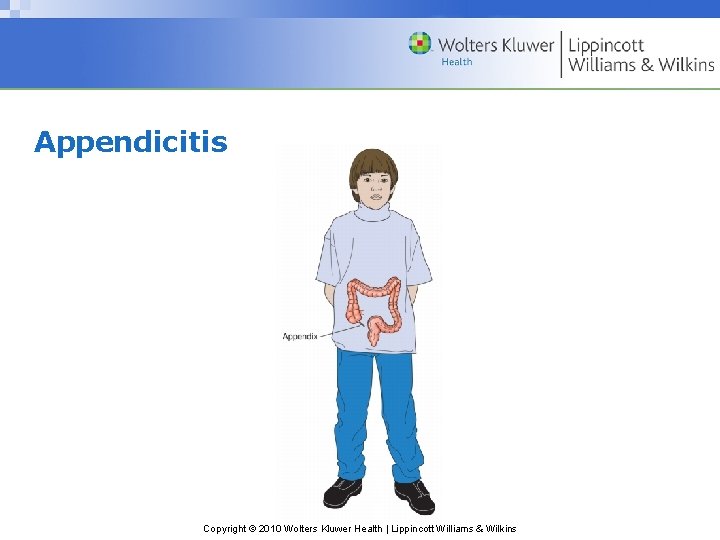
Common Gastrointestinal Disorders • Diarrhea and vomiting – Most common is rotavirus • Congenital anomalies – Esophageal atresia-esophagus doesn’t develop – Imperforate anus-opeing to the anus is blocked – Hernias-many types umbilical is common – Omphalocele-intestines protrude through umbilicus • Appendicitis Copyright © 2010 Wolters Kluwer Health | Lippincott Williams & Wilkins
Esophageal Atresia - Copyright © 2010 Wolters Kluwer Health | Lippincott Williams & Wilkins
Omphalocele Copyright © 2010 Wolters Kluwer Health | Lippincott Williams & Wilkins
Appendicitis Copyright © 2010 Wolters Kluwer Health | Lippincott Williams & Wilkins
The Most Common Endocrine Disorder • Type 1 diabetes mellitus – First signs are usually weight loss, slowed growth, and a lack of energy Copyright © 2010 Wolters Kluwer Health | Lippincott Williams & Wilkins
The Diabetic Child Observations that should immediately be reported to the nurse: • Odd, unusual, or antisocial behavior • Weakness, fatigue, or lethargy (lack of energy) • Nervousness • Headache • Blurred vision • Dizziness • Hunger • Pallor • Sweating Copyright © 2010 Wolters Kluwer Health | Lippincott Williams & Wilkins
Common Genitourinary Disorders • Cryptorchidism • Hypospadias Copyright © 2010 Wolters Kluwer Health | Lippincott Williams & Wilkins
Common Musculoskeletal Disorders • Fractures • Hip dysplasia • Juvenile rheumatoid arthritis • Muscular dystrophy Copyright © 2010 Wolters Kluwer Health | Lippincott Williams & Wilkins
Caring for a Child With a Cast Immediately report the following to the nurse: • The fingers or toes are pale, blue, or cold • The child complains of increased pain, numbness, or tingling • There is increased drainage on the cast • There is a foul odor Copyright © 2010 Wolters Kluwer Health | Lippincott Williams & Wilkins
Cancer • Leukemia • Lymphomas • Brain tumors • Wilms’ tumor • Nephroblastoma Copyright © 2010 Wolters Kluwer Health | Lippincott Williams & Wilkins
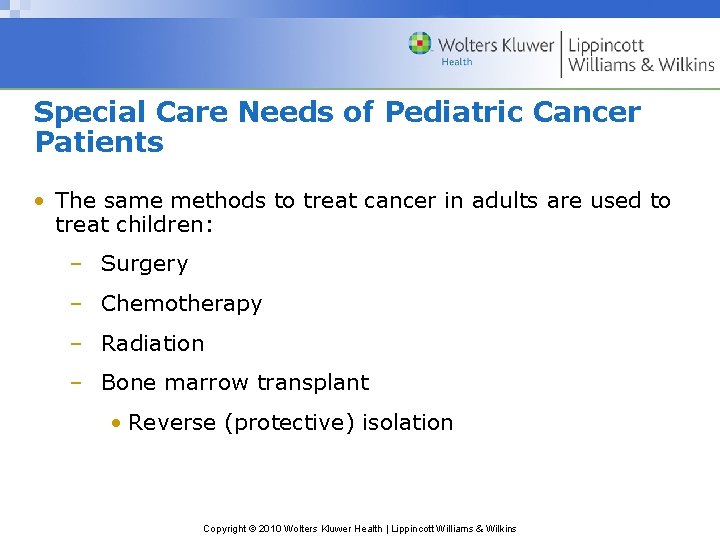
Special Care Needs of Pediatric Cancer Patients • The same methods to treat cancer in adults are used to treat children: – Surgery – Chemotherapy – Radiation – Bone marrow transplant • Reverse (protective) isolation Copyright © 2010 Wolters Kluwer Health | Lippincott Williams & Wilkins
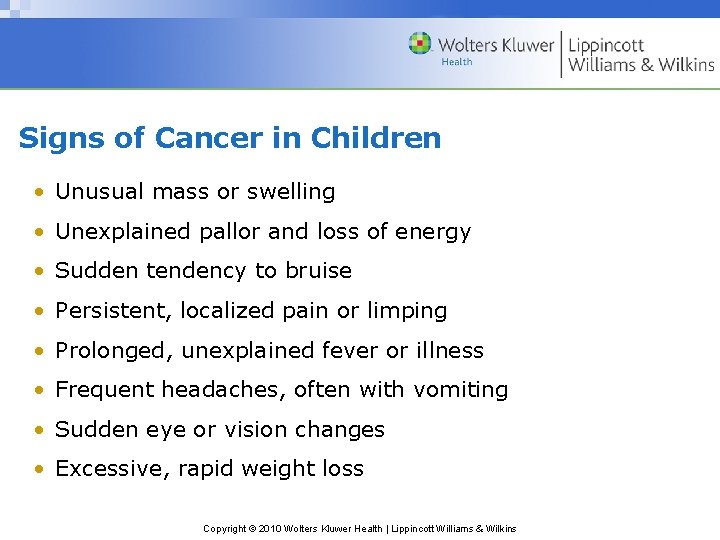
Signs of Cancer in Children • Unusual mass or swelling • Unexplained pallor and loss of energy • Sudden tendency to bruise • Persistent, localized pain or limping • Prolonged, unexplained fever or illness • Frequent headaches, often with vomiting • Sudden eye or vision changes • Excessive, rapid weight loss Copyright © 2010 Wolters Kluwer Health | Lippincott Williams & Wilkins
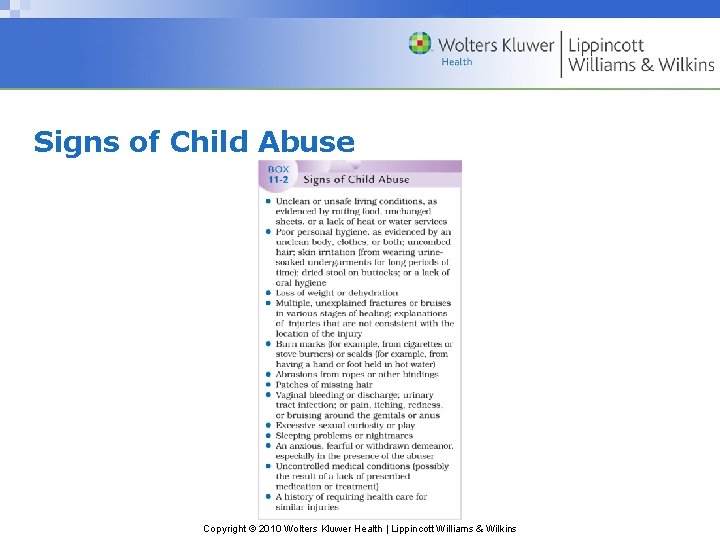
Signs of Child Abuse Copyright © 2010 Wolters Kluwer Health | Lippincott Williams & Wilkins
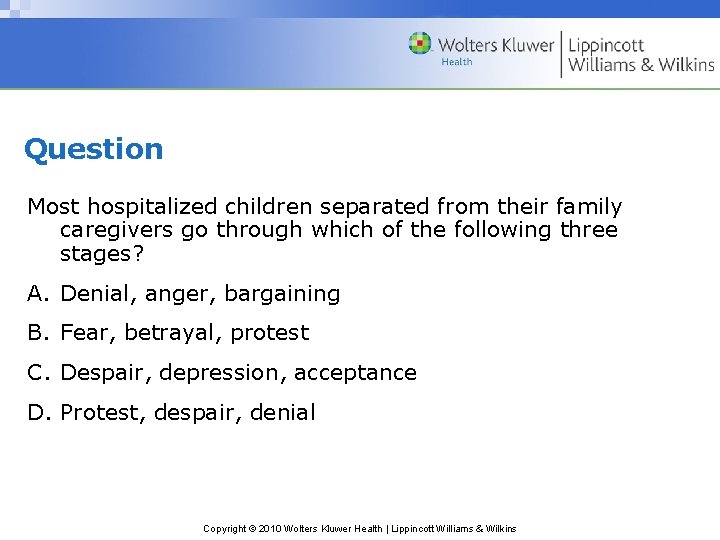
Question Most hospitalized children separated from their family caregivers go through which of the following three stages? A. Denial, anger, bargaining B. Fear, betrayal, protest C. Despair, depression, acceptance D. Protest, despair, denial Copyright © 2010 Wolters Kluwer Health | Lippincott Williams & Wilkins
Answer D. Protest, despair, denial A child’s illness or injury, especially if it results in the need for hospitalization, is very stressful for the child and family. Copyright © 2010 Wolters Kluwer Health | Lippincott Williams & Wilkins
Question Therapeutic play is a play technique that is often used for which of the following? A. A child who is unable to go to the central activity area (for example, because he has a contagious disease B. Choosing age-appropriate toys C. Helping a child have a better understanding of treatment or surgery D. Adolescents and teenagers Copyright © 2010 Wolters Kluwer Health | Lippincott Williams & Wilkins
Answer C. Helping a child have a better understanding of treatment or surgery Any type of play that increases the child’s understanding of what is going to happen will help to decrease the child’s anxiety. Copyright © 2010 Wolters Kluwer Health | Lippincott Williams & Wilkins
Question Tell whether the following statement is true or false. If you are suspicious about something a child has told you, question the child further yourself before reporting your suspicions to the nurse. A. True B. False Copyright © 2010 Wolters Kluwer Health | Lippincott Williams & Wilkins
Answer B. False It is better to allow a person who has experience and training in detecting child abuse to continue the questioning. Copyright © 2010 Wolters Kluwer Health | Lippincott Williams & Wilkins