
Chapter 11 Boomers Sooners and Oklahoma Territory STUDY

Chapter 11: Boomers, Sooners, and Oklahoma Territory STUDY PRESENTATION © 2013 Clairmont Press
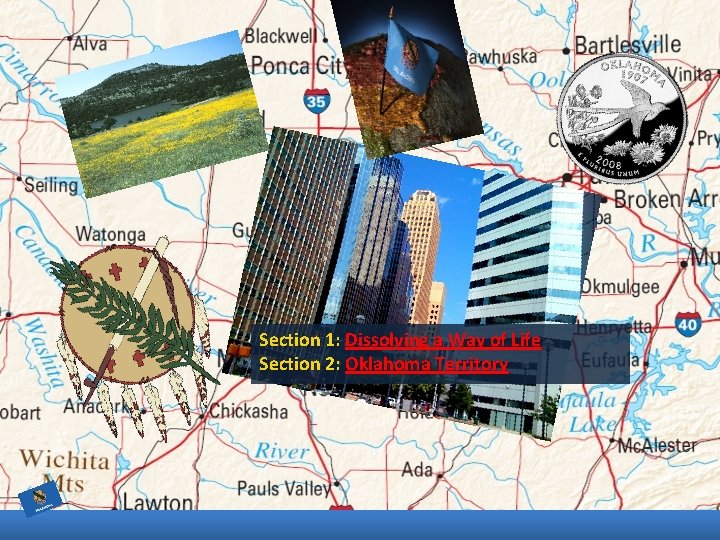
Section 1: Dissolving a Way of Life Section 2: Oklahoma Territory
Section 1: Dissolving a Way of Life Ø Essential Question: • How did the federal government work to break up the Indian nations in the late 1800 s? 3
Section 1: Dissolving a Way of Life Ø What terms do I need to know? • • • Dawes Severalty Act Curtis Act boomer rider squatter sooner 4
The Dawes Act Ø Friends of the Indians was a group led by Alice Fletcher. They believed the Indians would be best served by dividing lands into homesteads as in the white society. Ø 1887: The Dawes Severalty Act extended U. S. law to the territory and dissolved some tribal ownership of the lands. Ø 1893: All tribal ownership was dissolved for all tribes. 5

Boomers Ø Pressure increased to allow settlement of the 2 million acres of “unassigned lands. ” Ø Some Indians believed this might be good for the local economy. Ø “Boomer” was a term used to describe those who were part of the land boom. Ø David L. Payne led a group of settlers to the Unassigned Lands, but was driven off by federal troops. He returned several times until his death in 1884. Ø William L. Couch’s group of 400 settlers refused orders to leave, but were surrounded and not allowed to get supplies. They gave up and went back to Kansas. 6

Boomers: Indian Response Ø By law, non-Indians were forbidden to be in the Territory. Ø Tribes sent delegates to Washington to ask for help and remind politicians of the law; they helped marshals watch for illegal activity. Ø Judge Parker ruled in 1881 that the Indians did have an interest in the Unassigned Lands. 7

Boomers: The Springer Amendment Ø 1889: The Indian Appropriation Act authorized payment to tribes in exchange for dropping claims on the Unassigned Lands. Ø The Homestead Act allowed settlers into the region at noon on April 22, 1889 to claim a homestead. Ø “Sooners” were those who crossed the line early and staked a claim on choice land in the territory. 8
The First Land Opening Ø Word spread quickly of the opportunity for good land. Ø Rich, poor, black, white, young, old gathered in Kansas, Texas, and Arkansas days ahead of the entry date. 9

The First Land Opening: The Run for the Unassigned Lands Ø Hundreds of people, wagons, buggies, and animals of all sorts made their way across rivers into the Territory. Ø 50, 000 – 100, 000 people entered and claimed the two million acres within a few hours. 10
The First Land Opening: Claiming Land Ø Homesteaders had to find the surveyor’s stone with the land description, then report to the filing office and pay a filing fee. Ø They obtained title to the land after living and farming there for five years. Ø Fists, guns, and courts were used to settle disputes about ownership. 11

The First Land Opening: New Towns Ø The Seminole Townsite and Improvement Company came in early and mapped out locations for new towns. Ø Oklahoma City had 12, 000 people on its first day. Ø Many towns were started and local governments established quickly. Ø Blacksmiths and barbers served as dentists; lawyers and merchants set up shop quickly. Ø Food and water ran low in Guthrie due to the huge number of settlers. Ø 1890: African American Edward Mc. Cabe established the town of Langston. Thousands of blacks were a part of the land run; 50 all-black communities were formed. 12
Homesteading Ø Settlers might use their wagon as the first home. Ø If trees were scarce, dugouts or “soddies” served as a home. Ø Barns were often built first. Ø Sod houses were insulated and safe from fires; rain caused a wet, muddy mess. Ø If a farm was successful, a small wood house would be built. Ø Most farms would add cellars (food storage and tornado protection), windmills (for pumping water), and cisterns (to collect rainwater). Return to Main Menu 13
Section 2: Oklahoma Territory Ø Essential Question: • How did establishment of Oklahoma Territory affect Indians and settlers? 14
Section 2: Oklahoma Territory Ø What terms do I need to know? • Organic Act • township • normal school 15
The Organic Act Ø May 2, 1890: Oklahoma Territory was defined as west of the land of the Five Tribes, including No Man’s Land. Ø President Harrison was to appoint a governor, secretary, and three supreme court judges. Ø Citizens would elect a 13 -member council and 26 member house of representatives. Ø Seven counties set up with citizens to vote on county names. Ø Until they could create their own laws, they used the laws of Nebraska. 16

Oklahoma Territory and Indian Territory 17
The Organic Act: Greer County Ø Lands claimed by Texas were ruled by the Supreme Court as part of Oklahoma Territory. Ø Greer County was later divided into four counties (Beckham, Jackson, Greer, and Harmon). Ø Homesteaders were allowed to keep their land. Ø The Choctaw tribe was compensated for the loss. 18
The Organic Act: No Man’s Land Ø Oklahoma Panhandle had uncertain ownership. Ø Boundaries of other areas went around it; some thought it part of the Cherokee Outlet. Ø It was also known as the Public Land Strip and Neutral Strip of Indian Territory. Ø Though some had already settled there (and wanted to have their own “Cimarron Territory”), officially, settlement was allowed in 1890. Ø Called Beaver County until statehood, then became Beaver, Texas, and Cimarron counties. 19
The Organic Act: First Territorial Government Ø George W. Steele (Indiana) was named governor and Robert Martin named secretary. Ø Steele arrived May 23, 1890 and traveled the territory and set a date for territorial elections for the legislature. Ø His first act was to provide for care and custody of prisoners in Lansing, Kansas. Ø Public schools were quickly established with funds from the Organic Act. Ø Two sections of each township were reserved to fund schools. A township had 36 1 -square mile “sections”; each section had 640 acres. Ø A university was established at Norman, an agricultural and mechanical school at Stillwater, and a normal school for teacher training at Edmond. Ø The capital was at Guthrie. 20
The Cherokee (Jerome) Commission Ø The Cherokee, or Jerome Commission, was led by David Jerome for the federal government. Ø President Harrison wanted Indians to give up their “surplus” lands since there was huge demand by whites for homesteads. Ø By 1893, 15 million additional acres became available through more than 11 agreements. 21
More Land Openings Ø Reservations were dissolved and 20, 000 people participated on the run for the Sac and Fox, and Potawatomi, Iowa, and Shawnee lands. Ø 25, 000 people ran on the Arapaho and Cheyenne lands; however, some of this land was so rugged that settlers did not stay. Ø Opening of the Cherokee Outlet, Tonkawa, and Pawnee lands brought 100, 000 settlers. Ø The last run in 1895 was for Kickapoo lands. 22
Territorial Governors Ø Governor Steele resigned and went home to Indiana in 1891. Ø Robert Martin, secretary of the territory, was acting governor into 1892. Ø Abraham Seay was the second governor followed by William Renfrow (1893 -1897). Ø 1897: The Northwestern Normal School in Alva opened and the Colored Agricultural and Normal University opened in Langston. Ø Cassius M. Barnes was governor from 1897 -1901; he opened the University Preparatory School in Tonkawa and Southwestern Normal School in Weatherford. Ø William Jenkins was governor May – November 1901. Ø Thompson B. Ferguson and Frank Frantz were the last territorial governors. 23
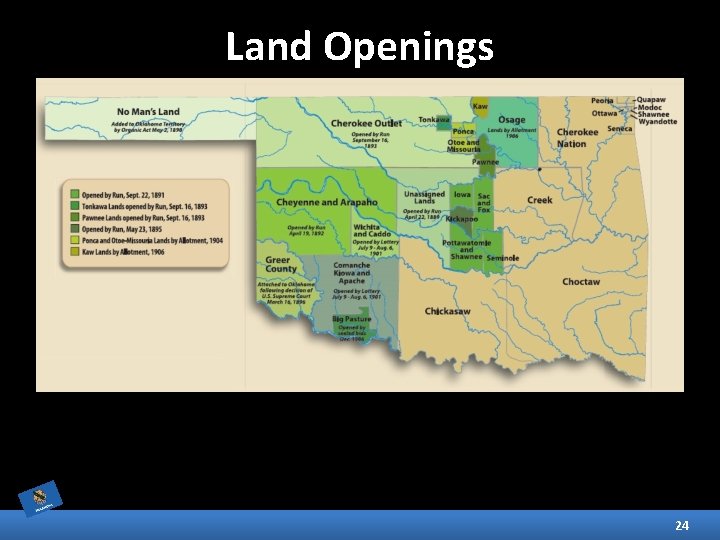
Land Openings 24
The Last Land Distributions Ø A land lottery used for later distributions. Ø 165, 000 homesteaders registered at land offices. Ø 300 registration cards were drawn per day; winners could pick their claim in county or town plans. Ø Land was divided in Ponca, Otoe-Missouri, Kaw, and Osage tribes to the members. There was no surplus land. Ø The Osage retained mineral rights on their lands. Ø Big Pasture land was sold by auction and money set aside for the Kiowa, Comanche, and Apache. 25
Image Credits Slide 1: Daniel Mayer on Wikimedia Commons; Slide 2: Public Domain; Image Credits Slide: Thomas Jones on Wikimedia Commons Return to Main Menu 26
- Slides: 26