
Chapter 11 Binary Search Trees Data Structures in
Chapter 11: Binary Search Trees Data Structures in Java: From Abstract Data Types to the Java Collections Framework by Simon Gray Copyright © 2007 Pearson Education, Inc. Publishing as Pearson Addison-Wesley
Introduction • Binary Search Tree (BST) – a Binary Tree whose elements are stored such that an inorder traversal would produce an ordered list – elegantly described using a recursive definition (soon!) – but…BSTs can be unbalanced; bad for searching • Want to make search of a BST efficient – AVL Tree: idea – minimize the height of the tree – Splay Tree: idea – optimize for repeated searches Copyright © 2007 Pearson Education, Inc. Publishing as Pearson Addison-Wesley 11 -2
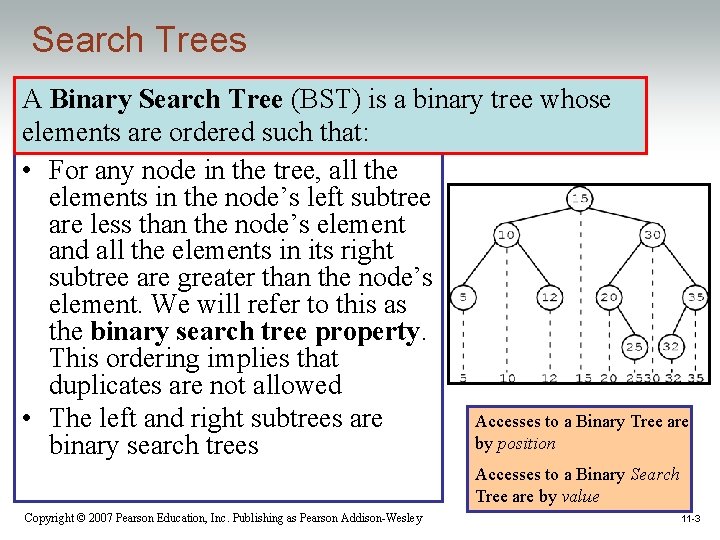
Search Trees A Binary Search Tree (BST) is a binary tree whose elements are ordered such that: • For any node in the tree, all the elements in the node’s left subtree are less than the node’s element and all the elements in its right subtree are greater than the node’s element. We will refer to this as the binary search tree property. This ordering implies that duplicates are not allowed Accesses to a Binary Tree are • The left and right subtrees are by position binary search trees Accesses to a Binary Search Tree are by value Copyright © 2007 Pearson Education, Inc. Publishing as Pearson Addison-Wesley 11 -3
Binary Search Tree ADT Description This ADT describes a binary search tree (BST) whose element type is left unspecified. The ordering of the tree’s elements is according to their “natural” ordering. Duplicates are not allowed. Properties 1. A BST is a hierarchical data structure. A node in a BST can have 0 to 2 children. 2. The root is the access point to a BST. 3. Elements are inserted such that all the elements in the node’s left subtree are less than the node’s element and all the elements in the node’s right subtree are greater than the node’s element. This is called the binary search tree property. 4. The elements of a BST must be comparable to one another. Copyright © 2007 Pearson Education, Inc. Publishing as Pearson Addison-Wesley 11 -4
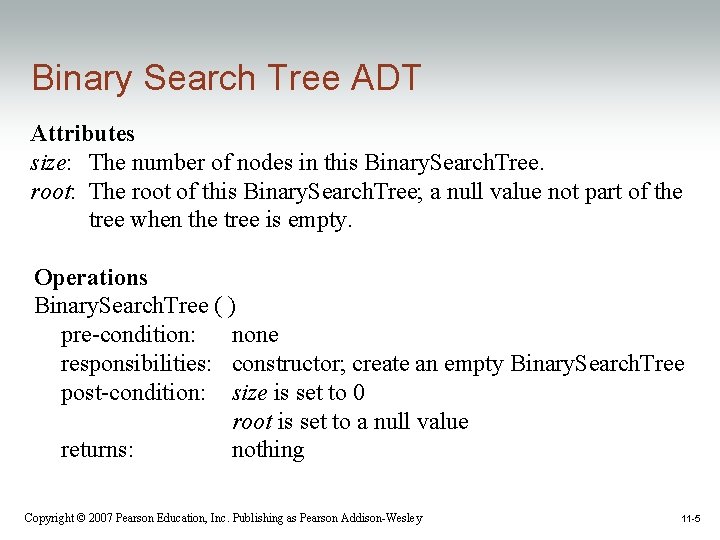
Binary Search Tree ADT Attributes size: The number of nodes in this Binary. Search. Tree. root: The root of this Binary. Search. Tree; a null value not part of the tree when the tree is empty. Operations Binary. Search. Tree ( ) pre-condition: none responsibilities: constructor; create an empty Binary. Search. Tree post-condition: size is set to 0 root is set to a null value returns: nothing Copyright © 2007 Pearson Education, Inc. Publishing as Pearson Addison-Wesley 11 -5
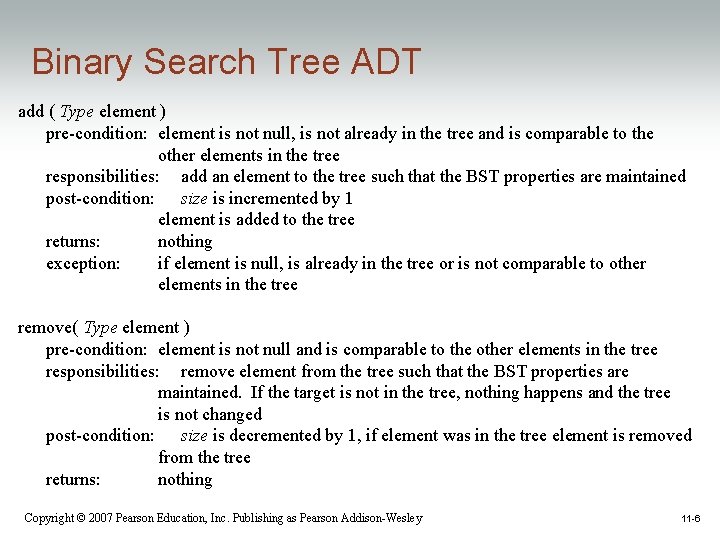
Binary Search Tree ADT add ( Type element ) pre-condition: element is not null, is not already in the tree and is comparable to the other elements in the tree responsibilities: add an element to the tree such that the BST properties are maintained post-condition: size is incremented by 1 element is added to the tree returns: nothing exception: if element is null, is already in the tree or is not comparable to other elements in the tree remove( Type element ) pre-condition: element is not null and is comparable to the other elements in the tree responsibilities: remove element from the tree such that the BST properties are maintained. If the target is not in the tree, nothing happens and the tree is not changed post-condition: size is decremented by 1, if element was in the tree element is removed from the tree returns: nothing Copyright © 2007 Pearson Education, Inc. Publishing as Pearson Addison-Wesley 11 -6
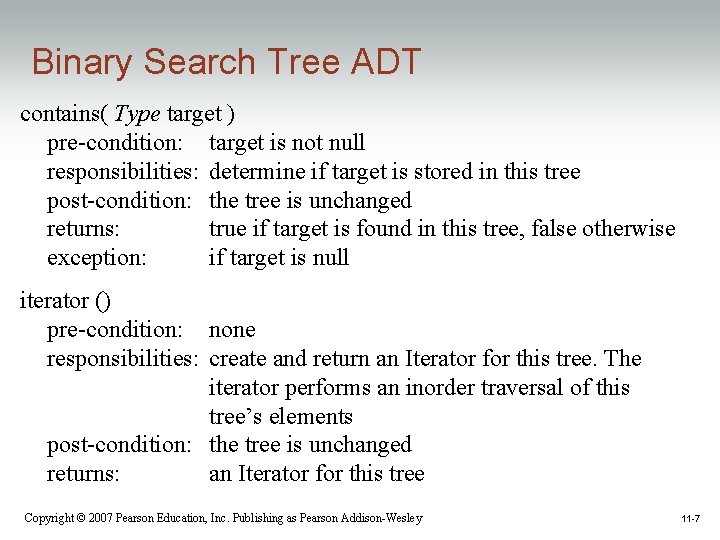
Binary Search Tree ADT contains( Type target ) pre-condition: target is not null responsibilities: determine if target is stored in this tree post-condition: the tree is unchanged returns: true if target is found in this tree, false otherwise exception: if target is null iterator () pre-condition: none responsibilities: create and return an Iterator for this tree. The iterator performs an inorder traversal of this tree’s elements post-condition: the tree is unchanged returns: an Iterator for this tree Copyright © 2007 Pearson Education, Inc. Publishing as Pearson Addison-Wesley 11 -7
Tree Iterator • The BST object will supply the client with an iterator object the client uses to iterate over the elements stored in the BST – this is the way iteration was done over the List implementations and Basic. Collection • The Tree Iterator will perform an inorder traversal of the tree, but not recursively, as done in the last chapter since that doesn’t allow the client to control the iteration. Copyright © 2007 Pearson Education, Inc. Publishing as Pearson Addison-Wesley 11 -8
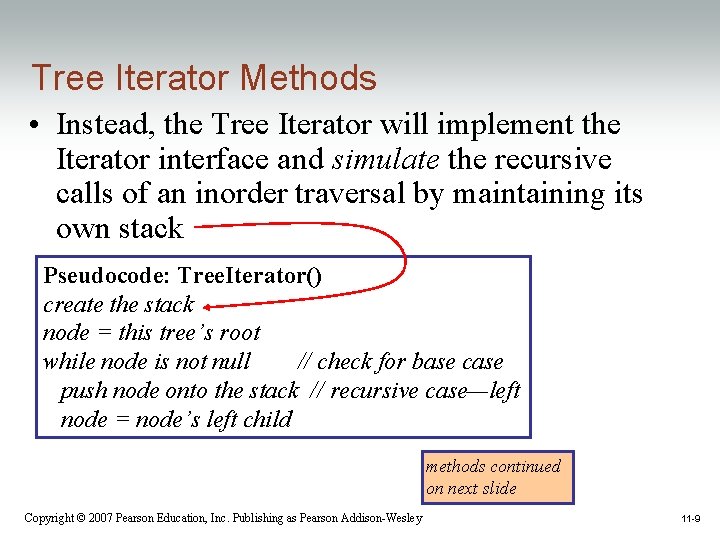
Tree Iterator Methods • Instead, the Tree Iterator will implement the Iterator interface and simulate the recursive calls of an inorder traversal by maintaining its own stack Pseudocode: Tree. Iterator() create the stack node = this tree’s root while node is not null // check for base case push node onto the stack // recursive case—left node = node’s left child methods continued on next slide Copyright © 2007 Pearson Education, Inc. Publishing as Pearson Addison-Wesley 11 -9
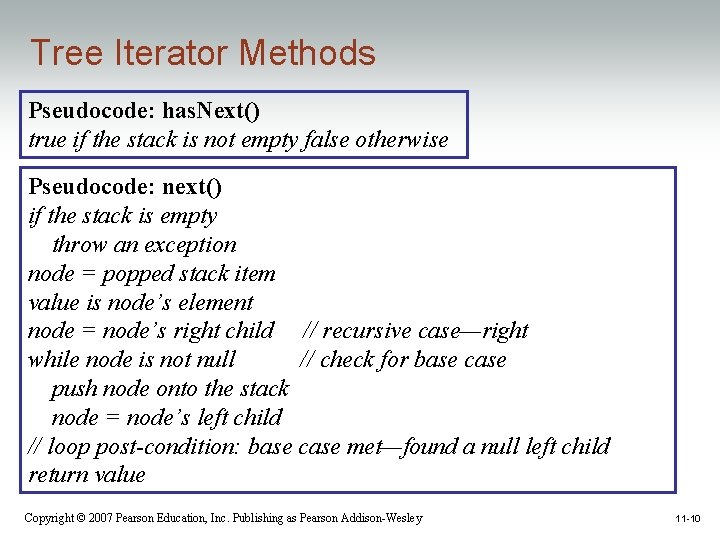
Tree Iterator Methods Pseudocode: has. Next() true if the stack is not empty false otherwise Pseudocode: next() if the stack is empty throw an exception node = popped stack item value is node’s element node = node’s right child // recursive case—right while node is not null // check for base case push node onto the stack node = node’s left child // loop post-condition: base case met—found a null left child return value Copyright © 2007 Pearson Education, Inc. Publishing as Pearson Addison-Wesley 11 -10
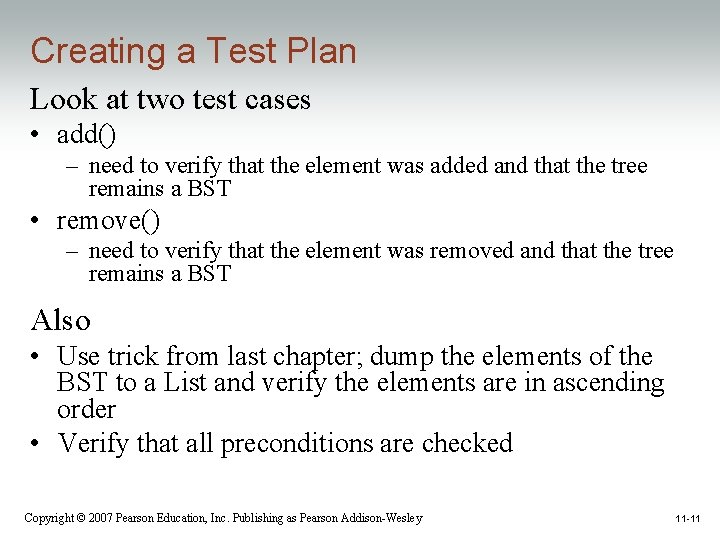
Creating a Test Plan Look at two test cases • add() – need to verify that the element was added and that the tree remains a BST • remove() – need to verify that the element was removed and that the tree remains a BST Also • Use trick from last chapter; dump the elements of the BST to a List and verify the elements are in ascending order • Verify that all preconditions are checked Copyright © 2007 Pearson Education, Inc. Publishing as Pearson Addison-Wesley 11 -11

Implementing the Binary Search Tree ADT Want to implement BST so that it is easily extended to produce an implementation for AVL Tree. Requires some careful thinking. Use lessons learned in earlier chapters: interfaces and abstract classes Copyright © 2007 Pearson Education, Inc. Publishing as Pearson Addison-Wesley 11 -12
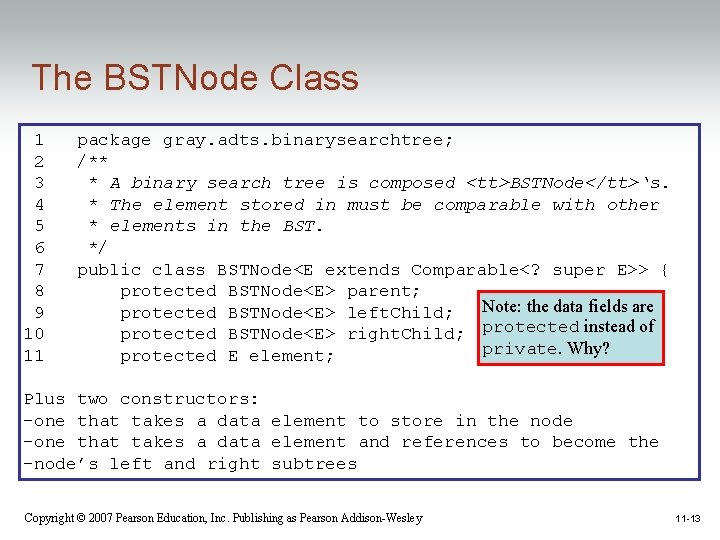
The BSTNode Class 1 2 3 4 5 6 7 8 9 10 11 package gray. adts. binarysearchtree; /** * A binary search tree is composed <tt>BSTNode</tt>‘s. * The element stored in must be comparable with other * elements in the BST. */ public class BSTNode<E extends Comparable<? super E>> { protected BSTNode<E> parent; Note: the data fields are protected BSTNode<E> left. Child; protected BSTNode<E> right. Child; protected instead of private. Why? protected E element; Plus two constructors: -one that takes a data element to store in the node -one that takes a data element and references to become the -node’s left and right subtrees Copyright © 2007 Pearson Education, Inc. Publishing as Pearson Addison-Wesley 11 -13
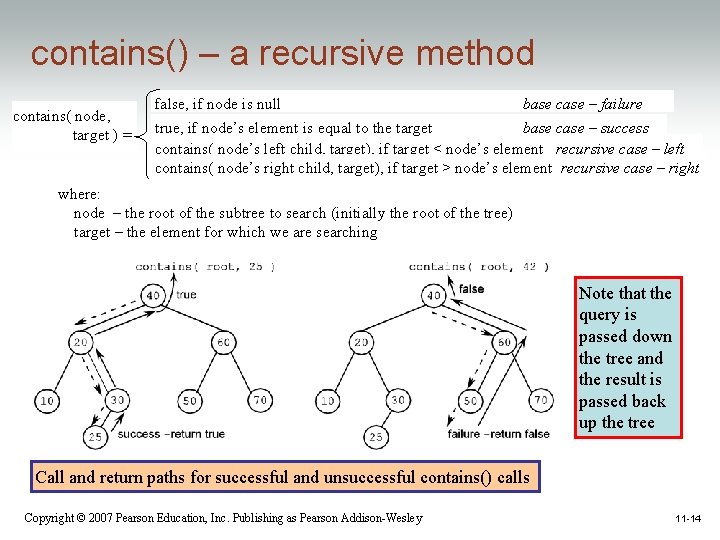
contains() – a recursive method contains( node, target ) = false, if node is null base case – failure true, if node’s element is equal to the target base case – success contains( node’s left child, target), if target < node’s element recursive case – left contains( node’s right child, target), if target > node’s element recursive case – right where: node – the root of the subtree to search (initially the root of the tree) target – the element for which we are searching Note that the query is passed down the tree and the result is passed back up the tree Call and return paths for successful and unsuccessful contains() calls Copyright © 2007 Pearson Education, Inc. Publishing as Pearson Addison-Wesley 11 -14
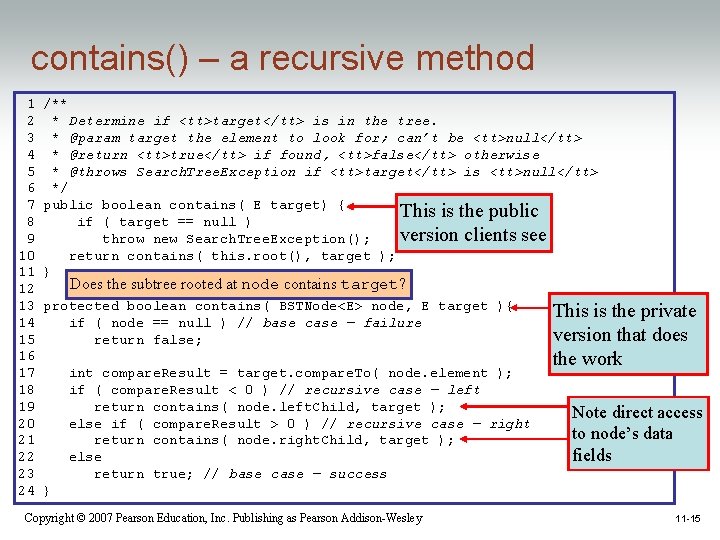
contains() – a recursive method 1 2 3 4 5 6 7 8 9 10 11 12 13 14 15 16 17 18 19 20 21 22 23 24 /** * Determine if <tt>target</tt> is in the tree. * @param target the element to look for; can’t be <tt>null</tt> * @return <tt>true</tt> if found, <tt>false</tt> otherwise * @throws Search. Tree. Exception if <tt>target</tt> is <tt>null</tt> */ public boolean contains( E target) { This is the public if ( target == null ) version clients see throw new Search. Tree. Exception(); return contains( this. root(), target ); } Does the subtree rooted at node contains target? protected boolean contains( BSTNode<E> node, E target ){ if ( node == null ) // base case — failure return false; int compare. Result = target. compare. To( node. element ); if ( compare. Result < 0 ) // recursive case — left return contains( node. left. Child, target ); else if ( compare. Result > 0 ) // recursive case — right return contains( node. right. Child, target ); else return true; // base case — success This is the private version that does the work Note direct access to node’s data fields } Copyright © 2007 Pearson Education, Inc. Publishing as Pearson Addison-Wesley 11 -15
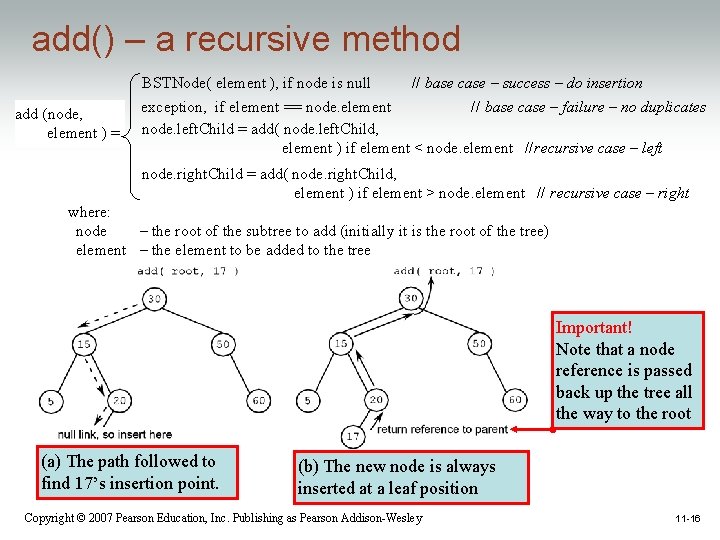
add() – a recursive method BSTNode( element ), if node is null add (node, element ) = // base case – success – do insertion exception, if element == node. element // base case – failure – no duplicates node. left. Child = add( node. left. Child, element ) if element < node. element //recursive case – left node. right. Child = add( node. right. Child, element ) if element > node. element // recursive case – right where: node – the root of the subtree to add (initially it is the root of the tree) element – the element to be added to the tree Important! Note that a node reference is passed back up the tree all the way to the root (a) The path followed to find 17’s insertion point. (b) The new node is always inserted at a leaf position Copyright © 2007 Pearson Education, Inc. Publishing as Pearson Addison-Wesley 11 -16
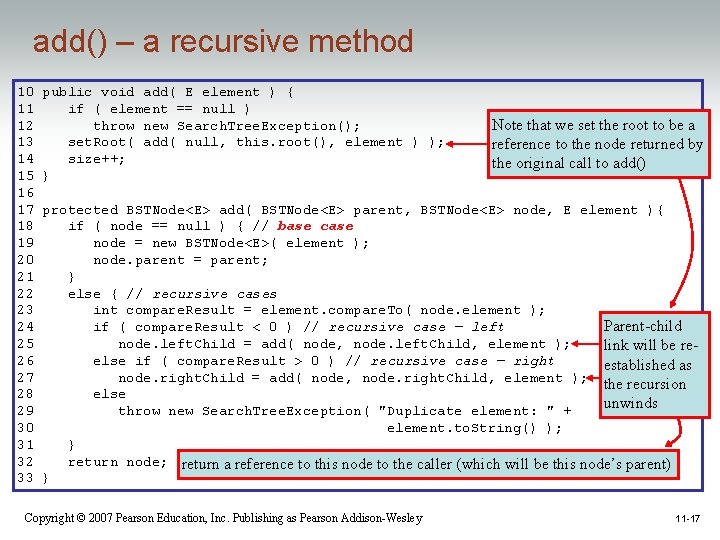
add() – a recursive method 10 11 12 13 14 15 16 17 18 19 20 21 22 23 24 25 26 27 28 29 30 31 32 33 public void add( E element ) { if ( element == null ) throw new Search. Tree. Exception(); set. Root( add( null, this. root(), element ) ); size++; } Note that we set the root to be a reference to the node returned by the original call to add() protected BSTNode<E> add( BSTNode<E> parent, BSTNode<E> node, E element ){ if ( node == null ) { // base case node = new BSTNode<E>( element ); node. parent = parent; } else { // recursive cases int compare. Result = element. compare. To( node. element ); if ( compare. Result < 0 ) // recursive case — left Parent-child node. left. Child = add( node, node. left. Child, element ); link will be reelse if ( compare. Result > 0 ) // recursive case — right established as node. right. Child = add( node, node. right. Child, element ); the recursion else unwinds throw new Search. Tree. Exception( "Duplicate element: " + element. to. String() ); } return node; return a reference to this node to the caller (which will be this node’s parent) } Copyright © 2007 Pearson Education, Inc. Publishing as Pearson Addison-Wesley 11 -17
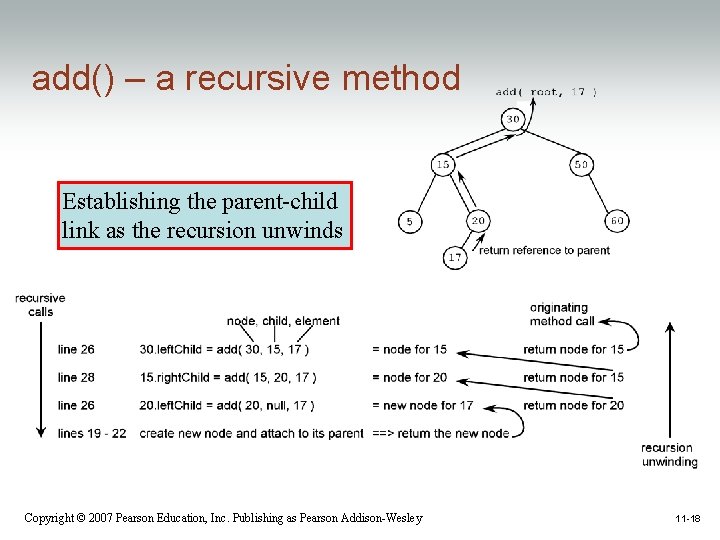
add() – a recursive method Establishing the parent-child link as the recursion unwinds Copyright © 2007 Pearson Education, Inc. Publishing as Pearson Addison-Wesley 11 -18
remove() – a recursive method • Removing a node is a little trickier – Need to keep the tree connected, and – Need to maintain the BST property • There are three cases to consider – Case 1 The node to remove is a leaf – Case 2 The node to remove is an internal node with one child – Case 3 The node to remove is an internal node with two children Copyright © 2007 Pearson Education, Inc. Publishing as Pearson Addison-Wesley 11 -19
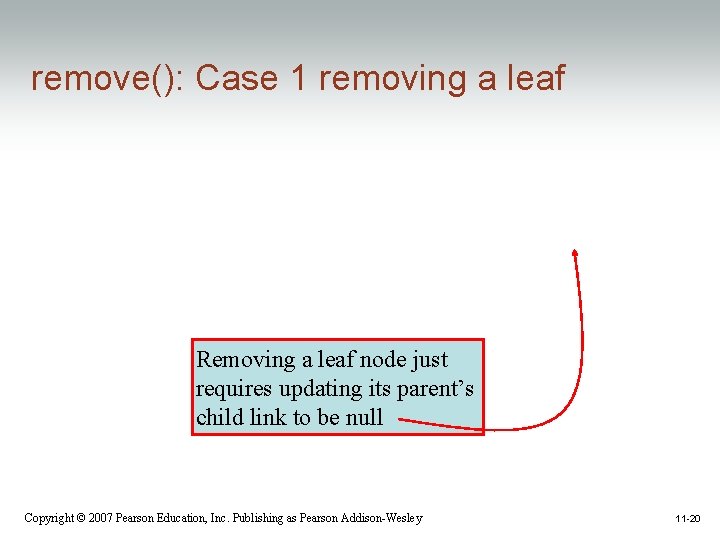
remove(): Case 1 removing a leaf Removing a leaf node just requires updating its parent’s child link to be null Copyright © 2007 Pearson Education, Inc. Publishing as Pearson Addison-Wesley 11 -20
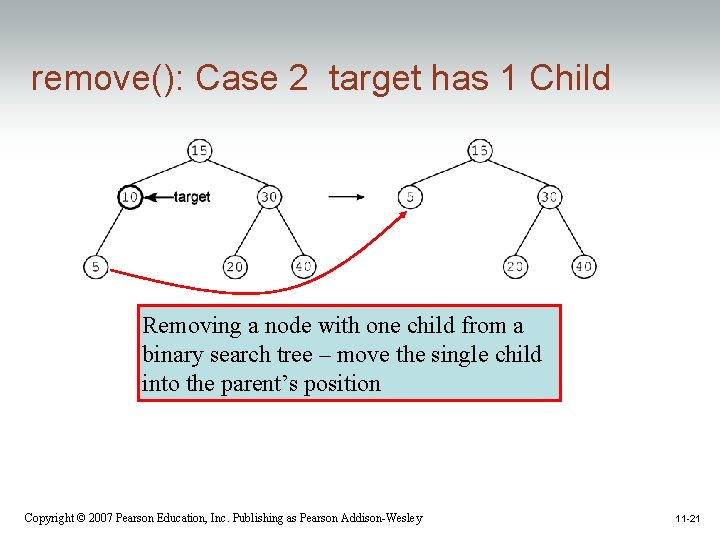
remove(): Case 2 target has 1 Child Removing a node with one child from a binary search tree – move the single child into the parent’s position Copyright © 2007 Pearson Education, Inc. Publishing as Pearson Addison-Wesley 11 -21
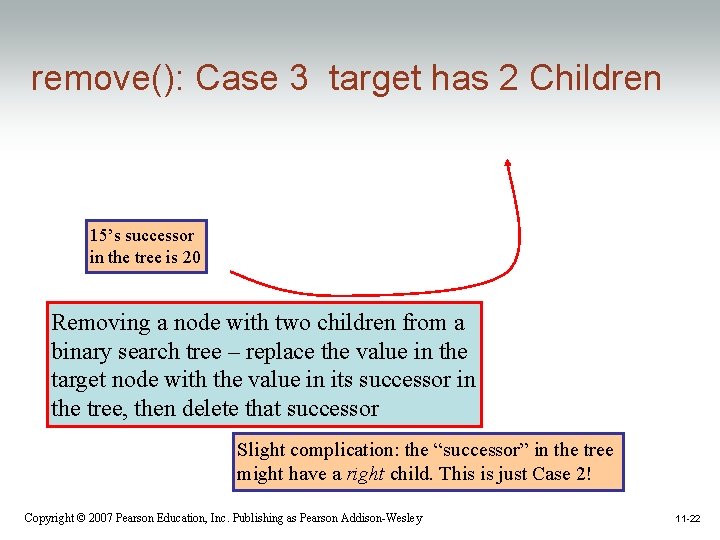
remove(): Case 3 target has 2 Children 15’s successor in the tree is 20 Removing a node with two children from a binary search tree – replace the value in the target node with the value in its successor in the tree, then delete that successor Slight complication: the “successor” in the tree might have a right child. This is just Case 2! Copyright © 2007 Pearson Education, Inc. Publishing as Pearson Addison-Wesley 11 -22
Abstract. Binary. Search. Tree • The recursive methods all take two arguments: a node and a target element. This is necessary because what happens in the recursive case always depends on the combination of the value at the current position (node) in the tree and the target element • The Binary. Search. Tree interface specifies that the public add() , remove(), and contains() methods only supply a target as an argument • This is easily handled by having the public method call an internal utility method using the tree’s root as the starting point Copyright © 2007 Pearson Education, Inc. Publishing as Pearson Addison-Wesley 11 -23
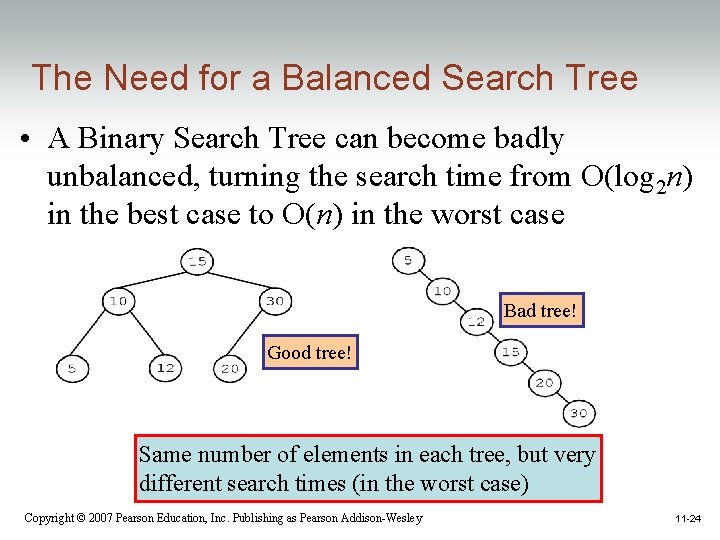
The Need for a Balanced Search Tree • A Binary Search Tree can become badly unbalanced, turning the search time from O(log 2 n) in the best case to O(n) in the worst case Bad tree! Good tree! Same number of elements in each tree, but very different search times (in the worst case) Copyright © 2007 Pearson Education, Inc. Publishing as Pearson Addison-Wesley 11 -24
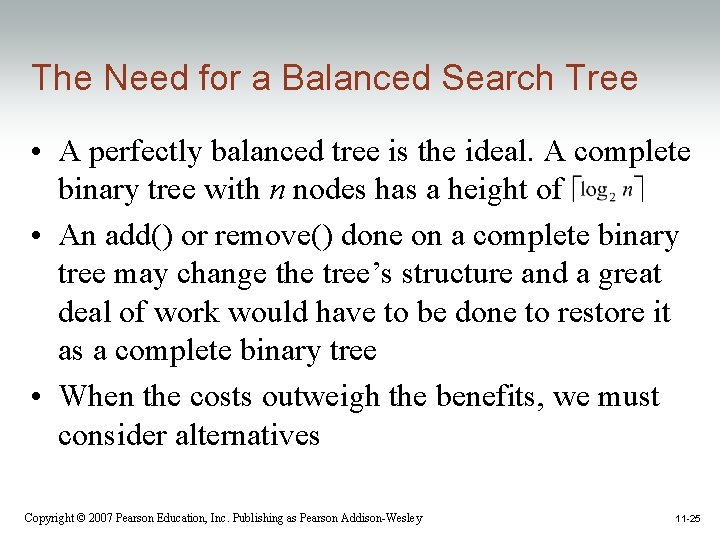
The Need for a Balanced Search Tree • A perfectly balanced tree is the ideal. A complete binary tree with n nodes has a height of • An add() or remove() done on a complete binary tree may change the tree’s structure and a great deal of work would have to be done to restore it as a complete binary tree • When the costs outweigh the benefits, we must consider alternatives Copyright © 2007 Pearson Education, Inc. Publishing as Pearson Addison-Wesley 11 -25
AVL Trees An AVL tree is a BST with the following additional constraints: • The height of a node’s left and right subtrees differ by no more than 1 • The left and right subtrees are AVL trees This approach is • cost effective, and • guarantees that the height of the tree is a small multiple of log 2 n, so it still provides O(log 2 n) access time Copyright © 2007 Pearson Education, Inc. Publishing as Pearson Addison-Wesley 11 -26
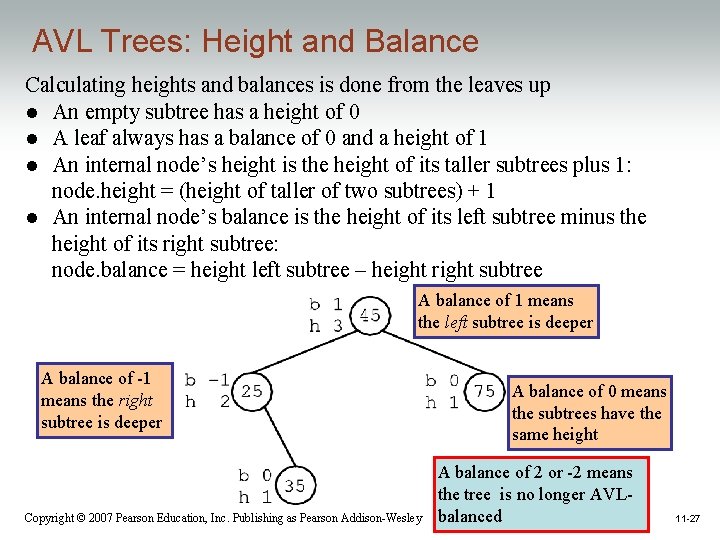
AVL Trees: Height and Balance Calculating heights and balances is done from the leaves up ● An empty subtree has a height of 0 ● A leaf always has a balance of 0 and a height of 1 ● An internal node’s height is the height of its taller subtrees plus 1: node. height = (height of taller of two subtrees) + 1 ● An internal node’s balance is the height of its left subtree minus the height of its right subtree: node. balance = height left subtree – height right subtree A balance of 1 means the left subtree is deeper A balance of -1 means the right subtree is deeper Copyright © 2007 Pearson Education, Inc. Publishing as Pearson Addison-Wesley A balance of 0 means the subtrees have the same height A balance of 2 or -2 means the tree is no longer AVLbalanced 11 -27
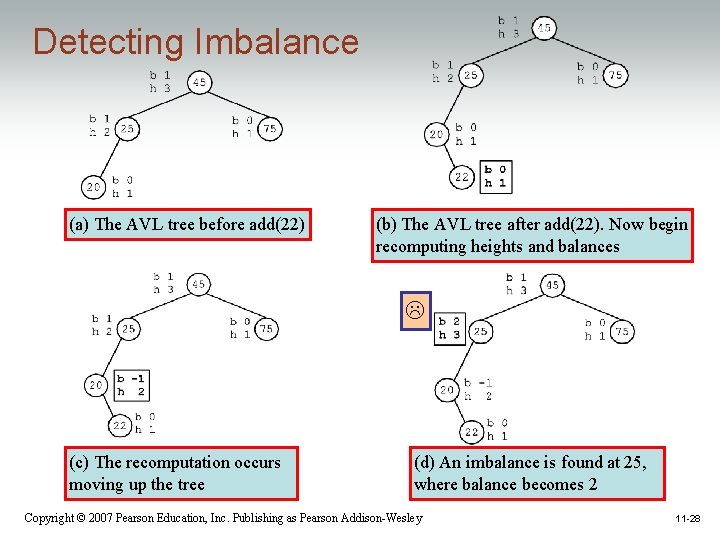
Detecting Imbalance (a) The AVL tree before add(22) (b) The AVL tree after add(22). Now begin recomputing heights and balances (c) The recomputation occurs moving up the tree (d) An imbalance is found at 25, where balance becomes 2 Copyright © 2007 Pearson Education, Inc. Publishing as Pearson Addison-Wesley 11 -28
Restoring AVL Balance: Rotations • When an imbalance is discovered, balance is restored through rotations of subtrees • There are four cases – Case LL The balance at X’s left child, XL, is 1, so the Left child’s Left subtree, rooted at XLL, is taller – Case LR The balance at X’s left child, XL, is – 1, so the Left child’s Right subtree, rooted at XLR, is taller – Case RR The balance at X’s right child, XR, is – 1, so the Right child’s Right subtree, rooted at XRR, is taller – Case RL The balance at X’s right child, XR, is 1, so the Right child’s Left subtree, rooted at XRL, is taller Copyright © 2007 Pearson Education, Inc. Publishing as Pearson Addison-Wesley 11 -29
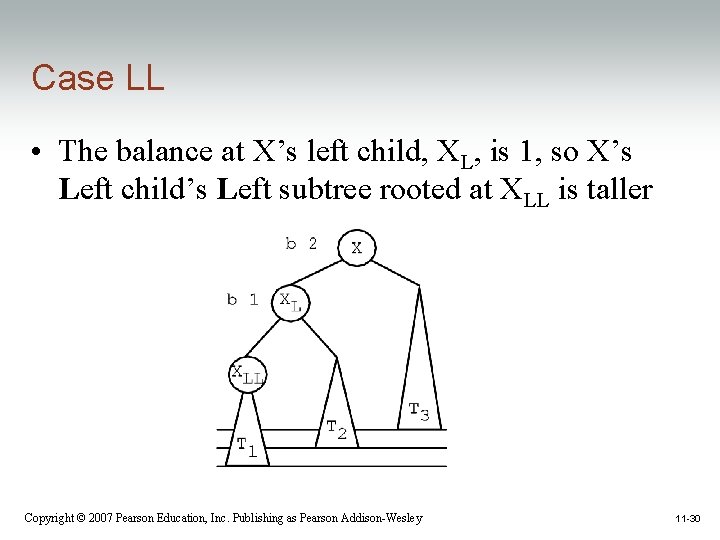
Case LL • The balance at X’s left child, XL, is 1, so X’s Left child’s Left subtree rooted at XLL is taller Copyright © 2007 Pearson Education, Inc. Publishing as Pearson Addison-Wesley 11 -30
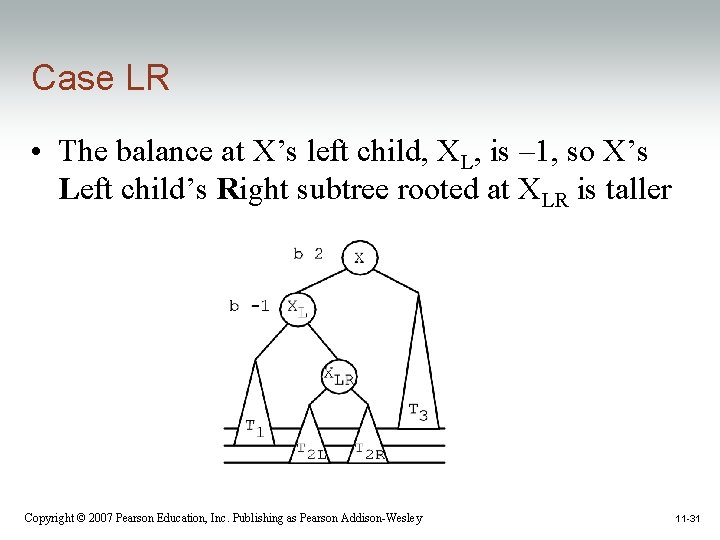
Case LR • The balance at X’s left child, XL, is – 1, so X’s Left child’s Right subtree rooted at XLR is taller Copyright © 2007 Pearson Education, Inc. Publishing as Pearson Addison-Wesley 11 -31
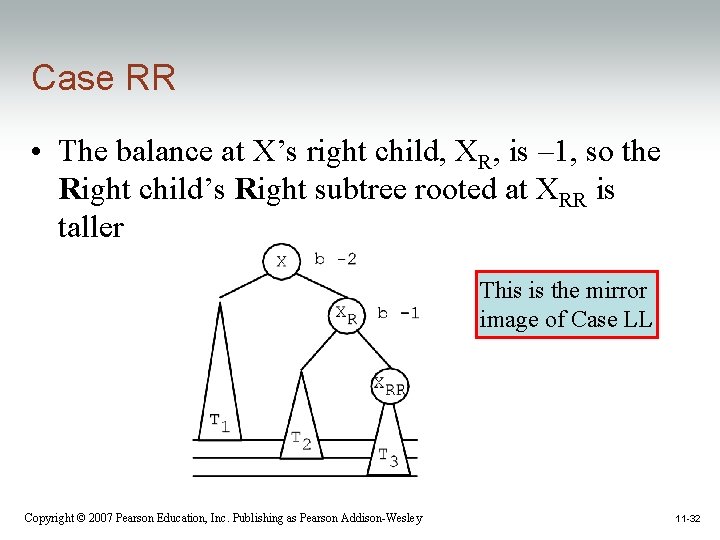
Case RR • The balance at X’s right child, XR, is – 1, so the Right child’s Right subtree rooted at XRR is taller This is the mirror image of Case LL Copyright © 2007 Pearson Education, Inc. Publishing as Pearson Addison-Wesley 11 -32
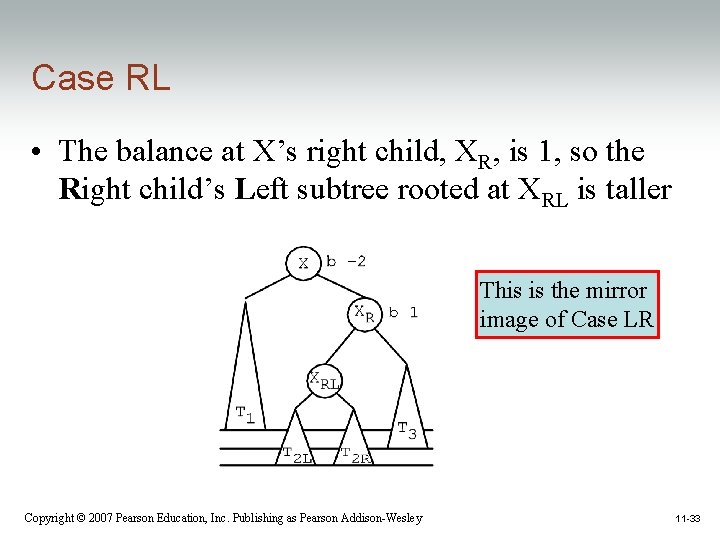
Case RL • The balance at X’s right child, XR, is 1, so the Right child’s Left subtree rooted at XRL is taller This is the mirror image of Case LR Copyright © 2007 Pearson Education, Inc. Publishing as Pearson Addison-Wesley 11 -33
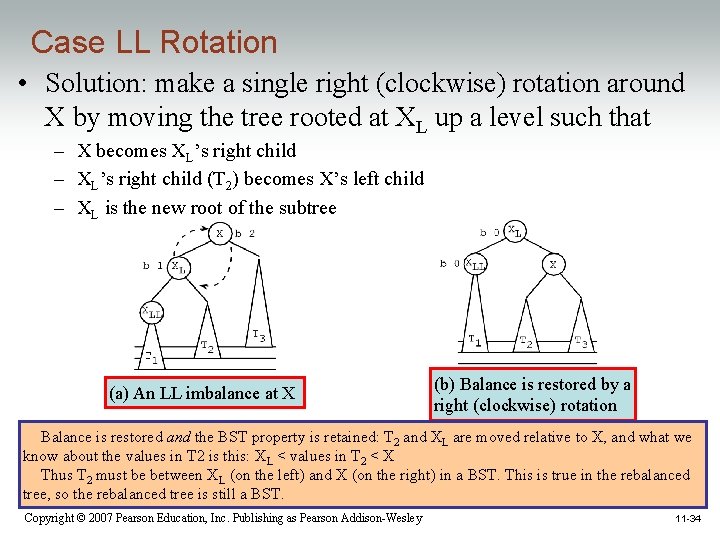
Case LL Rotation • Solution: make a single right (clockwise) rotation around X by moving the tree rooted at XL up a level such that – X becomes XL’s right child – XL’s right child (T 2) becomes X’s left child – XL is the new root of the subtree (a) An LL imbalance at X (b) Balance is restored by a right (clockwise) rotation Balance is restored and the BST property is retained: T 2 and XL are moved relative to X, and what we know about the values in T 2 is this: XL < values in T 2 < X Thus T 2 must be between XL (on the left) and X (on the right) in a BST. This is true in the rebalanced tree, so the rebalanced tree is still a BST. Copyright © 2007 Pearson Education, Inc. Publishing as Pearson Addison-Wesley 11 -34
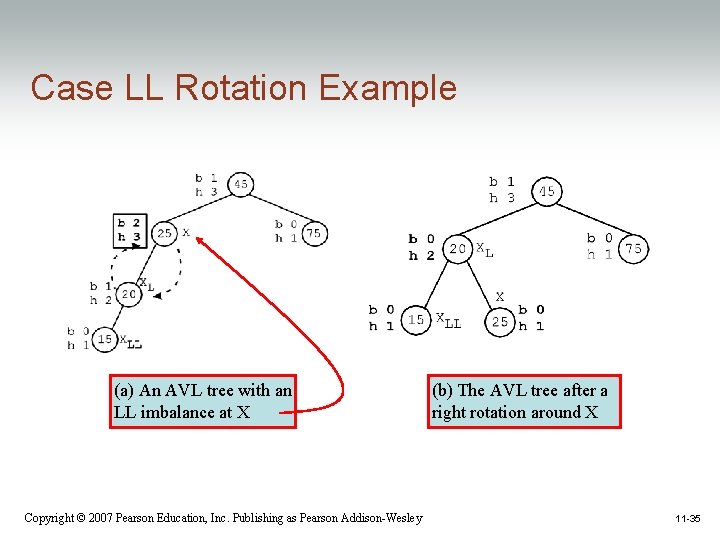
Case LL Rotation Example (a) An AVL tree with an LL imbalance at X Copyright © 2007 Pearson Education, Inc. Publishing as Pearson Addison-Wesley (b) The AVL tree after a right rotation around X 11 -35
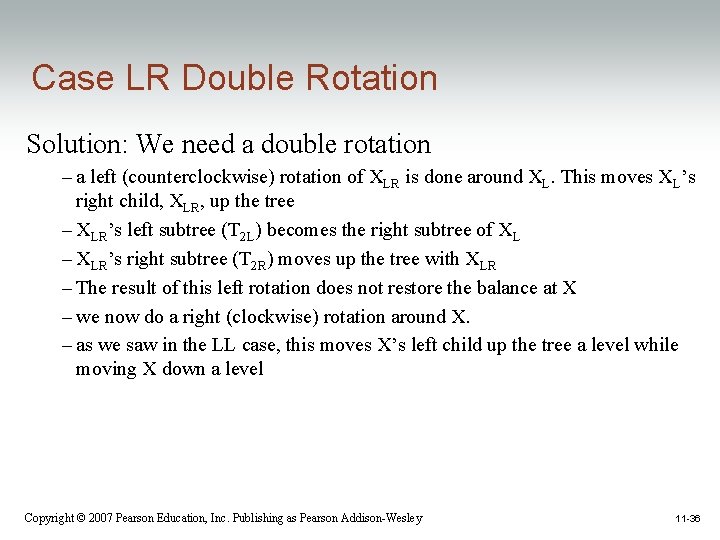
Case LR Double Rotation Solution: We need a double rotation – a left (counterclockwise) rotation of XLR is done around XL. This moves XL’s right child, XLR, up the tree – XLR’s left subtree (T 2 L) becomes the right subtree of XL – XLR’s right subtree (T 2 R) moves up the tree with XLR – The result of this left rotation does not restore the balance at X – we now do a right (clockwise) rotation around X. – as we saw in the LL case, this moves X’s left child up the tree a level while moving X down a level Copyright © 2007 Pearson Education, Inc. Publishing as Pearson Addison-Wesley 11 -36
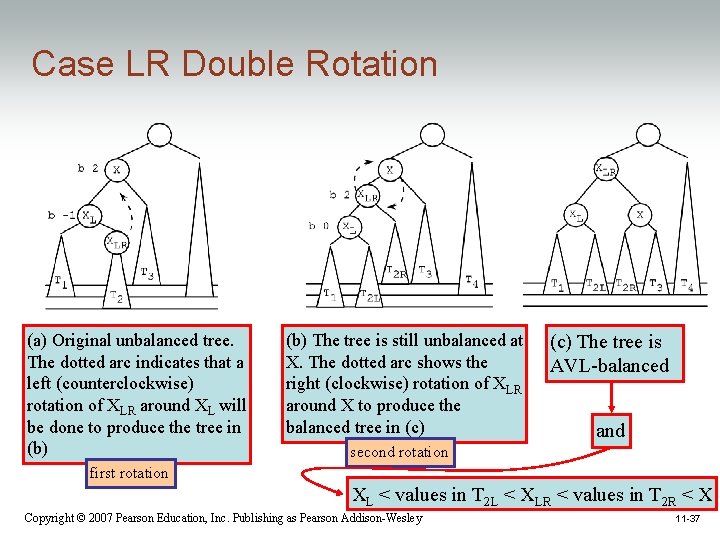
Case LR Double Rotation (a) Original unbalanced tree. The dotted arc indicates that a left (counterclockwise) rotation of XLR around XL will be done to produce the tree in (b) The tree is still unbalanced at X. The dotted arc shows the right (clockwise) rotation of XLR around X to produce the balanced tree in (c) The tree is AVL-balanced and second rotation first rotation XL < values in T 2 L < XLR < values in T 2 R < X Copyright © 2007 Pearson Education, Inc. Publishing as Pearson Addison-Wesley 11 -37
AVL Tree add() • Done pretty much as for Linked. BST • Recursively descend the tree looking for the leaf position where the new value will be inserted • Difference: – as the recursion unwinds, heights and balances need to be recomputed – if an imbalance is discovered, its type (LL, RR, LR, RL) needs to be identified and then balance must be restored Copyright © 2007 Pearson Education, Inc. Publishing as Pearson Addison-Wesley 11 -38
AVL Tree remove() • Similar to remove() for Linked. BST, but trickier • As with Linked. BST, replace the target with its successor • Complication – Need to recompute heights and balances as the recursion unwinds – BUT the recursive calls will not have descended all the way to the successor node – How to handle recomputation of heights and balances from the successor node up? Copyright © 2007 Pearson Education, Inc. Publishing as Pearson Addison-Wesley 11 -39
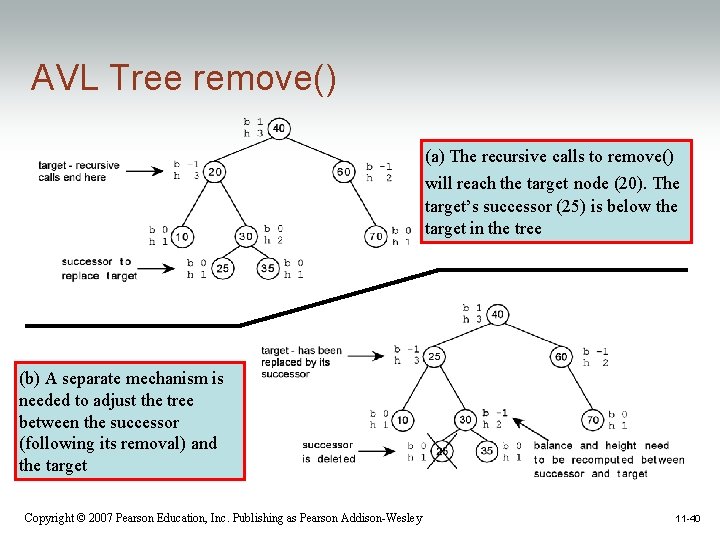
AVL Tree remove() (a) The recursive calls to remove() will reach the target node (20). The target’s successor (25) is below the target in the tree (b) A separate mechanism is needed to adjust the tree between the successor (following its removal) and the target Copyright © 2007 Pearson Education, Inc. Publishing as Pearson Addison-Wesley 11 -40
Splay Trees - Motivation • What do AVL-balanced trees get us? They an upper bound on the worst case search time no matter which element is searched for • But what if accesses to the tree were not evenly distributed over its elements? What if there was a pattern of accesses to the tree’s elements? • It would be nice to take advantage of this information to minimize search time • Alas, AVL Trees cannot help us Copyright © 2007 Pearson Education, Inc. Publishing as Pearson Addison-Wesley 11 -41
Splay Trees – the Idea • Idea: always move the most recently accessed element to the root under the assumption that it will be accessed again in the near future. If this turns out to be the case, subsequent accesses will be very efficient • Price: splay trees make no promises about height or balance – Tradeoff - forego AVL Tree’s guarantee of uniform access time and tolerate an occasional costly, O(n), access time in return for a larger number of very efficient, O(1), accesses, so that over time the average access cost is comparable to that of height balanced trees, O(log 2 n) Copyright © 2007 Pearson Education, Inc. Publishing as Pearson Addison-Wesley 11 -42
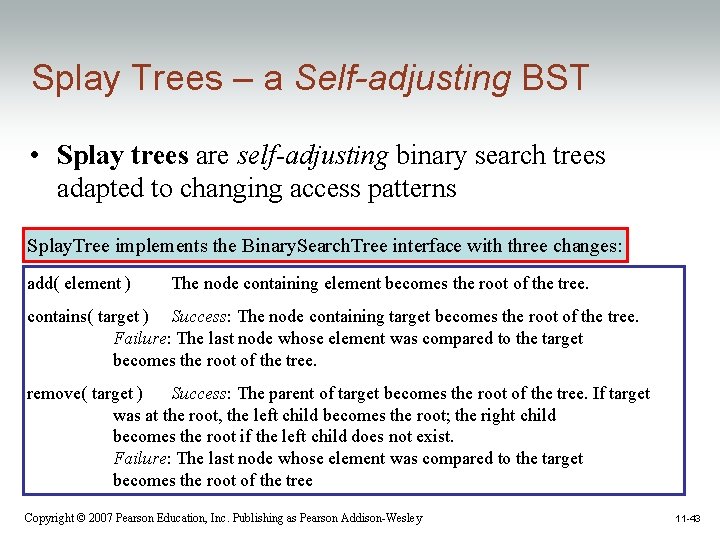
Splay Trees – a Self-adjusting BST • Splay trees are self-adjusting binary search trees adapted to changing access patterns Splay. Tree implements the Binary. Search. Tree interface with three changes: add( element ) The node containing element becomes the root of the tree. contains( target ) Success: The node containing target becomes the root of the tree. Failure: The last node whose element was compared to the target becomes the root of the tree. remove( target ) Success: The parent of target becomes the root of the tree. If target was at the root, the left child becomes the root; the right child becomes the root if the left child does not exist. Failure: The last node whose element was compared to the target becomes the root of the tree Copyright © 2007 Pearson Education, Inc. Publishing as Pearson Addison-Wesley 11 -43
Splay Tree Test Plan • Since a Splay Tree is a BST, all of the BST tests apply • Additional tests address the unique characteristics of splay trees. – After an add() and successful contains(), verify that the accessed node is the root – After a remove(), verify that the target’s parent is moved to the root. If the target was already in the root position, verify that the correct child was promoted – After an unsuccessful contains() or remove(), verify that the last node touched has become the root Copyright © 2007 Pearson Education, Inc. Publishing as Pearson Addison-Wesley 11 -44
Splay Rotations • Unlike with the AVL Tree, the purpose of Splay rotations isn’t to restore balance while maintaining the BST properties. Instead, it is to move some element to the root of the tree while maintaining the BST properties • Note: the AVL Tree rotations always moved some subtree up the tree – we take advantage of that Copyright © 2007 Pearson Education, Inc. Publishing as Pearson Addison-Wesley 11 -45
Splay Rotations • There are two 1 -level splay cases and four 2 level splay cases • The goal of the 1 -level rotation is to move the target up one level into the root • The goal of a 2 -level rotation is to move the target up the tree two levels • Idea: Combine a sequence of 1 - and 2 -level splay rotations until the target is at the root Copyright © 2007 Pearson Education, Inc. Publishing as Pearson Addison-Wesley 11 -46
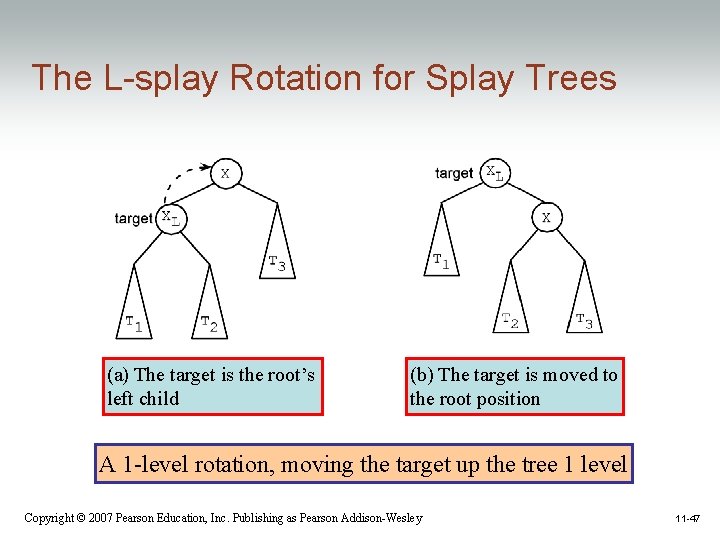
The L-splay Rotation for Splay Trees (a) The target is the root’s left child (b) The target is moved to the root position A 1 -level rotation, moving the target up the tree 1 level Copyright © 2007 Pearson Education, Inc. Publishing as Pearson Addison-Wesley 11 -47
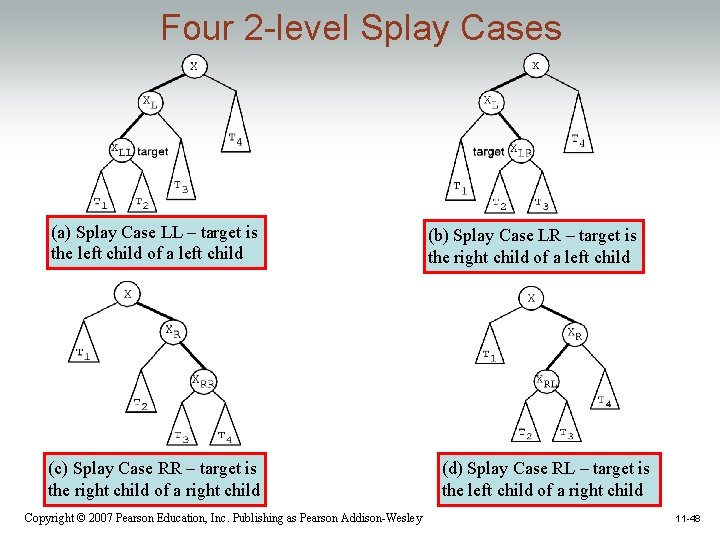
Four 2 -level Splay Cases (a) Splay Case LL – target is the left child of a left child (c) Splay Case RR – target is the right child of a right child Copyright © 2007 Pearson Education, Inc. Publishing as Pearson Addison-Wesley (b) Splay Case LR – target is the right child of a left child (d) Splay Case RL – target is the left child of a right child 11 -48
The 2 -level Splay Rotations • Rotations for the LR and RL splay cases are identical to the LR and RL AVL cases • The rotations for LL and RR are a little different from their AVL counterparts – Instead of doing a single rotation in the AVL case, for splay trees we do two rotations, thus achieving a 2 -level shift in the target node (the LL case is in the next slide) Copyright © 2007 Pearson Education, Inc. Publishing as Pearson Addison-Wesley 11 -49
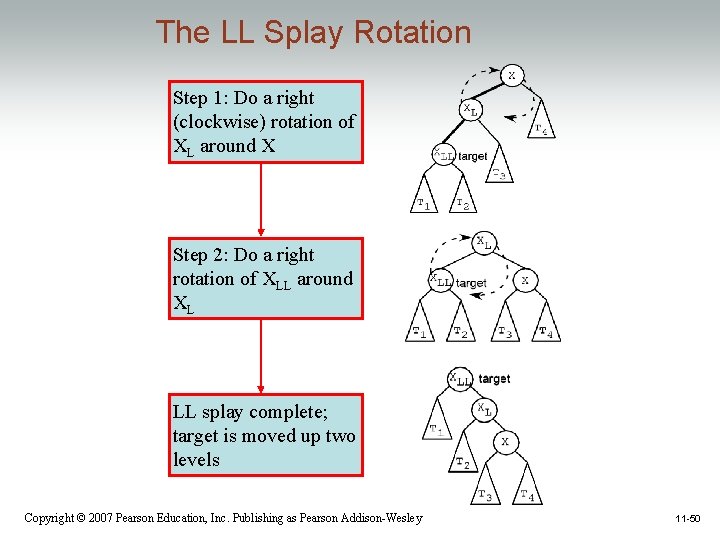
The LL Splay Rotation Step 1: Do a right (clockwise) rotation of XL around X Step 2: Do a right rotation of XLL around XL LL splay complete; target is moved up two levels Copyright © 2007 Pearson Education, Inc. Publishing as Pearson Addison-Wesley 11 -50
Amortization Analysis • The runtime complexity of an individual access to a splay tree is O(n) • But, it can be shown that a sequence of m accesses will have a cost of O(mlog 2 n), giving an amortized cost of O(log 2 n) per access • Idea: Some operations may be quite costly, but are laying the groundwork that will make operations in the near future very efficient Copyright © 2007 Pearson Education, Inc. Publishing as Pearson Addison-Wesley 11 -51
- Slides: 51