
Chapter 11 Behavior of Gases Section 11 1
Chapter 11: Behavior of Gases Section 11. 1: Gas Pressure
Objectives: #1 ~ Model the effects of changing number of particles, mass, temperature, pressure, and volume on a gas using kinetic theory. #2 ~ Evaluate atmospheric pressure. #3 ~ Demonstrate the ability to use dimensional analysis to convert pressure units.

Review: What is gas pressure? The force per unit area that the particles in the gas exert on the walls of their container.
Properties of gases Relationships among pressure, volume, temperature and mass
Pressure Force per unit area that particles in the gas exert on the walls of their container More air = More mass = More pressure
What three things affect the pressure of a gas? 1. # of particles/(mass): the more often gas particles collide with the walls of their container, the greater the pressure. Example: doubling gas particles will double the pressure
What three things affect the pressure of a gas? 2. temperature: higher temperature means higher kinetic energy; particles move faster and collide with the walls of the container more often and with greater force, therefore the pressure is greater.
What three things affect the pressure of a gas? 3. volume: when volume is not held constant, and temperature increases, volume increases at constant pressure. If volume decreases, pressure of a gas, increases. High pressures occur at low altitudes, atmospheric pressure decreases as you go up in altitude
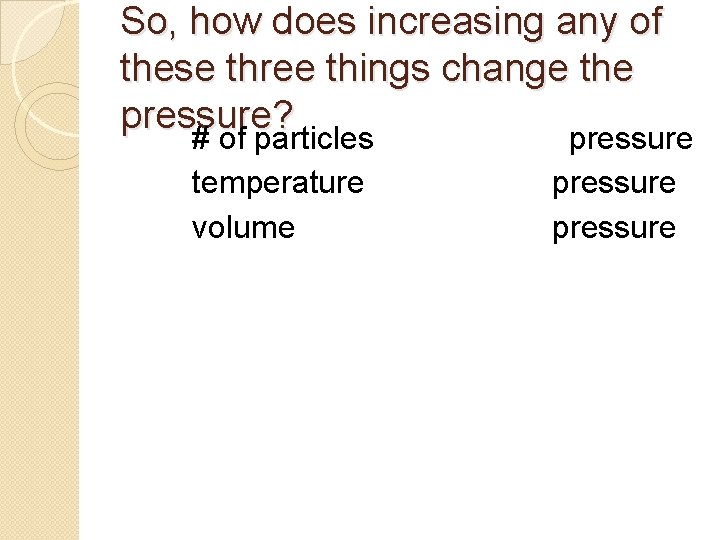
So, how does increasing any of these three things change the pressure? # of particles pressure temperature volume pressure
BAROMETER Evangelista Torricelli- an instrument that measures the pressure exerted by the atmosphere (barometers measure only atmospheric pressure) Atmospheric pressure is also called barometric pressure The height of the mercury column measures the pressure exerted by the atmosphere Units: mm Hg
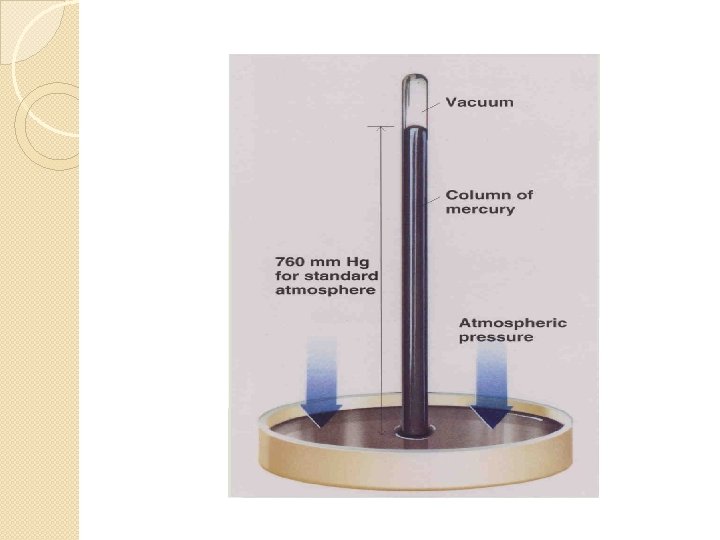
What units do we measure pressure in? Standard atmosphere (atm): the pressure that supports a 760 -mm column of mercury in a barometer; the pressure exerted by the gases of the atmosphere at sea level 1. 00 atm = 760 mm Hg
**When you hear a meteorologist say, "the barometer is falling", it means that the column of mercury is falling because atmospheric pressure is decreasing**
Pressure gauges �Used to measure air pressure inside objects, such as, tires, basketballs, or gas tanks �The pressure measured in these cases is actually the pressure above atmospheric pressure
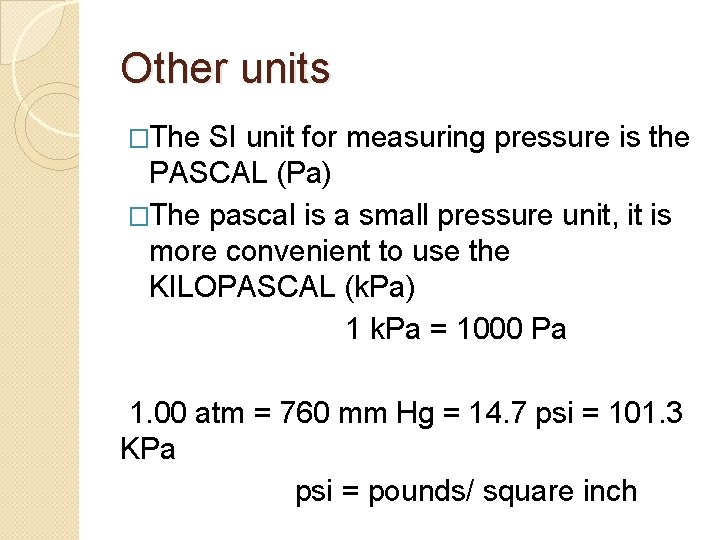
Other units �The SI unit for measuring pressure is the PASCAL (Pa) �The pascal is a small pressure unit, it is more convenient to use the KILOPASCAL (k. Pa) 1 k. Pa = 1000 Pa 1. 00 atm = 760 mm Hg = 14. 7 psi = 101. 3 KPa psi = pounds/ square inch
Conversions Dimensional Analysis/Factor Label Method : a way of changing the units of a measurement without affecting its value; uses conversion factors equal to one.
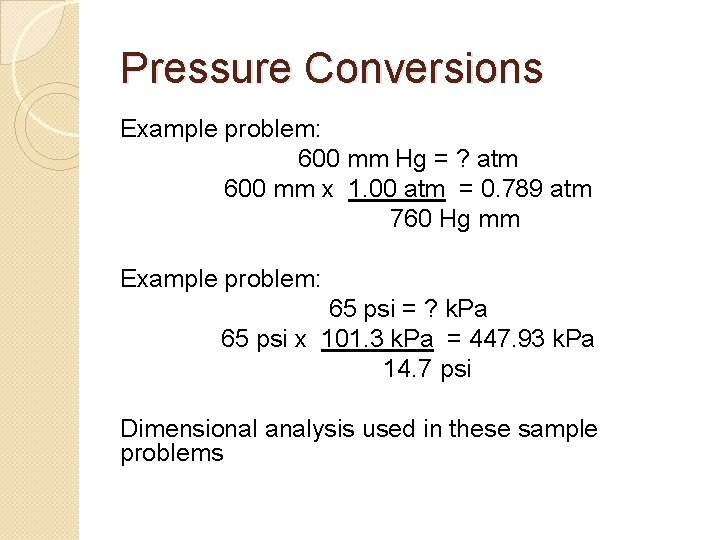
Pressure Conversions Example problem: 600 mm Hg = ? atm 600 mm x 1. 00 atm = 0. 789 atm 760 Hg mm Example problem: 65 psi = ? k. Pa 65 psi x 101. 3 k. Pa = 447. 93 k. Pa 14. 7 psi Dimensional analysis used in these sample problems
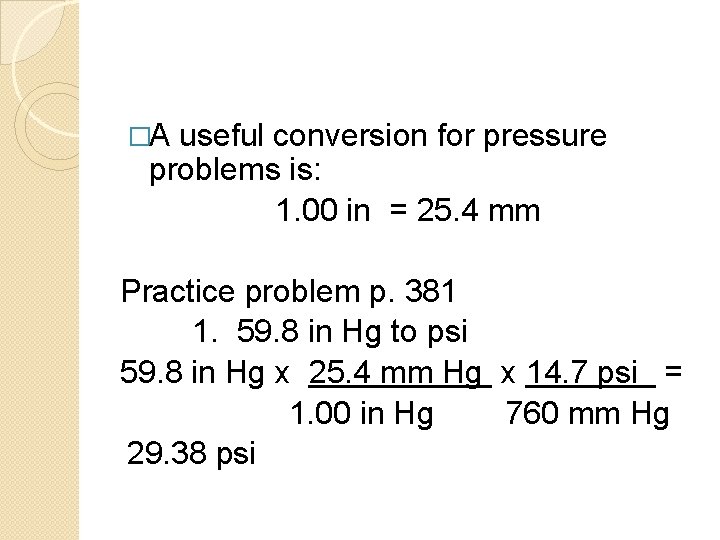
�A useful conversion for pressure problems is: 1. 00 in = 25. 4 mm Practice problem p. 381 1. 59. 8 in Hg to psi 59. 8 in Hg x 25. 4 mm Hg x 14. 7 psi = 1. 00 in Hg 760 mm Hg 29. 38 psi
- Slides: 18