
Chapter 11 Basic Approaches to Leadership ORGANIZATIONAL BEHAVIOR
Chapter 11 Basic Approaches to Leadership ORGANIZATIONAL BEHAVIOR
Michael Chaney - Wesfarmers ‘Consistent strategy – in terms of how it is developed, executed and communicated – and consistent performance are hallmarks of an effective chief executive. Wesfarmers has been one of Australia’s most consistent companies in recent years’. 2
Wal King – Leighton Holdings ‘Respondents to the Most Admired survey nominated King for his “excellent blend of vision and management skills” and Leighton’s “courageous growth”, a reference to long-term growth achieved despite the criticism of analysts. Others mentioned King’s longevity, Leighton’s record on shareholder returns, and its reshaping of the competitive landscape’. 3
What Is Leadership? Leadership The ability to influence a group toward the achievement of goals. Management Use of authority inherent in designated formal rank to obtain compliance from organizational members. 4
Leaders v. Managers Ø ‘There are so many ways to define leadership and management that the question becomes meaningless. There is certainly an overlap between the two…Do we need to know anyhow? In your working life you are not required to suddenly switch; you are both at the same time’ (AGSM, 2001) Ø ‘leadership is also different from management, since “many managers could not lead a squad of seven year olds to an ice cream counter”’ (Bolman & Deal, 2001) 5
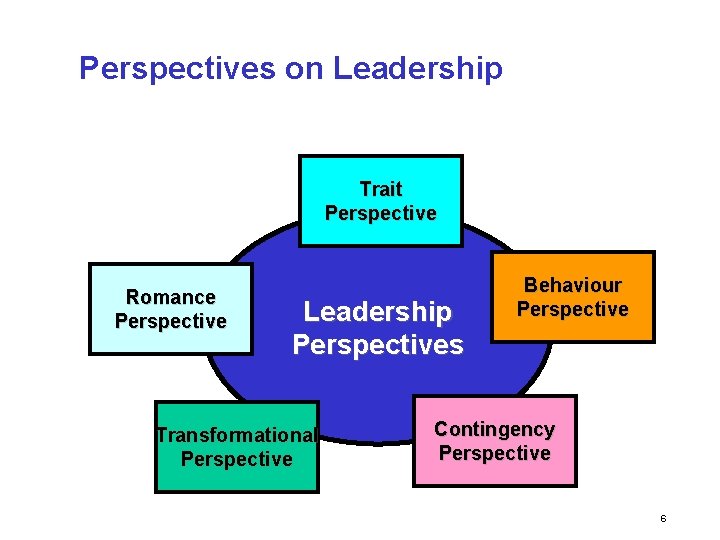
Perspectives on Leadership Trait Perspective Romance Perspective Leadership Perspectives Transformational Perspective Behaviour Perspective Contingency Perspective 6
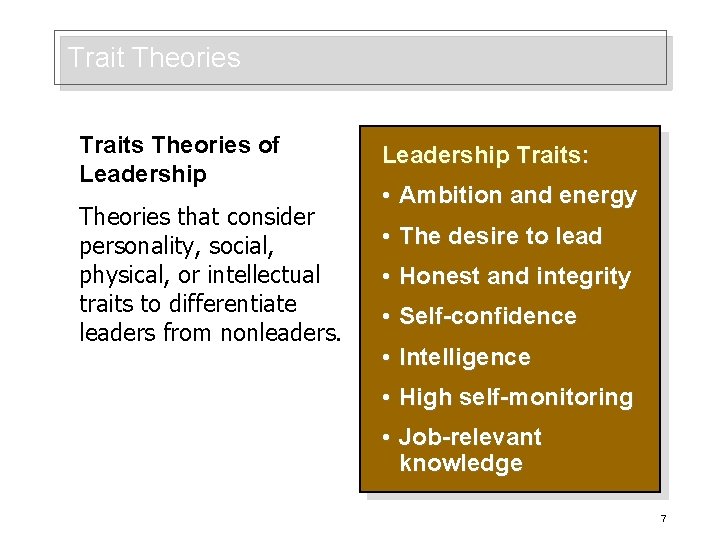
Trait Theories Traits Theories of Leadership Theories that consider personality, social, physical, or intellectual traits to differentiate leaders from nonleaders. Leadership Traits: • Ambition and energy • The desire to lead • Honest and integrity • Self-confidence • Intelligence • High self-monitoring • Job-relevant knowledge 7
Trait Approach ØEra of popularity – up to 1940 s, with comeback in 1990 s ØAssumptions: leaders have physical traits, individual behaviours and personality characteristics which distinguish them from non-leaders; competencies indicate leadership potential ØCriticisms: inconsistent evidence concerning importance of cited traits ØSeven competencies characterise effective leaders (Kirkpatrick & Locke, 1991; Gregerson et al, 1998; House & Aditya, 1997) – drive, leadership motivation, integrity, self-confidence, intelligence, knowledge of the business, emotional intelligence 8
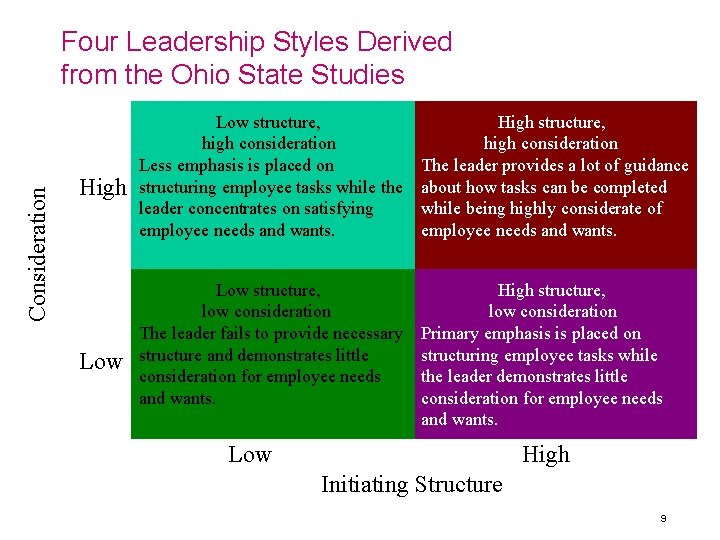
Consideration Four Leadership Styles Derived from the Ohio State Studies High Low structure, high consideration Less emphasis is placed on structuring employee tasks while the leader concentrates on satisfying employee needs and wants. High structure, high consideration The leader provides a lot of guidance about how tasks can be completed while being highly considerate of employee needs and wants. Low structure, low consideration The leader fails to provide necessary structure and demonstrates little consideration for employee needs and wants. High structure, low consideration Primary emphasis is placed on structuring employee tasks while the leader demonstrates little consideration for employee needs and wants. Low High Initiating Structure 9
Significant Australian Leadership Traits (Hunt, 2000) Ø Leaders differentiate themselves from their colleagues by possessing: – a strong need to achieve results – an ability to see the big picture – the ability to exercise initiative – an ability to persuade and influence others – having high internal work standards – maintaining sound overall business sense 10
Behavioral Theories of Leadership Theories proposing that specific behaviors differentiate leaders from nonleaders. • Trait theory: Leaders are born, not made. • Behavioral theory: Leadership traits can be taught. 11
Behavioural Perspectives of Leadership Ø Era of popularity – 1940 s-1960 s Ø Assumptions: emphasis on training rather than selecting leaders – developing the ‘one best style’; 2 key behavioural styles as shown in Blake & Mouton’s Managerial Grid: Ø People-oriented behaviours - showing mutual trust and respect; concern for employee needs; desire to look out for employee welfare Ø Task-oriented behaviours - assign specific tasks; ensure employees follow rules; push employees to reach peak performance – Argued that effective managers were “strong” on both styles Ø Criticisms: lack of attention to impact of situation; overly focused on formal leaders, not informal or political processes; inconsistent results 12
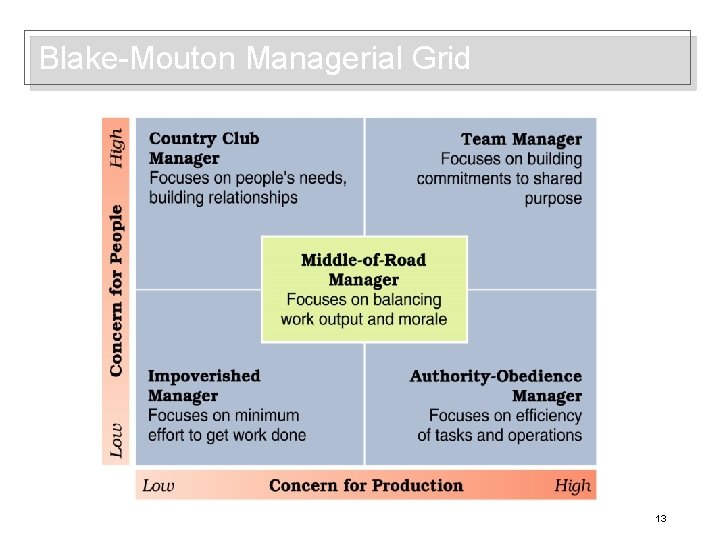
Blake-Mouton Managerial Grid 13
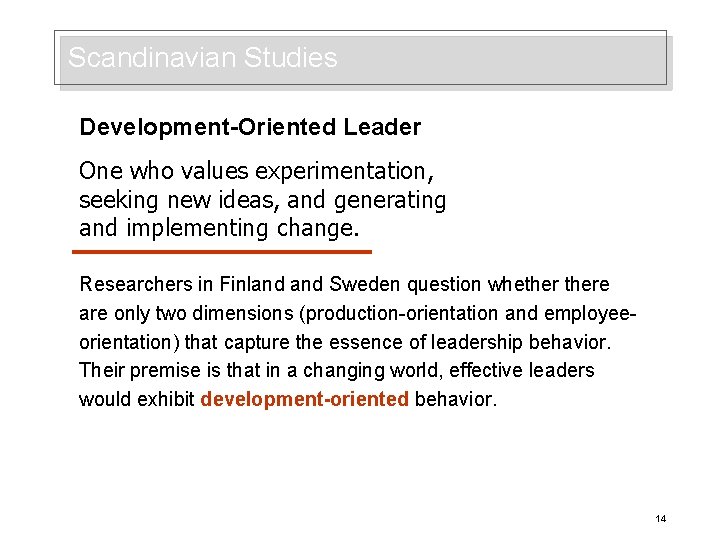
Scandinavian Studies Development-Oriented Leader One who values experimentation, seeking new ideas, and generating and implementing change. Researchers in Finland Sweden question whethere are only two dimensions (production-orientation and employeeorientation) that capture the essence of leadership behavior. Their premise is that in a changing world, effective leaders would exhibit development-oriented behavior. 14
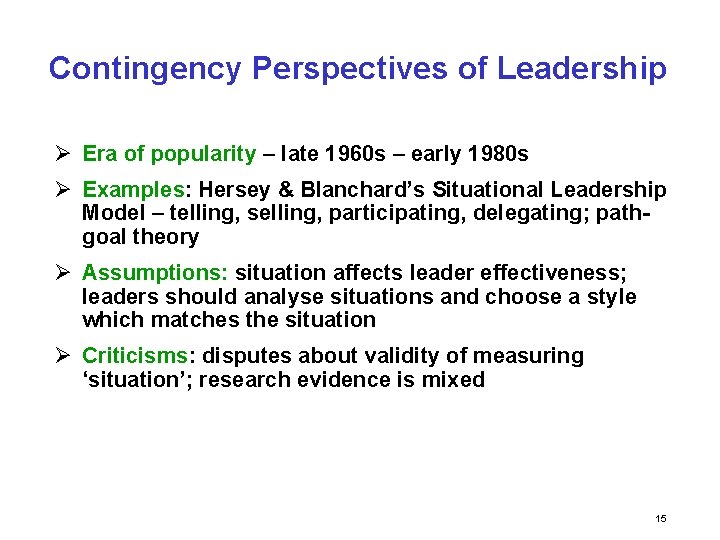
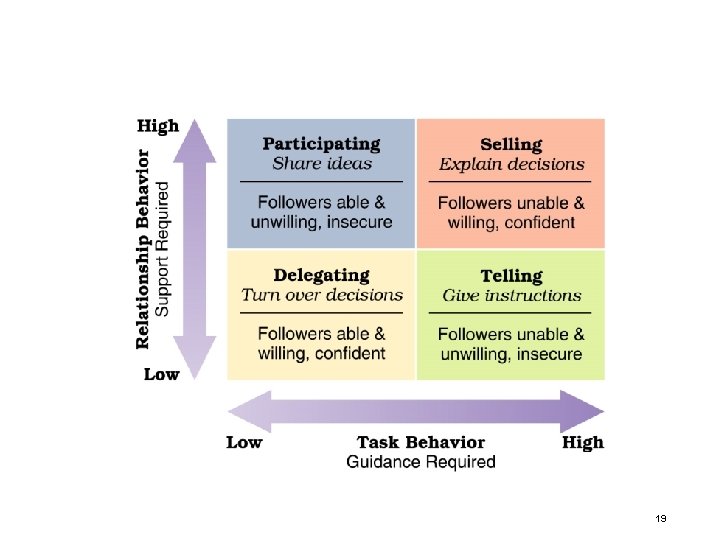
Contingency Perspectives of Leadership Ø Era of popularity – late 1960 s – early 1980 s Ø Examples: Hersey & Blanchard’s Situational Leadership Model – telling, selling, participating, delegating; pathgoal theory Ø Assumptions: situation affects leader effectiveness; leaders should analyse situations and choose a style which matches the situation Ø Criticisms: disputes about validity of measuring ‘situation’; research evidence is mixed 15
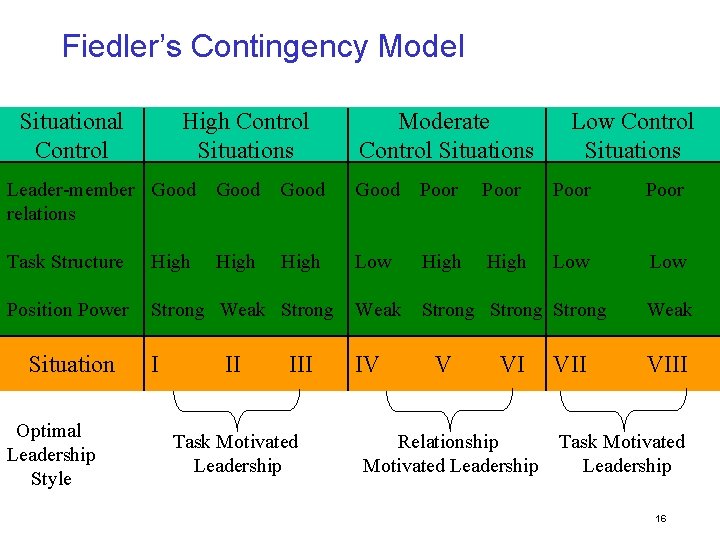
Fiedler’s Contingency Model Situational Control High Control Situations Moderate Control Situations Low Control Situations Leader-member Good relations Good Poor Task Structure High Low High Low Position Power Strong Weak Strong I IV Situation Optimal Leadership Style II III Task Motivated Leadership V VI Relationship Motivated Leadership VII Weak VIII Task Motivated Leadership 16
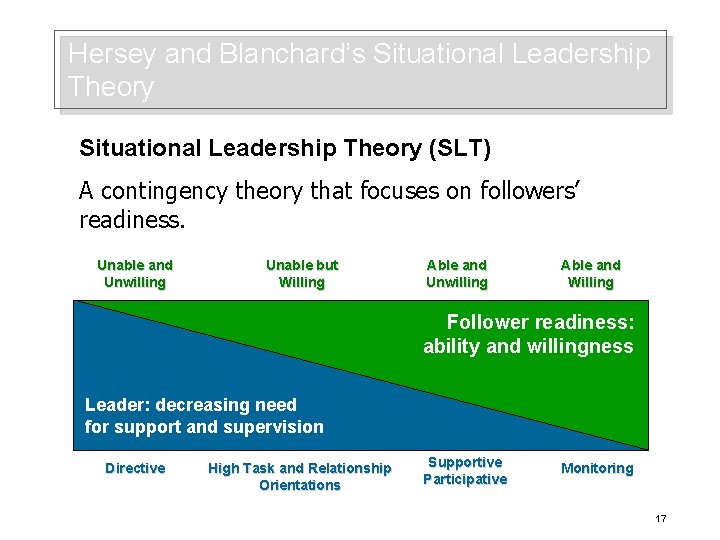
Hersey and Blanchard’s Situational Leadership Theory (SLT) A contingency theory that focuses on followers’ readiness. Unable and Unwilling Unable but Willing Able and Unwilling Able and Willing Follower readiness: ability and willingness Leader: decreasing need for support and supervision Directive High Task and Relationship Orientations Supportive Participative Monitoring 17
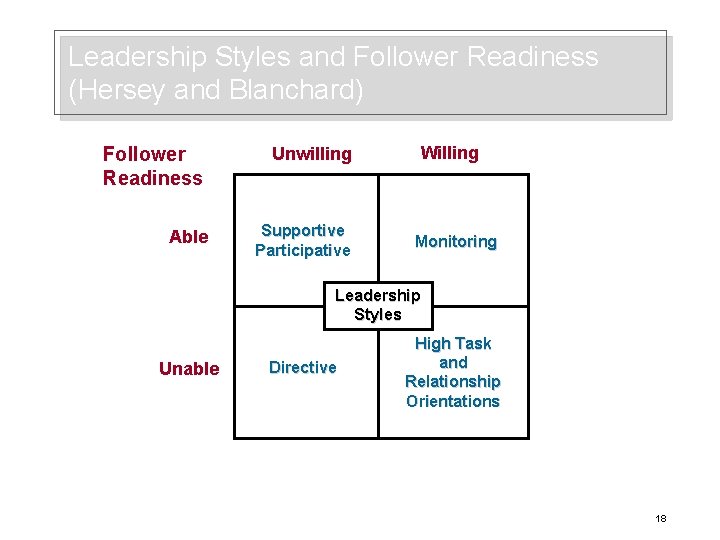
Leadership Styles and Follower Readiness (Hersey and Blanchard) Follower Readiness Able Unwilling Supportive Participative Willing Monitoring Leadership Styles Unable Directive High Task and Relationship Orientations 18
19
Leader–Member Exchange Theory Leader-Member Exchange (LMX) Theory Leaders create in-groups and out-groups, and subordinates with in-group status will have higher performance ratings, less turnover, and greater job satisfaction. 20
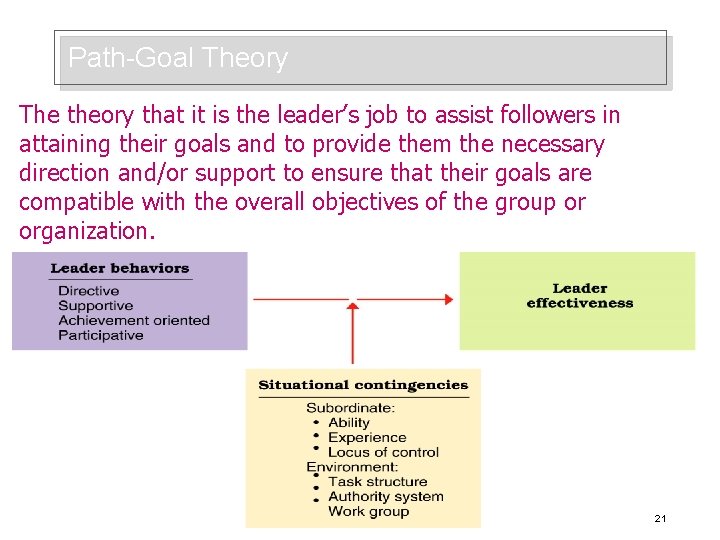
Path-Goal Theory The theory that it is the leader’s job to assist followers in attaining their goals and to provide them the necessary direction and/or support to ensure that their goals are compatible with the overall objectives of the group or organization. 21
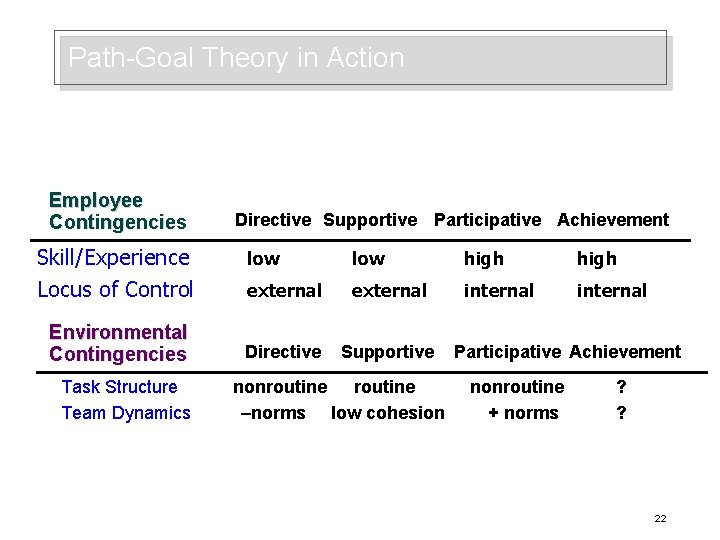
Path-Goal Theory in Action Employee Contingencies Skill/Experience Locus of Control Environmental Contingencies Task Structure Team Dynamics Directive Supportive Participative Achievement low high external internal Directive Supportive nonroutine –norms low cohesion Participative Achievement nonroutine + norms ? ? 22
Leader-Participation Model (Vroom and Yetton) A leadership theory that provides a set of rules to determine the form and amount of participative decision making in different situations. 23
- Slides: 23