
Chapter 11 Banking Industry Structure and Competition 20
Chapter 11 Banking Industry: Structure and Competition 20 -1 © 2016 Pearson Education Ltd. All rights reserved.
Preview • This chapter examines the historical trends in the banking industry that help explain the unique structure of the U. S. system. 1 -2 © 2016 Pearson Education Ltd. All rights reserved.

Learning Objectives • Recognize the key features of the banking system and the historical context of the implementation of these features. • Explain how financial innovation led to the growth of the shadow banking system. • Identify the key structural changes in the commercial banking industry. • Summarize the factors that led to consolidation in the commercial banking industry. 1 -3 © 2016 Pearson Education Ltd. All rights reserved.
Learning Objectives • Assess the reasons for separating banking from other financial services through legislation. • Summarize the distinctions between thrift institutions and commercial banks. • Identify the reasons for U. S. banks to operate in foreign countries and foreign banks to operate in the United States. 1 -4 © 2016 Pearson Education Ltd. All rights reserved.
Historical Development of the Banking System • Bank of North America chartered in 1782 • Controversy over the chartering of banks • National Bank Act of 1863 creates a new banking system of federally chartered banks – Office of the Comptroller of the Currency – Dual banking system • Federal Reserve System is created in 1913. 1 -5 © 2016 Pearson Education Ltd. All rights reserved.
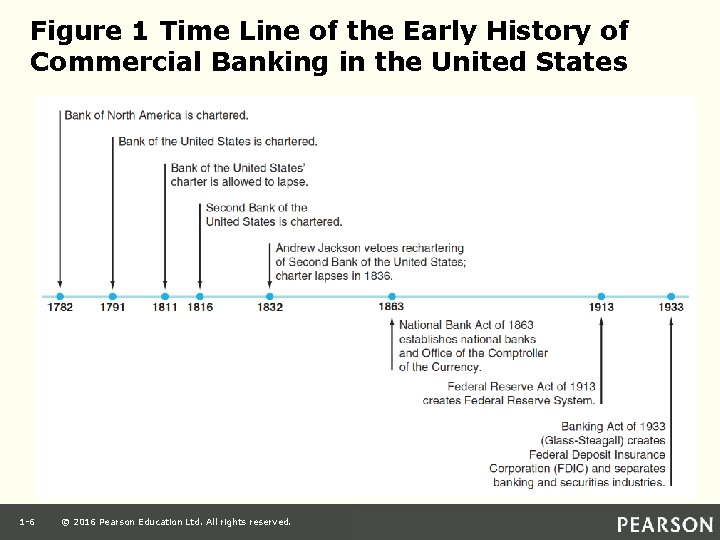
Figure 1 Time Line of the Early History of Commercial Banking in the United States 1 -6 © 2016 Pearson Education Ltd. All rights reserved.
Primary Supervisory Responsibility of Bank Regulatory Agencies • Federal Reserve and state banking authorities: state banks that are members of the Federal Reserve System. • Fed also regulates bank holding companies. • FDIC: insured state banks that are not Fed members. • State banking authorities: state banks without FDIC insurance. 1 -7 © 2016 Pearson Education Ltd. All rights reserved.
Financial Innovation and the Growth of the “Shadow Banking System” • Financial innovation is driven by the desire to earn profits • A change in the financial environment will stimulate a search by financial institutions for innovations that are likely to be profitable – Financial engineering 1 -8 © 2016 Pearson Education Ltd. All rights reserved.
Responses to Changes in Demand Conditions: Interest-Rate Volatility • Adjustable-rate mortgages – Flexible interest rates keep profits high when rates rise – Lower initial interest rates make them attractive to home buyers • Financial derivatives – Ability to hedge interest rate risk – Payoffs are linked to previously issued (i. e. derived from) securities. 1 -9 © 2016 Pearson Education Ltd. All rights reserved.
Responses to Changes in Supply Conditions: Information Technology • Bank credit and debit cards – Improved computer technology lowers transaction costs • Electronic banking – ATM, home banking, ABM and virtual banking • Junk bonds • Commercial paper market 1 -10 © 2016 Pearson Education Ltd. All rights reserved.
Securitization and the Shadow Banking System • Securitization – To transform otherwise illiquid financial assets into marketable capital market securities. – Securitization played an especially prominent role in the development of the subprime mortgage market in the mid 2000 s. 1 -11 © 2016 Pearson Education Ltd. All rights reserved.
Avoidance of Existing Regulations • Loophole Mining: – Reserve requirements act as a tax on deposits – Restrictions on interest paid on deposits led to disintermediation – Money market mutual funds – Sweep accounts 1 -12 © 2016 Pearson Education Ltd. All rights reserved.
Financial Innovation and the Decline of Traditional Banking • As a source of funds for borrowers, market share has fallen. • Commercial banks’ share of total financial intermediary assets has fallen • No decline in overall profitability • Increase in income from off-balance-sheet activities 1 -13 © 2016 Pearson Education Ltd. All rights reserved.
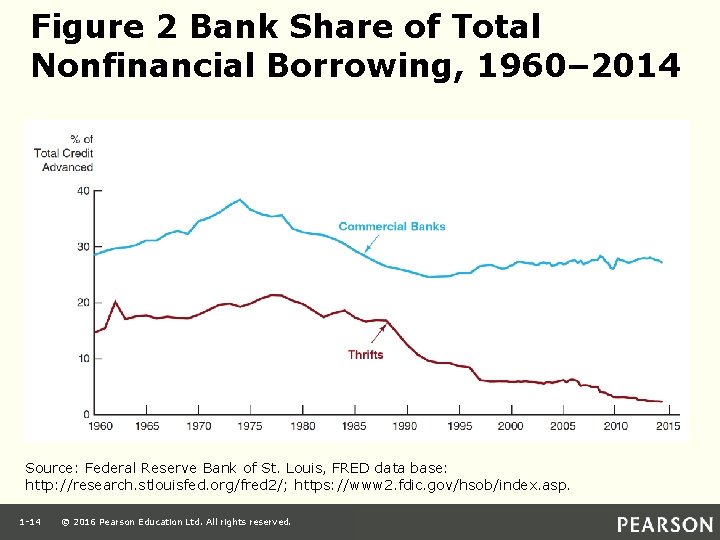
Figure 2 Bank Share of Total Nonfinancial Borrowing, 1960– 2014 Source: Federal Reserve Bank of St. Louis, FRED data base: http: //research. stlouisfed. org/fred 2/; https: //www 2. fdic. gov/hsob/index. asp. 1 -14 © 2016 Pearson Education Ltd. All rights reserved.
Financial Innovation and the Decline of Traditional Banking • Decline in cost advantages in acquiring funds (liabilities) – Rising inflation led to rise in interest rates and disintermediation – Low-cost source of funds, checkable deposits, declined in importance • Decline in income advantages on uses of funds (assets) – Information technology has decreased need for banks to finance short-term credit needs or to issue loans – Information technology has lowered transaction costs for other financial institutions, increasing competition 1 -15 © 2016 Pearson Education Ltd. All rights reserved.
Financial Innovation and the Decline of Traditional Banking • Banks’ Responses – Expand into new and riskier areas of lending • Commercial real estate loans • Corporate takeovers and leveraged buyouts – Pursue off-balance-sheet activities • Non-interest income • Concerns about risk 1 -16 © 2016 Pearson Education Ltd. All rights reserved.
Structure of the U. S. Commercial Banking Industry • Restrictions on branching – Mc. Fadden Act and state branching regulations • Response to ranching restrictions – Bank holding companies – Automated teller machines 1 -17 © 2016 Pearson Education Ltd. All rights reserved.
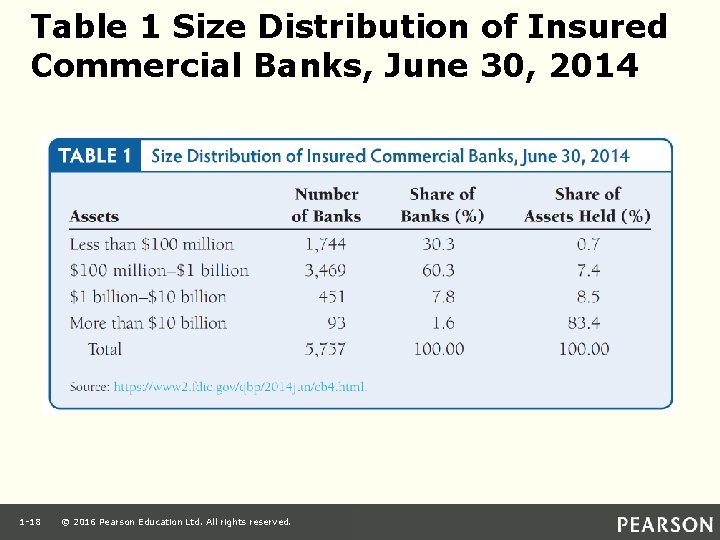
Table 1 Size Distribution of Insured Commercial Banks, June 30, 2014 1 -18 © 2016 Pearson Education Ltd. All rights reserved.
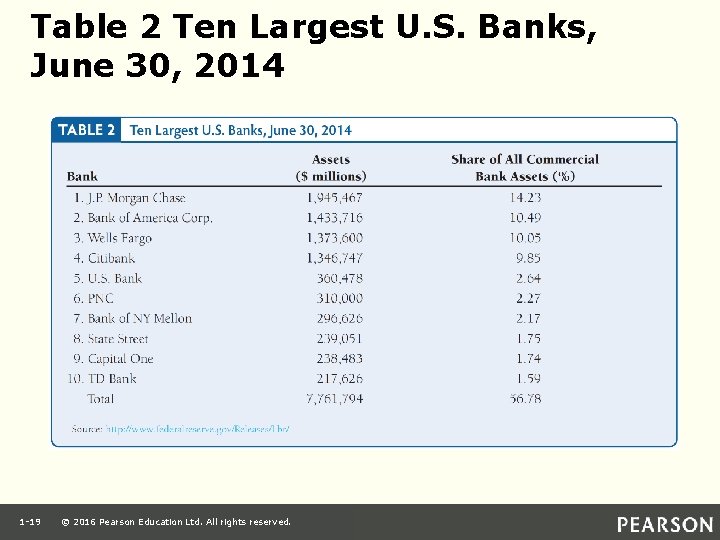
Table 2 Ten Largest U. S. Banks, June 30, 2014 1 -19 © 2016 Pearson Education Ltd. All rights reserved.
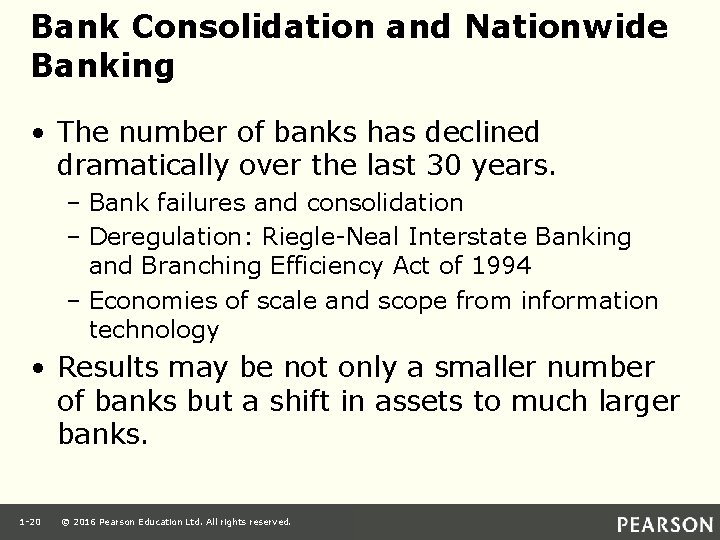
Bank Consolidation and Nationwide Banking • The number of banks has declined dramatically over the last 30 years. – Bank failures and consolidation – Deregulation: Riegle-Neal Interstate Banking and Branching Efficiency Act of 1994 – Economies of scale and scope from information technology • Results may be not only a smaller number of banks but a shift in assets to much larger banks. 1 -20 © 2016 Pearson Education Ltd. All rights reserved.
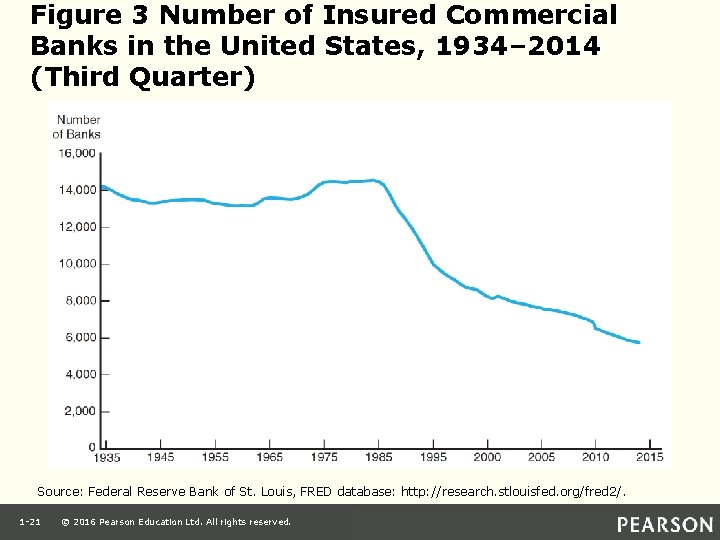
Figure 3 Number of Insured Commercial Banks in the United States, 1934– 2014 (Third Quarter) Source: Federal Reserve Bank of St. Louis, FRED database: http: //research. stlouisfed. org/fred 2/. 1 -21 © 2016 Pearson Education Ltd. All rights reserved.
What will the Structure of the U. S. Banking Industry Look Like in the Future? • Although the U. S. retains a unique banking structure in possessing a large number of banks, its structure is converging with systems in Europe and Japan. • How far the convergence between banking systems will extend is the subject of ongoing academic debate 1 -22 © 2016 Pearson Education Ltd. All rights reserved.
Are Bank Consolidation and Nationwide Banking Good Things? • Benefits – Increased competition, driving inefficient banks out of business – Also, increased efficiency from economies of scale and scope – Lower probability of bank failure from more diversified portfolios 1 -23 © 2016 Pearson Education Ltd. All rights reserved.
Are Bank Consolidation and Nationwide Banking Good Things? • Costs – Elimination of community banks may lead to less lending to small business – Banks expanding into new areas may take increased risks and fail 1 -24 © 2016 Pearson Education Ltd. All rights reserved.
Separation of the Banking and Other Financial Service Industries • Erosion of Glass-Steagall – Prohibited commercial banks from underwriting corporate securities or engaging in brokerage activities – Section 20 loophole was allowed by the Federal Reserve enabling affiliates of approved commercial banks to underwrite securities as long as the revenue did not exceed a specified amount – U. S. Supreme Court validated the Fed’s action in 1988 1 -25 © 2016 Pearson Education Ltd. All rights reserved.
Separation of the Banking and Other Financial Service Industries • Gramm-Leach-Bliley Financial Services Modernization Act of 1999 – Abolishes Glass-Steagall – States regulate insurance activities – SEC keeps oversight of securities activities – Office of the Comptroller of the Currency regulates bank subsidiaries engaged in securities underwriting – Federal Reserve oversees bank holding companies 1 -26 © 2016 Pearson Education Ltd. All rights reserved.
Separation of the Banking and Other Financial Service Industries • Universal banking – No separation between banking and securities industries • British-style universal banking – May engage in security underwriting • Separate legal subsidiaries are common • Bank equity holdings of commercial firms are less common • Few combinations of banking and insurance firms 1 -27 © 2016 Pearson Education Ltd. All rights reserved.
Separation of the Banking and Other Financial Service Industries • Some legal separation – Allowed to hold substantial equity stakes in commercial firms but holding companies are illegal 1 -28 © 2016 Pearson Education Ltd. All rights reserved.
Thrift Industry: Regulation and Structure • Savings and loan associations – Chartered by the federal government or by states – Most are members of Federal Home Loan Bank System (FHLBS) – Deposit insurance provided by Savings Association Insurance Fund (SAIF), part of FDIC – Regulated by the Office of Thrift Supervision 1 -29 © 2016 Pearson Education Ltd. All rights reserved.
Thrift Industry: Regulation and Structure • Mutual savings banks – Approximately half are chartered by states – Regulated by state in which they are located – Deposit insurance provided by FDIC or state insurance 1 -30 © 2016 Pearson Education Ltd. All rights reserved.
Thrift Industry: Regulation and Structure • Credit unions – Tax-exempt – Chartered by federal government or by states – Regulated by the National Credit Union Administration (NCUA) – Deposit insurance provided by National Credit Union Share Insurance Fund (NCUSIF) 1 -31 © 2016 Pearson Education Ltd. All rights reserved.
International Banking • Rapid growth – Growth in international trade and multinational corporations – Global investment banking is very profitable – Ability to tap into the Eurodollar market 1 -32 © 2016 Pearson Education Ltd. All rights reserved.
Eurodollar Market • Dollar-denominated deposits held in banks outside of the U. S. • Most widely used currency in international trade • Offshore deposits not subject to regulations • Important source of funds for U. S. banks 1 -33 © 2016 Pearson Education Ltd. All rights reserved.

Structure of U. S. Banking Overseas • Shell operation • Edge Act corporation • International banking facilities (IBFs) – Not subject to regulation and taxes – May not make loans to domestic residents 1 -34 © 2016 Pearson Education Ltd. All rights reserved.
Foreign Banks in the United States • Agency office of the foreign bank – Can lend and transfer fund in the U. S. – Cannot accept deposits from domestic residents – Not subject to regulations • Subsidiary U. S. bank – Subject to U. S. regulations – Owned by a foreign bank 1 -35 © 2016 Pearson Education Ltd. All rights reserved.
Foreign Banks in the United States • Branch of a foreign bank – May open branches only in state designated as home state or in state that allow entry of out-ofstate banks – Limited-service may be allowed in any other state • Subject to the International Banking Act of 1978 1 -36 © 2016 Pearson Education Ltd. All rights reserved.
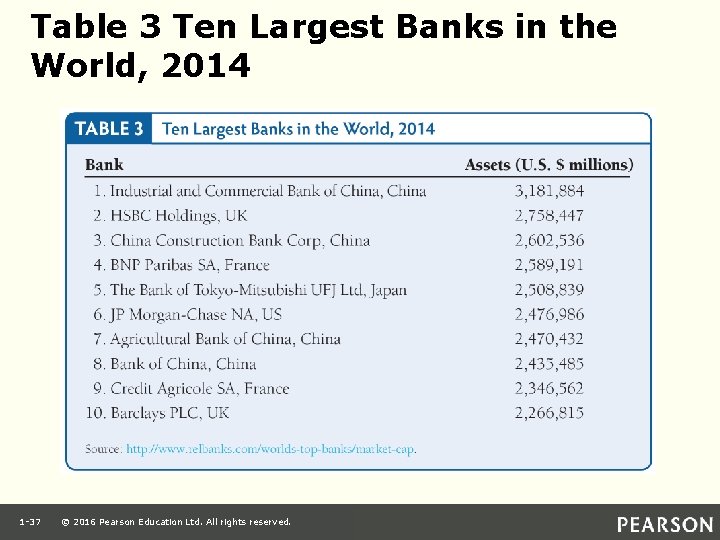
Table 3 Ten Largest Banks in the World, 2014 1 -37 © 2016 Pearson Education Ltd. All rights reserved.
- Slides: 37