
Chapter 11 Banking Industry Structure and Competition 1
Chapter 11 Banking Industry: Structure and Competition 1
Preview • We explore the historical development of the banking system in the U. S. and the effect from financial innovation to banking industry. We also examine the international banking and how it can be related to banking in U. S. 2
Learning Objectives • History of the banking system • Financial innovation and shadow banking system • Structure of commercial banking • Banking and the other financial service industries • Thrift industry • International banking 3
4

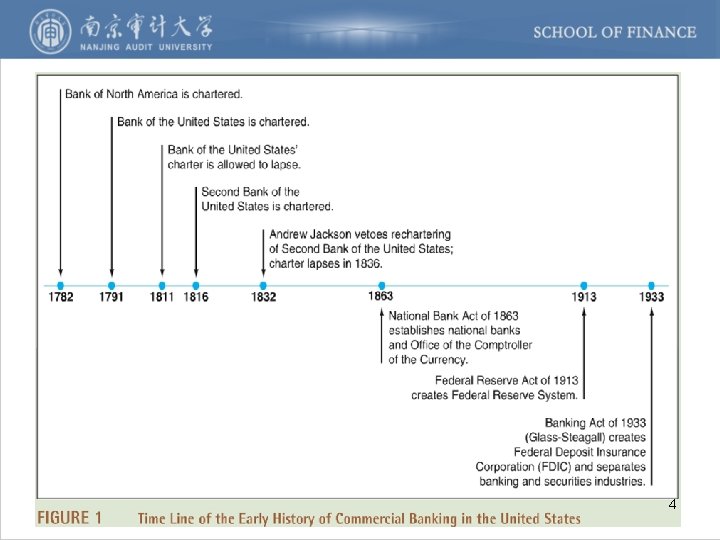
Historical Development of the Banking System • Bank of North America chartered in 1782 • Controversy over the chartering of banks • National Bank Act of 1863 creates a new banking system of federally chartered banks – Office of the Comptroller of the Currency – Dual banking system • Federal Reserve System is created in 1913. 5
Primary Supervisory Responsibility of Bank Regulatory Agencies • Federal Reserve and state banking authorities: state banks can be members of the Federal Reserve System. • Fed also regulates bank holding companies. • FDIC: insured state banks that are not Fed members. • State banking authorities: state banks without FDIC insurance. 6
Financial Innovation and the Growth of the “Shadow Banking System” • Financial innovation is driven by the desire to earn profits • A change in the financial environment will stimulate a search by financial institutions for innovations that are likely to be profitable – Financial engineering 7
Responses to Changes in Demand Conditions: Interest Rate Volatility • Adjustable-rate mortgages – Flexible interest rates keep profits high when rates rise – Lower initial interest rates make them attractive to home buyers • Financial Derivatives – Ability to hedge interest rate risk – Payoffs are linked to previously issued (i. e. derived from) securities. 8
Responses to Changes in Supply Conditions: Information Technology • Bank credit and debit cards – Improved computer technology lowers transaction costs • Electronic banking – ATM, home banking, ABM and virtual banking • Junk bonds • Commercial paper market • Securitization 9
Avoidance of Regulations: Loophole Mining • Reserve requirements act as a tax on deposits • Restrictions on interest paid on deposits led to disintermediation • Money market mutual funds • Sweep accounts 10
Financial Innovation and the Decline of Traditional Banking • As a source of funds for borrowers, market share has fallen • Commercial banks’ share of total financial intermediary assets has fallen • No decline in overall profitability • Increase in income from off-balance-sheet activities 11

12

13
14
Structure of the U. S. Commercial Banking Industry • Restrictions on branching – Mc. Fadden Act and state branching regulations • Response to branching restrictions – Bank holding companies – Automated teller machines 15
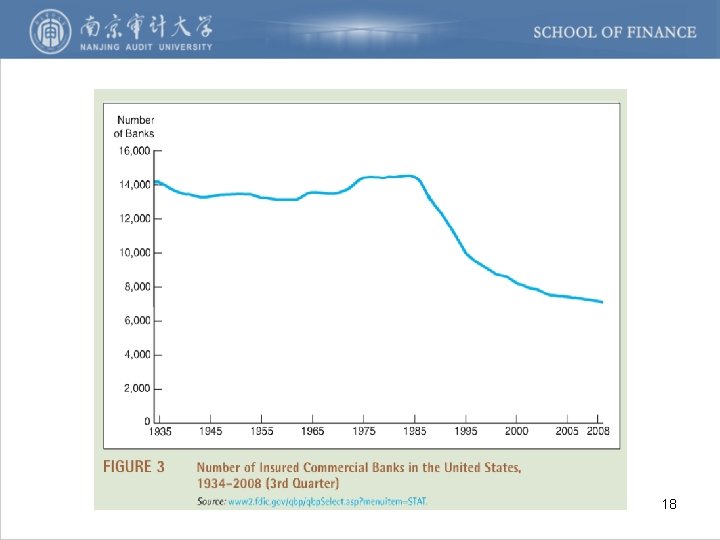
Bank Consolidation and Nationwide Banking • The number of banks has declined over the last 25 years – Bank failures and consolidation – Deregulation: Riegle-Neal Interstate Banking and Branching Efficiency Act of 1994 – Economies of scale and scope from information technology • Results may be not only a smaller number of banks but a shift in assets to much larger banks. 16
Benefits and Costs of Bank Consolidation • Benefits – Increased competition, driving inefficient banks out of business – Increased efficiency also from economies of scale and scope – Lower probability of bank failure from more diversified portfolios • Costs – Elimination of community banks may lead to less lending to small business – Banks expanding into new areas may take increased risks and fail 17
18
Separation of the Banking and Other Financial Service Industries • Erosion of Glass-Steagall Act – Prohibited commercial banks from underwriting corporate securities or engaging in brokerage activities – Section 20 loophole was allowed by the Federal Reserve enabling affiliates of approved commercial banks to underwrite securities as long as the revenue did not exceed a specified amount – U. S. Supreme Court validated the Fed’s action in 1988 19
Separation of Banking and Other Financial Services • Gramm-Leach-Bliley Financial Services Modernization Act of 1999 – Abolishes Glass-Steagall – States regulate insurance activities – SEC keeps oversight of securities activities – Office of the Comptroller of the Currency regulates bank subsidiaries engaged in securities underwriting – Federal Reserve oversees bank holding companies 20
Separation of Banking and Other Financial Services Industries Throughout the World • Universal banking – No separation between banking and securities industries • British-style universal banking – May engage in security underwriting • Separate legal subsidiaries are common • Bank equity holdings of commercial firms are less common • Few combinations of banking and insurance firms 21
Thrift Industry: Regulation and Structure • Savings and Loan Associations – Chartered by the federal government or by states – Most are members of Federal Home Loan Bank System (FHLBS) – Deposit insurance provided by Savings Association Insurance Fund (SAIF), part of FDIC – Regulated by the Office of Thrift Supervision • Mutual Savings Banks – Approximately half are chartered by states – Regulated by state in which they are located – Deposit insurance provided by FDIC or state insurance 22
Thrift Industry: Regulation and Structure • Credit Unions – Tax-exempt – Chartered by federal government or by states – Regulated by the National Credit Union Administration (NCUA) – Deposit insurance provided by National Credit Union Share Insurance Fund (NCUSIF) 23
International Banking • Rapid growth – Growth in international trade and multinational corporations – Global investment banking is very profitable – Ability to tap into the Eurodollar market 24
Eurodollar Market • Dollar-denominated deposits held in banks outside of the U. S. • Most widely used currency in international trade • Offshore deposits not subject to regulations • Important source of funds for U. S. banks 25
Structure of U. S. Banking Overseas • Shell operation • Edge Act corporation • International banking facilities (IBFs) – Not subject to regulation and taxes – May not make loans to domestic residents 26
Foreign Banks in the U. S. • Agency office of the foreign bank – Can lend and transfer fund in the U. S. – Cannot accept deposits from domestic residents – Not subject to regulations • Subsidiary U. S. bank – Subject to U. S. regulations – Owned by a foreign bank 27
Foreign Banks in the U. S. • Branch of a foreign bank – May open branches only in state designated as home state or in state that allow entry of out-of-state banks – Limited-service may be allowed in any other state • Subject to the International Banking Act of 1978 • Basel Accord (1988) – Example of international coordination of bank regulation – Sets minimum capital requirements for banks 28
29
- Slides: 29