
Chapter 11 Atmosphere Atmospheric Composition Air is a




- Slides: 49
Chapter 11: Atmosphere
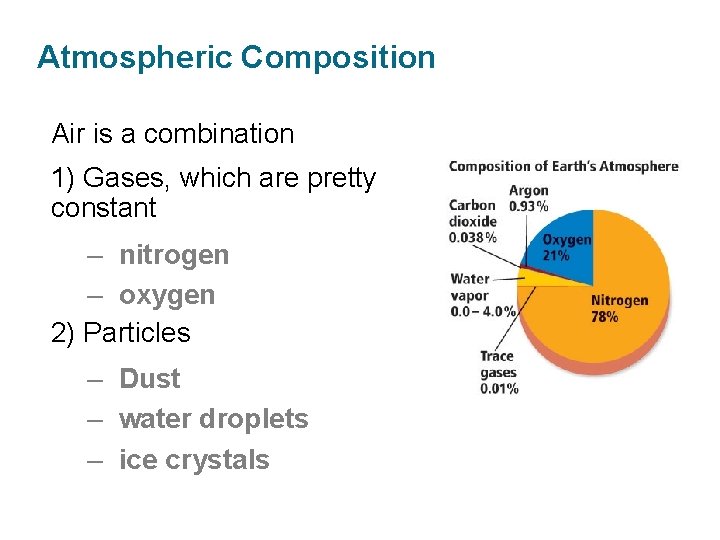
Atmospheric Composition Air is a combination 1) Gases, which are pretty constant – nitrogen – oxygen 2) Particles – Dust – water droplets – ice crystals
Atmospheric Composition Variable atmospheric gases • The concentration of water vapor in the atmosphere varies – with the seasons – with the altitude of a particular mass of air – with the properties of the surface beneath the air • Concentration of atmospheric carbon dioxide has increased over past 150 years, due primarily to the burning of fossil fuels
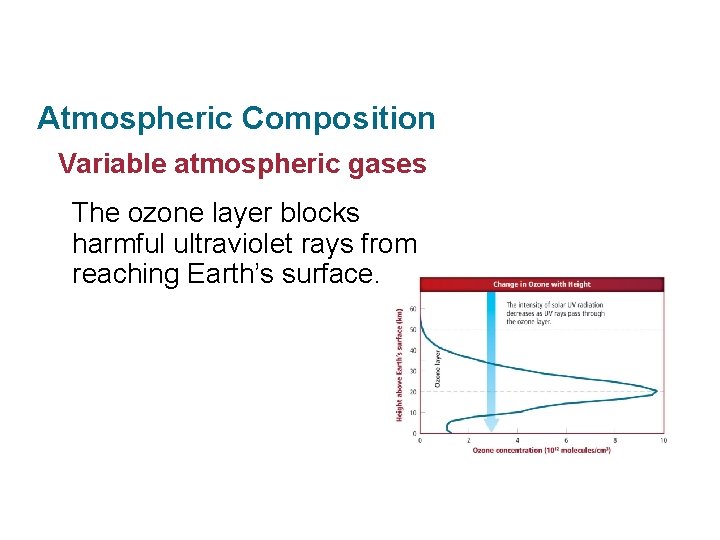
Section 11. 1 Atmospheric Basics Atmospheric Composition Variable atmospheric gases The ozone layer blocks harmful ultraviolet rays from reaching Earth’s surface.
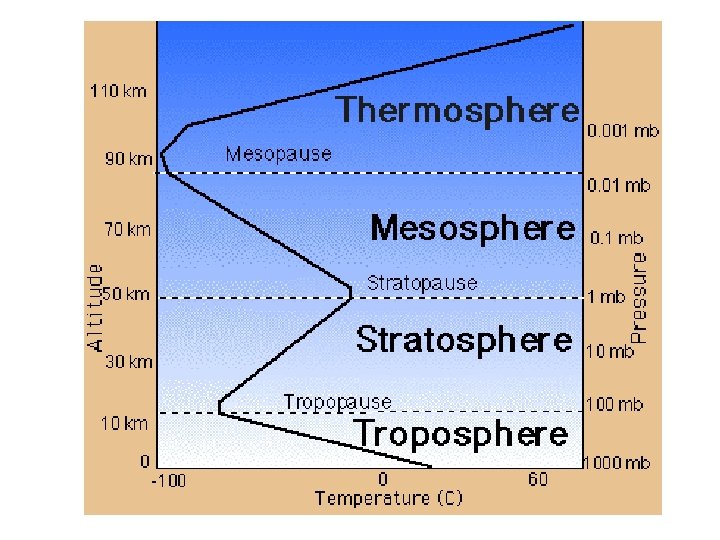
Atmospheric Layers The atmosphere is classified into five different layers 1. Troposphere 2. Stratosphere 3. Mesosphere 4. Thermosphere 5. Exosphere
Atmospheric Layers Troposphere The layer closest to Earth’s surface, the troposphere, contains most of the mass of the atmosphere and is where weather occurs. In the troposphere, air temperature decreases as altitude increases. The tropopause is the altitude at which the temperature stops decreasing.
Atmospheric Layers Stratosphere Above the tropopause is the stratosphere, a layer in which the air temperature mainly increases with altitude and which contains the ozone layer. At the stratopause, air temperature stops increasing with altitude.
Atmospheric Layers Mesosphere Above the stratopause is the mesosphere, in which air temperature decreases with altitude. Temperatures stop decreasing with altitude at the mesopause.
Atmospheric Layers Thermosphere The thermosphere is the layer above the mesopause and contains the ionosphere.
Atmospheric Layers Exosphere The exosphere is the outermost layer of Earth’s atmosphere and can be thought of as the transitional region between Earth’s atmosphere and outer space.
Weather Measurements
Section 11. 2 Properties of the Atmosphere Temperature Defined: A measure of the average kinetic energy in a substance. Particles have more kinetic energy when they are moving faster, so the higher the temperature of a material, the faster the particles are moving.
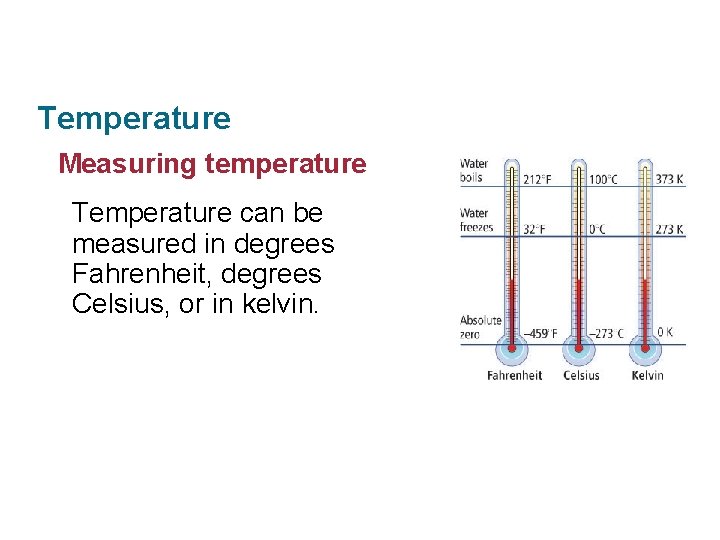
Section 11. 2 Properties of the Atmosphere Temperature Measuring temperature Temperature can be measured in degrees Fahrenheit, degrees Celsius, or in kelvin.
Section 11. 2 Properties of the Atmosphere Air Pressure Air pressure is the pressure exerted on a surface by the weight of the atmosphere above the surface. Air pressure is often measured in units of millibars (mb), mm of Hg or pascals.
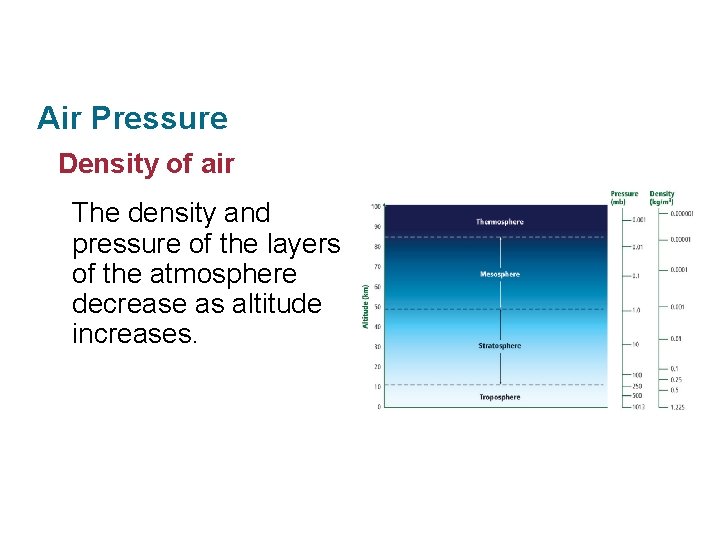
Section 11. 2 Properties of the Atmosphere Air Pressure Density of air The density and pressure of the layers of the atmosphere decrease as altitude increases.
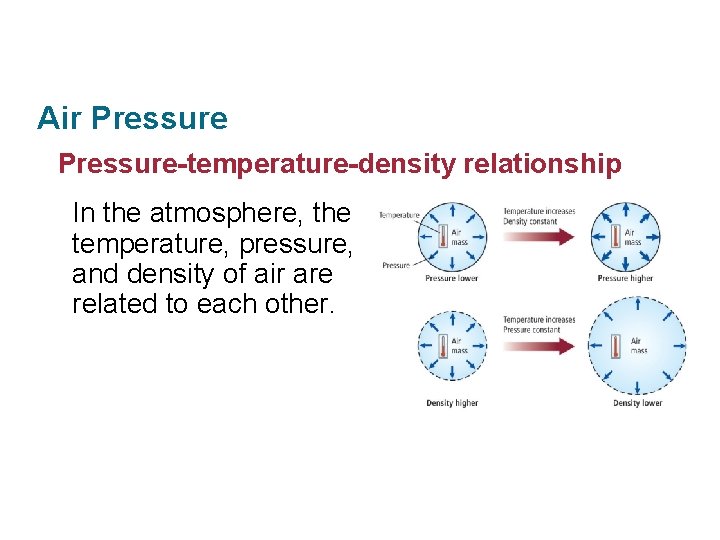
Section 11. 2 Properties of the Atmosphere Air Pressure-temperature-density relationship In the atmosphere, the temperature, pressure, and density of air are related to each other.
Section 11. 2 Properties of the Atmosphere Air Pressure-temperature-density relationship Temperature, pressure, and density are all related to one another. If temperature increases, but density is constant, the pressure increases. If the temperature increases and the pressure is constant, the density decreases.
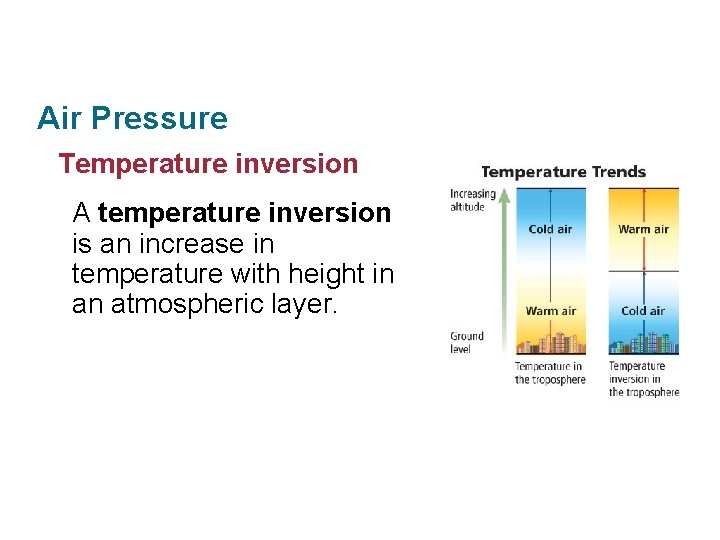
Section 11. 2 Properties of the Atmosphere Air Pressure Temperature inversion A temperature inversion is an increase in temperature with height in an atmospheric layer.
Section 11. 2 Air Pressure Properties of the Atmosphere Temperature inversion • If the land does not radiate thermal energy to the lower layers of the atmosphere, such as on a cold, clear, winter night when the air is calm, the lower layers of air become cooler than the air above them. • A temperature inversion can lead to fog or lowlevel clouds. • In some cities, a temperature inversion can worsen air-pollution problems.
Section 11. 2 Properties of the Atmosphere Air Pressure Wind The movement of air is commonly known as wind. In the lower atmosphere, air generally moves from regions of higher density and pressure to regions of lower density and pressure.
Section 11. 2 Properties of the Atmosphere Air Pressure Wind Near Earth’s surface, wind is constantly slowed by the friction that results from contact with surfaces including trees, buildings and hills. Higher up from Earth’s surface, air encounters less friction and wind speeds increase.
Section 11. 2 Properties of the Atmosphere Humidity is the amount of water vapor in the atmosphere at a given location on Earth’s surface.
Section 11. 2 Properties of the Atmosphere Humidity Relative humidity Saturation occurs when the amount of water vapor in a volume of air has reached the maximum amount possible for that temperature.
Section 11. 2 Properties of the Atmosphere Humidity Relative humidity The amount of water vapor in a volume of air relative to the amount of water vapor needed for that volume of air to reach saturation is called relative humidity.
Section 11. 2 Properties of the Atmosphere Humidity Relative humidity The dew point is the temperature to which air must be cooled at constant pressure to reach saturation.
Section 11. 2 Properties of the Atmosphere Humidity Relative humidity The extra thermal energy contained in water vapor compared to liquid water is called latent heat.
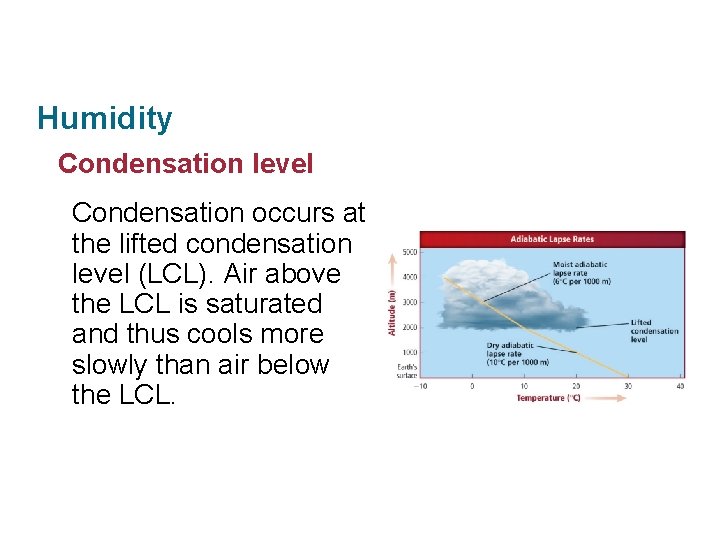
Section 11. 2 Properties of the Atmosphere Humidity Condensation level A process in which temperature changes without the addition or removal of thermal energy from a system is called an adiabatic process. Adiabatic heating occurs when air is compressed, and adiabatic cooling occurs when air expands.
Section 11. 2 Properties of the Atmosphere Humidity Condensation level At equilibrium, evaporation and condensation occur at equal rates, so the amount of water in the liquid form remains constant.
Section 11. 2 Properties of the Atmosphere Humidity Condensation level Condensation occurs at the lifted condensation level (LCL). Air above the LCL is saturated and thus cools more slowly than air below the LCL.
Section 11. 3 Clouds and Precipitation Cloud Formation As a warm air mass rises, it expands and cools adiabatically. The cooling of an air mass as it rises can cause water vapor in the air mass to condense.
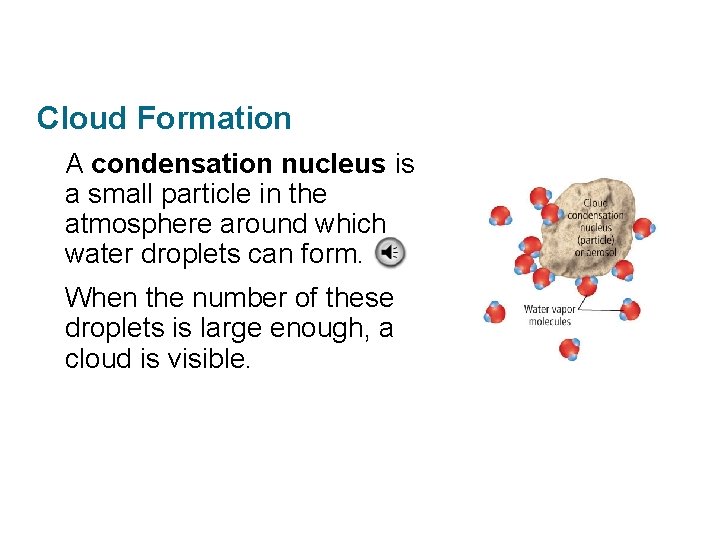
Section 11. 3 Clouds and Precipitation Cloud Formation A condensation nucleus is a small particle in the atmosphere around which water droplets can form. When the number of these droplets is large enough, a cloud is visible.
Section 11. 3 Clouds and Precipitation Cloud Formation Atmospheric stability As an air mass rises, it cools. However, the air mass will continue to rise as long as it is warmer than the surrounding air. When an air mass sinks back to its original position and resists rising, it is considered stable.
Section 11. 3 Clouds and Precipitation Cloud Formation Atmospheric stability The stability of air masses determines the type of clouds that form and the associated weather patterns. Stable air has a tendency to resist movement. Unstable air does not resist vertical displacement.
Clouds
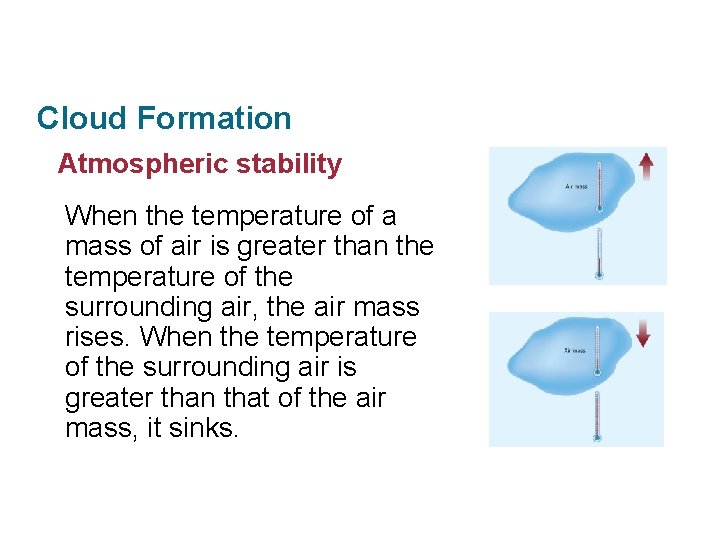
Section 11. 3 Clouds and Precipitation Cloud Formation Atmospheric stability When the temperature of a mass of air is greater than the temperature of the surrounding air, the air mass rises. When the temperature of the surrounding air is greater than that of the air mass, it sinks.
Section 11. 3 Clouds and Precipitation Cloud Formation Atmospheric lifting Clouds can form when moist air rises, expands, and cools enough for water vapor to condense. Clouds can also form when air is forced upward or lifted by mechanical processes.
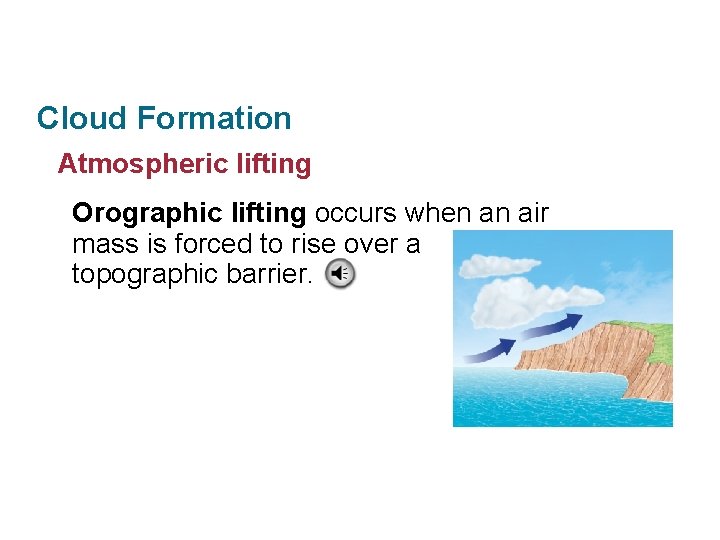
Section 11. 3 Clouds and Precipitation Cloud Formation Atmospheric lifting Orographic lifting occurs when an air mass is forced to rise over a topographic barrier.
Section 11. 3 Clouds and Precipitation Cloud Formation Atmospheric lifting Air can be lifted by convergence, which occurs when air flows into the same area from different directions and some of the air is forced upward. This process is even more pronounced when air masses at different temperatures collide.
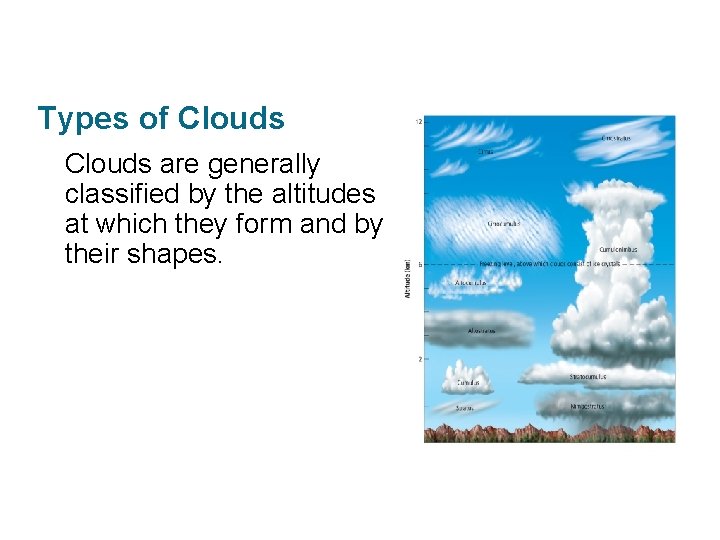
Section 11. 3 Clouds and Precipitation Types of Clouds are generally classified by the altitudes at which they form and by their shapes.
Section 11. 3 Clouds and Precipitation Types of Clouds Low clouds Cumulus clouds are puffy, lumpy-looking clouds that usually occur below 2000 m. Another type of cloud that forms at heights below 2000 m is a stratus, a layered sheetlike cloud that covers much or all of the sky in a given area.
Section 11. 3 Clouds and Precipitation Types of Clouds Middle clouds Altocumulus and altostratus clouds form at altitudes between 2000 m and 6000 m and are made up of ice crystals and water droplets.
Section 11. 3 Clouds and Precipitation Types of Clouds High clouds, made up of ice crystals, form at heights of 6000 m where temperatures are below freezing. Some, such as cirrus clouds, often have a wispy, indistinct appearance.
Section 11. 3 Clouds and Precipitation Types of Clouds Vertical development clouds If the air that makes up a cumulus cloud is unstable, the cloud will continue to grow upward through middle altitudes as a towering cumulonimbus. If conditions are right, it can reach nearly 18, 000 m.
Section 11. 3 Clouds and Precipitation All forms of water that fall from clouds to the ground are precipitation. Rain, snow, sleet, and hail are the four main types of precipitation.
Section 11. 3 Clouds and Precipitation Coalescence occurs when cloud droplets collide and join together to form a larger droplet. When the droplets become too heavy to remain suspended in the cloud, they fall to Earth as precipitation.
Section 11. 3 Clouds and Precipitation Snow, sleet, and hail The type of precipitation that reaches Earth depends on the vertical variation of temperature in the atmosphere.
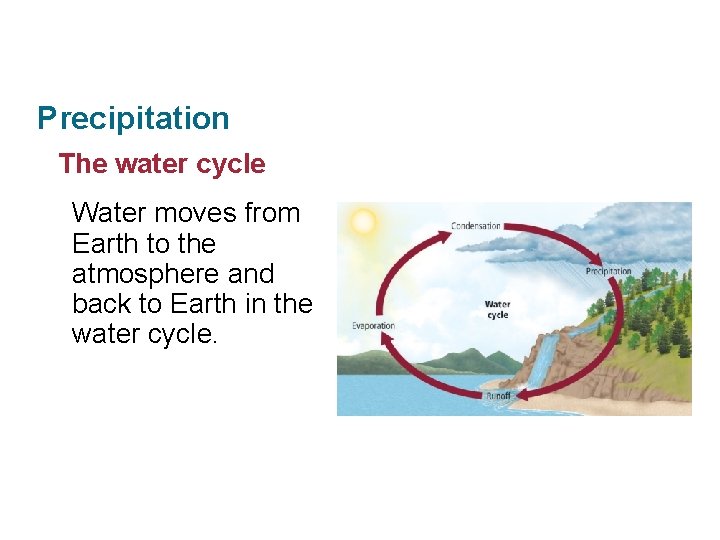
Section 11. 3 Clouds and Precipitation The water cycle Water moves from Earth to the atmosphere and back to Earth in the water cycle.