
Chapter 11 Arenes and Aromaticity 11 1 Benzene
Chapter 11: Arenes and Aromaticity 11. 1: Benzene - C 6 H 6 11. 2: Kekulé and the Structure of Benzene Kekule benzene: two forms are in rapid equilibrium • All bonds are 140 pm (intermediate between C-C and C=C) • C–C–C bond angles are 120° • Structure is planar, hexagonal 245
11. 3: A Resonance Picture of Bonding in Benzene resonance hybrid 6 -electron delocalized over 6 carbon atoms 11. 4: The Stability of Benzene Aromaticity: cyclic conjugated organic compounds such as benzene, exhibit special stability due to resonance delocalization of -electrons. 246
Heats of hydrogenation (Fig. 11. 2, p. 425) 1, 3, 5 -Hexatriene - conjugated but not cyclic Resonance energy of benzene is 129 - 152 KJ/mol 247
11. 5: An Orbital Hybridization View of Bonding in Benzene • Benzene is a planar, hexagonal cyclic hydrocarbon • The C–C–C bond angles are 120° = sp 2 hybridized • Each carbon possesses an unhybridized p-orbital, which makes up the conjugated -system. • The six -electrons are delocalized through the -system 11. 6: The Molecular Orbitals of Benzene - the aromatic system of benzene consists of six p-orbitals (atomic orbitals). Benzene must have six molecular orbitals. 248
Degenerate orbitals: orbitals that have the same energy Y 1: zero nodes Y 2 and Y 3: one node Bonding Y 4 and Y 5: two nodes Y 6: three node Anti-bonding 249
11. 7: Substituted Derivatives of Benzene and Their Nomenclature Generally, mono-substituted benzenes are named in a similar manner as hydrocarbons with -benzene as the parent name large number of non-systematic names that can serve as the parent name (Table 11. 1) 250
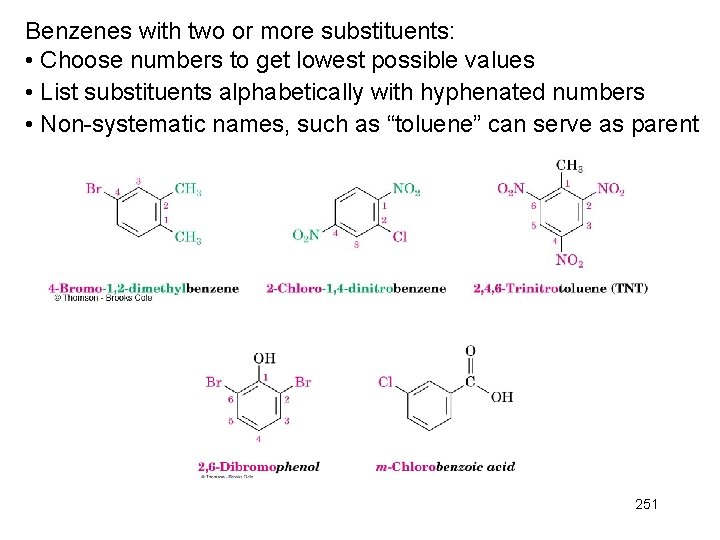
Benzenes with two or more substituents: • Choose numbers to get lowest possible values • List substituents alphabetically with hyphenated numbers • Non-systematic names, such as “toluene” can serve as parent 251
Disubstituted benzene: relative position of the substitutents 1, 2 -disubstituted: ortho (o-) 1, 3 -disubstituted: meta (m-) 1, 4 -disubstituted: para (p-) Note: ortho, meta, and para are not used in systematic nomenclature 252
When the benzene ring is a substituent of a parent chain, it is referred to as a phenyl group. The benzene ring is regarded as a substituent when the parent chain has greater than six carbons. The benzene ring is the parent when the longest alkyl chain substituent is six carbons or less A phenyl substituent (C 6 H 5 -) is often abbreviates as Ph. A C 6 H 5 -CH 2 - substitutent (phenylmethyl-) is often referred to as a benzyl group (Bn-) 253
11. 8: Polycyclic Aromatic Hydrocarbons (PAHs) 11. 9: Physical Properties of Arenes (please read) 254
11. 10: Reactions of Arenes: A Preview 1. Reactions involving the ring A. Reduction a. Catalytic hydrogenation (Chapter 11. 4) b. Birch reduction (Chapter 11. 11) B. Electrophilic aromatic substitution (Chapter 12) C. Nucleophilic aromatic substitution (Chapter 23) 2. The ring as a substituent A. Benzylic halogenation (Chapter 11. 12) B. Benzylic oxidation (Chapter 11. 13) C. Nucleophilic substitution of benzylic halides (Chapter 11. 14 -15) 255
11. 11: The Birch Reduction Catalytic Hydrogenation - Aromatic rings are inert to catalytic hydrogenation under conditions that will reduce alkene double bonds. Therefore, an alkene double bond can therefore be selectively reduced in the presence of an aromatic ring Reduction of an aromatic ring requires forcing reducing conditions (high pressure and/or highly active catalysts) 256
Birch Reduction – dissolving metal reduction of an aromatic ring Li, Na or K metal in liquid ammonia. Mechanism is related to the reduction of C C to trans-alkenes 257
11. 12: Free-Radical Halogenation of Alkylbenzenes The benzylic position (the carbon next to a benzene ring) is analogous to the allylic position and can stabilize carbocations, radicals, and anions. (CH 3)3 C—H H 2 C CHCH 2—H C 6 H 5 CH 2—H 380 k. J/mol 368 k. J/mol 356 k. J/mol (CH 3)3 C • H 2 C + H • • CHCH 2 + H • • C 6 H 5 CH 2 + H • 258
Mechanism is the same as allylic bromination 259
11. 13: Oxidation of Alkylbenzenes - Benzene rings do not react with strong oxidants. However, the benzene ring can activate the benzylic position of alkylbenzene toward oxidation with strong oxidants such as KMn. O 4 and Na 2 Cr 2 O 7 to give benzoic acids. Benzoic acid 260
11. 14: SN 1 Reactions of Benzylic Halides > 600 times more reactive Reactivity is reflective of the greater stability of the benzylic carbocation intermediate 261
11. 15: SN 2 Reactions of Benzylic Halides Benzylic halides undergo SN 2 reactions faster than a alkyl halides (similar to allylic halides) 11. 16: Preparation of Alkenylbenzenes (please read) 262
11. 17: Addition Reactions of Alkenylbenzenes - alkenyl substituents on a benzene ring undergo reactions typical of an alkene. The benzene ring can influence the reactivity. 263
11. 18: Polymerization of Styrene (please read) 11. 19: Cyclobutadiene and Cyclooctatetraene Not all cyclic conjugated systems are aromatic (no special stability) Cyclobutadiene: highly reactive two different C-C bonds 264
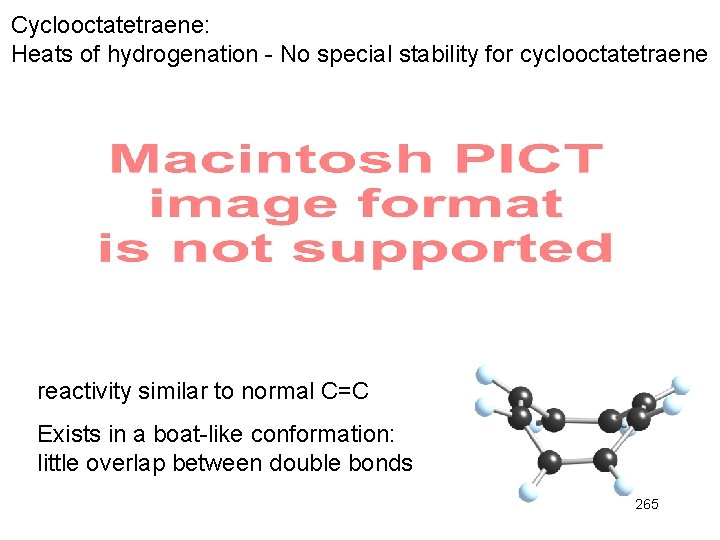
Cyclooctatetraene: Heats of hydrogenation - No special stability for cyclooctatetraene reactivity similar to normal C=C Exists in a boat-like conformation: little overlap between double bonds 265
Cyclic conjugation is necessary, but not sufficient criteria for aromaticity. 11. 20: Hückel's Rule: Aromatic: Cyclic Conjugated: “alternating single and double bonds” Planar: maximum overlap between conjugated -bonds Must contain 4 n+2 -electrons, where n is an integer (Hückel’s rule) Anti-aromatic: cyclic, conjugated, planar molecules that contain 4 n -electrons (where n is an integer). Destabilized (highly reactive) relative to the corresponding open-chain conjugated system 266
Frost Circles: relative energies of the molecular orbitals of cyclic, conjugated systems Inscribe the cyclic, conjugated molecule into a circle so that a vertex is at the bottom. The relative energies of the MO’s are where the ring atoms intersect the circle benzene: The bonding MO's will be filled for aromatic compounds, such as benzene. 267
Cyclobutadiene: For anti- aromatic compounds, such as cyclobutadiene and cyclooctatetraene, there will be unpaired electrons in bonding, non-bonding or antibonding MO's. Cyclooctatetraene: 268
![11. 21: Annulenes - monocyclic, conjugated, planar polyenes that conform to Hückel's rule. [10]annulene](http://slidetodoc.com/presentation_image_h/aa1da438fc3331b2d86c284e5fe2e906/image-25.jpg "11. 21: Annulenes - monocyclic, conjugated, planar polyenes that conform to Hückel's rule. [10]annulene")
11. 21: Annulenes - monocyclic, conjugated, planar polyenes that conform to Hückel's rule. [10]annulene 10 -electrons 4 n+2 = 10, n=2. [14]annulene 14 -electrons 4 n+2=14, n=3 [16]annulene 16 -electrons 4 n=16, n=4 [18]annulene 18 -electrons 4 n+2=18, n=4 269

11. 22: Aromatic Ions 270
Cyclopropenyl cation 4 n+2=2 n=0 aromatic Cyclopentadienyl cation 4 n=4 n=1 anti-aromatic Cycloheptatrienyl cation 4 n+2=6 n=1 aromatic 271
Cyclopropenyl anion 4 n=4 n=1 anti-aromatic Cyclopentadienyl anion 4 n+2=6 n=1 aromatic 272
11. 23: Heterocyclic Aromatic Compounds (please read) Heterocycle: any cyclic compound that contains ring atom(s) other than carbon (N, O, S, P). Cyclic compounds that contain only carbon are called carbocycles 11. 24: Heterocyclic Aromatic Compounds and Hückel's Rule Pyridine: -electron structure resembles benzene (6 -electrons) The nitrogen lone pair electrons are not part of the aromatic system. pyridine 273
Pyrrole: 6 -electron system similar to that of cyclopentadienyl anion. There are four sp 2 -hybridized carbons with 4 p orbitals perpendicular to the ring and 4 -electrons and a lone pair of electrons in an unhybridized p 2 orbital that is part of the aromatic sextet 274
- Slides: 30