
Chapter 11 Appendix Copyright 2002 Thomson Learning Inc

- Slides: 16
Chapter 11 Appendix Copyright © 2002 Thomson Learning, Inc. Thomson Learning™ is a trademark used herein under license. ALL RIGHTS RESERVED. Instructors of classes adopting PUBLIC FINANCE: A CONTEMPORARY APPLICATION OF THEORY TO POLICY, Seventh Edition by David N. Hyman assigned textbook may reproduce material from this publication for classroom use or in a secure electronic network environment that prevents downloading or reproducing the copyrighted material. Otherwise, no part of this work covered by the copyright hereon may be reproduced or used in any form or by any means—graphic, electronic, or mechanical, including, but not limited to, photocopying, recording, taping, Web distribution, information networks, or information storage and retrieval systems—without the written permission of the publisher. Printed in the United States of America ISBN 0 -03 -033652 -X Copyright © 2002 by Thomson Learning, Inc.
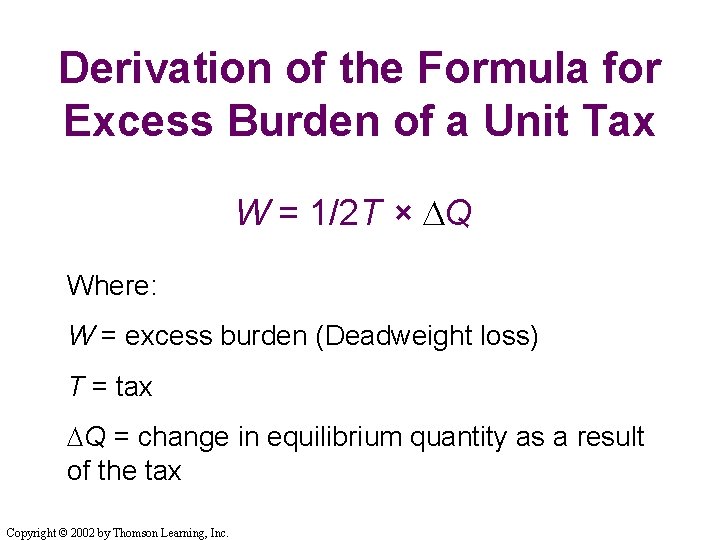
Derivation of the Formula for Excess Burden of a Unit Tax W = 1/2 T × DQ Where: W = excess burden (Deadweight loss) T = tax DQ = change in equilibrium quantity as a result of the tax Copyright © 2002 by Thomson Learning, Inc.
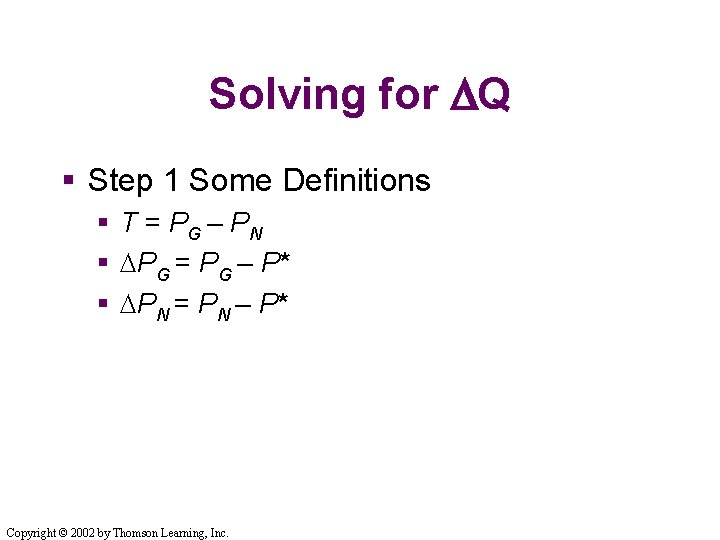
Solving for DQ § Step 1 Some Definitions § T = PG – PN § DPG = PG – P* § DPN = PN – P* Copyright © 2002 by Thomson Learning, Inc.
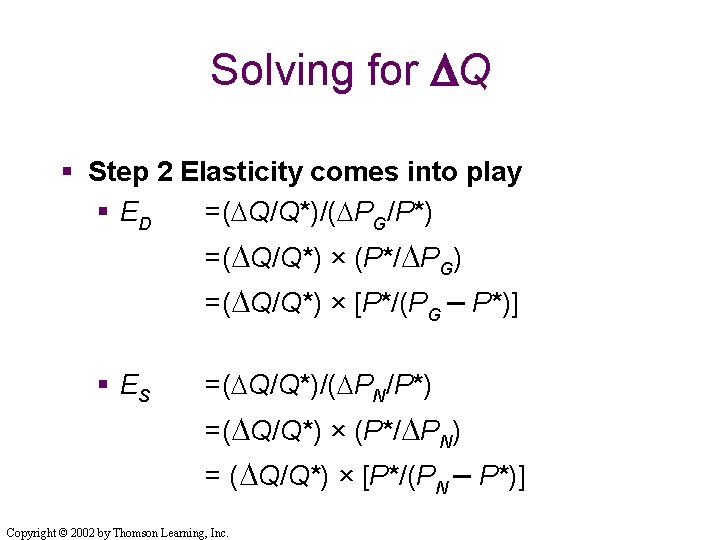
Solving for DQ § Step 2 Elasticity comes into play § ED =(DQ/Q*)/(DPG/P*) =(DQ/Q*) × (P*/DPG) =(DQ/Q*) × [P*/(PG – P*)] § ES =(DQ/Q*)/(DPN/P*) =(DQ/Q*) × (P*/DPN) = (DQ/Q*) × [P*/(PN – P*)] Copyright © 2002 by Thomson Learning, Inc.
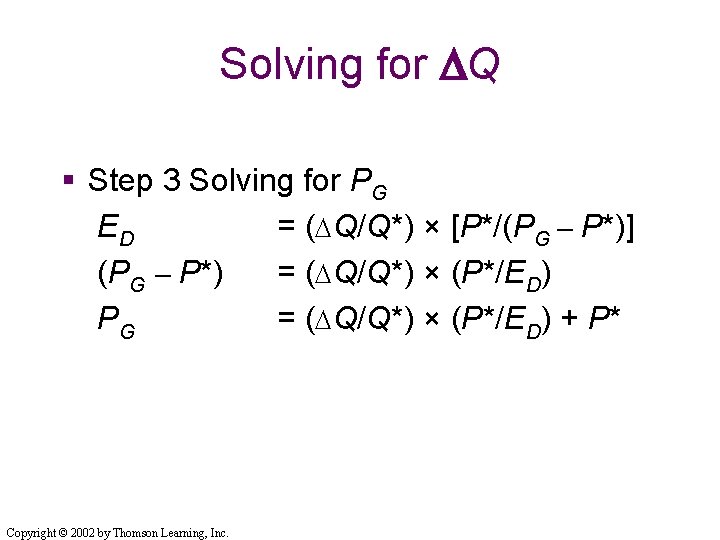
Solving for DQ § Step 3 Solving for PG ED = (DQ/Q*) × [P*/(PG – P*)] (PG – P*) = (DQ/Q*) × (P*/ED) PG = (DQ/Q*) × (P*/ED) + P* Copyright © 2002 by Thomson Learning, Inc.
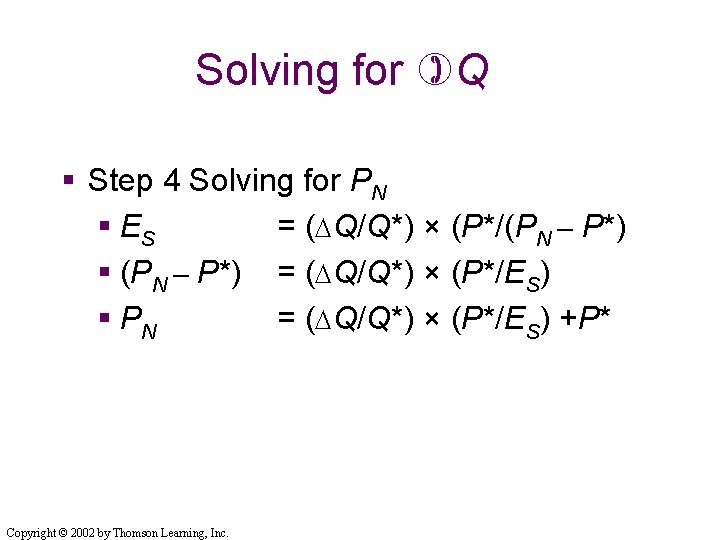
Solving for Q § Step 4 Solving for PN § ES = (DQ/Q*) × (P*/(PN – P*) § (PN – P*) = (DQ/Q*) × (P*/ES) § PN = (DQ/Q*) × (P*/ES) +P* Copyright © 2002 by Thomson Learning, Inc.
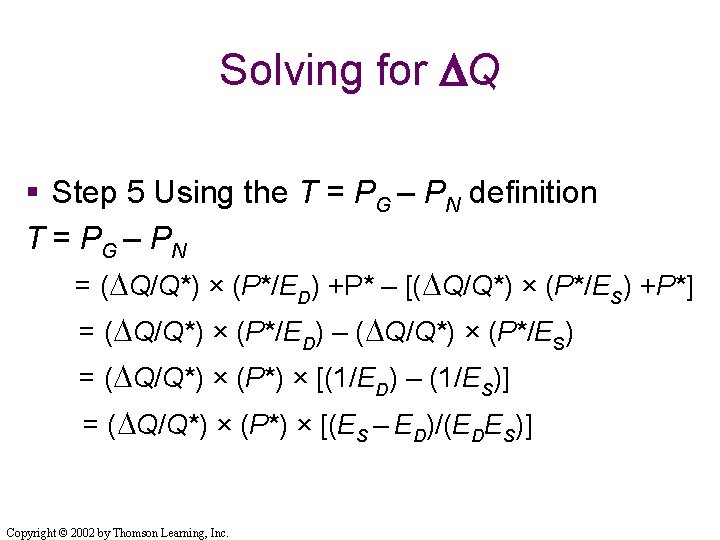
Solving for DQ § Step 5 Using the T = PG – PN definition T = PG – PN = (DQ/Q*) × (P*/ED) +P* – [(DQ/Q*) × (P*/ES) +P*] = (DQ/Q*) × (P*/ED) – (DQ/Q*) × (P*/ES) = (DQ/Q*) × (P*) × [(1/ED) – (1/ES)] = (DQ/Q*) × (P*) × [(ES – ED)/(EDES)] Copyright © 2002 by Thomson Learning, Inc.
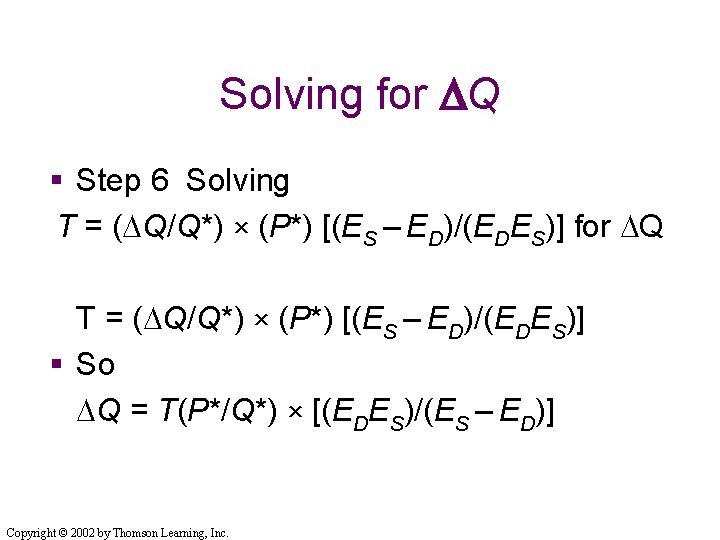
Solving for DQ § Step 6 Solving T = (DQ/Q*) × (P*) [(ES – ED)/(EDES)] for DQ T = (DQ/Q*) × (P*) [(ES – ED)/(EDES)] § So DQ = T(P*/Q*) × [(EDES)/(ES – ED)] Copyright © 2002 by Thomson Learning, Inc.
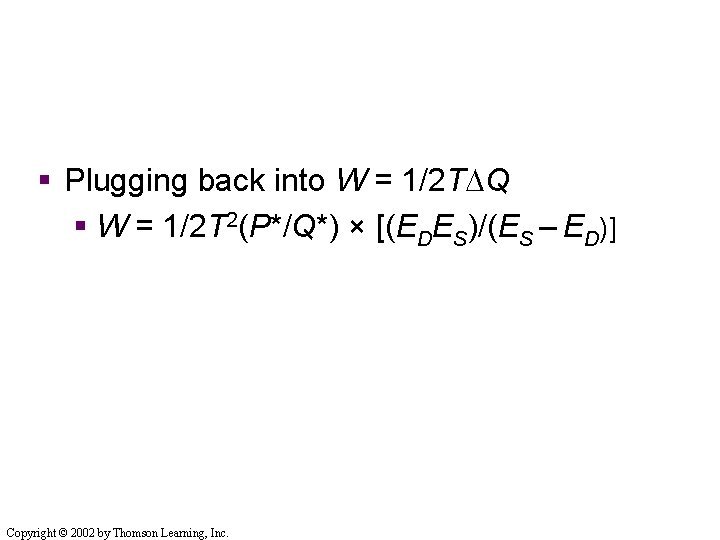
§ Plugging back into W = 1/2 TDQ § W = 1/2 T 2(P*/Q*) × [(EDES)/(ES – ED)] Copyright © 2002 by Thomson Learning, Inc.
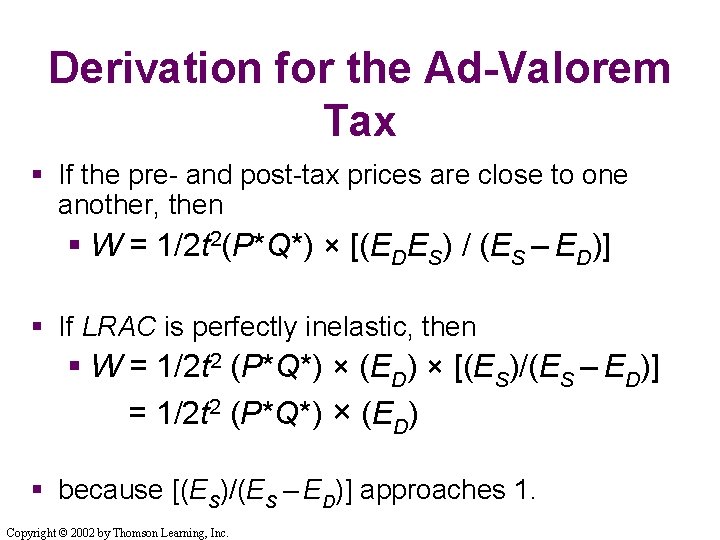
Derivation for the Ad-Valorem Tax § If the pre- and post-tax prices are close to one another, then § W = 1/2 t 2(P*Q*) × [(EDES) / (ES – ED)] § If LRAC is perfectly inelastic, then § W = 1/2 t 2 (P*Q*) × (ED) × [(ES)/(ES – ED)] = 1/2 t 2 (P*Q*) × (ED) § because [(ES)/(ES – ED)] approaches 1. Copyright © 2002 by Thomson Learning, Inc.
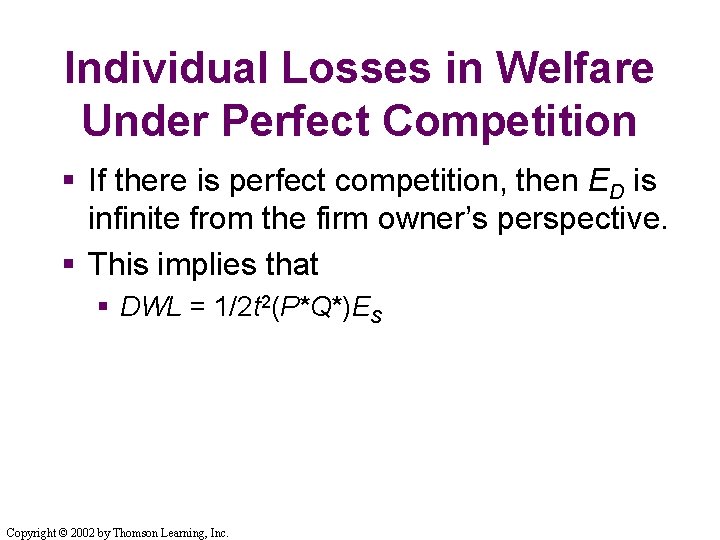
Individual Losses in Welfare Under Perfect Competition § If there is perfect competition, then ED is infinite from the firm owner’s perspective. § This implies that § DWL = 1/2 t 2(P*Q*)ES Copyright © 2002 by Thomson Learning, Inc.
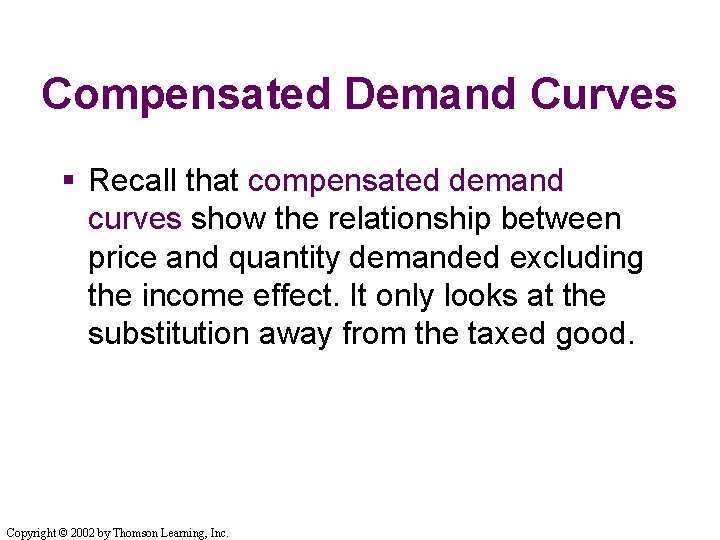
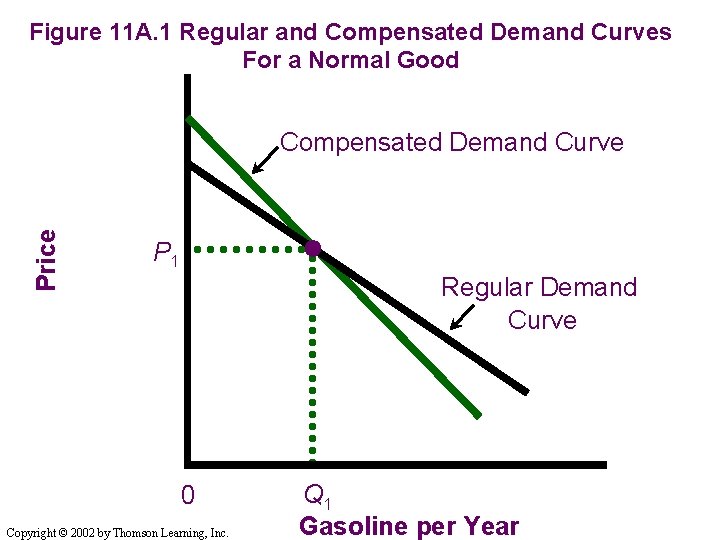
Compensated Demand Curves § Recall that compensated demand curves show the relationship between price and quantity demanded excluding the income effect. It only looks at the substitution away from the taxed good. Copyright © 2002 by Thomson Learning, Inc.
Figure 11 A. 1 Regular and Compensated Demand Curves For a Normal Good Price Compensated Demand Curve P 1 Regular Demand Curve 0 Copyright © 2002 by Thomson Learning, Inc. Q 1 Gasoline per Year
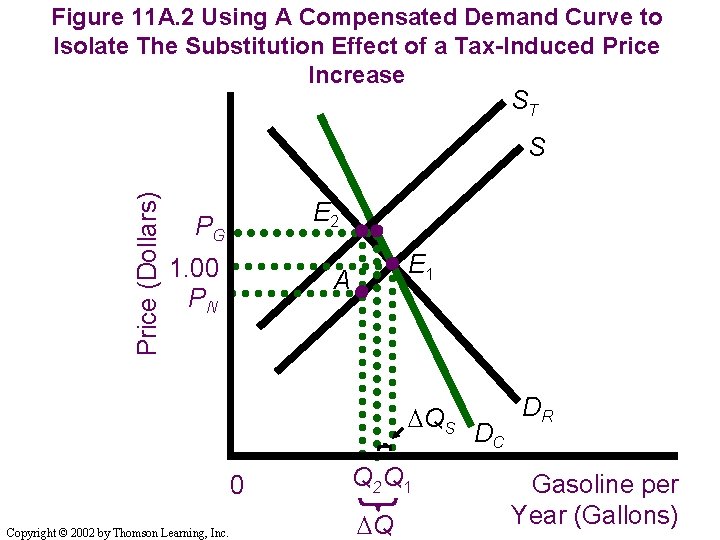
Compensated Supply Curves § Recall that compensated supply curves show the relationship between price and quantity supplied excluding the income effect. It only looks at the substitution away from the taxed good. Copyright © 2002 by Thomson Learning, Inc.
Figure 11 A. 2 Using A Compensated Demand Curve to Isolate The Substitution Effect of a Tax-Induced Price Increase ST Price (Dollars) S E 2 PG 1. 00 PN E 1 A DQS 0 Copyright © 2002 by Thomson Learning, Inc. Q 2 Q 1 DQ DC DR Gasoline per Year (Gallons)
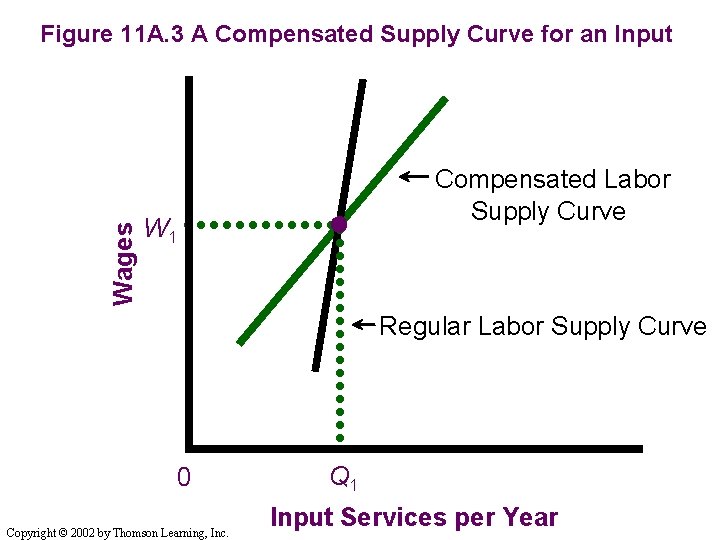
Wages Figure 11 A. 3 A Compensated Supply Curve for an Input Compensated Labor Supply Curve W 1 Regular Labor Supply Curve 0 Copyright © 2002 by Thomson Learning, Inc. Q 1 Input Services per Year