
Chapter 11 Angular Momentum The Vector Product and
- Slides: 30
Chapter 11 Angular Momentum
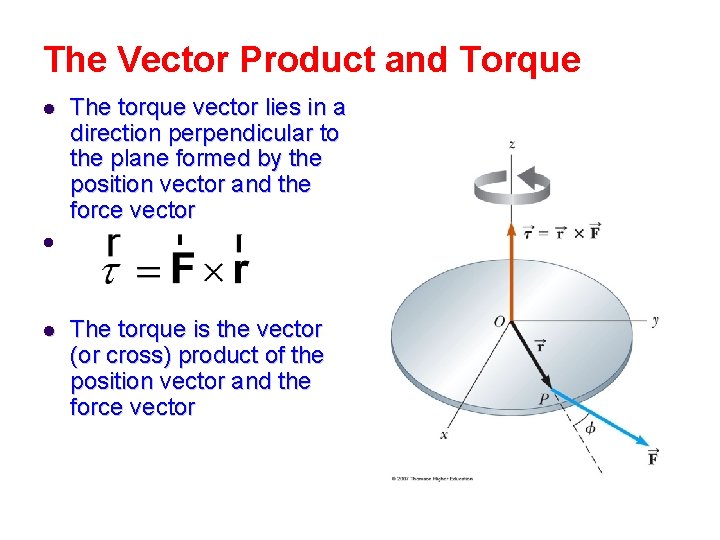
The Vector Product and Torque l The torque vector lies in a direction perpendicular to the plane formed by the position vector and the force vector l l The torque is the vector (or cross) product of the position vector and the force vector
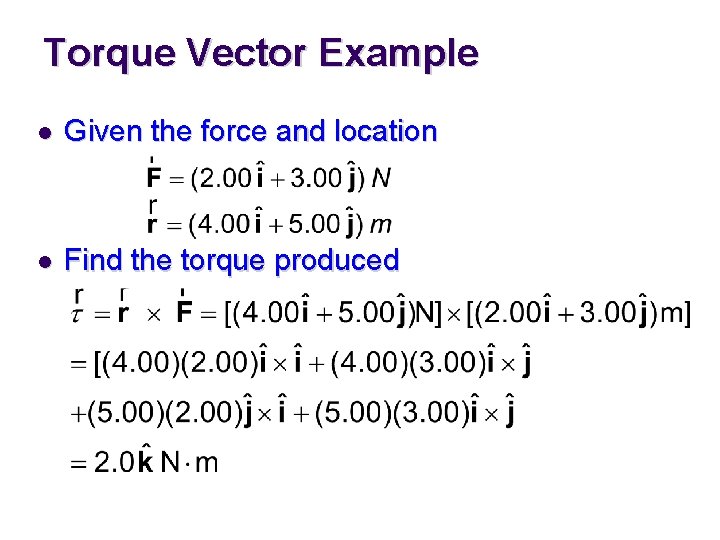
Torque Vector Example l Given the force and location l Find the torque produced
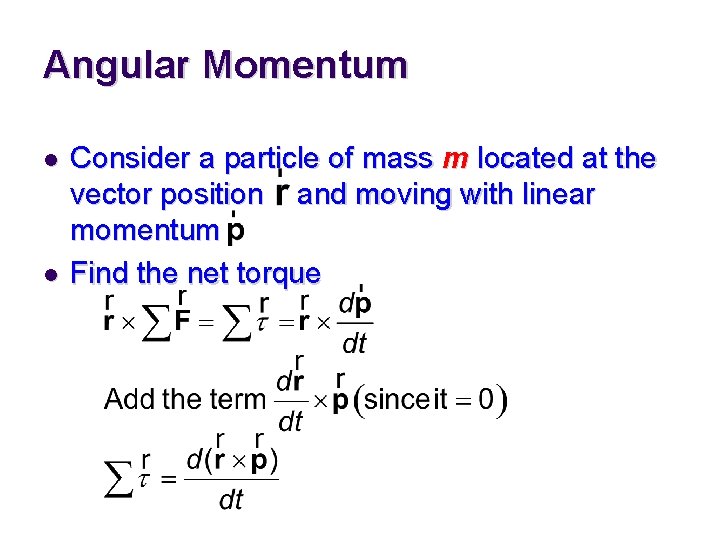
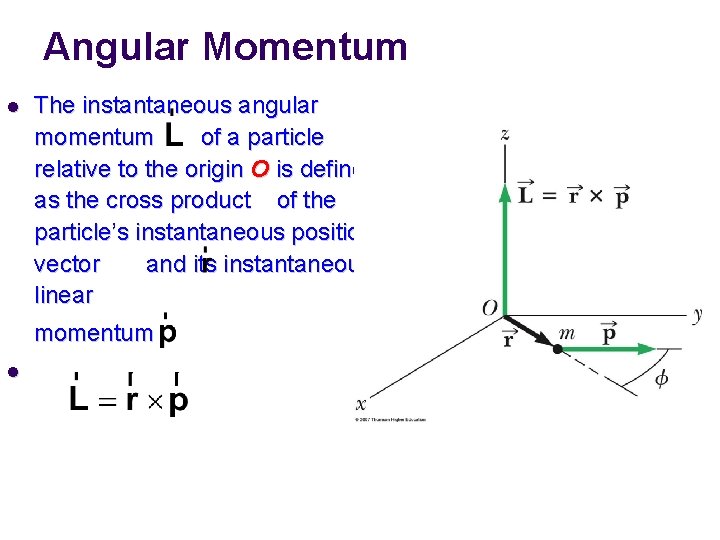
Angular Momentum l l Consider a particle of mass m located at the vector position and moving with linear momentum Find the net torque
Angular Momentum l The instantaneous angular momentum of a particle relative to the origin O is defined as the cross product of the particle’s instantaneous position vector and its instantaneous linear momentum l
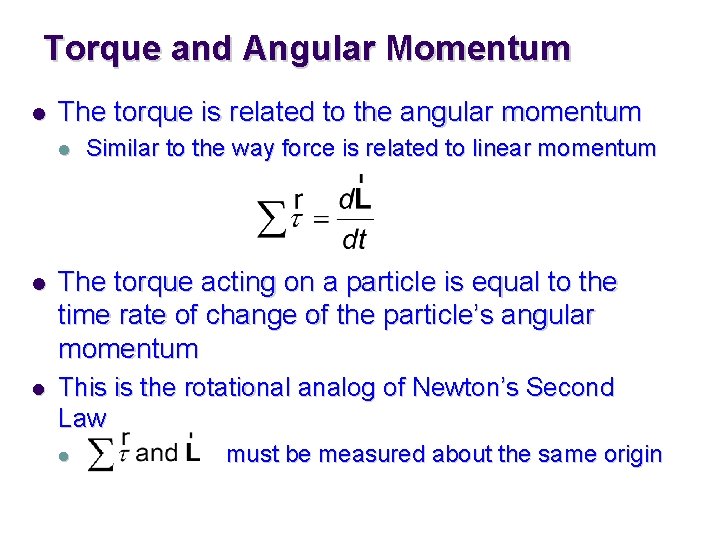
Torque and Angular Momentum l The torque is related to the angular momentum l Similar to the way force is related to linear momentum l The torque acting on a particle is equal to the time rate of change of the particle’s angular momentum l This is the rotational analog of Newton’s Second Law l must be measured about the same origin
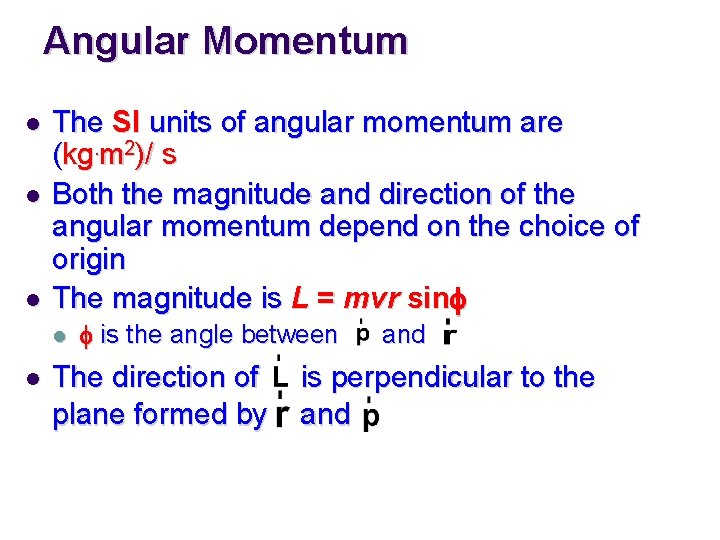
Angular Momentum l l l The SI units of angular momentum are (kg. m 2)/ s Both the magnitude and direction of the angular momentum depend on the choice of origin The magnitude is L = mvr sinf l l f is the angle between The direction of plane formed by and is perpendicular to the and
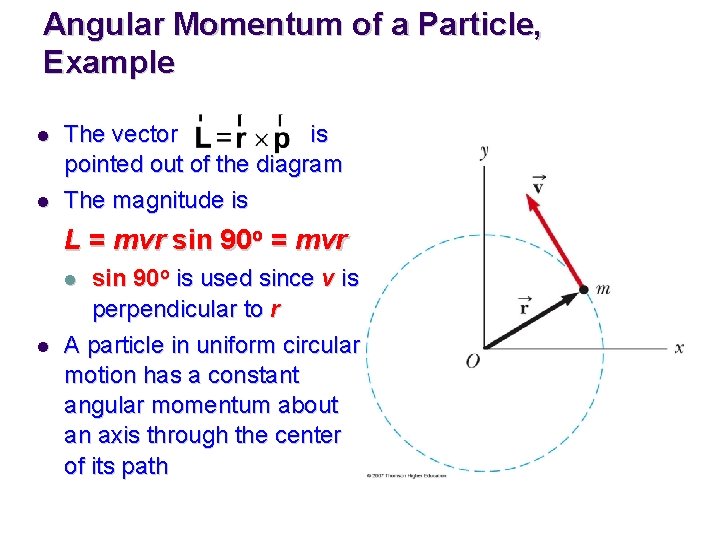
Angular Momentum of a Particle, Example l l The vector is pointed out of the diagram The magnitude is L = mvr sin 90 o is used since v is perpendicular to r A particle in uniform circular motion has a constant angular momentum about an axis through the center of its path l l
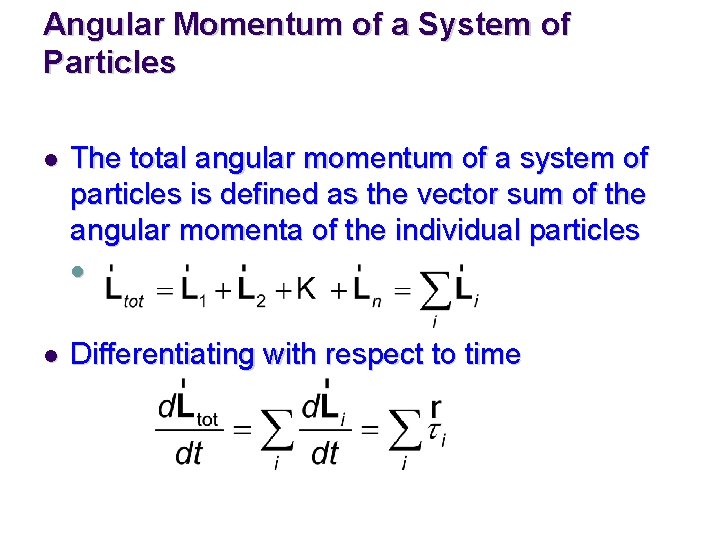
Angular Momentum of a System of Particles l The total angular momentum of a system of particles is defined as the vector sum of the angular momenta of the individual particles l l Differentiating with respect to time
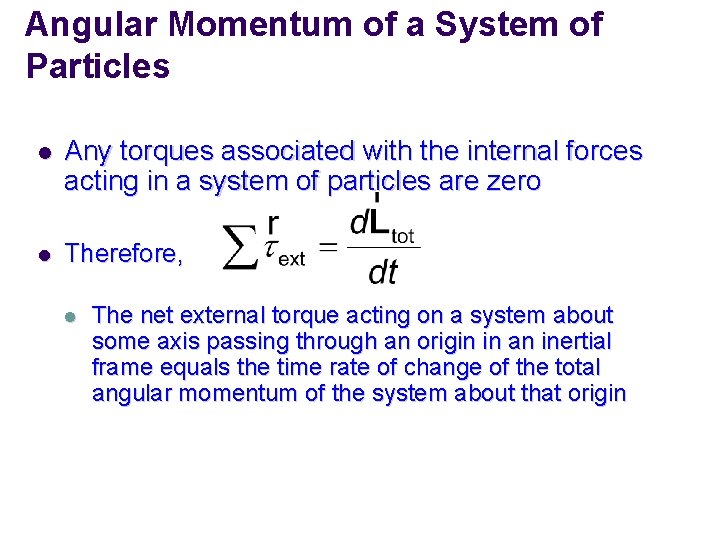
Angular Momentum of a System of Particles l Any torques associated with the internal forces acting in a system of particles are zero l Therefore, l The net external torque acting on a system about some axis passing through an origin in an inertial frame equals the time rate of change of the total angular momentum of the system about that origin
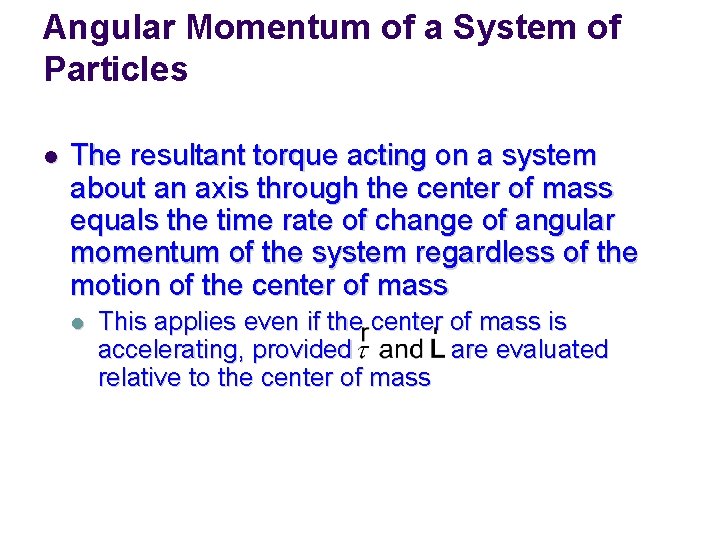
Angular Momentum of a System of Particles l The resultant torque acting on a system about an axis through the center of mass equals the time rate of change of angular momentum of the system regardless of the motion of the center of mass l This applies even if the center of mass is accelerating, provided are evaluated relative to the center of mass
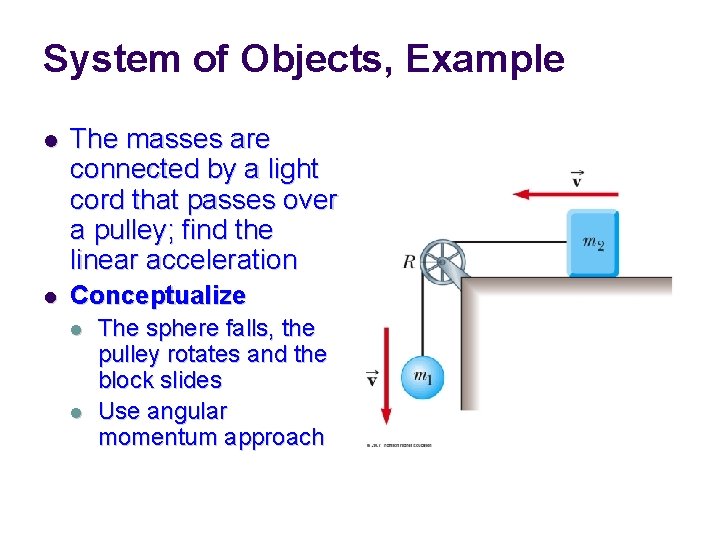
System of Objects, Example l The masses are connected by a light cord that passes over a pulley; find the linear acceleration l Conceptualize l l The sphere falls, the pulley rotates and the block slides Use angular momentum approach
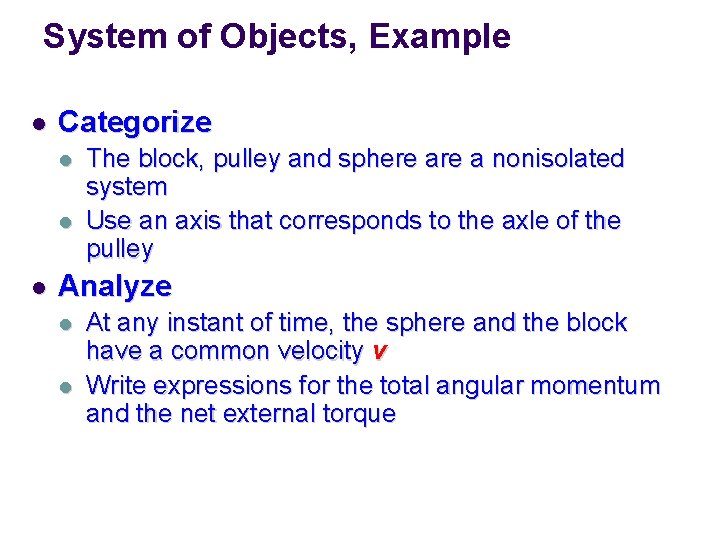
System of Objects, Example l Categorize l l l The block, pulley and sphere a nonisolated system Use an axis that corresponds to the axle of the pulley Analyze l l At any instant of time, the sphere and the block have a common velocity v Write expressions for the total angular momentum and the net external torque
System of Objects, Example l Solve the expression for the linear acceleration l l The system as a whole was analyzed so that internal forces could be ignored Only external forces are needed
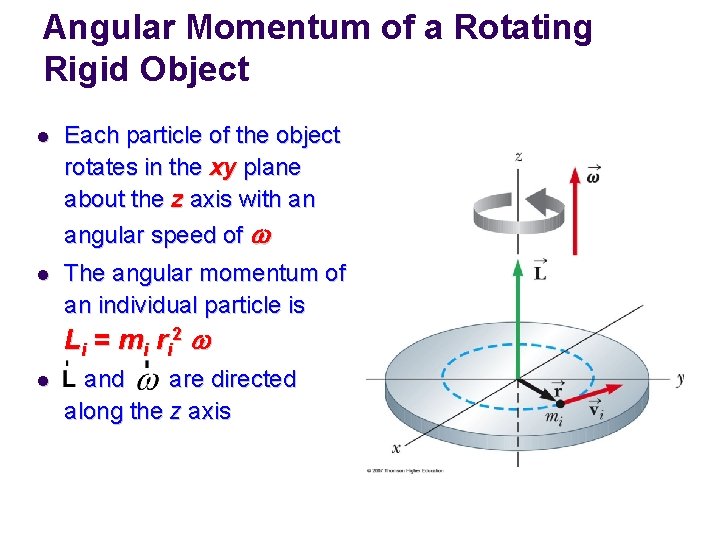
Angular Momentum of a Rotating Rigid Object l Each particle of the object rotates in the xy plane about the z axis with an angular speed of w l The angular momentum of an individual particle is L i = mi r i 2 w l and are directed along the z axis
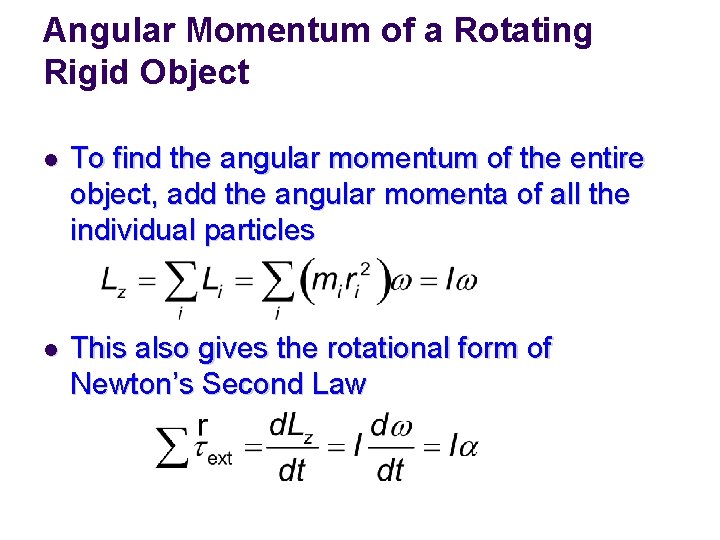
Angular Momentum of a Rotating Rigid Object l To find the angular momentum of the entire object, add the angular momenta of all the individual particles l This also gives the rotational form of Newton’s Second Law
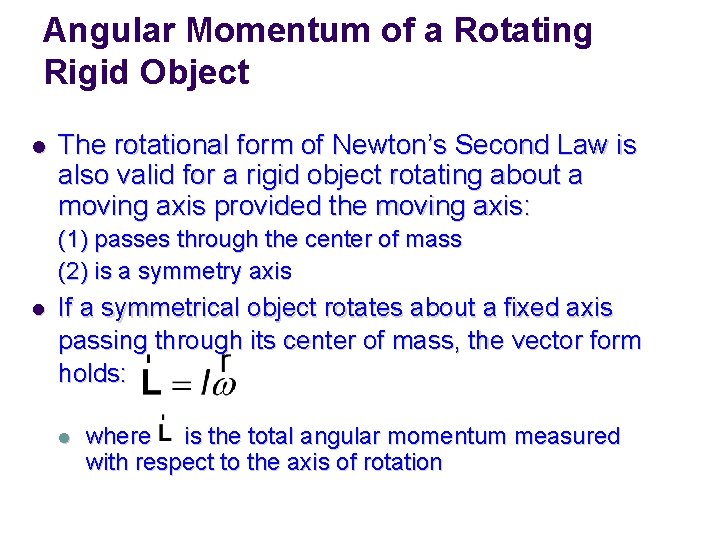
Angular Momentum of a Rotating Rigid Object l The rotational form of Newton’s Second Law is also valid for a rigid object rotating about a moving axis provided the moving axis: (1) passes through the center of mass (2) is a symmetry axis l If a symmetrical object rotates about a fixed axis passing through its center of mass, the vector form holds: l where is the total angular momentum measured with respect to the axis of rotation
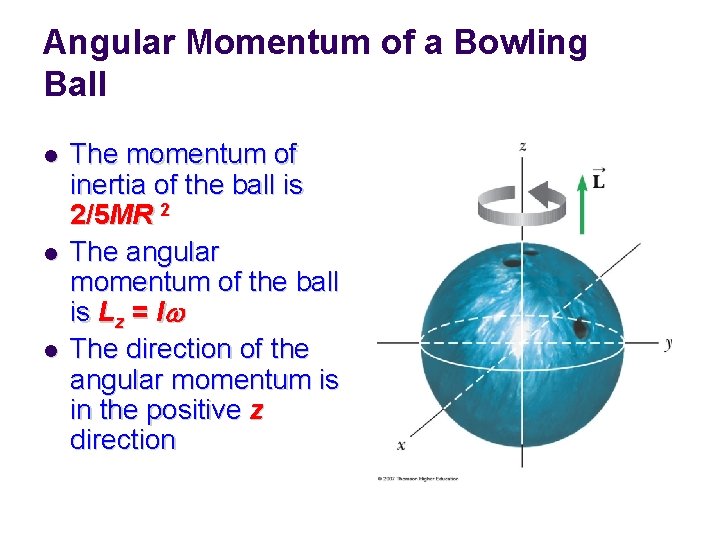
Angular Momentum of a Bowling Ball l The momentum of inertia of the ball is 2/5 MR 2 The angular momentum of the ball is Lz = Iw The direction of the angular momentum is in the positive z direction
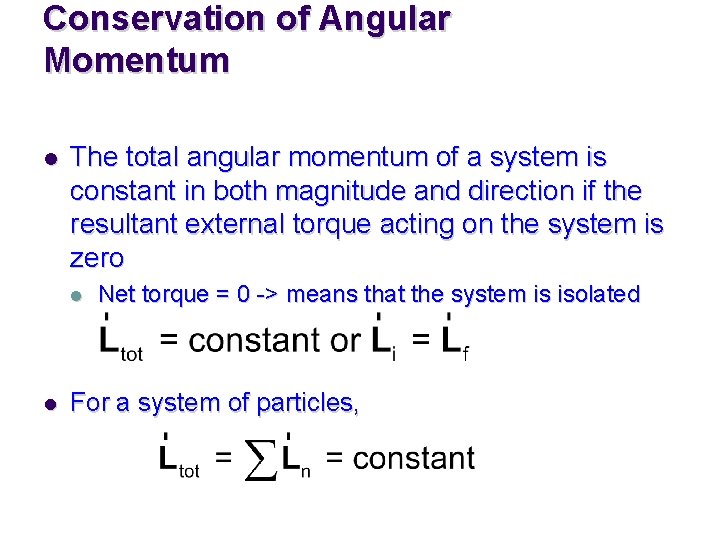
Conservation of Angular Momentum l The total angular momentum of a system is constant in both magnitude and direction if the resultant external torque acting on the system is zero l l Net torque = 0 -> means that the system is isolated For a system of particles,
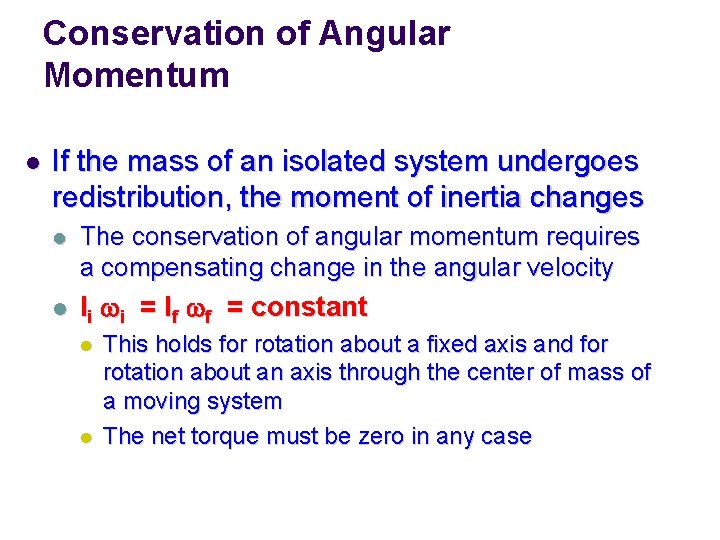
Conservation of Angular Momentum l If the mass of an isolated system undergoes redistribution, the moment of inertia changes l The conservation of angular momentum requires a compensating change in the angular velocity l Ii l l wi = If wf = constant This holds for rotation about a fixed axis and for rotation about an axis through the center of mass of a moving system The net torque must be zero in any case
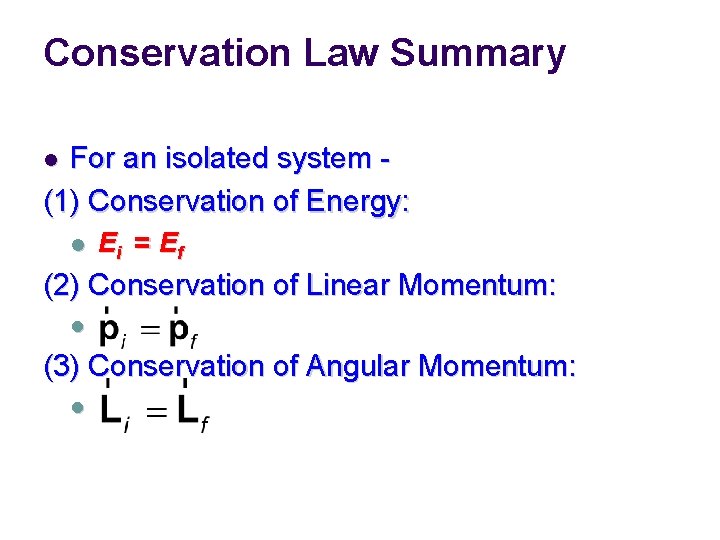
Conservation Law Summary For an isolated system (1) Conservation of Energy: l l Ei = Ef (2) Conservation of Linear Momentum: l (3) Conservation of Angular Momentum: l
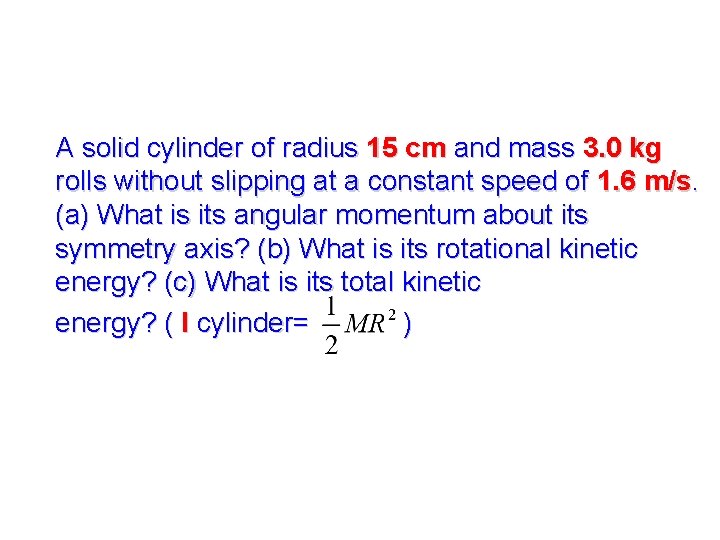
A solid cylinder of radius 15 cm and mass 3. 0 kg rolls without slipping at a constant speed of 1. 6 m/s. (a) What is its angular momentum about its symmetry axis? (b) What is its rotational kinetic energy? (c) What is its total kinetic energy? ( I cylinder= )
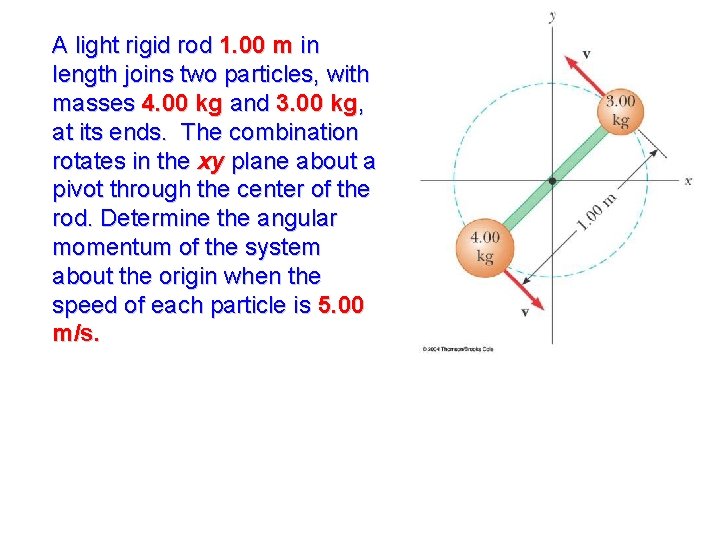
A light rigid rod 1. 00 m in length joins two particles, with masses 4. 00 kg and 3. 00 kg, at its ends. The combination rotates in the xy plane about a pivot through the center of the rod. Determine the angular momentum of the system about the origin when the speed of each particle is 5. 00 m/s.
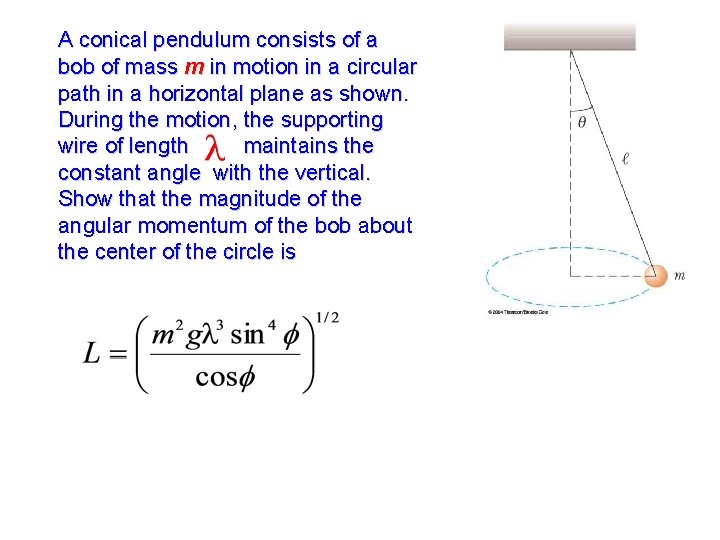
A conical pendulum consists of a bob of mass m in motion in a circular path in a horizontal plane as shown. During the motion, the supporting wire of length maintains the constant angle with the vertical. Show that the magnitude of the angular momentum of the bob about the center of the circle is
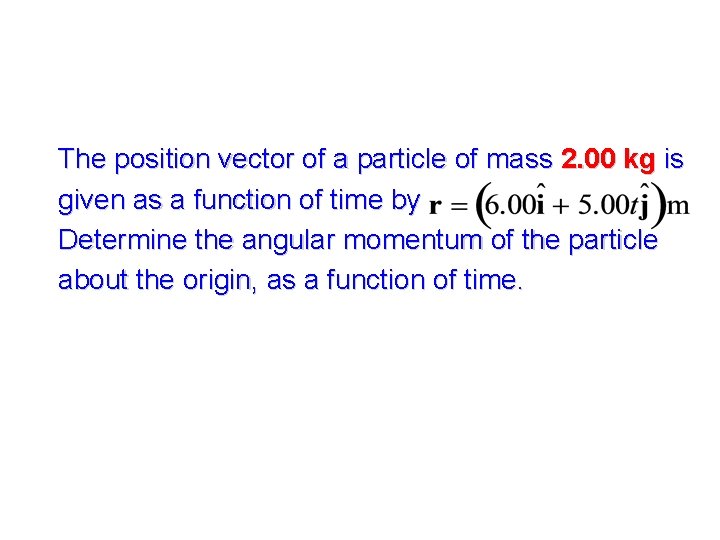
The position vector of a particle of mass 2. 00 kg is given as a function of time by Determine the angular momentum of the particle about the origin, as a function of time.
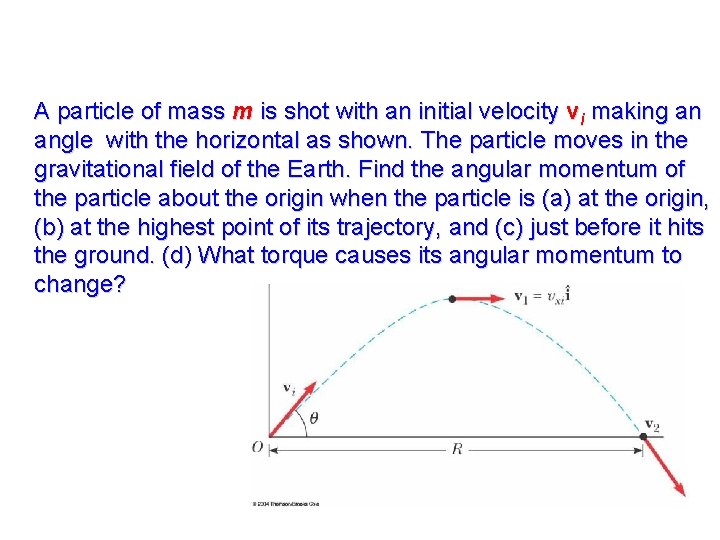
A particle of mass m is shot with an initial velocity vi making an angle with the horizontal as shown. The particle moves in the gravitational field of the Earth. Find the angular momentum of the particle about the origin when the particle is (a) at the origin, (b) at the highest point of its trajectory, and (c) just before it hits the ground. (d) What torque causes its angular momentum to change?
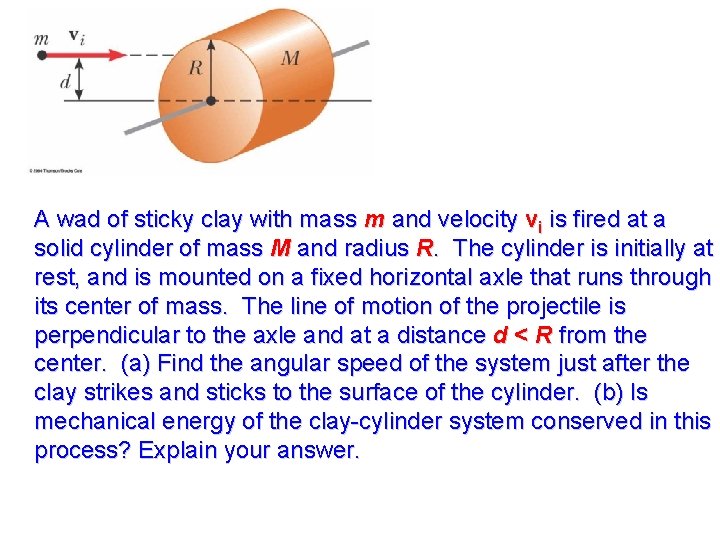
A wad of sticky clay with mass m and velocity vi is fired at a solid cylinder of mass M and radius R. The cylinder is initially at rest, and is mounted on a fixed horizontal axle that runs through its center of mass. The line of motion of the projectile is perpendicular to the axle and at a distance d < R from the center. (a) Find the angular speed of the system just after the clay strikes and sticks to the surface of the cylinder. (b) Is mechanical energy of the clay-cylinder system conserved in this process? Explain your answer.
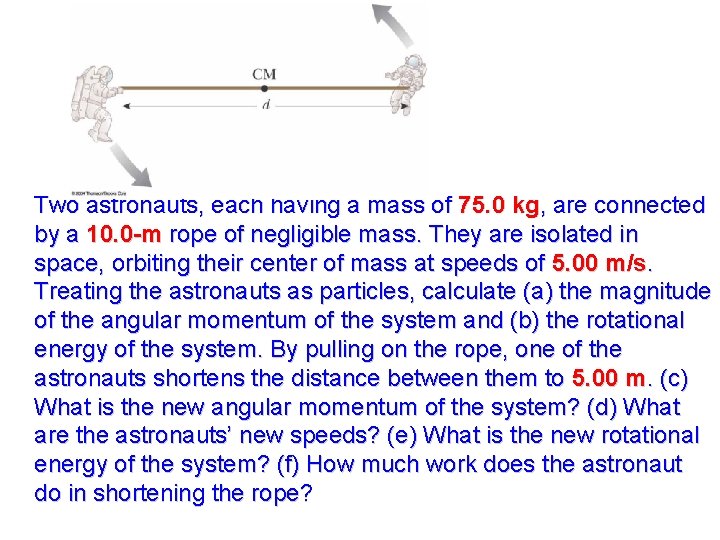
Two astronauts, each having a mass of 75. 0 kg, are connected by a 10. 0 -m rope of negligible mass. They are isolated in space, orbiting their center of mass at speeds of 5. 00 m/s. Treating the astronauts as particles, calculate (a) the magnitude of the angular momentum of the system and (b) the rotational energy of the system. By pulling on the rope, one of the astronauts shortens the distance between them to 5. 00 m. (c) What is the new angular momentum of the system? (d) What are the astronauts’ new speeds? (e) What is the new rotational energy of the system? (f) How much work does the astronaut do in shortening the rope?
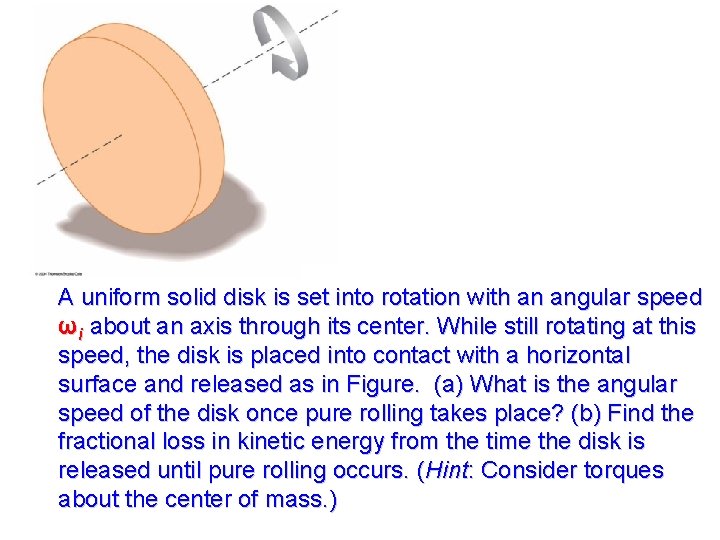
A uniform solid disk is set into rotation with an angular speed ωi about an axis through its center. While still rotating at this speed, the disk is placed into contact with a horizontal surface and released as in Figure. (a) What is the angular speed of the disk once pure rolling takes place? (b) Find the fractional loss in kinetic energy from the time the disk is released until pure rolling occurs. (Hint: Consider torques about the center of mass. )
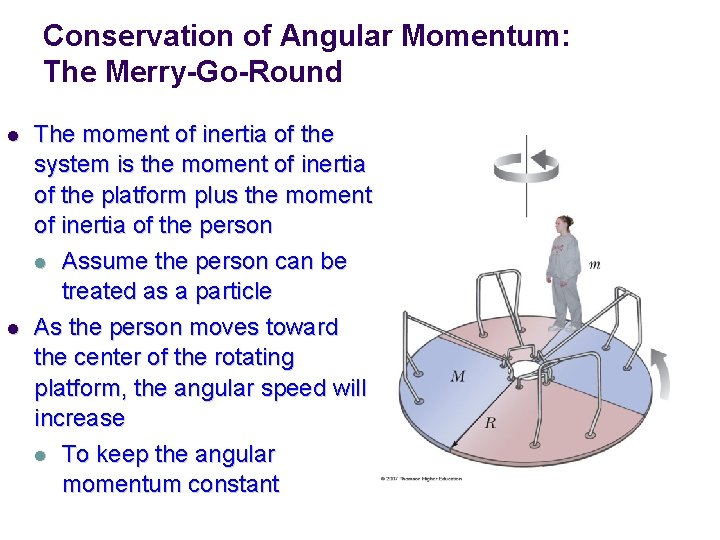
Conservation of Angular Momentum: The Merry-Go-Round l l The moment of inertia of the system is the moment of inertia of the platform plus the moment of inertia of the person l Assume the person can be treated as a particle As the person moves toward the center of the rotating platform, the angular speed will increase l To keep the angular momentum constant