
Chapter 11 Aggregate Planning and Master Scheduling Mc



- Slides: 40
Chapter 11 Aggregate Planning and Master Scheduling Mc. Graw-Hill/Irwin Copyright © 2012 by The Mc. Graw-Hill Companies, Inc. All rights reserved.
Chapter 11: Learning Objectives �You should be able to: 1. Explain what aggregate planning is and how it is useful 2. Identify the variables decision makers have to work with in aggregate planning and some of the possible strategies they can use 3. Describe some of the graphical and quantitative techniques planners use 4. Prepare aggregate plans and compute their costs 5. Describe the master scheduling process and explain its importance Instructor Slides 11 -2
Aggregate Planning �Aggregate planning �Intermediate-range capacity planning that typically covers a time horizon of 2 to 18 months �Useful for organizations that experience seasonal, or other variations in demand �Goal: �Achieve a production plan that will effectively utilize the organization’s resources to satisfy demand Instructor Slides 11 -3
Sales and Operations Planning �Some organizations use the term sales operations and planning rather than aggregate planning �Sales and operation planning �Intermediate-range planning decisions to balance supply and demand, integrating financial and operations planning �Since the plan affects functions throughout the organization, it is typically prepared with inputs from sales, finance, and operations Instructor Slides 11 -4
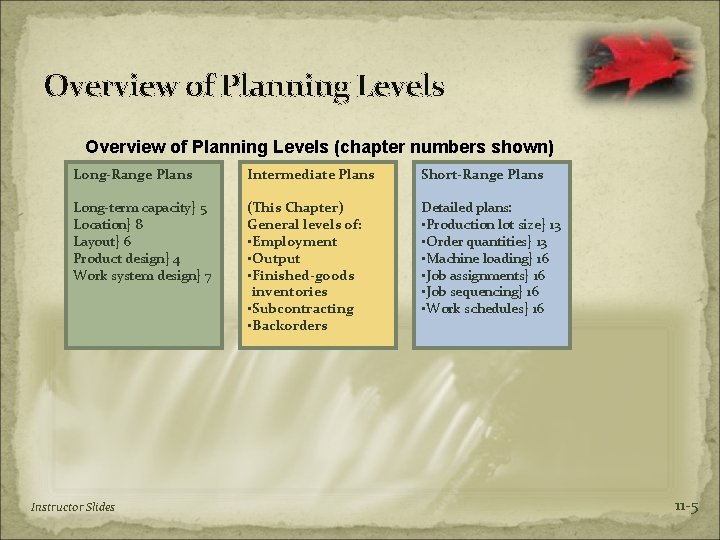
Overview of Planning Levels (chapter numbers shown) Long-Range Plans Intermediate Plans Short-Range Plans Long-term capacity} 5 Location} 8 Layout} 6 Product design} 4 Work system design} 7 (This Chapter) General levels of: • Employment • Output • Finished-goods inventories • Subcontracting • Backorders Detailed plans: • Production lot size} 13 • Order quantities} 13 • Machine loading} 16 • Job assignments} 16 • Job sequencing} 16 • Work schedules} 16 Instructor Slides 11 -5
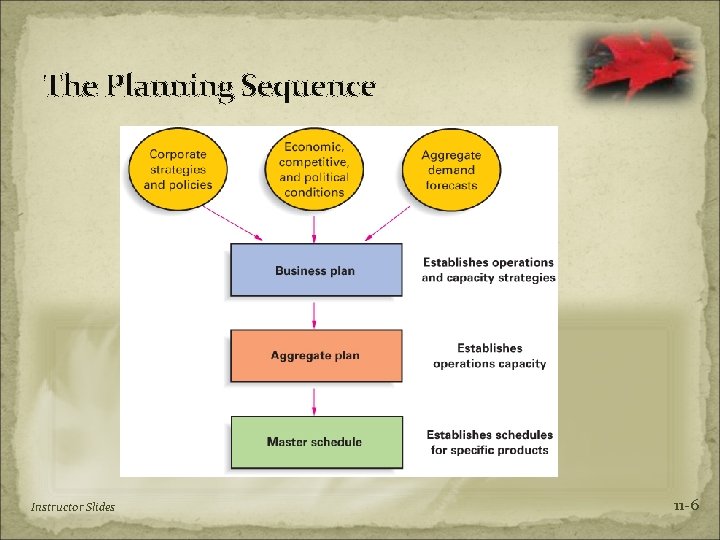
The Planning Sequence Instructor Slides 11 -6
Why Use Aggregate Planning � Why do organizations need to do aggregate planning? � Planning � It takes time to implement plans � Strategic � Aggregation is important because it is not possible to predict with accuracy the timing and volume of demand for individual items � It is connected to the budgeting process � It can help synchronize flow throughout the supply chain; it affects costs, equipment utilization; employment levels; and customer satisfaction Instructor Slides 11 -7
Aggregation �The plan must be in units of measurement that can be understood by the firm’s non-operations personnel • Aggregate units of output per month • Dollar value of total monthly output • Total output by factory • Measures that relate to capacity such as labor hours Instructor Slides 11 -8
Dealing with Variation �Most organizations use rolling 3, 6, 9 and 12 month forecasts �Forecasts are updated periodically, rather than relying on a once-a-year forecast �This allows planners to take into account any changes in either expected demand or expected supply and to develop revised plans Instructor Slides 11 -9
Dealing with Variation � Strategies to counter variation: � Maintain a certain amount of excess capacity to handle increases in demand � Maintain a degree of flexibility in dealing with changes �Hiring temporary workers �Using overtime � Wait as long as possible before committing to a certain level of supply capacity �Schedule products or services with known demands first �Wait to schedule other products until their demands become less uncertain Instructor Slides 11 -10
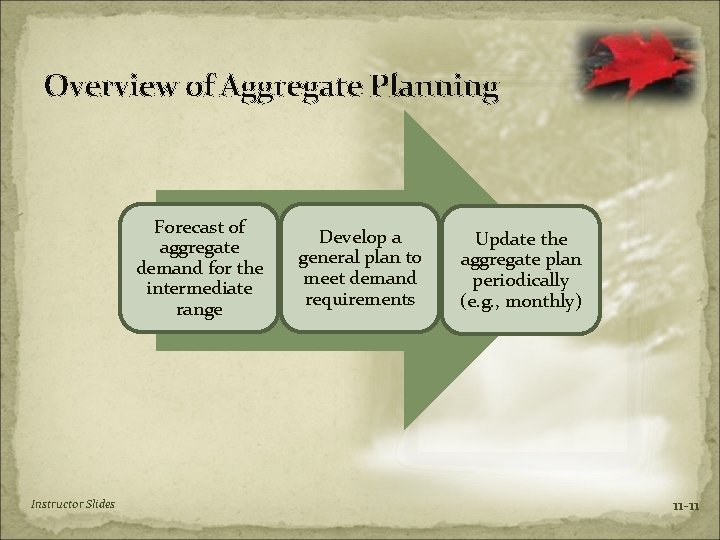
Overview of Aggregate Planning Forecast of aggregate demand for the intermediate range Instructor Slides Develop a general plan to meet demand requirements Update the aggregate plan periodically (e. g. , monthly) 11 -11
Demand Supply �Aggregate planners are concerned with the � Demand quantity �If demand exceeds capacity, attempt to achieve balance by altering capacity, demand, or both � Timing of demand �Even if demand capacity are approximately equal, planners still often have to deal with uneven demand within the planning period Instructor Slides 11 -12
Aggregate Planning Inputs Resources Workforce/production rates Facilities and equipment Demand forecast Policies Workforce changes Subcontracting Overtime Inventory levels/changes Back orders Instructor Slides Costs Inventory carrying Back orders Hiring/firing Overtime Inventory changes subcontracting 11 -13
Aggregate Planning Outputs �Total cost of a plan �Projected levels of �Inventory �Output �Employment �Subcontracting �Backordering Instructor Slides 11 -14
Aggregate Planning Strategies �Proactive �Alter demand to match capacity �Reactive �Alter capacity to match demand �Mixed �Some of each Instructor Slides 11 -15
Demand Options Pricing Used to shift demand from peak to off-peak periods Price elasticity is important Promotion Advertising and other forms of promotion Back orders Orders are taken in one period and deliveries promised for a later period New demand Instructor Slides 11 -16
Supply Options �Hire and layoff workers �Overtime/slack time �Part-time workers �Inventories �Subcontracting Instructor Slides 11 -17
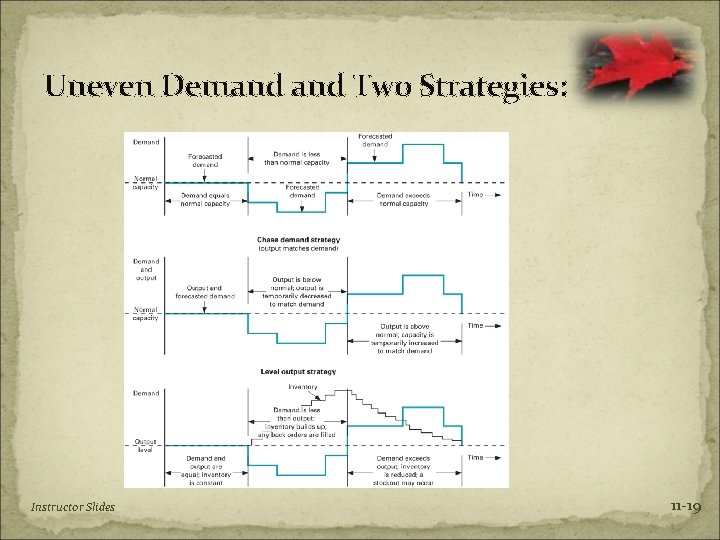
Aggregate Planning Pure Strategies �Level capacity strategy: �Maintaining a steady rate of regular-time output while meeting variations in demand by a combination of options: �inventories, overtime, part-time workers, subcontracting, and back orders �Chase demand strategy: �Matching capacity to demand; the planned output for a period is set at the expected demand for that period. Instructor Slides 11 -18
Uneven Demand Two Strategies: Instructor Slides 11 -19
Chase Approach �Capacities are adjusted to match demand requirements over the planning horizon �Advantages �Investment in inventory is low �Labor utilization in high �Disadvantages �The cost of adjusting output rates and/or workforce levels Instructor Slides 11 -20
Level Approach �Capacities are kept constant over the planning horizon �Advantages �Stable output rates and workforce �Disadvantages �Greater inventory costs �Increased overtime and idle time �Resource utilizations vary over time Instructor Slides 11 -21
Techniques for Aggregate Planning �General procedure: 1. Determine demand for each period 2. Determine capacities for each period 3. Identify company or departmental policies that are pertinent 4. Determine unit costs 5. Develop alternative plans and costs 6. Select the plan that best satisfies objectives. Otherwise return to step 5. Instructor Slides 11 -22
Trial-and-Error Techniques �Trial-and-error approaches consist of developing simple table or graphs that enable planners to visually compare projected demand requirements with existing capacity �Alternatives are compared based on their total costs �Disadvantage of such an approach is that it does not necessarily result in an optimal aggregate plan Instructor Slides 11 -23
Trial-and-Error Technique Assumptions 1. The regular output capacity is the same in all periods 2. Cost is a linear function composed of unit cost and number of units Plans are feasible All costs are associated with a decision option can be represented by a lump sum Cost figures can be reasonably estimated and are constant for the planning period Inventories are built up and drawn down at a uniform rate throughout each period Backlogs are treated as if they exist the entire period 3. 4. 5. 6. 7. Instructor Slides 11 -24
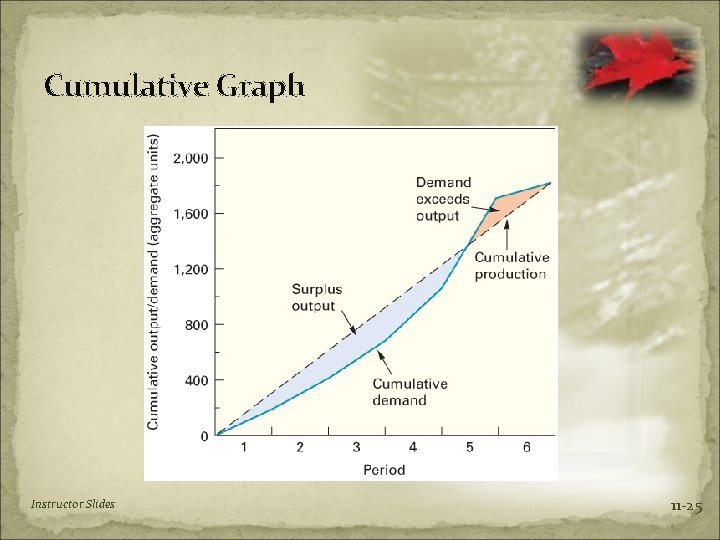
Cumulative Graph Instructor Slides 11 -25
Mathematical Techniques �Linear programming models �Simulation models �Computerized models that can be tested under different scenarios to identify acceptable solutions to problems Instructor Slides 11 -26
Aggregate Planning in Services � Hospitals: � Aggregate planning used to allocate funds, staff, and supplies to meet the demands of patients for their medical services � Airlines: � Aggregate planning in this environment is complex due to the number of factors involved � Capacity decisions must take into account the percentage of seats to be allocated to various fare classes in order to maximize profit or yield � Restaurants: � Aggregate planning in high-volume businesses is directed toward smoothing the service rate, determining workforce size, and managing demand to match a fixed capacity � Can use inventory; however, it is perishable Instructor Slides 11 -27
Aggregate Planning in Services �The resulting plan in services is a time-phased projection of service staff requirements �Aggregate planning in manufacturing and services is similar, but there are some key differences related to: 1. 2. 3. 4. Demand for service can be difficult to predict Capacity availability can be difficult to predict Labor flexibility can be an advantage in services Services occur when they are rendered Instructor Slides 11 -28
Disaggregation Aggregate Plan Disaggregation Master Schedule Instructor Slides 11 -29
Disaggregating the Aggregate Plan �Master schedule: �The result of disaggregating an aggregate plan �Shows quantity and timing of specific end items for a scheduled horizon Instructor Slides 11 -30
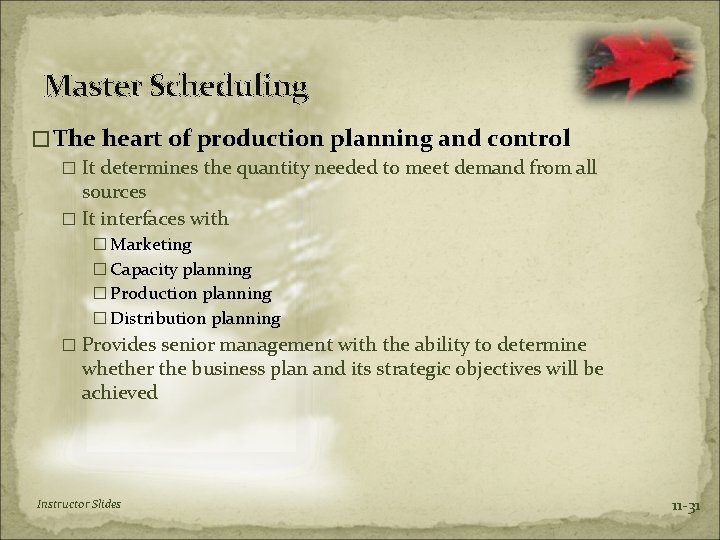
Master Scheduling �The heart of production planning and control � It determines the quantity needed to meet demand from all sources � It interfaces with � Marketing � Capacity planning � Production planning � Distribution planning � Provides senior management with the ability to determine whether the business plan and its strategic objectives will be achieved Instructor Slides 11 -31
The Master Scheduler �The master scheduler’s duties: � Evaluating the impact of new orders � Providing delivery dates for orders � Deals with problems �Evaluating the impact of production or delivery delays �Revising master schedule when necessary because of insufficient supplies or capacity �Bring instances of insufficient capacity to the attention of relevant personnel so they can participate in resolving conflicts Instructor Slides 11 -32
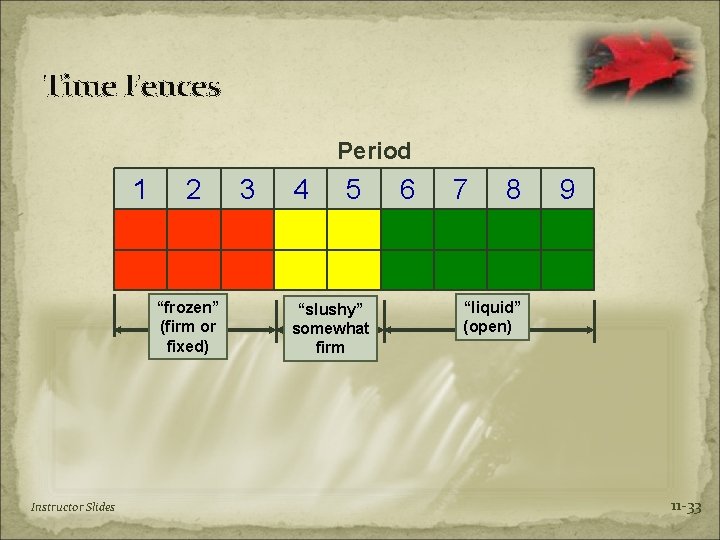
Time Fences Period 1 2 “frozen” (firm or fixed) Instructor Slides 3 4 5 “slushy” somewhat firm 6 7 8 9 “liquid” (open) 11 -33
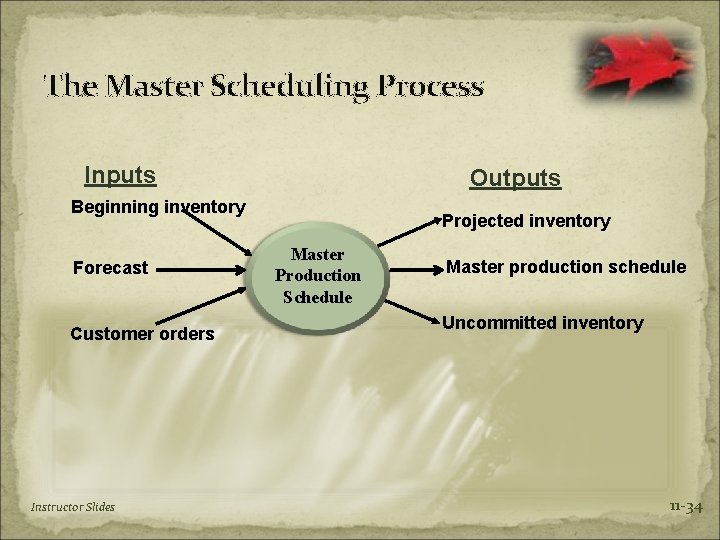
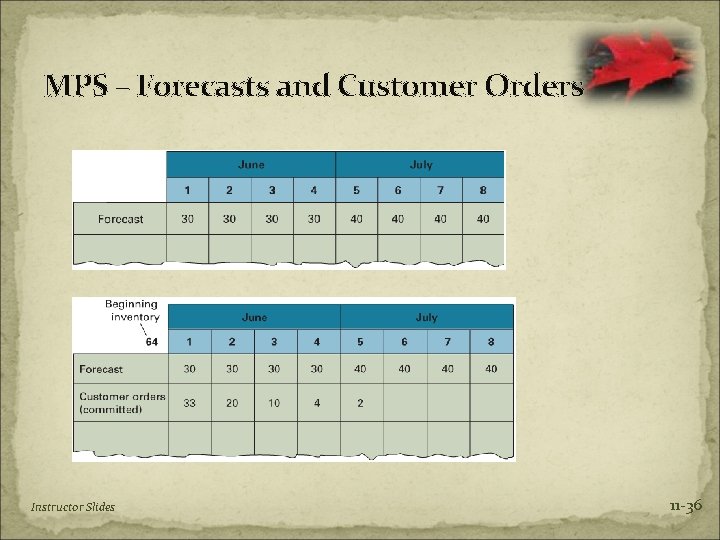
The Master Scheduling Process Inputs Outputs Beginning inventory Forecast Customer orders Instructor Slides Projected inventory Master Production Schedule Master production schedule Uncommitted inventory 11 -34
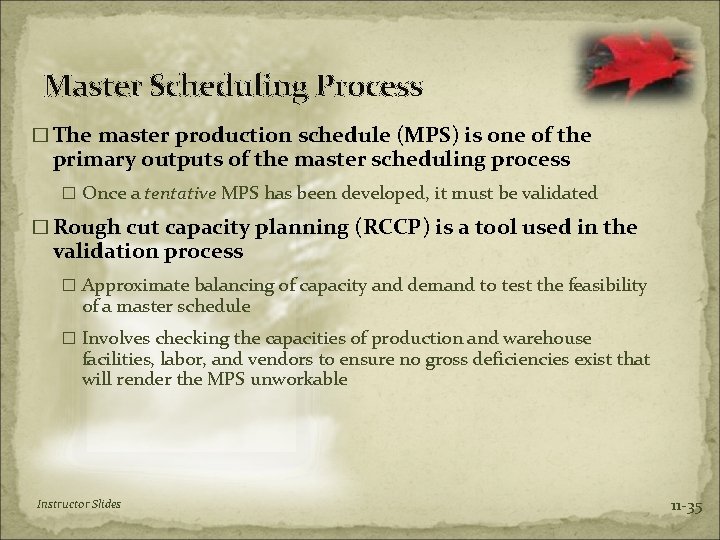
Master Scheduling Process � The master production schedule (MPS) is one of the primary outputs of the master scheduling process � Once a tentative MPS has been developed, it must be validated � Rough cut capacity planning (RCCP) is a tool used in the validation process � Approximate balancing of capacity and demand to test the feasibility of a master schedule � Involves checking the capacities of production and warehouse facilities, labor, and vendors to ensure no gross deficiencies exist that will render the MPS unworkable Instructor Slides 11 -35
MPS – Forecasts and Customer Orders Instructor Slides 11 -36
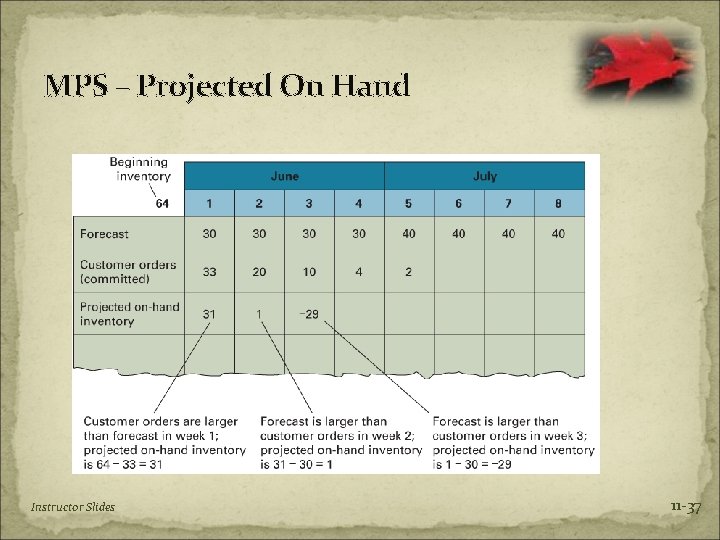
MPS – Projected On Hand Instructor Slides 11 -37
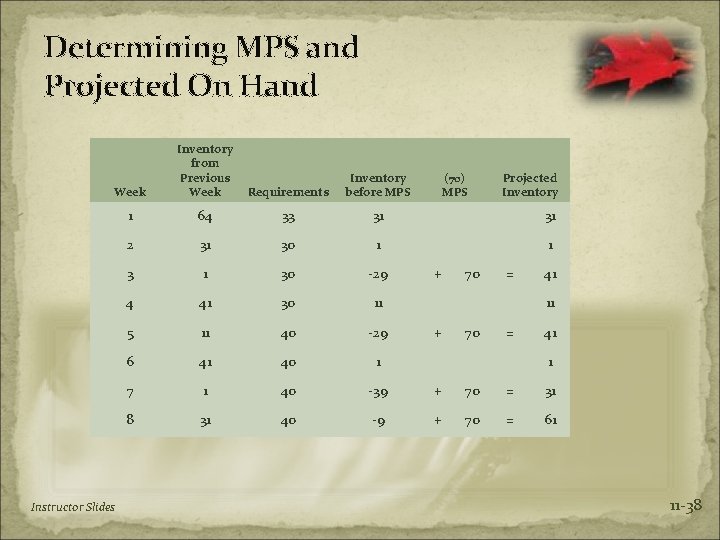
Determining MPS and Projected On Hand Week Inventory from Previous Week Requirements Inventory before MPS 1 64 33 31 31 2 31 30 1 1 30 -29 4 41 30 11 5 11 40 -29 6 41 40 1 7 1 40 -39 + 70 = 31 8 31 40 -9 + 70 = 61 Instructor Slides (70) MPS + 70 Projected Inventory = 41 11 + 70 = 41 1 11 -38
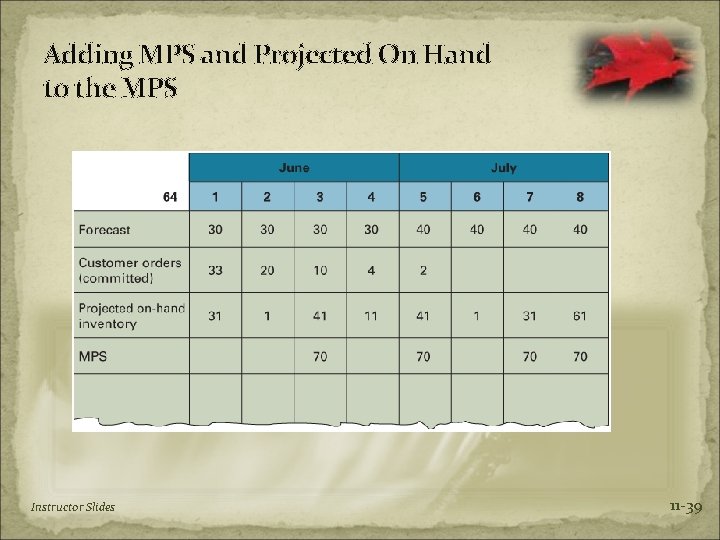
Adding MPS and Projected On Hand to the MPS Instructor Slides 11 -39
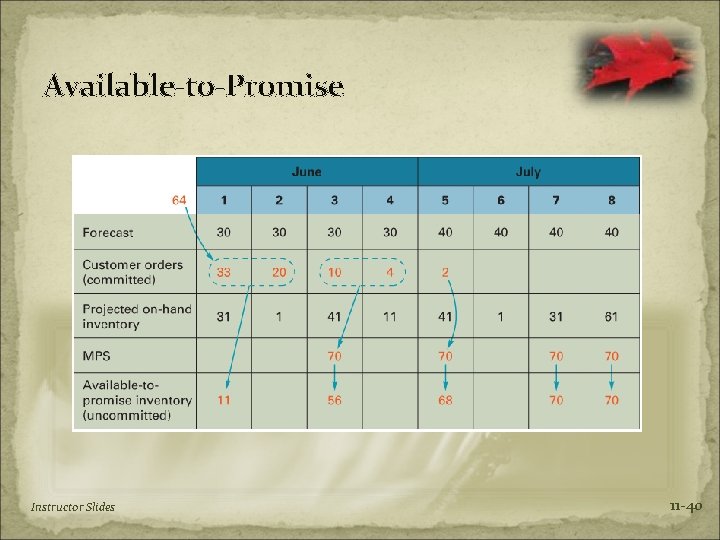
Available-to-Promise Instructor Slides 11 -40