
Chapter 11 Acids and Bases CHEMISTRY REVISION Tuesday
Chapter 11: Acids and Bases CHEMISTRY REVISION Tuesday, December 14, 2021 the_mighty_spirit@live. com 1
Chemistry Chapter 11: Acids and Bases Chapter 11. 1: Introduction to Acids Tuesday, December 14, 2021 the_mighty_spirit@live. com 2

Definition of Acid � An acid is a substance that produce hydrogen ions when dissolved in water. � All acids contain hydrogen. But not all substances with hydrogen contains acids (Water). � The hydrogen ions produced are responsible for the properties of an acid. Tuesday, December 14, 2021 the_mighty_spirit@live. com 3
Some common acids � Man-made: �Hydrochloric Acid (HCl) �Sulphuric Acid (H 2 SO 4) �Nitric Acid (HNO 3) � Natural Acids: �Ethanoic Acid (Found in vinegar) Tuesday, December 14, 2021 the_mighty_spirit@live. com 4
Chemistry Chapter 11: Acids and Bases Chapter 11. 2: Properties of Acids Tuesday, December 14, 2021 the_mighty_spirit@live. com 5
Properties of Acids � Acids have a sour taste � Acids dissolve in water to form solutions which conduct electricity. � Acids turn blue litmus paper red. � p. H value < 7. Tuesday, December 14, 2021 the_mighty_spirit@live. com 6

Chemical Properties of Acids react with reactive metals to form hydrogen and a salt. � Formula: Metal + Acid Salt + Hydrogen � Reactive metals give out electrons easily to form positive ions. � Example: Magnesium Ribbon with Dilute sulphuric acid. Equation: � Mg (s) + (H 2 SO 4) (aq) Mg. SO 4 (aq) + H 2 (g) 1. Very important! Tuesday, December 14, 2021 the_mighty_spirit@live. com 7

Chemical Properties of Acids To test for hydrogen, place a lighted splint at the test tube and a “pop sound” will be heard. � Some acid and metal reactions which do not give hydrogen: � � Unreactive metals (copper and silver) � Concentrated nitric acid reacts with metals but it does not give hydrogen (gives nitrogen dioxide) � Lead does not react as a coating is formed once lead is placed inside the acid. Very important! Tuesday, December 14, 2021 the_mighty_spirit@live. com 8
Chemical Properties of Acids 2. Acids react with carbonates to form a salt, carbon dioxide and water. � Equation: Acid + Carbonate Salt + Carbon Dioxide + Water � Example: Sodium Carbonate + Dilute hydrochloric acid Sodium Chloride + Water + Carbon Dioxide � Bubble the gas through limewater to test for carbon dioxide. Very important! Tuesday, December 14, 2021 the_mighty_spirit@live. com 9
Chemical Properties of Acids react with metal oxides and hydroxides (Insoluble bases) to form salt and water. � General Equations: Metal Oxide + Acid Salt and Water. Metal Hydroxide + Acid Salt and Water 3. Very important! Tuesday, December 14, 2021 the_mighty_spirit@live. com 10
Chemistry Chapter 11: Acids and Bases Chapter 11. 3: Role of water in acidity Tuesday, December 14, 2021 the_mighty_spirit@live. com 11
Role of Water in Acidity � Acids only react when placed into water. This is because water can break apart the acid into hydrogen ions and a salt. � Therefore, an acid dissociate in water to produce hydrogen ions which are responsible for the acidic properties. � Acids only show their properties when dissolved in water. Tuesday, December 14, 2021 the_mighty_spirit@live. com 12
Role of Water in Acidity � The hydrogen ions produced are not hydrogen gas. � They react with metals like magnesium to produce hydrogen gas and magnesium ions. � A few drops of water is enough to allow an acid to dissociate. Tuesday, December 14, 2021 the_mighty_spirit@live. com 13
Chemistry Chapter 11: Acids and Bases Chapter 11. 4: Uses of Acids Tuesday, December 14, 2021 the_mighty_spirit@live. com 14
Uses of Acids � Sulphuric Acid: �Detergents �Car Batteries � Ethanoic Acid: �Vinegar to preserve food �Adhesives (glue) � Hydrochloric acid �Cleaning metals �Leather processing Tuesday, December 14, 2021 the_mighty_spirit@live. com 15
Chemistry Chapter 11: Acids and Bases Chapter 11. 5: Bases Tuesday, December 14, 2021 the_mighty_spirit@live. com 16
Introduction of Bases �A base is any metal oxide or hydroxide. � A base is a substance that reacts with an acid to give salt and water only. � Acid + Base Salt and Water Similar to: Acid + Metal Oxide/Hydroxide Salt and Water. � Ionic Equation for this is always standard: OH- + H+ H 2 O (l) Tuesday, December 14, 2021 the_mighty_spirit@live. com 17
SOME COMMON BASES � Sodium Oxide � Zinc Oxide � Copper (II) Oxide � Magnesium Hydroxide � Aluminum Hydroxide Tuesday, December 14, 2021 the_mighty_spirit@live. com 18
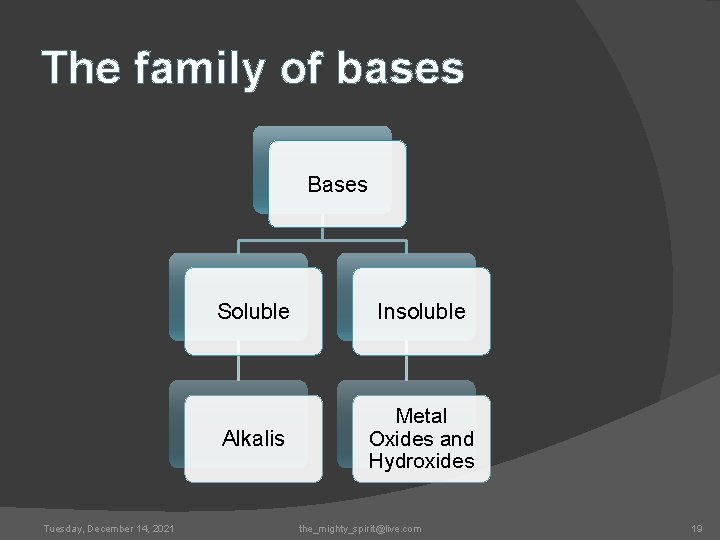
The family of bases Bases Tuesday, December 14, 2021 Soluble Insoluble Alkalis Metal Oxides and Hydroxides the_mighty_spirit@live. com 19
Chemistry Chapter 11: Acids and Bases Chapter 11. 6: Alkalis Tuesday, December 14, 2021 the_mighty_spirit@live. com 20
Definition � An alkali is a base that is soluble in water. � Some examples include: �Sodium Hydroxide �Potassium Hydroxide �Calcium Hydroxide �Barium Hydroxide �Aqueous Ammonia Tuesday, December 14, 2021 the_mighty_spirit@live. com 21
Properties of Alkalis � Alkalis have a bitter taste and soapy feel. � Alkalis turn red litmus paper blue. � p. H value > 7. Tuesday, December 14, 2021 the_mighty_spirit@live. com 22
Chemical Properties of Alkalis � All alkalis produce hydroxide ions when dissolved in water. � Example: Sodium Hydroxide + Water Sodium Ion + Hydroxide ion. Very important! Tuesday, December 14, 2021 the_mighty_spirit@live. com 23
Chemical Properties of Alkalis � All alkalis react with acids to form salt and water only. � This is also known as neutralisation. � The salt depends on the acid used. �Sulphuric Acid Sulphide �Hydrochloric Acid Chloride � The ionic equation for this is standardized. �H+ (aq) + OH- (aq) H 2 O (l). Very important! Tuesday, December 14, 2021 the_mighty_spirit@live. com 24
Chemical Properties of Alkalis � Alkalis heated with ammonium salts gives off ammonia gas. � General Equation: Alkali + Ammonium Salt Ammonia + Water + Salt. � Ammonia has a strong smell and turn red litmus paper blue. � Example: Calcium hydroxide + Ammonium chloride Calcium Chloride + Water + Ammonia. Very important! Tuesday, December 14, 2021 the_mighty_spirit@live. com 25
Chemical Properties of Alkalis � Alkalis can react with the solution of 1 metal salt to give metal hydroxide and another metal salt. � General Equation: Alkali + Salt (of metal A) Metal Hydroxide + Salt (of metal B) � Example: Sodium Hydroxide + Iron (II) Sulphate Iron (II) Hydroxide + Sodium Sulphate. Very important! Tuesday, December 14, 2021 the_mighty_spirit@live. com 26
Chemistry Chapter 11: Acids and Bases Chapter 11. 7: Uses of Alkalis Tuesday, December 14, 2021 the_mighty_spirit@live. com 27
Uses of Alkalis � Ammonia Solution: �Window cleaning solutions � Calcium Oxide: �To make iron, concrete, cement � Magnesium Hydroxide: �Toothpaste to neutralise acid o teeth �In antacids to relieve indigestion. � Sodium Hydroxide: �In making soaps and detergents. Tuesday, December 14, 2021 the_mighty_spirit@live. com 28
Chemistry Chapter 11: Acids and Bases Chapter 11. 8: Concentration and Strength Tuesday, December 14, 2021 the_mighty_spirit@live. com 29
Concentration � Concentration tells us how much of a substance is dissolved in 1 dm 3 of a solution. � It can be changed by either adding more solute or more solvent. Tuesday, December 14, 2021 the_mighty_spirit@live. com 30
Strength � Strength refers to how easily an acid or alkali dissociates when dissolved in water. � A strong acid like hydrochloric acid dissociates easily in water (almost 100% of the acid dissociates) � A weak acid like ethanoic acid does not fully dissociate when dissolved in water. Tuesday, December 14, 2021 the_mighty_spirit@live. com 31
Strength � The strength of an acid cannot be changed. � No matter how concentrated ethanoic acid is, it is still a weak acid. � The strength of an acid of an alkali can be shown using the p. H scale. Tuesday, December 14, 2021 the_mighty_spirit@live. com 32
- Slides: 32