
Chapter 10 Writing Effective Sentences Structuring Effective Sentences

- Slides: 10
Chapter 10 Writing Effective Sentences
Structuring Effective Sentences • Good tech com consists of clear, correct and graceful sentences that convey information economically • There are seven principles for structuring effective sentences
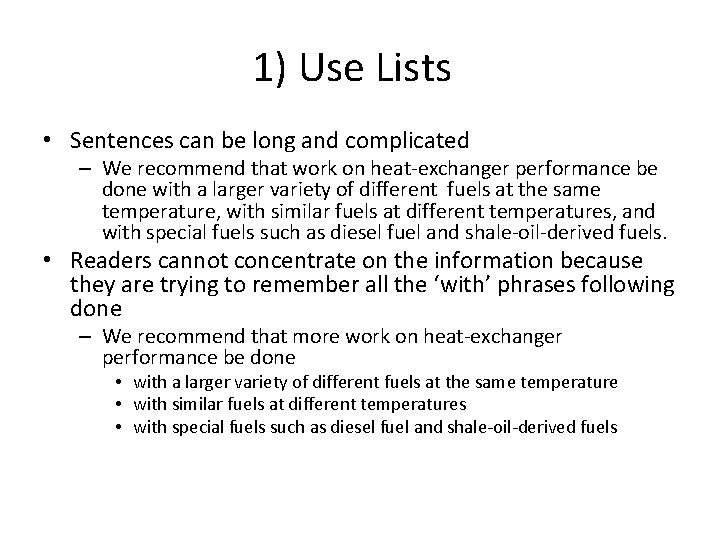
1) Use Lists • Sentences can be long and complicated – We recommend that work on heat-exchanger performance be done with a larger variety of different fuels at the same temperature, with similar fuels at different temperatures, and with special fuels such as diesel fuel and shale-oil-derived fuels. • Readers cannot concentrate on the information because they are trying to remember all the ‘with’ phrases following done – We recommend that more work on heat-exchanger performance be done • with a larger variety of different fuels at the same temperature • with similar fuels at different temperatures • with special fuels such as diesel fuel and shale-oil-derived fuels
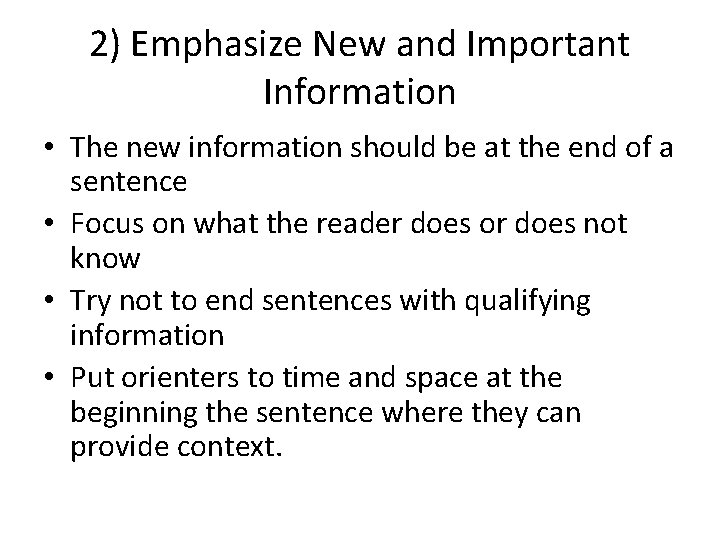
2) Emphasize New and Important Information • The new information should be at the end of a sentence • Focus on what the reader does or does not know • Try not to end sentences with qualifying information • Put orienters to time and space at the beginning the sentence where they can provide context.
3) Choose Appropriate Sentence Length • 15 -20 words • A 10 word sentence is choppy • A series of 35 word sentences would be too demanding for most readers • Avoid overly long sentences • Avoid overly short sentences
4) Focus on the “Real” Subject • Conceptual subject of the sentence should be the real subject of the sentence • Look for the real subject (the topic) and ask yourself whether the sentence would be more effective if the real subject was also the grammatical subject
5) Focus on the “Real” Verb • Like the ‘real’ subject, the ‘real’ verb should stand out in a sentence • Be careful of nominalized verbs
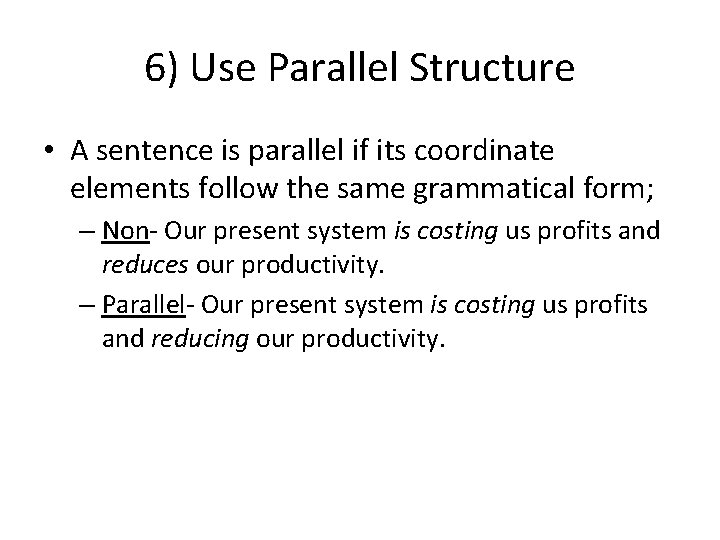
6) Use Parallel Structure • A sentence is parallel if its coordinate elements follow the same grammatical form; – Non- Our present system is costing us profits and reduces our productivity. – Parallel- Our present system is costing us profits and reducing our productivity.
7) Use Modifiers Effectively • Modifiers are words, phrases, and clauses that describe other elements in the sentence • Distinguish between restrictive and nonrestrictive modifiers • Avoid misplaced modifiers
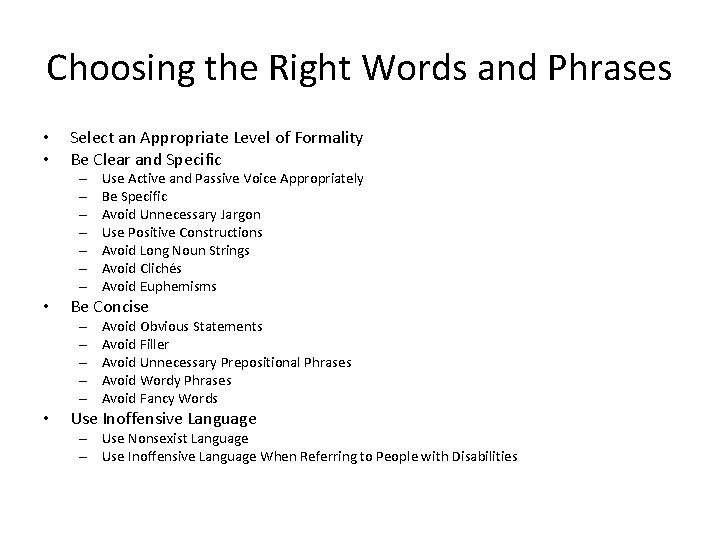
Choosing the Right Words and Phrases • • Select an Appropriate Level of Formality Be Clear and Specific – – – – • Be Concise – – – • Use Active and Passive Voice Appropriately Be Specific Avoid Unnecessary Jargon Use Positive Constructions Avoid Long Noun Strings Avoid Clichés Avoid Euphemisms Avoid Obvious Statements Avoid Filler Avoid Unnecessary Prepositional Phrases Avoid Wordy Phrases Avoid Fancy Words Use Inoffensive Language – Use Nonsexist Language – Use Inoffensive Language When Referring to People with Disabilities